MACROLIDES AND OTHER
ANTIBIOTICS
MACROLIDE ANTIBIOTICS
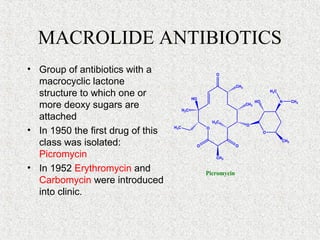
• Group of antibiotics with a
macrocyclic lactone
structure to which one or
more deoxy sugars are
attached
• In 1950 the first drug of this
class was isolated:
Picromycin
• In 1952 Erythromycin and
Carbomycin were introduced
into clinic.

O
CH3

H3C

HO
CH3

HO

N

H3C
H3C
H3C

O

O

O

O

O
CH3

Picromycin

CH3

CH3
Macrolides: Erythromycin
• It was isolated from Streptomyces erythreus in 1952
• It was the first of these drugs to find clinical
application, both as a drug of choice and an
alternative to penicillin in individuals who are allergic
to β-lactam antibiotics
• Slightly water soluble
• Macrolides are stable in aqueous solutions at or
below room temperature. They are unstable in acidic
or basic conditions or at high temperatures.
Erythromycin: Mechanism of action
• Bacteriostatic at low but cidal at high concentrations
• Cidal action also depends on the organism and its
rate of multiplication
• More active in alkaline medium
• Acts by inhibiting bacterial protein synthesis
• Bind irreversibly to a site on the 50s subunit of the
ribosome and interferes with ‘translocation’
Erythromycin: Resistance
• Becoming a serious problem
• Several mechanisms are:
– Inability of organism to take up the antibiotic or presence of efflux
pump
– Decreased affinity
– Presence of plasmid associated erythromycin esterase

• Both clarithromycin and azithromycin show cross
resistance with erythromycin
• But telithromycin can be effective against macrolideresistant organisms
Pharmacokinetics
• Erythromycin base is acid labile but all others (newer)
are stable
• Given as enteric coated tablets
• Food delays absorption by retarding gastric emptying
• Its acid esters are better absorbed
• Widely distributed in the body except CSF
• Diffuses into prostatic fluid, accumulates in
macrophages
Pharmacokinetics

Cont…

• Concentrates in liver
• Inflammation allows greater tissue penetration
• 70-80% plasma protein bound
• Partly metabolized and excreted primarily in the
active form (some enterohepatic circulation)
• Renal excretion is minor (5%)
• Its plasma t1/2 is 1.5hr, but it persists longer in
tissues
Adverse effects
• Epigastric distress
• Cholistatic jaundice
• Ototoxicity (at high doses)
• Hypersensitivity
Interactions
Uses
• As an alternative to pencillin
– Strep. Inf, Diptheria, Tetanus, Syphylis and Gonorrhoea

• As a first choice drug for:
– Atypical pneumania
– Whooping cough
– Chancroid

• As a second drug choice:
–
–
–
–

Campylobactor enteritis
Legionnaire’s pneumonia
Chlamydia trachomitis
Pencillin resistant Staphylococcal infections
Roxithromycin
• Acid stable
• Good enteral absorption and tissue
penetration
• 95% plasma protein bound
• Has longer half life 12hrs
Clarithromycin
• Acid stable
• Bioavailability is 50% due to first pass metabolism
• Follows zero order kinetics
• Longer half life (3-6hrs), its metabolite is also active
• Antibacterial spectrum is wider:
– Micobacterium avium complex
– M. leprae
– Toxoplasma gondii
Azithromycin
• Extended spectrum
• Better tolerability
• More active against H.influenza but less active
against gram possitive cocci
• Rapidly absorbed from empty stomach
• Longest half life (3days)
• Spectrum is identical to clarithromycin, except that it
is less active against Staphylococci and Streptococci
Other antibiotics
Clindamycin
• Mechanism of action is same as that of erythromycin
• Resistant mechanisms are same as those of
erythromycin
• It inhibits most of the gram possitive cocci
• Highly active against a vareity of anaerobes, specially
B. fragilis
• Aerobic gram negative bacilli are not effective
Clindamycin

Cont…

• Absorption is good
• Distributes well but not to CSF and brain
• Excreted in urine and bile
• Plasma half life is 3hrs
Clindamycin

Cont…

Adverse effects:
• Skin rashes
• Diarrhoea and pseudomembranous entero colitis
(C.difficile)
Vancomycin
• Glycopeptide antibiotic
• Discovered in 1956 as a pencillin substitute
• Effective against MRSA, Strep.viridans, enterococci
and clost.difficile
• Acts by inhibiting cell wall phospholipid synthesis as
well as peptidoglycon polymerization
(transglycolation step)
Vancomycin
Pharmacokinetics:
• No absorption from oral route
• Slow IV infusion is employed for treatment of
systemic infections or for prophylaxis
• Metabolism is minimal
• 90-100% excreted through glomeruar filtration

Cont…
Vancomycin
Adverse effects:
• Fever, chills, phlebitis at the infusion site
• Flushing (red man syndrome)
• Dose related hearing loss

Cont…
Linezolid
• Was introduced recently to combat resistant
gram possitive organisms such as:
– MRSA and VRSA
– VR enterococcus faecium, E. faecalis
– Pencillin resistant streptococci
Linezolid

Cont…

Mech of action:
• Inhibits bacterial protein synthesis by inhibiting the
formation of 70s initiation complex
Linezolid
Restance:
• Decreased binding to the target site confers
resistance
Pharmacokinetics:
• Completely absorbed on oral administration
• IV preparations also available
• Widely distributed throughout the body
• Partly metabolized non enzymatically
• Excreted in urine
• Plasma half life is 5hrs

Cont…
Linezolid

Cont…

Side effects:
• Well tolerated
• GI upset, nausea, diarrhoea, headache and rash
• Thrombocytopenia (2%)
Polypeptide Antibiotics
• Low molecular weight cationic polypeptide antibiotics
• All are powerful bactericidal agents
• Not used systemically due to toxicity
• All are produced by bacteria
• Clinically used ones are:
– Polymyxin B
– Colistin
– Bacitracin
8. macrolides and others

8. macrolides and others

  • 1.
  • 2.
    MACROLIDE ANTIBIOTICS • Groupof antibiotics with a macrocyclic lactone structure to which one or more deoxy sugars are attached • In 1950 the first drug of this class was isolated: Picromycin • In 1952 Erythromycin and Carbomycin were introduced into clinic. O CH3 H3C HO CH3 HO N H3C H3C H3C O O O O O CH3 Picromycin CH3 CH3
  • 3.
    Macrolides: Erythromycin • Itwas isolated from Streptomyces erythreus in 1952 • It was the first of these drugs to find clinical application, both as a drug of choice and an alternative to penicillin in individuals who are allergic to β-lactam antibiotics • Slightly water soluble • Macrolides are stable in aqueous solutions at or below room temperature. They are unstable in acidic or basic conditions or at high temperatures.
  • 4.
    Erythromycin: Mechanism ofaction • Bacteriostatic at low but cidal at high concentrations • Cidal action also depends on the organism and its rate of multiplication • More active in alkaline medium • Acts by inhibiting bacterial protein synthesis • Bind irreversibly to a site on the 50s subunit of the ribosome and interferes with ‘translocation’
  • 6.
    Erythromycin: Resistance • Becominga serious problem • Several mechanisms are: – Inability of organism to take up the antibiotic or presence of efflux pump – Decreased affinity – Presence of plasmid associated erythromycin esterase • Both clarithromycin and azithromycin show cross resistance with erythromycin • But telithromycin can be effective against macrolideresistant organisms
  • 7.
    Pharmacokinetics • Erythromycin baseis acid labile but all others (newer) are stable • Given as enteric coated tablets • Food delays absorption by retarding gastric emptying • Its acid esters are better absorbed • Widely distributed in the body except CSF • Diffuses into prostatic fluid, accumulates in macrophages
  • 8.
    Pharmacokinetics Cont… • Concentrates inliver • Inflammation allows greater tissue penetration • 70-80% plasma protein bound • Partly metabolized and excreted primarily in the active form (some enterohepatic circulation) • Renal excretion is minor (5%) • Its plasma t1/2 is 1.5hr, but it persists longer in tissues
  • 9.
    Adverse effects • Epigastricdistress • Cholistatic jaundice • Ototoxicity (at high doses) • Hypersensitivity
  • 10.
  • 11.
    Uses • As analternative to pencillin – Strep. Inf, Diptheria, Tetanus, Syphylis and Gonorrhoea • As a first choice drug for: – Atypical pneumania – Whooping cough – Chancroid • As a second drug choice: – – – – Campylobactor enteritis Legionnaire’s pneumonia Chlamydia trachomitis Pencillin resistant Staphylococcal infections
  • 13.
    Roxithromycin • Acid stable •Good enteral absorption and tissue penetration • 95% plasma protein bound • Has longer half life 12hrs
  • 14.
    Clarithromycin • Acid stable •Bioavailability is 50% due to first pass metabolism • Follows zero order kinetics • Longer half life (3-6hrs), its metabolite is also active • Antibacterial spectrum is wider: – Micobacterium avium complex – M. leprae – Toxoplasma gondii
  • 15.
    Azithromycin • Extended spectrum •Better tolerability • More active against H.influenza but less active against gram possitive cocci • Rapidly absorbed from empty stomach • Longest half life (3days) • Spectrum is identical to clarithromycin, except that it is less active against Staphylococci and Streptococci
  • 16.
  • 17.
    Clindamycin • Mechanism ofaction is same as that of erythromycin • Resistant mechanisms are same as those of erythromycin • It inhibits most of the gram possitive cocci • Highly active against a vareity of anaerobes, specially B. fragilis • Aerobic gram negative bacilli are not effective
  • 18.
    Clindamycin Cont… • Absorption isgood • Distributes well but not to CSF and brain • Excreted in urine and bile • Plasma half life is 3hrs
  • 19.
    Clindamycin Cont… Adverse effects: • Skinrashes • Diarrhoea and pseudomembranous entero colitis (C.difficile)
  • 20.
    Vancomycin • Glycopeptide antibiotic •Discovered in 1956 as a pencillin substitute • Effective against MRSA, Strep.viridans, enterococci and clost.difficile • Acts by inhibiting cell wall phospholipid synthesis as well as peptidoglycon polymerization (transglycolation step)
  • 21.
    Vancomycin Pharmacokinetics: • No absorptionfrom oral route • Slow IV infusion is employed for treatment of systemic infections or for prophylaxis • Metabolism is minimal • 90-100% excreted through glomeruar filtration Cont…
  • 22.
    Vancomycin Adverse effects: • Fever,chills, phlebitis at the infusion site • Flushing (red man syndrome) • Dose related hearing loss Cont…
  • 23.
    Linezolid • Was introducedrecently to combat resistant gram possitive organisms such as: – MRSA and VRSA – VR enterococcus faecium, E. faecalis – Pencillin resistant streptococci
  • 24.
    Linezolid Cont… Mech of action: •Inhibits bacterial protein synthesis by inhibiting the formation of 70s initiation complex
  • 26.
    Linezolid Restance: • Decreased bindingto the target site confers resistance Pharmacokinetics: • Completely absorbed on oral administration • IV preparations also available • Widely distributed throughout the body • Partly metabolized non enzymatically • Excreted in urine • Plasma half life is 5hrs Cont…
  • 27.
    Linezolid Cont… Side effects: • Welltolerated • GI upset, nausea, diarrhoea, headache and rash • Thrombocytopenia (2%)
  • 28.
    Polypeptide Antibiotics • Lowmolecular weight cationic polypeptide antibiotics • All are powerful bactericidal agents • Not used systemically due to toxicity • All are produced by bacteria • Clinically used ones are: – Polymyxin B – Colistin – Bacitracin

Editor's Notes