
MACROLIDE ANTIBIOTICS
Anusha Shaji, B.Pharm, M.Pharm
Assistant Professor
Department of Pharmacology
Nirmala College of Pharmacy,
Muvattupuzha, Ernakulam
MACROLIDE ANTIBIOTICS
Antibiotics having a macrocyclic lactone ring with attached sugars
First member: Erythromycin (discovered in 1950s)
Newer macrolides: Roxithromycin, Clarithromycin and Azithromycin
First ketolide antimicrobial agent: Telithromycin (a semisynthetic
derivative of erythromycin)
ketolides are active against many macrolide resistant gram positive strains
Erythromycin
Isolated from Streptomyces erythreus
An alternative to penicillin in individuals who are allergic to beta lactam
antibiotics
Limited water solubility & stable only when kept in cold
Mechanism of Action
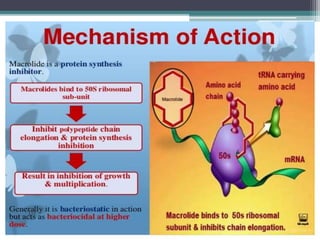
The macrolides bind irreversibly to a site on the 50s subunit of the
bacterial ribosome
↓
Thus inhibiting the translocation steps of protein synthesis
Also interfere at other steps, such as transpeptidation.
Erythromycin is Bacteriostatic at low concentrations
Bactericidal at high concentrations
Cidal action depends on the organism concerned and its rate of
multiplication
Sensitive gram positive bacteria accumulate erythromycin intracellularly by
active transport → which is responsible for their high susceptibility to this
antibiotic
The nonionized (penetrable) form of the drug is favoured at higher pH
↓
So its activity is enhanced several fold in alkaline medium
Antimicrobial Spectrum
Narrow spectrum antibiotic
Highly active against Str. Pyogenes and Str. Pneumoniae, N. gonorrhoeae,
Clostridia, C. diphtheriae, and Listeria
Resistant organisms: Penicillin resistant Staphylococci and Streptococci
Highly sensitive organisms to erythromycin: Campylobacter, Legionella,
Branhamella catarrhalis, Gardnerella vaginalis and Mycoplasma
Moderately Sensitive organisms: H. influenzae, B. pertussis, Rickettsiae,
H. ducreyi, Chlamydia trachomatis and Str. Viridans
Enterobacteriaceae, other gram negative bacilli and B.fragilis are not
inhibited
Resistance
All cocci readily develop resistance to erythromycin
↓
Mostly by acquiring the capacity to pump it out
Resistant Enterobacteriaceae have been found to an erythromycin
esterase.
↓
Alteration in the ribosomal binding site for erythromycin by a plasmid
encoded methylase enzyme → is an important mechanism of resistance in
gram positive bacteria.
All the above types of resistance are plasmid mediated
Change in the 50s ribosome by chromosomal mutation reducing macrolide
binding affinity occurs in some gram positive bacteria.
Bacteria that develop resistance to erythromycin are cross resistant to other
macrolides as well
Cross resistance with clindamycin and chloramphenicol also occurs →
Ribosomal binding sites for all these antibiotics are proximal to each other
Pharmacokinetics
Erythromycin base is acid labile
To protect it from gastric acid, it is given as enteric coated tablets
Absorption is incomplete
Food delays absorption by retarding gastric emptying
Its acid stable esters are better absorbed
Widely distributed in the body
Plasma protein bound: 70-80%
Partly metabolized and excreted primarily in bile in the active form
Renal excretion is minor
Plasma half life: 1.5 hr
But erythromycin persists longer in tissues
Dose
250-500 mg 6 hourly (max. 4 g/day)
Children: 30-60 mg/kg/day
Adverse Effects
Gastrointestinal: Mild to severe epigastric pain especially in children, on
oral digestion
Very high doses erythromycin have caused reversible hearing impairment
Hypersensitivity: Rashes and fever are infrequent
Drug Interaction
Erythromycin inhibits hepatic oxidation of many drugs
The clinically significant interactions are- rise in plasma levels of
theophylline, carbamazepine, valproate, ergotamine and warfarin
Uses
1. As an alternative to penicillin
Streptococcal pharyngitis, tonsillitis, mastoiditis and community
acquired respiratory infections
An alternative drug for prophylaxis of rheumatic fever and SABE
Diphtheria
Tetanus
Syphilis and gonorrhoea
Leptospirosis
2. As a first choice drug for
Atypical pneumonia caused by Mycoplasma pneumoniae
Whooping cough
Chancroid
3. As a second choice drug in
Campylobacter enteritis: duration of diarrhoea and presence of
organisms in stools is reduced
Legionnaires pneumonia
Chlamydia trachomatis infection of urogenital tract
Penicillin resistant Staphylococcal infections
NEWER MACROLIDES
Roxithromycin
Semisynthetic longer acting acid stable macrolide
Antimicrobial spectrum resembles closely with that of erythromycin
It is more potent against Branh. catarrhalis, Gard. Vaginalis and
Legionella
Less potent against B. pertussis
Good enteral absorption
plasma half life- 12 hours
It is more potent against Branh. catarrhalis, Gard. Vaginalis and
Legionella
Less potent against B. pertussis
Better gastric tolerability
Lower affinity for cytochrome P450
Used as an alternative to erythromycin for respiratory, ENT, skin and
soft tissues and genital tract infections with similar efficacy.
DOSE
150-300 mg BD 30 min before meals
Children: 2.5-5 mg/kg BD
Macrolide Antibiotics

Macrolide Antibiotics

  • 1.
    MACROLIDE ANTIBIOTICS Anusha Shaji,B.Pharm, M.Pharm Assistant Professor Department of Pharmacology Nirmala College of Pharmacy, Muvattupuzha, Ernakulam
  • 2.
    MACROLIDE ANTIBIOTICS Antibiotics havinga macrocyclic lactone ring with attached sugars First member: Erythromycin (discovered in 1950s) Newer macrolides: Roxithromycin, Clarithromycin and Azithromycin First ketolide antimicrobial agent: Telithromycin (a semisynthetic derivative of erythromycin) ketolides are active against many macrolide resistant gram positive strains Erythromycin Isolated from Streptomyces erythreus An alternative to penicillin in individuals who are allergic to beta lactam antibiotics Limited water solubility & stable only when kept in cold
  • 3.
    Mechanism of Action Themacrolides bind irreversibly to a site on the 50s subunit of the bacterial ribosome ↓ Thus inhibiting the translocation steps of protein synthesis Also interfere at other steps, such as transpeptidation. Erythromycin is Bacteriostatic at low concentrations Bactericidal at high concentrations Cidal action depends on the organism concerned and its rate of multiplication
  • 5.
    Sensitive gram positivebacteria accumulate erythromycin intracellularly by active transport → which is responsible for their high susceptibility to this antibiotic The nonionized (penetrable) form of the drug is favoured at higher pH ↓ So its activity is enhanced several fold in alkaline medium Antimicrobial Spectrum Narrow spectrum antibiotic Highly active against Str. Pyogenes and Str. Pneumoniae, N. gonorrhoeae, Clostridia, C. diphtheriae, and Listeria Resistant organisms: Penicillin resistant Staphylococci and Streptococci
  • 6.
    Highly sensitive organismsto erythromycin: Campylobacter, Legionella, Branhamella catarrhalis, Gardnerella vaginalis and Mycoplasma Moderately Sensitive organisms: H. influenzae, B. pertussis, Rickettsiae, H. ducreyi, Chlamydia trachomatis and Str. Viridans Enterobacteriaceae, other gram negative bacilli and B.fragilis are not inhibited Resistance All cocci readily develop resistance to erythromycin ↓ Mostly by acquiring the capacity to pump it out Resistant Enterobacteriaceae have been found to an erythromycin esterase. ↓
  • 7.
    Alteration in theribosomal binding site for erythromycin by a plasmid encoded methylase enzyme → is an important mechanism of resistance in gram positive bacteria. All the above types of resistance are plasmid mediated Change in the 50s ribosome by chromosomal mutation reducing macrolide binding affinity occurs in some gram positive bacteria. Bacteria that develop resistance to erythromycin are cross resistant to other macrolides as well Cross resistance with clindamycin and chloramphenicol also occurs → Ribosomal binding sites for all these antibiotics are proximal to each other
  • 8.
    Pharmacokinetics Erythromycin base isacid labile To protect it from gastric acid, it is given as enteric coated tablets Absorption is incomplete Food delays absorption by retarding gastric emptying Its acid stable esters are better absorbed Widely distributed in the body Plasma protein bound: 70-80% Partly metabolized and excreted primarily in bile in the active form Renal excretion is minor Plasma half life: 1.5 hr But erythromycin persists longer in tissues
  • 9.
    Dose 250-500 mg 6hourly (max. 4 g/day) Children: 30-60 mg/kg/day Adverse Effects Gastrointestinal: Mild to severe epigastric pain especially in children, on oral digestion Very high doses erythromycin have caused reversible hearing impairment Hypersensitivity: Rashes and fever are infrequent Drug Interaction Erythromycin inhibits hepatic oxidation of many drugs The clinically significant interactions are- rise in plasma levels of theophylline, carbamazepine, valproate, ergotamine and warfarin
  • 10.
    Uses 1. As analternative to penicillin Streptococcal pharyngitis, tonsillitis, mastoiditis and community acquired respiratory infections An alternative drug for prophylaxis of rheumatic fever and SABE Diphtheria Tetanus Syphilis and gonorrhoea Leptospirosis 2. As a first choice drug for Atypical pneumonia caused by Mycoplasma pneumoniae Whooping cough Chancroid
  • 11.
    3. As asecond choice drug in Campylobacter enteritis: duration of diarrhoea and presence of organisms in stools is reduced Legionnaires pneumonia Chlamydia trachomatis infection of urogenital tract Penicillin resistant Staphylococcal infections NEWER MACROLIDES Roxithromycin Semisynthetic longer acting acid stable macrolide Antimicrobial spectrum resembles closely with that of erythromycin It is more potent against Branh. catarrhalis, Gard. Vaginalis and Legionella Less potent against B. pertussis
  • 12.
    Good enteral absorption plasmahalf life- 12 hours It is more potent against Branh. catarrhalis, Gard. Vaginalis and Legionella Less potent against B. pertussis Better gastric tolerability Lower affinity for cytochrome P450 Used as an alternative to erythromycin for respiratory, ENT, skin and soft tissues and genital tract infections with similar efficacy. DOSE 150-300 mg BD 30 min before meals Children: 2.5-5 mg/kg BD