QUINOLONES
• Synthetic anti microbials
•
•
•
•
•

Bactericidal broad spectrum antimicrobial activity
Nalidixic acid, 1962-Lasher G-ve
1970s – Oxolinic acid & cinoxacin
Developed in 1980s
Increasingly used because of their relative safety,
their availability both orally and parenterally and
their favorable pharmacokinetics
• Comparatively slow rate of resistance to these
agents
Structure-Activity Relationships
4-quinolone-3-carboxylic acid
affect G(-ve)
activity

O
F

5

COOH
4

N

HN

1
N
8
R1
8-F- improve P.k

3

Cyclopropyl: inc. spectrum

Piperazine ring
:anti-pseudomonal activity
Generation

Drug Names

Clinical use
Uncomplicated

1st

Norfloxacin
Ciproflaxcin
Ofloxacin
Pefloxacin
Lomefloxacin

2nd

Levofloxacin
Fleroxacin
Clindafloxacin

Complicated UTI,
GIT infection
Prostatitis, STD

3rd

Gatifloxacin
Sparfloxacin

same+ community
acquried pneumonia

Atrofloxacin
Trovafloxacin
Alatrofloxacin

Major systems infection
(abdominal infections)

4th

UTI
M. O. A. :* ACT BY INHIBITING D. N. A. GYRASE IN

BACTERIA (PROKARYOTIC

CELLS).

*
*

ENZYME TOPOISOMERASE IV IN GRAM POSITIVE BACTERIA.

DO NOT AFFECT MAMMALS CELLS
(TOPOISOMERASE II ENZYME).

SPECTRUM :
* BROAD SPECTRUM.
* MORE ACTIVE AGAINST G -ve IN COMP. TO G+ BACTERIA.
MICROBIOLOGICAL FEATURES OF FQs:
•
•
•
•
•

Rapidly Bactericidal activity
Long Post-Antibiotic Effect
Low Frequency of Resistance
High Tissue Penetrability
Active against Beta-Lactum & Aminoglcoside
Resistant Bacteria.
PHARMACOKINETICS :
* ABSORBED P. O.
* DISTRIBUTED TO ALL BODY
COMPARTMENTS :
PROSTATE, BONE , LUNG, SPUTUM,
AQUEOUS HUMOR, NEUTROPHILLS
BUT CONC. IN C. S. F. IS POOR
* EXCRETION THROUGH KIDNEY
(Conc. Higher than Plasma)
Anti microbial spectrum
1st generation:
• Enterobacteriaceae (E. coli, Sallmonella, Shigella)
• G –ve: H.influenzae, H.ducreyi, P.aeruginosa, V.cholerae
• G-ve cocci :N. gonorrhoea, N. meningitidis
• G+ve bacilli : Bacillus anthracis (Modest activity)
• Other: M.tuberculosis, M. pneumoniae, Rickettsiae

2nd generation:
• Better activity against G+ve cocci
3rd generation:
• Enhanced activity against G –Ve cocci
4th generation:
• Enhanced activity against G+Ve cocci+ greater activity
against anaerobes
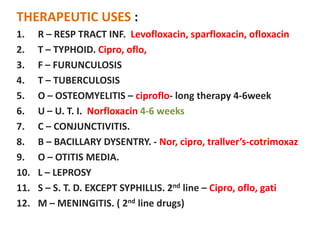
THERAPEUTIC USES :
1.
2.
3.
4.
5.
6.
7.
8.
9.
10.
11.
12.

R – RESP TRACT INF. Levofloxacin, sparfloxacin, ofloxacin
T – TYPHOID. Cipro, oflo,
F – FURUNCULOSIS
T – TUBERCULOSIS
O – OSTEOMYELITIS – ciproflo- long therapy 4-6week
U – U. T. I. Norfloxacin 4-6 weeks
C – CONJUNCTIVITIS.
B – BACILLARY DYSENTRY. - Nor, cipro, trallver’s-cotrimoxaz
O – OTITIS MEDIA.
L – LEPROSY
S – S. T. D. EXCEPT SYPHILLIS. 2nd line – Cipro, oflo, gati
M – MENINGITIS. ( 2nd line drugs)
RESERVED THERAPY FOR TREATMENT OF
UNTREATABLE CONDITION BY OTHER
LONG STANDING MICROBICIDALS.
Ciprofloxacin
•

Administration [Usual Dosage]: IV, PO [500 – 750 mg]

•

Spectrum: Gram- aerobic rods, and Legionella pneumophila, and other
atypicals. Poor activity against Strep. pneumoniae.

•

Indications:
-- Nosocomial pneumonia
-- Intra-abdominal infections
– Uncomplicated/complicated UTI
– Anthrax exposure and prophylaxis

•

Unique Qualities:
– Binds divalent cations (i.e. Ca & Mg) which decreases absorption
-- Increased effects of warfarin

•

ADRs
– QTC prolongation, arrhythmias
– Nausea, GI upset
– Interstitial nephritis
Levofloxacin
•

Administration [Usual Dosage]: IV, PO and ophthalmic [500-750 mg ]

•

Spectrum: Gram-, Gram+ (S. aureus including MRSA & S. pneumoniae) and
Legionella pneumophila, atypical resp. pathogens, Mycobacterium tuberculosis

•

Indications:
– Chronic bronchitis
– Nosocomial pneumonia
– Intra-abdominal infections

•

Unique Qualities:
– Binds divalent cations (i.e. Ca & Mg) which decreases absorption
ADRs
– Blood glucose disturbances in DM patients
– QTC prolongation, arrhythmias
– Nausea, GI upset
– Interstitial nephritis
Moxifloxacin
•
•

Administration [Usual Dosage]: IV, PO and ophthalmic
[400mg ]

•

Spectrum: Gram-, Gram+ (S. aureus including MRSA & S. pneumoniae) &
atypicals (L. pneumophila, C pneumonia & M. pneumoniae),
Mycobacterium tuberculosis, gram-negative anaerobes

•

Indications:
– Chronic bronchitis
– Bacterial conjuctivitis
– Sinusitis

•

Unique Qualities:
– Binds divalent cations (i.e. Ca & Mg) which decreases absorption
– Safety and efficacy not established in patients <18

•

ADRs
–
–
–
–

Blood glucose disturbances in DM patients
QTC prolongation, arrhythmias
Nausea, GI upset
Interstitial nephritis
Fluoroquinolones
Adverse Effects
• Gastrointestinal – 5 %


Nausea, vomiting, diarrhea, dyspepsia

• Central Nervous System



Headache, agitation, insomnia, dizziness, rarely,
hallucinations and seizures (elderly)

• Hepatotoxicity


LFT elevation (withdrawal of trovafloxacin)

• Phototoxicity

 levofloxacin, pefloxacin

• Cardiac



Variable prolongation in QTc interval
withdrawal of grepafloxacin, sparfloxacin
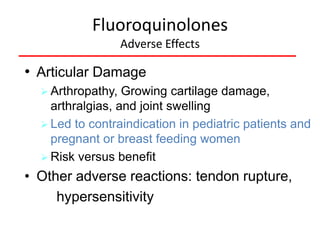
Fluoroquinolones
Adverse Effects

• Articular Damage
 Arthropathy,

Growing cartilage damage,
arthralgias, and joint swelling
 Led to contraindication in pediatric patients and
pregnant or breast feeding women
 Risk versus benefit

• Other adverse reactions: tendon rupture,
hypersensitivity
Fluoroquinolones
Drug Interactions
• Divalent and trivalent cations – ALL FQs




Zinc, Iron, Calcium, Aluminum, Magnesium
Antacids, Sucralfate, enteral feedings
Impair oral absorption of orally-administered FQs –
may lead to CLINICAL FAILURE

• Theophylline and Cyclosporine - cipro
 inhibition

of metabolism,

levels,

• Warfarin – idiosyncratic, all FQs

toxicity
Dose of commonly used quinolones
Drug
Norfloxacin
Ciproflaxcin
Ofloxacin
Pefloxacin
Lomefloxacin
Sparfloxacin
Gatifloxacin
Moxifloxacin
Gemifloxacin

Dosage per day
400mg twice
500-750mg twice
200-400mg twice
400mg twice
400mg once
200-400mg
400mg once
400mg once
320mg once
Introduction
• UTIs are defined by the presence of micro
organisms within the urinary tract that may
be difficult to distinguish between
contamination, colonisation or infection
● UTIs mainly contain gram negative
aerobic organisms originating from the
gut flora
● Proteus, other Enterobactericiae,
S. saprophyticus, enterococci, group B Strep
and Chlamydiae cause ~ 20% of
uncomplicated UTIs
TYPES
ACUTE
• Infection localized to
urethra and bladder.
• frequency,urgency,dysuria,
pain in perineum.
• No fever chills leucocytosis
• Pus cells (+++)
• Urine culture (+)–
“significant bactertiuria”

CHRONIC
• General loss of health
anaemia,hypertension.
• Chronic PylonephritisChronic hypertension &renal
failure.
• Pus cells (+)
• Significant bacteriuria
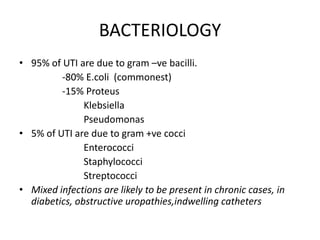
BACTERIOLOGY
• 95% of UTI are due to gram –ve bacilli.
-80% E.coli (commonest)
-15% Proteus
Klebsiella
Pseudomonas
• 5% of UTI are due to gram +ve cocci
Enterococci
Staphylococci
Streptococci
• Mixed infections are likely to be present in chronic cases, in
diabetics, obstructive uropathies,indwelling catheters
DRUG THERAPY
• BACTERIOSTATIC AGENT

Sulfonamides
Tetracycline
Nitrofurantoin
• URINARY ANTISEPTICS

Nalidixic acid
Methenamine mandelate
Nitrofurantoin

• BACTERICIDAL AGENTS

Cotrimoxazole
Ampicillin
Extended spect. Penicillin

Aminoglycosides
Fluroquinolones
Cephalosporins
SULFONAMIDES
•
•
•
•
•

Effective against E.coli
effective only un complicated UTIs
Cheap, easily available,and effective orally
Bacterial resistance major problem.
DOC: Sulfisoxazole 2g initially 1g for 7-10
days
• Prerequisite-Alkaline urine, liberal fluid intake.
NITROFURANTOIN
•
•
•
•
•
•

Sybthetic agent, active G-& +ve .
proteus, P.aureginosa resistence
Rapid g.i. absorption, high urinary concentration.
Bacteriostatic against common pathogens.
Pseudomonas, proteus resistant.
For ‘Chronic suppressive therapy’—
50-100 mg /day for several wks.
• Mainly useful for resistant infections, mixed infections,
infections associated with obstructive uropathy.
METHENAMINE MANDELATE
• Mandelic acid +methenamine
Formaldehyde (acid PH 5.5)
Active against g-ve pathogens

• Not effective in acute ,upper UTI,aginst
proteus & pseudomonas
• Dose:1 g qid
NALIDIXIC ACID
• Used as reserved drug for occasional cases (esp.
proteus resistant to other drugs)
• Dose: 1gm qid x 7-10 days
COTRIMOXAZOLE
• Highly potent and cost effective bactericidal
combination used aginst E.coli & proteus.
• Dose: acute UTI-2 tab bd x 7-10 days
chronic UTI-1 tab twice a wk.
• Contraindicated in pregnancy.
• Successful in recurrent UTI in men (prostatic
focus)
• Ineffective in renal insufficiency.
AMPICILLIN
• Effective bactericidal to E.coli ,aerobacter.
• Proteus,pseudomonas resistant.
• Ineffective against penicillinase producing
staph. aureus.
• Safe in pregnancy
• Dose:.0.5 g qid x 7-10 days.
• Resistant strains of E.coli esp..hospital
acquired has been found.
AMINOGLYCOSIDES
• Gentamicin is the only aminoglycoside used in
UTI.
• Effective against E.coli,proteus,pseudo.
• Disadv.- parental use
renal toxicity
ototoxicity
• Reserved for complicated UTI
FLUROQUINOLONES
• Ideal agents and drug of choice.
• Useful in nosocomial pylonephritis,
complicated UTI.
• Present status: first line drug for all UTI.
CEPHALOSPORINS
• Valuable in infections resistant to other
antibiotics (E.coli, Proteus ,Pseudomonas)
• Doc. –Klebsiella infections.
• Indicated in septicemic UTI.
UPPER UTI
1.Acute uncomplicated pylonephritis:
Drug regimen :
Cotrimoxazole /Gentamicin with/ without Ampicillin /
Cephalosporins
2.Complicated UTI :
Minimal symptoms- Cipro. 500mg bd
Severe illness :
(Inj. Cefotaxime 2g qid iv & Inj.Genta 5 mg/kg od iv) x7-14 days

3.Chronic Pylonephritis ;
cause to be searched.

Quinolones &UTI

  • 1.
  • 2.
    • Synthetic antimicrobials • • • • • Bactericidal broad spectrum antimicrobial activity Nalidixic acid, 1962-Lasher G-ve 1970s – Oxolinic acid & cinoxacin Developed in 1980s Increasingly used because of their relative safety, their availability both orally and parenterally and their favorable pharmacokinetics • Comparatively slow rate of resistance to these agents
  • 3.
    Structure-Activity Relationships 4-quinolone-3-carboxylic acid affectG(-ve) activity O F 5 COOH 4 N HN 1 N 8 R1 8-F- improve P.k 3 Cyclopropyl: inc. spectrum Piperazine ring :anti-pseudomonal activity
  • 4.
    Generation Drug Names Clinical use Uncomplicated 1st Norfloxacin Ciproflaxcin Ofloxacin Pefloxacin Lomefloxacin 2nd Levofloxacin Fleroxacin Clindafloxacin ComplicatedUTI, GIT infection Prostatitis, STD 3rd Gatifloxacin Sparfloxacin same+ community acquried pneumonia Atrofloxacin Trovafloxacin Alatrofloxacin Major systems infection (abdominal infections) 4th UTI
  • 5.
    M. O. A.:* ACT BY INHIBITING D. N. A. GYRASE IN BACTERIA (PROKARYOTIC CELLS). * * ENZYME TOPOISOMERASE IV IN GRAM POSITIVE BACTERIA. DO NOT AFFECT MAMMALS CELLS (TOPOISOMERASE II ENZYME). SPECTRUM : * BROAD SPECTRUM. * MORE ACTIVE AGAINST G -ve IN COMP. TO G+ BACTERIA.
  • 6.
    MICROBIOLOGICAL FEATURES OFFQs: • • • • • Rapidly Bactericidal activity Long Post-Antibiotic Effect Low Frequency of Resistance High Tissue Penetrability Active against Beta-Lactum & Aminoglcoside Resistant Bacteria.
  • 7.
    PHARMACOKINETICS : * ABSORBEDP. O. * DISTRIBUTED TO ALL BODY COMPARTMENTS : PROSTATE, BONE , LUNG, SPUTUM, AQUEOUS HUMOR, NEUTROPHILLS BUT CONC. IN C. S. F. IS POOR * EXCRETION THROUGH KIDNEY (Conc. Higher than Plasma)
  • 8.
    Anti microbial spectrum 1stgeneration: • Enterobacteriaceae (E. coli, Sallmonella, Shigella) • G –ve: H.influenzae, H.ducreyi, P.aeruginosa, V.cholerae • G-ve cocci :N. gonorrhoea, N. meningitidis • G+ve bacilli : Bacillus anthracis (Modest activity) • Other: M.tuberculosis, M. pneumoniae, Rickettsiae 2nd generation: • Better activity against G+ve cocci 3rd generation: • Enhanced activity against G –Ve cocci 4th generation: • Enhanced activity against G+Ve cocci+ greater activity against anaerobes
  • 9.
    THERAPEUTIC USES : 1. 2. 3. 4. 5. 6. 7. 8. 9. 10. 11. 12. R– RESP TRACT INF. Levofloxacin, sparfloxacin, ofloxacin T – TYPHOID. Cipro, oflo, F – FURUNCULOSIS T – TUBERCULOSIS O – OSTEOMYELITIS – ciproflo- long therapy 4-6week U – U. T. I. Norfloxacin 4-6 weeks C – CONJUNCTIVITIS. B – BACILLARY DYSENTRY. - Nor, cipro, trallver’s-cotrimoxaz O – OTITIS MEDIA. L – LEPROSY S – S. T. D. EXCEPT SYPHILLIS. 2nd line – Cipro, oflo, gati M – MENINGITIS. ( 2nd line drugs)
  • 10.
    RESERVED THERAPY FORTREATMENT OF UNTREATABLE CONDITION BY OTHER LONG STANDING MICROBICIDALS.
  • 11.
    Ciprofloxacin • Administration [Usual Dosage]:IV, PO [500 – 750 mg] • Spectrum: Gram- aerobic rods, and Legionella pneumophila, and other atypicals. Poor activity against Strep. pneumoniae. • Indications: -- Nosocomial pneumonia -- Intra-abdominal infections – Uncomplicated/complicated UTI – Anthrax exposure and prophylaxis • Unique Qualities: – Binds divalent cations (i.e. Ca & Mg) which decreases absorption -- Increased effects of warfarin • ADRs – QTC prolongation, arrhythmias – Nausea, GI upset – Interstitial nephritis
  • 12.
    Levofloxacin • Administration [Usual Dosage]:IV, PO and ophthalmic [500-750 mg ] • Spectrum: Gram-, Gram+ (S. aureus including MRSA & S. pneumoniae) and Legionella pneumophila, atypical resp. pathogens, Mycobacterium tuberculosis • Indications: – Chronic bronchitis – Nosocomial pneumonia – Intra-abdominal infections • Unique Qualities: – Binds divalent cations (i.e. Ca & Mg) which decreases absorption ADRs – Blood glucose disturbances in DM patients – QTC prolongation, arrhythmias – Nausea, GI upset – Interstitial nephritis
  • 13.
    Moxifloxacin • • Administration [Usual Dosage]:IV, PO and ophthalmic [400mg ] • Spectrum: Gram-, Gram+ (S. aureus including MRSA & S. pneumoniae) & atypicals (L. pneumophila, C pneumonia & M. pneumoniae), Mycobacterium tuberculosis, gram-negative anaerobes • Indications: – Chronic bronchitis – Bacterial conjuctivitis – Sinusitis • Unique Qualities: – Binds divalent cations (i.e. Ca & Mg) which decreases absorption – Safety and efficacy not established in patients <18 • ADRs – – – – Blood glucose disturbances in DM patients QTC prolongation, arrhythmias Nausea, GI upset Interstitial nephritis
  • 14.
    Fluoroquinolones Adverse Effects • Gastrointestinal– 5 %  Nausea, vomiting, diarrhea, dyspepsia • Central Nervous System   Headache, agitation, insomnia, dizziness, rarely, hallucinations and seizures (elderly) • Hepatotoxicity  LFT elevation (withdrawal of trovafloxacin) • Phototoxicity  levofloxacin, pefloxacin • Cardiac   Variable prolongation in QTc interval withdrawal of grepafloxacin, sparfloxacin
  • 15.
    Fluoroquinolones Adverse Effects • ArticularDamage  Arthropathy, Growing cartilage damage, arthralgias, and joint swelling  Led to contraindication in pediatric patients and pregnant or breast feeding women  Risk versus benefit • Other adverse reactions: tendon rupture, hypersensitivity
  • 16.
    Fluoroquinolones Drug Interactions • Divalentand trivalent cations – ALL FQs    Zinc, Iron, Calcium, Aluminum, Magnesium Antacids, Sucralfate, enteral feedings Impair oral absorption of orally-administered FQs – may lead to CLINICAL FAILURE • Theophylline and Cyclosporine - cipro  inhibition of metabolism, levels, • Warfarin – idiosyncratic, all FQs toxicity
  • 17.
    Dose of commonlyused quinolones Drug Norfloxacin Ciproflaxcin Ofloxacin Pefloxacin Lomefloxacin Sparfloxacin Gatifloxacin Moxifloxacin Gemifloxacin Dosage per day 400mg twice 500-750mg twice 200-400mg twice 400mg twice 400mg once 200-400mg 400mg once 400mg once 320mg once
  • 18.
    Introduction • UTIs aredefined by the presence of micro organisms within the urinary tract that may be difficult to distinguish between contamination, colonisation or infection
  • 19.
    ● UTIs mainlycontain gram negative aerobic organisms originating from the gut flora ● Proteus, other Enterobactericiae, S. saprophyticus, enterococci, group B Strep and Chlamydiae cause ~ 20% of uncomplicated UTIs
  • 20.
    TYPES ACUTE • Infection localizedto urethra and bladder. • frequency,urgency,dysuria, pain in perineum. • No fever chills leucocytosis • Pus cells (+++) • Urine culture (+)– “significant bactertiuria” CHRONIC • General loss of health anaemia,hypertension. • Chronic PylonephritisChronic hypertension &renal failure. • Pus cells (+) • Significant bacteriuria
  • 21.
    BACTERIOLOGY • 95% ofUTI are due to gram –ve bacilli. -80% E.coli (commonest) -15% Proteus Klebsiella Pseudomonas • 5% of UTI are due to gram +ve cocci Enterococci Staphylococci Streptococci • Mixed infections are likely to be present in chronic cases, in diabetics, obstructive uropathies,indwelling catheters
  • 22.
    DRUG THERAPY • BACTERIOSTATICAGENT Sulfonamides Tetracycline Nitrofurantoin • URINARY ANTISEPTICS Nalidixic acid Methenamine mandelate Nitrofurantoin • BACTERICIDAL AGENTS Cotrimoxazole Ampicillin Extended spect. Penicillin Aminoglycosides Fluroquinolones Cephalosporins
  • 23.
    SULFONAMIDES • • • • • Effective against E.coli effectiveonly un complicated UTIs Cheap, easily available,and effective orally Bacterial resistance major problem. DOC: Sulfisoxazole 2g initially 1g for 7-10 days • Prerequisite-Alkaline urine, liberal fluid intake.
  • 24.
    NITROFURANTOIN • • • • • • Sybthetic agent, activeG-& +ve . proteus, P.aureginosa resistence Rapid g.i. absorption, high urinary concentration. Bacteriostatic against common pathogens. Pseudomonas, proteus resistant. For ‘Chronic suppressive therapy’— 50-100 mg /day for several wks. • Mainly useful for resistant infections, mixed infections, infections associated with obstructive uropathy.
  • 25.
    METHENAMINE MANDELATE • Mandelicacid +methenamine Formaldehyde (acid PH 5.5) Active against g-ve pathogens • Not effective in acute ,upper UTI,aginst proteus & pseudomonas • Dose:1 g qid
  • 26.
    NALIDIXIC ACID • Usedas reserved drug for occasional cases (esp. proteus resistant to other drugs) • Dose: 1gm qid x 7-10 days
  • 27.
    COTRIMOXAZOLE • Highly potentand cost effective bactericidal combination used aginst E.coli & proteus. • Dose: acute UTI-2 tab bd x 7-10 days chronic UTI-1 tab twice a wk. • Contraindicated in pregnancy. • Successful in recurrent UTI in men (prostatic focus) • Ineffective in renal insufficiency.
  • 28.
    AMPICILLIN • Effective bactericidalto E.coli ,aerobacter. • Proteus,pseudomonas resistant. • Ineffective against penicillinase producing staph. aureus. • Safe in pregnancy • Dose:.0.5 g qid x 7-10 days. • Resistant strains of E.coli esp..hospital acquired has been found.
  • 29.
    AMINOGLYCOSIDES • Gentamicin isthe only aminoglycoside used in UTI. • Effective against E.coli,proteus,pseudo. • Disadv.- parental use renal toxicity ototoxicity • Reserved for complicated UTI
  • 30.
    FLUROQUINOLONES • Ideal agentsand drug of choice. • Useful in nosocomial pylonephritis, complicated UTI. • Present status: first line drug for all UTI.
  • 31.
    CEPHALOSPORINS • Valuable ininfections resistant to other antibiotics (E.coli, Proteus ,Pseudomonas) • Doc. –Klebsiella infections. • Indicated in septicemic UTI.
  • 32.
    UPPER UTI 1.Acute uncomplicatedpylonephritis: Drug regimen : Cotrimoxazole /Gentamicin with/ without Ampicillin / Cephalosporins 2.Complicated UTI : Minimal symptoms- Cipro. 500mg bd Severe illness : (Inj. Cefotaxime 2g qid iv & Inj.Genta 5 mg/kg od iv) x7-14 days 3.Chronic Pylonephritis ; cause to be searched.

Editor's Notes

  • #3 Nalidixic acid is not used for systemic infection because more (98.5%) protein bindingOxolinic acid – marginal better than Nalidixic acid
  • #10 Bacillary these drug donotdistrub normal flore  useful in acute entric bacterial infection. Traveller’sdiahrroeacotrimoxazoleThphoid – 3rd generation cephalosporinsSTD- ceftiaxone for N.Gonorrheae