Miss Snehal S. Chakorkar (M.pharm)
Dept Of Pharmacology
1
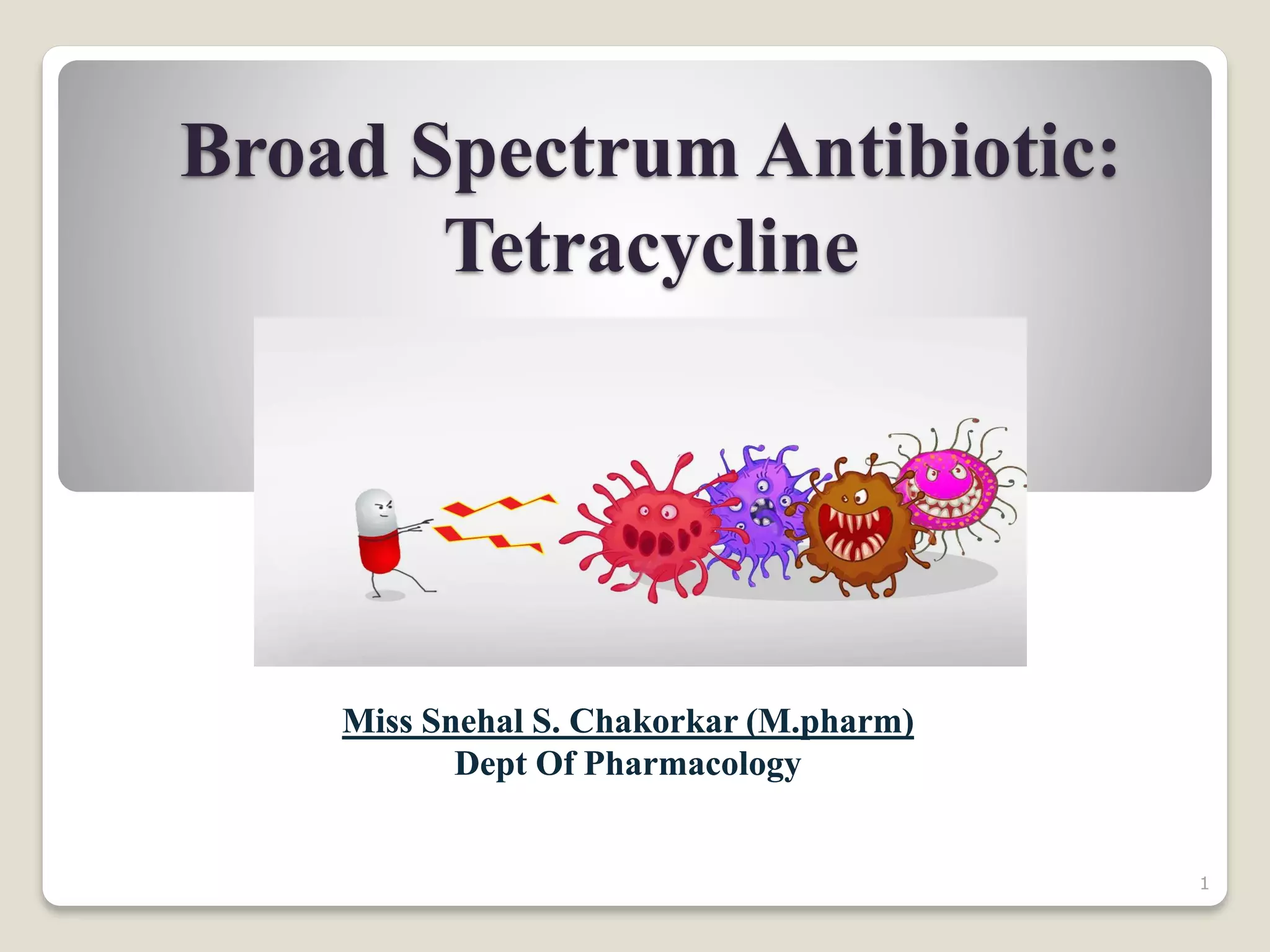
Broad Spectrum Antibiotic:
Tetracycline
Miss Snehal S. Chakorkar (M.pharm)
Dept Of Pharmacology
2
Introduction:
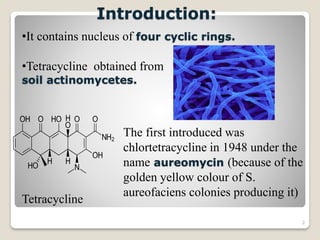
•It contains nucleus of four cyclic rings.
•Tetracycline obtained from
soil actinomycetes.
The first introduced was
chlortetracycline in 1948 under the
name aureomycin (because of the
golden yellow colour of S.
aureofaciens colonies producing it)
Tetracycline
3
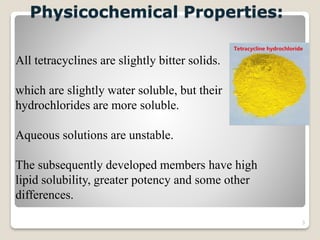
All tetracyclines are slightly bitter solids.
which are slightly water soluble, but their
hydrochlorides are more soluble.
Aqueous solutions are unstable.
The subsequently developed members have high
lipid solubility, greater potency and some other
differences.
Physicochemical Properties:
4
Classification
According to source:
Naturally occurring :
Ex- Tetracycline, Chlorotetracycline, Demeclocycline.
Semi-synthetic:
Ex-Doxycycline, Lymecycline, Meclocycline.
Prodrugs:
Ex-Rolitetracycline, Lymelicycline, Pipacycline,
Guamecycline.
5
Based on Duration of action :
Short acting(half-life 6 8hrs):
Ex-Tetracycline, Chlortetracycline, Oxytetracycline.
Intermediate acting(half-life12hrs):
Ex-Demeclocycline, Methacycline.
Long acting(half-life is 16hrs):
Ex-Doxycycline,Minocycline,Tigecycline.
6
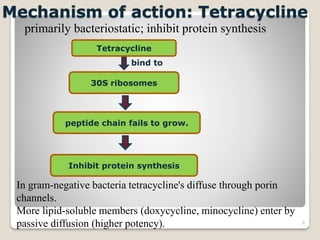
Mechanism of action: Tetracycline
primarily bacteriostatic; inhibit protein synthesis
peptide chain fails to grow.
30S ribosomes
Tetracycline
bind to
In gram-negative bacteria tetracycline's diffuse through porin
channels.
More lipid-soluble members (doxycycline, minocycline) enter by
passive diffusion (higher potency).
Inhibit protein synthesis
7
Most all types pathogenic microorganisms except fungi
and viruses;
More antibacterial action on
1. Cocci: Gram-positive and gram-negative cocci were originally
sensitive, but now only few Strep. pyogenes, Staph. aureus
(includingMRSA) and enterococci respond.
Tetracyclines (especially minocycline) are now active against N.
gonorrhoeae and N. meningitidis.
2. Most gram-positive bacilli, e.g. Clostridia and other
anaerobes, Listeria, Corynebacteria, Propionibacterium acnes, B.
anthracis areinhibited but not Mycobacteria, except M. Leprae (to
minocycline) and some atypical ones.
Antimicrobial spectrum
8
3. Sensitive gram-negative bacilli are— H. ducreyi,
Calymmatobacterium granulomatis, V. Cholerae etc many
anaerobes.
4. Spirochetes, including T. pallidum and Borrelia are quite
sensitive.
5. All rickettsiae (typhus, etc.) and chlamydiae are highly sensitive.
6. Mycoplasma and Actinomyces are moderately sensitive.
7. Protozoa like Entamoeba histolytica and Plasmodia are inhibited
at high concentrations.
9
Resistance
Resistance develops by following mechanism;
•Bacteria acquire capacity to pump tetracycline
out.
•Bacterial Plasmid synthesize ‘protection’ protein
which prevent the tetracycline to bind with
ribosomal binding site.
•Elaboration of tetracycline inactivating enzymes
(tetracyclineresistance)
10
Pharmacokinetics
Absorption: incompletely absorbed from GIT. absorption is
better if taken in empty stomach.
Tetracyclines have chelating property and form insoluble and
unabsorbable complexes with calcium and other metals. Milk,
iron preparations, nonsystemic antacids and sucralfate reduce their
absorption.
Distribution:widely distributed in the body (volume of
distribution > 1 L/kg). concentrated in liver, spleen and bind to the
connective tissue in bone and teeth.
Metabolism: Liver.
Excretion: urine by glomerular filtration.
11
Dosage forms
Capsule: Oral capsule is the dosage most preferred. The capsule
should be taken ½ hr before or 2 hr after food.
Liquid oral preparations for paediatric use are banned in India.
I.m. route produces pain, Slow i.v. injection may be given in
severe cases.
A variety of topical preparations (ointment, cream, etc.) are
available, but should not be used causes sensitivity reaction.
12
Adverse effects
A. Irritative effects Tetracyclines.
B.Organ toxicity is dose related.
1. Liver damage
2. Kidney damage
3. Phototoxicity A sunburn
4. Teeth and bones
5. Antianabolic effect
6. Increased intracranial pressure
7. Diabetes insipidus
8. Vestibular toxicity
C.Hypersensitivity.
D.Superinfection
13
A.Irritative effects :
Tetracyclines have irritant property; on oral
administration causes epigastric pain, nausea, vomiting
and diarrhoea.
Odynophagia (esophageal ulceration) occurred when
material from capsules releases in the esophagus during
swallowing.
Intramuscular injection of tetracyclines is very painful;
thrombophlebitis occurs on repeated i.v. injection.
14
B. Organ toxicity: This is dose related.
1. Liver damage Fatty infiltration of liver and jaundice may
occurs. Oxytetracycline andtetracycline are safer in this regard.
Tetracyclines are risky in pregnant women; can precipitate acute
hepatic necrosis which may be fatal.
2. Kidney damage If existing kidney disease is present then
kidney damage is more. A reversible Fanconi syndrome like
condition is produced due to degraded products—epitetracycline,
anhydrotetracycline and epianhydrotetracycline which damage
proximal tubules.
Exposure to acidic pH, moisture and heat favours suc degradation.
3. Phototoxicity A sunburn-like or other severe skin reaction on
exposed parts. A higher incidence has been noted with
demeclocycline and doxycycline.
15
4. Teeth and bones Tetracyclines have chelating property.
Calcium-tetracycline chelate gets deposited in developing teeth and
bone.
Given from midpregnancy to 5 months of extrauterin life, the
deciduous teeth are affected: brown discolouration, ill-formed
teeth.
Given during late pregnancy or childhood, cause temporary
suppression of bone growth, deformities and reduction
in height are a possibility with prolonged use.
5. Antianabolic effect Tetracyclines reduce protein synthesis and
have an overall catabolic effect.
They induce negative nitrogen balance and can increase blood urea.
16
6. Increased intracranial pressure is noted in some infants.
7. Diabetes insipidus Demeclocycline antagonizes ADH action and
reduces urine concentrating ability of the kidney.
8. Vestibular toxicity Minocycline can cause ataxia, vertigo and
nystagmus.
C. Hypersensitivity: Skin rashes, urticaria, glossitis, pruritus
ani and vulvae, even exfoliative dermatitis.
Angioedema and anaphylaxis are extremely rare.
D.Superinfection Tetracyclines cause more marked suppression of
the resident flora.
Though mouth, skin or vagina may be involved, intestinal
superinfection by Candida albicans pseudomembranous enterocolitis
is rare.
17
1. Tetracyclines should not be used during pregnancy,
lactation and in children.
2. They should be avoided in patients on diuretics: blood
urea may rise in such patients.
3. They should be used cautiously in renal or hepatic
insufficiency.
4. Preparations should never be used beyond their expiry
date.
5. Do not mix injectable tetracyclines with penicillin—
inactivation occurs.
6. Do not inject tetracyclines intrathecally.
Precautions
18
Tetracyclines are broad-spectrum antibiotics. Due to availability
of fluoroquinolones tetracyclines is less preferd .
1. Empirical therapy : When the nature and sensitivity of the
infecting organism cannot be guessed then tetracycline is used .
They used for initial treatment of mixed infections.
2. Tetracyclines are the first choice drugs: In following
condition.
A. Venereal diseases
a. Lymphogranuloma venereum
b. Granuloma inguinale: due to Calymm.
c.granulomatis.
B. Atypical pneumonia: due to Mycoplasma pneumoniae.
C.Cholera.
D.Brucellosis.
E.Plague
F.Relapsing fever
G.Rickettsial infections
Uses
19
3. Tetracyclines are second choice drugs:
•To penicillin/ampicillin for tetanus, anthrax, actinomycosis and
Listeria infections.
•To ceftriaxone, amoxicillin or azithromycin for gonorrhoea,
especially for penicillin resistant non-PPNG; also in patients
allergic to penicillin, but response rate has decreased.
•To ceftriaxone for syphilis in patients allergic to penicillin; early
syphilis can be treated in 2 weeks but late syphilis requires 1
month.
•To penicillin for leptospirosis; doxycycline 100 mg BD for 7
days is curative. Weekly doxycycline (200 mg) has been used as
prophylactic
20
4. Other situations in which tetracyclines may be used are:
•Urinary tract infections: Odd cases in which the organism has
been found sensitive.
•Community-acquired pneumonia, when a more selective
antibiotic cannot be used.
•Amoebiasis: along with other amoebicides
•for chronic intestinal amoebiasis.
•As adjuvant to quinine or artesunate for chloroquine-resistant P.
falciparum malaria .
•Acne vulgaris: prolonged therapy with low doses may be used in
severe cases.
•Chronic obstructive lung disease: prophylactic use may reduce
the frequency of exacerbations, but the risk : benefit ratio is
controversial.
21
Reference:
Rang H.P. and Dale M.M.: Pharmacology, Churchill
Livingstone, Edinbergh.
Katzung B.G.: Basic and Clinical Pharmacology, Lange
Medical Publications, California.
Craig C.R. and Stitzel R.E.: Modern Pharmacology, Little
Brown and Co., Boston.
Bowman W.C. and Rand M.J.: Textbook of Pharmacology,
Blackwell Scientific Publications, Oxford.
P.N Bennett & M J Brown: Clinical Pharmacology,
Churchill Livingstone, Edinburgh.
Tripathi K.D.: Essentials of Medical Pharmacology, Jaypee
Brothers, Medical Publishers, New Delhi.
Any query don’t hesitate to contact & If like then comment in box 22

Broad spectrum antibiotic tetracycline converted

  • 1.
    Miss Snehal S.Chakorkar (M.pharm) Dept Of Pharmacology 1 Broad Spectrum Antibiotic: Tetracycline Miss Snehal S. Chakorkar (M.pharm) Dept Of Pharmacology
  • 2.
    2 Introduction: •It contains nucleusof four cyclic rings. •Tetracycline obtained from soil actinomycetes. The first introduced was chlortetracycline in 1948 under the name aureomycin (because of the golden yellow colour of S. aureofaciens colonies producing it) Tetracycline
  • 3.
    3 All tetracyclines areslightly bitter solids. which are slightly water soluble, but their hydrochlorides are more soluble. Aqueous solutions are unstable. The subsequently developed members have high lipid solubility, greater potency and some other differences. Physicochemical Properties:
  • 4.
    4 Classification According to source: Naturallyoccurring : Ex- Tetracycline, Chlorotetracycline, Demeclocycline. Semi-synthetic: Ex-Doxycycline, Lymecycline, Meclocycline. Prodrugs: Ex-Rolitetracycline, Lymelicycline, Pipacycline, Guamecycline.
  • 5.
    5 Based on Durationof action : Short acting(half-life 6 8hrs): Ex-Tetracycline, Chlortetracycline, Oxytetracycline. Intermediate acting(half-life12hrs): Ex-Demeclocycline, Methacycline. Long acting(half-life is 16hrs): Ex-Doxycycline,Minocycline,Tigecycline.
  • 6.
    6 Mechanism of action:Tetracycline primarily bacteriostatic; inhibit protein synthesis peptide chain fails to grow. 30S ribosomes Tetracycline bind to In gram-negative bacteria tetracycline's diffuse through porin channels. More lipid-soluble members (doxycycline, minocycline) enter by passive diffusion (higher potency). Inhibit protein synthesis
  • 7.
    7 Most all typespathogenic microorganisms except fungi and viruses; More antibacterial action on 1. Cocci: Gram-positive and gram-negative cocci were originally sensitive, but now only few Strep. pyogenes, Staph. aureus (includingMRSA) and enterococci respond. Tetracyclines (especially minocycline) are now active against N. gonorrhoeae and N. meningitidis. 2. Most gram-positive bacilli, e.g. Clostridia and other anaerobes, Listeria, Corynebacteria, Propionibacterium acnes, B. anthracis areinhibited but not Mycobacteria, except M. Leprae (to minocycline) and some atypical ones. Antimicrobial spectrum
  • 8.
    8 3. Sensitive gram-negativebacilli are— H. ducreyi, Calymmatobacterium granulomatis, V. Cholerae etc many anaerobes. 4. Spirochetes, including T. pallidum and Borrelia are quite sensitive. 5. All rickettsiae (typhus, etc.) and chlamydiae are highly sensitive. 6. Mycoplasma and Actinomyces are moderately sensitive. 7. Protozoa like Entamoeba histolytica and Plasmodia are inhibited at high concentrations.
  • 9.
    9 Resistance Resistance develops byfollowing mechanism; •Bacteria acquire capacity to pump tetracycline out. •Bacterial Plasmid synthesize ‘protection’ protein which prevent the tetracycline to bind with ribosomal binding site. •Elaboration of tetracycline inactivating enzymes (tetracyclineresistance)
  • 10.
    10 Pharmacokinetics Absorption: incompletely absorbedfrom GIT. absorption is better if taken in empty stomach. Tetracyclines have chelating property and form insoluble and unabsorbable complexes with calcium and other metals. Milk, iron preparations, nonsystemic antacids and sucralfate reduce their absorption. Distribution:widely distributed in the body (volume of distribution > 1 L/kg). concentrated in liver, spleen and bind to the connective tissue in bone and teeth. Metabolism: Liver. Excretion: urine by glomerular filtration.
  • 11.
    11 Dosage forms Capsule: Oralcapsule is the dosage most preferred. The capsule should be taken ½ hr before or 2 hr after food. Liquid oral preparations for paediatric use are banned in India. I.m. route produces pain, Slow i.v. injection may be given in severe cases. A variety of topical preparations (ointment, cream, etc.) are available, but should not be used causes sensitivity reaction.
  • 12.
    12 Adverse effects A. Irritativeeffects Tetracyclines. B.Organ toxicity is dose related. 1. Liver damage 2. Kidney damage 3. Phototoxicity A sunburn 4. Teeth and bones 5. Antianabolic effect 6. Increased intracranial pressure 7. Diabetes insipidus 8. Vestibular toxicity C.Hypersensitivity. D.Superinfection
  • 13.
    13 A.Irritative effects : Tetracyclineshave irritant property; on oral administration causes epigastric pain, nausea, vomiting and diarrhoea. Odynophagia (esophageal ulceration) occurred when material from capsules releases in the esophagus during swallowing. Intramuscular injection of tetracyclines is very painful; thrombophlebitis occurs on repeated i.v. injection.
  • 14.
    14 B. Organ toxicity:This is dose related. 1. Liver damage Fatty infiltration of liver and jaundice may occurs. Oxytetracycline andtetracycline are safer in this regard. Tetracyclines are risky in pregnant women; can precipitate acute hepatic necrosis which may be fatal. 2. Kidney damage If existing kidney disease is present then kidney damage is more. A reversible Fanconi syndrome like condition is produced due to degraded products—epitetracycline, anhydrotetracycline and epianhydrotetracycline which damage proximal tubules. Exposure to acidic pH, moisture and heat favours suc degradation. 3. Phototoxicity A sunburn-like or other severe skin reaction on exposed parts. A higher incidence has been noted with demeclocycline and doxycycline.
  • 15.
    15 4. Teeth andbones Tetracyclines have chelating property. Calcium-tetracycline chelate gets deposited in developing teeth and bone. Given from midpregnancy to 5 months of extrauterin life, the deciduous teeth are affected: brown discolouration, ill-formed teeth. Given during late pregnancy or childhood, cause temporary suppression of bone growth, deformities and reduction in height are a possibility with prolonged use. 5. Antianabolic effect Tetracyclines reduce protein synthesis and have an overall catabolic effect. They induce negative nitrogen balance and can increase blood urea.
  • 16.
    16 6. Increased intracranialpressure is noted in some infants. 7. Diabetes insipidus Demeclocycline antagonizes ADH action and reduces urine concentrating ability of the kidney. 8. Vestibular toxicity Minocycline can cause ataxia, vertigo and nystagmus. C. Hypersensitivity: Skin rashes, urticaria, glossitis, pruritus ani and vulvae, even exfoliative dermatitis. Angioedema and anaphylaxis are extremely rare. D.Superinfection Tetracyclines cause more marked suppression of the resident flora. Though mouth, skin or vagina may be involved, intestinal superinfection by Candida albicans pseudomembranous enterocolitis is rare.
  • 17.
    17 1. Tetracyclines shouldnot be used during pregnancy, lactation and in children. 2. They should be avoided in patients on diuretics: blood urea may rise in such patients. 3. They should be used cautiously in renal or hepatic insufficiency. 4. Preparations should never be used beyond their expiry date. 5. Do not mix injectable tetracyclines with penicillin— inactivation occurs. 6. Do not inject tetracyclines intrathecally. Precautions
  • 18.
    18 Tetracyclines are broad-spectrumantibiotics. Due to availability of fluoroquinolones tetracyclines is less preferd . 1. Empirical therapy : When the nature and sensitivity of the infecting organism cannot be guessed then tetracycline is used . They used for initial treatment of mixed infections. 2. Tetracyclines are the first choice drugs: In following condition. A. Venereal diseases a. Lymphogranuloma venereum b. Granuloma inguinale: due to Calymm. c.granulomatis. B. Atypical pneumonia: due to Mycoplasma pneumoniae. C.Cholera. D.Brucellosis. E.Plague F.Relapsing fever G.Rickettsial infections Uses
  • 19.
    19 3. Tetracyclines aresecond choice drugs: •To penicillin/ampicillin for tetanus, anthrax, actinomycosis and Listeria infections. •To ceftriaxone, amoxicillin or azithromycin for gonorrhoea, especially for penicillin resistant non-PPNG; also in patients allergic to penicillin, but response rate has decreased. •To ceftriaxone for syphilis in patients allergic to penicillin; early syphilis can be treated in 2 weeks but late syphilis requires 1 month. •To penicillin for leptospirosis; doxycycline 100 mg BD for 7 days is curative. Weekly doxycycline (200 mg) has been used as prophylactic
  • 20.
    20 4. Other situationsin which tetracyclines may be used are: •Urinary tract infections: Odd cases in which the organism has been found sensitive. •Community-acquired pneumonia, when a more selective antibiotic cannot be used. •Amoebiasis: along with other amoebicides •for chronic intestinal amoebiasis. •As adjuvant to quinine or artesunate for chloroquine-resistant P. falciparum malaria . •Acne vulgaris: prolonged therapy with low doses may be used in severe cases. •Chronic obstructive lung disease: prophylactic use may reduce the frequency of exacerbations, but the risk : benefit ratio is controversial.
  • 21.
    21 Reference: Rang H.P. andDale M.M.: Pharmacology, Churchill Livingstone, Edinbergh. Katzung B.G.: Basic and Clinical Pharmacology, Lange Medical Publications, California. Craig C.R. and Stitzel R.E.: Modern Pharmacology, Little Brown and Co., Boston. Bowman W.C. and Rand M.J.: Textbook of Pharmacology, Blackwell Scientific Publications, Oxford. P.N Bennett & M J Brown: Clinical Pharmacology, Churchill Livingstone, Edinburgh. Tripathi K.D.: Essentials of Medical Pharmacology, Jaypee Brothers, Medical Publishers, New Delhi.
  • 22.
    Any query don’thesitate to contact & If like then comment in box 22