Erythromycin
By: Aachal D. Jain
Roll No.: 07
Class: Msc –II
Paper: 3
INTRODUCTION
• Antibiotics are a type of antimicrobial drug used in
the treatment and prevention of bacterial infections. They may
either kill or inhibit the growth of bacteria.
• Discovered by : Alexander Fleming in 1928.
• Antibiotics can be bacteriostatic or bactericidal.
• The main classes of antibiotics:
• Aminoglycosides
• Cephalosporins
• Fluoroquinolones
• Macrolides
• Penicillins
• Tetracyclines
• Erythromycin-like antibiotics are also known as
macrolides.
• Macrolides belong to the polyketide class of natural
products.
• Macrolide antibiotics are are hydrophobic, basic
compound.
• Macrolide antibiotics slow the growth of, or sometimes
kill sensitive bacteria by reducing the production of
important proteins needed by the bacteria to survive.
• The commonly used macrolides are:
• Erythromycin
• Clarithromycin
• Roxithromycin
• Azithromycin
ERYTHROMYCIN
General Characteristics
• Erythromycin is a macrolide antibiotic that has an
antimicrobial spectrum similar to or slightly wider
than that of penicillin.
• Erythromycin was discovered in 1952 by McGuire
and coworkers from a strain of Streptomyces
erythreus.
• It is often used for people who have allergy to
penicillin.
• It is poorly soluble in water.
• Bactericidal, particularly at higher concentrations.
• Trade name is E-mycin or Erythrocin
GENERAL STRUCTURE
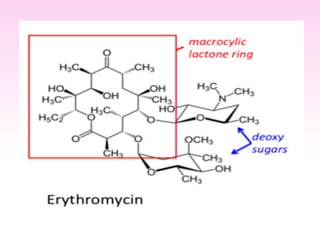
Erythromycin contains three characteristics parts in the molecule:
1. A highly substituted macrocyclic lactone: aglycone.
• It is a macrocyclic compound containing 14-membered lactone
ring with 10 asymmetric centers
2. A ketone group.
3. An amino desoxysugar: glycon, and in some of the macrolides,
a neutral desoxysugar which are glycosisically attached to the
aglycone ring.
• The two sugars are namely: L-Cladinose and D-Desoamine.
• Its chemical formula is C37H67N1O13.
MECHANISM OF ACTION
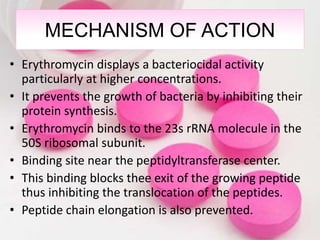
• Erythromycin displays a bacteriocidal activity
particularly at higher concentrations.
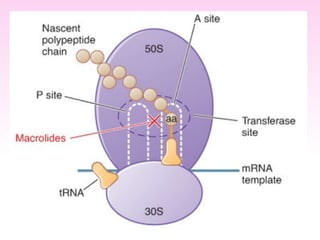
• It prevents the growth of bacteria by inhibiting their
protein synthesis.
• Erythromycin binds to the 23s rRNA molecule in the
50S ribosomal subunit.
• Binding site near the peptidyltransferase center.
• This binding blocks thee exit of the growing peptide
thus inhibiting the translocation of the peptides.
• Peptide chain elongation is also prevented.
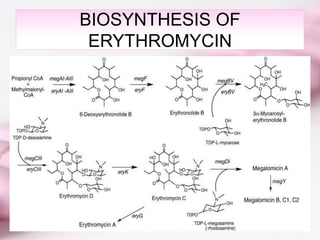
BIOSYNTHESIS OF
ERYTHROMYCIN
INDUSTRIAL PRODUCTION
• Erythromycin is produced from Streptomyces
and Micromonospora.
• Erythroymycin is produced mainly by
submerged fermentation.
• During fermentation, different types of
erythromycin are produced like erythromycin
A, B, C, and D.
• The steps for erythromycin production are as
follows:
1. Inoculum Development:
– Inoculum is prepared from suspension of at least 108
cells/ml.
– Sporulation of S.erythraeus is done on tryptone agar slant.
– Cells are harvested from agar plates and suspension is
taken in sterile water and stored at 4oC.
2. Medium:
• Sucrose– 5%
• Corn steep liquor – 0.5%
• Soyabean oil meal – 1.5%
• Yeast – 1.0%
• NaCl – 0.5%
• CaCo3 precipitate – 0.3%
• pH – 7.0 -7.2
3. Fermentation :
• Fermentation is carried out in stirred tank
fermenter.
• It should have proper aeration and agitation, pH,
temperature, viscosity and dissolved oxygen
concentration.
• Temp: Fermentation temperature is 33oC.
• Duration: The length of fermentation is 3-7 days.
• Production of Erythromycin production occurs
when froth reaches stationary phase.
• Addition of n-propanol as precursor increases
the production of erythromycin.
4. Isolation:
• Mycelium is separated from the broth by filter
press, centrifugation or drum filtration.
• Acidic condition helps to separate mycelium the
broth.
• Acidic condition is maintained by addition of
Butyl acetate which favors the separation of the
mycelium. Also it dissolves the antibiotic.
• It is then washed with water.
5. Extraction:
• It is extracted using methyl iso butyl ketone or
ethyl acetate.
• It is then transferred to acidic water.
• pH is adjusted with HCl, acetic acid and citric acid.
• Purification and concentration is carried out in ion
exchange resin amberlite 50.
• Elution is carried out by a mixture of organic
solvents and water at pH 3 to 8.
• Erythromycin is obtained as dihydrate salt.
• The dehydrate crystals of erythromycin are filtered
and dried on vaccum tray dryer.
CLINICAL USES
• Drug of choice in corynebacterial infections:
diphtheria, corynebacterial sepsis, erythrasma.
• In respiratory, neonatal, ocular, or genital
chlamydial infections.
• Treatment of community-acquired pneumonia.
• Penicillin substitute in penicillin allergic
individuals.
• Prophylaxis against endocarditis during dental
procedures in individuals with valvular heart
disease.
Thank You

Erythromycin

  • 1.
    Erythromycin By: Aachal D.Jain Roll No.: 07 Class: Msc –II Paper: 3
  • 2.
    INTRODUCTION • Antibiotics area type of antimicrobial drug used in the treatment and prevention of bacterial infections. They may either kill or inhibit the growth of bacteria. • Discovered by : Alexander Fleming in 1928. • Antibiotics can be bacteriostatic or bactericidal. • The main classes of antibiotics: • Aminoglycosides • Cephalosporins • Fluoroquinolones • Macrolides • Penicillins • Tetracyclines
  • 3.
    • Erythromycin-like antibioticsare also known as macrolides. • Macrolides belong to the polyketide class of natural products. • Macrolide antibiotics are are hydrophobic, basic compound. • Macrolide antibiotics slow the growth of, or sometimes kill sensitive bacteria by reducing the production of important proteins needed by the bacteria to survive. • The commonly used macrolides are: • Erythromycin • Clarithromycin • Roxithromycin • Azithromycin
  • 4.
    ERYTHROMYCIN General Characteristics • Erythromycinis a macrolide antibiotic that has an antimicrobial spectrum similar to or slightly wider than that of penicillin. • Erythromycin was discovered in 1952 by McGuire and coworkers from a strain of Streptomyces erythreus. • It is often used for people who have allergy to penicillin. • It is poorly soluble in water. • Bactericidal, particularly at higher concentrations. • Trade name is E-mycin or Erythrocin
  • 5.
    GENERAL STRUCTURE Erythromycin containsthree characteristics parts in the molecule: 1. A highly substituted macrocyclic lactone: aglycone. • It is a macrocyclic compound containing 14-membered lactone ring with 10 asymmetric centers 2. A ketone group. 3. An amino desoxysugar: glycon, and in some of the macrolides, a neutral desoxysugar which are glycosisically attached to the aglycone ring. • The two sugars are namely: L-Cladinose and D-Desoamine. • Its chemical formula is C37H67N1O13.
  • 7.
    MECHANISM OF ACTION •Erythromycin displays a bacteriocidal activity particularly at higher concentrations. • It prevents the growth of bacteria by inhibiting their protein synthesis. • Erythromycin binds to the 23s rRNA molecule in the 50S ribosomal subunit. • Binding site near the peptidyltransferase center. • This binding blocks thee exit of the growing peptide thus inhibiting the translocation of the peptides. • Peptide chain elongation is also prevented.
  • 9.
  • 10.
    INDUSTRIAL PRODUCTION • Erythromycinis produced from Streptomyces and Micromonospora. • Erythroymycin is produced mainly by submerged fermentation. • During fermentation, different types of erythromycin are produced like erythromycin A, B, C, and D. • The steps for erythromycin production are as follows:
  • 11.
    1. Inoculum Development: –Inoculum is prepared from suspension of at least 108 cells/ml. – Sporulation of S.erythraeus is done on tryptone agar slant. – Cells are harvested from agar plates and suspension is taken in sterile water and stored at 4oC. 2. Medium: • Sucrose– 5% • Corn steep liquor – 0.5% • Soyabean oil meal – 1.5% • Yeast – 1.0% • NaCl – 0.5% • CaCo3 precipitate – 0.3% • pH – 7.0 -7.2
  • 12.
    3. Fermentation : •Fermentation is carried out in stirred tank fermenter. • It should have proper aeration and agitation, pH, temperature, viscosity and dissolved oxygen concentration. • Temp: Fermentation temperature is 33oC. • Duration: The length of fermentation is 3-7 days. • Production of Erythromycin production occurs when froth reaches stationary phase. • Addition of n-propanol as precursor increases the production of erythromycin.
  • 13.
    4. Isolation: • Myceliumis separated from the broth by filter press, centrifugation or drum filtration. • Acidic condition helps to separate mycelium the broth. • Acidic condition is maintained by addition of Butyl acetate which favors the separation of the mycelium. Also it dissolves the antibiotic. • It is then washed with water.
  • 14.
    5. Extraction: • Itis extracted using methyl iso butyl ketone or ethyl acetate. • It is then transferred to acidic water. • pH is adjusted with HCl, acetic acid and citric acid. • Purification and concentration is carried out in ion exchange resin amberlite 50. • Elution is carried out by a mixture of organic solvents and water at pH 3 to 8. • Erythromycin is obtained as dihydrate salt. • The dehydrate crystals of erythromycin are filtered and dried on vaccum tray dryer.
  • 15.
    CLINICAL USES • Drugof choice in corynebacterial infections: diphtheria, corynebacterial sepsis, erythrasma. • In respiratory, neonatal, ocular, or genital chlamydial infections. • Treatment of community-acquired pneumonia. • Penicillin substitute in penicillin allergic individuals. • Prophylaxis against endocarditis during dental procedures in individuals with valvular heart disease.
  • 16.