Macrolides,Macrolides,
Lincosamide &Lincosamide &
GlycopeptideGlycopeptide
AntimicrobialsAntimicrobials
Dr. Sahil Kumar
Department of Pharmacology
Maulana Azad Medical College
INTRODUCTION
 Characterized by a macrocyclic lactone ring (usually
containing 14 or 16 atoms) to which deoxysugars
are attached.
 Prototype drug – Erythromycin.
Part APart A: Macrolides: Macrolides
11.. AntimicrobialAntimicrobial spectrumspectrum ::
 GG++
organismsorganisms
 GG--
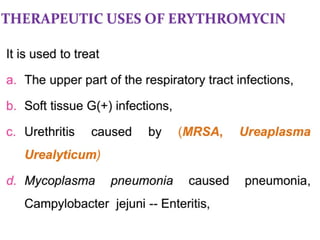
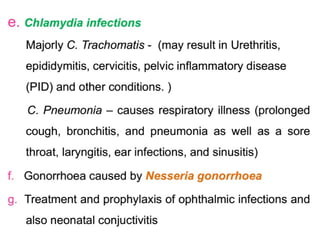
cocci:cocci: Streptococcus pyogenes and pneumoniaeStreptococcus pyogenes and pneumoniae
 Mycoplasma pneumoniae and Legionnellapneumoniae and Legionnella etcetc.
2.2. Antimicrobial activity:Antimicrobial activity:
 Typically bacteriostatic activity.Typically bacteriostatic activity.
 Bactericidal at high concentrations against veryBactericidal at high concentrations against very
susceptible organismssusceptible organisms
 More active at alkaline pHMore active at alkaline pH
General properties ofGeneral properties of MacrolidesMacrolides
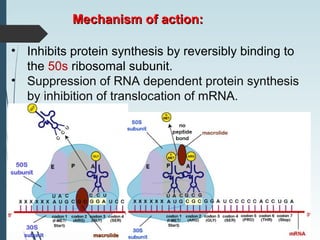
Mechanism of action:Mechanism of action:
macrolidemacrolidesubunitsubunit
• Inhibits protein synthesis by reversibly binding to
the 50s ribosomal subunit.
• Suppression of RNA dependent protein synthesis
by inhibition of translocation of mRNA.
Mechanism of resistance:Mechanism of resistance:
 Modification of the ribosomal binding siteModification of the ribosomal binding site
 Production ofProduction of esteraseesterase that hydrolyzethat hydrolyze
macrolides.macrolides.
 Reduced permeability of cell membrane orReduced permeability of cell membrane or
active effluxactive efflux system is involved.system is involved.
 Cross-resistance is complete betweenCross-resistance is complete between
erythromycin and the other macrolides.erythromycin and the other macrolides.
1)1) AAbsorption:bsorption:
Stearate and ester of erythromycin areStearate and ester of erythromycin are
fairly acid-resistant and somewhat betterfairly acid-resistant and somewhat better
absorbed. Food interferes withabsorbed. Food interferes with
absorption.absorption.
Erythromycin base is destroyed byErythromycin base is destroyed by
stomach acid and must be given withstomach acid and must be given with
enteric coating.enteric coating.
PharmacokineticsPharmacokinetics
2)2) DDistribution: does not cross BBB.istribution: does not cross BBB.
3)3) EElimination: it is concentrated in thelimination: it is concentrated in the
liver, where some is unactived, whileliver, where some is unactived, while
some is excreted in active form insome is excreted in active form in
the bile.the bile.
PharmacokineticsPharmacokinetics
Adverse response:Adverse response:
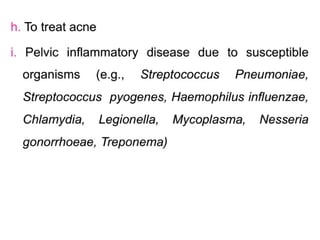
1)1) GI Effects: nausea, vomiting, abdominalGI Effects: nausea, vomiting, abdominal
crampscramps
2)2) Liver Toxicity: Cholestatic hepatitis.Liver Toxicity: Cholestatic hepatitis.
3)3) Cardiotoxic effectsCardiotoxic effects
4) Auditory impairment (Ototoxicity)4) Auditory impairment (Ototoxicity)
Hypersensitivity reactionsHypersensitivity reactions
SuperinfectionsSuperinfections
General properties ofGeneral properties of MacrolidesMacrolides
Drug interactionsDrug interactions
• Erythromycin metabolites canErythromycin metabolites can
inhibit cytochrome P450inhibit cytochrome P450
enzyme.enzyme.
General properties ofGeneral properties of MacrolidesMacrolides
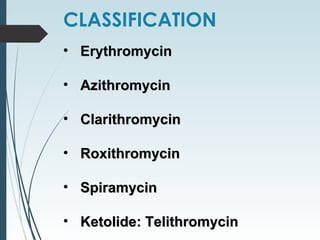
• ErythromycinErythromycin
• AzithromycinAzithromycin
• ClarithromycinClarithromycin
• RoxithromycinRoxithromycin
• SpiramycinSpiramycin
• Ketolide: TelithromycinKetolide: Telithromycin
CLASSIFICATION
Therapeutic uses of Telithromycin
 Telithromycin is the first ketolide antibiotic to enter
clinical use.
 Used to treat community acquired pneumonia of mild
to moderate severity.
 After significant safety concerns, the US Food and Drug
Administration sharply curtailed the approved use of
the drug in early 2007.
 Liver failure, vision problems, blackouts, syncope, and
potentially fatal cases of myasthenia gravis.
• LincomycinLincomycin
• ClindamycinClindamycin
Part B:Part B: LincosamidesLincosamides
Antimicrobial propertiesAntimicrobial properties
• Resemble Erythromycin inResemble Erythromycin in
antibacterial spectrum, activity,antibacterial spectrum, activity,
mechanism and resistance.mechanism and resistance.
• Lincomycin is forerunner ofLincomycin is forerunner of
Clindamycin. Less potent; moreClindamycin. Less potent; more
diarrhea.diarrhea.
Lincomycin & ClindamycinLincomycin & Clindamycin
Mechanism of resistance:Mechanism of resistance:
 Modification of the ribosomal binding siteModification of the ribosomal binding site
 Antibiotic efflux isAntibiotic efflux is notnot an importantan important
mechanism of Clindamycin resistance.mechanism of Clindamycin resistance.
(unlike macrolides)(unlike macrolides)
 Cross-resistance is complete betweenCross-resistance is complete between
erythromycin and the other macrolides.erythromycin and the other macrolides.
Clinical UsesClinical Uses
• Severe anaerobic infectionSevere anaerobic infection
• Aerobic GAerobic G++
cocci infection (but not MRSA).cocci infection (but not MRSA).
• Combination with pyrimethamine for AIDS-Combination with pyrimethamine for AIDS-
related toxoplasmosis.related toxoplasmosis.
• Combination with primaquine for AIDS-relatedCombination with primaquine for AIDS-related
pneumocystis cariniipneumocystis carinii pneumonia.pneumonia.
Lincomycin & ClindamycinLincomycin & Clindamycin
Adverse response:Adverse response:
1) GI effects: Antibiotic-associated1) GI effects: Antibiotic-associated
colitiscolitis ((pseudomembranouspseudomembranous
colitis)colitis)..
2) Allergic reaction.2) Allergic reaction.
3) Impaired liver function.3) Impaired liver function.
Lincomycin & ClindamycinLincomycin & Clindamycin
Clindamycin, Erythromycin and
Chloramphenicol can exhibit mutual
antagonism, because their ribosomal
binding sites are proximal.
VancomycinVancomycin
TeicoplaninTeicoplanin
Part C: GlycopeptidesPart C: Glycopeptides
Antibacterial activityAntibacterial activity
Bactericidal for GBactericidal for G++
bacteria (especially Gbacteria (especially G++
cocci, including MRSA & MRSE)cocci, including MRSA & MRSE)
VancomycinVancomycin
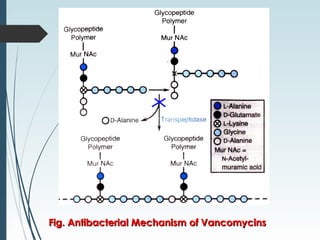
• Antibacterial MechanismAntibacterial Mechanism
Inhibiting cell wall synthesis byInhibiting cell wall synthesis by
binding to thebinding to the DD-Ala--Ala-DD-Ala terminus-Ala terminus
of nascent peptidoglycan penta-of nascent peptidoglycan penta-
peptide.peptide.
• ResistanceResistance
Occurrs because of the alteration ofOccurrs because of the alteration of DD--
Ala-Ala-DD-Ala to the-Ala to the DD-Ala--Ala-DD-Ser.-Ser.
VancomycinVancomycin
Fig. Antibacterial MechanismFig. Antibacterial Mechanism of Vancomycinsof Vancomycins
• ADMEADME
• Oral administration (poorly absorbed).Oral administration (poorly absorbed).
• Intravenous administration, is excreted byIntravenous administration, is excreted by
glomerular filtration (accumulates when renalglomerular filtration (accumulates when renal
function is impaired).function is impaired).
• Widely distributed in the body, including CSFWidely distributed in the body, including CSF
when the meninges are inflamed.when the meninges are inflamed.
VancomycinVancomycin
Clinical UsesClinical Uses
1) Severe infection caused by MRSA1) Severe infection caused by MRSA etcetc..
2) Alternative for2) Alternative for ββ-lactam-lactam
3) Enterococcal or staphylococcal3) Enterococcal or staphylococcal
endocarditis (combination withendocarditis (combination with
gentamicin).gentamicin).
4)4) Pseudomembranous colitisPseudomembranous colitis
VancomycinVancomycin
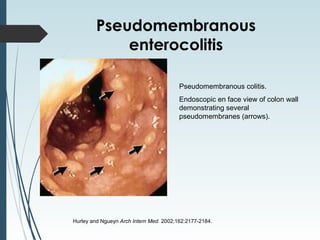
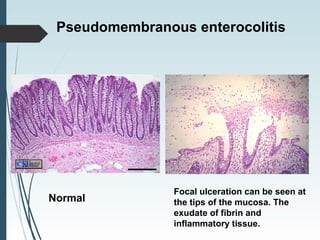
Pseudomembranous
enterocolitis
Hurley and Ngueyn Arch Intern Med. 2002;162:2177-2184.
Pseudomembranous colitis.
Endoscopic en face view of colon wall
demonstrating several
pseudomembranes (arrows).
Focal ulceration can be seen at
the tips of the mucosa. The
exudate of fibrin and
inflammatory tissue.
Pseudomembranous enterocolitis
Normal
Adverse ReactionsAdverse Reactions
1) Hypersensitive reaction – it releases1) Hypersensitive reaction – it releases
histamine (e.g. red man syndrome)histamine (e.g. red man syndrome)
2) Ototoxicity2) Ototoxicity
3) Nephrotoxicity3) Nephrotoxicity
4) G4) Gl effects,l effects, etcetc..
VancomycinVancomycin
Teicoplanin
 Active against G+ bacteria only.
 MOA and spectrum similar to Vancomycin.
 More active than Vanco against
Enterococci and equally effective against
MRSA.
 Some VRE but not VRSA are susceptible to
Teicoplanin.
 Can be injected i.m. as well.
 Toxicity is less than Vancomycin.
Thanks!

Macrolides, Lincosamides and Vancomycin

  • 1.
  • 2.
    INTRODUCTION  Characterized bya macrocyclic lactone ring (usually containing 14 or 16 atoms) to which deoxysugars are attached.  Prototype drug – Erythromycin. Part APart A: Macrolides: Macrolides
  • 3.
    11.. AntimicrobialAntimicrobial spectrumspectrum::  GG++ organismsorganisms  GG-- cocci:cocci: Streptococcus pyogenes and pneumoniaeStreptococcus pyogenes and pneumoniae  Mycoplasma pneumoniae and Legionnellapneumoniae and Legionnella etcetc. 2.2. Antimicrobial activity:Antimicrobial activity:  Typically bacteriostatic activity.Typically bacteriostatic activity.  Bactericidal at high concentrations against veryBactericidal at high concentrations against very susceptible organismssusceptible organisms  More active at alkaline pHMore active at alkaline pH General properties ofGeneral properties of MacrolidesMacrolides
  • 4.
    Mechanism of action:Mechanismof action: macrolidemacrolidesubunitsubunit • Inhibits protein synthesis by reversibly binding to the 50s ribosomal subunit. • Suppression of RNA dependent protein synthesis by inhibition of translocation of mRNA.
  • 5.
    Mechanism of resistance:Mechanismof resistance:  Modification of the ribosomal binding siteModification of the ribosomal binding site  Production ofProduction of esteraseesterase that hydrolyzethat hydrolyze macrolides.macrolides.  Reduced permeability of cell membrane orReduced permeability of cell membrane or active effluxactive efflux system is involved.system is involved.  Cross-resistance is complete betweenCross-resistance is complete between erythromycin and the other macrolides.erythromycin and the other macrolides.
  • 6.
    1)1) AAbsorption:bsorption: Stearate andester of erythromycin areStearate and ester of erythromycin are fairly acid-resistant and somewhat betterfairly acid-resistant and somewhat better absorbed. Food interferes withabsorbed. Food interferes with absorption.absorption. Erythromycin base is destroyed byErythromycin base is destroyed by stomach acid and must be given withstomach acid and must be given with enteric coating.enteric coating. PharmacokineticsPharmacokinetics
  • 7.
    2)2) DDistribution: doesnot cross BBB.istribution: does not cross BBB. 3)3) EElimination: it is concentrated in thelimination: it is concentrated in the liver, where some is unactived, whileliver, where some is unactived, while some is excreted in active form insome is excreted in active form in the bile.the bile. PharmacokineticsPharmacokinetics
  • 8.
    Adverse response:Adverse response: 1)1)GI Effects: nausea, vomiting, abdominalGI Effects: nausea, vomiting, abdominal crampscramps 2)2) Liver Toxicity: Cholestatic hepatitis.Liver Toxicity: Cholestatic hepatitis. 3)3) Cardiotoxic effectsCardiotoxic effects 4) Auditory impairment (Ototoxicity)4) Auditory impairment (Ototoxicity) Hypersensitivity reactionsHypersensitivity reactions SuperinfectionsSuperinfections General properties ofGeneral properties of MacrolidesMacrolides
  • 9.
    Drug interactionsDrug interactions •Erythromycin metabolites canErythromycin metabolites can inhibit cytochrome P450inhibit cytochrome P450 enzyme.enzyme. General properties ofGeneral properties of MacrolidesMacrolides
  • 10.
    • ErythromycinErythromycin • AzithromycinAzithromycin •ClarithromycinClarithromycin • RoxithromycinRoxithromycin • SpiramycinSpiramycin • Ketolide: TelithromycinKetolide: Telithromycin CLASSIFICATION
  • 20.
    Therapeutic uses ofTelithromycin  Telithromycin is the first ketolide antibiotic to enter clinical use.  Used to treat community acquired pneumonia of mild to moderate severity.  After significant safety concerns, the US Food and Drug Administration sharply curtailed the approved use of the drug in early 2007.  Liver failure, vision problems, blackouts, syncope, and potentially fatal cases of myasthenia gravis.
  • 21.
  • 22.
    Antimicrobial propertiesAntimicrobial properties •Resemble Erythromycin inResemble Erythromycin in antibacterial spectrum, activity,antibacterial spectrum, activity, mechanism and resistance.mechanism and resistance. • Lincomycin is forerunner ofLincomycin is forerunner of Clindamycin. Less potent; moreClindamycin. Less potent; more diarrhea.diarrhea. Lincomycin & ClindamycinLincomycin & Clindamycin
  • 23.
    Mechanism of resistance:Mechanismof resistance:  Modification of the ribosomal binding siteModification of the ribosomal binding site  Antibiotic efflux isAntibiotic efflux is notnot an importantan important mechanism of Clindamycin resistance.mechanism of Clindamycin resistance. (unlike macrolides)(unlike macrolides)  Cross-resistance is complete betweenCross-resistance is complete between erythromycin and the other macrolides.erythromycin and the other macrolides.
  • 24.
    Clinical UsesClinical Uses •Severe anaerobic infectionSevere anaerobic infection • Aerobic GAerobic G++ cocci infection (but not MRSA).cocci infection (but not MRSA). • Combination with pyrimethamine for AIDS-Combination with pyrimethamine for AIDS- related toxoplasmosis.related toxoplasmosis. • Combination with primaquine for AIDS-relatedCombination with primaquine for AIDS-related pneumocystis cariniipneumocystis carinii pneumonia.pneumonia. Lincomycin & ClindamycinLincomycin & Clindamycin
  • 25.
    Adverse response:Adverse response: 1)GI effects: Antibiotic-associated1) GI effects: Antibiotic-associated colitiscolitis ((pseudomembranouspseudomembranous colitis)colitis).. 2) Allergic reaction.2) Allergic reaction. 3) Impaired liver function.3) Impaired liver function. Lincomycin & ClindamycinLincomycin & Clindamycin
  • 26.
    Clindamycin, Erythromycin and Chloramphenicolcan exhibit mutual antagonism, because their ribosomal binding sites are proximal.
  • 27.
  • 28.
    Antibacterial activityAntibacterial activity Bactericidalfor GBactericidal for G++ bacteria (especially Gbacteria (especially G++ cocci, including MRSA & MRSE)cocci, including MRSA & MRSE) VancomycinVancomycin
  • 29.
    • Antibacterial MechanismAntibacterialMechanism Inhibiting cell wall synthesis byInhibiting cell wall synthesis by binding to thebinding to the DD-Ala--Ala-DD-Ala terminus-Ala terminus of nascent peptidoglycan penta-of nascent peptidoglycan penta- peptide.peptide. • ResistanceResistance Occurrs because of the alteration ofOccurrs because of the alteration of DD-- Ala-Ala-DD-Ala to the-Ala to the DD-Ala--Ala-DD-Ser.-Ser. VancomycinVancomycin
  • 30.
    Fig. Antibacterial MechanismFig.Antibacterial Mechanism of Vancomycinsof Vancomycins
  • 31.
    • ADMEADME • Oraladministration (poorly absorbed).Oral administration (poorly absorbed). • Intravenous administration, is excreted byIntravenous administration, is excreted by glomerular filtration (accumulates when renalglomerular filtration (accumulates when renal function is impaired).function is impaired). • Widely distributed in the body, including CSFWidely distributed in the body, including CSF when the meninges are inflamed.when the meninges are inflamed. VancomycinVancomycin
  • 32.
    Clinical UsesClinical Uses 1)Severe infection caused by MRSA1) Severe infection caused by MRSA etcetc.. 2) Alternative for2) Alternative for ββ-lactam-lactam 3) Enterococcal or staphylococcal3) Enterococcal or staphylococcal endocarditis (combination withendocarditis (combination with gentamicin).gentamicin). 4)4) Pseudomembranous colitisPseudomembranous colitis VancomycinVancomycin
  • 33.
    Pseudomembranous enterocolitis Hurley and NgueynArch Intern Med. 2002;162:2177-2184. Pseudomembranous colitis. Endoscopic en face view of colon wall demonstrating several pseudomembranes (arrows).
  • 34.
    Focal ulceration canbe seen at the tips of the mucosa. The exudate of fibrin and inflammatory tissue. Pseudomembranous enterocolitis Normal
  • 35.
    Adverse ReactionsAdverse Reactions 1)Hypersensitive reaction – it releases1) Hypersensitive reaction – it releases histamine (e.g. red man syndrome)histamine (e.g. red man syndrome) 2) Ototoxicity2) Ototoxicity 3) Nephrotoxicity3) Nephrotoxicity 4) G4) Gl effects,l effects, etcetc.. VancomycinVancomycin
  • 36.
    Teicoplanin  Active againstG+ bacteria only.  MOA and spectrum similar to Vancomycin.  More active than Vanco against Enterococci and equally effective against MRSA.  Some VRE but not VRSA are susceptible to Teicoplanin.  Can be injected i.m. as well.  Toxicity is less than Vancomycin.
  • 37.

Editor's Notes

  • #7 Erythromycin base is destroyed by stomach acid and must be administrated with enteric coating.
  • #8 Erythromycin diffuses readily into most tissues, including prostatic fluid and placenta.
  • #9 Ototoxicity:Transsient deafness has been associated with erythromycin, especially at high dosages.
  • #11 Chemistry:Contain a many-membered lactone ring (14-16-membered ring) to which are attached one or more deoxy sugars.