CHEMOTHERAPY OF LEPROSY
EPIDEMIOLOGY OF LEPROSY
• Leprosy is a chronic granulomatous infection
• Agent
– Mycobacterium Leprae -1873-Armauer

• Large number of person may be infected but
only few suffer chemically
• Source of Infection
– Nasal secretion
– Discharged from superficial ulcers
Clinical Manifestation
Cardinal features…
–
–
–
–

Hypo pigmented patches (T)
Loss of coetaneous sensation in affected areas.
Thickened nerves
M. Leprae in skin or nasal passage.

Signs of advanced disease…
–
–
–
–
–
–

Nodules / lumps in skin of face & ears.
Planter ulcers
Loss of fingers / toes
Nasal depression
Foot drop
Claw hand and toes.
BACTERIOLOGICAL CLASSIFICATION
PAUCIBACILLARY

MULTIBACILLARY

• NON INFECTIOUS

• INFECTIOUS

• TUBERCULOID

• LEPROMATOUS

• Incubation period 2-5yr

• Incubation period 8-12y

• < 5 LESIONS
• NORMAL CMI/ partially deficient
• +ve LEPROMIN

• FEW BACILLI

• > 5 LESIONS
• DEFICIENT CMI
• -ve LEPROMIN
• NUMEROUS BACILLI
Classification of Leprosy
– Indeterminate Type/Borderline Type
– Which ultimately progresses to either
tuberculoid or lepromatous
ANTILEPROTIC DRUGS
– SULFONE

:

DAPSONE, SULFOXONE, ACEDAPSONE

– PHENAZINE

:

CLOFAZIMINE

– ANTITUBERCULAR

:

RIFAMPIN

– ANTIBIOTICS

:

FQ: OFLOXACIN
Tetra: MINOCYCLIN
Macrolids: CLARITHROMYCIN
DAPSONE
– Diamino Diphenyl Sulfone (DDS) -1940
– Oldest, cheapest, most active, most commonly used

MOA :
Inhibition of PABA
Inhibit Bacterial Folic Acid Synthesis
Leprostatic

RESISTANCE : 1964
–
–
–
–

More in lepromatous leprosy patients if used monotherapy
Primary- harbouring from resistant bacilli
Secondary- during treatment
Combined with Rifampicin
Pharmacokinetics of DAPSONE
– p. o. absorbed

– Distributed to all body compartment
– Retains in skin & organs upto 3 wks.
– Metabolised by
– acetylation
– glucuronid conjugation

– half life > 24 hrs.
– Dose is cumulative
– excretion through kidney (1-2 wks)
ADVERSE EFFECTS OF DAPSONE
– HAEMOLYTIC ANAEMIA

– METHAEMOGLOBINEMIA
– GASTRIC INTOLERANCE –decrease later
– CUTANEOUS REACTIONS
–
–
–
–

ALLERGIC RASHES
FIXED DRUG ERUPTION
HYPERMELANOSIS
PHOTOTOXICITY

– LEPRA REACTIONS

– SULFONE SYNDROME
ADVERSE EFFECTS OF DAPSONE
Type 2

Type 1
• Delayed hypersensitivity

• Erythema nodosum leprosum

• IV

• Humoral antibody response

• Reversal reaction
•

Reactions to M. Leprae antigens

• Characterized by cutanoeus
ulceration, multiple nerve
involvement
• Prevented by corticosteroids

•

III

•

Response to dead bacteria

• Characterized lesions enlarge,
become red, inflamed, painful
• Treated by
clofazamine/corticosteriods
SULFONE SYNDROME
• If lepra reactions develops after 1-2months c/s sulfone syndrome
• Characterized by

–
–
–
–
–

Fever
Lymphnode enlargement
general malaise
Jaundice
anaemia
INDICATIONS OF DAPSONE
– WELL TOLERATED

– CHEAP
– TABLET : 100 mg OD
– I.M. DEPOT : Acedapsone
– BOTH TYPE OF LEPROSY
– CI in Hb% below 7g
– OTHER –
– PNEUMOCYSTIS CARINII PNEUMONIA(100mg)

– DERMATITIS HERPETIFORMIS (first 50mg, slow 300mg)
CLOFAZIMINE
• MOA :
– BINDS TO DNA 
 INTERFERES TEMPLATE FUNCTION of DNA
 INHIBITS GROWTH
– LEPROSTATIC
– ANTI-INFLAMMATORY
KINETICS OF CLOFAZIMINE

– P. O. INCOMPLETE ABSORPTION
– WIDELY DISTRIBUTED IN TISSUES : PHAGOCYTES
– HALF LIFE : 60 – 70 hrs.
– Elimination through FAECES
ADVERSE EFFECTS OF CLOFAZIMINE
– REDDISH-BROWN DISCOLORATION
• SKIN ; HAIR ; SECRETIONS

– CONJUNCTIVAL PIGMENTATION
– ACNEFORM ERRUPTIONS
– PHOTOTOXICITY
– GASTRIC INTOLERANCE
• ABDOMINAL PAIN
• LOOSE STOOL

PRECAUTION

:

PREGNANCY/Liver/Kidney damage
INDICATIONS OF CLOFAZIMINE

– DAPSONE RESISTANT LEPROSY
– PREFERED IN MDT OF LEPROSY
– LEPRA REACTION

– ULCERATIVE LESIONS : M. ulcerans
RIFAMPIN
– INHIBIT DNA DEPENDENT RNA SYNTHESIS

– BACTERIOCIDAL
– KILLS 99.9 % M. leprae : NONCONTAGIOUS

– RESISTANCE : MONOTHERAPY
– USE IN MDT :

DURATION OF T/t

– DOSE 600 mg MONTHLY
OFLOXACIN
– KILLS 99.9 % BACILLI

: 22 Day MONOTHERAPY

– HASTEN BACTERIOLOGICAL & CLINICAL RESPONSE
– SHORTEN DURATION OF THERAPY
– ALTERNATIVE DRUG
– RIFAMPIN INTOLERANCE / RESISTANCE

– DOSE : 400 mg/day
CLARITHROMYCIN
– MACROLIDE ANTIBIOTIC
– BACTERICIDAL < RIFAMPIN
– KILLS 99.9 % BACILLI IN 8 wks
– DOSE : 500 mg/day
– ALTERNATIVE DRUG
MINOCYCLINE
– TETRACYCLIN
– RIFAMPIN > MINOCYCLINE >
CLARITHROMYCIN
– ALTERNATIVE TO CLOFAZIMINE

– DOSE : 100 mg/day
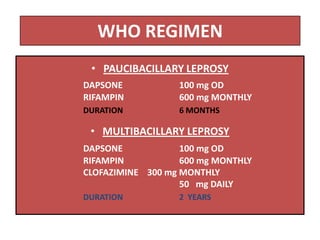
WHO REGIMEN
• PAUCIBACILLARY LEPROSY
DAPSONE
RIFAMPIN

100 mg OD
600 mg MONTHLY

DURATION

6 MONTHS

• MULTIBACILLARY LEPROSY
DAPSONE
100 mg OD
RIFAMPIN
600 mg MONTHLY
CLOFAZIMINE 300 mg MONTHLY
50 mg DAILY
DURATION

2 YEARS

10. antileprotic

  • 1.
  • 2.
    EPIDEMIOLOGY OF LEPROSY •Leprosy is a chronic granulomatous infection • Agent – Mycobacterium Leprae -1873-Armauer • Large number of person may be infected but only few suffer chemically • Source of Infection – Nasal secretion – Discharged from superficial ulcers
  • 3.
    Clinical Manifestation Cardinal features… – – – – Hypopigmented patches (T) Loss of coetaneous sensation in affected areas. Thickened nerves M. Leprae in skin or nasal passage. Signs of advanced disease… – – – – – – Nodules / lumps in skin of face & ears. Planter ulcers Loss of fingers / toes Nasal depression Foot drop Claw hand and toes.
  • 4.
    BACTERIOLOGICAL CLASSIFICATION PAUCIBACILLARY MULTIBACILLARY • NONINFECTIOUS • INFECTIOUS • TUBERCULOID • LEPROMATOUS • Incubation period 2-5yr • Incubation period 8-12y • < 5 LESIONS • NORMAL CMI/ partially deficient • +ve LEPROMIN • FEW BACILLI • > 5 LESIONS • DEFICIENT CMI • -ve LEPROMIN • NUMEROUS BACILLI
  • 5.
    Classification of Leprosy –Indeterminate Type/Borderline Type – Which ultimately progresses to either tuberculoid or lepromatous
  • 6.
    ANTILEPROTIC DRUGS – SULFONE : DAPSONE,SULFOXONE, ACEDAPSONE – PHENAZINE : CLOFAZIMINE – ANTITUBERCULAR : RIFAMPIN – ANTIBIOTICS : FQ: OFLOXACIN Tetra: MINOCYCLIN Macrolids: CLARITHROMYCIN
  • 7.
    DAPSONE – Diamino DiphenylSulfone (DDS) -1940 – Oldest, cheapest, most active, most commonly used MOA : Inhibition of PABA Inhibit Bacterial Folic Acid Synthesis Leprostatic RESISTANCE : 1964 – – – – More in lepromatous leprosy patients if used monotherapy Primary- harbouring from resistant bacilli Secondary- during treatment Combined with Rifampicin
  • 8.
    Pharmacokinetics of DAPSONE –p. o. absorbed – Distributed to all body compartment – Retains in skin & organs upto 3 wks. – Metabolised by – acetylation – glucuronid conjugation – half life > 24 hrs. – Dose is cumulative – excretion through kidney (1-2 wks)
  • 9.
    ADVERSE EFFECTS OFDAPSONE – HAEMOLYTIC ANAEMIA – METHAEMOGLOBINEMIA – GASTRIC INTOLERANCE –decrease later – CUTANEOUS REACTIONS – – – – ALLERGIC RASHES FIXED DRUG ERUPTION HYPERMELANOSIS PHOTOTOXICITY – LEPRA REACTIONS – SULFONE SYNDROME
  • 10.
    ADVERSE EFFECTS OFDAPSONE Type 2 Type 1 • Delayed hypersensitivity • Erythema nodosum leprosum • IV • Humoral antibody response • Reversal reaction • Reactions to M. Leprae antigens • Characterized by cutanoeus ulceration, multiple nerve involvement • Prevented by corticosteroids • III • Response to dead bacteria • Characterized lesions enlarge, become red, inflamed, painful • Treated by clofazamine/corticosteriods
  • 11.
    SULFONE SYNDROME • Iflepra reactions develops after 1-2months c/s sulfone syndrome • Characterized by – – – – – Fever Lymphnode enlargement general malaise Jaundice anaemia
  • 12.
    INDICATIONS OF DAPSONE –WELL TOLERATED – CHEAP – TABLET : 100 mg OD – I.M. DEPOT : Acedapsone – BOTH TYPE OF LEPROSY – CI in Hb% below 7g – OTHER – – PNEUMOCYSTIS CARINII PNEUMONIA(100mg) – DERMATITIS HERPETIFORMIS (first 50mg, slow 300mg)
  • 13.
    CLOFAZIMINE • MOA : –BINDS TO DNA   INTERFERES TEMPLATE FUNCTION of DNA  INHIBITS GROWTH – LEPROSTATIC – ANTI-INFLAMMATORY
  • 14.
    KINETICS OF CLOFAZIMINE –P. O. INCOMPLETE ABSORPTION – WIDELY DISTRIBUTED IN TISSUES : PHAGOCYTES – HALF LIFE : 60 – 70 hrs. – Elimination through FAECES
  • 15.
    ADVERSE EFFECTS OFCLOFAZIMINE – REDDISH-BROWN DISCOLORATION • SKIN ; HAIR ; SECRETIONS – CONJUNCTIVAL PIGMENTATION – ACNEFORM ERRUPTIONS – PHOTOTOXICITY – GASTRIC INTOLERANCE • ABDOMINAL PAIN • LOOSE STOOL PRECAUTION : PREGNANCY/Liver/Kidney damage
  • 16.
    INDICATIONS OF CLOFAZIMINE –DAPSONE RESISTANT LEPROSY – PREFERED IN MDT OF LEPROSY – LEPRA REACTION – ULCERATIVE LESIONS : M. ulcerans
  • 17.
    RIFAMPIN – INHIBIT DNADEPENDENT RNA SYNTHESIS – BACTERIOCIDAL – KILLS 99.9 % M. leprae : NONCONTAGIOUS – RESISTANCE : MONOTHERAPY – USE IN MDT : DURATION OF T/t – DOSE 600 mg MONTHLY
  • 18.
    OFLOXACIN – KILLS 99.9% BACILLI : 22 Day MONOTHERAPY – HASTEN BACTERIOLOGICAL & CLINICAL RESPONSE – SHORTEN DURATION OF THERAPY – ALTERNATIVE DRUG – RIFAMPIN INTOLERANCE / RESISTANCE – DOSE : 400 mg/day
  • 19.
    CLARITHROMYCIN – MACROLIDE ANTIBIOTIC –BACTERICIDAL < RIFAMPIN – KILLS 99.9 % BACILLI IN 8 wks – DOSE : 500 mg/day – ALTERNATIVE DRUG
  • 20.
    MINOCYCLINE – TETRACYCLIN – RIFAMPIN> MINOCYCLINE > CLARITHROMYCIN – ALTERNATIVE TO CLOFAZIMINE – DOSE : 100 mg/day
  • 21.
    WHO REGIMEN • PAUCIBACILLARYLEPROSY DAPSONE RIFAMPIN 100 mg OD 600 mg MONTHLY DURATION 6 MONTHS • MULTIBACILLARY LEPROSY DAPSONE 100 mg OD RIFAMPIN 600 mg MONTHLY CLOFAZIMINE 300 mg MONTHLY 50 mg DAILY DURATION 2 YEARS

Editor's Notes

  • #3 It does not growth in culture media so sensitivity test not possible It present in macrophages and remain dormant but alive
  • #4 Clow hand – hyperextension of proximal phalanges, clow toes – dorsal flexion of 1st phalanx and planttar extension of 2nd &amp; 3rd
  • #5 Lepromein test used to determine tissue resistance to leprosy
  • #10 Haemolyticanaemia, methaemoglobinemia- in person having G6PD defiency
  • #11 Haemolyticanaemia, methaemoglobinemia- in person having G6PD defiency
  • #13 Dermatitis - chronic blistering skin- (bubbles on skin filled with watery fluid caused by heat -