Antimalarial Drugs
Dr Naser Ashraf Tadvi
Plasmodium species which
infect humans
• Plasmodium vivax (tertian):
• Plasmodium ovale (tertian)
• Plasmodium falciparum (tertian)
• Plasmodium malariae (quartan)
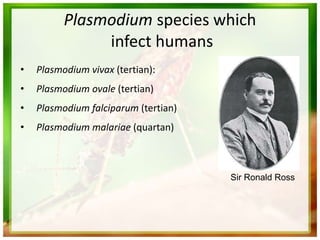
Sir Ronald Ross
Symptoms of malaria
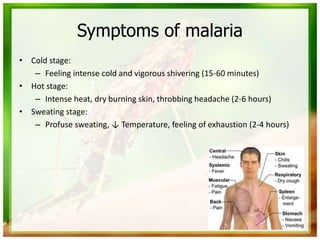
• Cold stage:
– Feeling intense cold and vigorous shivering (15-60 minutes)
• Hot stage:
– Intense heat, dry burning skin, throbbing headache (2-6 hours)
• Sweating stage:
– Profuse sweating, ↓ Temperature, feeling of exhaustion (2-4 hours)
Life cycle of the malarial parasite
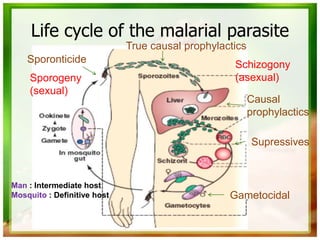
Sporogeny
(sexual)
Schizogony
(asexual)
Man : Intermediate host
Mosquito : Definitive host
True causal prophylactics
Causal
prophylactics
Supressives
Gametocidal
Sporonticide
Objectives of antimalarial treatment
• Prevent clinical attack of malaria (Prophylaxis)
• Treat clinical attack of malaria (Clinical curative)
• To completely eradicate parasite from patient body
(Radical Curative)
• Cut down human –mosquito transmission
(Gametocidal)
Classification of antimalarials
• Therapeutic classification
• Chemical classification
Therapeutic classification
• Causal prophylaxis: (Tissue schizonticides)
– Destroy parasite in liver cells and prevent invasion of
erythrocytes
– Primaquine, proguanil
• Supressives Prophylaxis:
– Destroy merozoites released from liver
– Supress the erythrocytic phase and thus attack of malarial
fever can be used as prophylactics
– Chloroquine, proguanil, mefloquine, doxycycline
Therapeutic classification
• Clinical cure: erythrocytic schizonticides
– used to terminate an episode of malarial fever
• Fast acting high efficacy
– Chloroquine, quinine, mefloquine, atovaquone,
artemisinin
• Slow acting low efficacy drugs
– Proguanil, pyrimethamine, sulfonamides,
tetracyclines
Therapeutic classification
• Radical curatives:
– Eradicate all forms of P.vivax & P.ovale from the body
– Supressive drugs + hypnozoitocidal drugs
– For vivax: primaquine 15 mg daily for 14 days
• Gametocidal:
– Destroy gametocytes and prevent transmission
– Primaquine, artemisinin – against all plasmodia
– Chloroquine, quinine – Pl Vivax
– Proguanil , pyrimethamine – prevent development of
sporozoites
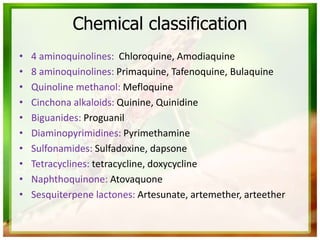
Chemical classification
• 4 aminoquinolines: Chloroquine, Amodiaquine
• 8 aminoquinolines: Primaquine, Tafenoquine, Bulaquine
• Quinoline methanol: Mefloquine
• Cinchona alkaloids: Quinine, Quinidine
• Biguanides: Proguanil
• Diaminopyrimidines: Pyrimethamine
• Sulfonamides: Sulfadoxine, dapsone
• Tetracyclines: tetracycline, doxycycline
• Naphthoquinone: Atovaquone
• Sesquiterpene lactones: Artesunate, artemether, arteether
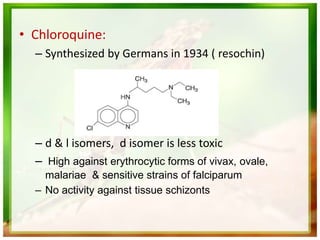
• Chloroquine:
– Synthesized by Germans in 1934 ( resochin)
– d & l isomers, d isomer is less toxic
– High against erythrocytic forms of vivax, ovale,
malariae & sensitive strains of falciparum
– No activity against tissue schizonts
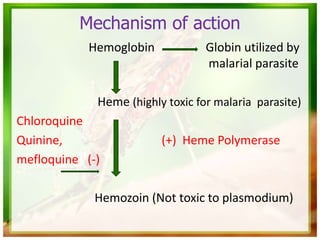
Hemoglobin Globin utilized by
malarial parasite
Heme (highly toxic for malaria parasite)
Chloroquine
Quinine, (+) Heme Polymerase
mefloquine (-)
Hemozoin (Not toxic to plasmodium)
Mechanism of action
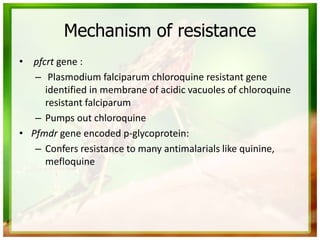
Mechanism of resistance
• pfcrt gene :
– Plasmodium falciparum chloroquine resistant gene
identified in membrane of acidic vacuoles of chloroquine
resistant falciparum
– Pumps out chloroquine
• Pfmdr gene encoded p-glycoprotein:
– Confers resistance to many antimalarials like quinine,
mefloquine
Other actions
1. Other parasitic infections:
– Giardiasis, taeniasis, extrainstestinal amoebiasis
2. Other actions:
– Cardiac depressant,
– Direct relaxant effect on vascular smooth muscle
– antiinflammatory, antihistaminic, local anaesthetic
Pharmacokinetics
• Well absorbed, tmax 2-3 hrs , 50 % protein bound
• Concentrated in liver , spleen, kidney, lungs , leucocytes
• Selective accumulation in retina: occular toxicity
• T1/2 = 3-10 days increases from few days to weeks
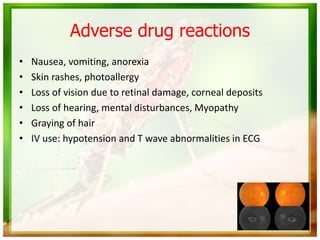
Adverse drug reactions
• Nausea, vomiting, anorexia
• Skin rashes, photoallergy
• Loss of vision due to retinal damage, corneal deposits
• Loss of hearing, mental disturbances, Myopathy
• Graying of hair
• IV use: hypotension and T wave abnormalities in ECG
Dosage
• 600 mg of base stat
• 300 mg base after 8 hours
• 150 mg of base BD for 2 days
• 200 mg oral tablet of chloroquine phosphate consists of 150 mg base
Chloroquine is administered in loading
dose in malaria
• Chloroquine is well absorbed after oral
administration. It is extensively tissue bound
and sequestrated by tissues particularly liver,
spleen, kidney it has got large apparent
volume of distribution
• So it is given in loading dose to rapidly achieve
the effective plasma conc.
Therapeutic uses
1. Malaria
2. Giardiasis
3. Rheumatoid arthritis
4. Extraintestinal Amoebiasis
5. Discoid Lupus Erythematosus
6. Control manifestation of lepra reaction
7. Infectious mononucleosis
8. Photogenic reactions
9. Clonorchis sinensis
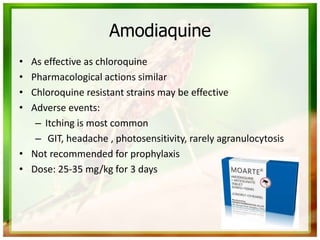
Amodiaquine
• As effective as chloroquine
• Pharmacological actions similar
• Chloroquine resistant strains may be effective
• Adverse events:
– Itching is most common
– GIT, headache , photosensitivity, rarely agranulocytosis
• Not recommended for prophylaxis
• Dose: 25-35 mg/kg for 3 days
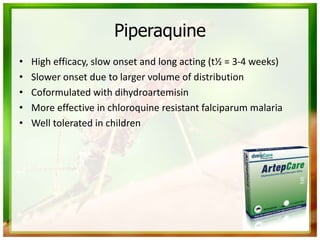
Piperaquine
• High efficacy, slow onset and long acting (t½ = 3-4 weeks)
• Slower onset due to larger volume of distribution
• Coformulated with dihydroartemisin
• More effective in chloroquine resistant falciparum malaria
• Well tolerated in children
Mefloquine
• Quinoline methanol derivative
• Rapidly acting erythrocytic schizonticide , slower than
chloroquine & quinine
• Effective against chloroquine sensitive & resistant plasmodia
• Mechanism of action similar to chloroquine
Pharmacokinetics
• Good but slow oral absorption
• High protein binding
• Concentrated in liver, lung, intestine
• Extensive metabolism in liver, primarily secreted in bile , undergoes
enterohepatic circulation
• Long t1/2 = 2 – 3 weeks
Adverse events
• GIT: bitter taste, nausea, vomiting, abdominal pain , diarrhoea
• Neuropsychiatric disturbances:
– anxiety, hallucinations, sleep disturbances, psychosis, errors
in operating machinery, convulsions
• CVS: Bradycardia, sinus arhythmia, & QT prolongation
• Teratogenicity: Avoided in first trimester
• Miscellaneous: allergic skin reactions, hepatitis
Uses
• Effective drug for MDR falciparum
1. T/t of uncomplicated falciparum in MDR malaria
should be used along with artesunate (ACT)
2. Prophylaxis in MDR areas 250 mg per week
started 2- 3 weeks before to assess side effects
• Due to fear of development of drug resistance
mefloquine should not be used as drug for
prophylaxis in residents of endemic area
Quinine
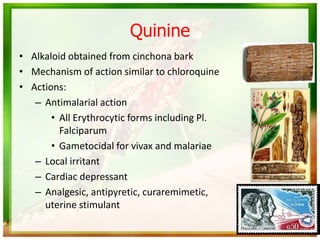
• Alkaloid obtained from cinchona bark
• Mechanism of action similar to chloroquine
• Actions:
– Antimalarial action
• All Erythrocytic forms including Pl.
Falciparum
• Gametocidal for vivax and malariae
– Local irritant
– Cardiac depressant
– Analgesic, antipyretic, curaremimetic,
uterine stimulant
Quinine
• Uses
– Malaria: resistant falciparum malaria, Cerebral malarial
– Myotonia congenita: 300 to 600 mg BD/ TDS
– Nocturnal muscle cramps: 200 – 300 mg before sleeping
– Spermicidal in vaginal creams
– Varicose veins: along with urethane
• Adverse effects
– Cinchonism
– Cardiotoxicity
– Black water fever
– Hypoglycemia
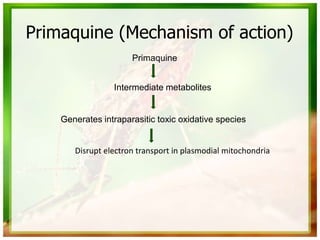
Primaquine
Intermediate metabolites
Generates intraparasitic toxic oxidative species
Disrupt electron transport in plasmodial mitochondria
Primaquine (Mechanism of action)
Antimalarial action
• Liver hypnozoites
• Weak action against erythrocytic stage of vivax, so
used with supressives in radical cure
• No action against erythrocytic stage of falciparum
• Has gametocidal action and is most effective
antimalarial to prevent transmission disease against
all 4 species
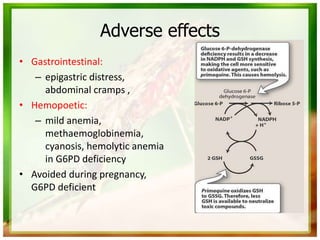
Adverse effects
• Gastrointestinal:
– epigastric distress,
abdominal cramps ,
• Hemopoetic:
– mild anemia,
methaemoglobinemia,
cyanosis, hemolytic anemia
in G6PD deficiency
• Avoided during pregnancy,
G6PD deficient
Uses
• Primary use is radical cure of relapsing malaria 15 mg
daily for 14 days with dose of chloroquine
• Falciparum malaria 45 mg of single dose with
chloroquine curative dose to kill gametes & cut down
transmission of malaria.
• Tafenoquine:
– More active slowly metabolized analog of primaquine, has
advantage that it can be given on weekly basis.
• Bulaquine:
– Congener of primaquine developed in india
– Comparable antirelapse activity when used for 5 days
– Partly metabolized to primaquine
– Better tolerated in G6PD deficiency
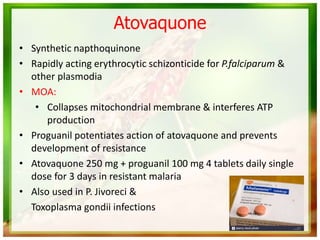
Atovaquone
• Synthetic napthoquinone
• Rapidly acting erythrocytic schizonticide for P.falciparum &
other plasmodia
• MOA:
• Collapses mitochondrial membrane & interferes ATP
production
• Proguanil potentiates action of atovaquone and prevents
development of resistance
• Atovaquone 250 mg + proguanil 100 mg 4 tablets daily single
dose for 3 days in resistant malaria
• Also used in P. Jivoreci &
Toxoplasma gondii infections
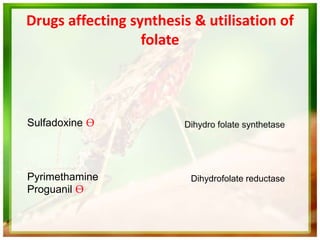
Drugs affecting synthesis & utilisation of
folate
Dihydrofolate reductase
Sulfadoxine Ѳ
Pyrimethamine
Proguanil Ѳ
Pyrimethamine
• Diaminopyrimidine more potent than proguanil & effective
against erythrocytic forms of all species.
• Tasteless so suitable for children
 Adverse events:
 megaloblastic anemia, thrombocytopenia, agranulocytosis.
• Generally combined with sulfadoxine 500 mg + pyrimethamine
25 mg, 3 tablets once for acute attack
• Not recommended for prophylaxis due to severe cutaneous
reactions like exfoliative dermatitis & stevenson johnson
syndrome.
Proguanil
• Biguanide converted to active compound cycloguanil
• Act slowly on erythrocytic stage of vivax & falciparum
• Sporonticidal & also prevents development of
gametes
 Adverse effects:
 Stomatitis, mouth ulcers, larger doses depression
of myocardium , megaloblastic anemia
 Not a drug for acute attack
 Causal prophylaxis: 100 – 200 mg daily
Halofantrine
• Quinoline methanol
• Used in chloroquine resistant malaria since 1980
• Erratic bioavailabilty, lethal cardiotoxicity &
cross resistance to mefloquine limited its use
• Now a days used only when no other alternative
available
• Adverse events; Nausea, vomiting, QT
prolongation , diarrhoea, itching , rashes
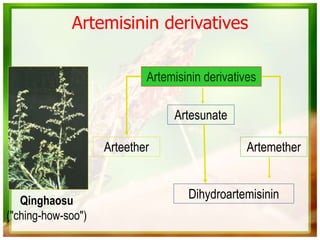
Artemisinin derivatives
Arteether Artemether
Artesunate
Qinghaosu
("ching-how-soo")
Artemisinin derivatives
Dihydroartemisinin
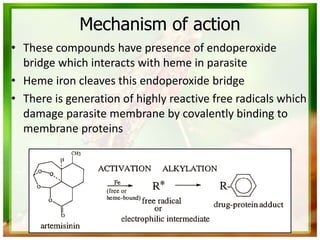
Mechanism of action
• These compounds have presence of endoperoxide
bridge which interacts with heme in parasite
• Heme iron cleaves this endoperoxide bridge
• There is generation of highly reactive free radicals which
damage parasite membrane by covalently binding to
membrane proteins
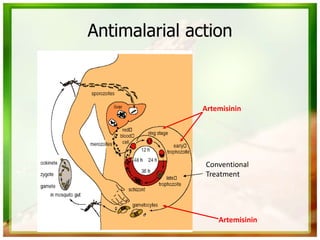
Antimalarial action
Artemisinin
Artemisinin
Conventional
Treatment
Artesunate
• Water soluble ester of dihydroartemisinin
• Dose: can be given oral, IM,IV
– Oral : 100 mg BD
– Parenteral : 2.4 mg/kg BD
• Advantages
• Rapid substantial reduction of the parasite biomass & symptoms
• Effective action against multi-drug resistant P. falciparum
• Reduction of gametocyte carriage
• No documented/ minimal parasite resistance yet
• Few reported adverse effects.
Artemisinin derivatives
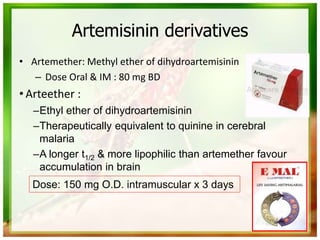
• Artemether: Methyl ether of dihydroartemisinin
– Dose Oral & IM : 80 mg BD
• Arteether :
–Ethyl ether of dihydroartemisinin
–Therapeutically equivalent to quinine in cerebral
malaria
–A longer t1/2 & more lipophilic than artemether favour
accumulation in brain
Dose: 150 mg O.D. intramuscular x 3 days
Adverse events
• GIT: nausea, vomiting, abdominal pain (common)
• Leucopenia
• Hypersensitivity: Drug fever, itching
• ECG changes: ST-T changes, QT prolongation
• Abnormal bleeding, dark urine
• Reticulocytopenia
Artemisinin based combination therapy
(ACT)
• Artemisinin compounds are shorter acting drugs
• Monotherapy needs to be extended beyond
disappearance of parasite to prevent recrudescence
• This can be prevented by combining 3-5 day regimen of
artemisin compounds with one long acting drug like
mefloquine 15 mg/kg single dose
• Indicated by WHO in acute uncomplicated resistant
falciparum malaria
Why combination therapy
• Rapid clinical & parasitological cure
• High cure rates and low relapse rates
• Absence of resistance
• Good tolerability profile
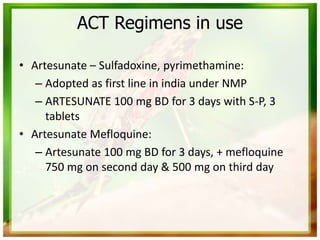
ACT Regimens in use
• Artesunate – Sulfadoxine, pyrimethamine:
– Adopted as first line in india under NMP
– ARTESUNATE 100 mg BD for 3 days with S-P, 3
tablets
• Artesunate Mefloquine:
– Artesunate 100 mg BD for 3 days, + mefloquine
750 mg on second day & 500 mg on third day
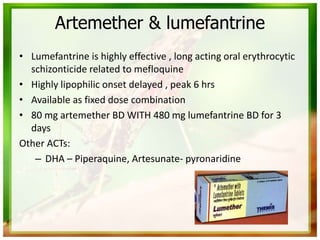
Artemether & lumefantrine
• Lumefantrine is highly effective , long acting oral erythrocytic
schizonticide related to mefloquine
• Highly lipophilic onset delayed , peak 6 hrs
• Available as fixed dose combination
• 80 mg artemether BD WITH 480 mg lumefantrine BD for 3
days
Other ACTs:
– DHA – Piperaquine, Artesunate- pyronaridine
Other ACT regimens for uncomplicated
Falciparum malaria
• Artesunate 100 mg BD + Amodiaquine 300 mg BD X 3 DAYS
• Dihydroartemisinin 120 mg + Piperaquine 960 mg X 3 days
• Arterolone 150 mg + piperaquine 750 mg daily X 3 days
Management of Malaria
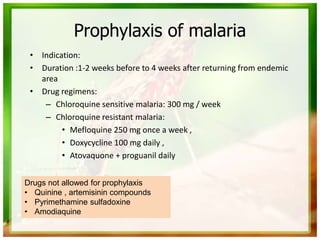
Prophylaxis of malaria
• Indication:
• Duration :1-2 weeks before to 4 weeks after returning from endemic
area
• Drug regimens:
– Chloroquine sensitive malaria: 300 mg / week
– Chloroquine resistant malaria:
• Mefloquine 250 mg once a week ,
• Doxycycline 100 mg daily ,
• Atovaquone + proguanil daily
Drugs not allowed for prophylaxis
• Quinine , artemisinin compounds
• Pyrimethamine sulfadoxine
• Amodiaquine
• Tab. Chloroquine phosphate 250 mg
– Contains 150 mg of base
– Give 4 tablets stat , 2 tablets after 8 hours and , 1 tablet BD for 2 days
• Patients who cannot take orally
– 3.5 mg/kg IM every 6 hrs for 3 days
• Tab primaquine 15 mg OD for 14 days in Plasmodium vivax, ovale
• Primaqine 45 mg single dose for falciparum after chloroquine
(gametocidal)
Acute attack of chloroquine sensitive
malaria:
Treatment of uncomplicated falciparum
malaria
A. Pts who can take orally:
– Artesunate 100 mg BD x 3 days with Sulfadoxine 1500 mg +
pyrimethamine 75 mg (Single dose)
– Any other ACT
When should resistance be suspected
– All patients with complication
– Any patient who has already received chloroquine last 1 month
– Hb continues to fall in absence of bleeding & asexual forms persist
along with symptoms after 48 hrs of treatment
Severe and complicated falciparum
malaria
• Hyperparasitaemia
• Hyperpyrexia
• Fluid electrolyte disturbances, acidosis
• Hypoglycemia
• Cardiovascular collapse
• Jaundice, severe anaemia
• Spontaneous bleeding
• Pulmonary edema
• Renal failure
• Hemoglobinuria, black water fever
• Cerebral malaria
Treatment of severe and complicated
falciparum malaria
• Inj Artesunate 2.4 mg/kg IV/Im followed by 2.4 mg/kg after 12 and 24
hours and then once daily for 7 days OR
• Artemether 3.2 mg/kg IM on day 1 then 1.6 mg/kg daily for 7 days OR
• Arteether 150 mg IM daily for 3 days
– Switchover to 3 Day oral ACT in between whenever patient can take
oral medication
– Or
– Inj quinine diHCL 20 mg/ kg diluted in 10 ml/kg 5 % dextrose or DNS
intravenously over 4 hours followed by 10 mg/kg maintenance dose
every 8 hours till patient can swallow
• Malaria in children:
– Quinine parenteral high toxicity / oral well tolerated
– Primaquine avoided in neonates
– Mefloquine not used in children below 15 kg weight
• Acute malaria in pregnant women
– Chloroqune in usual doses
– Mefloquine C/I in first trimester
– Primaquine/ tetracycline avoided
– Anemia: folic acid & iron
Practice points
• Most antimalarials are bitter in taste give along with milk or fruit juice
• If vomiting occurs within hour of drug repeat full dose, in case of
mefloquine repeat half dose
• If vomiting after 1 hour no need to repeat
• Postural hypotension : quinine, chloroquine