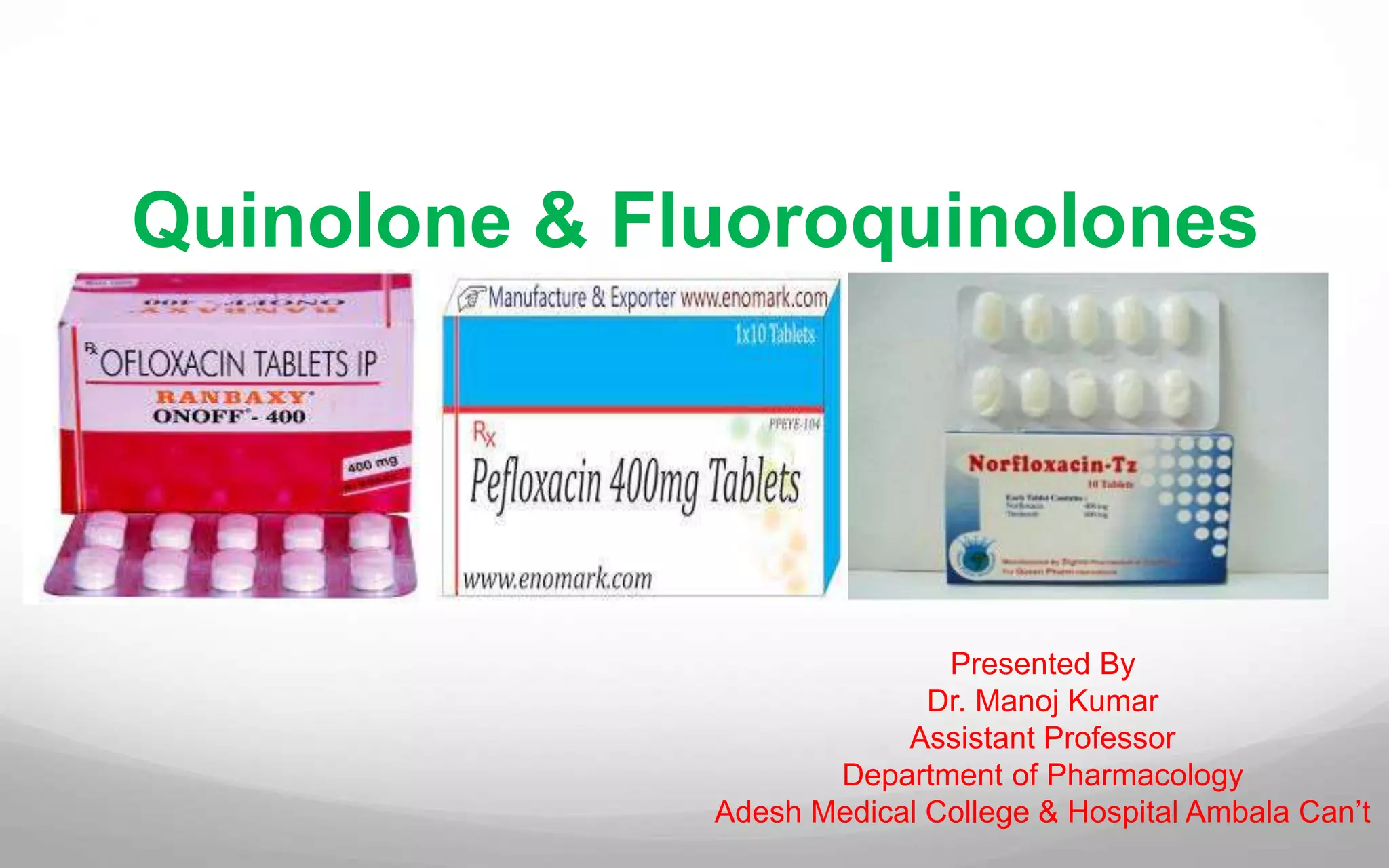
Quinolone & Fluoroquinolones
Presented By
Dr. Manoj Kumar
Assistant Professor
Department of Pharmacology
Adesh Medical College & Hospital Ambala Can’t
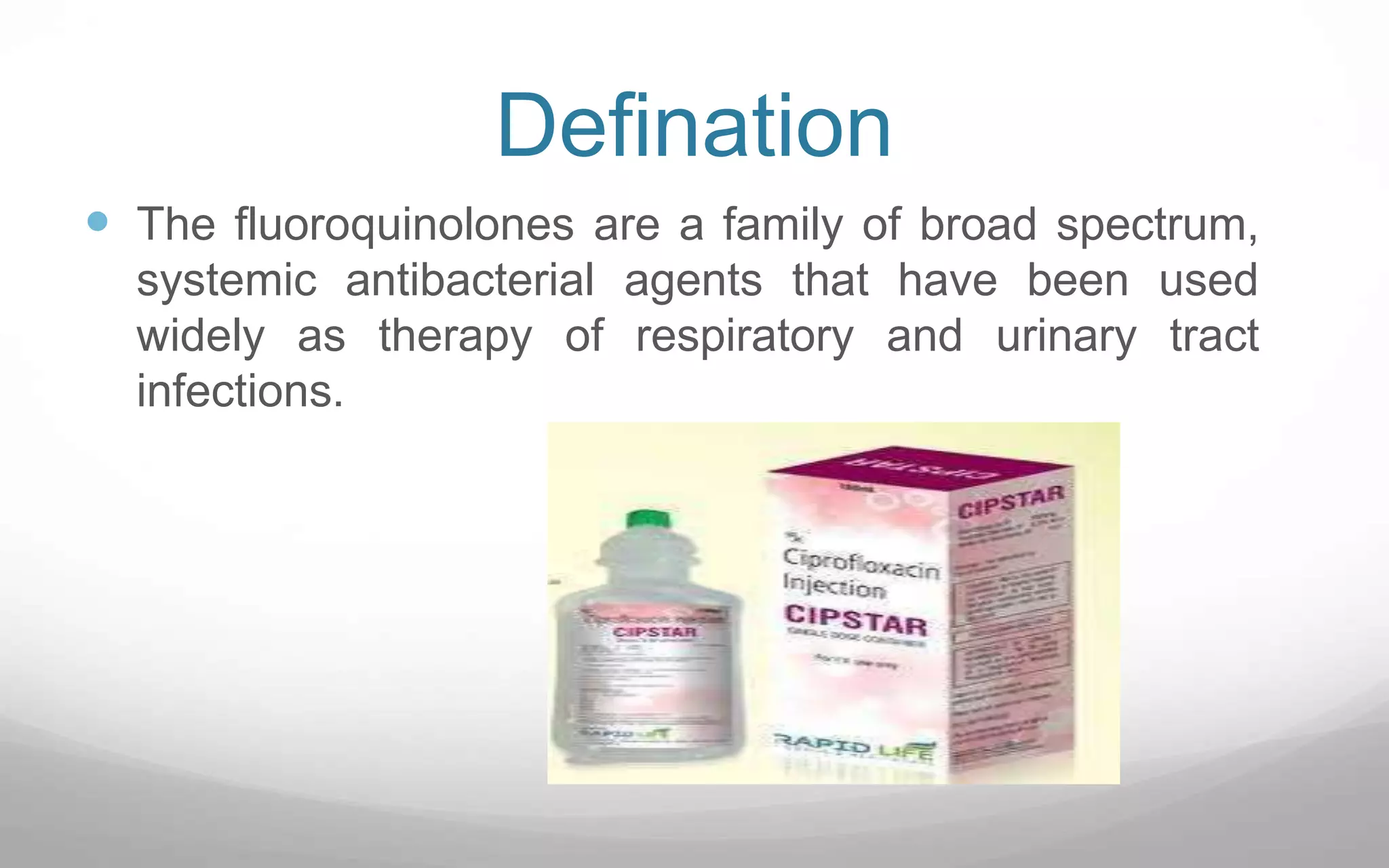
 The fluoroquinolones are a family of broad spectrum,
systemic antibacterial agents that have been used
widely as therapy of respiratory and urinary tract
infections.
Defination
Quinolone
NALIDIXICACID
• Available for the managementofUTI.
• Limited therapeutic ability.
•A/E–GI upset, rashes,neurological toxicity, hemolysis.
• Bacterialresistance.
4
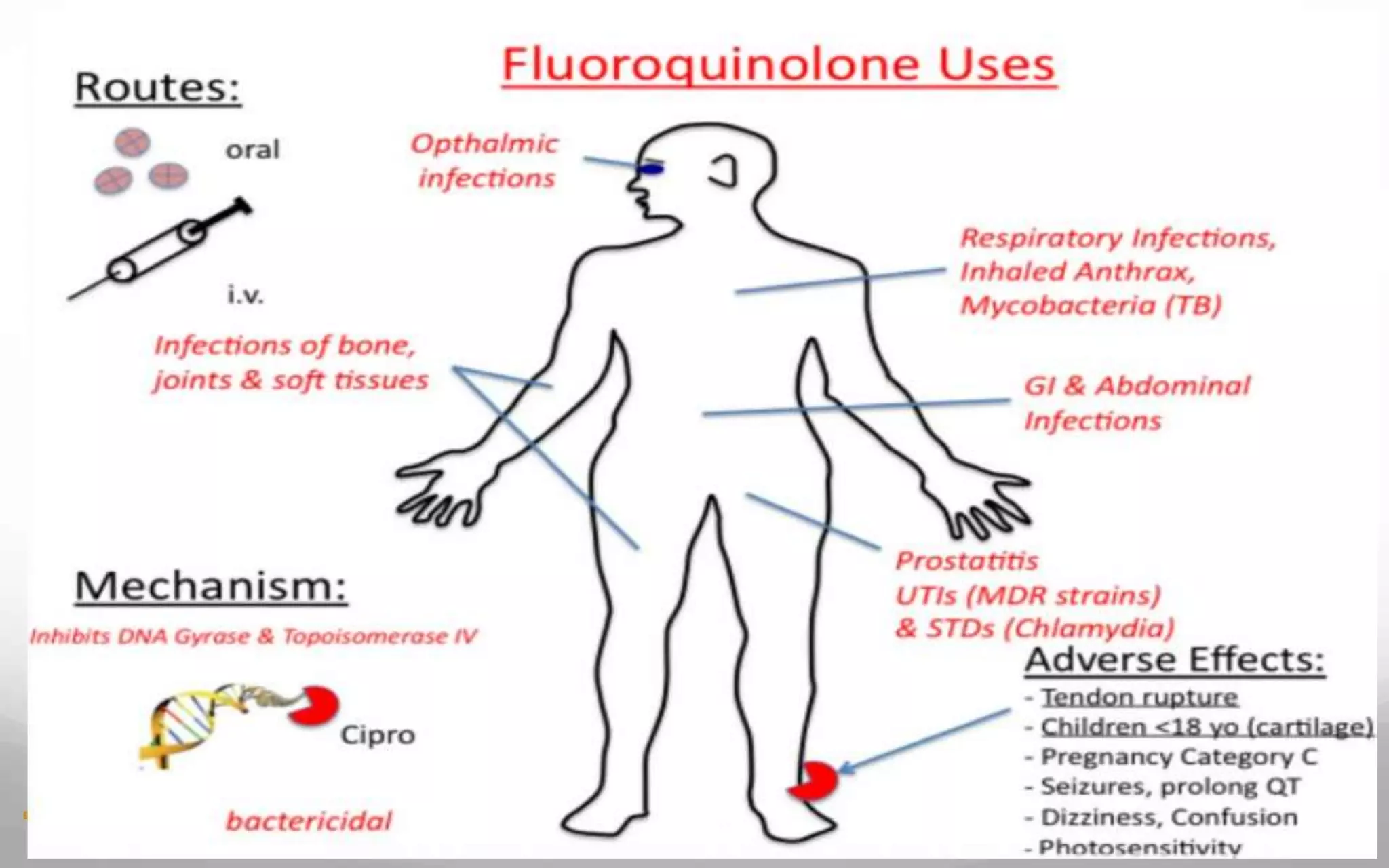
 Fluroquinolones are bactericidal agents.
 They block bacterial DNA synthesis by
inhibiting bacterial DNA gyrase and
topoisomerase IV.
 Inhibition of DNA gyrase prevents the
relaxation of positively supercoiled
 DNA is required for normal transcription and
replication
 Inhibition of topoisomerase IV interferes
with separation of replicated chromosomal
DNA into the respective daughter cells
during cell division.
Mechanism of Action
Mechanism of Resistance
 Well absorbed orally, except norfloxacin.
 Bioavailability highest in gatifloxacin (>98%).
 Attend higher concentrations in urine, kidney, bone, genital tract,
prostate, lung & bronchial mucosa.
 CSF penetration low except in pefloxacin.
 Elimination renal.
 Food delays absorption of ciprofloxacin, norfloxacin, pefloxacin &
lomefloxacin.
 Have prolonged post antibiotic effect (6 hours).
Pharmacokinetics
 GIT :Nausea, abdominal discomfort, vomiting, diarrhoea.
 CNS :Headache, dizziness, agitation, alteration of mood, sleep
disturbances, seizures, hallucinations, delirium.
 Hypersensitivity : Allergic reactions, rash, purities, rarely fever,
urticaria, angioedema.
 Lomefloxacin, sparfloxacin and moxifloxacin cause phototoxicity.
 Sparfloxacin, moxifloxacin and gatifloxacin prolong QT interval on
ECG.
 Crystalluria, Arthralgias and cartilage erosions with joint swellings.
Adverse effects
 Food,Antacids & Iron: Decreaseabsorption
 Theophylline, caffeine, warfarin: increased serum
concentration.
 EnzymeInhibition.
 NSAIDsmayincreaseCNStoxicity. (Seizures)
Drug interactions
 UTI
 TB
 Typhoid
 Diarrhoea
 Gonorrhoea
 Chancroid
 Respiratory tract infections.
 Eye infection.
 Anthrax.
 Neutropenic patients.
 Gram-negative septicaemias
 Bone, Joint, Soft tissue and
intra-abdominal infections.
Therapeutic Uses
 Most commonly used (FQ).
 Very active against gram negative aerobes and Staphylococci.
 Food delays absorption.
 Bioavailability 60-70 % & t1/2 3-5 hours.
 Excretion in urine and faces.
 Dose: 250 -750 mg 12hourly.
 Gonorrhoea: 500 mg BD.
 Chancroid: 500 mg BD for 3 days.
Ciprofloxacin
 Serum concentrations low outside genitourinary and intestinal tract.
 Food decreases absorption.
 Bioavailability 35-40 % & t1/2 4.5 hours.
 No interaction with theophylline and caffeine.
 Useful in long term prophylaxis in recurrent UTI & travelling
diarrhoea.
 Dose: 400 mg 12 hourly.
 Gonorrhoea: 800 mg OD.
 UTI prophylaxis: 200 mg OD.
Norfloxacin
 More active against some anaerobes, M. tuberculosis, M.
leprae.
 Use in multidrug regimens in leprosy & TB (300-800
mg/day.)
 Food does not interfere with absorption.
 Penetrates CSF & t1/2 5-7.5 hours.
 Bioavailability 95%
 Crosses BBB & excreted unchanged by the kidneys.
 No interaction with theophylline and caffeine.
Ofloxacin
 Highly lipid soluble derivative of norfloxacin.
 Food delays absorption.
 Bioavailability 90% & t1/2 8-13 hours.
 Better tissue penetration
 Higher concentration in CSF.
 Dose to be reduced in hepatic insufficiency.
 Increases levels of theophylline and caffeine.
Pefloxacin
 Oral bioavailability >95% & Food delays absorption.
 Widely distributed & t1/2 6-7.5 hours.
 Excreted unchanged over 24 hours.
 Incidence of phototoxicity highest.
 No interaction with theophylline and caffeine.
 Used in respiratory infection, urinary, skin and soft tissue infection.
 Dose: 400 mg OD.
Levofloxacin
 More active than ciprofloxacin against Staphylococci, Streptococci,
Mycobacteria, Mycoplasma.
 Food does not interfere with absorption.
 Longest t1/2 16-3O hours & Bioavailability 90%
 Phototoxicity seen in 8% patients,
 Increases QT interval on ECG.
 No interaction with theophylline, caffeine and warfarin.
 Banned in many countries including India.
 Dose: 200 mg OD.
Sparfloxacin
 Oral bioavailability >90% & t1/2 6-8 hours.
 Active as ofloxacin.
 CSF penetration good remains in the tissues for a longer
period.
 Used in the treatment of urinary and respiratory tract
infection.
 Dose: 500 mg OD.
Lomefloxacin
 Second generation FQ & Oral bioavailability >85%.
 t1/2 12hours & excretion in urine.
 Improved gram positive activity including penicillin-resistant S.
pneumoniae and anaerobes.
 Less active against enterobacteriacea, Pseudomonas.
 Phototoxicity, CNS adverse effects common & prolongs QT interval on
ECG.
 Not interfere with theophyllin or warfarin.
 Dose: 400 mg OD
Moifloxcin
 Second generation FQ
 Oral bioavailability 95% & t1/2 7-10 hours.
 Increased activity against penicillin resistant S. pneumonia.
 Excreted unchanged by the kidneys
 Can prolong QT interval on ECG.
 Used in respiratory and genitourinary infection.
 Banned in many countries, available in India.
 Dose: 400 mg OD.
Gatifloxacin
 Potent broad spectrum quinolone used topically.
 Good activity against gram positive bacteria and
anaerobes.
 Can be absorbed systemically on topical application.
 Not recommended for simple infections like acne.
 Indicated for bacterial skin infections.
Nadifloxacin
 Children (not absolute)
 Pregnancy
 Lactation
 Epilepsy
 QTc prolongation
Contraindication
THANK YOU
23

Quinolone & Fluoroquinolones

  • 1.
    Quinolone & Fluoroquinolones PresentedBy Dr. Manoj Kumar Assistant Professor Department of Pharmacology Adesh Medical College & Hospital Ambala Can’t
  • 2.
     The fluoroquinolonesare a family of broad spectrum, systemic antibacterial agents that have been used widely as therapy of respiratory and urinary tract infections. Defination
  • 3.
    Quinolone NALIDIXICACID • Available forthe managementofUTI. • Limited therapeutic ability. •A/E–GI upset, rashes,neurological toxicity, hemolysis. • Bacterialresistance.
  • 4.
  • 5.
     Fluroquinolones arebactericidal agents.  They block bacterial DNA synthesis by inhibiting bacterial DNA gyrase and topoisomerase IV.  Inhibition of DNA gyrase prevents the relaxation of positively supercoiled  DNA is required for normal transcription and replication  Inhibition of topoisomerase IV interferes with separation of replicated chromosomal DNA into the respective daughter cells during cell division. Mechanism of Action
  • 6.
  • 7.
     Well absorbedorally, except norfloxacin.  Bioavailability highest in gatifloxacin (>98%).  Attend higher concentrations in urine, kidney, bone, genital tract, prostate, lung & bronchial mucosa.  CSF penetration low except in pefloxacin.  Elimination renal.  Food delays absorption of ciprofloxacin, norfloxacin, pefloxacin & lomefloxacin.  Have prolonged post antibiotic effect (6 hours). Pharmacokinetics
  • 8.
     GIT :Nausea,abdominal discomfort, vomiting, diarrhoea.  CNS :Headache, dizziness, agitation, alteration of mood, sleep disturbances, seizures, hallucinations, delirium.  Hypersensitivity : Allergic reactions, rash, purities, rarely fever, urticaria, angioedema.  Lomefloxacin, sparfloxacin and moxifloxacin cause phototoxicity.  Sparfloxacin, moxifloxacin and gatifloxacin prolong QT interval on ECG.  Crystalluria, Arthralgias and cartilage erosions with joint swellings. Adverse effects
  • 9.
     Food,Antacids &Iron: Decreaseabsorption  Theophylline, caffeine, warfarin: increased serum concentration.  EnzymeInhibition.  NSAIDsmayincreaseCNStoxicity. (Seizures) Drug interactions
  • 10.
     UTI  TB Typhoid  Diarrhoea  Gonorrhoea  Chancroid  Respiratory tract infections.  Eye infection.  Anthrax.  Neutropenic patients.  Gram-negative septicaemias  Bone, Joint, Soft tissue and intra-abdominal infections. Therapeutic Uses
  • 12.
     Most commonlyused (FQ).  Very active against gram negative aerobes and Staphylococci.  Food delays absorption.  Bioavailability 60-70 % & t1/2 3-5 hours.  Excretion in urine and faces.  Dose: 250 -750 mg 12hourly.  Gonorrhoea: 500 mg BD.  Chancroid: 500 mg BD for 3 days. Ciprofloxacin
  • 13.
     Serum concentrationslow outside genitourinary and intestinal tract.  Food decreases absorption.  Bioavailability 35-40 % & t1/2 4.5 hours.  No interaction with theophylline and caffeine.  Useful in long term prophylaxis in recurrent UTI & travelling diarrhoea.  Dose: 400 mg 12 hourly.  Gonorrhoea: 800 mg OD.  UTI prophylaxis: 200 mg OD. Norfloxacin
  • 14.
     More activeagainst some anaerobes, M. tuberculosis, M. leprae.  Use in multidrug regimens in leprosy & TB (300-800 mg/day.)  Food does not interfere with absorption.  Penetrates CSF & t1/2 5-7.5 hours.  Bioavailability 95%  Crosses BBB & excreted unchanged by the kidneys.  No interaction with theophylline and caffeine. Ofloxacin
  • 15.
     Highly lipidsoluble derivative of norfloxacin.  Food delays absorption.  Bioavailability 90% & t1/2 8-13 hours.  Better tissue penetration  Higher concentration in CSF.  Dose to be reduced in hepatic insufficiency.  Increases levels of theophylline and caffeine. Pefloxacin
  • 16.
     Oral bioavailability>95% & Food delays absorption.  Widely distributed & t1/2 6-7.5 hours.  Excreted unchanged over 24 hours.  Incidence of phototoxicity highest.  No interaction with theophylline and caffeine.  Used in respiratory infection, urinary, skin and soft tissue infection.  Dose: 400 mg OD. Levofloxacin
  • 17.
     More activethan ciprofloxacin against Staphylococci, Streptococci, Mycobacteria, Mycoplasma.  Food does not interfere with absorption.  Longest t1/2 16-3O hours & Bioavailability 90%  Phototoxicity seen in 8% patients,  Increases QT interval on ECG.  No interaction with theophylline, caffeine and warfarin.  Banned in many countries including India.  Dose: 200 mg OD. Sparfloxacin
  • 18.
     Oral bioavailability>90% & t1/2 6-8 hours.  Active as ofloxacin.  CSF penetration good remains in the tissues for a longer period.  Used in the treatment of urinary and respiratory tract infection.  Dose: 500 mg OD. Lomefloxacin
  • 19.
     Second generationFQ & Oral bioavailability >85%.  t1/2 12hours & excretion in urine.  Improved gram positive activity including penicillin-resistant S. pneumoniae and anaerobes.  Less active against enterobacteriacea, Pseudomonas.  Phototoxicity, CNS adverse effects common & prolongs QT interval on ECG.  Not interfere with theophyllin or warfarin.  Dose: 400 mg OD Moifloxcin
  • 20.
     Second generationFQ  Oral bioavailability 95% & t1/2 7-10 hours.  Increased activity against penicillin resistant S. pneumonia.  Excreted unchanged by the kidneys  Can prolong QT interval on ECG.  Used in respiratory and genitourinary infection.  Banned in many countries, available in India.  Dose: 400 mg OD. Gatifloxacin
  • 21.
     Potent broadspectrum quinolone used topically.  Good activity against gram positive bacteria and anaerobes.  Can be absorbed systemically on topical application.  Not recommended for simple infections like acne.  Indicated for bacterial skin infections. Nadifloxacin
  • 22.
     Children (notabsolute)  Pregnancy  Lactation  Epilepsy  QTc prolongation Contraindication
  • 23.