TOTAL
QUALITY
MANAGEMENT
By: -
Hakeem–Ur–Rehman
PCBA–UCP
T MQCONTINUAL QUALITY IMPROVEMENT APPROACHES
 TQM, 3rd Edition, By: Besterfield (Chapter # 5 & 16)
 5–S Handouts
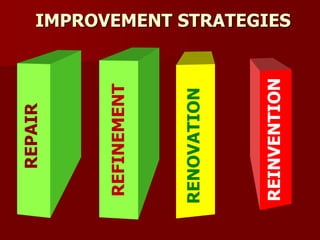
IMPROVEMENT STRATEGIES
REPAIR
REFINEMENT
RENOVATION
REINVENTION
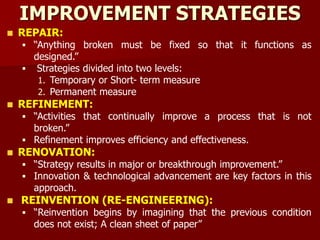
IMPROVEMENT STRATEGIES
REPAIR:
 “Anything broken must be fixed so that it functions as
designed.”
 Strategies divided into two levels:
1. Temporary or Short- term measure
2. Permanent measure
REFINEMENT:
 “Activities that continually improve a process that is not
broken.”
 Refinement improves efficiency and effectiveness.
RENOVATION:
 “Strategy results in major or breakthrough improvement.”
 Innovation & technological advancement are key factors in this
approach.
REINVENTION (RE-ENGINEERING):
 “Reinvention begins by imagining that the previous condition
does not exist; A clean sheet of paper”
PROBLEM SOLVING
METHOD
“Also called the Scientific method”
“ Some People approach every
problem with an open mouth.”
(Adlai Stevenson)
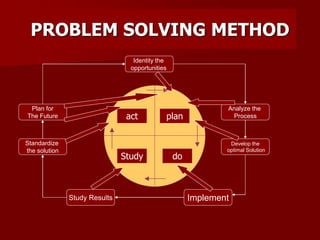
PROBLEM SOLVING METHOD
Identity the
opportunities
Implement
Develop the
optimal Solution
Analyze the
Process
Standardize
the solution
Study Results
Plan for
The Future act
doStudy
plan
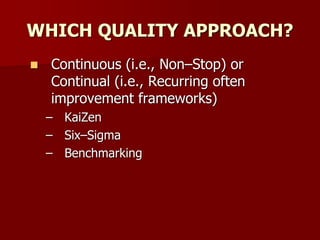
WHICH QUALITY APPROACH?
 Continuous (i.e., Non–Stop) or
Continual (i.e., Recurring often
improvement frameworks)
– KaiZen
– Six–Sigma
– Benchmarking
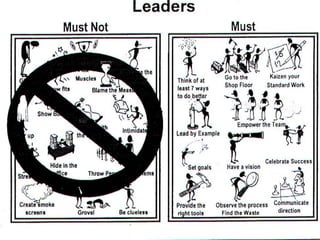
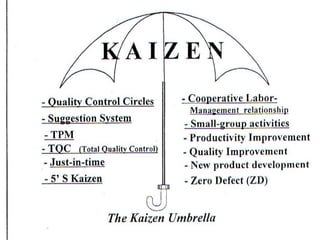
KaiZen
 “Kai”  Change; “Zen”  Better
 Kaizen  Make it Better (Improvement)
 KaiZen is a System of accumulated improvement.
 The main purpose of Kaizen is to evolve total employee participation and
it also helps in building capable work force for an organization
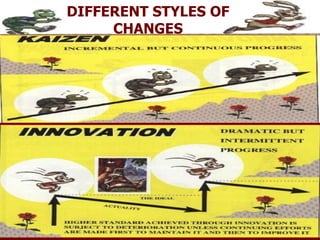
 The results of Kaizen are not very drastic but incremental that’s why
continuous improvement leads to accumulated improvement.
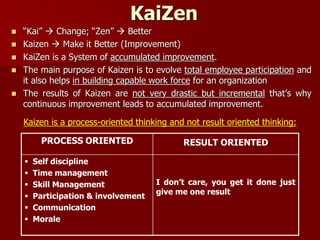
Kaizen is a process-oriented thinking and not result oriented thinking:
PROCESS ORIENTED RESULT ORIENTED
 Self discipline
 Time management
 Skill Management
 Participation & involvement
 Communication
 Morale
I don’t care, you get it done just
give me one result
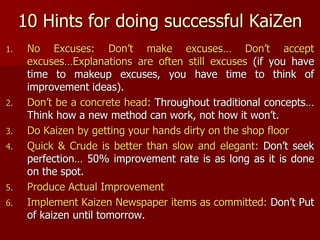
10 Hints for doing successful KaiZen
1. No Excuses: Don’t make excuses… Don’t accept
excuses…Explanations are often still excuses (if you have
time to makeup excuses, you have time to think of
improvement ideas).
2. Don’t be a concrete head: Throughout traditional concepts…
Think how a new method can work, not how it won’t.
3. Do Kaizen by getting your hands dirty on the shop floor
4. Quick & Crude is better than slow and elegant: Don’t seek
perfection… 50% improvement rate is as long as it is done
on the spot.
5. Produce Actual Improvement
6. Implement Kaizen Newspaper items as committed: Don’t Put
of kaizen until tomorrow.
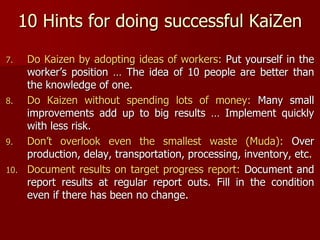
10 Hints for doing successful KaiZen
7. Do Kaizen by adopting ideas of workers: Put yourself in the
worker’s position … The idea of 10 people are better than
the knowledge of one.
8. Do Kaizen without spending lots of money: Many small
improvements add up to big results … Implement quickly
with less risk.
9. Don’t overlook even the smallest waste (Muda): Over
production, delay, transportation, processing, inventory, etc.
10. Document results on target progress report: Document and
report results at regular report outs. Fill in the condition
even if there has been no change.
DIFFERENT STYLES OF
CHANGES
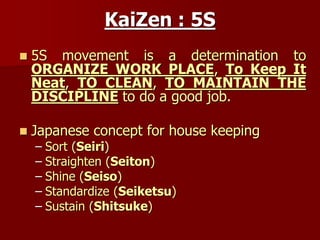
KaiZen : 5S
 5S movement is a determination to
ORGANIZE WORK PLACE, To Keep It
Neat, TO CLEAN, TO MAINTAIN THE
DISCIPLINE to do a good job.
 Japanese concept for house keeping
– Sort (Seiri)
– Straighten (Seiton)
– Shine (Seiso)
– Standardize (Seiketsu)
– Sustain (Shitsuke)
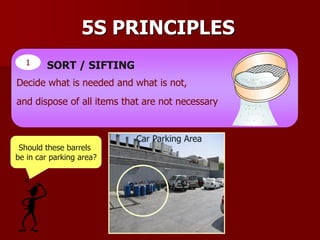
Decide what is needed and what is not,
and dispose of all items that are not necessary
1 SORT / SIFTING
Car Parking Area
Should these barrels
be in car parking area?
5S PRINCIPLES
5 S PRINCIPLES
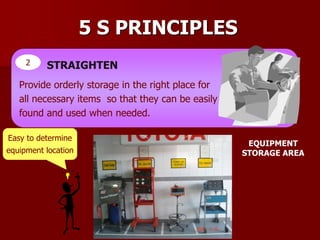
2 STRAIGHTEN
Provide orderly storage in the right place for
all necessary items so that they can be easily
found and used when needed.
EQUIPMENT
STORAGE AREA
Easy to determine
equipment location
5S PRINCIPLES
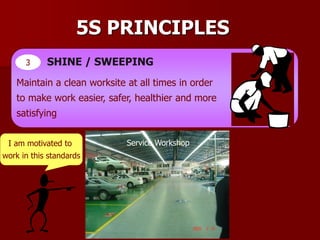
3 SHINE / SWEEPING
Maintain a clean worksite at all times in order
to make work easier, safer, healthier and more
satisfying
I am motivated to
work in this standards
Service Workshop
5 S PRINCIPLES
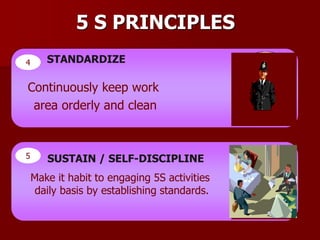
4 STANDARDIZE
Continuously keep work
area orderly and clean
5 SUSTAIN / SELF-DISCIPLINE
Make it habit to engaging 5S activities
daily basis by establishing standards.
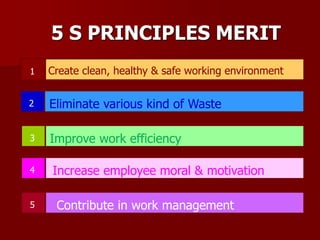
3 Improve work efficiency
4 Increase employee moral & motivation
Eliminate various kind of Waste2
5 Contribute in work management
Create clean, healthy & safe working environment1
5 S PRINCIPLES MERIT
TOTAL PRODUCTIVE MAINTENANCE
 Total Productive Maintenance (TPM) is keeping the current
plant and equipment at its highest productive level through
cooperation of all areas of the organization.
 Generally, the first task is to break down the traditional
barriers between maintenance and production personnel so
they are working together.
 TOTAL: All encompassing by maintenance and production
individuals working together.
 PRODUCTIVE: Production of goods and services that
meet or exceed customers’ expectation.
 MAINTENANCE: Keeping equipment and plant in as good
as or better than the original condition at all times.
TOTAL PRODUCTIVE MAINTENANCE
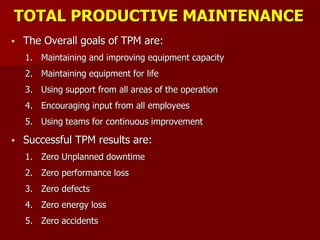
 The Overall goals of TPM are:
1. Maintaining and improving equipment capacity
2. Maintaining equipment for life
3. Using support from all areas of the operation
4. Encouraging input from all employees
5. Using teams for continuous improvement
 Successful TPM results are:
1. Zero Unplanned downtime
2. Zero performance loss
3. Zero defects
4. Zero energy loss
5. Zero accidents
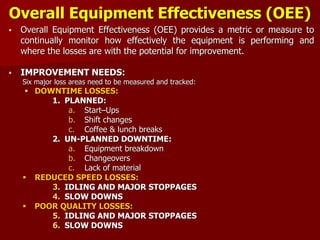
Overall Equipment Effectiveness (OEE)
 Overall Equipment Effectiveness (OEE) provides a metric or measure to
continually monitor how effectively the equipment is performing and
where the losses are with the potential for improvement.
 IMPROVEMENT NEEDS:
Six major loss areas need to be measured and tracked:
 DOWNTIME LOSSES:
1. PLANNED:
a. Start–Ups
b. Shift changes
c. Coffee & lunch breaks
2. UN-PLANNED DOWNTIME:
a. Equipment breakdown
b. Changeovers
c. Lack of material
 REDUCED SPEED LOSSES:
3. IDLING AND MAJOR STOPPAGES
4. SLOW DOWNS
 POOR QUALITY LOSSES:
5. IDLING AND MAJOR STOPPAGES
6. SLOW DOWNS
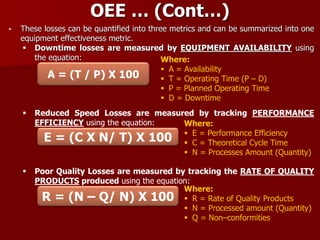
OEE … (Cont…)
 These losses can be quantified into three metrics and can be summarized into one
equipment effectiveness metric.
 Downtime losses are measured by EQUIPMENT AVAILABILITY using
the equation:
A = (T / P) X 100
Where:
 A = Availability
 T = Operating Time (P – D)
 P = Planned Operating Time
 D = Downtime
 Reduced Speed Losses are measured by tracking PERFORMANCE
EFFICIENCY using the equation:
E = (C X N/ T) X 100
Where:
 E = Performance Efficiency
 C = Theoretical Cycle Time
 N = Processes Amount (Quantity)
 Poor Quality Losses are measured by tracking the RATE OF QUALITY
PRODUCTS produced using the equation:
R = (N – Q/ N) X 100
Where:
 R = Rate of Quality Products
 N = Processed amount (Quantity)
 Q = Non–conformities
OEE … (Cont…)
 BENCHMARK:
 Some of the literature suggests that world – class
firms have AVAILABILITY greater than 90%,
PERFORMANCE EFFICIENCY greater than 95%,
and a RATE OF QUALITY PRODUCTS greater than
99%.
 Therefore, the OEE for world – class companies
should exceeds 85%.
OEE = A X E X R
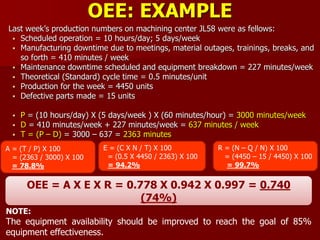
OEE: EXAMPLE
Last week’s production numbers on machining center JL58 were as fellows:
 Scheduled operation = 10 hours/day; 5 days/week
 Manufacturing downtime due to meetings, material outages, trainings, breaks, and
so forth = 410 minutes / week
 Maintenance downtime scheduled and equipment breakdown = 227 minutes/week
 Theoretical (Standard) cycle time = 0.5 minutes/unit
 Production for the week = 4450 units
 Defective parts made = 15 units
 P = (10 hours/day) X (5 days/week ) X (60 minutes/hour) = 3000 minutes/week
 D = 410 minutes/week + 227 minutes/week = 637 minutes / week
 T = (P – D) = 3000 – 637 = 2363 minutes
A = (T / P) X 100
= (2363 / 3000) X 100
= 78.8%
E = (C X N / T) X 100
= (0.5 X 4450 / 2363) X 100
= 94.2%
R = (N – Q / N) X 100
= (4450 – 15 / 4450) X 100
= 99.7%
OEE = A X E X R = 0.778 X 0.942 X 0.997 = 0.740
(74%)
NOTE:
The equipment availability should be improved to reach the goal of 85%
equipment effectiveness.
Questions
& Answers
Questions
& Answers
QUESTIONS
&
ANSWERS

7. cqia (kaizen, 5 s, tpm)

  • 1.
    TOTAL QUALITY MANAGEMENT By: - Hakeem–Ur–Rehman PCBA–UCP T MQCONTINUALQUALITY IMPROVEMENT APPROACHES  TQM, 3rd Edition, By: Besterfield (Chapter # 5 & 16)  5–S Handouts
  • 2.
  • 3.
    IMPROVEMENT STRATEGIES REPAIR:  “Anythingbroken must be fixed so that it functions as designed.”  Strategies divided into two levels: 1. Temporary or Short- term measure 2. Permanent measure REFINEMENT:  “Activities that continually improve a process that is not broken.”  Refinement improves efficiency and effectiveness. RENOVATION:  “Strategy results in major or breakthrough improvement.”  Innovation & technological advancement are key factors in this approach. REINVENTION (RE-ENGINEERING):  “Reinvention begins by imagining that the previous condition does not exist; A clean sheet of paper”
  • 4.
    PROBLEM SOLVING METHOD “Also calledthe Scientific method” “ Some People approach every problem with an open mouth.” (Adlai Stevenson)
  • 5.
    PROBLEM SOLVING METHOD Identitythe opportunities Implement Develop the optimal Solution Analyze the Process Standardize the solution Study Results Plan for The Future act doStudy plan
  • 6.
    WHICH QUALITY APPROACH? Continuous (i.e., Non–Stop) or Continual (i.e., Recurring often improvement frameworks) – KaiZen – Six–Sigma – Benchmarking
  • 7.
    KaiZen  “Kai” Change; “Zen”  Better  Kaizen  Make it Better (Improvement)  KaiZen is a System of accumulated improvement.  The main purpose of Kaizen is to evolve total employee participation and it also helps in building capable work force for an organization  The results of Kaizen are not very drastic but incremental that’s why continuous improvement leads to accumulated improvement. Kaizen is a process-oriented thinking and not result oriented thinking: PROCESS ORIENTED RESULT ORIENTED  Self discipline  Time management  Skill Management  Participation & involvement  Communication  Morale I don’t care, you get it done just give me one result
  • 9.
    10 Hints fordoing successful KaiZen 1. No Excuses: Don’t make excuses… Don’t accept excuses…Explanations are often still excuses (if you have time to makeup excuses, you have time to think of improvement ideas). 2. Don’t be a concrete head: Throughout traditional concepts… Think how a new method can work, not how it won’t. 3. Do Kaizen by getting your hands dirty on the shop floor 4. Quick & Crude is better than slow and elegant: Don’t seek perfection… 50% improvement rate is as long as it is done on the spot. 5. Produce Actual Improvement 6. Implement Kaizen Newspaper items as committed: Don’t Put of kaizen until tomorrow.
  • 10.
    10 Hints fordoing successful KaiZen 7. Do Kaizen by adopting ideas of workers: Put yourself in the worker’s position … The idea of 10 people are better than the knowledge of one. 8. Do Kaizen without spending lots of money: Many small improvements add up to big results … Implement quickly with less risk. 9. Don’t overlook even the smallest waste (Muda): Over production, delay, transportation, processing, inventory, etc. 10. Document results on target progress report: Document and report results at regular report outs. Fill in the condition even if there has been no change.
  • 12.
  • 13.
    KaiZen : 5S 5S movement is a determination to ORGANIZE WORK PLACE, To Keep It Neat, TO CLEAN, TO MAINTAIN THE DISCIPLINE to do a good job.  Japanese concept for house keeping – Sort (Seiri) – Straighten (Seiton) – Shine (Seiso) – Standardize (Seiketsu) – Sustain (Shitsuke)
  • 14.
    Decide what isneeded and what is not, and dispose of all items that are not necessary 1 SORT / SIFTING Car Parking Area Should these barrels be in car parking area? 5S PRINCIPLES
  • 15.
    5 S PRINCIPLES 2STRAIGHTEN Provide orderly storage in the right place for all necessary items so that they can be easily found and used when needed. EQUIPMENT STORAGE AREA Easy to determine equipment location
  • 16.
    5S PRINCIPLES 3 SHINE/ SWEEPING Maintain a clean worksite at all times in order to make work easier, safer, healthier and more satisfying I am motivated to work in this standards Service Workshop
  • 17.
    5 S PRINCIPLES 4STANDARDIZE Continuously keep work area orderly and clean 5 SUSTAIN / SELF-DISCIPLINE Make it habit to engaging 5S activities daily basis by establishing standards.
  • 18.
    3 Improve workefficiency 4 Increase employee moral & motivation Eliminate various kind of Waste2 5 Contribute in work management Create clean, healthy & safe working environment1 5 S PRINCIPLES MERIT
  • 19.
    TOTAL PRODUCTIVE MAINTENANCE Total Productive Maintenance (TPM) is keeping the current plant and equipment at its highest productive level through cooperation of all areas of the organization.  Generally, the first task is to break down the traditional barriers between maintenance and production personnel so they are working together.  TOTAL: All encompassing by maintenance and production individuals working together.  PRODUCTIVE: Production of goods and services that meet or exceed customers’ expectation.  MAINTENANCE: Keeping equipment and plant in as good as or better than the original condition at all times.
  • 20.
    TOTAL PRODUCTIVE MAINTENANCE The Overall goals of TPM are: 1. Maintaining and improving equipment capacity 2. Maintaining equipment for life 3. Using support from all areas of the operation 4. Encouraging input from all employees 5. Using teams for continuous improvement  Successful TPM results are: 1. Zero Unplanned downtime 2. Zero performance loss 3. Zero defects 4. Zero energy loss 5. Zero accidents
  • 21.
    Overall Equipment Effectiveness(OEE)  Overall Equipment Effectiveness (OEE) provides a metric or measure to continually monitor how effectively the equipment is performing and where the losses are with the potential for improvement.  IMPROVEMENT NEEDS: Six major loss areas need to be measured and tracked:  DOWNTIME LOSSES: 1. PLANNED: a. Start–Ups b. Shift changes c. Coffee & lunch breaks 2. UN-PLANNED DOWNTIME: a. Equipment breakdown b. Changeovers c. Lack of material  REDUCED SPEED LOSSES: 3. IDLING AND MAJOR STOPPAGES 4. SLOW DOWNS  POOR QUALITY LOSSES: 5. IDLING AND MAJOR STOPPAGES 6. SLOW DOWNS
  • 22.
    OEE … (Cont…) These losses can be quantified into three metrics and can be summarized into one equipment effectiveness metric.  Downtime losses are measured by EQUIPMENT AVAILABILITY using the equation: A = (T / P) X 100 Where:  A = Availability  T = Operating Time (P – D)  P = Planned Operating Time  D = Downtime  Reduced Speed Losses are measured by tracking PERFORMANCE EFFICIENCY using the equation: E = (C X N/ T) X 100 Where:  E = Performance Efficiency  C = Theoretical Cycle Time  N = Processes Amount (Quantity)  Poor Quality Losses are measured by tracking the RATE OF QUALITY PRODUCTS produced using the equation: R = (N – Q/ N) X 100 Where:  R = Rate of Quality Products  N = Processed amount (Quantity)  Q = Non–conformities
  • 23.
    OEE … (Cont…) BENCHMARK:  Some of the literature suggests that world – class firms have AVAILABILITY greater than 90%, PERFORMANCE EFFICIENCY greater than 95%, and a RATE OF QUALITY PRODUCTS greater than 99%.  Therefore, the OEE for world – class companies should exceeds 85%. OEE = A X E X R
  • 24.
    OEE: EXAMPLE Last week’sproduction numbers on machining center JL58 were as fellows:  Scheduled operation = 10 hours/day; 5 days/week  Manufacturing downtime due to meetings, material outages, trainings, breaks, and so forth = 410 minutes / week  Maintenance downtime scheduled and equipment breakdown = 227 minutes/week  Theoretical (Standard) cycle time = 0.5 minutes/unit  Production for the week = 4450 units  Defective parts made = 15 units  P = (10 hours/day) X (5 days/week ) X (60 minutes/hour) = 3000 minutes/week  D = 410 minutes/week + 227 minutes/week = 637 minutes / week  T = (P – D) = 3000 – 637 = 2363 minutes A = (T / P) X 100 = (2363 / 3000) X 100 = 78.8% E = (C X N / T) X 100 = (0.5 X 4450 / 2363) X 100 = 94.2% R = (N – Q / N) X 100 = (4450 – 15 / 4450) X 100 = 99.7% OEE = A X E X R = 0.778 X 0.942 X 0.997 = 0.740 (74%) NOTE: The equipment availability should be improved to reach the goal of 85% equipment effectiveness.
  • 25.