QUALITY TOOLS &
TECHNIQUES
1
TQ T
FALIURE MODE & EFFECT ANALYSIS
By: -
Hakeem–Ur–Rehman
Certified Six Sigma Black Belt (SQII – Singapore)
IRCA (UK) Lead Auditor ISO 9001
MS–Total Quality Management (P.U.)
MSc (Information & Operations Management) (P.U.)
IQTM–PU
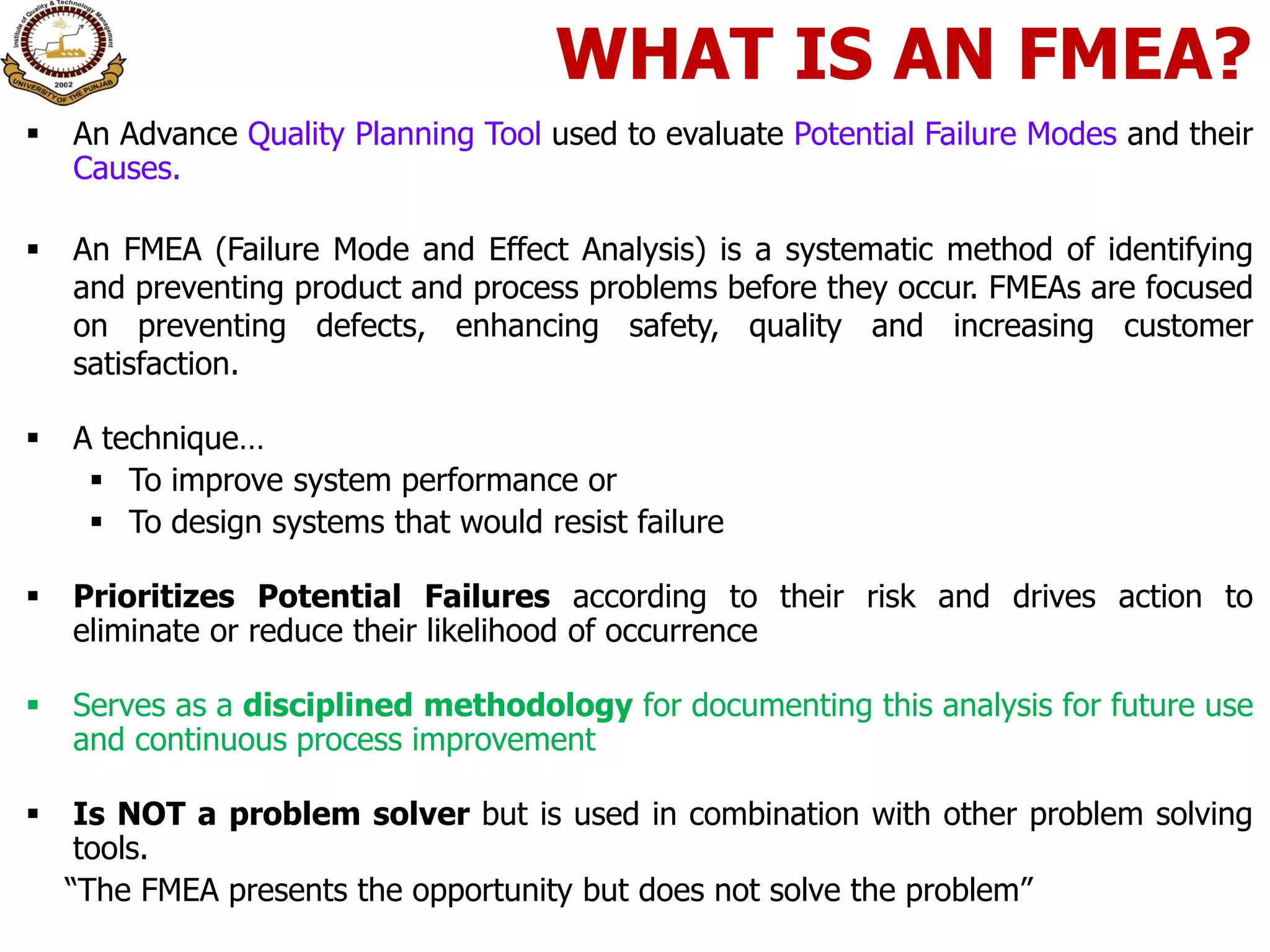
 An Advance Quality Planning Tool used to evaluate Potential Failure Modes and their
Causes.
 An FMEA (Failure Mode and Effect Analysis) is a systematic method of identifying
and preventing product and process problems before they occur. FMEAs are focused
on preventing defects, enhancing safety, quality and increasing customer
satisfaction.
 A technique…
 To improve system performance or
 To design systems that would resist failure
 Prioritizes Potential Failures according to their risk and drives action to
eliminate or reduce their likelihood of occurrence
 Serves as a disciplined methodology for documenting this analysis for future use
and continuous process improvement
 Is NOT a problem solver but is used in combination with other problem solving
tools.
“The FMEA presents the opportunity but does not solve the problem”
WHAT IS AN FMEA?
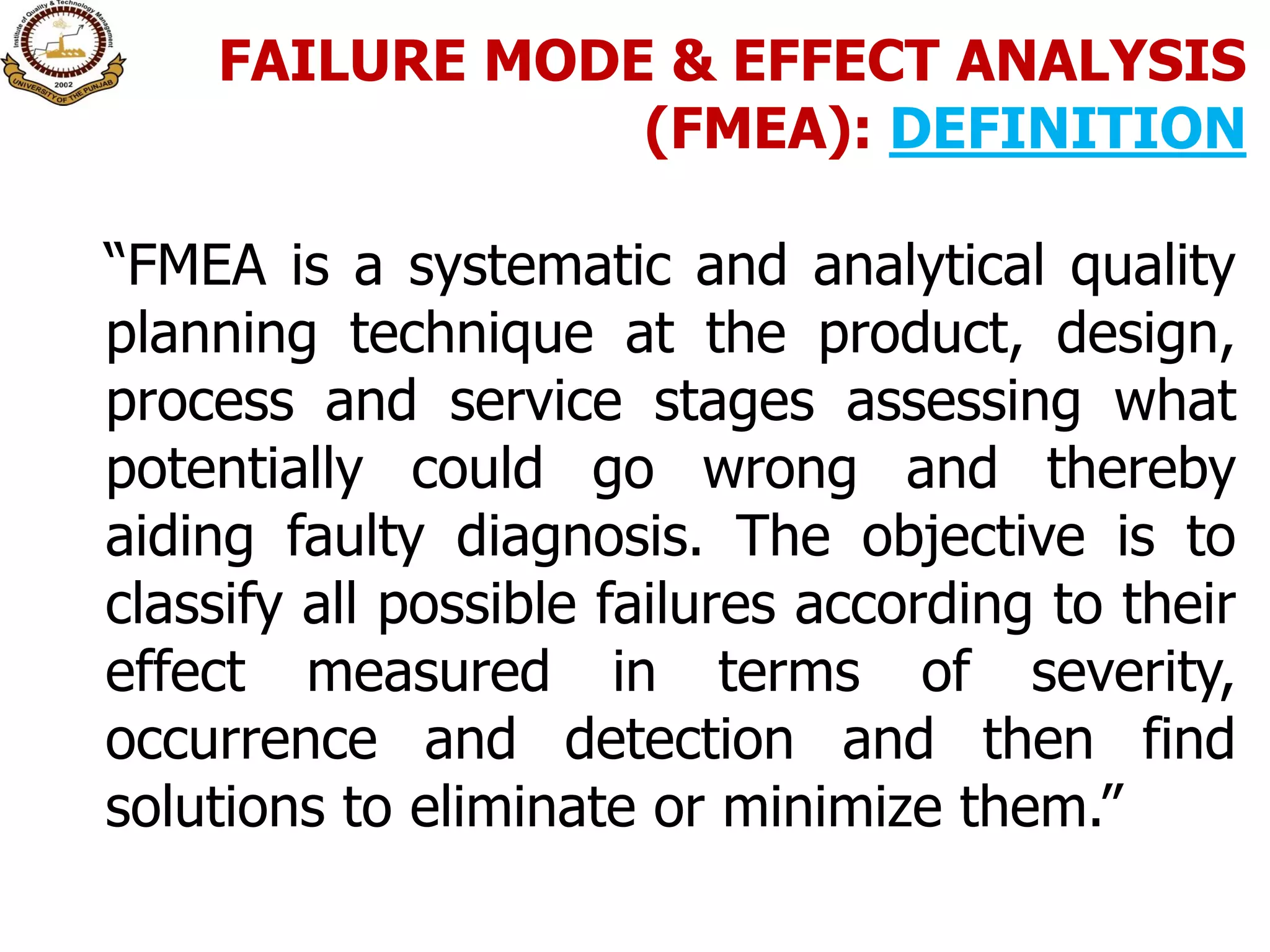
FAILURE MODE & EFFECT ANALYSIS
(FMEA): DEFINITION
“FMEA is a systematic and analytical quality
planning technique at the product, design,
process and service stages assessing what
potentially could go wrong and thereby
aiding faulty diagnosis. The objective is to
classify all possible failures according to their
effect measured in terms of severity,
occurrence and detection and then find
solutions to eliminate or minimize them.”
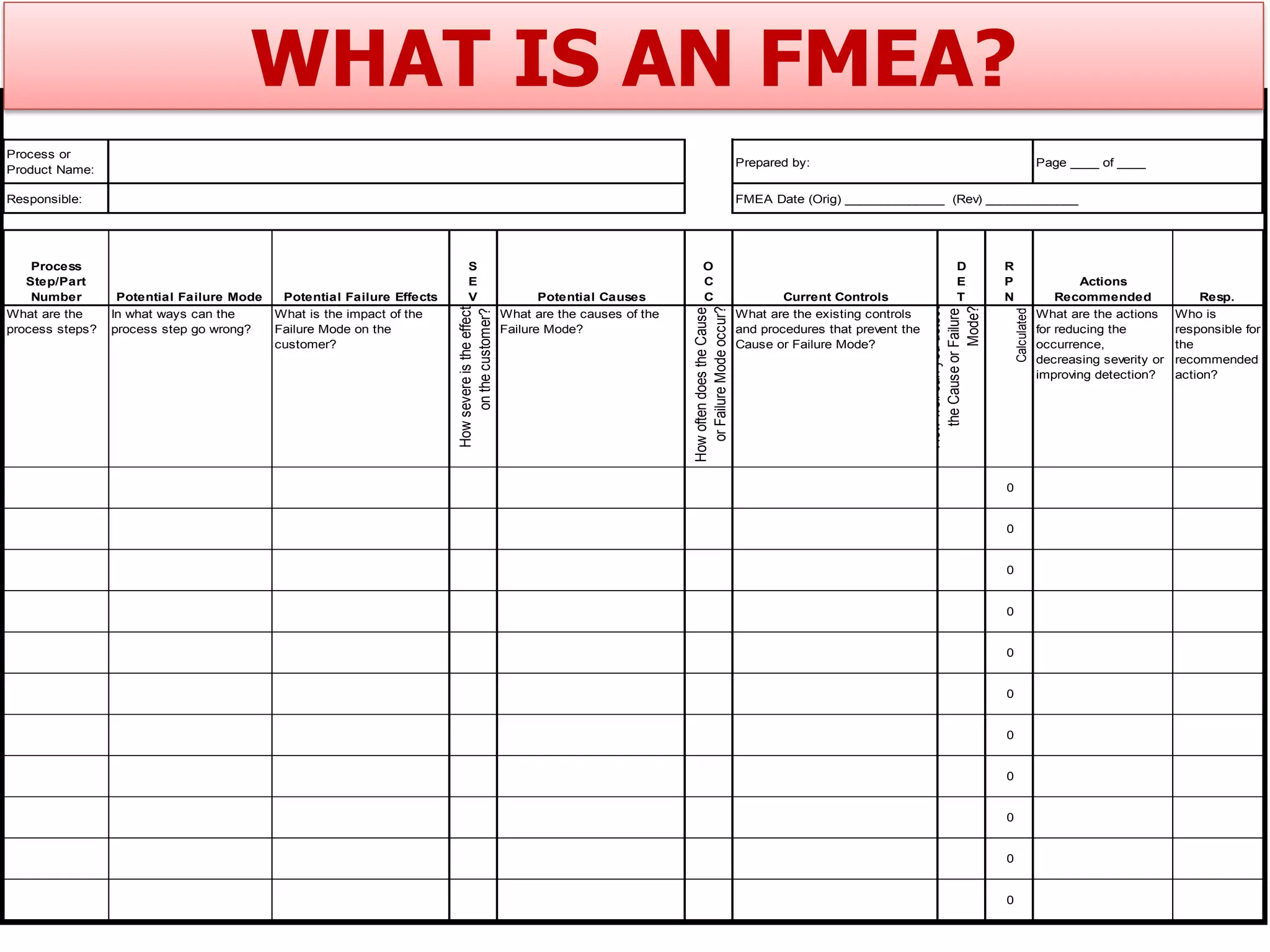
Process or
Product Name:
Prepared by: Page ____ of ____
Responsible: FMEA Date (Orig) ______________ (Rev) _____________
Process
Step/Part
Number Potential Failure Mode Potential Failure Effects
S
E
V Potential Causes
O
C
C Current Controls
D
E
T
R
P
N
Actions
Recommended Resp.
What are the
process steps?
In what ways can the
process step go wrong?
What is the impact of the
Failure Mode on the
customer?
Howsevereistheeffect
onthecustomer?
What are the causes of the
Failure Mode?
HowoftendoestheCause
orFailureModeoccur?
What are the existing controls
and procedures that prevent the
Cause or Failure Mode?
Howwellcanyoudetect
theCauseorFailure
Mode?
Calculated
What are the actions
for reducing the
occurrence,
decreasing severity or
improving detection?
Who is
responsible for
the
recommended
action?
0
0
0
0
0
0
0
0
0
0
0
(FMEA)WHAT IS AN FMEA?
FAILURE MODE & EFFECT ANALYSIS
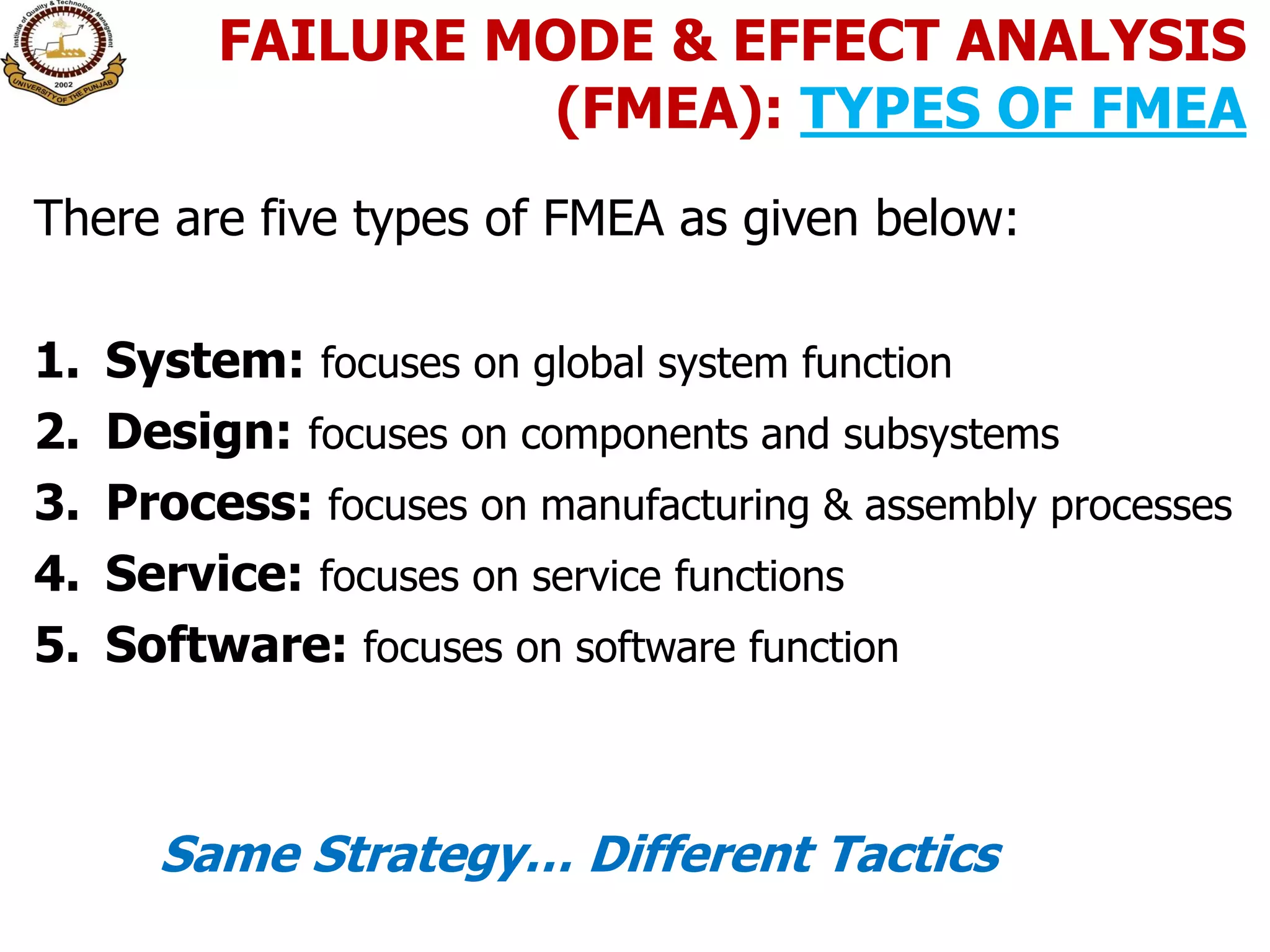
(FMEA): TYPES OF FMEA
There are five types of FMEA as given below:
1. System: focuses on global system function
2. Design: focuses on components and subsystems
3. Process: focuses on manufacturing & assembly processes
4. Service: focuses on service functions
5. Software: focuses on software function
Same Strategy… Different Tactics
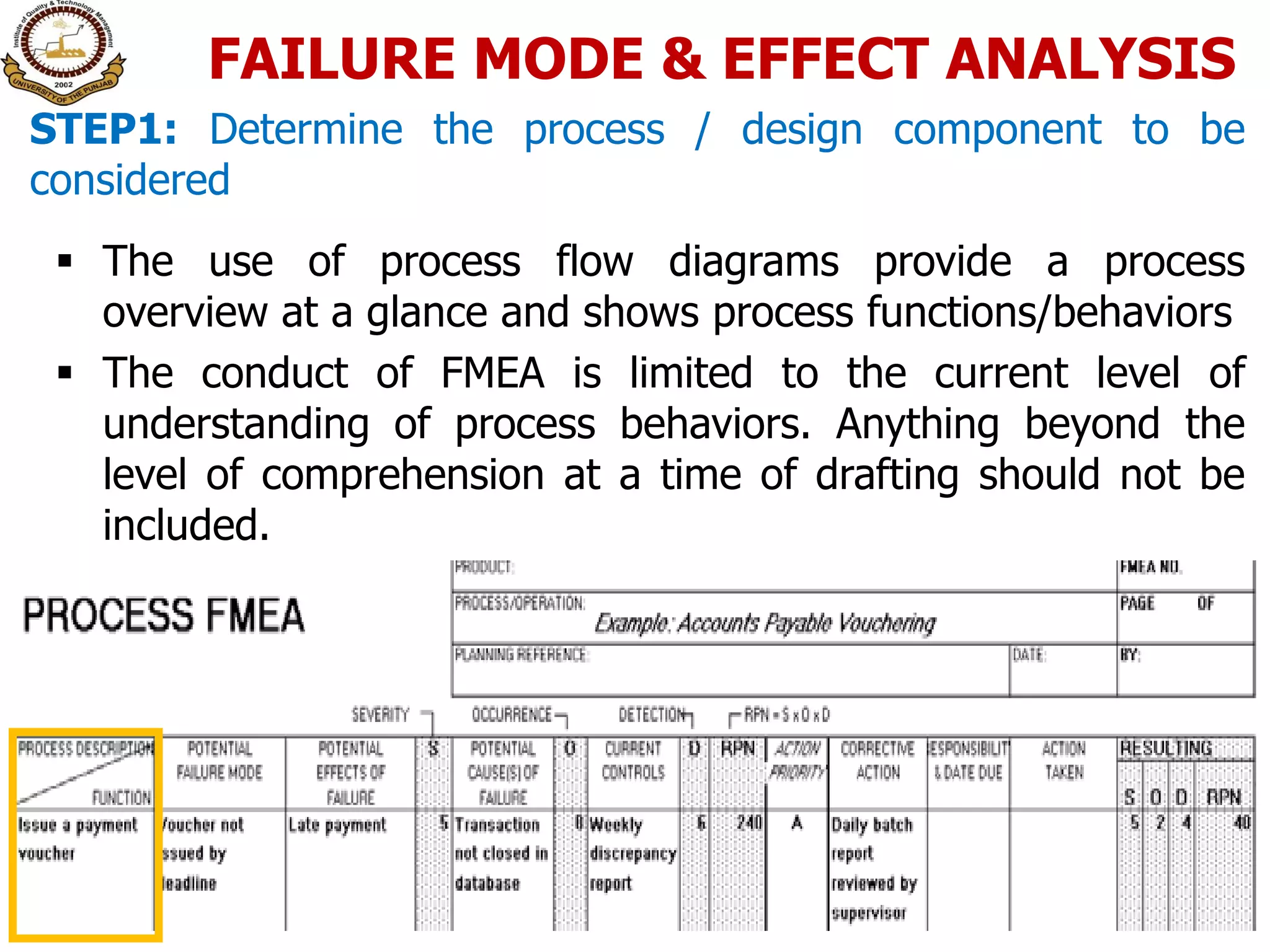
STEP1: Determine the process / design component to be
considered
 The use of process flow diagrams provide a process
overview at a glance and shows process functions/behaviors
 The conduct of FMEA is limited to the current level of
understanding of process behaviors. Anything beyond the
level of comprehension at a time of drafting should not be
included.
FAILURE MODE & EFFECT ANALYSIS
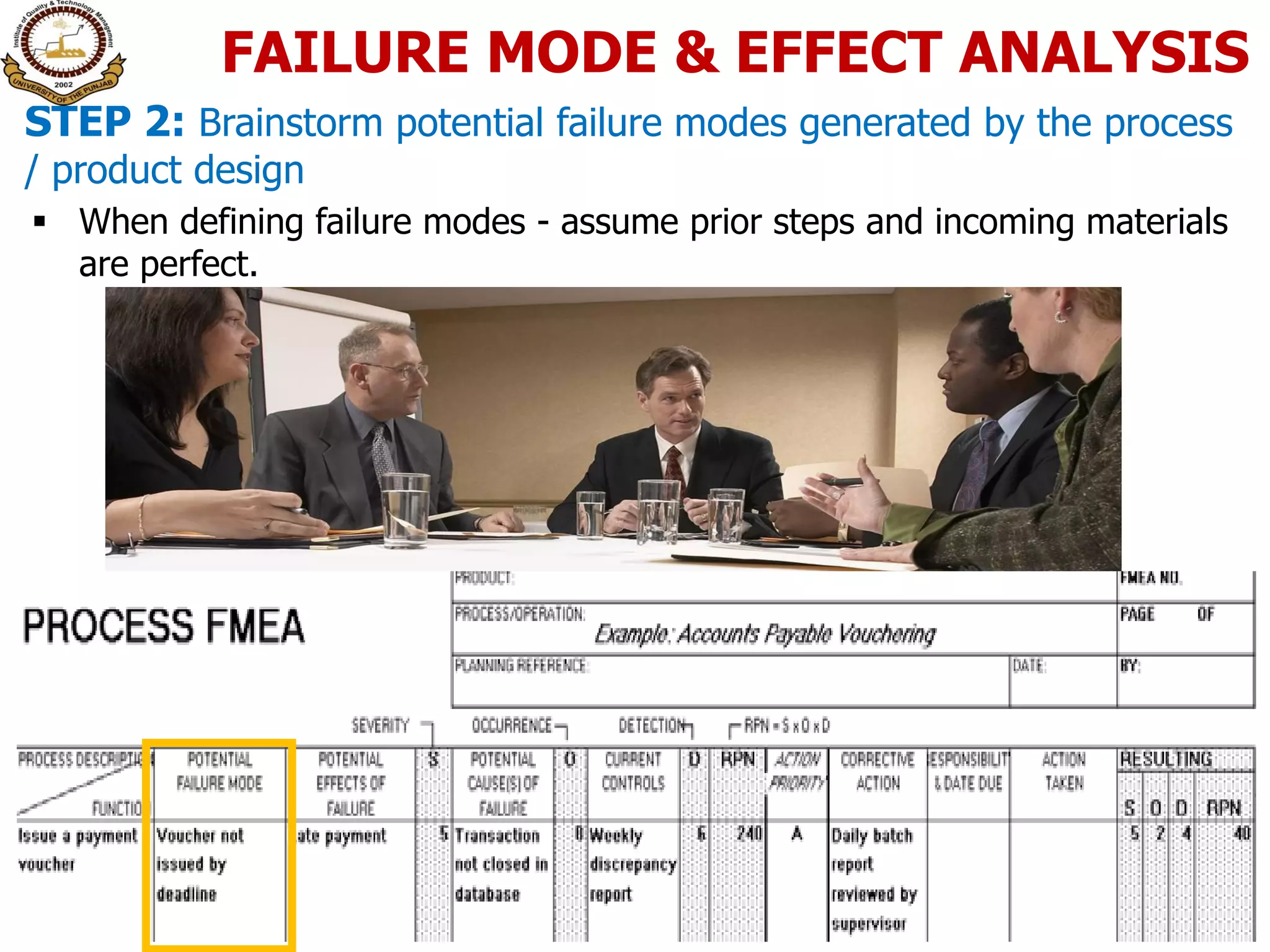
 When defining failure modes - assume prior steps and incoming materials
are perfect.
STEP 2: Brainstorm potential failure modes generated by the process
/ product design
FAILURE MODE & EFFECT ANALYSIS
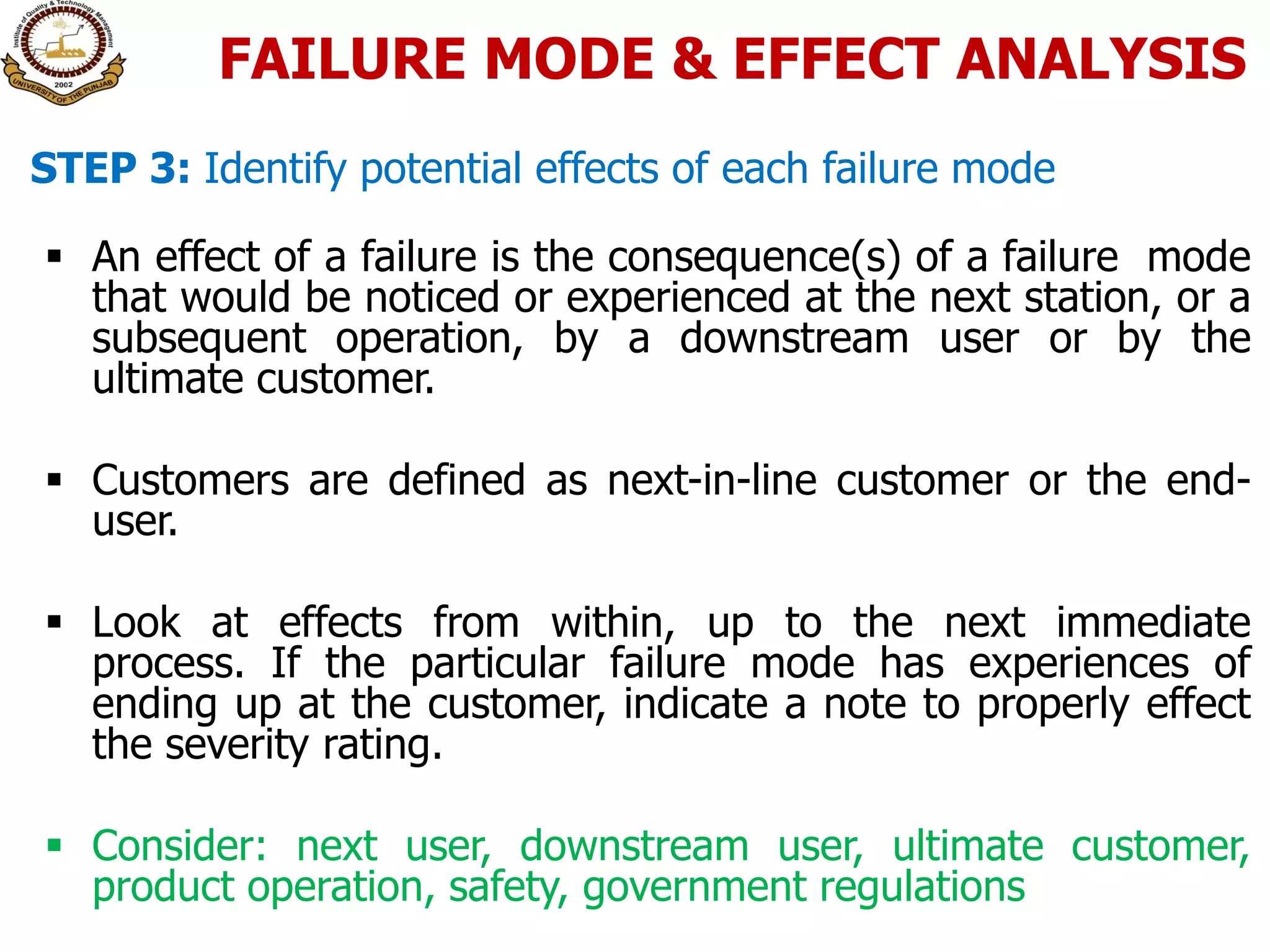
 An effect of a failure is the consequence(s) of a failure mode
that would be noticed or experienced at the next station, or a
subsequent operation, by a downstream user or by the
ultimate customer.
 Customers are defined as next-in-line customer or the end-
user.
 Look at effects from within, up to the next immediate
process. If the particular failure mode has experiences of
ending up at the customer, indicate a note to properly effect
the severity rating.
 Consider: next user, downstream user, ultimate customer,
product operation, safety, government regulations
STEP 3: Identify potential effects of each failure mode
FAILURE MODE & EFFECT ANALYSIS
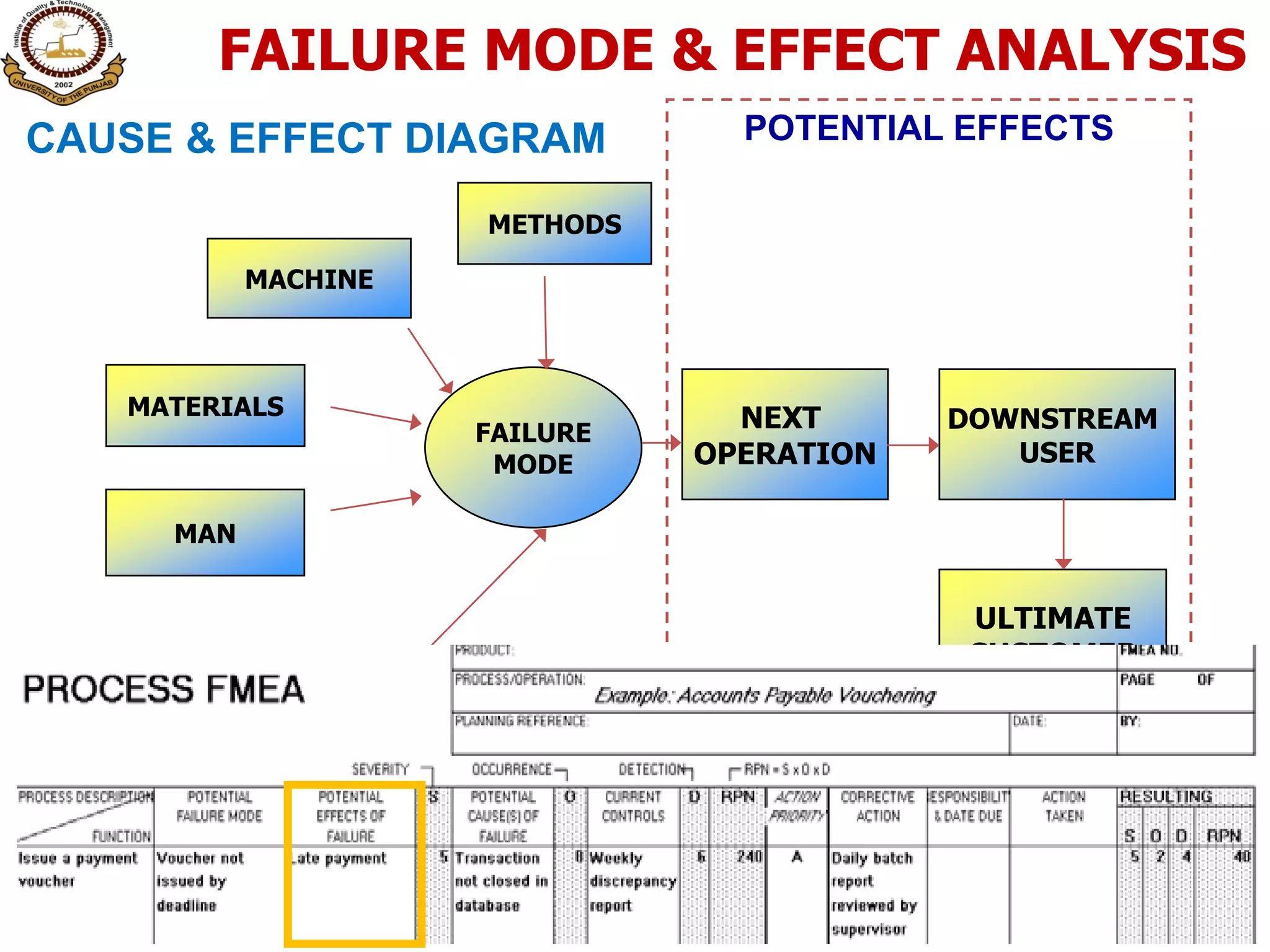
MAN
METHODS
MACHINE
ULTIMATE
CUSTOMER
MATERIALS
FAILURE
MODE
DOWNSTREAM
USER
NEXT
OPERATION
POTENTIAL EFFECTSCAUSE & EFFECT DIAGRAM
MEASUREMENT
SYSTEM
FAILURE MODE & EFFECT ANALYSIS
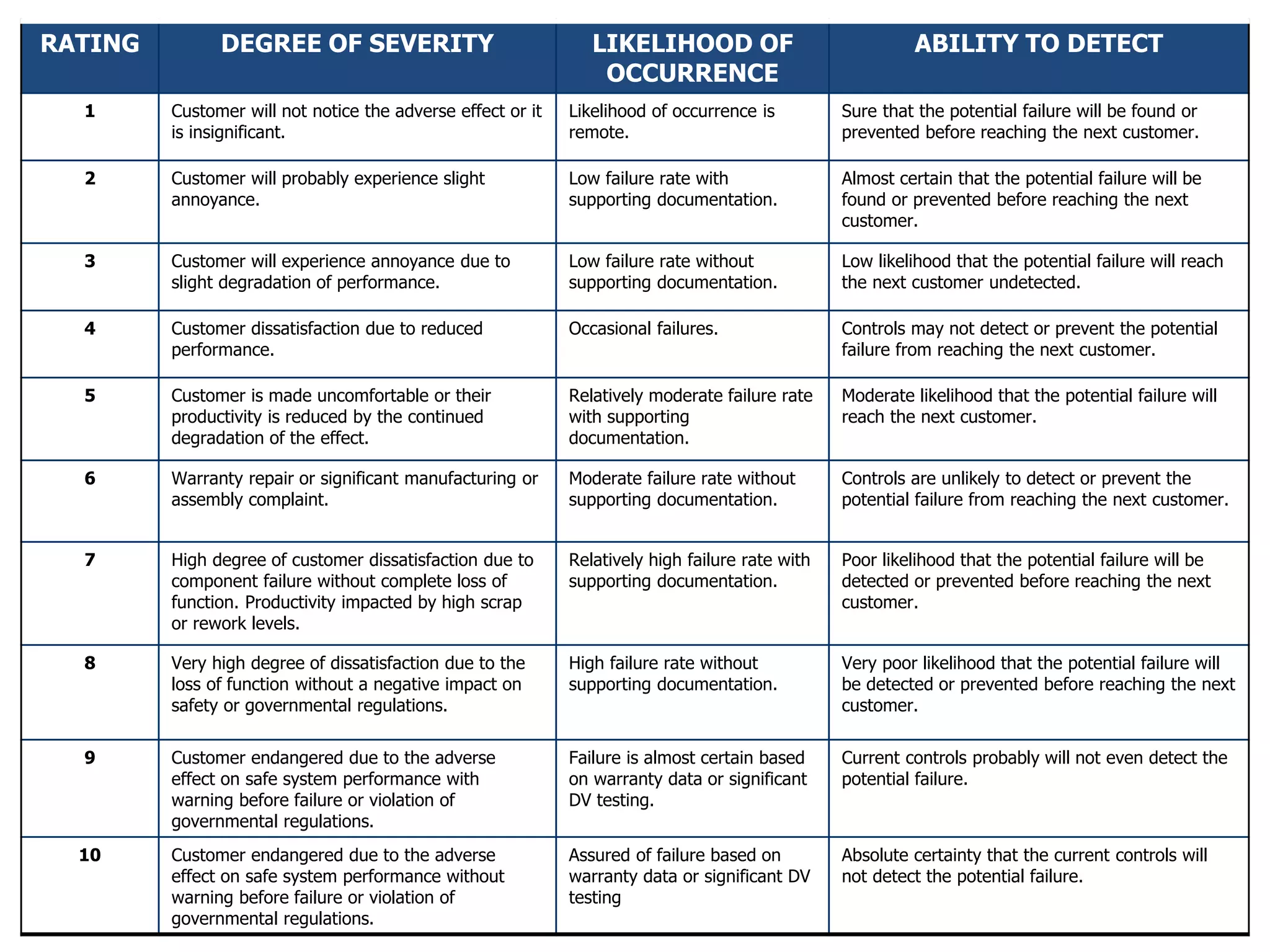
RATING DEGREE OF SEVERITY LIKELIHOOD OF
OCCURRENCE
ABILITY TO DETECT
1 Customer will not notice the adverse effect or it
is insignificant.
Likelihood of occurrence is
remote.
Sure that the potential failure will be found or
prevented before reaching the next customer.
2 Customer will probably experience slight
annoyance.
Low failure rate with
supporting documentation.
Almost certain that the potential failure will be
found or prevented before reaching the next
customer.
3 Customer will experience annoyance due to
slight degradation of performance.
Low failure rate without
supporting documentation.
Low likelihood that the potential failure will reach
the next customer undetected.
4 Customer dissatisfaction due to reduced
performance.
Occasional failures. Controls may not detect or prevent the potential
failure from reaching the next customer.
5 Customer is made uncomfortable or their
productivity is reduced by the continued
degradation of the effect.
Relatively moderate failure rate
with supporting
documentation.
Moderate likelihood that the potential failure will
reach the next customer.
6 Warranty repair or significant manufacturing or
assembly complaint.
Moderate failure rate without
supporting documentation.
Controls are unlikely to detect or prevent the
potential failure from reaching the next customer.
7 High degree of customer dissatisfaction due to
component failure without complete loss of
function. Productivity impacted by high scrap
or rework levels.
Relatively high failure rate with
supporting documentation.
Poor likelihood that the potential failure will be
detected or prevented before reaching the next
customer.
8 Very high degree of dissatisfaction due to the
loss of function without a negative impact on
safety or governmental regulations.
High failure rate without
supporting documentation.
Very poor likelihood that the potential failure will
be detected or prevented before reaching the next
customer.
9 Customer endangered due to the adverse
effect on safe system performance with
warning before failure or violation of
governmental regulations.
Failure is almost certain based
on warranty data or significant
DV testing.
Current controls probably will not even detect the
potential failure.
10 Customer endangered due to the adverse
effect on safe system performance without
warning before failure or violation of
governmental regulations.
Assured of failure based on
warranty data or significant DV
testing
Absolute certainty that the current controls will
not detect the potential failure.
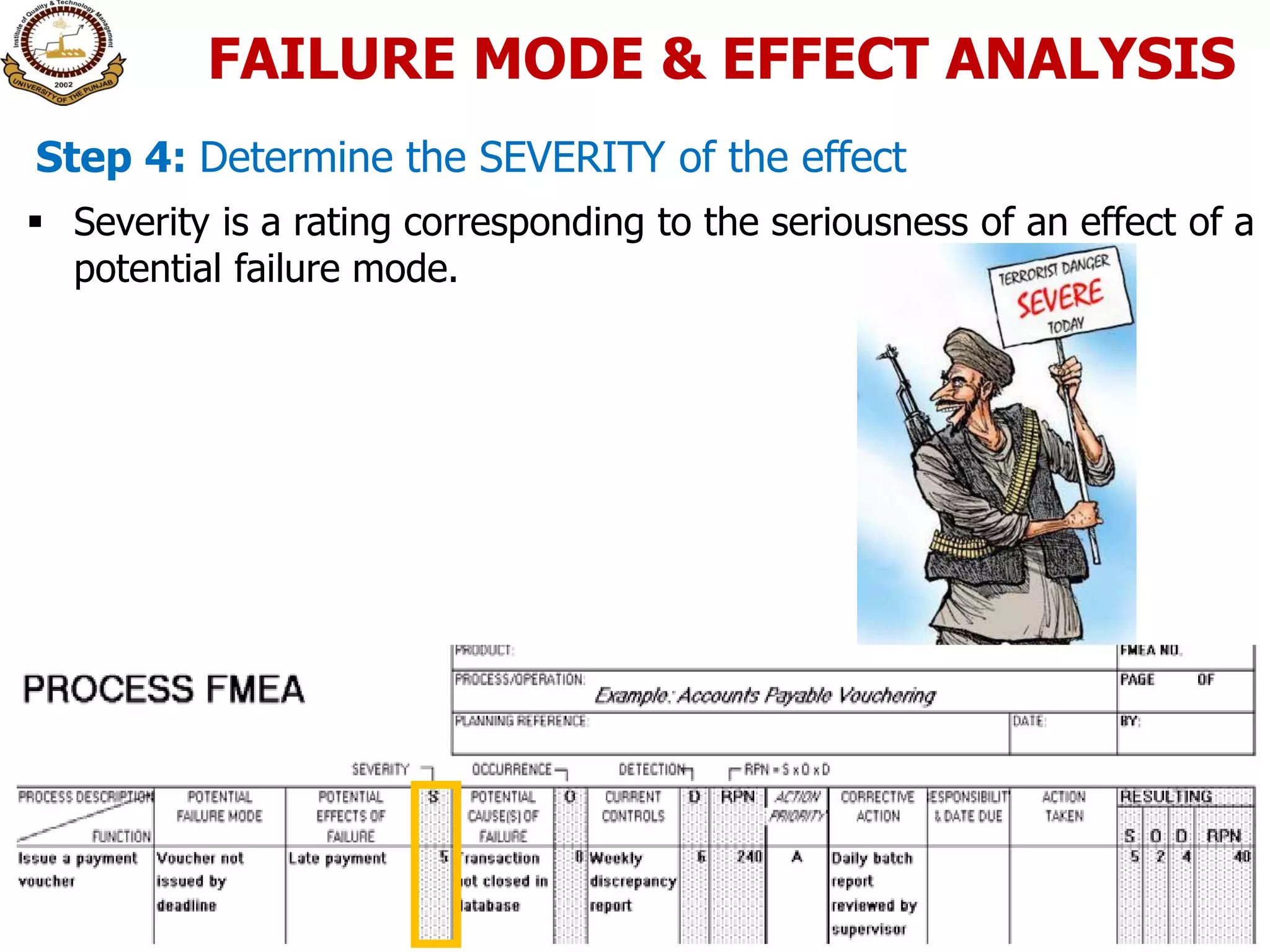
 Severity is a rating corresponding to the seriousness of an effect of a
potential failure mode.
Step 4: Determine the SEVERITY of the effect
FAILURE MODE & EFFECT ANALYSIS
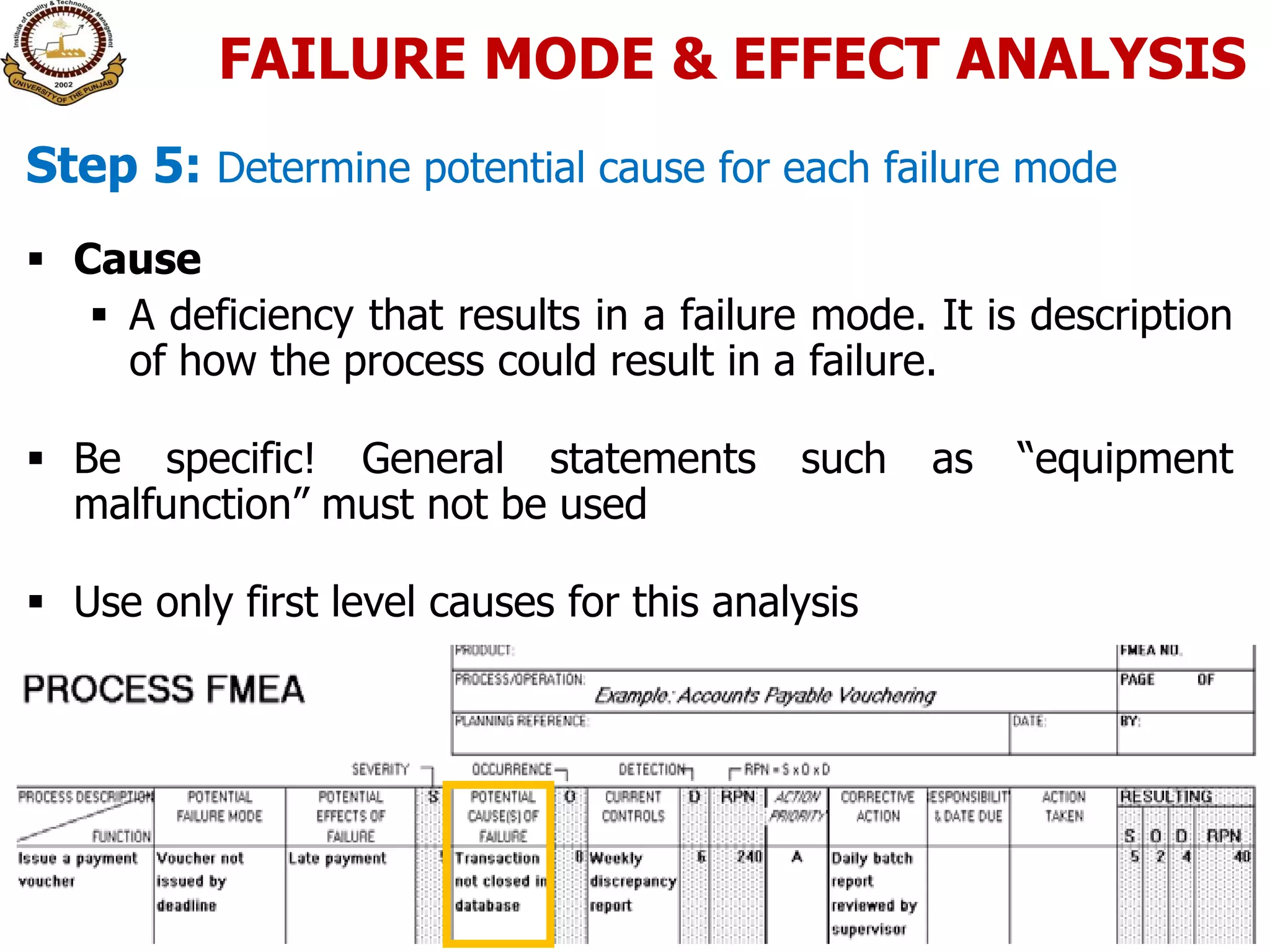
 Cause
 A deficiency that results in a failure mode. It is description
of how the process could result in a failure.
 Be specific! General statements such as “equipment
malfunction” must not be used
 Use only first level causes for this analysis
Step 5: Determine potential cause for each failure mode
FAILURE MODE & EFFECT ANALYSIS
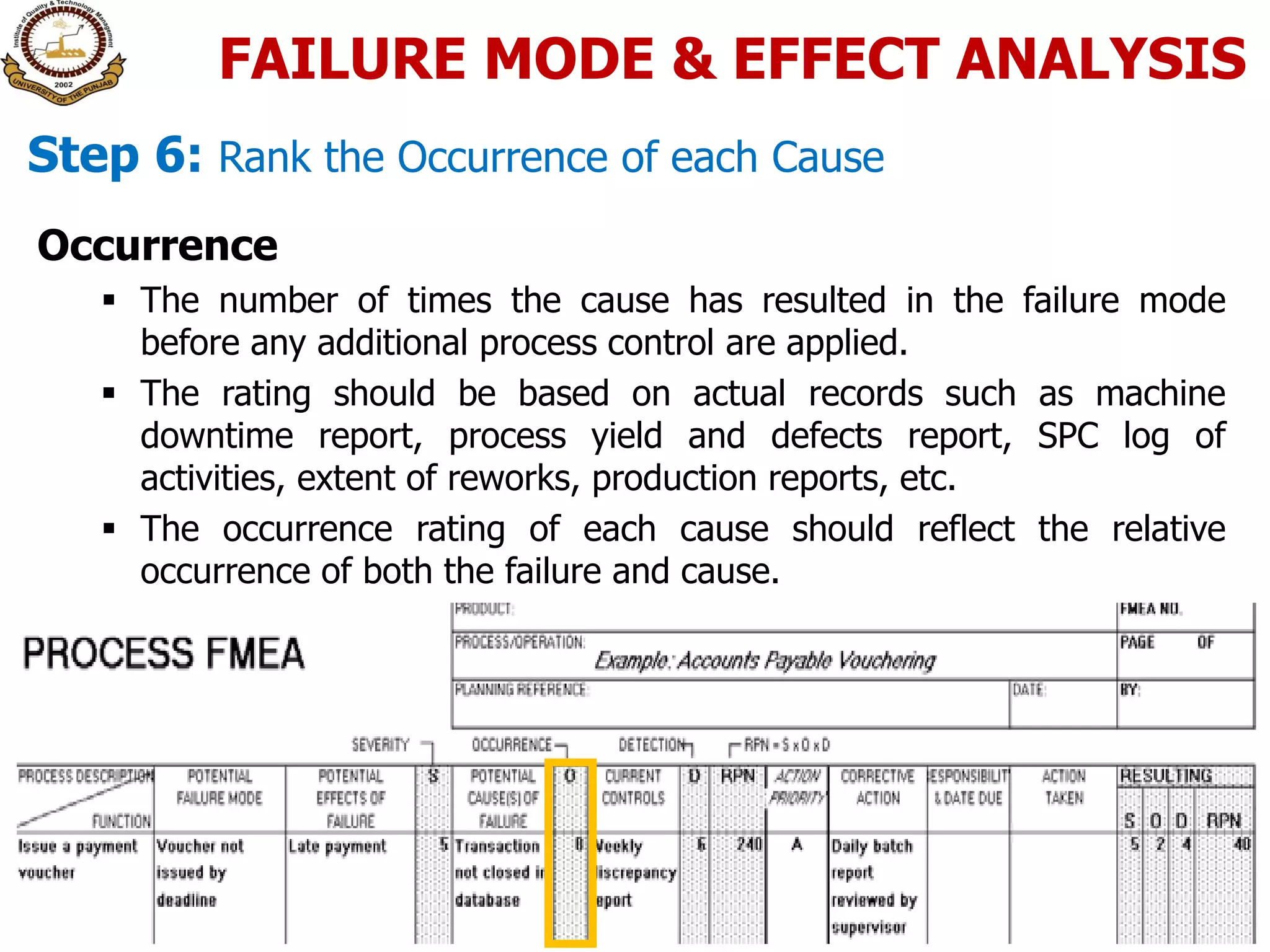
Occurrence
 The number of times the cause has resulted in the failure mode
before any additional process control are applied.
 The rating should be based on actual records such as machine
downtime report, process yield and defects report, SPC log of
activities, extent of reworks, production reports, etc.
 The occurrence rating of each cause should reflect the relative
occurrence of both the failure and cause.
Step 6: Rank the Occurrence of each Cause
FAILURE MODE & EFFECT ANALYSIS
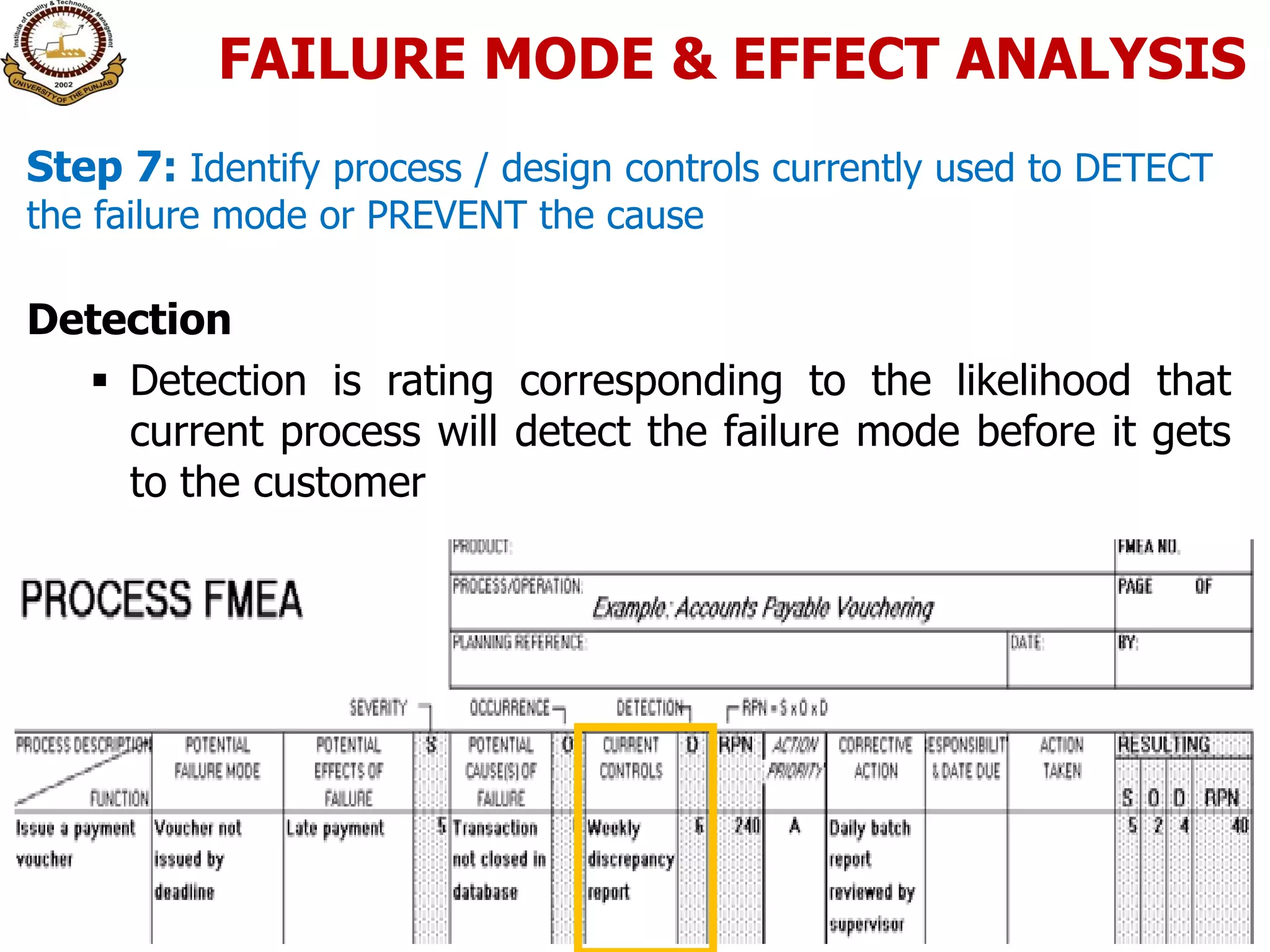
Detection
 Detection is rating corresponding to the likelihood that
current process will detect the failure mode before it gets
to the customer
Step 7: Identify process / design controls currently used to DETECT
the failure mode or PREVENT the cause
FAILURE MODE & EFFECT ANALYSIS
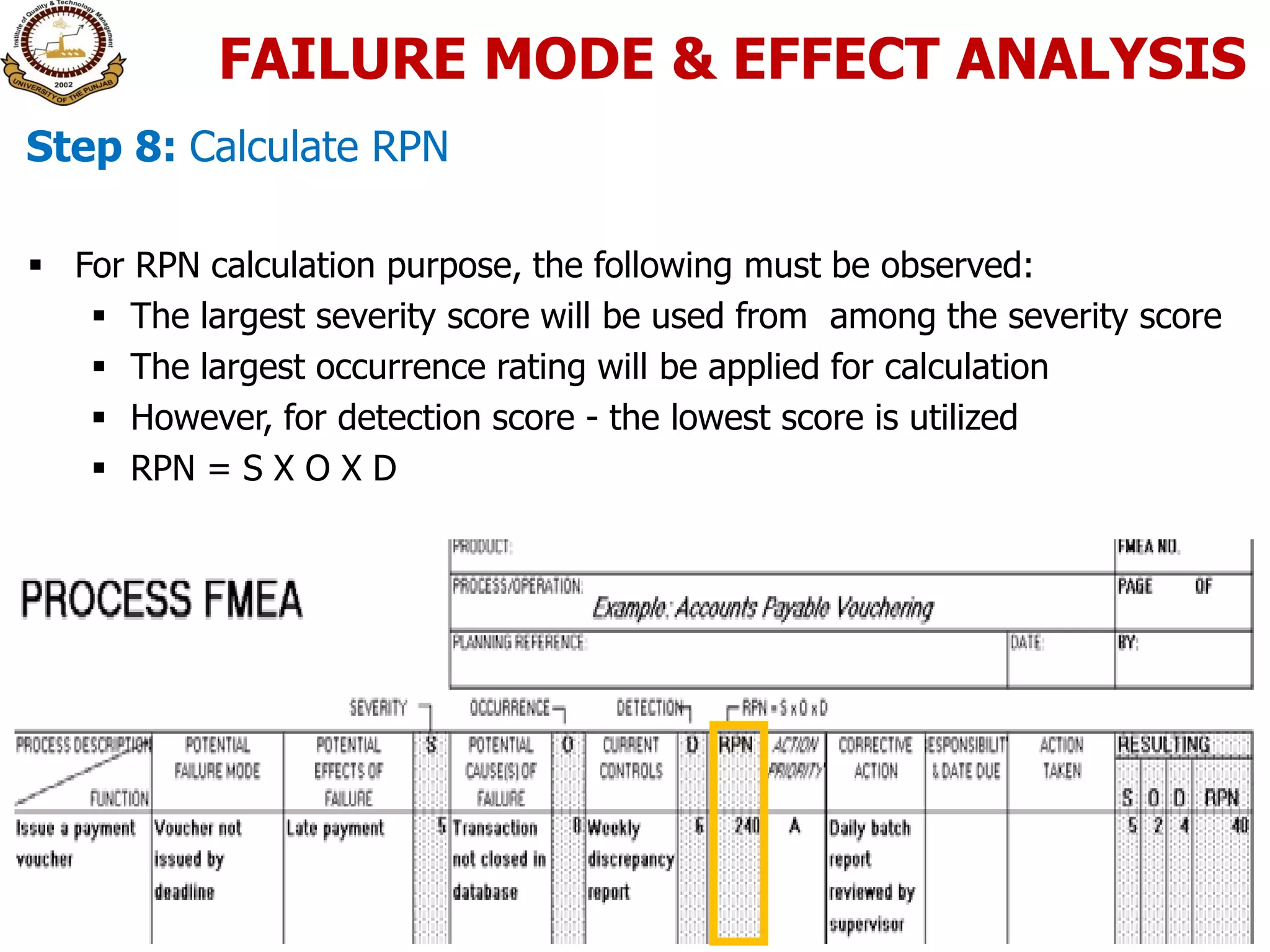
 For RPN calculation purpose, the following must be observed:
 The largest severity score will be used from among the severity score
 The largest occurrence rating will be applied for calculation
 However, for detection score - the lowest score is utilized
 RPN = S X O X D
Step 8: Calculate RPN
FAILURE MODE & EFFECT ANALYSIS
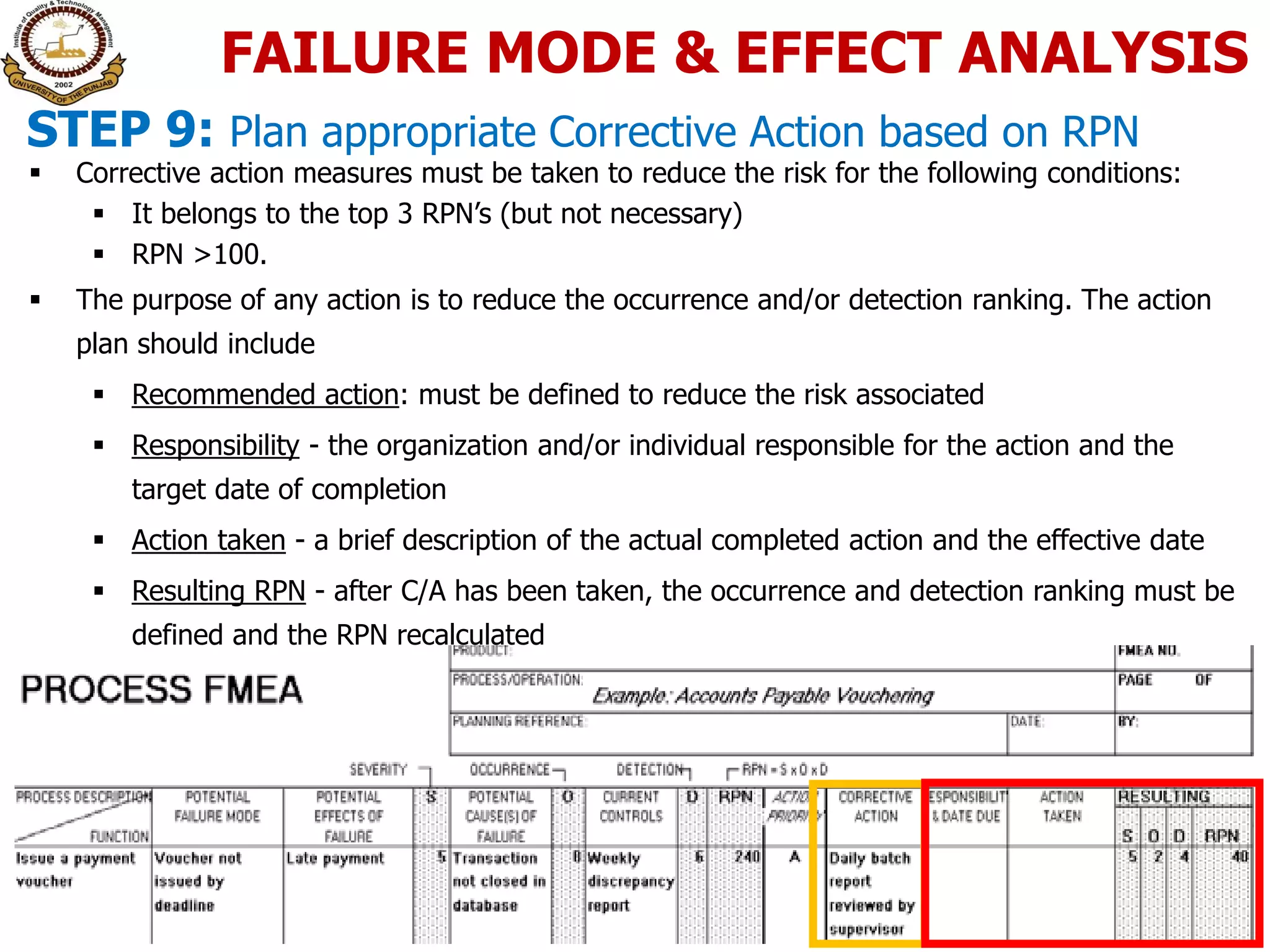
 Corrective action measures must be taken to reduce the risk for the following conditions:
 It belongs to the top 3 RPN’s (but not necessary)
 RPN >100.
 The purpose of any action is to reduce the occurrence and/or detection ranking. The action
plan should include
 Recommended action: must be defined to reduce the risk associated
 Responsibility - the organization and/or individual responsible for the action and the
target date of completion
 Action taken - a brief description of the actual completed action and the effective date
 Resulting RPN - after C/A has been taken, the occurrence and detection ranking must be
defined and the RPN recalculated
STEP 9: Plan appropriate Corrective Action based on RPN
FAILURE MODE & EFFECT ANALYSIS
QUESTIONS

11. faliure mode & effect analysis

  • 1.
    QUALITY TOOLS & TECHNIQUES 1 TQT FALIURE MODE & EFFECT ANALYSIS By: - Hakeem–Ur–Rehman Certified Six Sigma Black Belt (SQII – Singapore) IRCA (UK) Lead Auditor ISO 9001 MS–Total Quality Management (P.U.) MSc (Information & Operations Management) (P.U.) IQTM–PU
  • 2.
     An AdvanceQuality Planning Tool used to evaluate Potential Failure Modes and their Causes.  An FMEA (Failure Mode and Effect Analysis) is a systematic method of identifying and preventing product and process problems before they occur. FMEAs are focused on preventing defects, enhancing safety, quality and increasing customer satisfaction.  A technique…  To improve system performance or  To design systems that would resist failure  Prioritizes Potential Failures according to their risk and drives action to eliminate or reduce their likelihood of occurrence  Serves as a disciplined methodology for documenting this analysis for future use and continuous process improvement  Is NOT a problem solver but is used in combination with other problem solving tools. “The FMEA presents the opportunity but does not solve the problem” WHAT IS AN FMEA?
  • 3.
    FAILURE MODE &EFFECT ANALYSIS (FMEA): DEFINITION “FMEA is a systematic and analytical quality planning technique at the product, design, process and service stages assessing what potentially could go wrong and thereby aiding faulty diagnosis. The objective is to classify all possible failures according to their effect measured in terms of severity, occurrence and detection and then find solutions to eliminate or minimize them.”
  • 4.
    Process or Product Name: Preparedby: Page ____ of ____ Responsible: FMEA Date (Orig) ______________ (Rev) _____________ Process Step/Part Number Potential Failure Mode Potential Failure Effects S E V Potential Causes O C C Current Controls D E T R P N Actions Recommended Resp. What are the process steps? In what ways can the process step go wrong? What is the impact of the Failure Mode on the customer? Howsevereistheeffect onthecustomer? What are the causes of the Failure Mode? HowoftendoestheCause orFailureModeoccur? What are the existing controls and procedures that prevent the Cause or Failure Mode? Howwellcanyoudetect theCauseorFailure Mode? Calculated What are the actions for reducing the occurrence, decreasing severity or improving detection? Who is responsible for the recommended action? 0 0 0 0 0 0 0 0 0 0 0 (FMEA)WHAT IS AN FMEA?
  • 5.
    FAILURE MODE &EFFECT ANALYSIS (FMEA): TYPES OF FMEA There are five types of FMEA as given below: 1. System: focuses on global system function 2. Design: focuses on components and subsystems 3. Process: focuses on manufacturing & assembly processes 4. Service: focuses on service functions 5. Software: focuses on software function Same Strategy… Different Tactics
  • 6.
    STEP1: Determine theprocess / design component to be considered  The use of process flow diagrams provide a process overview at a glance and shows process functions/behaviors  The conduct of FMEA is limited to the current level of understanding of process behaviors. Anything beyond the level of comprehension at a time of drafting should not be included. FAILURE MODE & EFFECT ANALYSIS
  • 7.
     When definingfailure modes - assume prior steps and incoming materials are perfect. STEP 2: Brainstorm potential failure modes generated by the process / product design FAILURE MODE & EFFECT ANALYSIS
  • 8.
     An effectof a failure is the consequence(s) of a failure mode that would be noticed or experienced at the next station, or a subsequent operation, by a downstream user or by the ultimate customer.  Customers are defined as next-in-line customer or the end- user.  Look at effects from within, up to the next immediate process. If the particular failure mode has experiences of ending up at the customer, indicate a note to properly effect the severity rating.  Consider: next user, downstream user, ultimate customer, product operation, safety, government regulations STEP 3: Identify potential effects of each failure mode FAILURE MODE & EFFECT ANALYSIS
  • 9.
  • 10.
    RATING DEGREE OFSEVERITY LIKELIHOOD OF OCCURRENCE ABILITY TO DETECT 1 Customer will not notice the adverse effect or it is insignificant. Likelihood of occurrence is remote. Sure that the potential failure will be found or prevented before reaching the next customer. 2 Customer will probably experience slight annoyance. Low failure rate with supporting documentation. Almost certain that the potential failure will be found or prevented before reaching the next customer. 3 Customer will experience annoyance due to slight degradation of performance. Low failure rate without supporting documentation. Low likelihood that the potential failure will reach the next customer undetected. 4 Customer dissatisfaction due to reduced performance. Occasional failures. Controls may not detect or prevent the potential failure from reaching the next customer. 5 Customer is made uncomfortable or their productivity is reduced by the continued degradation of the effect. Relatively moderate failure rate with supporting documentation. Moderate likelihood that the potential failure will reach the next customer. 6 Warranty repair or significant manufacturing or assembly complaint. Moderate failure rate without supporting documentation. Controls are unlikely to detect or prevent the potential failure from reaching the next customer. 7 High degree of customer dissatisfaction due to component failure without complete loss of function. Productivity impacted by high scrap or rework levels. Relatively high failure rate with supporting documentation. Poor likelihood that the potential failure will be detected or prevented before reaching the next customer. 8 Very high degree of dissatisfaction due to the loss of function without a negative impact on safety or governmental regulations. High failure rate without supporting documentation. Very poor likelihood that the potential failure will be detected or prevented before reaching the next customer. 9 Customer endangered due to the adverse effect on safe system performance with warning before failure or violation of governmental regulations. Failure is almost certain based on warranty data or significant DV testing. Current controls probably will not even detect the potential failure. 10 Customer endangered due to the adverse effect on safe system performance without warning before failure or violation of governmental regulations. Assured of failure based on warranty data or significant DV testing Absolute certainty that the current controls will not detect the potential failure.
  • 11.
     Severity isa rating corresponding to the seriousness of an effect of a potential failure mode. Step 4: Determine the SEVERITY of the effect FAILURE MODE & EFFECT ANALYSIS
  • 12.
     Cause  Adeficiency that results in a failure mode. It is description of how the process could result in a failure.  Be specific! General statements such as “equipment malfunction” must not be used  Use only first level causes for this analysis Step 5: Determine potential cause for each failure mode FAILURE MODE & EFFECT ANALYSIS
  • 13.
    Occurrence  The numberof times the cause has resulted in the failure mode before any additional process control are applied.  The rating should be based on actual records such as machine downtime report, process yield and defects report, SPC log of activities, extent of reworks, production reports, etc.  The occurrence rating of each cause should reflect the relative occurrence of both the failure and cause. Step 6: Rank the Occurrence of each Cause FAILURE MODE & EFFECT ANALYSIS
  • 14.
    Detection  Detection israting corresponding to the likelihood that current process will detect the failure mode before it gets to the customer Step 7: Identify process / design controls currently used to DETECT the failure mode or PREVENT the cause FAILURE MODE & EFFECT ANALYSIS
  • 15.
     For RPNcalculation purpose, the following must be observed:  The largest severity score will be used from among the severity score  The largest occurrence rating will be applied for calculation  However, for detection score - the lowest score is utilized  RPN = S X O X D Step 8: Calculate RPN FAILURE MODE & EFFECT ANALYSIS
  • 16.
     Corrective actionmeasures must be taken to reduce the risk for the following conditions:  It belongs to the top 3 RPN’s (but not necessary)  RPN >100.  The purpose of any action is to reduce the occurrence and/or detection ranking. The action plan should include  Recommended action: must be defined to reduce the risk associated  Responsibility - the organization and/or individual responsible for the action and the target date of completion  Action taken - a brief description of the actual completed action and the effective date  Resulting RPN - after C/A has been taken, the occurrence and detection ranking must be defined and the RPN recalculated STEP 9: Plan appropriate Corrective Action based on RPN FAILURE MODE & EFFECT ANALYSIS
  • 17.