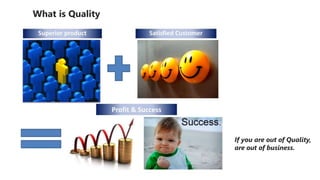
What is Quality
If you are out of Quality,
are out of business.
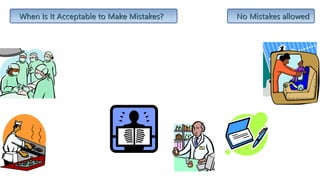
When Is It Acceptable to Make Mistakes? No Mistakes allowed
“Quality is never an accident; it is always the result of
high intention, sincere effort, intelligent direction
and skillful execution; it represents the wise choice of
many alternatives.”
William A. Foster
Achieving Quality is a Serious Business
4
The History of Quality
QUALITY IN THE INDUSTRIAL REVOLUTION
Until the early 19th century, manufacturing in the industrialized world tended to follow this craftsmanship model.
QUALITY IN WORLD WAR II
After entering World War II, the United States enacted legislation to help gear the civilian economy to military
production. During this period, quality became a critical component of the war effort and an important safety
issue.
QUALITY IN THE EARLY 20TH CENTURY
The beginning of the 20th century marked the inclusion of "processes" in quality practices. A "process" is defined
as a group of activities that takes an input, adds value to it, and provides an output. Walter Shewhart began to
focus on controlling processes in the mid-1920s, making quality relevant not only for the finished product but for
the processes that created it.
5
The History of Quality
THE HISTORY OF TOTAL QUALITY IN AMERICA
At first, Japan had a widely held reputation for shoddy exports, and their goods were shunned by international
markets. This led Japanese organizations to explore new ways of thinking about quality.
THE AMERICAN TOTAL QUALITY MANAGEMENT RESPONSE
At first, U.S. manufacturers held onto to their assumption that Japanese success was price-related, and thus
responded to Japanese competition with strategies aimed at reducing domestic production costs and restricting
imports.
The U.S. response, emphasizing not only statistics but approaches that embraced the entire organization,
became known as Total Quality Management (TQM).
BEYOND TOTAL QUALITY MANAGEMENT
As the 21st century begins, the quality movement has matured. New quality systems have evolved beyond the
foundations laid by Deming, Juran, and the early Japanese practitioners of quality.
ISO 9001, SIX SIGMA, Quality Function deployment etc.
6
TENNECO CONFIDENTIAL
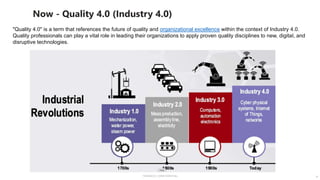
Now - Quality 4.0 (Industry 4.0)
"Quality 4.0" is a term that references the future of quality and organizational excellence within the context of Industry 4.0.
Quality professionals can play a vital role in leading their organizations to apply proven quality disciplines to new, digital, and
disruptive technologies.
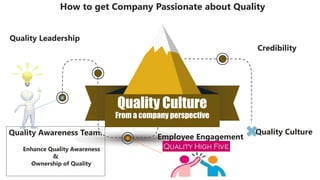
Quality Culture
From a company perspective
Quality Awareness Team.
Enhance Quality Awareness
&
Ownership of Quality
Employee Engagement
Quality Leadership
How to get Company Passionate about Quality
Credibility
Quality Culture
8
DIFFERENCES BETWEEN QA AND QC
9
TENNECO CONFIDENTIAL
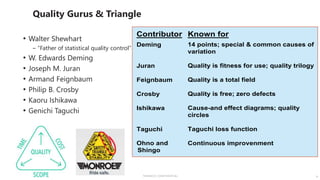
Quality Gurus & Triangle
• Walter Shewhart
− “Father of statistical quality control”
• W. Edwards Deming
• Joseph M. Juran
• Armand Feignbaum
• Philip B. Crosby
• Kaoru Ishikawa
• Genichi Taguchi
Contributor
Deming
Juran
Feignbaum
Crosby
Ishikawa
Taguchi
Ohno and
Shingo
Known for
14 points; special & common causes of
variation
Quality is fitness for use; quality trilogy
Quality is a total field
Quality is free; zero defects
Cause-and effect diagrams; quality
circles
Taguchi loss function
Continuous improvenment
Quality
10
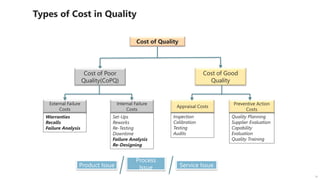
Types of Cost in Quality
Cost of Quality
Cost of Poor
Quality(CoPQ)
Cost of Good
Quality
External Failure
Costs
Internal Failure
Costs
Appraisal Costs
Preventive Action
Costs
Warranties
Recalls
Failure Analysis
Set-Ups
Reworks
Re-Testing
Downtime
Failure Analysis
Re-Designing
Inspection
Calibration
Testing
Audits
Quality Planning
Supplier Evaluation
Capability
Evaluation
Quality Training
Product Issue
Process
Issue Service Issue
11
Consequences of Poor Quality
Lost Productivity Lower Profit
12
TENNECO CONFIDENTIAL
Importance of Good Quality
13
TENNECO CONFIDENTIAL
Responsibility of Quality
 Top management
 Design
 Procurement
 Production/operations
 Quality assurance
 Packaging and shipping
 Marketing and sales
 Customer service
14
Dimensions of Quality
• Performance - main characteristics of the product/service
• Aesthetics - appearance, feel, smell, taste
• Special Features - extra characteristics
• Conformance - how well product/service conforms to customer’s expectations
• Reliability - consistency of performance
• Durability - useful life of the product/service
• Perceived Quality - indirect evaluation of quality (e.g. reputation)
• Serviceability - service after sale
15
TENNECO CONFIDENTIAL
Examples of Quality Dimensions
Dimension
1. Performance
2. Aesthetics
3. Special features
(Product)
Automobile
Everything works, fit &
finish
Ride, handling, grade of
materials used
Interior design, soft touch
Gauge/control placement
Cellular phone, CD
player
(Service)
Auto Repair
All work done, at agreed
price
Friendliness, courtesy,
Competency, quickness
Clean work/waiting area
Location, call when ready
Computer diagnostics
16
TENNECO CONFIDENTIAL
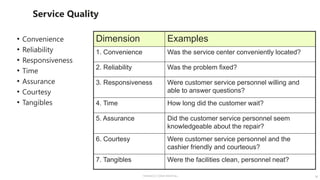
Service Quality
• Convenience
• Reliability
• Responsiveness
• Time
• Assurance
• Courtesy
• Tangibles
Dimension Examples
1. Convenience Was the service center conveniently located?
2. Reliability Was the problem fixed?
3. Responsiveness Were customer service personnel willing and
able to answer questions?
4. Time How long did the customer wait?
5. Assurance Did the customer service personnel seem
knowledgeable about the repair?
6. Courtesy Were customer service personnel and the
cashier friendly and courteous?
7. Tangibles Were the facilities clean, personnel neat?
17
TENNECO CONFIDENTIAL
Quality Certification
• ISO 9000 - Set of international standards on quality management and quality
assurance, critical to international business.
o System requirements
o Management
o Resource
o Realization
o Corrective
• ISO 14000 - set of international standards for assessing a company’s
environmental performance
oManagement systems
oOperations
oEnvironmental systems
18
TENNECO CONFIDENTIAL
Total Quality Management
A philosophy that involves everyone in an organization in a continual effort to improve quality
and achieve customer satisfaction.
T Q M
1.Find out what the customer wants
2.Design a product or service that meets or exceeds
customer wants
3.Design processes that facilitates doing the job right the
first time
4.Keep track of results
5.Extend these concepts to suppliers
The TQM Approach
1. Continual improvement
2. Competitive benchmarking
3. Employee empowerment
4. Team approach
5. Decisions based on facts
6. Knowledge of tools
7. Supplier quality
8. Champion
9. Quality at the source
10. Suppliers
TQM Elements
19
TENNECO CONFIDENTIAL
Obstacles to Implementing TQM
• Lack of:
− Company-wide definition of quality
− Strategic plan for change
− Customer focus
− Real employee empowerment
− Strong motivation
− Time to devote to quality initiatives
− Leadership
− Poor inter-organizational communication
− View of quality as a “quick fix”
− Emphasis on short-term financial results
− Internal political and “turf” wars
20
TENNECO CONFIDENTIAL
Problem Solving Philosophy
21
TENNECO CONFIDENTIAL
Basic Steps in Problem Solving
22
TENNECO CONFIDENTIAL
PLAN-DO-CHECK-ACT (PDCA) CYCLE
23
TENNECO CONFIDENTIAL
PDCA cycle in Kaizen
24
TENNECO CONFIDENTIAL
Six Sigma – DMAIC with Tools on each Phase
25
TENNECO CONFIDENTIAL
Quality Tools
26
TENNECO CONFIDENTIAL
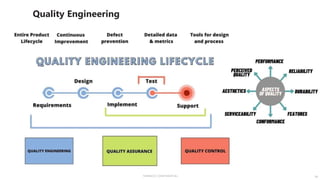
Quality Engineering
27
TENNECO CONFIDENTIAL
Quality Engineering

Quality Awareness Session.pptx

  • 1.
    What is Quality Ifyou are out of Quality, are out of business.
  • 2.
    When Is ItAcceptable to Make Mistakes? No Mistakes allowed
  • 3.
    “Quality is neveran accident; it is always the result of high intention, sincere effort, intelligent direction and skillful execution; it represents the wise choice of many alternatives.” William A. Foster Achieving Quality is a Serious Business
  • 4.
    4 The History ofQuality QUALITY IN THE INDUSTRIAL REVOLUTION Until the early 19th century, manufacturing in the industrialized world tended to follow this craftsmanship model. QUALITY IN WORLD WAR II After entering World War II, the United States enacted legislation to help gear the civilian economy to military production. During this period, quality became a critical component of the war effort and an important safety issue. QUALITY IN THE EARLY 20TH CENTURY The beginning of the 20th century marked the inclusion of "processes" in quality practices. A "process" is defined as a group of activities that takes an input, adds value to it, and provides an output. Walter Shewhart began to focus on controlling processes in the mid-1920s, making quality relevant not only for the finished product but for the processes that created it.
  • 5.
    5 The History ofQuality THE HISTORY OF TOTAL QUALITY IN AMERICA At first, Japan had a widely held reputation for shoddy exports, and their goods were shunned by international markets. This led Japanese organizations to explore new ways of thinking about quality. THE AMERICAN TOTAL QUALITY MANAGEMENT RESPONSE At first, U.S. manufacturers held onto to their assumption that Japanese success was price-related, and thus responded to Japanese competition with strategies aimed at reducing domestic production costs and restricting imports. The U.S. response, emphasizing not only statistics but approaches that embraced the entire organization, became known as Total Quality Management (TQM). BEYOND TOTAL QUALITY MANAGEMENT As the 21st century begins, the quality movement has matured. New quality systems have evolved beyond the foundations laid by Deming, Juran, and the early Japanese practitioners of quality. ISO 9001, SIX SIGMA, Quality Function deployment etc.
  • 6.
    6 TENNECO CONFIDENTIAL Now -Quality 4.0 (Industry 4.0) "Quality 4.0" is a term that references the future of quality and organizational excellence within the context of Industry 4.0. Quality professionals can play a vital role in leading their organizations to apply proven quality disciplines to new, digital, and disruptive technologies.
  • 7.
    Quality Culture From acompany perspective Quality Awareness Team. Enhance Quality Awareness & Ownership of Quality Employee Engagement Quality Leadership How to get Company Passionate about Quality Credibility Quality Culture
  • 8.
  • 9.
    9 TENNECO CONFIDENTIAL Quality Gurus& Triangle • Walter Shewhart − “Father of statistical quality control” • W. Edwards Deming • Joseph M. Juran • Armand Feignbaum • Philip B. Crosby • Kaoru Ishikawa • Genichi Taguchi Contributor Deming Juran Feignbaum Crosby Ishikawa Taguchi Ohno and Shingo Known for 14 points; special & common causes of variation Quality is fitness for use; quality trilogy Quality is a total field Quality is free; zero defects Cause-and effect diagrams; quality circles Taguchi loss function Continuous improvenment Quality
  • 10.
    10 Types of Costin Quality Cost of Quality Cost of Poor Quality(CoPQ) Cost of Good Quality External Failure Costs Internal Failure Costs Appraisal Costs Preventive Action Costs Warranties Recalls Failure Analysis Set-Ups Reworks Re-Testing Downtime Failure Analysis Re-Designing Inspection Calibration Testing Audits Quality Planning Supplier Evaluation Capability Evaluation Quality Training Product Issue Process Issue Service Issue
  • 11.
    11 Consequences of PoorQuality Lost Productivity Lower Profit
  • 12.
  • 13.
    13 TENNECO CONFIDENTIAL Responsibility ofQuality  Top management  Design  Procurement  Production/operations  Quality assurance  Packaging and shipping  Marketing and sales  Customer service
  • 14.
    14 Dimensions of Quality •Performance - main characteristics of the product/service • Aesthetics - appearance, feel, smell, taste • Special Features - extra characteristics • Conformance - how well product/service conforms to customer’s expectations • Reliability - consistency of performance • Durability - useful life of the product/service • Perceived Quality - indirect evaluation of quality (e.g. reputation) • Serviceability - service after sale
  • 15.
    15 TENNECO CONFIDENTIAL Examples ofQuality Dimensions Dimension 1. Performance 2. Aesthetics 3. Special features (Product) Automobile Everything works, fit & finish Ride, handling, grade of materials used Interior design, soft touch Gauge/control placement Cellular phone, CD player (Service) Auto Repair All work done, at agreed price Friendliness, courtesy, Competency, quickness Clean work/waiting area Location, call when ready Computer diagnostics
  • 16.
    16 TENNECO CONFIDENTIAL Service Quality •Convenience • Reliability • Responsiveness • Time • Assurance • Courtesy • Tangibles Dimension Examples 1. Convenience Was the service center conveniently located? 2. Reliability Was the problem fixed? 3. Responsiveness Were customer service personnel willing and able to answer questions? 4. Time How long did the customer wait? 5. Assurance Did the customer service personnel seem knowledgeable about the repair? 6. Courtesy Were customer service personnel and the cashier friendly and courteous? 7. Tangibles Were the facilities clean, personnel neat?
  • 17.
    17 TENNECO CONFIDENTIAL Quality Certification •ISO 9000 - Set of international standards on quality management and quality assurance, critical to international business. o System requirements o Management o Resource o Realization o Corrective • ISO 14000 - set of international standards for assessing a company’s environmental performance oManagement systems oOperations oEnvironmental systems
  • 18.
    18 TENNECO CONFIDENTIAL Total QualityManagement A philosophy that involves everyone in an organization in a continual effort to improve quality and achieve customer satisfaction. T Q M 1.Find out what the customer wants 2.Design a product or service that meets or exceeds customer wants 3.Design processes that facilitates doing the job right the first time 4.Keep track of results 5.Extend these concepts to suppliers The TQM Approach 1. Continual improvement 2. Competitive benchmarking 3. Employee empowerment 4. Team approach 5. Decisions based on facts 6. Knowledge of tools 7. Supplier quality 8. Champion 9. Quality at the source 10. Suppliers TQM Elements
  • 19.
    19 TENNECO CONFIDENTIAL Obstacles toImplementing TQM • Lack of: − Company-wide definition of quality − Strategic plan for change − Customer focus − Real employee empowerment − Strong motivation − Time to devote to quality initiatives − Leadership − Poor inter-organizational communication − View of quality as a “quick fix” − Emphasis on short-term financial results − Internal political and “turf” wars
  • 20.
  • 21.
  • 22.
  • 23.
  • 24.
    24 TENNECO CONFIDENTIAL Six Sigma– DMAIC with Tools on each Phase
  • 25.
  • 26.
  • 27.