ADVANCED
OPERATIONS
RESEARCH
By: -
Hakeem–Ur–Rehman
IQTM–PU 1
RA O
NETWORK MODELING/ANALYSIS:
APPLICATIONS OF
NETWORK OPTIMIZATION
2
APPLICATIONS
PHYSICAL ANALOG
OF NODES
PHYSICAL ANALOG
OF ARCS
FLOW
Communication
systems
phone exchanges,
computers,
transmission
facilities, satellites
Cables, fiber optic
links, microwave
relay links
Voice messages,
Data,
Video transmissions
Hydraulic systems
Pumping stations
Reservoirs, Lakes
Pipelines
Water, Gas, Oil,
Hydraulic fluids
Integrated
computer circuits
Gates, registers,
processors
Wires Electrical current
Mechanical systems Joints
Rods, Beams,
Springs
Heat, Energy
Transportation
systems
Intersections,
Airports,
Rail yards
Highways,
Airline routes
Railbeds
Passengers,
freight,
vehicles,
operators
NETWORKS ARE
EVERYWHERE
 Physical Networks
 Road Networks
 Railway Networks
 Airline traffic Networks
 Electrical networks, e.g., the power grid
 Abstract networks
 organizational charts
 precedence relationships in projects
 Others?
NETWORKS ANALYSIS:
DESCRIPTION
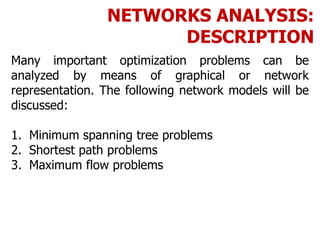
Many important optimization problems can be
analyzed by means of graphical or network
representation. The following network models will be
discussed:
1. Minimum spanning tree problems
2. Shortest path problems
3. Maximum flow problems
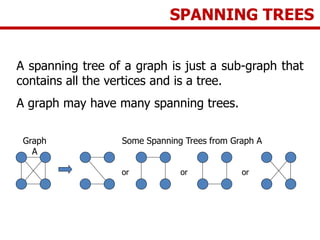
A spanning tree of a graph is just a sub-graph that
contains all the vertices and is a tree.
A graph may have many spanning trees.
or or or
Some Spanning Trees from Graph AGraph
A
SPANNING TREES
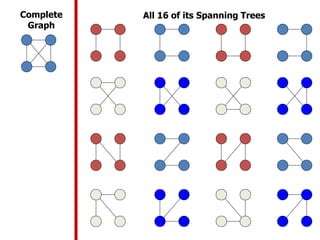
All 16 of its Spanning TreesComplete
Graph
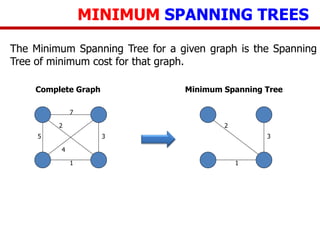
MINIMUM SPANNING TREES
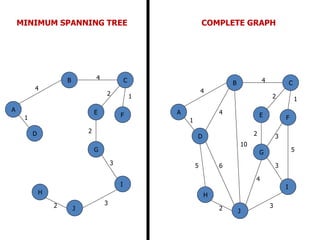
The Minimum Spanning Tree for a given graph is the Spanning
Tree of minimum cost for that graph.
5
7
2
1
3
4
2
1
3
Complete Graph Minimum Spanning Tree
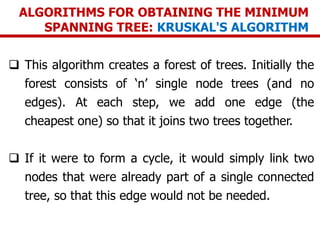
ALGORITHMS FOR OBTAINING THE MINIMUM
SPANNING TREE: KRUSKAL'S ALGORITHM
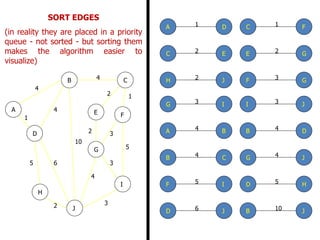
 This algorithm creates a forest of trees. Initially the
forest consists of ‘n’ single node trees (and no
edges). At each step, we add one edge (the
cheapest one) so that it joins two trees together.
 If it were to form a cycle, it would simply link two
nodes that were already part of a single connected
tree, so that this edge would not be needed.
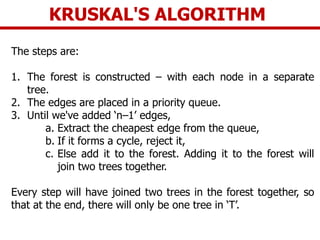
The steps are:
1. The forest is constructed – with each node in a separate
tree.
2. The edges are placed in a priority queue.
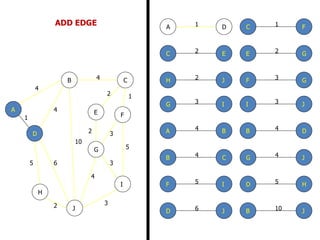
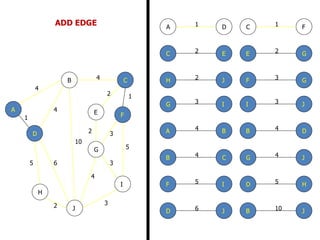
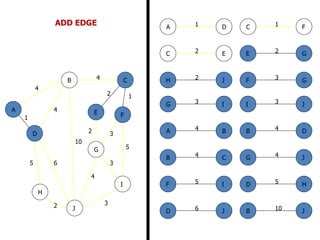
3. Until we've added ‘n–1’ edges,
a. Extract the cheapest edge from the queue,
b. If it forms a cycle, reject it,
c. Else add it to the forest. Adding it to the forest will
join two trees together.
Every step will have joined two trees in the forest together, so
that at the end, there will only be one tree in ‘T’.
KRUSKAL'S ALGORITHM
4
1
2 3
2 1
3
5
3
4
2
5 6
4
4
10
A
B C
D
E F
G
H
I
J
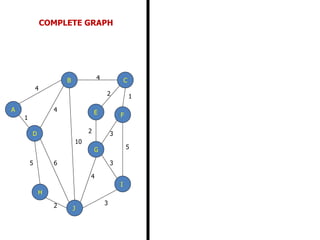
COMPLETE GRAPH
1
4
2
5
2
5
4
3
4
4
4
10
1
6
3
3
2
1
2 3
2 1
3
5
3
4
2
5 6
4
4
10
A
B C
D
E F
G
H
I
J
A AB D
B B
B
C D
J C
C
E
F
D
D H
J E G
F FG I
G GI J
H J JI
2
5
2
5
4
3
4
4
10
1
6
3
3
2
1
2 3
2 1
3
5
3
4
2
5 6
4
4
10
A
B C
D
E F
G
H
I
J
B
B
D
J
C
C
E
F
D
D H
J
E G
F
F
G
I
G
G
I
J
H J
JI
1A D
4B C
4A B
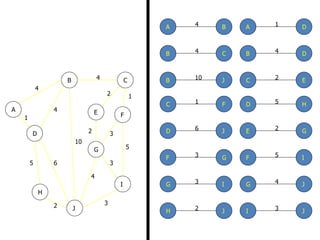
SORT EDGES
(in reality they are placed in a priority
queue - not sorted - but sorting them
makes the algorithm easier to
visualize)
2
5
2
5
4
3
4
4
10
1
6
3
3
2
1
2 3
2 1
3
5
3
4
2
5 6
4
4
10
A
B C
D
E F
G
H
I
J
B
B
D
J
C
C
E
F
D
D H
J
E G
F
F
G
I
G
G
I
J
H J
JI
1A D
4B C
4A B
ADD EDGE
2
5
2
5
4
3
4
4
10
1
6
3
3
2
1
2 3
2 1
3
5
3
4
2
5 6
4
4
10
A
B C
D
E F
G
H
I
J
B
B
D
J
C
C
E
F
D
D H
J
E G
F
F
G
I
G
G
I
J
H J
JI
1A D
4B C
4A B
ADD EDGE
2
5
2
5
4
3
4
4
10
1
6
3
3
2
1
2 3
2 1
3
5
3
4
2
5 6
4
4
10
A
B C
D
E F
G
H
I
J
B
B
D
J
C
C
E
F
D
D H
J
E G
F
F
G
I
G
G
I
J
H J
JI
1A D
4B C
4A B
ADD EDGE
2
5
2
5
4
3
4
4
10
1
6
3
3
2
1
2 3
2 1
3
5
3
4
2
5 6
4
4
10
A
B C
D
E F
G
H
I
J
B
B
D
J
C
C
E
F
D
D H
J
E G
F
F
G
I
G
G
I
J
H J
JI
1A D
4B C
4A B
ADD EDGE
2
5
2
5
4
3
4
4
10
1
6
3
3
2
1
2 3
2 1
3
5
3
4
2
5 6
4
4
10
A
B C
D
E F
G
H
I
J
B
B
D
J
C
C
E
F
D
D H
J
E G
F
F
G
I
G
G
I
J
H J
JI
1A D
4B C
4A B
ADD EDGE
2
5
2
5
4
3
4
4
10
1
6
3
3
2
1
2 3
2 1
3
5
3
4
2
5 6
4
4
10
A
B C
D
E F
G
H
I
J
B
B
D
J
C
C
E
F
D
D H
J
E G
F
F
G
I
G
G
I
J
H J
JI
1A D
4B C
4A B
CYCLE
DON’T ADD EDGE
2
5
2
5
4
3
4
4
10
1
6
3
3
2
1
2 3
2 1
3
5
3
4
2
5 6
4
4
10
A
B C
D
E F
G
H
I
J
B
B
D
J
C
C
E
F
D
D H
J
E G
F
F
G
I
G
G
I
J
H J
JI
1A D
4B C
4A B
ADD EDGE
2
5
2
5
4
3
4
4
10
1
6
3
3
2
1
2 3
2 1
3
5
3
4
2
5 6
4
4
10
A
B C
D
E F
G
H
I
J
B
B
D
J
C
C
E
F
D
D H
J
E G
F
F
G
I
G
G
I
J
H J
JI
1A D
4B C
4A B
ADD EDGE
2
5
2
5
4
3
4
4
10
1
6
3
3
2
1
2 3
2 1
3
5
3
4
2
5 6
4
4
10
A
B C
D
E F
G
H
I
J
B
B
D
J
C
C
E
F
D
D H
J
E G
F
F
G
I
G
G
I
J
H J
JI
1A D
4B C
4A B
ADD EDGE
2
5
2
5
4
3
4
4
10
1
6
3
3
2
1
2 3
2 1
3
5
3
4
2
5 6
4
4
10
A
B C
D
E F
G
H
I
J
B
B
D
J
C
C
E
F
D
D H
J
E G
F
F
G
I
G
G
I
J
H J
JI
1A D
4B C
4A B
CYCLE
DON’T ADD EDGE
2
5
2
5
4
3
4
4
10
1
6
3
3
2
1
2 3
2 1
3
5
3
4
2
5 6
4
4
10
A
B C
D
E F
G
H
I
J
B
B
D
J
C
C
E
F
D
D H
J
E G
F
F
G
I
G
G
I
J
H J
JI
1A D
4B C
4A B
ADD EDGE
4
1
2
2 1
3
32
4
A
B C
D
E F
G
H
I
J
4
1
2 3
2 1
3
5
3
4
2
5 6
4
4
10
A
B C
D
E F
G
H
I
J
MINIMUM SPANNING TREE COMPLETE GRAPH
SHORTEST PATH
PROBLEM:
FLOYD’S ALGORITHM
FLOYD’S ALGORITHM
Use to find the shortest path between any two nodes
in the network.
• Floyd’s algorithm represents an ‘n’ node network as a
square matrix with ‘n’ rows and ‘n’ columns.
• Where:
Dn = [ dij ] and Sn = Matrix of the node –
Sequence
• For matrix Dn: Entry (i, j) of the matrix gives the
distance dij from node – ‘i’ to node – ‘j’, which is finite
if ‘i’ is linked directly to ‘j’, and infinite otherwise.
FLOYD’S ALGORITHM
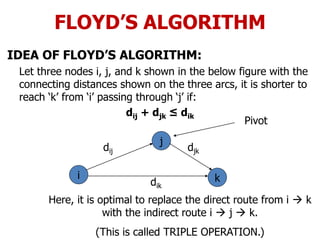
IDEA OF FLOYD’S ALGORITHM:
Let three nodes i, j, and k shown in the below figure with the
connecting distances shown on the three arcs, it is shorter to
reach ‘k’ from ‘i’ passing through ‘j’ if:
dij + djk ≤ dik
i k
j
dij djk
dik
Here, it is optimal to replace the direct route from i  k
with the indirect route i  j  k.
(This is called TRIPLE OPERATION.)
Pivot
FLOYD’S ALGORITHM
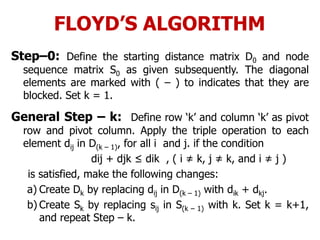
Step–0: Define the starting distance matrix D0 and node
sequence matrix S0 as given subsequently. The diagonal
elements are marked with ( – ) to indicates that they are
blocked. Set k = 1.
General Step – k: Define row ‘k’ and column ‘k’ as pivot
row and pivot column. Apply the triple operation to each
element dij in D(k – 1), for all i and j. if the condition
dij + djk ≤ dik , ( i ≠ k, j ≠ k, and i ≠ j )
is satisfied, make the following changes:
a) Create Dk by replacing dij in D(k – 1) with dik + dkj.
b) Create Sk by replacing sij in S(k – 1) with k. Set k = k+1,
and repeat Step – k.
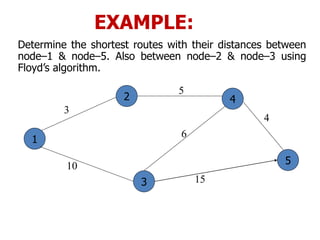
EXAMPLE:
Determine the shortest routes with their distances between
node–1 & node–5. Also between node–2 & node–3 using
Floyd’s algorithm.
1
2
3
4
5
3
10
5
15
4
6
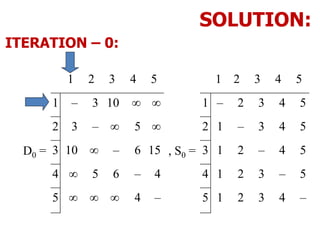
SOLUTION:
ITERATION – 0:
D0 =
1 2 3 4 5
, S0 =
1 2 3 4 5
1 – 3 10 ∞ ∞ 1 – 2 3 4 5
2 3 – ∞ 5 ∞ 2 1 – 3 4 5
3 10 ∞ – 6 15 3 1 2 – 4 5
4 ∞ 5 6 – 4 4 1 2 3 – 5
5 ∞ ∞ ∞ 4 – 5 1 2 3 4 –
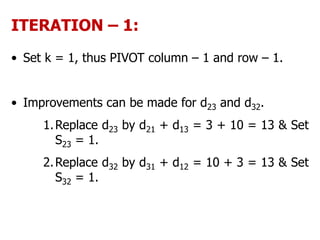
ITERATION – 1:
• Set k = 1, thus PIVOT column – 1 and row – 1.
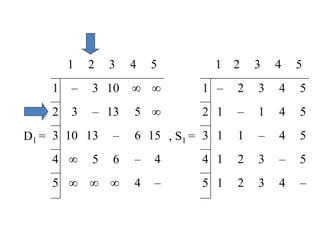
• Improvements can be made for d23 and d32.
1.Replace d23 by d21 + d13 = 3 + 10 = 13 & Set
S23 = 1.
2.Replace d32 by d31 + d12 = 10 + 3 = 13 & Set
S32 = 1.
D1 =
1 2 3 4 5
, S1 =
1 2 3 4 5
1 – 3 10 ∞ ∞ 1 – 2 3 4 5
2 3 – 13 5 ∞ 2 1 – 1 4 5
3 10 13 – 6 15 3 1 1 – 4 5
4 ∞ 5 6 – 4 4 1 2 3 – 5
5 ∞ ∞ ∞ 4 – 5 1 2 3 4 –
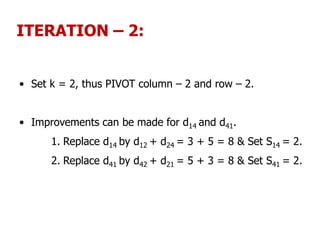
ITERATION – 2:
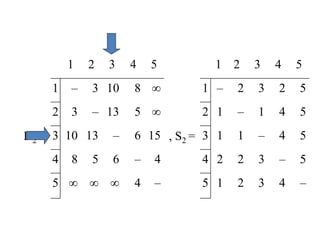
• Set k = 2, thus PIVOT column – 2 and row – 2.
• Improvements can be made for d14 and d41.
1. Replace d14 by d12 + d24 = 3 + 5 = 8 & Set S14 = 2.
2. Replace d41 by d42 + d21 = 5 + 3 = 8 & Set S41 = 2.
D2 =
1 2 3 4 5
, S2 =
1 2 3 4 5
1 – 3 10 8 ∞ 1 – 2 3 2 5
2 3 – 13 5 ∞ 2 1 – 1 4 5
3 10 13 – 6 15 3 1 1 – 4 5
4 8 5 6 – 4 4 2 2 3 – 5
5 ∞ ∞ ∞ 4 – 5 1 2 3 4 –
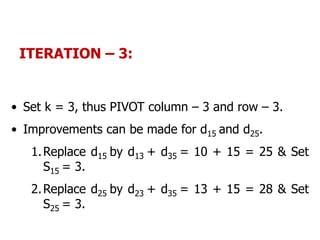
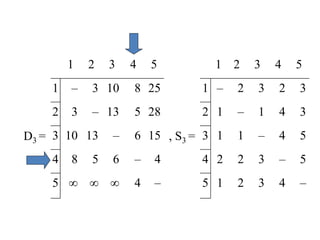
ITERATION – 3:
• Set k = 3, thus PIVOT column – 3 and row – 3.
• Improvements can be made for d15 and d25.
1.Replace d15 by d13 + d35 = 10 + 15 = 25 & Set
S15 = 3.
2.Replace d25 by d23 + d35 = 13 + 15 = 28 & Set
S25 = 3.
D3 =
1 2 3 4 5
, S3 =
1 2 3 4 5
1 – 3 10 8 25 1 – 2 3 2 3
2 3 – 13 5 28 2 1 – 1 4 3
3 10 13 – 6 15 3 1 1 – 4 5
4 8 5 6 – 4 4 2 2 3 – 5
5 ∞ ∞ ∞ 4 – 5 1 2 3 4 –
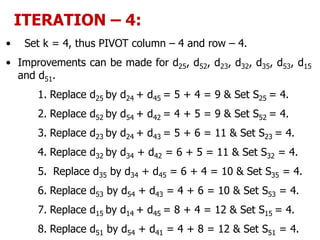
ITERATION – 4:
• Set k = 4, thus PIVOT column – 4 and row – 4.
• Improvements can be made for d25, d52, d23, d32, d35, d53, d15
and d51.
1. Replace d25 by d24 + d45 = 5 + 4 = 9 & Set S25 = 4.
2. Replace d52 by d54 + d42 = 4 + 5 = 9 & Set S52 = 4.
3. Replace d23 by d24 + d43 = 5 + 6 = 11 & Set S23 = 4.
4. Replace d32 by d34 + d42 = 6 + 5 = 11 & Set S32 = 4.
5. Replace d35 by d34 + d45 = 6 + 4 = 10 & Set S35 = 4.
6. Replace d53 by d54 + d43 = 4 + 6 = 10 & Set S53 = 4.
7. Replace d15 by d14 + d45 = 8 + 4 = 12 & Set S15 = 4.
8. Replace d51 by d54 + d41 = 4 + 8 = 12 & Set S51 = 4.
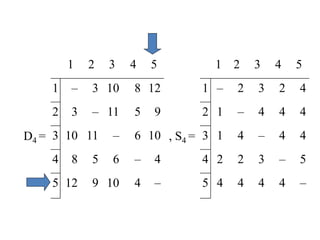
D4 =
1 2 3 4 5
, S4 =
1 2 3 4 5
1 – 3 10 8 12 1 – 2 3 2 4
2 3 – 11 5 9 2 1 – 4 4 4
3 10 11 – 6 10 3 1 4 – 4 4
4 8 5 6 – 4 4 2 2 3 – 5
5 12 9 10 4 – 5 4 4 4 4 –
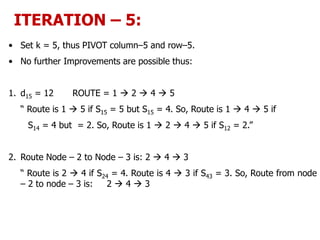
ITERATION – 5:
• Set k = 5, thus PIVOT column–5 and row–5.
• No further Improvements are possible thus:
1. d15 = 12 ROUTE = 1  2  4  5
“ Route is 1  5 if S15 = 5 but S15 = 4. So, Route is 1  4  5 if
S14 = 4 but = 2. So, Route is 1  2  4  5 if S12 = 2.”
2. Route Node – 2 to Node – 3 is: 2  4  3
“ Route is 2  4 if S24 = 4. Route is 4  3 if S43 = 3. So, Route from node
– 2 to node – 3 is: 2  4  3
MAXIMUM FLOW
ALGORITHM
MAXIMUM FLOW ALGORITHM
NOTATIONS:
Cij = Initial capacity of arc from node ‘ i ’ to node ‘ j ’.
Cji = Initial capacity of arc from node ‘ j ’ to node ‘ i ’.
Cij = Residual capacity of arc from node ‘ i ’ to node ‘ j ’.
Cji = Residual capacity of arc from node ‘ i ’ to node ‘ j ’.
[ aj , i ] = Denotes that aj amount of flow is received at node ‘
j’ from node ‘ i ’.
MAXIMUM FLOW ALGORITHM
Step_1: Set a1= ∞, then label node_1 as [∞, -].
Step_2: Si=Set of unlabelled nodes ‘ j ’ directly connected to node
‘ i ’ , with positive capacity i.e.: Cij>0.
Step_3: Determine Cik = Max { Cij }
For Example:
j ε Si
1
3
2
4
[∞, -]
5
10
8
[10,1]
S1 = { 2,3,4}
Max = { C12,C13,C14}
= C13
Thus, ak = Cik, label node_k {ak,i}
Set i = k, go to step_2.
MAXIMUM FLOW ALGORITHM
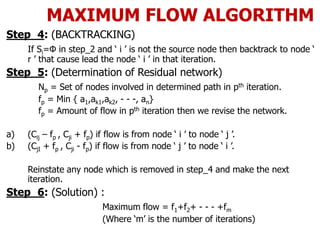
Step_4: (BACKTRACKING)
If Si=Φ in step_2 and ‘ i ’ is not the source node then backtrack to node ‘
r ’ that cause lead the node ‘ i ’ in that iteration.
Step_5: (Determination of Residual network)
Np = Set of nodes involved in determined path in pth iteration.
fp = Min { a1,ak1,ak2, - - -, an}
fp = Amount of flow in pth iteration then we revise the network.
a) (Cij – fp , Cji + fp) if flow is from node ‘ i ’ to node ‘ j ’.
b) (CjI + fp , Cji - fp) if flow is from node ‘ j ’ to node ‘ i ’.
Reinstate any node which is removed in step_4 and make the next
iteration.
Step_6: (Solution) :
Maximum flow = f1+f2+ - - - +fm
(Where ‘m’ is the number of iterations)
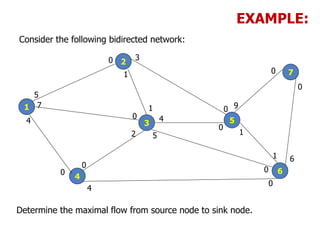
EXAMPLE:
Consider the following bidirected network:
1
2
3
4
Determine the maximal flow from source node to sink node.
5
7
6
5
7
4
3
1
4
52
4
9
1
1
0
0
0
0
0
0
0
0
1
0
0
6
SOLUTION:
Iteration_1: -
1
2
3
4
5
6
7
7
50
0
6
0[∞ , -] [7 , 1]
[5 , 3]
[6 , 6]
f1 = 5
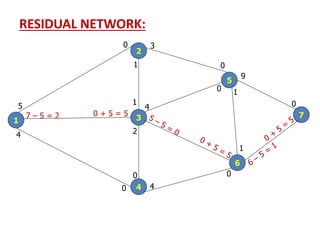
Now, We develop the Residual network from the
above network ---
RESIDUAL NETWORK:
1
2
3
4
5
6
77 – 5 = 2
4
4
0
1
3
0 + 5 = 5
0
0
0
5 1
2
4
0 1
9
0
0
1
SOLUTION:
Iteration_2: -
1
2
3
4
5
6
7
0
5
3 0 9
[∞ , -]
[5 , 1]
[9 , 5]
f2 = 3
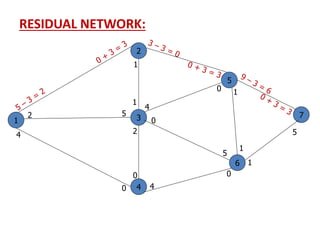
Now again, We develop the Residual network from
the above network ---
[3 , 2]
0
RESIDUAL NETWORK:
1
2
3
4
5
6
7
4
4
5
1
0
5
0
0
2
1
2
4
0 1
1
5
0
1
Solution:
Iteration_3: -
1
2
3
4
5
6
7
0
4
3 0 6
[∞ , -]
[6 , 5]
f3 = 4
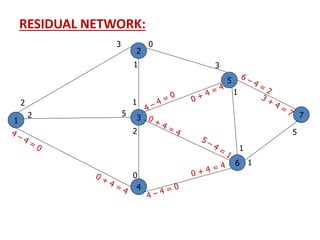
Now again, We develop the Residual network from
the above network ---
[4 , 1]
3
4 0
5
[4 , 4]
0
4[5 , 6]
[4 , 3]
RESIDUAL NETWORK:
1
2
3
4
5
6
7
2
5
1
3
0
2
1
2
0
1
1
5
3
1
Solution:
Iteration_4: -
1
2
3
4
5
6
7
2
4
1
[∞ , -]
[1 , 6]
f4 = 1
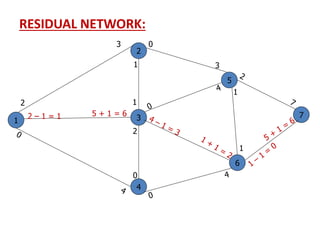
Now again, We develop the Residual network from
the above network ---
[4 , 6]
5
0 4
1
[4 , 3]
5
[2 , 1]
RESIDUAL NETWORK:
1
2
3
4
5
6
7
2
5 + 1 = 6
1
3
0
2 – 1 = 1
1
2
0
1
3
1
Solution:
Iteration_5: -
1
2
3
4
5
6
7
2
3
1
[∞ , -]
[2 , 5]
f5 = 1
Now again, We develop the Residual network from
the above network ---
[4 , 6]
7
0 4
2
[3 , 3]
[2 , 1]
3
1
1
[1 , 2]
1
[1 , 6]
2
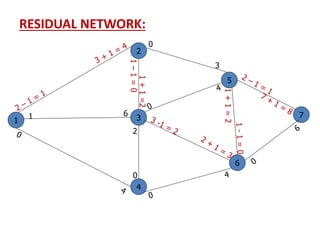
RESIDUAL NETWORK:
1
2
3
4
5
6
71 6
1–1=0
0
1+1=2
2
0
1+1=2
3
Solution:
Iteration_6: -
1
2
3
4
5
6
7
1
2
[∞ , -]
[4 , 6]
0 4
3
[2 , 3]
6
[1 , 1]
Now, There is no way to move towards sink node. So,
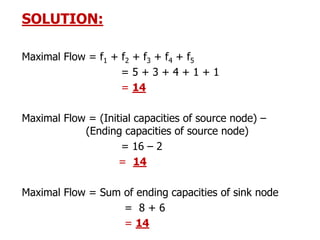
SOLUTION:
Maximal Flow = f1 + f2 + f3 + f4 + f5
= 5 + 3 + 4 + 1 + 1
= 14
Maximal Flow = (Initial capacities of source node) –
(Ending capacities of source node)
= 16 – 2
= 14
Maximal Flow = Sum of ending capacities of sink node
= 8 + 6
= 14
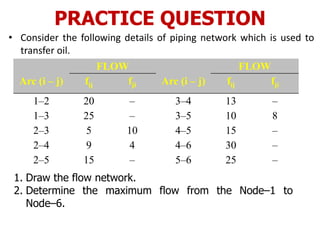
PRACTICE QUESTION
• Consider the following details of piping network which is used to
transfer oil.
FLOW FLOW
Arc (i – j) fij fji Arc (i – j) fij fji
1–2 20 – 3–4 13 –
1–3 25 – 3–5 10 8
2–3 5 10 4–5 15 –
2–4 9 4 4–6 30 –
2–5 15 – 5–6 25 –
1. Draw the flow network.
2. Determine the maximum flow from the Node–1 to
Node–6.
QUESTIONS
58

Network analysis

  • 1.
  • 2.
    APPLICATIONS OF NETWORK OPTIMIZATION 2 APPLICATIONS PHYSICALANALOG OF NODES PHYSICAL ANALOG OF ARCS FLOW Communication systems phone exchanges, computers, transmission facilities, satellites Cables, fiber optic links, microwave relay links Voice messages, Data, Video transmissions Hydraulic systems Pumping stations Reservoirs, Lakes Pipelines Water, Gas, Oil, Hydraulic fluids Integrated computer circuits Gates, registers, processors Wires Electrical current Mechanical systems Joints Rods, Beams, Springs Heat, Energy Transportation systems Intersections, Airports, Rail yards Highways, Airline routes Railbeds Passengers, freight, vehicles, operators
  • 3.
    NETWORKS ARE EVERYWHERE  PhysicalNetworks  Road Networks  Railway Networks  Airline traffic Networks  Electrical networks, e.g., the power grid  Abstract networks  organizational charts  precedence relationships in projects  Others?
  • 4.
    NETWORKS ANALYSIS: DESCRIPTION Many importantoptimization problems can be analyzed by means of graphical or network representation. The following network models will be discussed: 1. Minimum spanning tree problems 2. Shortest path problems 3. Maximum flow problems
  • 5.
    A spanning treeof a graph is just a sub-graph that contains all the vertices and is a tree. A graph may have many spanning trees. or or or Some Spanning Trees from Graph AGraph A SPANNING TREES
  • 6.
    All 16 ofits Spanning TreesComplete Graph
  • 7.
    MINIMUM SPANNING TREES TheMinimum Spanning Tree for a given graph is the Spanning Tree of minimum cost for that graph. 5 7 2 1 3 4 2 1 3 Complete Graph Minimum Spanning Tree
  • 8.
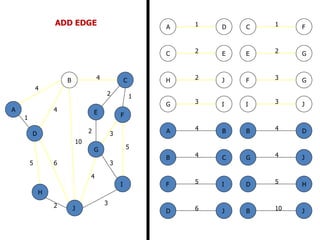
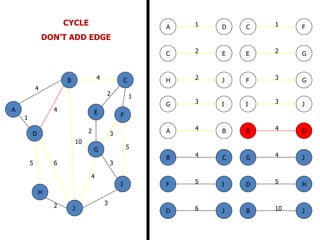
    ALGORITHMS FOR OBTAININGTHE MINIMUM SPANNING TREE: KRUSKAL'S ALGORITHM  This algorithm creates a forest of trees. Initially the forest consists of ‘n’ single node trees (and no edges). At each step, we add one edge (the cheapest one) so that it joins two trees together.  If it were to form a cycle, it would simply link two nodes that were already part of a single connected tree, so that this edge would not be needed.
  • 9.
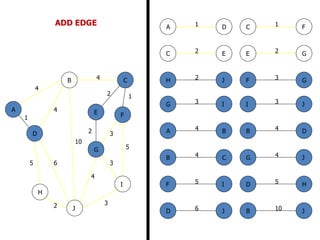
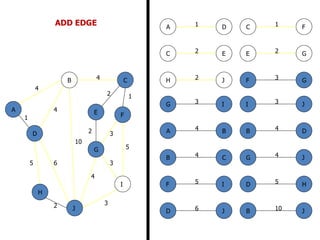
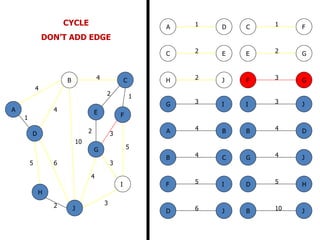
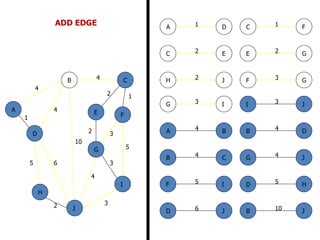
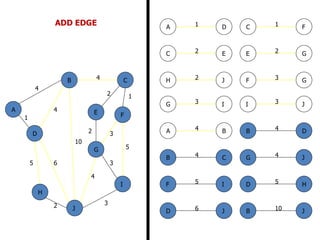
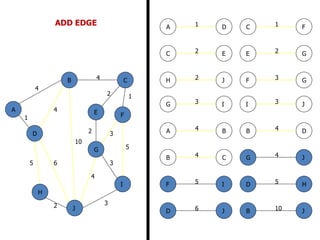
    The steps are: 1.The forest is constructed – with each node in a separate tree. 2. The edges are placed in a priority queue. 3. Until we've added ‘n–1’ edges, a. Extract the cheapest edge from the queue, b. If it forms a cycle, reject it, c. Else add it to the forest. Adding it to the forest will join two trees together. Every step will have joined two trees in the forest together, so that at the end, there will only be one tree in ‘T’. KRUSKAL'S ALGORITHM
  • 10.
    4 1 2 3 2 1 3 5 3 4 2 56 4 4 10 A B C D E F G H I J COMPLETE GRAPH
  • 11.
    1 4 2 5 2 5 4 3 4 4 4 10 1 6 3 3 2 1 2 3 2 1 3 5 3 4 2 56 4 4 10 A B C D E F G H I J A AB D B B B C D J C C E F D D H J E G F FG I G GI J H J JI
  • 12.
    2 5 2 5 4 3 4 4 10 1 6 3 3 2 1 2 3 2 1 3 5 3 4 2 56 4 4 10 A B C D E F G H I J B B D J C C E F D D H J E G F F G I G G I J H J JI 1A D 4B C 4A B SORT EDGES (in reality they are placed in a priority queue - not sorted - but sorting them makes the algorithm easier to visualize)
  • 13.
    2 5 2 5 4 3 4 4 10 1 6 3 3 2 1 2 3 2 1 3 5 3 4 2 56 4 4 10 A B C D E F G H I J B B D J C C E F D D H J E G F F G I G G I J H J JI 1A D 4B C 4A B ADD EDGE
  • 14.
    2 5 2 5 4 3 4 4 10 1 6 3 3 2 1 2 3 2 1 3 5 3 4 2 56 4 4 10 A B C D E F G H I J B B D J C C E F D D H J E G F F G I G G I J H J JI 1A D 4B C 4A B ADD EDGE
  • 15.
    2 5 2 5 4 3 4 4 10 1 6 3 3 2 1 2 3 2 1 3 5 3 4 2 56 4 4 10 A B C D E F G H I J B B D J C C E F D D H J E G F F G I G G I J H J JI 1A D 4B C 4A B ADD EDGE
  • 16.
    2 5 2 5 4 3 4 4 10 1 6 3 3 2 1 2 3 2 1 3 5 3 4 2 56 4 4 10 A B C D E F G H I J B B D J C C E F D D H J E G F F G I G G I J H J JI 1A D 4B C 4A B ADD EDGE
  • 17.
    2 5 2 5 4 3 4 4 10 1 6 3 3 2 1 2 3 2 1 3 5 3 4 2 56 4 4 10 A B C D E F G H I J B B D J C C E F D D H J E G F F G I G G I J H J JI 1A D 4B C 4A B ADD EDGE
  • 18.
    2 5 2 5 4 3 4 4 10 1 6 3 3 2 1 2 3 2 1 3 5 3 4 2 56 4 4 10 A B C D E F G H I J B B D J C C E F D D H J E G F F G I G G I J H J JI 1A D 4B C 4A B CYCLE DON’T ADD EDGE
  • 19.
    2 5 2 5 4 3 4 4 10 1 6 3 3 2 1 2 3 2 1 3 5 3 4 2 56 4 4 10 A B C D E F G H I J B B D J C C E F D D H J E G F F G I G G I J H J JI 1A D 4B C 4A B ADD EDGE
  • 20.
    2 5 2 5 4 3 4 4 10 1 6 3 3 2 1 2 3 2 1 3 5 3 4 2 56 4 4 10 A B C D E F G H I J B B D J C C E F D D H J E G F F G I G G I J H J JI 1A D 4B C 4A B ADD EDGE
  • 21.
    2 5 2 5 4 3 4 4 10 1 6 3 3 2 1 2 3 2 1 3 5 3 4 2 56 4 4 10 A B C D E F G H I J B B D J C C E F D D H J E G F F G I G G I J H J JI 1A D 4B C 4A B ADD EDGE
  • 22.
    2 5 2 5 4 3 4 4 10 1 6 3 3 2 1 2 3 2 1 3 5 3 4 2 56 4 4 10 A B C D E F G H I J B B D J C C E F D D H J E G F F G I G G I J H J JI 1A D 4B C 4A B CYCLE DON’T ADD EDGE
  • 23.
    2 5 2 5 4 3 4 4 10 1 6 3 3 2 1 2 3 2 1 3 5 3 4 2 56 4 4 10 A B C D E F G H I J B B D J C C E F D D H J E G F F G I G G I J H J JI 1A D 4B C 4A B ADD EDGE
  • 24.
    4 1 2 2 1 3 32 4 A B C D EF G H I J 4 1 2 3 2 1 3 5 3 4 2 5 6 4 4 10 A B C D E F G H I J MINIMUM SPANNING TREE COMPLETE GRAPH
  • 25.
  • 26.
    FLOYD’S ALGORITHM Use tofind the shortest path between any two nodes in the network. • Floyd’s algorithm represents an ‘n’ node network as a square matrix with ‘n’ rows and ‘n’ columns. • Where: Dn = [ dij ] and Sn = Matrix of the node – Sequence • For matrix Dn: Entry (i, j) of the matrix gives the distance dij from node – ‘i’ to node – ‘j’, which is finite if ‘i’ is linked directly to ‘j’, and infinite otherwise.
  • 27.
    FLOYD’S ALGORITHM IDEA OFFLOYD’S ALGORITHM: Let three nodes i, j, and k shown in the below figure with the connecting distances shown on the three arcs, it is shorter to reach ‘k’ from ‘i’ passing through ‘j’ if: dij + djk ≤ dik i k j dij djk dik Here, it is optimal to replace the direct route from i  k with the indirect route i  j  k. (This is called TRIPLE OPERATION.) Pivot
  • 28.
    FLOYD’S ALGORITHM Step–0: Definethe starting distance matrix D0 and node sequence matrix S0 as given subsequently. The diagonal elements are marked with ( – ) to indicates that they are blocked. Set k = 1. General Step – k: Define row ‘k’ and column ‘k’ as pivot row and pivot column. Apply the triple operation to each element dij in D(k – 1), for all i and j. if the condition dij + djk ≤ dik , ( i ≠ k, j ≠ k, and i ≠ j ) is satisfied, make the following changes: a) Create Dk by replacing dij in D(k – 1) with dik + dkj. b) Create Sk by replacing sij in S(k – 1) with k. Set k = k+1, and repeat Step – k.
  • 29.
    EXAMPLE: Determine the shortestroutes with their distances between node–1 & node–5. Also between node–2 & node–3 using Floyd’s algorithm. 1 2 3 4 5 3 10 5 15 4 6
  • 30.
    SOLUTION: ITERATION – 0: D0= 1 2 3 4 5 , S0 = 1 2 3 4 5 1 – 3 10 ∞ ∞ 1 – 2 3 4 5 2 3 – ∞ 5 ∞ 2 1 – 3 4 5 3 10 ∞ – 6 15 3 1 2 – 4 5 4 ∞ 5 6 – 4 4 1 2 3 – 5 5 ∞ ∞ ∞ 4 – 5 1 2 3 4 –
  • 31.
    ITERATION – 1: •Set k = 1, thus PIVOT column – 1 and row – 1. • Improvements can be made for d23 and d32. 1.Replace d23 by d21 + d13 = 3 + 10 = 13 & Set S23 = 1. 2.Replace d32 by d31 + d12 = 10 + 3 = 13 & Set S32 = 1.
  • 32.
    D1 = 1 23 4 5 , S1 = 1 2 3 4 5 1 – 3 10 ∞ ∞ 1 – 2 3 4 5 2 3 – 13 5 ∞ 2 1 – 1 4 5 3 10 13 – 6 15 3 1 1 – 4 5 4 ∞ 5 6 – 4 4 1 2 3 – 5 5 ∞ ∞ ∞ 4 – 5 1 2 3 4 –
  • 33.
    ITERATION – 2: •Set k = 2, thus PIVOT column – 2 and row – 2. • Improvements can be made for d14 and d41. 1. Replace d14 by d12 + d24 = 3 + 5 = 8 & Set S14 = 2. 2. Replace d41 by d42 + d21 = 5 + 3 = 8 & Set S41 = 2.
  • 34.
    D2 = 1 23 4 5 , S2 = 1 2 3 4 5 1 – 3 10 8 ∞ 1 – 2 3 2 5 2 3 – 13 5 ∞ 2 1 – 1 4 5 3 10 13 – 6 15 3 1 1 – 4 5 4 8 5 6 – 4 4 2 2 3 – 5 5 ∞ ∞ ∞ 4 – 5 1 2 3 4 –
  • 35.
    ITERATION – 3: •Set k = 3, thus PIVOT column – 3 and row – 3. • Improvements can be made for d15 and d25. 1.Replace d15 by d13 + d35 = 10 + 15 = 25 & Set S15 = 3. 2.Replace d25 by d23 + d35 = 13 + 15 = 28 & Set S25 = 3.
  • 36.
    D3 = 1 23 4 5 , S3 = 1 2 3 4 5 1 – 3 10 8 25 1 – 2 3 2 3 2 3 – 13 5 28 2 1 – 1 4 3 3 10 13 – 6 15 3 1 1 – 4 5 4 8 5 6 – 4 4 2 2 3 – 5 5 ∞ ∞ ∞ 4 – 5 1 2 3 4 –
  • 37.
    ITERATION – 4: •Set k = 4, thus PIVOT column – 4 and row – 4. • Improvements can be made for d25, d52, d23, d32, d35, d53, d15 and d51. 1. Replace d25 by d24 + d45 = 5 + 4 = 9 & Set S25 = 4. 2. Replace d52 by d54 + d42 = 4 + 5 = 9 & Set S52 = 4. 3. Replace d23 by d24 + d43 = 5 + 6 = 11 & Set S23 = 4. 4. Replace d32 by d34 + d42 = 6 + 5 = 11 & Set S32 = 4. 5. Replace d35 by d34 + d45 = 6 + 4 = 10 & Set S35 = 4. 6. Replace d53 by d54 + d43 = 4 + 6 = 10 & Set S53 = 4. 7. Replace d15 by d14 + d45 = 8 + 4 = 12 & Set S15 = 4. 8. Replace d51 by d54 + d41 = 4 + 8 = 12 & Set S51 = 4.
  • 38.
    D4 = 1 23 4 5 , S4 = 1 2 3 4 5 1 – 3 10 8 12 1 – 2 3 2 4 2 3 – 11 5 9 2 1 – 4 4 4 3 10 11 – 6 10 3 1 4 – 4 4 4 8 5 6 – 4 4 2 2 3 – 5 5 12 9 10 4 – 5 4 4 4 4 –
  • 39.
    ITERATION – 5: •Set k = 5, thus PIVOT column–5 and row–5. • No further Improvements are possible thus: 1. d15 = 12 ROUTE = 1  2  4  5 “ Route is 1  5 if S15 = 5 but S15 = 4. So, Route is 1  4  5 if S14 = 4 but = 2. So, Route is 1  2  4  5 if S12 = 2.” 2. Route Node – 2 to Node – 3 is: 2  4  3 “ Route is 2  4 if S24 = 4. Route is 4  3 if S43 = 3. So, Route from node – 2 to node – 3 is: 2  4  3
  • 40.
  • 41.
    MAXIMUM FLOW ALGORITHM NOTATIONS: Cij= Initial capacity of arc from node ‘ i ’ to node ‘ j ’. Cji = Initial capacity of arc from node ‘ j ’ to node ‘ i ’. Cij = Residual capacity of arc from node ‘ i ’ to node ‘ j ’. Cji = Residual capacity of arc from node ‘ i ’ to node ‘ j ’. [ aj , i ] = Denotes that aj amount of flow is received at node ‘ j’ from node ‘ i ’.
  • 42.
    MAXIMUM FLOW ALGORITHM Step_1:Set a1= ∞, then label node_1 as [∞, -]. Step_2: Si=Set of unlabelled nodes ‘ j ’ directly connected to node ‘ i ’ , with positive capacity i.e.: Cij>0. Step_3: Determine Cik = Max { Cij } For Example: j ε Si 1 3 2 4 [∞, -] 5 10 8 [10,1] S1 = { 2,3,4} Max = { C12,C13,C14} = C13 Thus, ak = Cik, label node_k {ak,i} Set i = k, go to step_2.
  • 43.
    MAXIMUM FLOW ALGORITHM Step_4:(BACKTRACKING) If Si=Φ in step_2 and ‘ i ’ is not the source node then backtrack to node ‘ r ’ that cause lead the node ‘ i ’ in that iteration. Step_5: (Determination of Residual network) Np = Set of nodes involved in determined path in pth iteration. fp = Min { a1,ak1,ak2, - - -, an} fp = Amount of flow in pth iteration then we revise the network. a) (Cij – fp , Cji + fp) if flow is from node ‘ i ’ to node ‘ j ’. b) (CjI + fp , Cji - fp) if flow is from node ‘ j ’ to node ‘ i ’. Reinstate any node which is removed in step_4 and make the next iteration. Step_6: (Solution) : Maximum flow = f1+f2+ - - - +fm (Where ‘m’ is the number of iterations)
  • 44.
    EXAMPLE: Consider the followingbidirected network: 1 2 3 4 Determine the maximal flow from source node to sink node. 5 7 6 5 7 4 3 1 4 52 4 9 1 1 0 0 0 0 0 0 0 0 1 0 0 6
  • 45.
    SOLUTION: Iteration_1: - 1 2 3 4 5 6 7 7 50 0 6 0[∞ ,-] [7 , 1] [5 , 3] [6 , 6] f1 = 5 Now, We develop the Residual network from the above network ---
  • 46.
    RESIDUAL NETWORK: 1 2 3 4 5 6 77 –5 = 2 4 4 0 1 3 0 + 5 = 5 0 0 0 5 1 2 4 0 1 9 0 0 1
  • 47.
    SOLUTION: Iteration_2: - 1 2 3 4 5 6 7 0 5 3 09 [∞ , -] [5 , 1] [9 , 5] f2 = 3 Now again, We develop the Residual network from the above network --- [3 , 2] 0
  • 48.
  • 49.
    Solution: Iteration_3: - 1 2 3 4 5 6 7 0 4 3 06 [∞ , -] [6 , 5] f3 = 4 Now again, We develop the Residual network from the above network --- [4 , 1] 3 4 0 5 [4 , 4] 0 4[5 , 6] [4 , 3]
  • 50.
  • 51.
    Solution: Iteration_4: - 1 2 3 4 5 6 7 2 4 1 [∞ ,-] [1 , 6] f4 = 1 Now again, We develop the Residual network from the above network --- [4 , 6] 5 0 4 1 [4 , 3] 5 [2 , 1]
  • 52.
    RESIDUAL NETWORK: 1 2 3 4 5 6 7 2 5 +1 = 6 1 3 0 2 – 1 = 1 1 2 0 1 3 1
  • 53.
    Solution: Iteration_5: - 1 2 3 4 5 6 7 2 3 1 [∞ ,-] [2 , 5] f5 = 1 Now again, We develop the Residual network from the above network --- [4 , 6] 7 0 4 2 [3 , 3] [2 , 1] 3 1 1 [1 , 2] 1 [1 , 6] 2
  • 54.
  • 55.
    Solution: Iteration_6: - 1 2 3 4 5 6 7 1 2 [∞ ,-] [4 , 6] 0 4 3 [2 , 3] 6 [1 , 1] Now, There is no way to move towards sink node. So,
  • 56.
    SOLUTION: Maximal Flow =f1 + f2 + f3 + f4 + f5 = 5 + 3 + 4 + 1 + 1 = 14 Maximal Flow = (Initial capacities of source node) – (Ending capacities of source node) = 16 – 2 = 14 Maximal Flow = Sum of ending capacities of sink node = 8 + 6 = 14
  • 57.
    PRACTICE QUESTION • Considerthe following details of piping network which is used to transfer oil. FLOW FLOW Arc (i – j) fij fji Arc (i – j) fij fji 1–2 20 – 3–4 13 – 1–3 25 – 3–5 10 8 2–3 5 10 4–5 15 – 2–4 9 4 4–6 30 – 2–5 15 – 5–6 25 – 1. Draw the flow network. 2. Determine the maximum flow from the Node–1 to Node–6.
  • 58.