MSA
MEASUREMENT SYSTEM
ANALYSIS
INTRODUCTION:
• The process of Measurement involves variation.
• Any measurement that is taken is made up of the true
value and the error.
• The error is made up of variation inherent in the measuring
equipment and the individual or method us in measuring
• It is important to assess the quality of the measurement
system that generate that measurements on which a facility
depends.
• Total variation = Product variation + Measurement
variation
• MSA applies to all measurement system stated in control
plan.
PURPOSE :
• The purpose of analysis of measurement system
is to better understanding the sources of
variation that can influence the result produced
by the system.
• This understanding will allow us to quantify and
communicate the limitation of specific
measurement system.
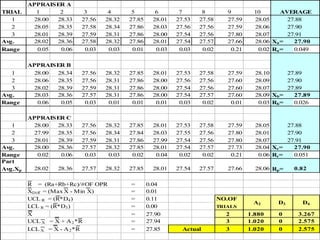
FUNDAMENTALS ISSUES.
Three fundamentals issue need to be address in evaluating
a measurement system.
1. Adequate discrimination.(The amount of change from
reference value that an instrument can detect and faithfully
indicated , is also referred as readability or resolution)
A common rule of thumb :
• The gauge should have graduations that allows for at least
one tenth of the smaller of either:
- The specification limits (Tolerance Spread)
- The process variability.
FUNDAMENTALS ISSUES.
2. The measurement system must be stable over time
3. The measurement error (Measurement system variability)
must be small compare to:
• The tolerance spread (Specification Limits)
• The process Variability.
ANALYSIS OF MEASUREMENT SYSTEM
The distribution that can be used to describe the
measurement system`s variation can be characterized by:
1. Width or spread
• Repeatability
• Reproducibility
2. Location
• Accuracy
• Stability
• Bias
• Linearity
The Repeatability and Reproducibility are often major
contributors to variations in the measurement system.
The measurement system analysis therefore consists of
evaluating the 6 properties of system in a statistical
manner i.e Repeatability, Reproducibility, Accuracy, Bias
Linearity and stability.
ACCURACY :
Closeness to the true value or to an acceptance reference
value
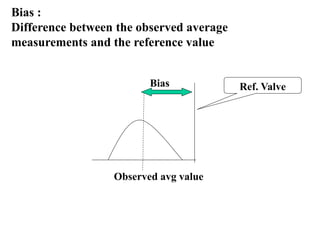
Bias :
Difference between the observed average
measurements and the reference value
Observed avg value
Ref. ValveBias
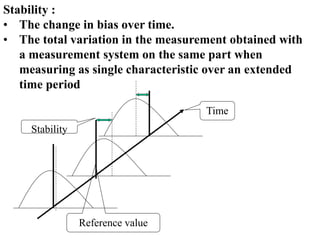
Stability :
• The change in bias over time.
• The total variation in the measurement obtained with
a measurement system on the same part when
measuring as single characteristic over an extended
time period
Reference value
Time
Stability
LINEARITY :
• The change in bias over the normal operating range.
• The correlation of multiple and independent bias
errors over the operating range .
Reference value
Reference value
Bias Bias
Repeatability:
• Is the variation in the measurements obtained with
one measurement instrument when used
several times by same person while measuring
the identical characteristic in the same part
Repeatability
Reproducibility :
• Is the variation in the average of measurements made
by different persons using the same
measuring instrument while measuring the same
characteristic in the same part
Reproducibility
A B C
WHEN TO DO MSA
The measurement system study analysis is also called
gauge R&R study . This study may be required in the
following situations:
• A required component: for calculating process
variation and acceptability of production process.
• A new measuring equipment for acceptance.
• Comparison of one measuring device against the
other.
• MSA is a must for all measuring system referenced in
customer approved control plan.
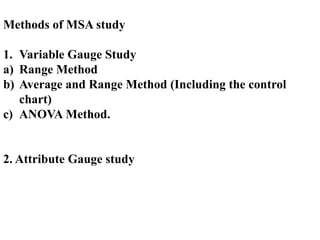
Methods of MSA study
1. Variable Gauge Study
a) Range Method
b) Average and Range Method (Including the control
chart)
c) ANOVA Method.
2. Attribute Gauge study
PREPARATION FOR MEASUREMENT STSTEM
STUDY
Sufficient planning and preparation should be done prior
to conducting a study
1. Sample part must be selected from process and
represent its entire operating range.
2. The appraiser chosen should be selected from those who
normally operate the instrument.
PREPARATION FOR MEASUREMENT STSTEM
STUDY
3. The instrument must have a discrimination that allows
at least one tenth of the expected process variation.
4. The measurements should be made in random error. A
possible bias in measurements is to be avoided.
RANGE METHOD
Is a modified variable gage study which will provide a
quick approximation of measurement variability.
This method provide only the overall picture of the
measurement system. It does not decompose the variability
into repeatability and reproducibility.
It is typically used as a quick check to verify that GRR has
not changed.
The range method typically uses two appraiser and five
parts for study.
Both appraiser measure each part once.
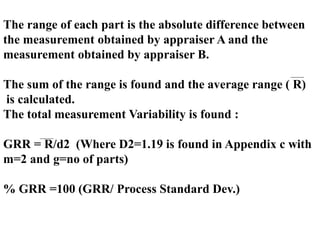
The range of each part is the absolute difference between
the measurement obtained by appraiser A and the
measurement obtained by appraiser B.
The sum of the range is found and the average range ( R)
is calculated.
The total measurement Variability is found :
GRR = R/d2 (Where D2=1.19 is found in Appendix c with
m=2 and g=no of parts)
% GRR =100 (GRR/ Process Standard Dev.)
AVERAGE AND RANGE METHOD
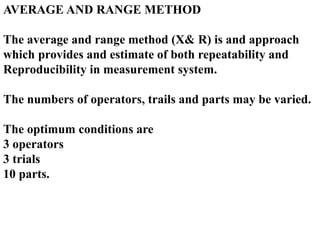
The average and range method (X& R) is and approach
which provides and estimate of both repeatability and
Reproducibility in measurement system.
The numbers of operators, trails and parts may be varied.
The optimum conditions are
3 operators
3 trials
10 parts.
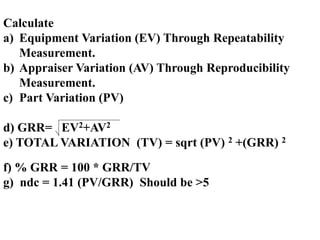
Calculate
a) Equipment Variation (EV) Through Repeatability
Measurement.
b) Appraiser Variation (AV) Through Reproducibility
Measurement.
c) Part Variation (PV)
d) GRR= EV2+AV2
e) TOTAL VARIATION (TV) = sqrt (PV) 2 +(GRR) 2
f) % GRR = 100 * GRR/TV
g) ndc = 1.41 (PV/GRR) Should be >5
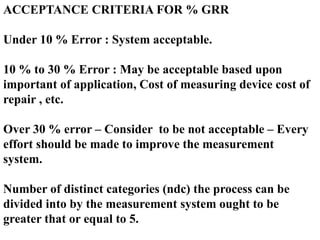
ACCEPTANCE CRITERIA FOR % GRR
Under 10 % Error : System acceptable.
10 % to 30 % Error : May be acceptable based upon
important of application, Cost of measuring device cost of
repair , etc.
Over 30 % error – Consider to be not acceptable – Every
effort should be made to improve the measurement
system.
Number of distinct categories (ndc) the process can be
divided into by the measurement system ought to be
greater that or equal to 5.
Average Chart
The averages of the the multiple readings by each
appraiser on each part are plotted by appraiser with part
number as index.
Help in determining consistency between appraisers.
The area within the control limits represents the
measurement sensitivity.
Average Chart
Approx one half or more the average should fall outside
the control limits . If the data show this pattern than the
measurement system should be adequate to detect part -to-
part variation and measurement system can provided
useful information for analyzing and controlling the
process.
If less than half fall outside the control limits then either
the measurement system lack adequate effective resolution
or the sample does not represent the expected process
variation.
RANGE CHARTS
Is used to determine whether the process is in control
If all range are in control , all appraisers are doing the
same job.
If all appraisers have some out of control ranges, the
measurement system is sensitive to appraiser technique
and needs improvement to obtain useful data.
APPRAISER A
TRIAL 1 2 3 4 5 6 7 8 9 10
1 28.00 28.33 27.56 28.32 27.85 28.01 27.53 27.58 27.59 28.05
2 28.05 28.35 27.58 28.34 27.86 28.03 27.56 27.56 27.59 28.06
3 28.01 28.39 27.59 28.31 27.86 28.00 27.54 27.56 27.80 28.07
Avg. 28.02 28.36 27.58 28.32 27.86 28.01 27.54 27.57 27.66 28.06 Xa= 27.90
Range 0.05 0.06 0.03 0.03 0.01 0.03 0.03 0.02 0.21 0.02 Ra= 0.049
APPRAISER B
1 28.00 28.34 27.56 28.32 27.85 28.01 27.53 27.58 27.59 28.10
2 28.06 28.35 27.56 28.31 27.86 28.00 27.56 27.56 27.60 28.09
3 28.02 28.39 27.59 28.31 27.86 28.00 27.54 27.56 27.60 28.07
Avg. 28.03 28.36 27.57 28.31 27.86 28.00 27.54 27.57 27.60 28.09 Xb= 27.89
Range 0.06 0.05 0.03 0.01 0.01 0.01 0.03 0.02 0.01 0.03 Rb= 0.026
APPRAISER C
1 28.00 28.33 27.56 28.32 27.85 28.01 27.53 27.58 27.59 28.05
2 27.99 28.35 27.56 28.34 27.84 28.03 27.55 27.56 27.80 28.01
3 28.01 28.39 27.59 28.31 27.86 27.99 27.54 27.56 27.80 28.07
Avg. 28.00 28.36 27.57 28.32 27.85 28.01 27.54 27.57 27.73 28.04 Xc= 27.90
Range 0.02 0.06 0.03 0.03 0.02 0.04 0.02 0.02 0.21 0.06 Rc= 0.051
Part
Avg.Xp 28.02 28.36 27.57 28.32 27.85 28.01 27.54 27.57 27.66 28.06 Rp= 0.82
R = (Ra+Rb+Rc)/#OF OPR = 0.04
XDiff = (MaxX - Min X) = 0.01
UCL R = (R*D4) = 0.11 NO.OF
LCL R = (R*D3) = 0.00 TRIALS
X = 27.90 2 1.880 0 3.267
= 27.94 3 1.020 0 2.575
= 27.85 3 1.020 0 2.575
27.89
27.90
AVERAGE
27.89
A2 D3
27.88
27.90
27.91
D4
Actual
UCL X = X + A2*R
LCL X = X - A2*R
27.88
27.90
27.91
REPEATABILITY-EQUIPMENT VARIATION(EV)
TRIAL: K1
2 0.8862
EV = R*K1 = 0.0248 3 0.5908
3 0.5908
REPRODUCIBILITY-APPRAISER VARIATION
OPERATOR : K2
AV = [(Xdiff*K2)2
-(EV2
/nr)] 2 0.7071
AV = 0.00 3 0.5231
3 0.5231
REPEATABILITY & REPRODUCIBILITY
R&R = (EV2
+ AV2
)
R&R = 0.02
PART VARIATION (PV)
PV = Rp*K3 = 0.26
PART K3
TOTAL VARIATION (TV) 2 0.7071
TV = (R&R2
+ PV2
) 3 0.5231
TV = 0.26 4 0.4467
% EV = 10 5 0.4030
6 0.3742
% AV = 0 7 0.3534
8 0.3375
% R&R = 10 9 0.3249
10 0.3146
% PV = 100 10 0.3146
Actual
Actual
MEASUREMENT UNIT ANALYSIS
Actual
0.00
5.00
10.00
15.00
20.00
25.00
30.00
1 2 3 4 5 6 7 8 9 10
0.00
5.00
10.00
15.00
20.00
25.00
30.00
1 2 3 4 5 6 7 8 9 10
0.000
5.000
10.000
15.000
20.000
25.000
30.000
1 2 3 4 5 6 7 8 9 10
0.00
0.05
0.10
0.15
0.20
0.25
1 2 3 4 5 6 7 8 9 10
0.00
0.05
0.10
0.15
1 2 3 4 5 6 7 8 9 10
0.00
0.05
0.10
0.15
0.20
0.25
1 2 3 4 5 6 7 8 9 10

MSA

  • 1.
  • 2.
    INTRODUCTION: • The processof Measurement involves variation. • Any measurement that is taken is made up of the true value and the error. • The error is made up of variation inherent in the measuring equipment and the individual or method us in measuring • It is important to assess the quality of the measurement system that generate that measurements on which a facility depends. • Total variation = Product variation + Measurement variation • MSA applies to all measurement system stated in control plan.
  • 3.
    PURPOSE : • Thepurpose of analysis of measurement system is to better understanding the sources of variation that can influence the result produced by the system. • This understanding will allow us to quantify and communicate the limitation of specific measurement system.
  • 4.
    FUNDAMENTALS ISSUES. Three fundamentalsissue need to be address in evaluating a measurement system. 1. Adequate discrimination.(The amount of change from reference value that an instrument can detect and faithfully indicated , is also referred as readability or resolution) A common rule of thumb : • The gauge should have graduations that allows for at least one tenth of the smaller of either: - The specification limits (Tolerance Spread) - The process variability.
  • 5.
    FUNDAMENTALS ISSUES. 2. Themeasurement system must be stable over time 3. The measurement error (Measurement system variability) must be small compare to: • The tolerance spread (Specification Limits) • The process Variability.
  • 6.
    ANALYSIS OF MEASUREMENTSYSTEM The distribution that can be used to describe the measurement system`s variation can be characterized by: 1. Width or spread • Repeatability • Reproducibility 2. Location • Accuracy • Stability • Bias • Linearity
  • 7.
    The Repeatability andReproducibility are often major contributors to variations in the measurement system. The measurement system analysis therefore consists of evaluating the 6 properties of system in a statistical manner i.e Repeatability, Reproducibility, Accuracy, Bias Linearity and stability. ACCURACY : Closeness to the true value or to an acceptance reference value
  • 8.
    Bias : Difference betweenthe observed average measurements and the reference value Observed avg value Ref. ValveBias
  • 9.
    Stability : • Thechange in bias over time. • The total variation in the measurement obtained with a measurement system on the same part when measuring as single characteristic over an extended time period Reference value Time Stability
  • 10.
    LINEARITY : • Thechange in bias over the normal operating range. • The correlation of multiple and independent bias errors over the operating range . Reference value Reference value Bias Bias
  • 11.
    Repeatability: • Is thevariation in the measurements obtained with one measurement instrument when used several times by same person while measuring the identical characteristic in the same part Repeatability
  • 12.
    Reproducibility : • Isthe variation in the average of measurements made by different persons using the same measuring instrument while measuring the same characteristic in the same part Reproducibility A B C
  • 13.
    WHEN TO DOMSA The measurement system study analysis is also called gauge R&R study . This study may be required in the following situations: • A required component: for calculating process variation and acceptability of production process. • A new measuring equipment for acceptance. • Comparison of one measuring device against the other. • MSA is a must for all measuring system referenced in customer approved control plan.
  • 14.
    Methods of MSAstudy 1. Variable Gauge Study a) Range Method b) Average and Range Method (Including the control chart) c) ANOVA Method. 2. Attribute Gauge study
  • 15.
    PREPARATION FOR MEASUREMENTSTSTEM STUDY Sufficient planning and preparation should be done prior to conducting a study 1. Sample part must be selected from process and represent its entire operating range. 2. The appraiser chosen should be selected from those who normally operate the instrument.
  • 16.
    PREPARATION FOR MEASUREMENTSTSTEM STUDY 3. The instrument must have a discrimination that allows at least one tenth of the expected process variation. 4. The measurements should be made in random error. A possible bias in measurements is to be avoided.
  • 17.
    RANGE METHOD Is amodified variable gage study which will provide a quick approximation of measurement variability. This method provide only the overall picture of the measurement system. It does not decompose the variability into repeatability and reproducibility. It is typically used as a quick check to verify that GRR has not changed. The range method typically uses two appraiser and five parts for study. Both appraiser measure each part once.
  • 18.
    The range ofeach part is the absolute difference between the measurement obtained by appraiser A and the measurement obtained by appraiser B. The sum of the range is found and the average range ( R) is calculated. The total measurement Variability is found : GRR = R/d2 (Where D2=1.19 is found in Appendix c with m=2 and g=no of parts) % GRR =100 (GRR/ Process Standard Dev.)
  • 19.
    AVERAGE AND RANGEMETHOD The average and range method (X& R) is and approach which provides and estimate of both repeatability and Reproducibility in measurement system. The numbers of operators, trails and parts may be varied. The optimum conditions are 3 operators 3 trials 10 parts.
  • 20.
    Calculate a) Equipment Variation(EV) Through Repeatability Measurement. b) Appraiser Variation (AV) Through Reproducibility Measurement. c) Part Variation (PV) d) GRR= EV2+AV2 e) TOTAL VARIATION (TV) = sqrt (PV) 2 +(GRR) 2 f) % GRR = 100 * GRR/TV g) ndc = 1.41 (PV/GRR) Should be >5
  • 21.
    ACCEPTANCE CRITERIA FOR% GRR Under 10 % Error : System acceptable. 10 % to 30 % Error : May be acceptable based upon important of application, Cost of measuring device cost of repair , etc. Over 30 % error – Consider to be not acceptable – Every effort should be made to improve the measurement system. Number of distinct categories (ndc) the process can be divided into by the measurement system ought to be greater that or equal to 5.
  • 22.
    Average Chart The averagesof the the multiple readings by each appraiser on each part are plotted by appraiser with part number as index. Help in determining consistency between appraisers. The area within the control limits represents the measurement sensitivity.
  • 23.
    Average Chart Approx onehalf or more the average should fall outside the control limits . If the data show this pattern than the measurement system should be adequate to detect part -to- part variation and measurement system can provided useful information for analyzing and controlling the process. If less than half fall outside the control limits then either the measurement system lack adequate effective resolution or the sample does not represent the expected process variation.
  • 24.
    RANGE CHARTS Is usedto determine whether the process is in control If all range are in control , all appraisers are doing the same job. If all appraisers have some out of control ranges, the measurement system is sensitive to appraiser technique and needs improvement to obtain useful data.
  • 25.
    APPRAISER A TRIAL 12 3 4 5 6 7 8 9 10 1 28.00 28.33 27.56 28.32 27.85 28.01 27.53 27.58 27.59 28.05 2 28.05 28.35 27.58 28.34 27.86 28.03 27.56 27.56 27.59 28.06 3 28.01 28.39 27.59 28.31 27.86 28.00 27.54 27.56 27.80 28.07 Avg. 28.02 28.36 27.58 28.32 27.86 28.01 27.54 27.57 27.66 28.06 Xa= 27.90 Range 0.05 0.06 0.03 0.03 0.01 0.03 0.03 0.02 0.21 0.02 Ra= 0.049 APPRAISER B 1 28.00 28.34 27.56 28.32 27.85 28.01 27.53 27.58 27.59 28.10 2 28.06 28.35 27.56 28.31 27.86 28.00 27.56 27.56 27.60 28.09 3 28.02 28.39 27.59 28.31 27.86 28.00 27.54 27.56 27.60 28.07 Avg. 28.03 28.36 27.57 28.31 27.86 28.00 27.54 27.57 27.60 28.09 Xb= 27.89 Range 0.06 0.05 0.03 0.01 0.01 0.01 0.03 0.02 0.01 0.03 Rb= 0.026 APPRAISER C 1 28.00 28.33 27.56 28.32 27.85 28.01 27.53 27.58 27.59 28.05 2 27.99 28.35 27.56 28.34 27.84 28.03 27.55 27.56 27.80 28.01 3 28.01 28.39 27.59 28.31 27.86 27.99 27.54 27.56 27.80 28.07 Avg. 28.00 28.36 27.57 28.32 27.85 28.01 27.54 27.57 27.73 28.04 Xc= 27.90 Range 0.02 0.06 0.03 0.03 0.02 0.04 0.02 0.02 0.21 0.06 Rc= 0.051 Part Avg.Xp 28.02 28.36 27.57 28.32 27.85 28.01 27.54 27.57 27.66 28.06 Rp= 0.82 R = (Ra+Rb+Rc)/#OF OPR = 0.04 XDiff = (MaxX - Min X) = 0.01 UCL R = (R*D4) = 0.11 NO.OF LCL R = (R*D3) = 0.00 TRIALS X = 27.90 2 1.880 0 3.267 = 27.94 3 1.020 0 2.575 = 27.85 3 1.020 0 2.575 27.89 27.90 AVERAGE 27.89 A2 D3 27.88 27.90 27.91 D4 Actual UCL X = X + A2*R LCL X = X - A2*R 27.88 27.90 27.91
  • 26.
    REPEATABILITY-EQUIPMENT VARIATION(EV) TRIAL: K1 20.8862 EV = R*K1 = 0.0248 3 0.5908 3 0.5908 REPRODUCIBILITY-APPRAISER VARIATION OPERATOR : K2 AV = [(Xdiff*K2)2 -(EV2 /nr)] 2 0.7071 AV = 0.00 3 0.5231 3 0.5231 REPEATABILITY & REPRODUCIBILITY R&R = (EV2 + AV2 ) R&R = 0.02 PART VARIATION (PV) PV = Rp*K3 = 0.26 PART K3 TOTAL VARIATION (TV) 2 0.7071 TV = (R&R2 + PV2 ) 3 0.5231 TV = 0.26 4 0.4467 % EV = 10 5 0.4030 6 0.3742 % AV = 0 7 0.3534 8 0.3375 % R&R = 10 9 0.3249 10 0.3146 % PV = 100 10 0.3146 Actual Actual MEASUREMENT UNIT ANALYSIS Actual
  • 27.
    0.00 5.00 10.00 15.00 20.00 25.00 30.00 1 2 34 5 6 7 8 9 10 0.00 5.00 10.00 15.00 20.00 25.00 30.00 1 2 3 4 5 6 7 8 9 10 0.000 5.000 10.000 15.000 20.000 25.000 30.000 1 2 3 4 5 6 7 8 9 10 0.00 0.05 0.10 0.15 0.20 0.25 1 2 3 4 5 6 7 8 9 10 0.00 0.05 0.10 0.15 1 2 3 4 5 6 7 8 9 10 0.00 0.05 0.10 0.15 0.20 0.25 1 2 3 4 5 6 7 8 9 10