TOTAL PRODUCTIVE
MAINTENANCE (TPM)
BY
AAKASH G.T(17CER001)
BALA ARAVINTH B(17CER026)
DHANVARSAN S(17CER041)
TOTAL PRODUCTIVE
MAINTENANCE
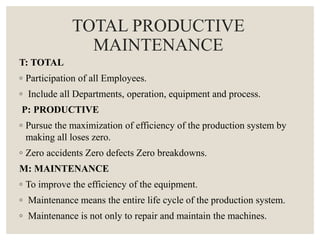
T: TOTAL
◦ Participation of all Employees.
◦ Include all Departments, operation, equipment and process.
P: PRODUCTIVE
◦ Pursue the maximization of efficiency of the production system by
making all loses zero.
◦ Zero accidents Zero defects Zero breakdowns.
M: MAINTENANCE
◦ To improve the efficiency of the equipment.
◦ Maintenance means the entire life cycle of the production system.
◦ Maintenance is not only to repair and maintain the machines.
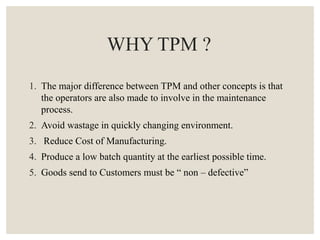
WHY TPM ?
1. The major difference between TPM and other concepts is that
the operators are also made to involve in the maintenance
process.
2. Avoid wastage in quickly changing environment.
3. Reduce Cost of Manufacturing.
4. Produce a low batch quantity at the earliest possible time.
5. Goods send to Customers must be “ non – defective”
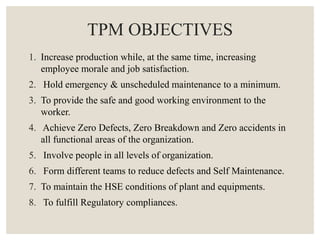
TPM OBJECTIVES
1. Increase production while, at the same time, increasing
employee morale and job satisfaction.
2. Hold emergency & unscheduled maintenance to a minimum.
3. To provide the safe and good working environment to the
worker.
4. Achieve Zero Defects, Zero Breakdown and Zero accidents in
all functional areas of the organization.
5. Involve people in all levels of organization.
6. Form different teams to reduce defects and Self Maintenance.
7. To maintain the HSE conditions of plant and equipments.
8. To fulfill Regulatory compliances.
BENEFITS OF TPM
✓Increased Employee Morale
✓Increased Productivity
✓Improved Sharing and Working as a Tea
✓Improved tidines and cleaning of the working place
✓Improved Product Quality
✓Improved Customer Satisfaction
✓Reduced Costs
✓Improved Delivery Time
✓Enhanced safety Records
✓Improved Image
✓Improved Reputation
TYPES OF MAINTENANCE
1. Breakdown Maintenance
2. Preventive Maintenance
a)Periodic Maintenance
b)Predictive Maintenance
3. Corrective Maintenance
4. Routine Maintenance
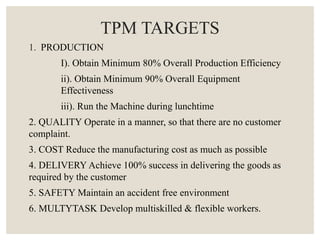
TPM TARGETS
1. PRODUCTION
I). Obtain Minimum 80% Overall Production Efficiency
ii). Obtain Minimum 90% Overall Equipment
Effectiveness
iii). Run the Machine during lunchtime
2. QUALITY Operate in a manner, so that there are no customer
complaint.
3. COST Reduce the manufacturing cost as much as possible
4. DELIVERY Achieve 100% success in delivering the goods as
required by the customer
5. SAFETY Maintain an accident free environment
6. MULTYTASK Develop multiskilled & flexible workers.
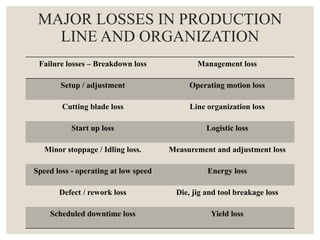
MAJOR LOSSES IN PRODUCTION
LINE AND ORGANIZATION
Failure losses – Breakdown loss Management loss
Setup / adjustment Operating motion loss
Cutting blade loss Line organization loss
Start up loss Logistic loss
Minor stoppage / Idling loss. Measurement and adjustment loss
Speed loss - operating at low speed Energy loss
Defect / rework loss Die, jig and tool breakage loss
Scheduled downtime loss Yield loss
FIVE PILLARS OF TPM
The five pillars of TPM are
1. Autonomous Maintenance
2. Focussed improvement
3. Planned Maintenance
4. Quality maintenance
5. Education &Training on the Job
AUTONOMOUS MAINTENANCE
POLICY
1. Uninterrupted operation of equipments
2. Flexible operators to operate & maintain other equipments
3. Eliminating the defects at source through active employee participation
4. Stepwise implementation of JISHU HOZEN activities. .
STEPS
1. Preparation of employees
2. Initial cleanup of machines
3. Take counter measures
4. Fix tentative JH standards
5. General inspection
6. Autonomus inspection
7. Standardization 8. Autonomus management
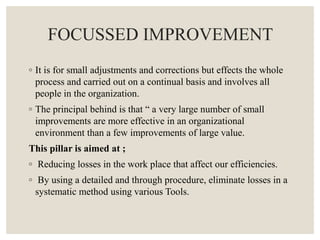
FOCUSSED IMPROVEMENT
◦ It is for small adjustments and corrections but effects the whole
process and carried out on a continual basis and involves all
people in the organization.
◦ The principal behind is that “ a very large number of small
improvements are more effective in an organizational
environment than a few improvements of large value.
This pillar is aimed at ;
◦ Reducing losses in the work place that affect our efficiencies.
◦ By using a detailed and through procedure, eliminate losses in a
systematic method using various Tools.
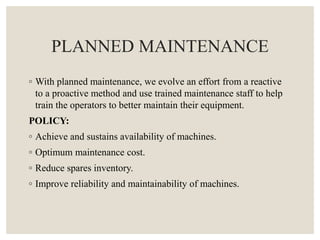
PLANNED MAINTENANCE
◦ With planned maintenance, we evolve an effort from a reactive
to a proactive method and use trained maintenance staff to help
train the operators to better maintain their equipment.
POLICY:
◦ Achieve and sustains availability of machines.
◦ Optimum maintenance cost.
◦ Reduce spares inventory.
◦ Improve reliability and maintainability of machines.
STEPS AND TARGET:
◦ Equipment evaluation and recording present status.
◦ Restore deterioration and improve weakness.
◦ Building up information management system.
◦ Prepare time based information system, select equipment, parts
and members and map on the plan.
◦ Prepare predictive maintenance system by introducing
equipment diagnostic techniques.
◦ Evaluation of planned maintenance
QUALITY MAINTENANCE
◦ It is aimed towards customer delight through highest quality
through defect free manufacturing. Focus is on eliminating non-
conformances in a systematic manner.
◦ Quality defects are classified as “CUSTOMER END defects”
and “IN HOUSE defects”.
◦ For customer-end data, we have to get data on Customer-end line
rejection and field complaints. In-house data include data related
to products and data related to process.
POLICY:
◦ Defect free conditions and control of equipments .
◦ QM activities to support quality assurances.
◦ Focus of prevention of defects at source.
◦ Focus on precaution (Pokayoke) system.
◦ In-line detection and segregation of defects.
◦ Effective implementation of operator quality assurance.
TARGET:
◦ Achieve and sustain customer complaints at zero.
◦ Reduce in-process defects by 50%.
◦ Reduce cost of quality by 50%.
EDUCATION &TRAINING ON
THE JOB
◦ It is aimed to have multi-skilled revitalized employees whose
moral is high and who has eager to come to work and perform all
required functions effectively and independently. Education is
given to operators to upgrade their skill.
◦ The employees should be trained to achieve the form phase of
skill which are as under:
PHASE 1: Do not know
PHASE 2: Know the theory but cannot do.
PHASE 3: Can do but cannot teach.
PHASE 4: Can do and also teach.
STEPS IN TRAINING :
1. Setting policies and priorities and checking present status of
education and training.
2. Establish of training system for operations and maintenance
skill up gradation.
3. Training the employees for up gradation the operation and
maintenance skills.
4. Preparation of training calendar.
5. Evaluation of activities and study of future approach
THANK YOU

Total productive maintenance

  • 1.
    TOTAL PRODUCTIVE MAINTENANCE (TPM) BY AAKASHG.T(17CER001) BALA ARAVINTH B(17CER026) DHANVARSAN S(17CER041)
  • 2.
    TOTAL PRODUCTIVE MAINTENANCE T: TOTAL ◦Participation of all Employees. ◦ Include all Departments, operation, equipment and process. P: PRODUCTIVE ◦ Pursue the maximization of efficiency of the production system by making all loses zero. ◦ Zero accidents Zero defects Zero breakdowns. M: MAINTENANCE ◦ To improve the efficiency of the equipment. ◦ Maintenance means the entire life cycle of the production system. ◦ Maintenance is not only to repair and maintain the machines.
  • 3.
    WHY TPM ? 1.The major difference between TPM and other concepts is that the operators are also made to involve in the maintenance process. 2. Avoid wastage in quickly changing environment. 3. Reduce Cost of Manufacturing. 4. Produce a low batch quantity at the earliest possible time. 5. Goods send to Customers must be “ non – defective”
  • 4.
    TPM OBJECTIVES 1. Increaseproduction while, at the same time, increasing employee morale and job satisfaction. 2. Hold emergency & unscheduled maintenance to a minimum. 3. To provide the safe and good working environment to the worker. 4. Achieve Zero Defects, Zero Breakdown and Zero accidents in all functional areas of the organization. 5. Involve people in all levels of organization. 6. Form different teams to reduce defects and Self Maintenance. 7. To maintain the HSE conditions of plant and equipments. 8. To fulfill Regulatory compliances.
  • 5.
    BENEFITS OF TPM ✓IncreasedEmployee Morale ✓Increased Productivity ✓Improved Sharing and Working as a Tea ✓Improved tidines and cleaning of the working place ✓Improved Product Quality ✓Improved Customer Satisfaction ✓Reduced Costs ✓Improved Delivery Time ✓Enhanced safety Records ✓Improved Image ✓Improved Reputation
  • 6.
    TYPES OF MAINTENANCE 1.Breakdown Maintenance 2. Preventive Maintenance a)Periodic Maintenance b)Predictive Maintenance 3. Corrective Maintenance 4. Routine Maintenance
  • 7.
    TPM TARGETS 1. PRODUCTION I).Obtain Minimum 80% Overall Production Efficiency ii). Obtain Minimum 90% Overall Equipment Effectiveness iii). Run the Machine during lunchtime 2. QUALITY Operate in a manner, so that there are no customer complaint. 3. COST Reduce the manufacturing cost as much as possible 4. DELIVERY Achieve 100% success in delivering the goods as required by the customer 5. SAFETY Maintain an accident free environment 6. MULTYTASK Develop multiskilled & flexible workers.
  • 8.
    MAJOR LOSSES INPRODUCTION LINE AND ORGANIZATION Failure losses – Breakdown loss Management loss Setup / adjustment Operating motion loss Cutting blade loss Line organization loss Start up loss Logistic loss Minor stoppage / Idling loss. Measurement and adjustment loss Speed loss - operating at low speed Energy loss Defect / rework loss Die, jig and tool breakage loss Scheduled downtime loss Yield loss
  • 9.
    FIVE PILLARS OFTPM The five pillars of TPM are 1. Autonomous Maintenance 2. Focussed improvement 3. Planned Maintenance 4. Quality maintenance 5. Education &Training on the Job
  • 10.
    AUTONOMOUS MAINTENANCE POLICY 1. Uninterruptedoperation of equipments 2. Flexible operators to operate & maintain other equipments 3. Eliminating the defects at source through active employee participation 4. Stepwise implementation of JISHU HOZEN activities. . STEPS 1. Preparation of employees 2. Initial cleanup of machines 3. Take counter measures 4. Fix tentative JH standards 5. General inspection 6. Autonomus inspection 7. Standardization 8. Autonomus management
  • 11.
    FOCUSSED IMPROVEMENT ◦ Itis for small adjustments and corrections but effects the whole process and carried out on a continual basis and involves all people in the organization. ◦ The principal behind is that “ a very large number of small improvements are more effective in an organizational environment than a few improvements of large value. This pillar is aimed at ; ◦ Reducing losses in the work place that affect our efficiencies. ◦ By using a detailed and through procedure, eliminate losses in a systematic method using various Tools.
  • 12.
    PLANNED MAINTENANCE ◦ Withplanned maintenance, we evolve an effort from a reactive to a proactive method and use trained maintenance staff to help train the operators to better maintain their equipment. POLICY: ◦ Achieve and sustains availability of machines. ◦ Optimum maintenance cost. ◦ Reduce spares inventory. ◦ Improve reliability and maintainability of machines.
  • 13.
    STEPS AND TARGET: ◦Equipment evaluation and recording present status. ◦ Restore deterioration and improve weakness. ◦ Building up information management system. ◦ Prepare time based information system, select equipment, parts and members and map on the plan. ◦ Prepare predictive maintenance system by introducing equipment diagnostic techniques. ◦ Evaluation of planned maintenance
  • 14.
    QUALITY MAINTENANCE ◦ Itis aimed towards customer delight through highest quality through defect free manufacturing. Focus is on eliminating non- conformances in a systematic manner. ◦ Quality defects are classified as “CUSTOMER END defects” and “IN HOUSE defects”. ◦ For customer-end data, we have to get data on Customer-end line rejection and field complaints. In-house data include data related to products and data related to process.
  • 15.
    POLICY: ◦ Defect freeconditions and control of equipments . ◦ QM activities to support quality assurances. ◦ Focus of prevention of defects at source. ◦ Focus on precaution (Pokayoke) system. ◦ In-line detection and segregation of defects. ◦ Effective implementation of operator quality assurance. TARGET: ◦ Achieve and sustain customer complaints at zero. ◦ Reduce in-process defects by 50%. ◦ Reduce cost of quality by 50%.
  • 16.
    EDUCATION &TRAINING ON THEJOB ◦ It is aimed to have multi-skilled revitalized employees whose moral is high and who has eager to come to work and perform all required functions effectively and independently. Education is given to operators to upgrade their skill. ◦ The employees should be trained to achieve the form phase of skill which are as under: PHASE 1: Do not know PHASE 2: Know the theory but cannot do. PHASE 3: Can do but cannot teach. PHASE 4: Can do and also teach.
  • 17.
    STEPS IN TRAINING: 1. Setting policies and priorities and checking present status of education and training. 2. Establish of training system for operations and maintenance skill up gradation. 3. Training the employees for up gradation the operation and maintenance skills. 4. Preparation of training calendar. 5. Evaluation of activities and study of future approach
  • 18.