Decision Making and
         Process Improvement


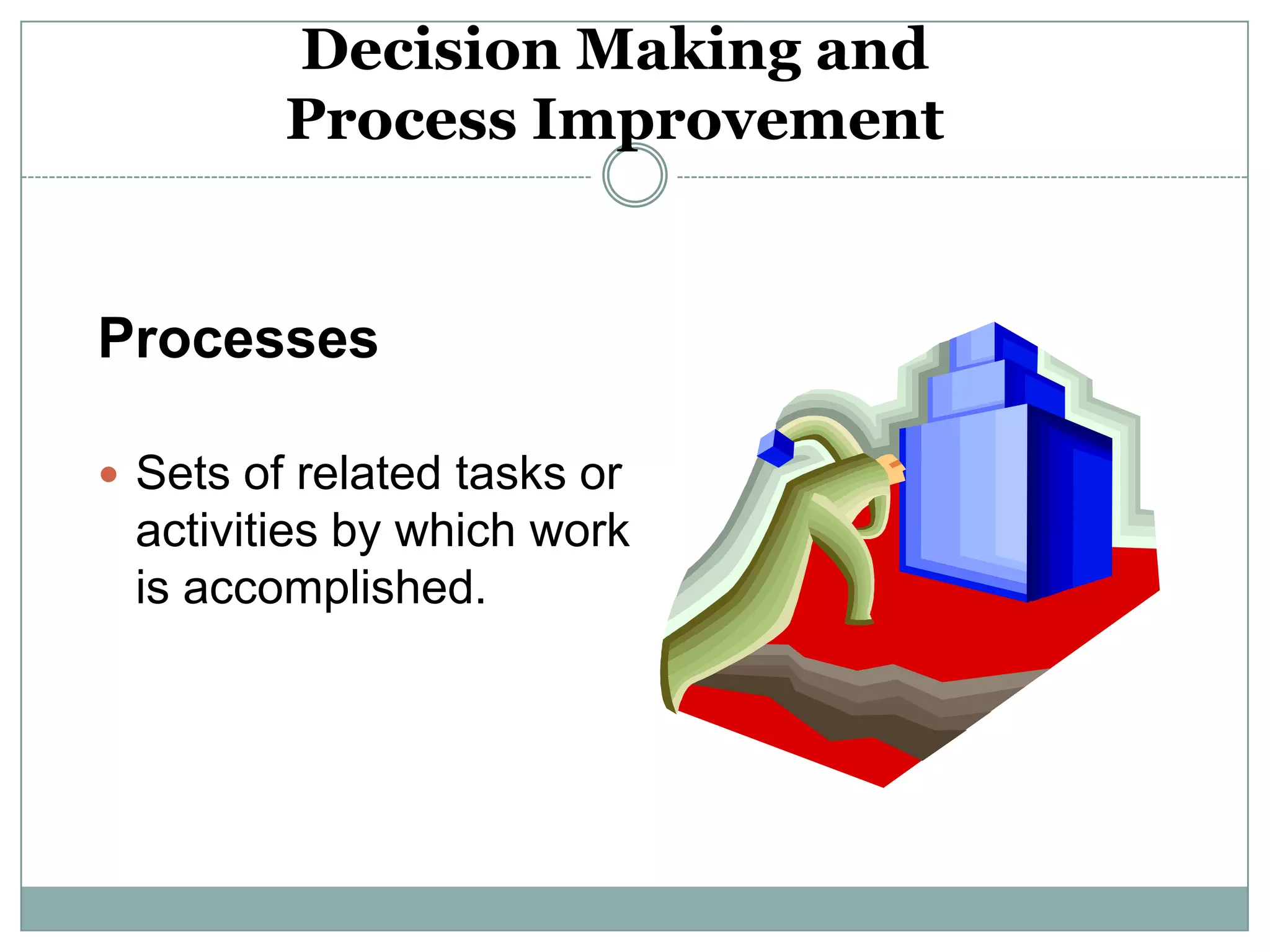
Processes

 Sets of related tasks or
 activities by which work
 is accomplished.
Operational Definition
     Continuous Process Improvement–
 A comprehensive philosophy of operations that is
built around the concept that there are always
ways in which a process can be improved to better
meet the needs of the customer and that an
organization should constantly strive to make
those improvements.

            Source: DoD Continuous Process Improvement Transformation Guidebook
Con    Why Continuous Improvement Process
Why?


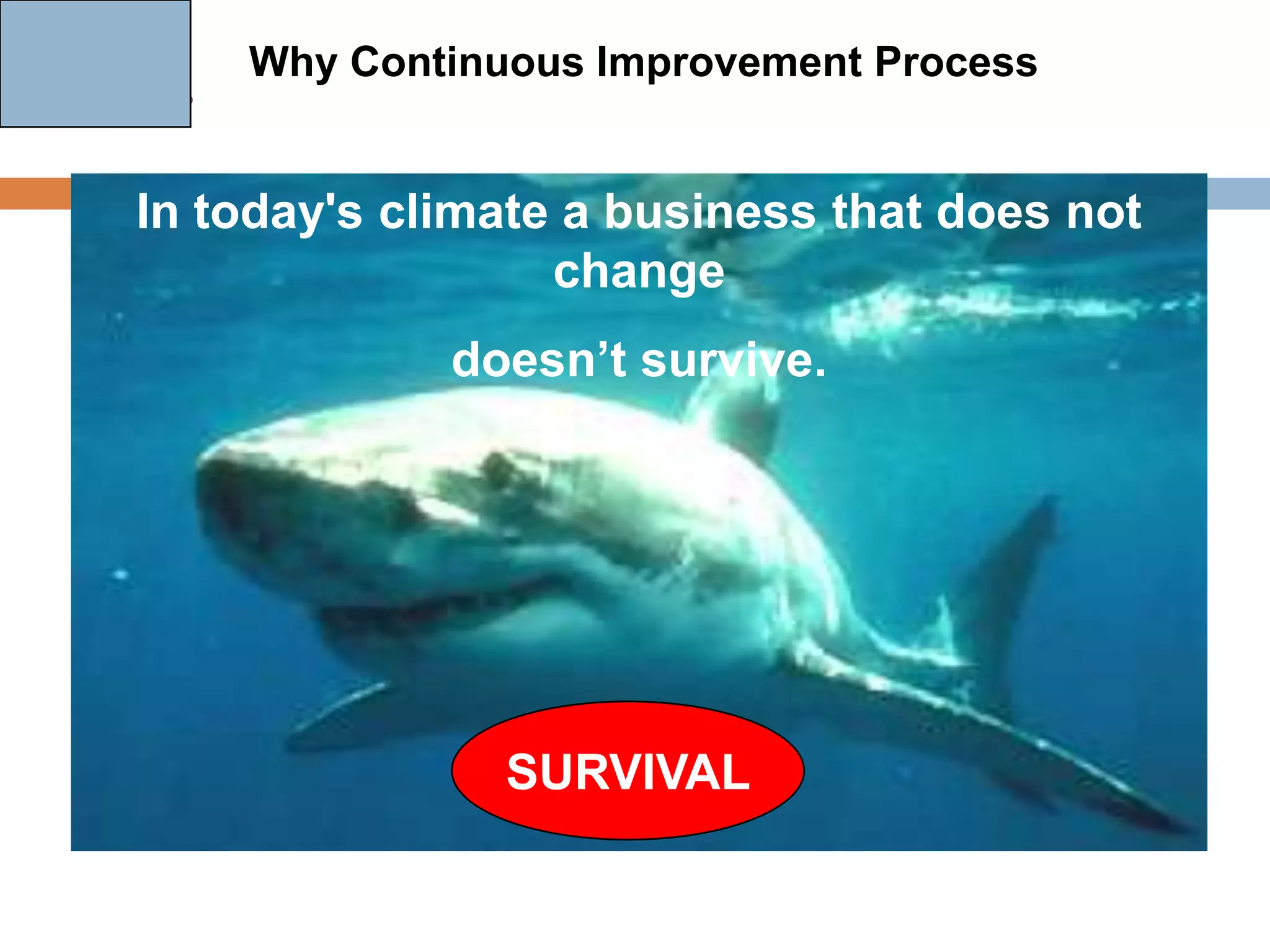
 In today's climate a business that does not
                   change
               doesn’t survive.


                  SURVIVAL
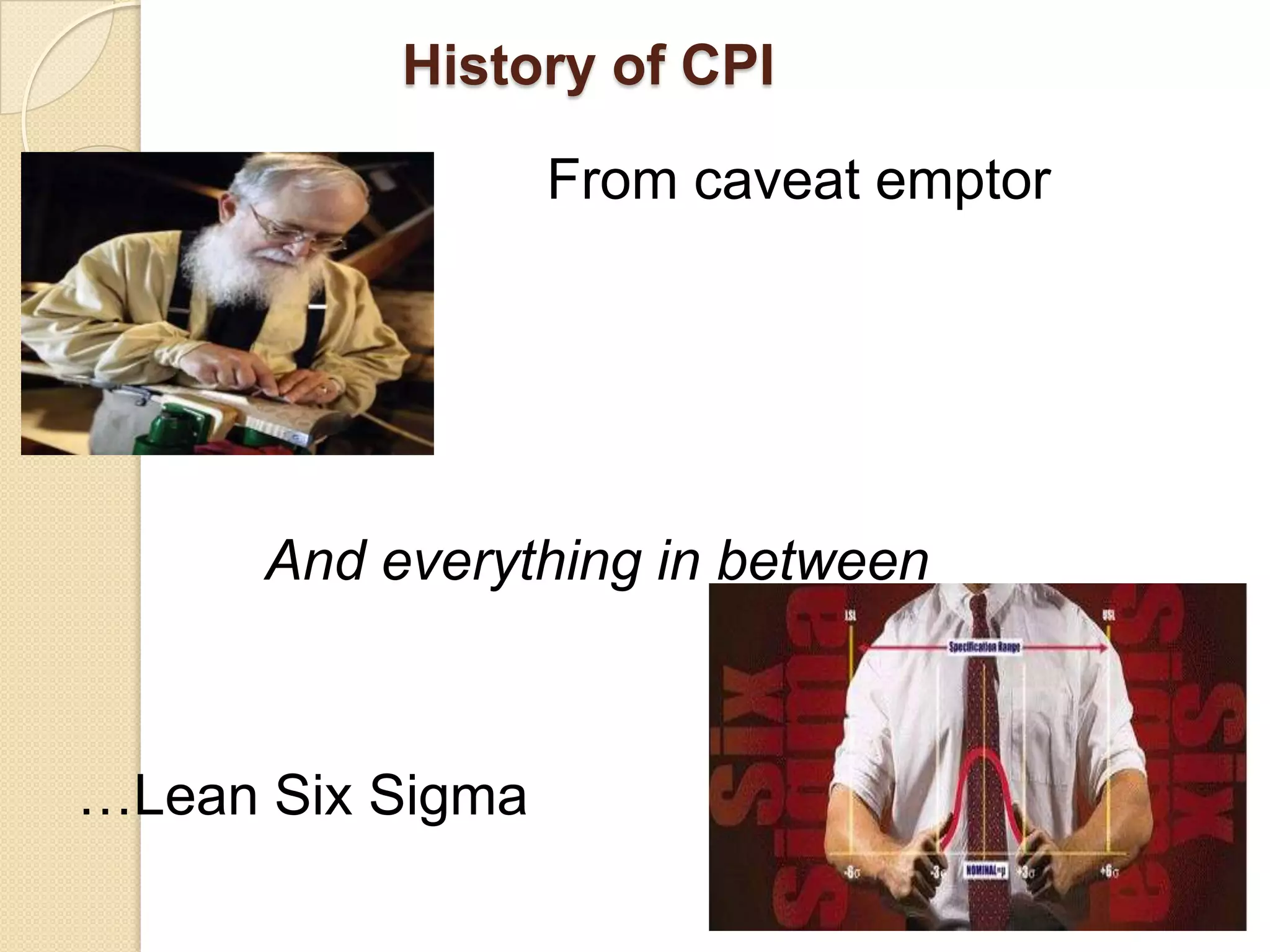
History of CPI

                 From caveat emptor
 to…


       And everything in between


…Lean Six Sigma
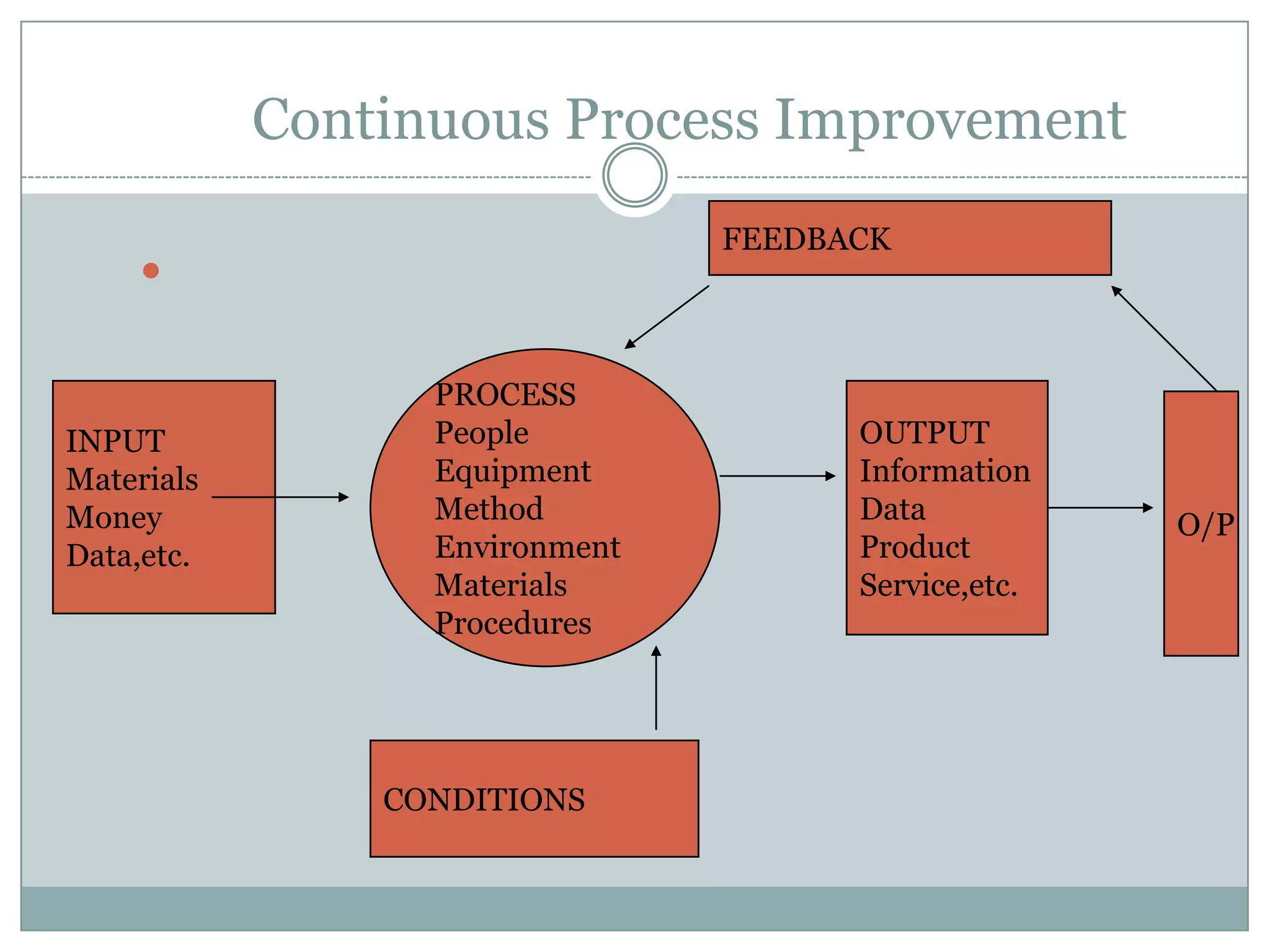
Continuous Process Improvement
                                FEEDBACK
     

                  PROCESS
INPUT             People              OUTPUT
Materials         Equipment           Information
Money             Method              Data           O/P
Data,etc.         Environment         Product
                  Materials           Service,etc.
                  Procedures


                CONDITIONS
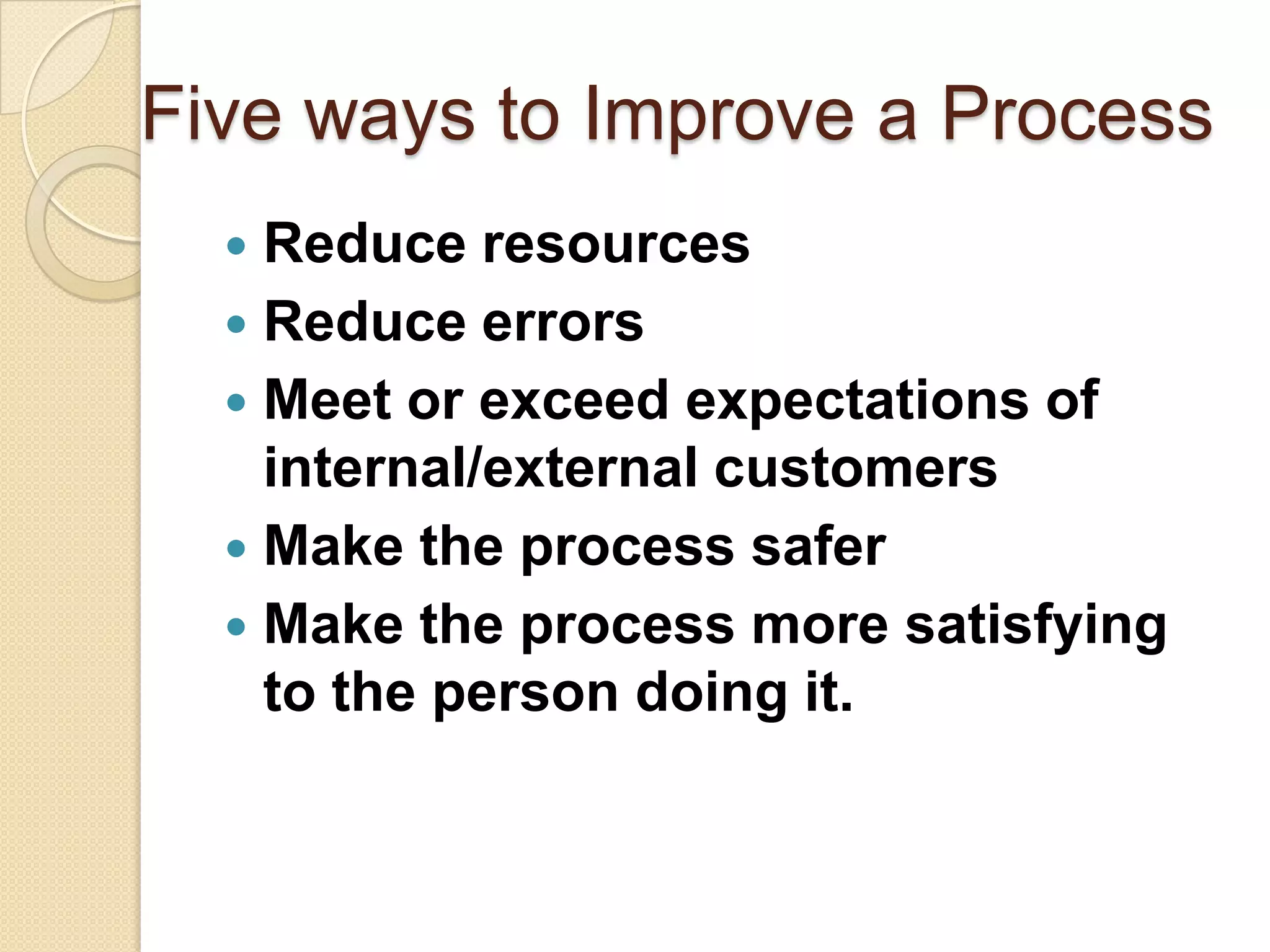
Five ways to Improve a Process
   Reduce resources
   Reduce errors
   Meet or exceed expectations of
    internal/external customers
   Make the process safer
   Make the process more satisfying
    to the person doing it.
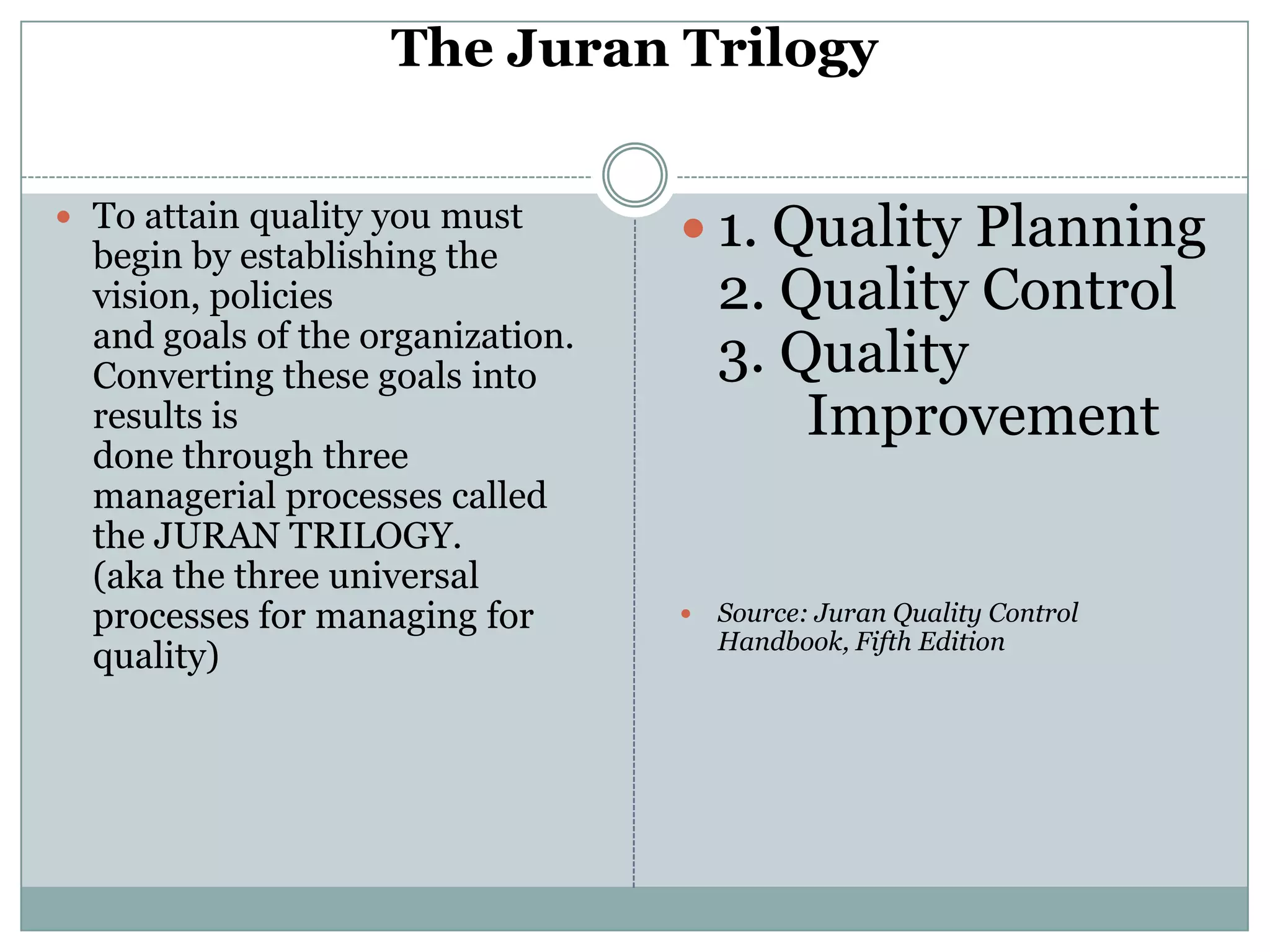
The Juran Trilogy


 To attain quality you must
  begin by establishing the
                                    1. Quality Planning
  vision, policies                     2. Quality Control
  and goals of the organization.
  Converting these goals into          3. Quality
  results is                               Improvement
  done through three
  managerial processes called
  the JURAN TRILOGY.
  (aka the three universal
  processes for managing for          Source: Juran Quality Control
                                       Handbook, Fifth Edition
  quality)
THE JURAN TRILOGY

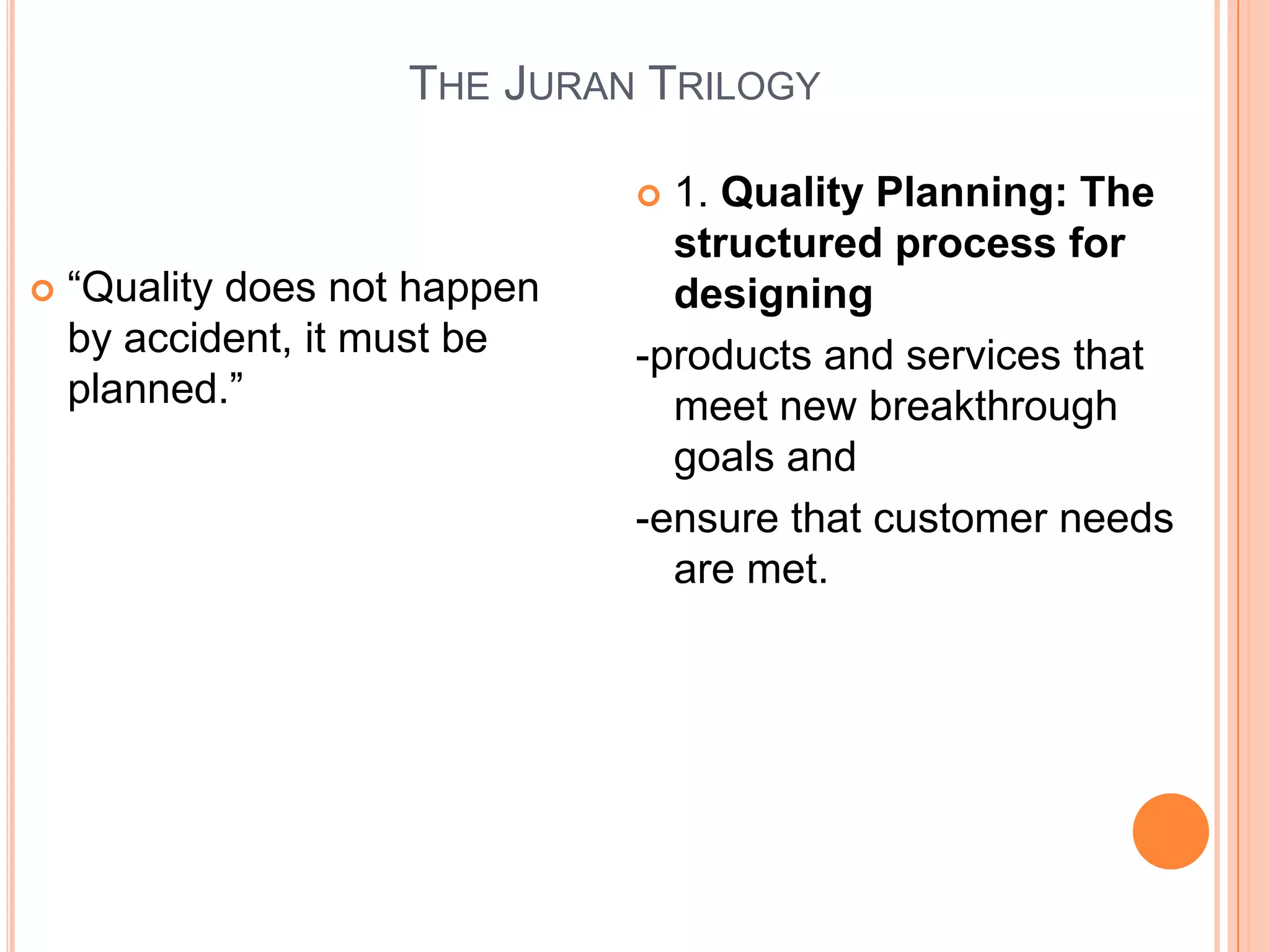
                                1. Quality Planning: The
                                 structured process for
   ―Quality does not happen     designing
    by accident, it must be    -products and services that
    planned.‖                    meet new breakthrough
                                 goals and
                               -ensure that customer needs
                                 are met.
THE JURAN TRILOGY
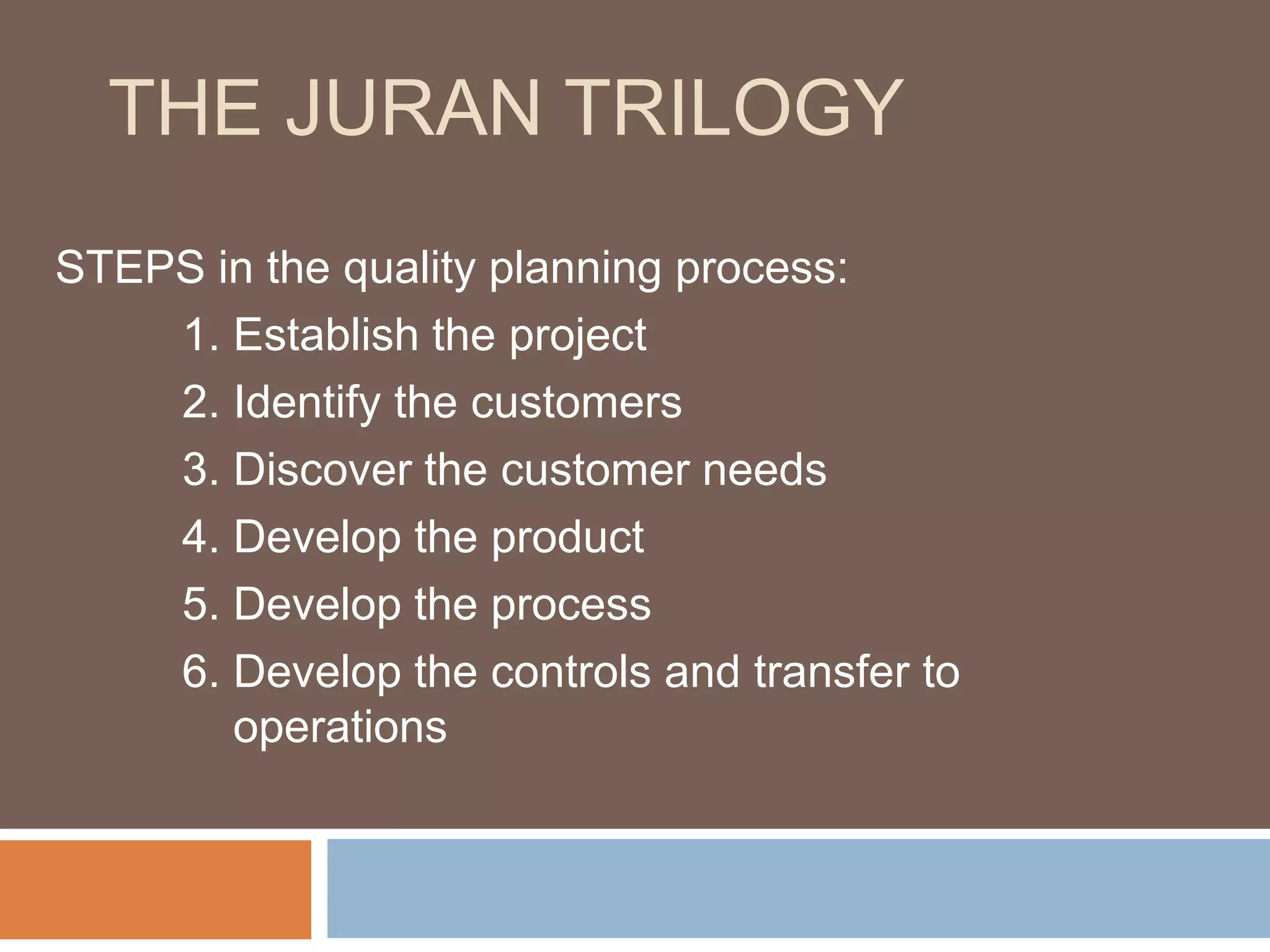
STEPS in the quality planning process:
    1. Establish the project
    2. Identify the customers
    3. Discover the customer needs
    4. Develop the product
    5. Develop the process
    6. Develop the controls and transfer to
       operations
THE JURAN TRILOGY

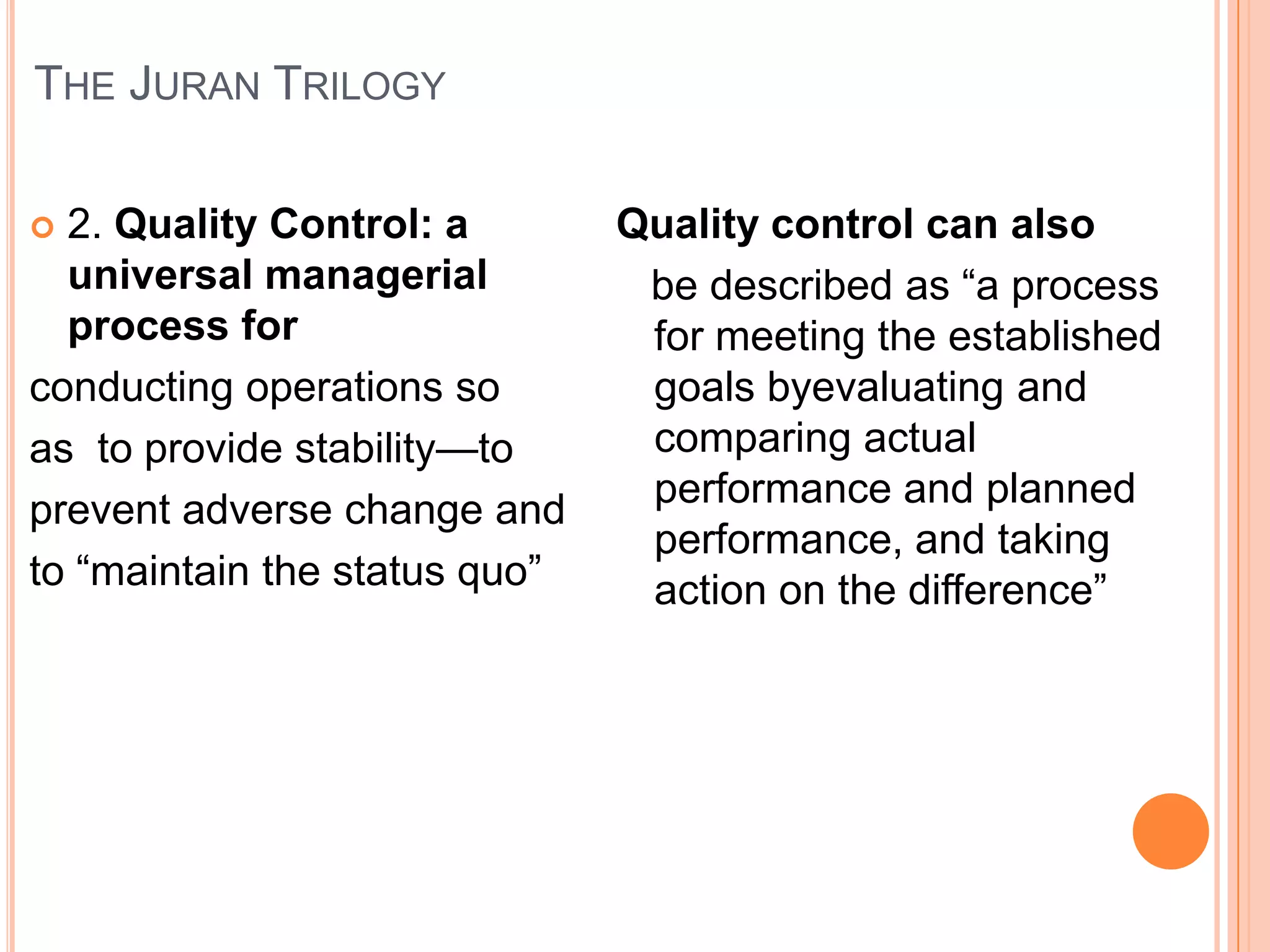
 2. Quality Control: a        Quality control can also
  universal managerial          be described as ―a process
  process for                   for meeting the established
conducting operations so        goals byevaluating and
as to provide stability—to      comparing actual
                                performance and planned
prevent adverse change and
                                performance, and taking
to ―maintain the status quo‖    action on the difference‖
The Juran Trilogy
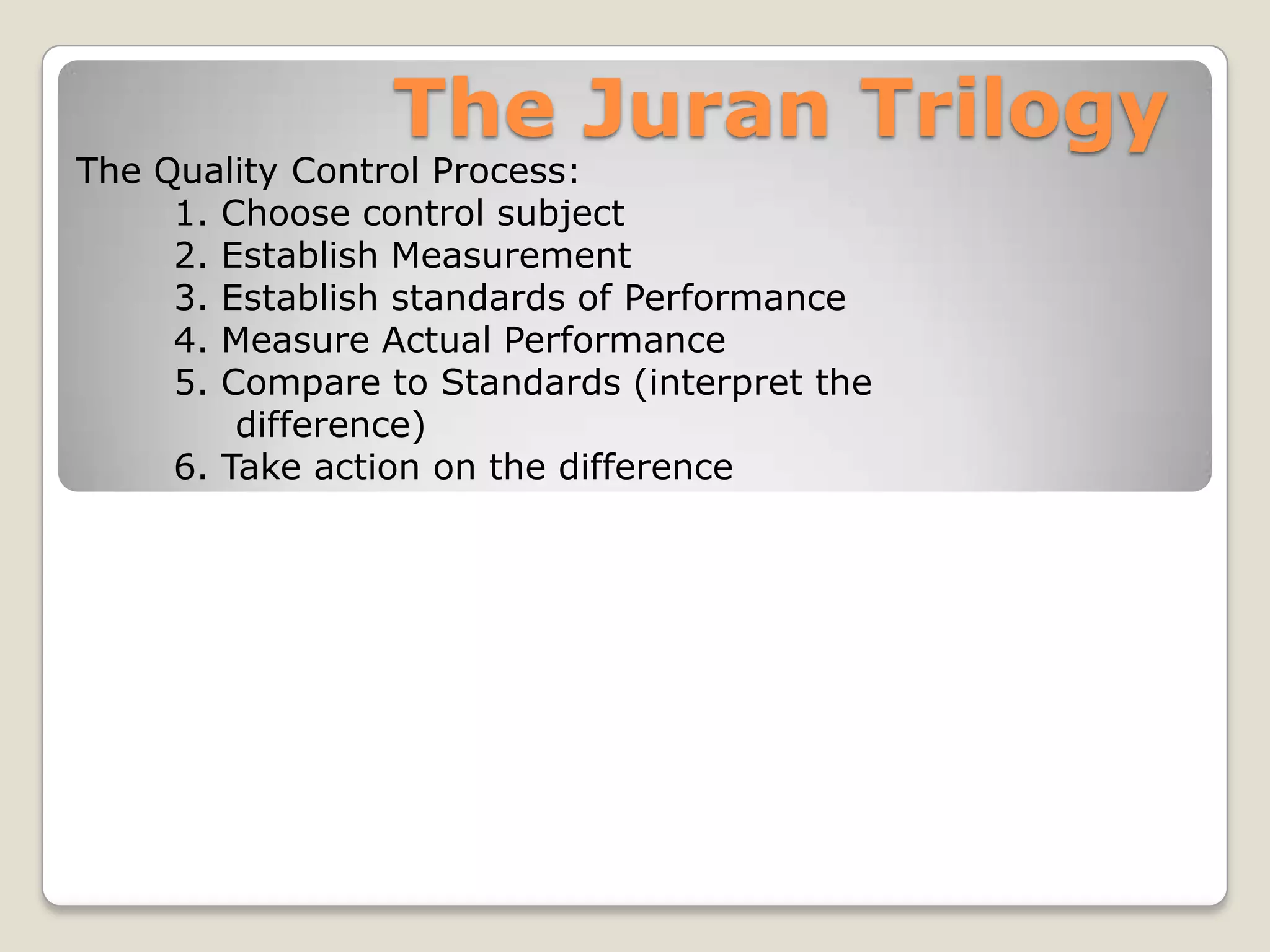
The Quality Control Process:
     1. Choose control subject
     2. Establish Measurement
     3. Establish standards of Performance
     4. Measure Actual Performance
     5. Compare to Standards (interpret the
         difference)
     6. Take action on the difference
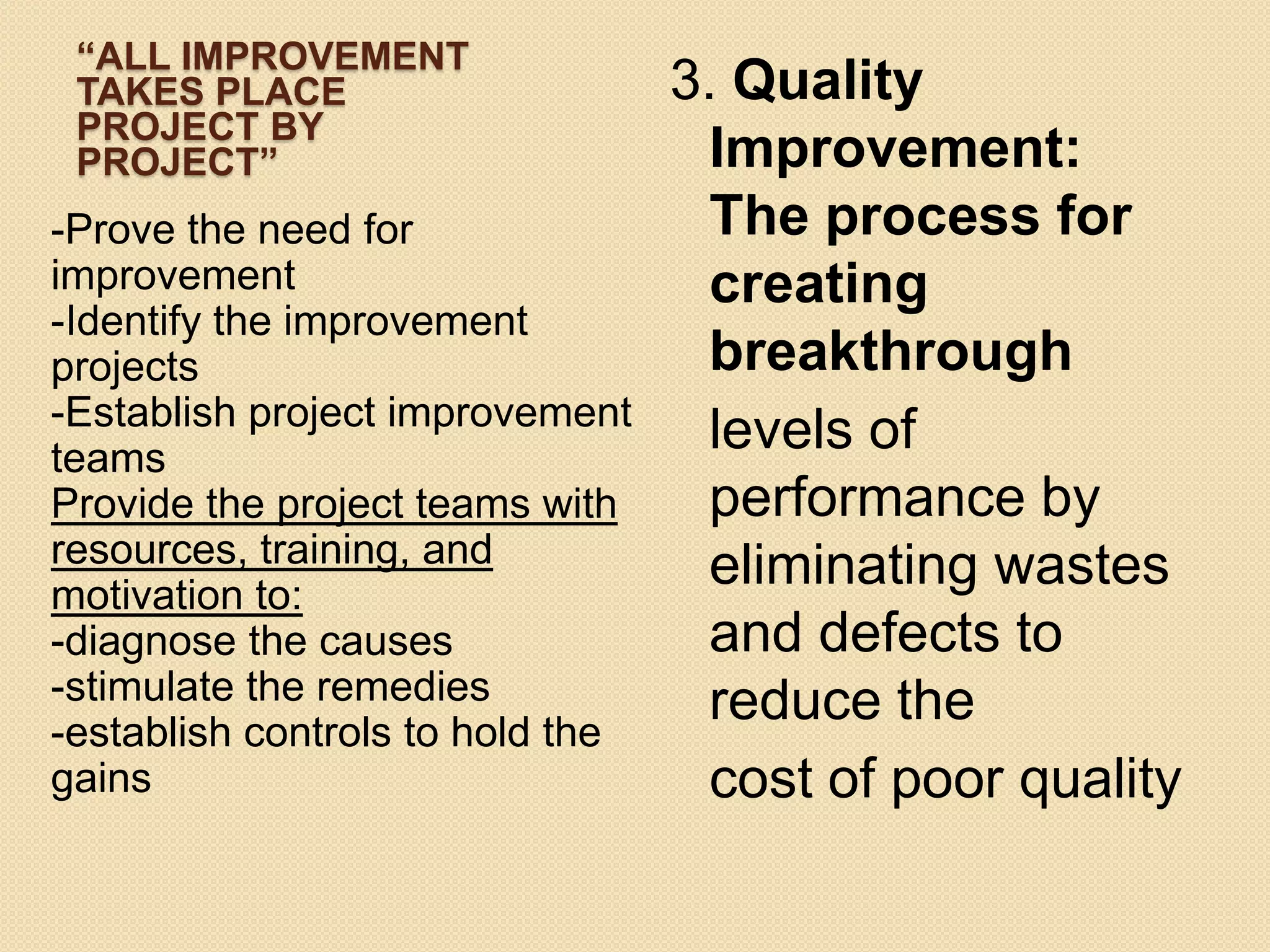
“ALL IMPROVEMENT
 TAKES PLACE                      3. Quality
 PROJECT BY
 PROJECT”                           Improvement:
-Prove the need for                 The process for
improvement                         creating
-Identify the improvement
projects                            breakthrough
-Establish project improvement
teams
                                    levels of
Provide the project teams with      performance by
resources, training, and            eliminating wastes
motivation to:
-diagnose the causes                and defects to
-stimulate the remedies             reduce the
-establish controls to hold the
gains                               cost of poor quality
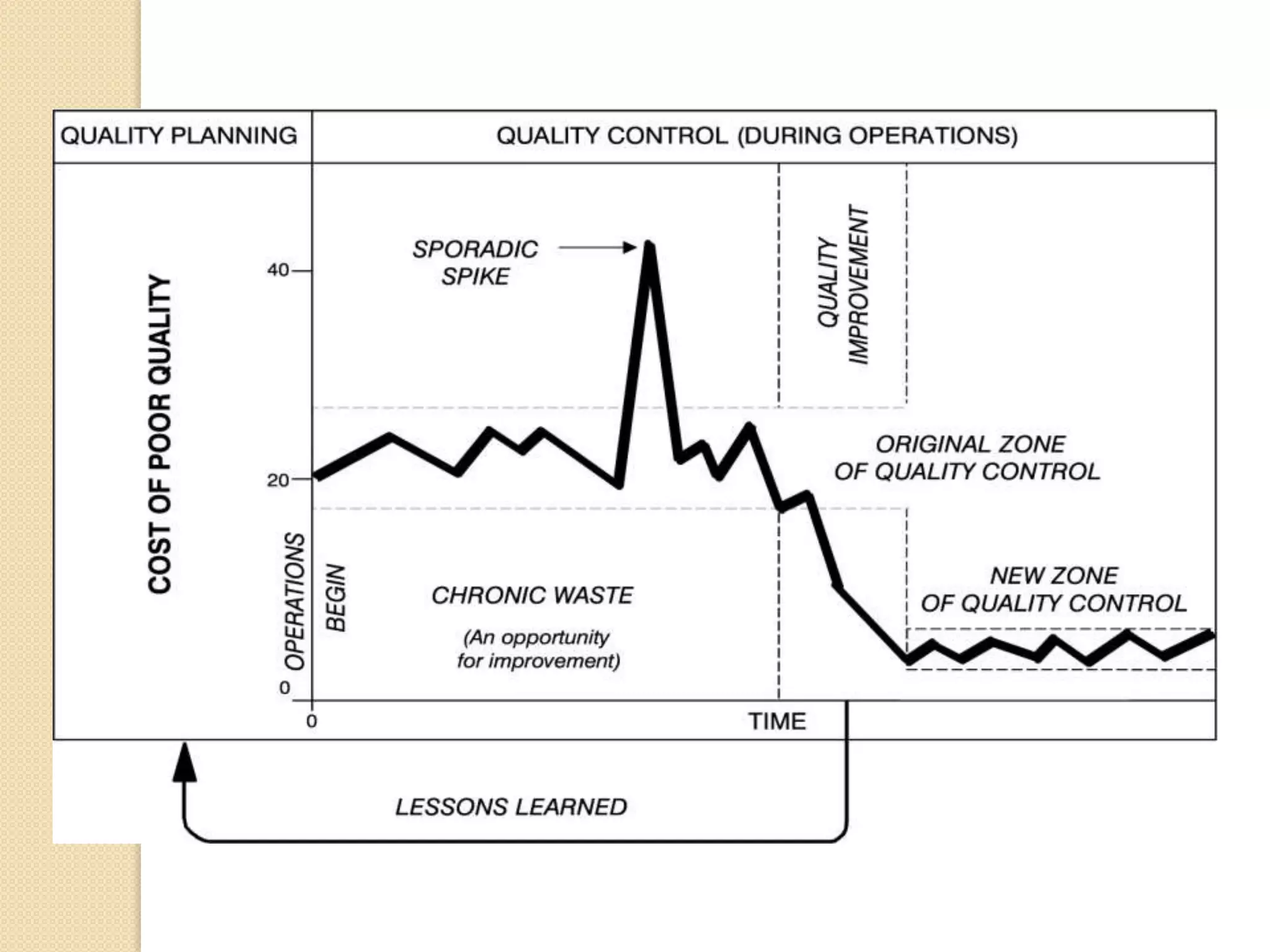
Fig : THE JURAN’S TRILOGY
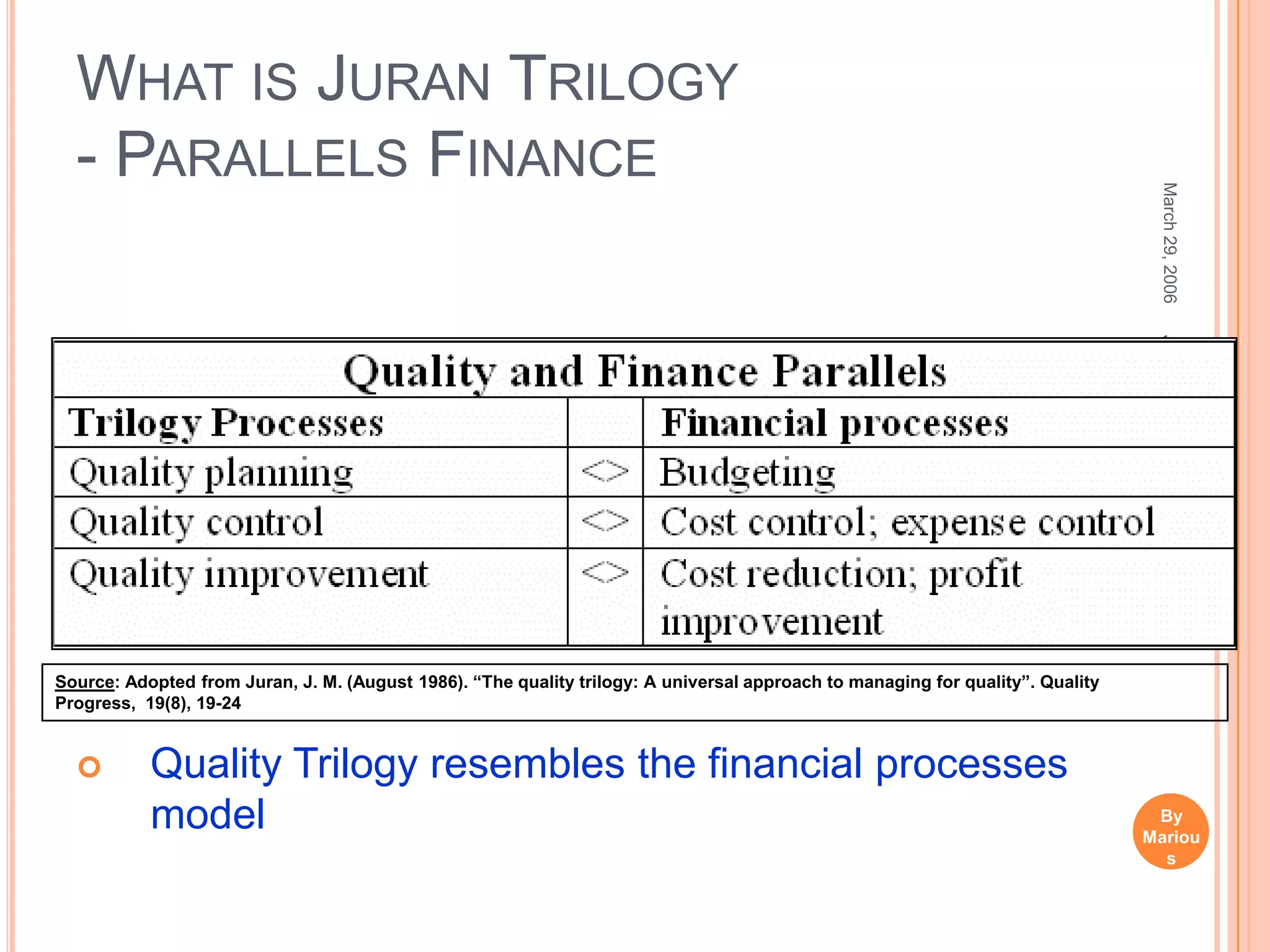
WHAT IS JURAN TRILOGY
  - PARALLELS FINANCE


                                                                                                                                  March 29, 2006
                                                                                                                                 Juran Trilogy – A Training Tool
Source: Adopted from Juran, J. M. (August 1986). “The quality trilogy: A universal approach to managing for quality”. Quality
Progress, 19(8), 19-24


          Quality Trilogy resembles the financial processes                                                                     15

           model                                                                                                                  By
                                                                                                                                Mariou
                                                                                                                                   s
                                                                                                                                Tcherp
                                                                                                                                 okov
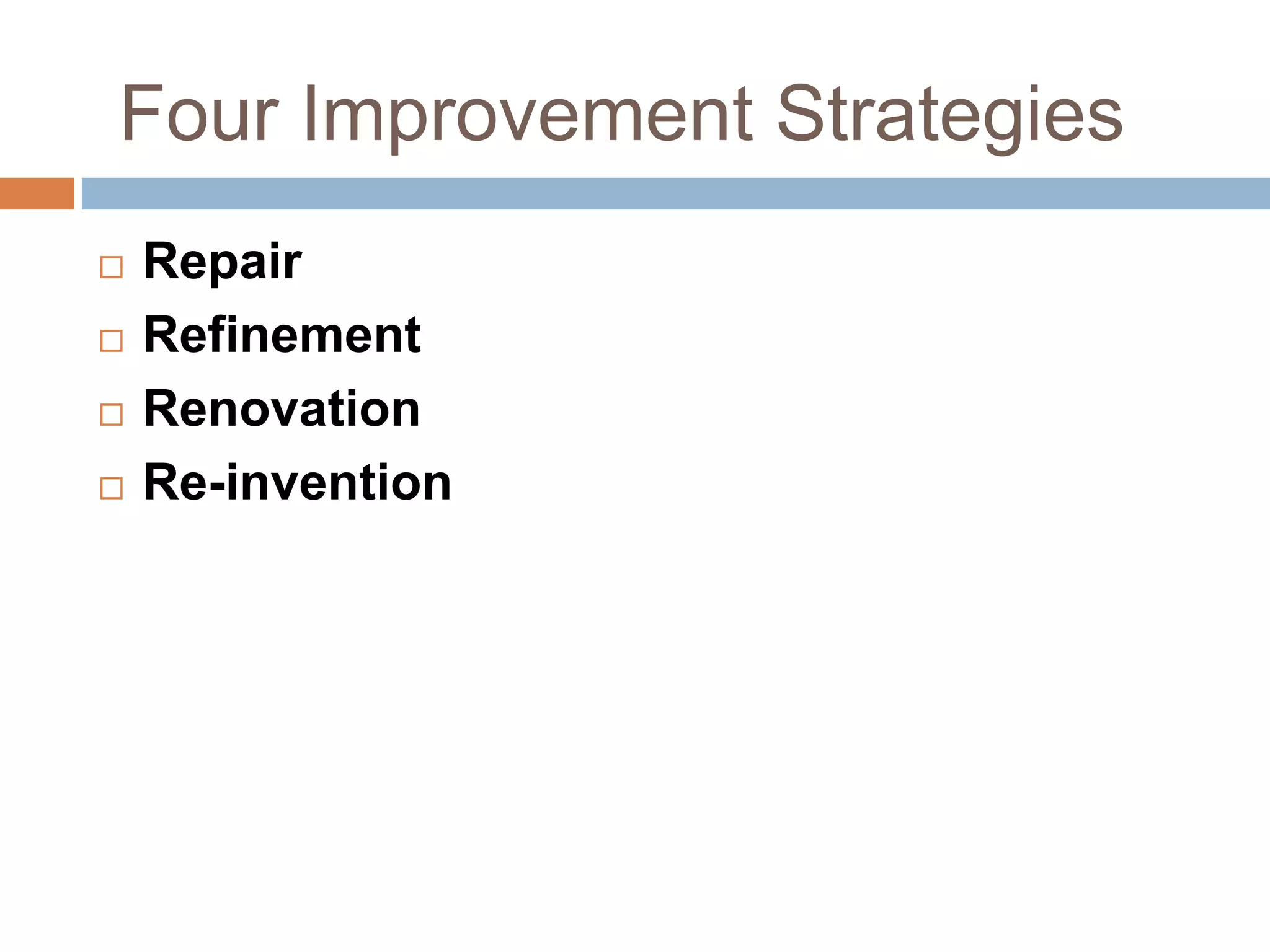
Four Improvement Strategies
   Repair
   Refinement
   Renovation
   Re-invention
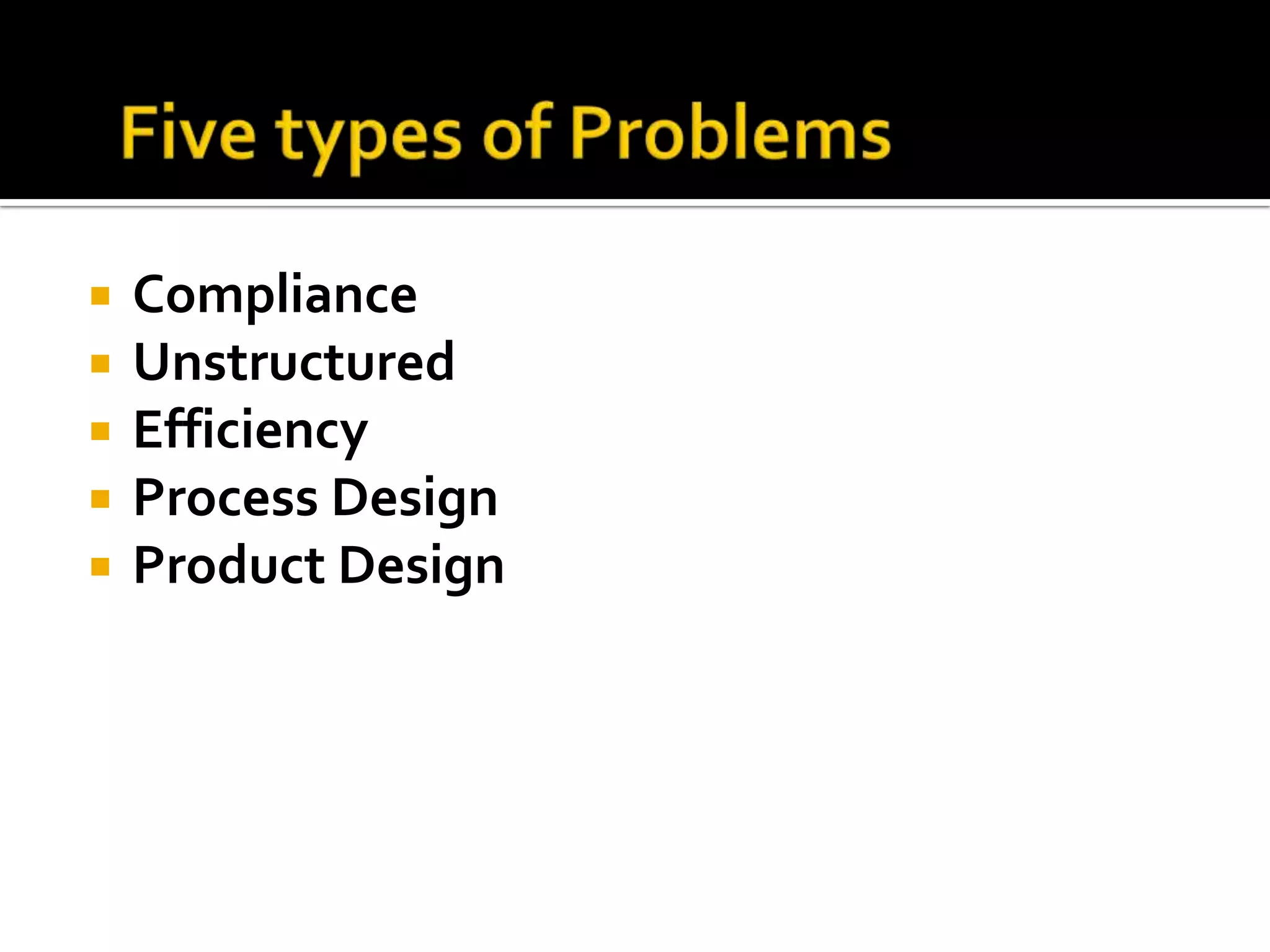
   Compliance
   Unstructured
   Efficiency
   Process Design
   Product Design
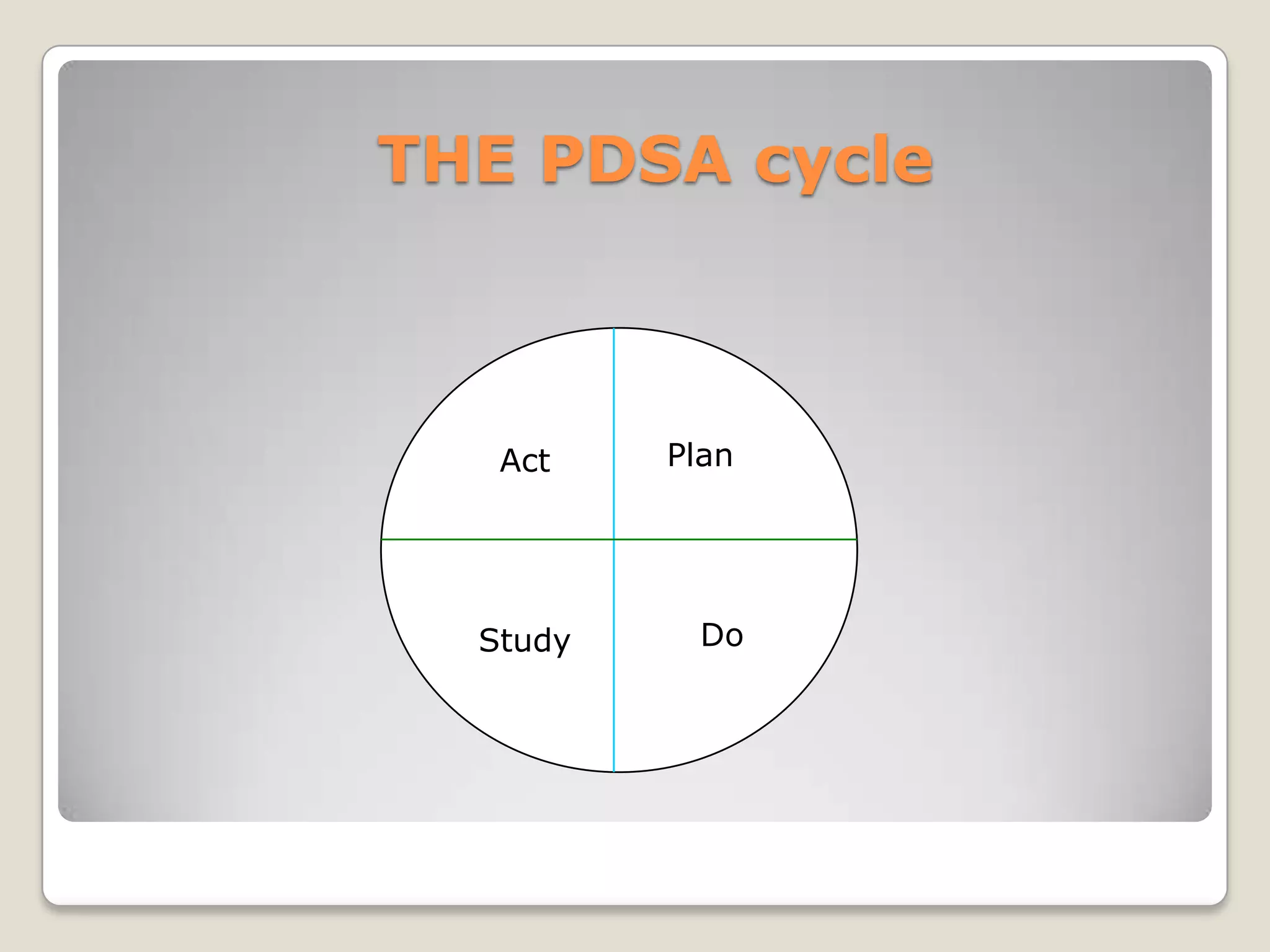
THE PDSA cycle


   Act    Plan
           Plan
           Plan


  Study    Do
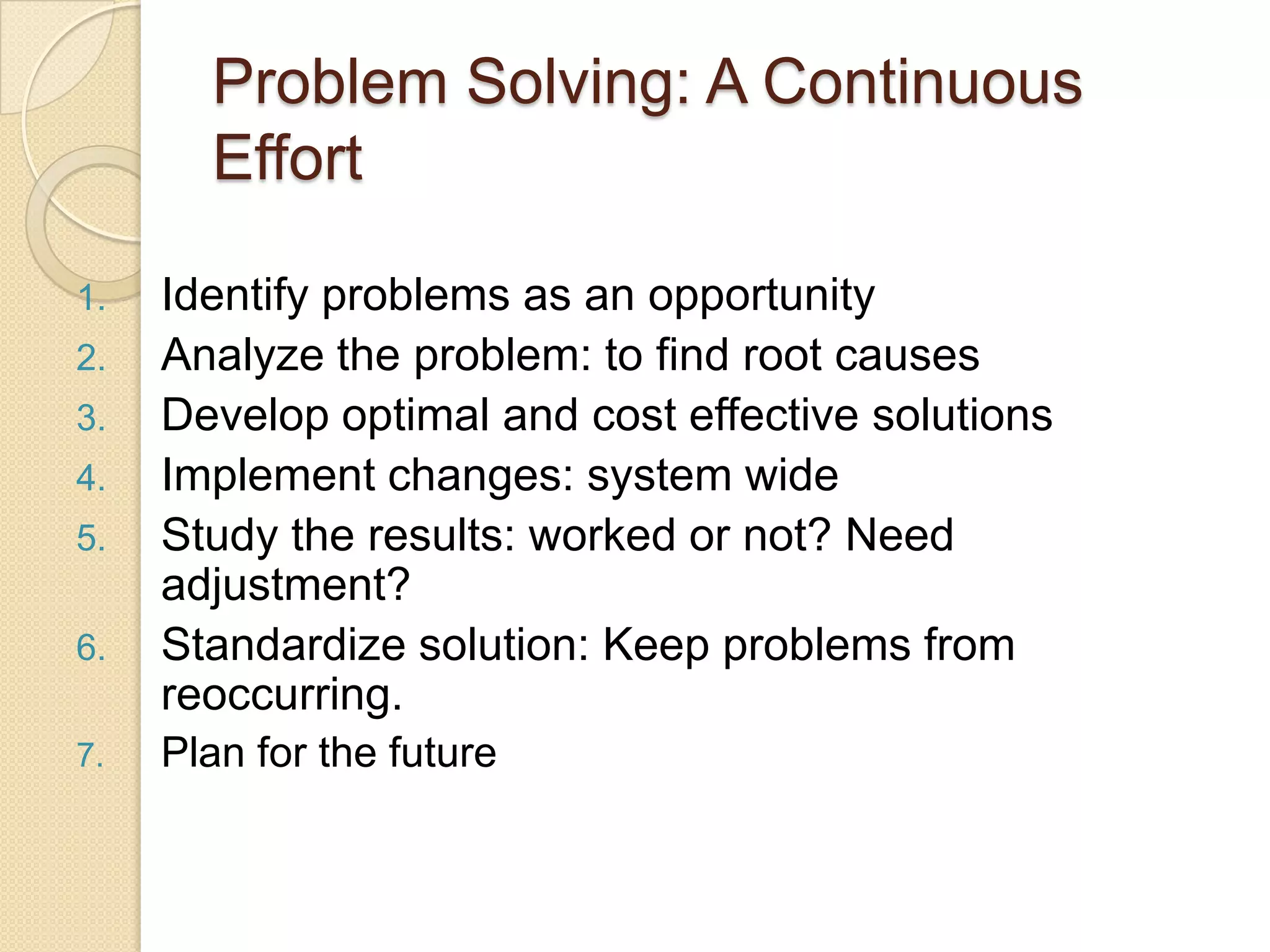
Problem Solving: A Continuous
       Effort

1.   Identify problems as an opportunity
2.   Analyze the problem: to find root causes
3.   Develop optimal and cost effective solutions
4.   Implement changes: system wide
5.   Study the results: worked or not? Need
     adjustment?
6.   Standardize solution: Keep problems from
     reoccurring.
7.   Plan for the future
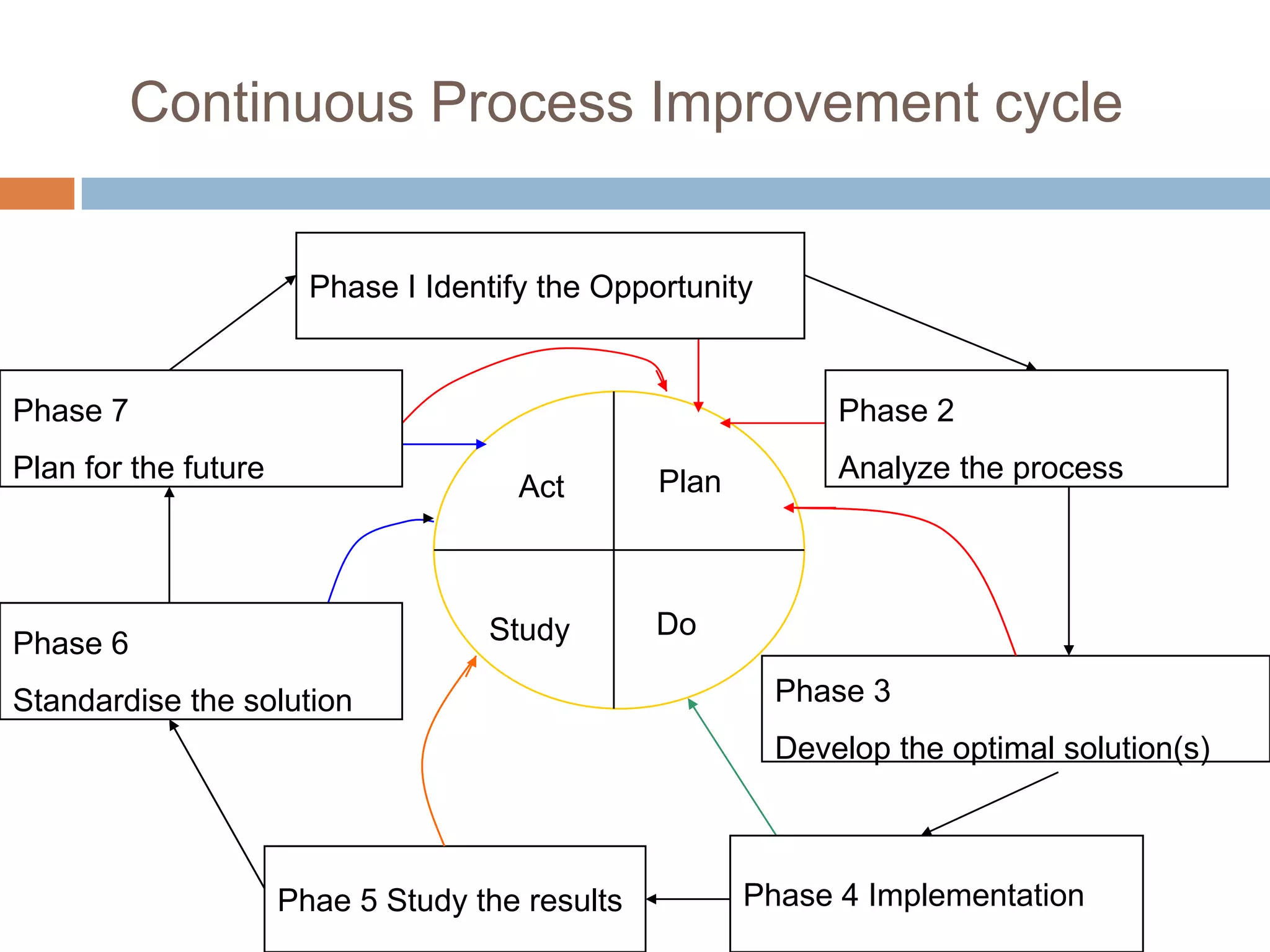
Continuous Process Improvement cycle


                        Phase I Identify the Opportunity


Phase 7                                                        Phase 2
Plan for the future                              Plan          Analyze the process
                                       Act


                                    Study        Do
Phase 6
Standardise the solution                                   Phase 3
                                                           Develop the optimal solution(s)


                      Phae 5 Study the results          Phase 4 Implementation
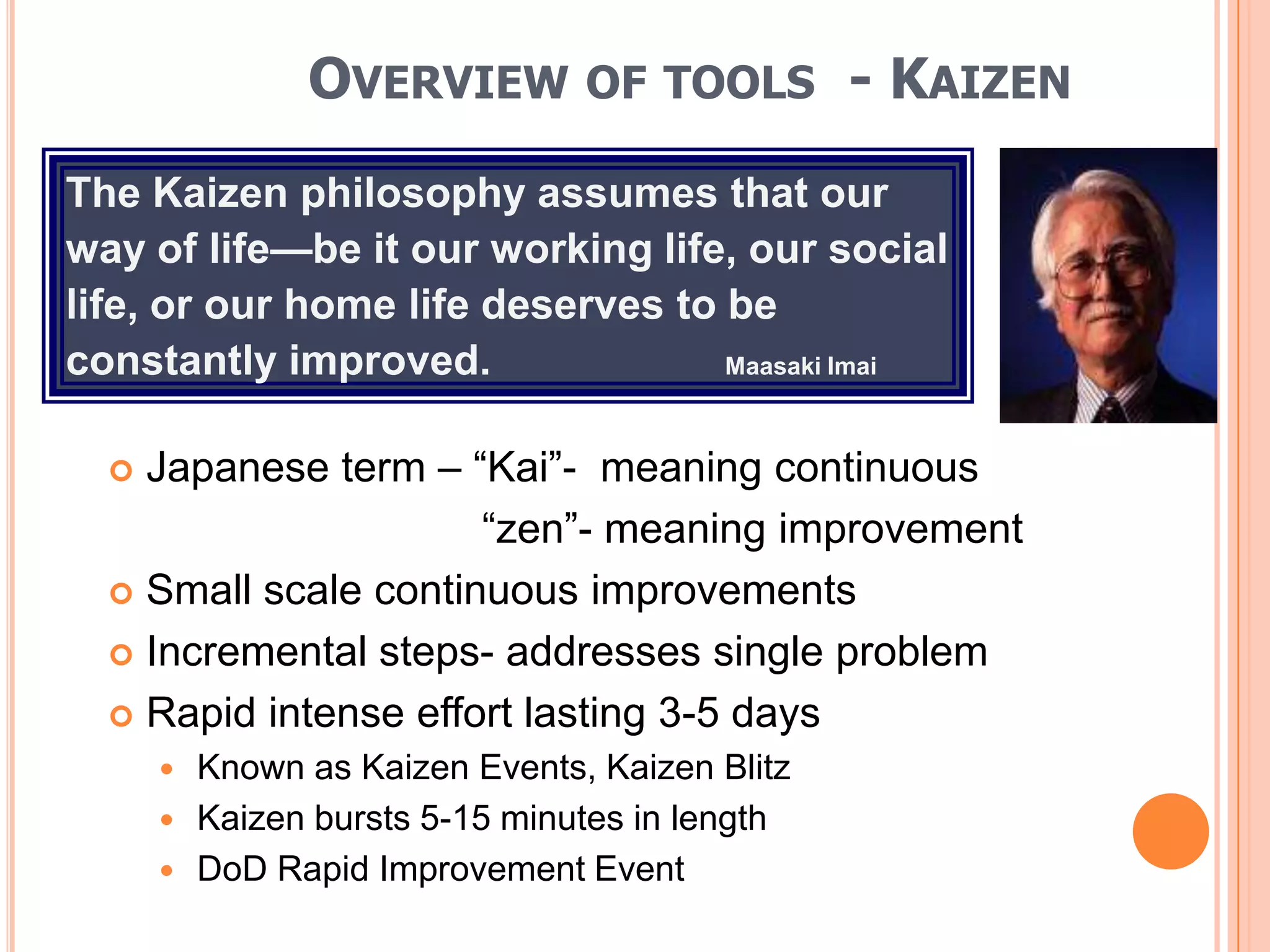
OVERVIEW OF TOOLS - KAIZEN
The Kaizen philosophy assumes that our
way of life—be it our working life, our social
life, or our home life deserves to be
constantly improved.               Maasaki Imai


   Japanese term – ―Kai‖- meaning continuous
                      ―zen‖- meaning improvement
   Small scale continuous improvements

   Incremental steps- addresses single problem

   Rapid intense effort lasting 3-5 days
         Known as Kaizen Events, Kaizen Blitz
         Kaizen bursts 5-15 minutes in length
         DoD Rapid Improvement Event
Kaizen

   Value and non-value added work activities
   Muda-seven classes of waste
   Principles of motion study and work-cell use
   Principles of materials handling and use of
    one-piece flow
   Documentation of standard operating
    procedures
   The 5S’s
   Visual displays for communicating to factory
    personnel
   JIT- to produce right quantities at right time
    and with right resources
   Poka-yoke to prevent or detect errors
   Team dynamics – problem solving
    ,comm.,conflict resoln.
The 5S Method
   Seiko    - Sort ( Proper arrangement )
   Seiton   - Set ( Systematic or
                          Orderliness )
   Seiso    - Shine ( Sweep or clean-up )
   Seiketso - Standard ( Personal
                          cleanliness )
   Shitsuke - Sustain ( Self-discipline )
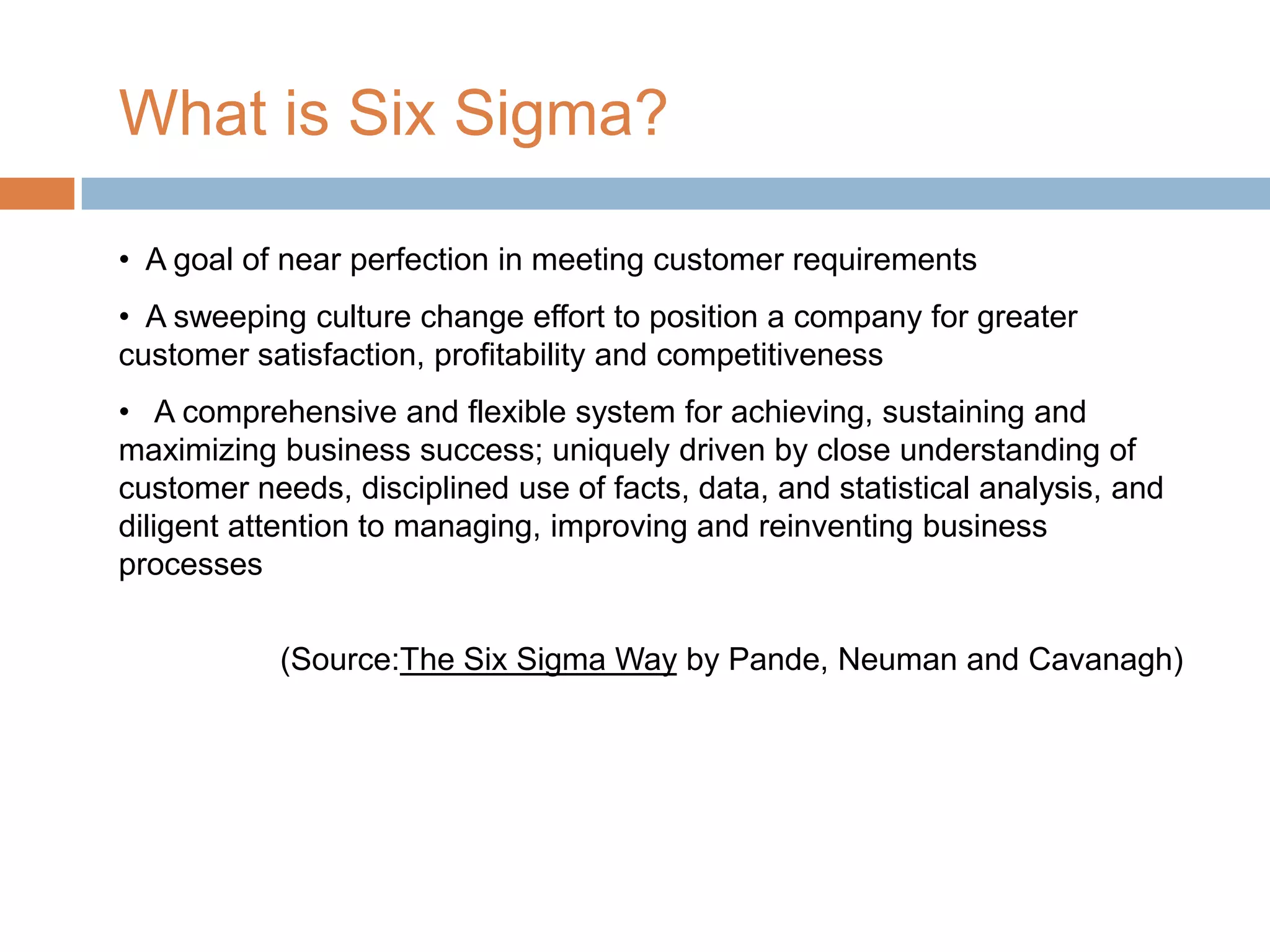
What is Six Sigma?

• A goal of near perfection in meeting customer requirements
• A sweeping culture change effort to position a company for greater
customer satisfaction, profitability and competitiveness
• A comprehensive and flexible system for achieving, sustaining and
maximizing business success; uniquely driven by close understanding of
customer needs, disciplined use of facts, data, and statistical analysis, and
diligent attention to managing, improving and reinventing business
processes


           (Source:The Six Sigma Way by Pande, Neuman and Cavanagh)
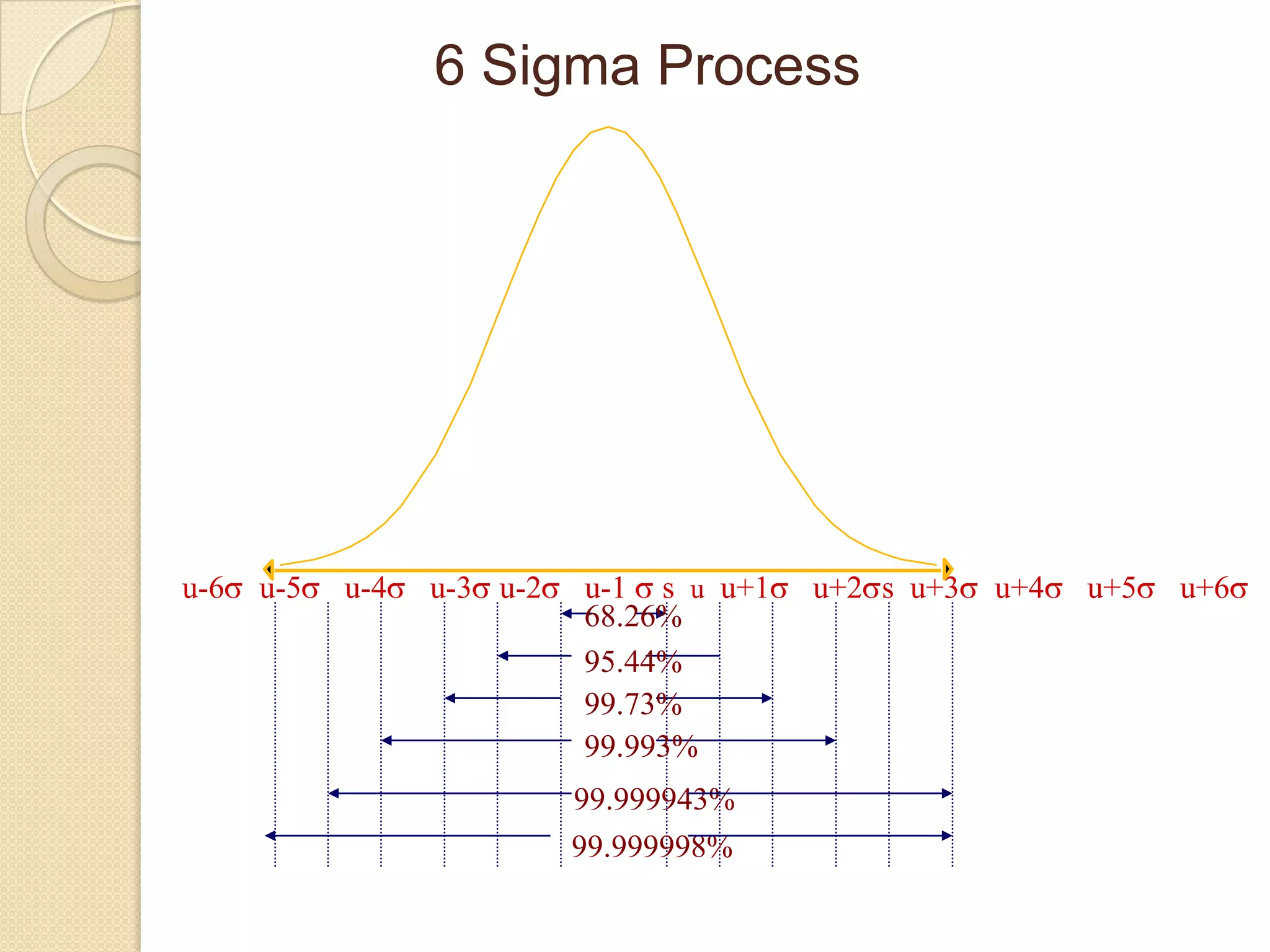
6 Sigma Process


u-6   u-5   u-4   u-3 u-2   u-1 s u u+1   u+2 s u+3   u+4   u+5   u+6
                            68.26%
                            95.44%
                            99.73%
                            99.993%
                            99.999943%
                            99.999998%

Continuous process improvement

  • 2.
    Decision Making and Process Improvement Processes  Sets of related tasks or activities by which work is accomplished.
  • 3.
    Operational Definition Continuous Process Improvement– A comprehensive philosophy of operations that is built around the concept that there are always ways in which a process can be improved to better meet the needs of the customer and that an organization should constantly strive to make those improvements. Source: DoD Continuous Process Improvement Transformation Guidebook
  • 4.
    Con Why Continuous Improvement Process Why? In today's climate a business that does not change doesn’t survive. SURVIVAL
  • 5.
    History of CPI From caveat emptor to… And everything in between …Lean Six Sigma
  • 6.
    Continuous Process Improvement FEEDBACK  PROCESS INPUT People OUTPUT Materials Equipment Information Money Method Data O/P Data,etc. Environment Product Materials Service,etc. Procedures CONDITIONS
  • 7.
    Five ways toImprove a Process  Reduce resources  Reduce errors  Meet or exceed expectations of internal/external customers  Make the process safer  Make the process more satisfying to the person doing it.
  • 8.
    The Juran Trilogy To attain quality you must begin by establishing the  1. Quality Planning vision, policies 2. Quality Control and goals of the organization. Converting these goals into 3. Quality results is Improvement done through three managerial processes called the JURAN TRILOGY. (aka the three universal processes for managing for  Source: Juran Quality Control Handbook, Fifth Edition quality)
  • 9.
    THE JURAN TRILOGY  1. Quality Planning: The structured process for  ―Quality does not happen designing by accident, it must be -products and services that planned.‖ meet new breakthrough goals and -ensure that customer needs are met.
  • 10.
    THE JURAN TRILOGY STEPSin the quality planning process: 1. Establish the project 2. Identify the customers 3. Discover the customer needs 4. Develop the product 5. Develop the process 6. Develop the controls and transfer to operations
  • 11.
    THE JURAN TRILOGY 2. Quality Control: a Quality control can also universal managerial be described as ―a process process for for meeting the established conducting operations so goals byevaluating and as to provide stability—to comparing actual performance and planned prevent adverse change and performance, and taking to ―maintain the status quo‖ action on the difference‖
  • 12.
    The Juran Trilogy TheQuality Control Process: 1. Choose control subject 2. Establish Measurement 3. Establish standards of Performance 4. Measure Actual Performance 5. Compare to Standards (interpret the difference) 6. Take action on the difference
  • 13.
    “ALL IMPROVEMENT TAKESPLACE 3. Quality PROJECT BY PROJECT” Improvement: -Prove the need for The process for improvement creating -Identify the improvement projects breakthrough -Establish project improvement teams levels of Provide the project teams with performance by resources, training, and eliminating wastes motivation to: -diagnose the causes and defects to -stimulate the remedies reduce the -establish controls to hold the gains cost of poor quality
  • 14.
    Fig : THEJURAN’S TRILOGY
  • 15.
    WHAT IS JURANTRILOGY - PARALLELS FINANCE March 29, 2006 Juran Trilogy – A Training Tool Source: Adopted from Juran, J. M. (August 1986). “The quality trilogy: A universal approach to managing for quality”. Quality Progress, 19(8), 19-24  Quality Trilogy resembles the financial processes 15 model By Mariou s Tcherp okov
  • 16.
    Four Improvement Strategies  Repair  Refinement  Renovation  Re-invention
  • 17.
    Compliance  Unstructured  Efficiency  Process Design  Product Design
  • 18.
    THE PDSA cycle Act Plan Plan Plan Study Do
  • 19.
    Problem Solving: AContinuous Effort 1. Identify problems as an opportunity 2. Analyze the problem: to find root causes 3. Develop optimal and cost effective solutions 4. Implement changes: system wide 5. Study the results: worked or not? Need adjustment? 6. Standardize solution: Keep problems from reoccurring. 7. Plan for the future
  • 20.
    Continuous Process Improvementcycle Phase I Identify the Opportunity Phase 7 Phase 2 Plan for the future Plan Analyze the process Act Study Do Phase 6 Standardise the solution Phase 3 Develop the optimal solution(s) Phae 5 Study the results Phase 4 Implementation
  • 21.
    OVERVIEW OF TOOLS- KAIZEN The Kaizen philosophy assumes that our way of life—be it our working life, our social life, or our home life deserves to be constantly improved. Maasaki Imai  Japanese term – ―Kai‖- meaning continuous ―zen‖- meaning improvement  Small scale continuous improvements  Incremental steps- addresses single problem  Rapid intense effort lasting 3-5 days  Known as Kaizen Events, Kaizen Blitz  Kaizen bursts 5-15 minutes in length  DoD Rapid Improvement Event
  • 22.
    Kaizen  Value and non-value added work activities  Muda-seven classes of waste  Principles of motion study and work-cell use  Principles of materials handling and use of one-piece flow  Documentation of standard operating procedures  The 5S’s  Visual displays for communicating to factory personnel  JIT- to produce right quantities at right time and with right resources  Poka-yoke to prevent or detect errors  Team dynamics – problem solving ,comm.,conflict resoln.
  • 23.
    The 5S Method  Seiko - Sort ( Proper arrangement )  Seiton - Set ( Systematic or Orderliness )  Seiso - Shine ( Sweep or clean-up )  Seiketso - Standard ( Personal cleanliness )  Shitsuke - Sustain ( Self-discipline )
  • 24.
    What is SixSigma? • A goal of near perfection in meeting customer requirements • A sweeping culture change effort to position a company for greater customer satisfaction, profitability and competitiveness • A comprehensive and flexible system for achieving, sustaining and maximizing business success; uniquely driven by close understanding of customer needs, disciplined use of facts, data, and statistical analysis, and diligent attention to managing, improving and reinventing business processes (Source:The Six Sigma Way by Pande, Neuman and Cavanagh)
  • 25.
    6 Sigma Process u-6 u-5 u-4 u-3 u-2 u-1 s u u+1 u+2 s u+3 u+4 u+5 u+6 68.26% 95.44% 99.73% 99.993% 99.999943% 99.999998%