Ms. Revathi Gnanavelou., M.Pharm.,
Assistant Professor,
Department of Pharmaceutical chemistry,
SVCP
ASTRINGENT
INTRODUCTION
 Astringent  Are the substances which precipitates the protein.
 Is a drug which makes the cell shrink by precipitating the proteins from their surfaces.
 Used in lotions to harden and protect the skin and to reduce bleeding from minor abrasions
 Other preparations, in which they are used are anti-perspirant preparation, mouth washes, eye
drops, throat lozenges etc.,
 It stimulates growth of new tissues, when they applied topically and produces corrosive effect in
concentrated solutions to remove undesireable tissue growth eg: Warts.
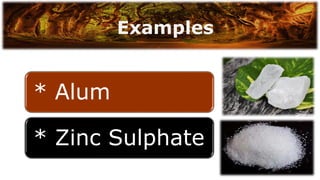
Examples
* Alum
* Zinc Sulphate
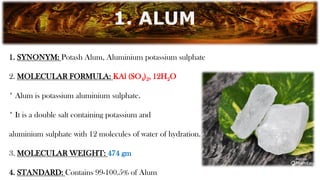
1. SYNONYM: Potash Alum, Aluminium potassium sulphate
2. MOLECULAR FORMULA: KAl (SO4)2, 12H2O
* Alum is potassium aluminium sulphate.
* It is a double salt containing potassium and
aluminium sulphate with 12 molecules of water of hydration.
3. MOLECULAR WEIGHT: 474 gm
4. STANDARD: Contains 99-100.5% of Alum
1. ALUM
5. PREPARATION:
 It is prepared by adding a hot concentrated solution of potassium sulphate to a hot solution of
an equal amount of aluminium sulphate  concentrated, cooled and crystallizes out
K2SO4 + Al2 (SO4)3 + 24 H2O → 2KAl (SO4)2. 12H2O
6.PHYSICAL PROPERTIES:
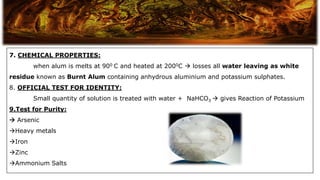
1. Colourless transparent crystals having a sweet astringent taste.
2. It is soluble in water but insoluble in alcohol.
3. At 2000C it loses its water at crystallization and becomes anhydrous.
4. Acidic to litmus and pH 4.6
7. CHEMICAL PROPERTIES:
when alum is melts at 900 C and heated at 2000C  losses all water leaving as white
residue known as Burnt Alum containing anhydrous aluminium and potassium sulphates.
8. OFFICIAL TEST FOR IDENTITY:
Small quantity of solution is treated with water + NaHCO3  gives Reaction of Potassium
9.Test for Purity:
 Arsenic
Heavy metals
Iron
Zinc
Ammonium Salts
10. ASSAY: Complexometric Titration Method
11. STORAGE:
Stored in a well-closed container
12. MEDICINAL AND PHARMACEUTICAL USES:
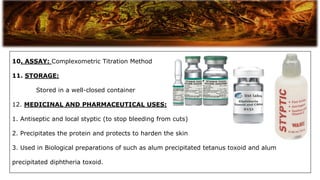
1. Antiseptic and local styptic (to stop bleeding from cuts)
2. Precipitates the protein and protects to harden the skin
3. Used in Biological preparations of such as alum precipitated tetanus toxoid and alum
precipitated diphtheria toxoid.
1. MOLECULAR FORMULA: ZnSO4. 7H2O
2. MOLECULAR WEIGHT: 288 gm
3. STANDARD: Contains 99% of ZnSO4. 7H2O
4. PREPARATION:
Prepared by boiling the slight excess of Metallic zinc with dilute sulphuric acid.
Zn + H2SO4  ZnSO4 + H2
Solution is filtered to remove unreacted zinc , concentrated and crystallized.
2. ZINC SULPHATE
5. PROPERTIES:
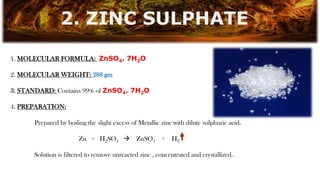
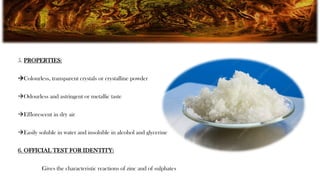
Colourless, transparent crystals or crystalline powder
Odourless and astringent or metallic taste
Efflorescent in dry air
Easily soluble in water and insoluble in alcohol and glycerine
6. OFFICIAL TEST FOR IDENTITY:
Gives the characteristic reactions of zinc and of sulphates
7. TEST FOR PURITY:
Arsenic
Purity and colour of solution
pH
Iron
Chloride
8. ASSAY:
Complexometric titration
9. INCOMPATIBILITY:
Alkali carbonates, hydroxides and astringent decoctions and infusions.
10.STORAGE:
Since,it is efflorescent , store in a well-closed, non-metallic container.
11.PHARMACEUTICAL AND MEDICINAL USES:
Internally used as a Emetic
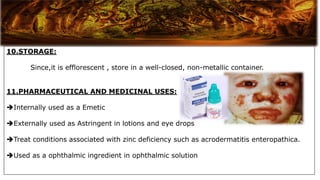
Externally used as Astringent in lotions and eye drops
Treat conditions associated with zinc deficiency such as acrodermatitis enteropathica.
Used as a ophthalmic ingredient in ophthalmic solution
References
1.Inorganic chemistry by
Mohammed Ali
2. Pharmaceutical chemistry by
Rajasekaran
3. Inorganic chemistry by
Paradkar
Contact: Revathi@svcppondy.ac.in
ASTRINGENT
Black Elk – Oglala Sioux Medicine Man
Thank You……

Astringent

  • 1.
    Ms. Revathi Gnanavelou.,M.Pharm., Assistant Professor, Department of Pharmaceutical chemistry, SVCP ASTRINGENT
  • 2.
    INTRODUCTION  Astringent Are the substances which precipitates the protein.  Is a drug which makes the cell shrink by precipitating the proteins from their surfaces.  Used in lotions to harden and protect the skin and to reduce bleeding from minor abrasions  Other preparations, in which they are used are anti-perspirant preparation, mouth washes, eye drops, throat lozenges etc.,  It stimulates growth of new tissues, when they applied topically and produces corrosive effect in concentrated solutions to remove undesireable tissue growth eg: Warts.
  • 3.
  • 4.
    1. SYNONYM: PotashAlum, Aluminium potassium sulphate 2. MOLECULAR FORMULA: KAl (SO4)2, 12H2O * Alum is potassium aluminium sulphate. * It is a double salt containing potassium and aluminium sulphate with 12 molecules of water of hydration. 3. MOLECULAR WEIGHT: 474 gm 4. STANDARD: Contains 99-100.5% of Alum 1. ALUM
  • 5.
    5. PREPARATION:  Itis prepared by adding a hot concentrated solution of potassium sulphate to a hot solution of an equal amount of aluminium sulphate  concentrated, cooled and crystallizes out K2SO4 + Al2 (SO4)3 + 24 H2O → 2KAl (SO4)2. 12H2O 6.PHYSICAL PROPERTIES: 1. Colourless transparent crystals having a sweet astringent taste. 2. It is soluble in water but insoluble in alcohol. 3. At 2000C it loses its water at crystallization and becomes anhydrous. 4. Acidic to litmus and pH 4.6
  • 6.
    7. CHEMICAL PROPERTIES: whenalum is melts at 900 C and heated at 2000C  losses all water leaving as white residue known as Burnt Alum containing anhydrous aluminium and potassium sulphates. 8. OFFICIAL TEST FOR IDENTITY: Small quantity of solution is treated with water + NaHCO3  gives Reaction of Potassium 9.Test for Purity:  Arsenic Heavy metals Iron Zinc Ammonium Salts
  • 7.
    10. ASSAY: ComplexometricTitration Method 11. STORAGE: Stored in a well-closed container 12. MEDICINAL AND PHARMACEUTICAL USES: 1. Antiseptic and local styptic (to stop bleeding from cuts) 2. Precipitates the protein and protects to harden the skin 3. Used in Biological preparations of such as alum precipitated tetanus toxoid and alum precipitated diphtheria toxoid.
  • 8.
    1. MOLECULAR FORMULA:ZnSO4. 7H2O 2. MOLECULAR WEIGHT: 288 gm 3. STANDARD: Contains 99% of ZnSO4. 7H2O 4. PREPARATION: Prepared by boiling the slight excess of Metallic zinc with dilute sulphuric acid. Zn + H2SO4  ZnSO4 + H2 Solution is filtered to remove unreacted zinc , concentrated and crystallized. 2. ZINC SULPHATE
  • 9.
    5. PROPERTIES: Colourless, transparentcrystals or crystalline powder Odourless and astringent or metallic taste Efflorescent in dry air Easily soluble in water and insoluble in alcohol and glycerine 6. OFFICIAL TEST FOR IDENTITY: Gives the characteristic reactions of zinc and of sulphates
  • 10.
    7. TEST FORPURITY: Arsenic Purity and colour of solution pH Iron Chloride 8. ASSAY: Complexometric titration 9. INCOMPATIBILITY: Alkali carbonates, hydroxides and astringent decoctions and infusions.
  • 11.
    10.STORAGE: Since,it is efflorescent, store in a well-closed, non-metallic container. 11.PHARMACEUTICAL AND MEDICINAL USES: Internally used as a Emetic Externally used as Astringent in lotions and eye drops Treat conditions associated with zinc deficiency such as acrodermatitis enteropathica. Used as a ophthalmic ingredient in ophthalmic solution
  • 12.
    References 1.Inorganic chemistry by MohammedAli 2. Pharmaceutical chemistry by Rajasekaran 3. Inorganic chemistry by Paradkar Contact: Revathi@svcppondy.ac.in
  • 13.
    ASTRINGENT Black Elk –Oglala Sioux Medicine Man Thank You……