Limit test for arsenic
• The original Gutzeit test was
quantitative one and the liberated
arsine gas is detected by covering the
mouth of the flask with filter paper,
on which small amount of silver
nitrate crystals were placed. The
liberated arsine turns silver nitrate
complex black.
• In the modified test, filter paper
dipped in mercuric chloride solution
is used, which yields a yellow colored
complex. It produces a stain in the
filter paper.
Principle
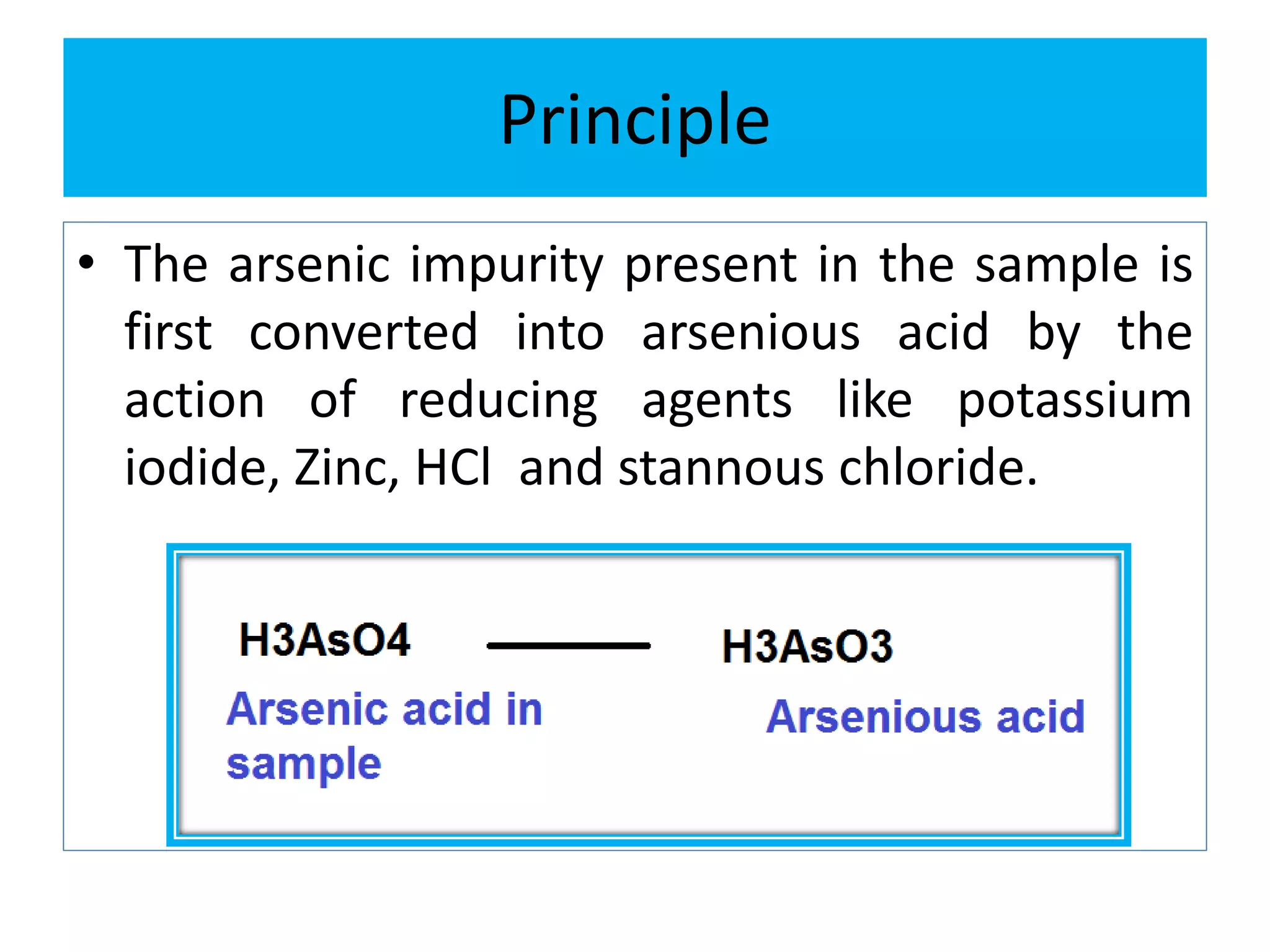
• The arsenic impurity present in the sample is
first converted into arsenious acid by the
action of reducing agents like potassium
iodide, Zinc, HCl and stannous chloride.
• The arsenious acid is then reduced to arsine
by the action of nascent hydrogen which is
produced by the reaction between Zinc and
HCl.
• The liberated arsine gas reacts with mercuric
chloride paper and forms yellow stain
Gutzeit apparatus
Procedure
• The required amount of sample solution is placed in
the wide mouthed bottle.
• To this add 1 g of potassium iodide and 10 g of
granulated zinc AST.
• Immediately close the bottle with stopper assembly.
• The acid present in the test solution and zinc reacts,
produces nascent hydrogen which reacts with
arsenious acid present in the sample and liberates
arsine gas which passes through the tube and reacts
with mercuric chloride paper and produces yellow
stain.
• The reaction is maintained for 40 minutes to
ensure complete conversion of arsenious acid
to arsine gas.
• Some heat pressure are produced during the
reaction due to the increased amount of gas in
the inside of the apparatus.
• The rate of reaction is increased by placing the
total assembly on a warm surface.
Standard of standard stain
• Standard stain is prepared by using dilute
arsenic solution [ 0.132 g of arsenic in 100 ml]
• I ml is diluted to 100 ml .
• The comparison of the stain is done after the
completion of the test immediately, so the
test and standard should be carried out
simultaneously.
Precaution
• If the stain present in the filter paper becomes
dark, the test should be repeated by using pure
reagents.
• The most suitable temperature for carry out this
test is 40C.
• Cotton wool dipped in lead acetate solution is
used to trap any hydrogen sulphide gas liberated
with arsine gas.
• Care must be taken that the filter paper remains
quite dry during the reaction.
• During the succeeding tests the tube must be
washed with HCl AsT rinsed with water and
dried.
• All the reagents used for this test should be
free from arsenic and mentioned as AsT.

7.limit test for arsenic

  • 1.
  • 2.
    • The originalGutzeit test was quantitative one and the liberated arsine gas is detected by covering the mouth of the flask with filter paper, on which small amount of silver nitrate crystals were placed. The liberated arsine turns silver nitrate complex black.
  • 3.
    • In themodified test, filter paper dipped in mercuric chloride solution is used, which yields a yellow colored complex. It produces a stain in the filter paper.
  • 4.
    Principle • The arsenicimpurity present in the sample is first converted into arsenious acid by the action of reducing agents like potassium iodide, Zinc, HCl and stannous chloride.
  • 5.
    • The arseniousacid is then reduced to arsine by the action of nascent hydrogen which is produced by the reaction between Zinc and HCl. • The liberated arsine gas reacts with mercuric chloride paper and forms yellow stain
  • 6.
  • 7.
    Procedure • The requiredamount of sample solution is placed in the wide mouthed bottle. • To this add 1 g of potassium iodide and 10 g of granulated zinc AST. • Immediately close the bottle with stopper assembly. • The acid present in the test solution and zinc reacts, produces nascent hydrogen which reacts with arsenious acid present in the sample and liberates arsine gas which passes through the tube and reacts with mercuric chloride paper and produces yellow stain.
  • 8.
    • The reactionis maintained for 40 minutes to ensure complete conversion of arsenious acid to arsine gas. • Some heat pressure are produced during the reaction due to the increased amount of gas in the inside of the apparatus. • The rate of reaction is increased by placing the total assembly on a warm surface.
  • 9.
    Standard of standardstain • Standard stain is prepared by using dilute arsenic solution [ 0.132 g of arsenic in 100 ml] • I ml is diluted to 100 ml . • The comparison of the stain is done after the completion of the test immediately, so the test and standard should be carried out simultaneously.
  • 10.
    Precaution • If thestain present in the filter paper becomes dark, the test should be repeated by using pure reagents. • The most suitable temperature for carry out this test is 40C. • Cotton wool dipped in lead acetate solution is used to trap any hydrogen sulphide gas liberated with arsine gas. • Care must be taken that the filter paper remains quite dry during the reaction.
  • 11.
    • During thesucceeding tests the tube must be washed with HCl AsT rinsed with water and dried. • All the reagents used for this test should be free from arsenic and mentioned as AsT.