LIMIT TESTS
Prepared by
G. Nikitha, M.Pharmacy
Assistant Professor
Department of Pharmaceutical Chemistry
Sree Dattha Institute of Pharmacy
Hyderabad
Subject Name: Pharmaceutical Inorganic chemistry
Year: Pharm-D Ist year
CONTENTS
 Introduction
 Limit Test for Chlorides
 Limit Test for sulphates
 Limit Test for Heavy metals
 Limit Test for Iron
 Limit Test for Arsenic
 Limit Test for Lead
INTRODUCTION
limit test is defined as quantitative or semi quantitative test designed to identify and
control small quantities of impurity which is likely to be present in the
substance. Limit test is generally carried out to determine the inorganic
impurities present in compound.
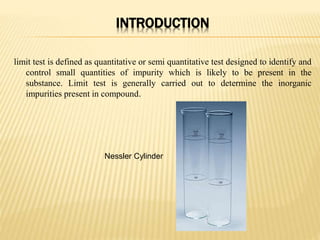
Nessler Cylinder
LIMIT TEST FOR CHLORIDES
Principle:
Limit test of chloride is based on the reaction of soluble chloride with silver
nitrate in presence of dilute nitric acid to form silver chloride, which appears as
solid particles (Opalescence) in the solution.
 The silver chloride produced in the presence of dilute nitric acid makes the test
solution turbid., the extent of turbidity depending upon the amount of chloride
present in the substance is compared with a standard opalescence produced by
addition of silver nitrate to a standard solution having a known amount of
chloride and the same volume of dilute nitric acid as used in the test solution.
 If turbidity from the sample has been less than the standard turbidity, the sample
will pass the limit test.
Method for the limiting test for chlorides
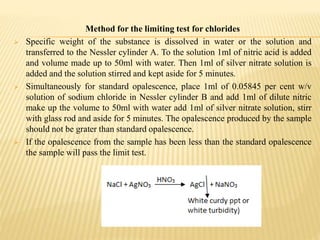
 Specific weight of the substance is dissolved in water or the solution and
transferred to the Nessler cylinder A. To the solution 1ml of nitric acid is added
and volume made up to 50ml with water. Then 1ml of silver nitrate solution is
added and the solution stirred and kept aside for 5 minutes.
 Simultaneously for standard opalescence, place 1ml of 0.05845 per cent w/v
solution of sodium chloride in Nessler cylinder B and add 1ml of dilute nitric
make up the volume to 50ml with water add 1ml of silver nitrate solution, stirr
with glass rod and aside for 5 minutes. The opalescence produced by the sample
should not be grater than standard opalescence.
 If the opalescence from the sample has been less than the standard opalescence
the sample will pass the limit test.
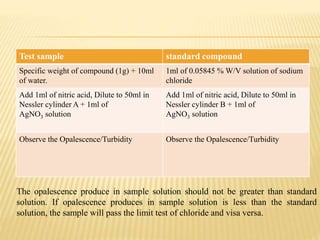
Test sample standard compound
Specific weight of compound (1g) + 10ml
of water.
1ml of 0.05845 % W/V solution of sodium
chloride
Add 1ml of nitric acid, Dilute to 50ml in
Nessler cylinder A + 1ml of
AgNO3 solution
Add 1ml of nitric acid, Dilute to 50ml in
Nessler cylinder B + 1ml of
AgNO3 solution
Observe the Opalescence/Turbidity Observe the Opalescence/Turbidity
The opalescence produce in sample solution should not be greater than standard
solution. If opalescence produces in sample solution is less than the standard
solution, the sample will pass the limit test of chloride and visa versa.
LIMIT TEST FOR SULPHATES
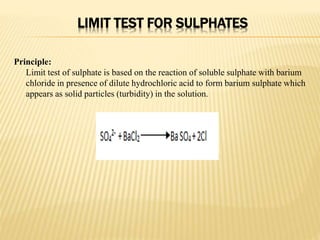
Principle:
Limit test of sulphate is based on the reaction of soluble sulphate with barium
chloride in presence of dilute hydrochloric acid to form barium sulphate which
appears as solid particles (turbidity) in the solution.
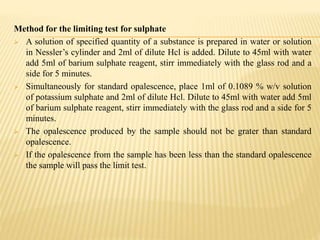
Method for the limiting test for sulphate
 A solution of specified quantity of a substance is prepared in water or solution
in Nessler’s cylinder and 2ml of dilute Hcl is added. Dilute to 45ml with water
add 5ml of barium sulphate reagent, stirr immediately with the glass rod and a
side for 5 minutes.
 Simultaneously for standard opalescence, place 1ml of 0.1089 % w/v solution
of potassium sulphate and 2ml of dilute Hcl. Dilute to 45ml with water add 5ml
of barium sulphate reagent, stirr immediately with the glass rod and a side for 5
minutes.
 The opalescence produced by the sample should not be grater than standard
opalescence.
 If the opalescence from the sample has been less than the standard opalescence
the sample will pass the limit test.
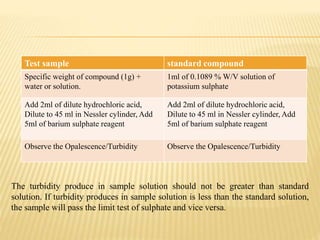
Test sample standard compound
Specific weight of compound (1g) +
water or solution.
1ml of 0.1089 % W/V solution of
potassium sulphate
Add 2ml of dilute hydrochloric acid,
Dilute to 45 ml in Nessler cylinder, Add
5ml of barium sulphate reagent
Add 2ml of dilute hydrochloric acid,
Dilute to 45 ml in Nessler cylinder, Add
5ml of barium sulphate reagent
Observe the Opalescence/Turbidity Observe the Opalescence/Turbidity
The turbidity produce in sample solution should not be greater than standard
solution. If turbidity produces in sample solution is less than the standard solution,
the sample will pass the limit test of sulphate and vice versa.
LIMIT TEST FOR HEAVY METALS
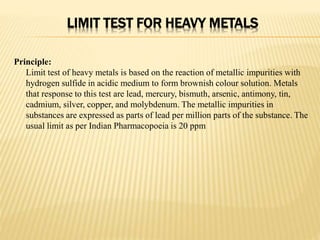
Principle:
Limit test of heavy metals is based on the reaction of metallic impurities with
hydrogen sulfide in acidic medium to form brownish colour solution. Metals
that response to this test are lead, mercury, bismuth, arsenic, antimony, tin,
cadmium, silver, copper, and molybdenum. The metallic impurities in
substances are expressed as parts of lead per million parts of the substance. The
usual limit as per Indian Pharmacopoeia is 20 ppm
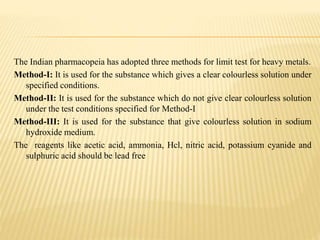
The Indian pharmacopeia has adopted three methods for limit test for heavy metals.
Method-I: It is used for the substance which gives a clear colourless solution under
specified conditions.
Method-II: It is used for the substance which do not give clear colourless solution
under the test conditions specified for Method-I
Method-III: It is used for the substance that give colourless solution in sodium
hydroxide medium.
The reagents like acetic acid, ammonia, Hcl, nitric acid, potassium cyanide and
sulphuric acid should be lead free
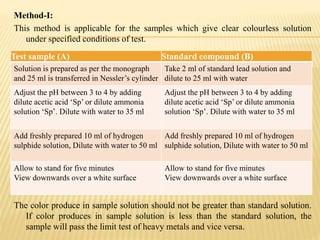
Method-I:
This method is applicable for the samples which give clear colourless solution
under specified conditions of test.
The color produce in sample solution should not be greater than standard solution.
If color produces in sample solution is less than the standard solution, the
sample will pass the limit test of heavy metals and vice versa.
Test sample (A) Standard compound (B)
Solution is prepared as per the monograph
and 25 ml is transferred in Nessler’s cylinder
Take 2 ml of standard lead solution and
dilute to 25 ml with water
Adjust the pH between 3 to 4 by adding
dilute acetic acid ‘Sp’ or dilute ammonia
solution ‘Sp’. Dilute with water to 35 ml
Adjust the pH between 3 to 4 by adding
dilute acetic acid ‘Sp’ or dilute ammonia
solution ‘Sp’. Dilute with water to 35 ml
Add freshly prepared 10 ml of hydrogen
sulphide solution, Dilute with water to 50 ml
Add freshly prepared 10 ml of hydrogen
sulphide solution, Dilute with water to 50 ml
Allow to stand for five minutes
View downwards over a white surface
Allow to stand for five minutes
View downwards over a white surface
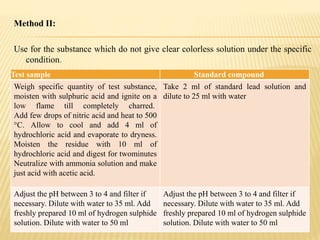
Method II:
Use for the substance which do not give clear colorless solution under the specific
condition.
Test sample Standard compound
Weigh specific quantity of test substance,
moisten with sulphuric acid and ignite on a
low flame till completely charred.
Add few drops of nitric acid and heat to 500
°C. Allow to cool and add 4 ml of
hydrochloric acid and evaporate to dryness.
Moisten the residue with 10 ml of
hydrochloric acid and digest for twominutes
Neutralize with ammonia solution and make
just acid with acetic acid.
Take 2 ml of standard lead solution and
dilute to 25 ml with water
Adjust the pH between 3 to 4 and filter if
necessary. Dilute with water to 35 ml. Add
freshly prepared 10 ml of hydrogen sulphide
solution. Dilute with water to 50 ml
Adjust the pH between 3 to 4 and filter if
necessary. Dilute with water to 35 ml. Add
freshly prepared 10 ml of hydrogen sulphide
solution. Dilute with water to 50 ml
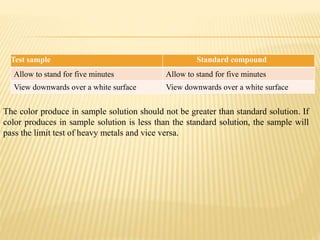
Test sample Standard compound
Allow to stand for five minutes Allow to stand for five minutes
View downwards over a white surface View downwards over a white surface
The color produce in sample solution should not be greater than standard solution. If
color produces in sample solution is less than the standard solution, the sample will
pass the limit test of heavy metals and vice versa.
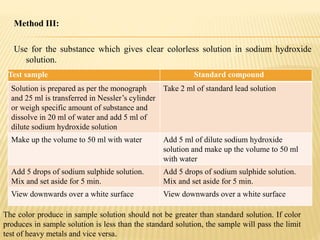
Method III:
Use for the substance which gives clear colorless solution in sodium hydroxide
solution.
Test sample Standard compound
Solution is prepared as per the monograph
and 25 ml is transferred in Nessler’s cylinder
or weigh specific amount of substance and
dissolve in 20 ml of water and add 5 ml of
dilute sodium hydroxide solution
Take 2 ml of standard lead solution
Make up the volume to 50 ml with water Add 5 ml of dilute sodium hydroxide
solution and make up the volume to 50 ml
with water
Add 5 drops of sodium sulphide solution.
Mix and set aside for 5 min.
Add 5 drops of sodium sulphide solution.
Mix and set aside for 5 min.
View downwards over a white surface View downwards over a white surface
The color produce in sample solution should not be greater than standard solution. If color
produces in sample solution is less than the standard solution, the sample will pass the limit
test of heavy metals and vice versa.
LIMIT TEST FOR IRON
LIMIT TEST FOR IRON
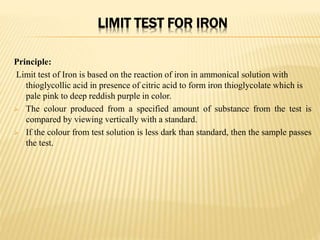
Principle:
Limit test of Iron is based on the reaction of iron in ammonical solution with
thioglycollic acid in presence of citric acid to form iron thioglycolate which is
pale pink to deep reddish purple in color.
 The colour produced from a specified amount of substance from the test is
compared by viewing vertically with a standard.
 If the colour from test solution is less dark than standard, then the sample passes
the test.
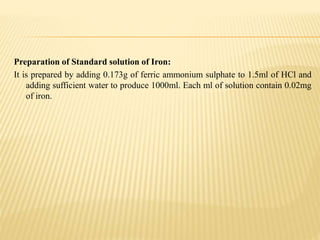
Preparation of Standard solution of Iron:
It is prepared by adding 0.173g of ferric ammonium sulphate to 1.5ml of HCl and
adding sufficient water to produce 1000ml. Each ml of solution contain 0.02mg
of iron.
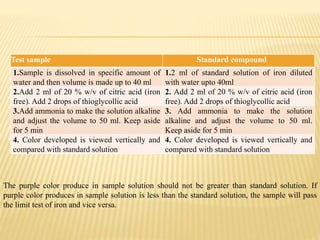
Test sample Standard compound
1.Sample is dissolved in specific amount of
water and then volume is made up to 40 ml
1.2 ml of standard solution of iron diluted
with water upto 40ml
2.Add 2 ml of 20 % w/v of citric acid (iron
free). Add 2 drops of thioglycollic acid
2. Add 2 ml of 20 % w/v of citric acid (iron
free). Add 2 drops of thioglycollic acid
3.Add ammonia to make the solution alkaline
and adjust the volume to 50 ml. Keep aside
for 5 min
3. Add ammonia to make the solution
alkaline and adjust the volume to 50 ml.
Keep aside for 5 min
4. Color developed is viewed vertically and
compared with standard solution
4. Color developed is viewed vertically and
compared with standard solution
The purple color produce in sample solution should not be greater than standard solution. If
purple color produces in sample solution is less than the standard solution, the sample will pass
the limit test of iron and vice versa.
LIMIT TEST FOR LEAD
LIMIT TEST FOR LEAD
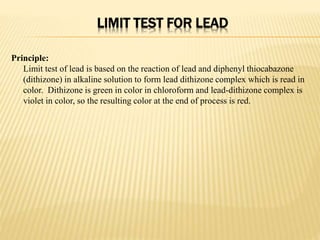
Principle:
Limit test of lead is based on the reaction of lead and diphenyl thiocabazone
(dithizone) in alkaline solution to form lead dithizone complex which is read in
color. Dithizone is green in color in chloroform and lead-dithizone complex is
violet in color, so the resulting color at the end of process is red.
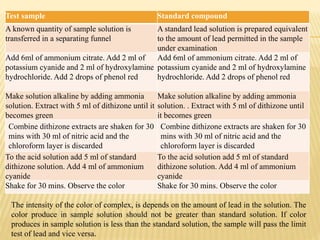
Test sample Standard compound
A known quantity of sample solution is
transferred in a separating funnel
A standard lead solution is prepared equivalent
to the amount of lead permitted in the sample
under examination
Add 6ml of ammonium citrate. Add 2 ml of
potassium cyanide and 2 ml of hydroxylamine
hydrochloride. Add 2 drops of phenol red
Add 6ml of ammonium citrate. Add 2 ml of
potassium cyanide and 2 ml of hydroxylamine
hydrochloride. Add 2 drops of phenol red
Make solution alkaline by adding ammonia
solution. Extract with 5 ml of dithizone until it
becomes green
Make solution alkaline by adding ammonia
solution. . Extract with 5 ml of dithizone until
it becomes green
Combine dithizone extracts are shaken for 30
mins with 30 ml of nitric acid and the
chloroform layer is discarded
Combine dithizone extracts are shaken for 30
mins with 30 ml of nitric acid and the
chloroform layer is discarded
To the acid solution add 5 ml of standard
dithizone solution. Add 4 ml of ammonium
cyanide
To the acid solution add 5 ml of standard
dithizone solution. Add 4 ml of ammonium
cyanide
Shake for 30 mins. Observe the color Shake for 30 mins. Observe the color
The intensity of the color of complex, is depends on the amount of lead in the solution. The
color produce in sample solution should not be greater than standard solution. If color
produces in sample solution is less than the standard solution, the sample will pass the limit
test of lead and vice versa.
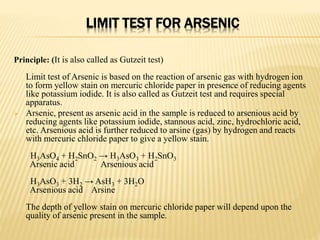
LIMIT TEST FOR ARSENIC
Principle: (It is also called as Gutzeit test)
Limit test of Arsenic is based on the reaction of arsenic gas with hydrogen ion
to form yellow stain on mercuric chloride paper in presence of reducing agents
like potassium iodide. It is also called as Gutzeit test and requires special
apparatus.
 Arsenic, present as arsenic acid in the sample is reduced to arsenious acid by
reducing agents like potassium iodide, stannous acid, zinc, hydrochloric acid,
etc. Arsenious acid is further reduced to arsine (gas) by hydrogen and reacts
with mercuric chloride paper to give a yellow stain.
H3AsO4 + H2SnO2 → H3AsO3 + H2SnO3
Arsenic acid Arsenious acid
H3AsO3 + 3H2 → AsH3 + 3H2O
Arsenious acid Arsine
The depth of yellow stain on mercuric chloride paper will depend upon the
quality of arsenic present in the sample.
APPARATUS
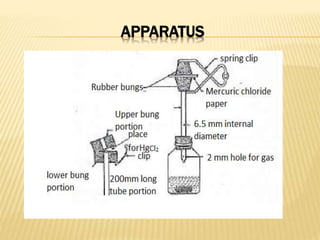
 It is having a wide mouthed glass bottle of 120 ml capacity having mouth of
about 2.5cm in diameter.
 The bottle is fitted with a rubber bung through which passes a glass tube 20cm
long having an external diameter of about 0.8cm and inter diameter of 0.65cm.
 The tube is constructed at its lower end extremity to about 1mm diameter and
there is blown a hole not less 2mm in diameter in the side of tube near the
constricted part.
 The upper end of the glass tube has been fitted with two rubber bungs each
having a hole bored centrally and exactly 6.5 mm in diameter.
 One of the bungs has been fitted to the upper end of the tube while the second
bung has to be fitted upon the first bung in such a way that the mercuric
chloride paper gets exactly sandwiched between the central perforation of two.
 The bungs are kept in close contact by using string clip in such a manner that
gas evolved from bottle must have to pass through the 0.65mm internal circle of
mercuric chloride paper.
Procedure:
The glass tube is lightly packed with cotton wool, previously moistened with lead
acetate solution and dried, so that the upper surface of the cotton wool is not
less than 25 mm below the top of the tube. The upper end of the tube is then
inserted into the narrow end of one of the pair of rubber bungs, to a depth of l0
mm (the tube must have a rounded-off end). A piece of mercuric chloride paper
is placed flat on the top of the bung and the other bung placed over it and
secured by means of the spring clip in such a manner that the holes of the two
bungs meet to form a true tube 6.5 mm diameter interrupted by a diaphragm of
mercuric chloride paper.
 The test solution prepared as specified, is placed in the wide-mouthed bottle, 1 g
of KI (AsT) and 10 g of Zn (AsT) are added, and the prepared glass tube is
placed quickly in position. The reaction is allowed to proceed for 40 minutes.
The yellow stain that is produced on the HgCl2 paper if As is present is
compared by daylight with the standard stains obtained by performing in an
identical manner with known quantities of dilute arsenic solution (AsT). The
comparison of the stains is made immediately at the completion of the test.
 By matching the intensity and depth of colour with standard stains, the
proportion of arsenic in the substance may be estimated. Thus, a stain
equivalent to the 1 ml standard stain obtained by performing on l0 g of a
substance implies that the proportion of As is 1 part per million.
REFERENCE
 Pharmaceutical Chemistry -Inorganic Volume-1 by G. R. Chatwal.
 Essentials of Inorganic Chemistry by Katja A. Strohfeldt.
 Indian Pharmacopoeia.
 M.L Schroff, Inorganic Pharmaceutical Chemistry.
 P. GunduRao, Inorganic Pharmaceutical Chemistry, 3rd Edition
 A.I. Vogel, Text Book of Quantitative Inorganic analysis.
 Bentley and Driver's Textbook of Pharmaceutical Chemistry.
THANK YOU