4TH UNIT
CORTICOSTEROIDS
Prepared by
G. Nikitha, M.Pharmacy
Assistant Professor
Department of Pharmaceutical
Chemistry
Sree Dattha Institute Of
Pharmacy
Hyderabad
1
Subject: Medicinal Chemistry-II
Year: B.Pharmacy 3rd Year
Semister: 1st Semister
CONTENTS
 Introduction.
 Types of Corticosteroids
 Biosynthesis of Corticosteroids
 Biological Effects
 Uses
 Classification
 Synthesis
 Reference
2
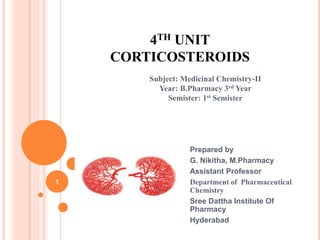
INTRODUCTION
 Adrenal glands are triangular and highly vascularized glands located
above each kidney. Each adrenal gland is structurally and
functionally divided into two regions outer adrenal cortex and inner
adrenal medulla. Adrenal cortex is divided into three zones viz. zona
glomerulosa, zona fasciculate and zona reticularis.
 Corticosteroids are steroid hormones secreted by the adrenal cortex.
These hormones are essential for the survival as they are concerned
with the maintenance of water and electrolyte balance,
cardiovascular and energy substrate balance and functional status of
nervous system and skeletal muscles. Corticosteroids are basically of
3 types.
3
TYPES OF CORTICOSTEROIDS
1. Glucocorticoids
Glucocorticoids are secreted by the zona fasciculate of adrenal
cortex. They are concerned with carbohydrate, protein and fat
metabolism. Cortisol and corticosterone are the two major
glucocorticoids. They have carbohydrate storing. Anti-inflammatory,
Anti-allergic and anti-corticotrophic properties.
2. Mineralocortiods:
Mineralocortiods are secreted by the zona glomerulosa of adrenal
cortex. They include aldosterone and deoxycorticosterone. They are
concerned K+, Na+ and fluid balance.
3. Sex Hormones:
Male sex hormones (androgens) are released by zona recticularis of
the adrenal cortex. These are released in small amounts and are weak
in action.
4
BIOSYNTHESIS OF CORTICOSTEROIDS
 Adrenocorticosteroids are 21 carbon compounds containing
cyclopentenoperhydrophenantherene ring. They are synthesized in
the adrenocortical cells under the influence of ACTH
(adrenocorticotrophin hormone) from cholesterol.
5
6
BIOLOGICAL EFFECTS AND USES
 They act on carbohydrate and protein metabolism, promote glycogen
deposition in liver.
 They promote lipolysis due to glycogen, growth hormone
adrenaline, Thyroxine.
 They inhibit intestinal absorption and enhance renal excretion of Ca+
Uses:
Used in the following conditions
 Acute adrenal insufficiency, chronic adrenal insufficiency, severe
allergic reactions, autoimmune disease, asthma, eye diseases, skin
diseases.
7
MINERALOCORTIODS
8
GLUCOCORTICOIDS
9
Glucocorticoids with moderate-to-low salt retention
10
11
Ophthalmic Glucocorticoids
12
13
Glucocorticoids used for the treatment of asthma and allergy
MECHANISM OF ACTION
 Steroids penetrate into the cell as free molecule and bind to cytosolic
corticoid receptor.
 The steroid-receptor complex then forms a homodimer (S-R+S-R)
which allows its translocation into the nucleus where it binds to
glucocorticoid responsive element (GRE) in the regulatory region of
the concerned gene.
 This result in the transcription of mRNA which is transported to
cytoplasm where it causes translation of desired proteins that brings
about the final hormone response.
14
15
Pharmacokinetics:
 All natural and synthetic corticosteroids are well absorbed orally.
 Hydrocortisone is highly bound to plasma proteins.
 All the corticosteroids get metabolized in liver and are excreted in
urine.
16
ADVERSE DRUG EFFECTS
Short term therapy with small or moderate doses does not produce
any side effects. However, long term therapy with large doses is
liable to cause certain adverse effects which are enlisted below.
 On GIT: Acute haemorrhage, gastritis, peptic ulceration intestinal
perforation and pancreatitis can occur. These occur due to decrease
in the production of PIGI2 which protects the gastric mucosa.
 On CNS: Glucocorticoids produce psychological disturbances
ranging from euphoria to manic depressive psychosis. However,
such reactions are reversible upon discontinuation of therapy.
 Crushing’s Habitus: prolonged therapy with glucocorticoids causes
cushingoid appearance which is characterized by round face,
relatively thin limbs.
17
 On cardiovascular and renal system: Hypertension,
hypokalaemic alkalosis and oedema due to Na+ and water retention
are potential complications.
 Suppression of Hypothalamo-pituitary Adrenal (HAP) Axis:
Sudden cessation or reduction in the dosage of glucocorticoids can
precipitate withdrawal syndrome characterized by malaise, fever,
nausea, anorexia, myalgia, weakness and postural hypertension.
Hence, the therapy should be gradually withdrawn to allow
physiological recovery of the normal pituitary and adrenal functions.
 Osteoporosis and Glycosuria: Osteoporosis is a common adverse
effect particularly involving vertebrae and other flat spongy bones.
In post-menopausal women, this complication can be fatal.
 Hyperglycaemia and Glycosuria: A diabetic-like state can be
precipitated because of anti-insulin effects of glucocorticoids.
However, they are reversible upon discontinuation of therapy.
18
 Ocular effects: Prolonged topic or systemic use of glucocorticoids
is associated with posterior subcapsular effects and glaucoma.
 Retardation of linear growth: Prolonged glucocorticoids therapy
even with small doses can cause growth retardation in children.
 Supression of inflammation and immune response:
Glucocorticoids only dampen the manifestation of a disease, while
the disease continues to progress; further, they favour the spread of
infectious diseases by impairing the defensive capacity of the body.
 Delay wounds Healing: They interfere with the healing of wounds
and surgical incisions.
19
THERAPEUTIC USES
Used in the treatment of Acute
 Adrenal Insufficiency, Chronic Adrenal Insufficiency, Congenital
Adrenal Hyperplasia.
 Arthritis, Autoimmune disease, Several allergic reactions, Intestinal
disease, Ocular disease,
 Bronchial Asthma, Skin disease
20
Cortisone:
IUPAC: 17-hydroxy-17-(2-hydroxyacetyl)-10,13-dimethyl-
1,2,6,7,8,9,12,14,15,16-decahydrocyclopenta [a] phenanthrene-3,11-
dione
Properties and Uses: It is white crystalline powder, which is insoluble
in water, soluble in alcohol. It is used in arthritis, allergic conditions,
chronic lymphatic leukemia.
21
Molecular Formula: C21H28O5
22
Synthesis:
Hydroxycortisone:
IUPAC: 11,17-dihydroxy-17-(2-hydroxyacetyl)-10,13-dimethyl-
2,6,7,8,9,11,12,14,15,16-decahydro-1H-cyclopenta[a]phenanthren-
3-one
23
It is a glucocorticosteroid and is the most important adrenocortical hormone
which is physiologically more active than cortisone. It is isolated by kendoll in
1937. It is used in the treatment of rheumatoid arthritis, rheumatoid fever, severe
shock and allergic condition.
Molecular Formula: C21H30O5
Properties and Uses: It is white crystalline powder, which is soluble in
water and alcohol. It is used in anti-inflammatory agent.
24
 Synthesis:
Route-1: From Progesterone
25
Route-2: From cortisone acetone
26
Prednisolone:
IUPAC: 11,17-dihydroxy-17-(2-hydroxyacetyl)-10,13-dimethyl-
7,8,9,11,12,14,15,16-octahydro-6H-cyclopenta[a]phenanthren-3-one
Properties and Uses: It is white crystalline powder, which is sparingly
soluble in alcohol. It is four times as potent as hydrocortisone.
27
Molecular Formula: C21H28O5
Synthesis:
28
Daxamethasone
IUPAC: 9-fluoro-11,17-dihydroxy-17-(2-hydroxyacetyl)-10,13,16-
trimethyl-6,7,8,11,12,14,15,16-octahydrocyclopenta[a]phenanthren-
3-one
Properties and Uses: It is white crystalline powder, which is insoluble
in water, soluble in alcohol. It is used as anti-inflammatory, anti-
allergic drugs.
29
Molecular Formula: C22H29FO5
Betamethasone
IUPAC: 9-fluoro-11,17-dihydroxy-17-(2-hydroxyacetyl)-10,13,16-
trimethyl-6,7,8,11,12,14,15,16-octahydrocyclopenta[a]phenanthren-
3-one
Properties and Uses: It is white crystalline powder, odorless, soluble
in acetone, alcohol, sparingly soluble in methanol, chloroform, ether.
It is used to treat allergies, skin rashes, dermatitis, itching.
30
Molecular Formula: C22H29FO5
Reference books
 Text book of Medicinal chemistry volume-1-3rd edition by
V.Alagarasamy.
 Text book of Medicinal chemistry volume-2-3rd edition by
V.Alagarasamy.
 Medicinal chemistry by Rama Rao Nadendla.
 Faye’s Principles of Medicinal Chemistry- 7th edition by Thoms
L.Lemke, Victoria F.Roche, S. Willam Zito.
 Medicinal Chemistry- 4th edition by Ashutosh Kar
31
THANK YOU
32

4th unit corticosteroids

  • 1.
    4TH UNIT CORTICOSTEROIDS Prepared by G.Nikitha, M.Pharmacy Assistant Professor Department of Pharmaceutical Chemistry Sree Dattha Institute Of Pharmacy Hyderabad 1 Subject: Medicinal Chemistry-II Year: B.Pharmacy 3rd Year Semister: 1st Semister
  • 2.
    CONTENTS  Introduction.  Typesof Corticosteroids  Biosynthesis of Corticosteroids  Biological Effects  Uses  Classification  Synthesis  Reference 2
  • 3.
    INTRODUCTION  Adrenal glandsare triangular and highly vascularized glands located above each kidney. Each adrenal gland is structurally and functionally divided into two regions outer adrenal cortex and inner adrenal medulla. Adrenal cortex is divided into three zones viz. zona glomerulosa, zona fasciculate and zona reticularis.  Corticosteroids are steroid hormones secreted by the adrenal cortex. These hormones are essential for the survival as they are concerned with the maintenance of water and electrolyte balance, cardiovascular and energy substrate balance and functional status of nervous system and skeletal muscles. Corticosteroids are basically of 3 types. 3
  • 4.
    TYPES OF CORTICOSTEROIDS 1.Glucocorticoids Glucocorticoids are secreted by the zona fasciculate of adrenal cortex. They are concerned with carbohydrate, protein and fat metabolism. Cortisol and corticosterone are the two major glucocorticoids. They have carbohydrate storing. Anti-inflammatory, Anti-allergic and anti-corticotrophic properties. 2. Mineralocortiods: Mineralocortiods are secreted by the zona glomerulosa of adrenal cortex. They include aldosterone and deoxycorticosterone. They are concerned K+, Na+ and fluid balance. 3. Sex Hormones: Male sex hormones (androgens) are released by zona recticularis of the adrenal cortex. These are released in small amounts and are weak in action. 4
  • 5.
    BIOSYNTHESIS OF CORTICOSTEROIDS Adrenocorticosteroids are 21 carbon compounds containing cyclopentenoperhydrophenantherene ring. They are synthesized in the adrenocortical cells under the influence of ACTH (adrenocorticotrophin hormone) from cholesterol. 5
  • 6.
  • 7.
    BIOLOGICAL EFFECTS ANDUSES  They act on carbohydrate and protein metabolism, promote glycogen deposition in liver.  They promote lipolysis due to glycogen, growth hormone adrenaline, Thyroxine.  They inhibit intestinal absorption and enhance renal excretion of Ca+ Uses: Used in the following conditions  Acute adrenal insufficiency, chronic adrenal insufficiency, severe allergic reactions, autoimmune disease, asthma, eye diseases, skin diseases. 7
  • 8.
  • 9.
  • 10.
  • 11.
  • 12.
  • 13.
    13 Glucocorticoids used forthe treatment of asthma and allergy
  • 14.
    MECHANISM OF ACTION Steroids penetrate into the cell as free molecule and bind to cytosolic corticoid receptor.  The steroid-receptor complex then forms a homodimer (S-R+S-R) which allows its translocation into the nucleus where it binds to glucocorticoid responsive element (GRE) in the regulatory region of the concerned gene.  This result in the transcription of mRNA which is transported to cytoplasm where it causes translation of desired proteins that brings about the final hormone response. 14
  • 15.
  • 16.
    Pharmacokinetics:  All naturaland synthetic corticosteroids are well absorbed orally.  Hydrocortisone is highly bound to plasma proteins.  All the corticosteroids get metabolized in liver and are excreted in urine. 16
  • 17.
    ADVERSE DRUG EFFECTS Shortterm therapy with small or moderate doses does not produce any side effects. However, long term therapy with large doses is liable to cause certain adverse effects which are enlisted below.  On GIT: Acute haemorrhage, gastritis, peptic ulceration intestinal perforation and pancreatitis can occur. These occur due to decrease in the production of PIGI2 which protects the gastric mucosa.  On CNS: Glucocorticoids produce psychological disturbances ranging from euphoria to manic depressive psychosis. However, such reactions are reversible upon discontinuation of therapy.  Crushing’s Habitus: prolonged therapy with glucocorticoids causes cushingoid appearance which is characterized by round face, relatively thin limbs. 17
  • 18.
     On cardiovascularand renal system: Hypertension, hypokalaemic alkalosis and oedema due to Na+ and water retention are potential complications.  Suppression of Hypothalamo-pituitary Adrenal (HAP) Axis: Sudden cessation or reduction in the dosage of glucocorticoids can precipitate withdrawal syndrome characterized by malaise, fever, nausea, anorexia, myalgia, weakness and postural hypertension. Hence, the therapy should be gradually withdrawn to allow physiological recovery of the normal pituitary and adrenal functions.  Osteoporosis and Glycosuria: Osteoporosis is a common adverse effect particularly involving vertebrae and other flat spongy bones. In post-menopausal women, this complication can be fatal.  Hyperglycaemia and Glycosuria: A diabetic-like state can be precipitated because of anti-insulin effects of glucocorticoids. However, they are reversible upon discontinuation of therapy. 18
  • 19.
     Ocular effects:Prolonged topic or systemic use of glucocorticoids is associated with posterior subcapsular effects and glaucoma.  Retardation of linear growth: Prolonged glucocorticoids therapy even with small doses can cause growth retardation in children.  Supression of inflammation and immune response: Glucocorticoids only dampen the manifestation of a disease, while the disease continues to progress; further, they favour the spread of infectious diseases by impairing the defensive capacity of the body.  Delay wounds Healing: They interfere with the healing of wounds and surgical incisions. 19
  • 20.
    THERAPEUTIC USES Used inthe treatment of Acute  Adrenal Insufficiency, Chronic Adrenal Insufficiency, Congenital Adrenal Hyperplasia.  Arthritis, Autoimmune disease, Several allergic reactions, Intestinal disease, Ocular disease,  Bronchial Asthma, Skin disease 20
  • 21.
    Cortisone: IUPAC: 17-hydroxy-17-(2-hydroxyacetyl)-10,13-dimethyl- 1,2,6,7,8,9,12,14,15,16-decahydrocyclopenta [a]phenanthrene-3,11- dione Properties and Uses: It is white crystalline powder, which is insoluble in water, soluble in alcohol. It is used in arthritis, allergic conditions, chronic lymphatic leukemia. 21 Molecular Formula: C21H28O5
  • 22.
  • 23.
    Hydroxycortisone: IUPAC: 11,17-dihydroxy-17-(2-hydroxyacetyl)-10,13-dimethyl- 2,6,7,8,9,11,12,14,15,16-decahydro-1H-cyclopenta[a]phenanthren- 3-one 23 It isa glucocorticosteroid and is the most important adrenocortical hormone which is physiologically more active than cortisone. It is isolated by kendoll in 1937. It is used in the treatment of rheumatoid arthritis, rheumatoid fever, severe shock and allergic condition. Molecular Formula: C21H30O5
  • 24.
    Properties and Uses:It is white crystalline powder, which is soluble in water and alcohol. It is used in anti-inflammatory agent. 24
  • 25.
  • 26.
  • 27.
    Prednisolone: IUPAC: 11,17-dihydroxy-17-(2-hydroxyacetyl)-10,13-dimethyl- 7,8,9,11,12,14,15,16-octahydro-6H-cyclopenta[a]phenanthren-3-one Properties andUses: It is white crystalline powder, which is sparingly soluble in alcohol. It is four times as potent as hydrocortisone. 27 Molecular Formula: C21H28O5
  • 28.
  • 29.
    Daxamethasone IUPAC: 9-fluoro-11,17-dihydroxy-17-(2-hydroxyacetyl)-10,13,16- trimethyl-6,7,8,11,12,14,15,16-octahydrocyclopenta[a]phenanthren- 3-one Properties andUses: It is white crystalline powder, which is insoluble in water, soluble in alcohol. It is used as anti-inflammatory, anti- allergic drugs. 29 Molecular Formula: C22H29FO5
  • 30.
    Betamethasone IUPAC: 9-fluoro-11,17-dihydroxy-17-(2-hydroxyacetyl)-10,13,16- trimethyl-6,7,8,11,12,14,15,16-octahydrocyclopenta[a]phenanthren- 3-one Properties andUses: It is white crystalline powder, odorless, soluble in acetone, alcohol, sparingly soluble in methanol, chloroform, ether. It is used to treat allergies, skin rashes, dermatitis, itching. 30 Molecular Formula: C22H29FO5
  • 31.
    Reference books  Textbook of Medicinal chemistry volume-1-3rd edition by V.Alagarasamy.  Text book of Medicinal chemistry volume-2-3rd edition by V.Alagarasamy.  Medicinal chemistry by Rama Rao Nadendla.  Faye’s Principles of Medicinal Chemistry- 7th edition by Thoms L.Lemke, Victoria F.Roche, S. Willam Zito.  Medicinal Chemistry- 4th edition by Ashutosh Kar 31
  • 32.