KNOWLEDGE FOR THE BENEFIT OF HUMANITYKNOWLEDGE FOR THE BENEFIT OF HUMANITY
PUBLIC HEALTH AND EPIDEMIOLOGY (HFS3063)
Epidemiological Study Designs:
CASE CONTROL
Dr.Dr. MohdMohd RazifRazif ShahrilShahril
School of Nutrition & DieteticsSchool of Nutrition & Dietetics
Faculty of Health SciencesFaculty of Health Sciences
UniversitiUniversiti SultanSultan ZainalZainal AbidinAbidin
1
Topic Learning Outcomes
By the end of this lecture, students should be able to;
• describe case control study design.
• explain the advantages and disadvantages of case
control study design.
2
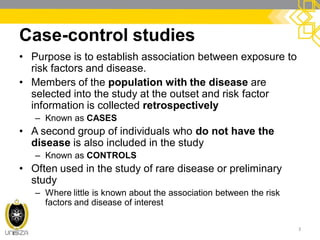
Case-control studies
• Purpose is to establish association between exposure to
risk factors and disease.
• Members of the population with the disease are
selected into the study at the outset and risk factor
information is collected retrospectively
– Known as CASES
• A second group of individuals who do not have the
disease is also included in the study
– Known as CONTROLS
• Often used in the study of rare disease or preliminary
study
– Where little is known about the association between the risk
factors and disease of interest
3
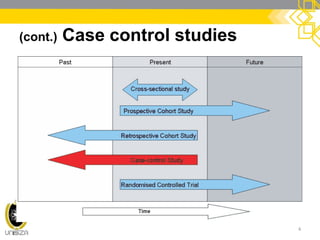
(cont.) Case control studies
4
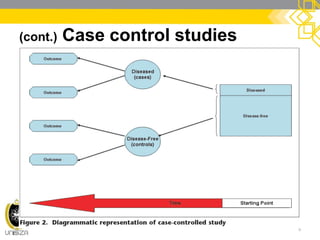
(cont.) Case control studies
5
(cont.) Case control studies
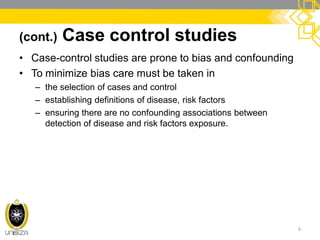
• Case-control studies are prone to bias and confounding
• To minimize bias care must be taken in
– the selection of cases and control
– establishing definitions of disease, risk factors
– ensuring there are no confounding associations between
detection of disease and risk factors exposure.
6
Choice of cases
• Care must be taken when choosing cases for the study.
• It is important to distinguish between stages or subtypes
of disease and to define a measure of health status
– E.g. when studying physical activity it is important to define what
is meant by physical activity in terms of types, nature and level.
• It is also important to establish whether interest is in
– incident cases, subjects entered into study on detection of
disease, OR
– prevalent cases, those who have been diagnosed as having the
disease prior to the study
7
(cont.) Choice of cases
• Views, behavior and reports of exposure to risk factor
amongst incident cases and prevalent cases will tend to
differ
– Those diagnosed previously are likely to be more informed about
the disease and may have altered their behavior and attitudes
• Incident case design is preferred as it reduces recall bias
and over-representation of cases with long standing
base.
8
Choice of controls
• Controls should
– come from the same population at risk of disease
– not have the disease
– be representative of the target population
• Selecting controls often proves harder than cases and
requires great care in the prevention of bias.
• A sampling frame of hospital patients is often used to
select controls
– however risk factors such as diet and smoking are commonly
linked to many diseases
9
(cont.) Choice of controls
• Selecting controls from hospital patients sampling frame
might therefore over-estimate population exposure
– underestimation of association between disease and exposure
– to overcome this; use more than one control group
• Multiple controls can be used for each case
– Giving the study greater power
– Particularly where the number of cases is small due to the
disease being rare.
10
Exposure to risk factors and matching
• Exposure measurements are reliant on memory
(interviewed retrospectively) and/or medical records.
• Exposure estimates are vulnerable to recall bias
– Those with disease are more likely to remember exposure than
those without
• Exposure estimates are vulnerable to interview or
measurement bias
– Interviewer interviews or reports findings systematically
differently between cases and control and confounding factors
– Can be overcome by including blinding in the design so that they
do not know who is a case and who is a control at the time of
interview.
11
(cont.) Exposure to risk factors and matching
• Confounding factors must be identified prior to the start
of study.
• Individuals matched to controls where it is thought that
other factors, aside from those risk factors of interest,
might contribute to the development of disease
– E.g: age, sex,
• The factor upon which cases and controls are matched
can not be studied as risk factor.
• Alternative method of overcoming confounding is to
collect relevant information on them and adjust
statistically.
12
(cont.) Exposure to risk factors and matching
• Matching is used in case-control studies for;
– To permit allowance for confounders which are complex of
difficult to define
• e.g. by comparing within identical twin case/control pairs it is possible to
allow for ill-defined genetic confounders.
– To make allowance for confounders statistically more efficient.
Efficient analysis requires that there be a similar ratio of cases to
controls at each level of exposure to the confounding variable
– To reduce biases in the ascertainment of exposure.
• Egg. Data collected from deceased cases should be matched to deceased
control as information is collected from their family members.
13
Analysis of data
• Case control study measure the odd of exposure based
on disease
– Compared to cohort study which measure relative risk of disease
based on exposure
• Odds ratio has two components;
– The odds of exposure for cases
– The odds of exposure for controls
14
(cont.) Analysis of data
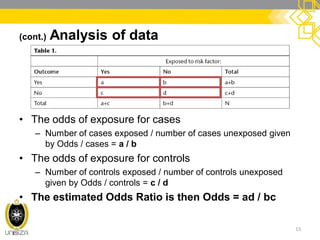
• The odds of exposure for cases
– Number of cases exposed / number of cases unexposed given
by Odds / cases = a / b
• The odds of exposure for controls
– Number of controls exposed / number of controls unexposed
given by Odds / controls = c / d
• The estimated Odds Ratio is then Odds = ad / bc
15
(cont.) Analysis of data
• The Odds Ratio is interpreted as
– OR < 1; Odds of exposure for cases are less than those for
control. Exposure appears to reduce risk of disease.
– OR = 1; Odds of exposure for cases are the same as those for
control. Exposure does not appear to be a risk factor.
– OR > 1; Odds of exposure for cases are more than those for
control. Exposure appears to increase risk of disease.
• A 95% confidence interval (95% CI) gives an indication
of the confidence we have in the estimated Odds Ratio
– E.g. if the entire 95% CI is above 1, it is concluded that exposure
significantly increases the risk of disease at the 95% level.
16
(cont.) Analysis of data
• Assessment of whether an observed association is likely
to be directly causal and not the results of unrecognized
confounding depends on;
– The size of the relative risk – higher relative risk are less likely to
be explained by unknown confounders.
– The presence of a dose-response relation – the observation of a
higher risk in subjects with a greater exposure to the risk factor
favors a direct causal relationship.
– The existence of plausible biological mechanism which might
explain a causal relationship.
17
Advantages of case control studies
• Quick
• Cheap
• Particularly suited to the study of rare diseases as the
diseased are selected at the outset of the study.
18
Disadvantages of case control studies
• Difficulties in overcoming potential bias and confounding.
• The successful selection of both cases and controls who
are representative of their respective population is often
difficult.
• An inability to infer causality and no information on the
chronology of disease and exposure.
• Inefficient in studying risk factors which are rare.
• Studies are often not population based, therefore it is
impossible to calculate incidence of disease.
19
Recapitulate
In this lecture, you have been exposed to;
• definition of case-control studies
• choice of cases and controls
• exposure to risk factors and matching
• analysis of data for case-control studies
• advantages and disadvantages of case-control studies
20
Thank YouThank You
21

5. Case control

  • 1.
    KNOWLEDGE FOR THEBENEFIT OF HUMANITYKNOWLEDGE FOR THE BENEFIT OF HUMANITY PUBLIC HEALTH AND EPIDEMIOLOGY (HFS3063) Epidemiological Study Designs: CASE CONTROL Dr.Dr. MohdMohd RazifRazif ShahrilShahril School of Nutrition & DieteticsSchool of Nutrition & Dietetics Faculty of Health SciencesFaculty of Health Sciences UniversitiUniversiti SultanSultan ZainalZainal AbidinAbidin 1
  • 2.
    Topic Learning Outcomes Bythe end of this lecture, students should be able to; • describe case control study design. • explain the advantages and disadvantages of case control study design. 2
  • 3.
    Case-control studies • Purposeis to establish association between exposure to risk factors and disease. • Members of the population with the disease are selected into the study at the outset and risk factor information is collected retrospectively – Known as CASES • A second group of individuals who do not have the disease is also included in the study – Known as CONTROLS • Often used in the study of rare disease or preliminary study – Where little is known about the association between the risk factors and disease of interest 3
  • 4.
  • 5.
  • 6.
    (cont.) Case controlstudies • Case-control studies are prone to bias and confounding • To minimize bias care must be taken in – the selection of cases and control – establishing definitions of disease, risk factors – ensuring there are no confounding associations between detection of disease and risk factors exposure. 6
  • 7.
    Choice of cases •Care must be taken when choosing cases for the study. • It is important to distinguish between stages or subtypes of disease and to define a measure of health status – E.g. when studying physical activity it is important to define what is meant by physical activity in terms of types, nature and level. • It is also important to establish whether interest is in – incident cases, subjects entered into study on detection of disease, OR – prevalent cases, those who have been diagnosed as having the disease prior to the study 7
  • 8.
    (cont.) Choice ofcases • Views, behavior and reports of exposure to risk factor amongst incident cases and prevalent cases will tend to differ – Those diagnosed previously are likely to be more informed about the disease and may have altered their behavior and attitudes • Incident case design is preferred as it reduces recall bias and over-representation of cases with long standing base. 8
  • 9.
    Choice of controls •Controls should – come from the same population at risk of disease – not have the disease – be representative of the target population • Selecting controls often proves harder than cases and requires great care in the prevention of bias. • A sampling frame of hospital patients is often used to select controls – however risk factors such as diet and smoking are commonly linked to many diseases 9
  • 10.
    (cont.) Choice ofcontrols • Selecting controls from hospital patients sampling frame might therefore over-estimate population exposure – underestimation of association between disease and exposure – to overcome this; use more than one control group • Multiple controls can be used for each case – Giving the study greater power – Particularly where the number of cases is small due to the disease being rare. 10
  • 11.
    Exposure to riskfactors and matching • Exposure measurements are reliant on memory (interviewed retrospectively) and/or medical records. • Exposure estimates are vulnerable to recall bias – Those with disease are more likely to remember exposure than those without • Exposure estimates are vulnerable to interview or measurement bias – Interviewer interviews or reports findings systematically differently between cases and control and confounding factors – Can be overcome by including blinding in the design so that they do not know who is a case and who is a control at the time of interview. 11
  • 12.
    (cont.) Exposure torisk factors and matching • Confounding factors must be identified prior to the start of study. • Individuals matched to controls where it is thought that other factors, aside from those risk factors of interest, might contribute to the development of disease – E.g: age, sex, • The factor upon which cases and controls are matched can not be studied as risk factor. • Alternative method of overcoming confounding is to collect relevant information on them and adjust statistically. 12
  • 13.
    (cont.) Exposure torisk factors and matching • Matching is used in case-control studies for; – To permit allowance for confounders which are complex of difficult to define • e.g. by comparing within identical twin case/control pairs it is possible to allow for ill-defined genetic confounders. – To make allowance for confounders statistically more efficient. Efficient analysis requires that there be a similar ratio of cases to controls at each level of exposure to the confounding variable – To reduce biases in the ascertainment of exposure. • Egg. Data collected from deceased cases should be matched to deceased control as information is collected from their family members. 13
  • 14.
    Analysis of data •Case control study measure the odd of exposure based on disease – Compared to cohort study which measure relative risk of disease based on exposure • Odds ratio has two components; – The odds of exposure for cases – The odds of exposure for controls 14
  • 15.
    (cont.) Analysis ofdata • The odds of exposure for cases – Number of cases exposed / number of cases unexposed given by Odds / cases = a / b • The odds of exposure for controls – Number of controls exposed / number of controls unexposed given by Odds / controls = c / d • The estimated Odds Ratio is then Odds = ad / bc 15
  • 16.
    (cont.) Analysis ofdata • The Odds Ratio is interpreted as – OR < 1; Odds of exposure for cases are less than those for control. Exposure appears to reduce risk of disease. – OR = 1; Odds of exposure for cases are the same as those for control. Exposure does not appear to be a risk factor. – OR > 1; Odds of exposure for cases are more than those for control. Exposure appears to increase risk of disease. • A 95% confidence interval (95% CI) gives an indication of the confidence we have in the estimated Odds Ratio – E.g. if the entire 95% CI is above 1, it is concluded that exposure significantly increases the risk of disease at the 95% level. 16
  • 17.
    (cont.) Analysis ofdata • Assessment of whether an observed association is likely to be directly causal and not the results of unrecognized confounding depends on; – The size of the relative risk – higher relative risk are less likely to be explained by unknown confounders. – The presence of a dose-response relation – the observation of a higher risk in subjects with a greater exposure to the risk factor favors a direct causal relationship. – The existence of plausible biological mechanism which might explain a causal relationship. 17
  • 18.
    Advantages of casecontrol studies • Quick • Cheap • Particularly suited to the study of rare diseases as the diseased are selected at the outset of the study. 18
  • 19.
    Disadvantages of casecontrol studies • Difficulties in overcoming potential bias and confounding. • The successful selection of both cases and controls who are representative of their respective population is often difficult. • An inability to infer causality and no information on the chronology of disease and exposure. • Inefficient in studying risk factors which are rare. • Studies are often not population based, therefore it is impossible to calculate incidence of disease. 19
  • 20.
    Recapitulate In this lecture,you have been exposed to; • definition of case-control studies • choice of cases and controls • exposure to risk factors and matching • analysis of data for case-control studies • advantages and disadvantages of case-control studies 20
  • 21.