KNOWLEDGE FOR THE BENEFIT OF HUMANITY 
ADVANCED NUTRITION (HFS4352) GLYCEMIC INDEX 
Mohd Razif Shahril, PhD 
School of Nutrition & Dietetics 
Faculty of Medicine and Health Sciences 
Universiti Sultan Zainal Abidin 
1
Outline 
•What is Glycemix Index (GI)? 
•Glycemix Index Determination Protocol 
•Factors Influencing GI 
•Benefits of Low GI Diet 
•Take home message 
2
What is Glycemix Index (GI) 
•A scale that ranks carbohydrate by how much they raise blood glucose levels compared to a reference food. 
–Developed by Jenkins et al. 1981. Am J Clin Nutr. 34(3):362-366. 
•References on GI 
–Brand-Miller et al. 2006. The New Glucose Revolution. 3rd ed. New York, NY: Marlowe & Co. 
–Written by experts on GI 
–Atkinson et al. 2008. Diabetes Care 31(12):2281- 2283 
–Most comprehensive table of the GI of foods that has been assembled to date 
3
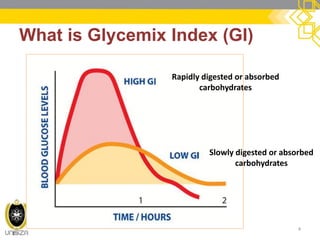
What is Glycemix Index (GI) 
4 
Rapidly digested or absorbed carbohydrates 
Slowly digested or absorbed carbohydrates
What does the GI value mean? 
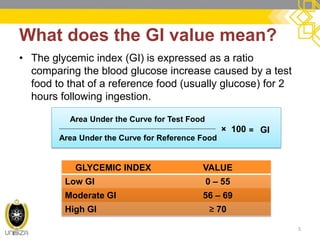
•The glycemic index (GI) is expressed as a ratio comparing the blood glucose increase caused by a test food to that of a reference food (usually glucose) for 2 hours following ingestion. 
5 
Area Under the Curve for Test Food 
Area Under the Curve for Reference Food 
× 100 
= GI 
GLYCEMIC INDEX 
VALUE 
Low GI 
0 – 55 
Moderate GI 
56 – 69 
High GI 
≥ 70
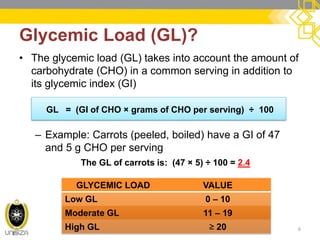
•The glycemic load (GL) takes into account the amount of carbohydrate (CHO) in a common serving in addition to its glycemic index (GI) 
–Example: Carrots (peeled, boiled) have a GI of 47 and 5 g CHO per serving 
Glycemic Load (GL)? 
6 
GL = (GI of CHO × grams of CHO per serving) ÷ 100 
The GL of carrots is: (47 × 5) ÷ 100 = 2.4 
GLYCEMIC LOAD 
VALUE 
Low GL 
0 – 10 
Moderate GL 
11 – 19 
High GL 
≥ 20
GI Determination Protocol 
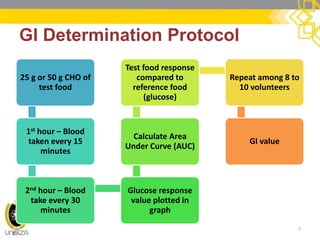
25 g or 50 g CHO of test food 
1st hour – Blood taken every 15 minutes 
2nd hour – Blood take every 30 minutes 
Glucose response value plotted in graph 
Calculate Area Under Curve (AUC) 
Test food response compared to reference food (glucose) 
Repeat among 8 to 10 volunteers 
GI value 
7
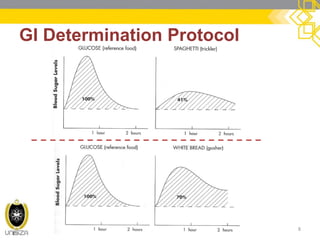
GI Determination Protocol 
8
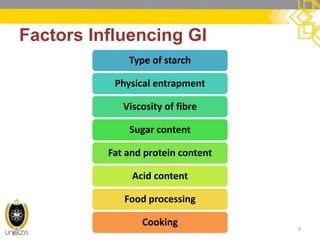
Factors Influencing GI 
Type of starch 
Physical entrapment 
Viscosity of fibre 
Sugar content 
Fat and protein content 
Acid content 
Food processing 
Cooking 
9
[1] Type of starch 
10 
Amylose 
Absorbs less water 
Molecules form tight clumps 
Slower rate of digestion 
LOWER GI 
E.g. Kidney beans (28) 
Amylopectin 
Absorbs more water 
Molecules are more open 
Faster rate of digestion 
HIGHER GI 
Eg. Russet potato (85)
[1] Type of starch 
11
[2] Physical entrapment 
•Bran acts as a physical barrier that slows down enzymatic activity on the internal starch layer. 
•Lower GI 
–All Bran (38) 
–Pumpernickel bread (50) 
•Higher GI 
–Bagel (72) 
–Corn Flakes (92) 
12
[2] Physical entrapment 
13
[3] Viscosity of fibre 
•Viscous, soluble fibers transform intestinal contents into gel-like matter that slows down enzymatic activity on starch. 
•High soluble fibre = lower GI 
•Lower GI 
–Apple (40) 
–Rolled oats (51) 
•Higher GI 
–Whole wheat bread (73) 
–Cheerios (74) 
14
[4] Sugar content 
15
[4] Sugar content 
•Lower GI 
–Frosted Flakes (55) 
–Raisin Bran (61) 
•Higher GI 
–Golden Grahams (71) 
–Rice Krispies (82) 
16 
sugar sucrose glucose + fructose 
starch maltose glucose + glucose 
(GI 60) (GI 100) (GI 19) 
(GI 105) (GI 100) (GI 100)
[5] Fat and protein content 
•Fat and protein slow down gastric emptying, and thus, slows down digestion of starch. 
•High fat and protein foods have lower GI 
•Lower GI 
–Peanut M&M’s (33) 
–Potato chips (54) 
–Special K (69) 
•Higher GI 
–Jelly beans (78) 
–Baked potato (85) 
–Corn Flakes (92) 
17
[6] Acid content 
•Acid slows down gastric emptying, and thus, slows down the digestion of starch. 
•Foods with higher acid content = lower GI 
•Lower GI 
–Sourdough wheat bread (54) 
•Higher GI 
–Wonder white bread (73) 
18
[7] Food processing 
•Highly processed foods require less digestive processing. 
•Processed foods = higher GI 
•Lower GI 
–Old fashioned, rolled oats (51) 
•Higher GI 
–Quick, 1-minute oats (66) 
19
[8] Cooking 
•Cooking swells starch molecules and softens foods, which speeds up the rate of digestion. 
•Overly cooked foods = Higher GI 
•Lower GI 
–Al dente spaghetti – boiled 10 to 15 minutes (44) 
•Higher GI 
–Over-cooked spaghetti – boiled 20 minutes (64) 
20
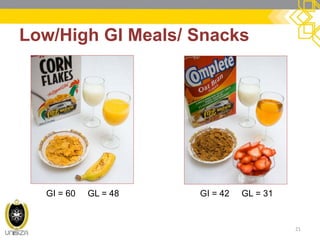
Low/High GI Meals/ Snacks 
21 
GI = 60 GL = 48 
GI = 42 GL = 31
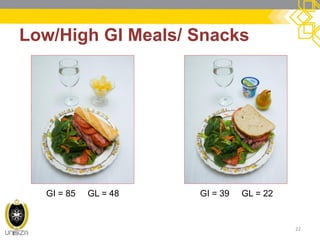
Low/High GI Meals/ Snacks 
22 
GI = 85 GL = 48 
GI = 39 GL = 22
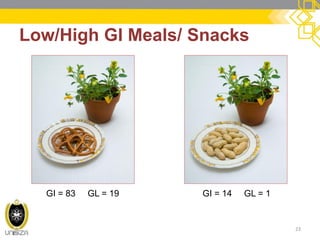
Low/High GI Meals/ Snacks 
23 
GI = 83 GL = 19 
GI = 14 GL = 1
Low/High GI Meals/ Snacks 
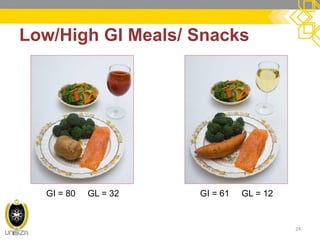
24 
GI = 80 GL = 32 
GI = 61 GL = 12
Low/High GI Meals/ Snacks 
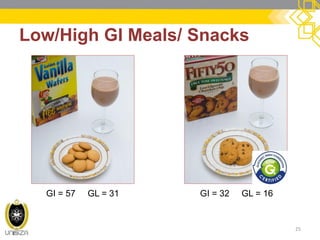
25 
GI = 57 GL = 31 
GI = 32 GL = 16
GI Symbol 
26
Benefits of Low GI Diet 
27 
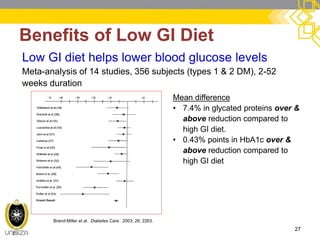
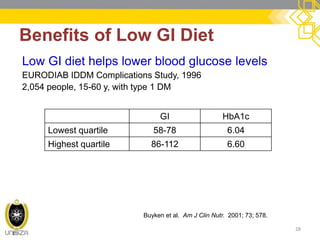
Low GI diet helps lower blood glucose levels 
Meta-analysis of 14 studies, 356 subjects (types 1 & 2 DM), 2-52 weeks duration 
Mean difference 
•7.4% in glycated proteins over & above reduction compared to high GI diet. 
•0.43% points in HbA1c over & above reduction compared to high GI diet 
Brand-Miller et al. Diabetes Care. 2003; 26; 2263.
Benefits of Low GI Diet 
28 
Low GI diet helps lower blood glucose levels 
EURODIAB IDDM Complications Study, 1996 
2,054 people, 15-60 y, with type 1 DM 
Buyken et al. Am J Clin Nutr. 2001; 73; 578. 
GI 
HbA1c 
Lowest quartile 
58-78 
6.04 
Highest quartile 
86-112 
6.60
Benefits of Low GI Diet 
29 
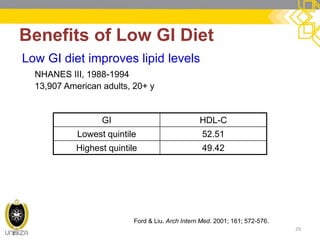
Low GI diet improves lipid levels 
NHANES III, 1988-1994 
13,907 American adults, 20+ y 
Ford & Liu. Arch Intern Med. 2001; 161; 572-576. 
GI 
HDL-C 
Lowest quintile 
52.51 
Highest quintile 
49.42
Benefits of Low GI Diet 
30 
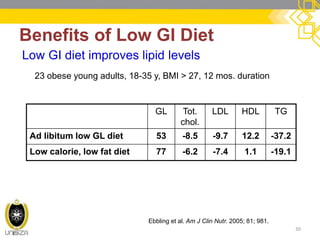
Low GI diet improves lipid levels 
23 obese young adults, 18-35 y, BMI > 27, 12 mos. duration 
GL 
Tot. chol. 
LDL 
HDL 
TG 
Ad libitum low GL diet 
53 
-8.5 
-9.7 
12.2 
-37.2 
Low calorie, low fat diet 
77 
-6.2 
-7.4 
1.1 
-19.1 
Ebbling et al. Am J Clin Nutr. 2005; 81; 981.
Benefits of Low GI Diet 
31 
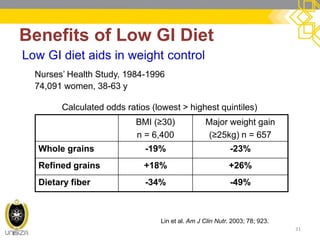
Nurses’ Health Study, 1984-1996 
74,091 women, 38-63 y 
Lin et al. Am J Clin Nutr. 2003; 78; 923. 
Calculated odds ratios (lowest > highest quintiles) 
BMI (≥30) 
n = 6,400 
Major weight gain 
(≥25kg) n = 657 
Whole grains 
-19% 
-23% 
Refined grains 
+18% 
+26% 
Dietary fiber 
-34% 
-49% 
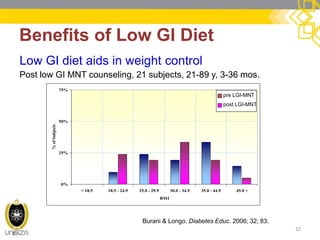
Low GI diet aids in weight control
Benefits of Low GI Diet 
32 
0% 
25% 
50% 
75% 
< 18.5 18.5 - 24.9 25.0 - 29.9 30.0 - 34.9 35.0 - 44.9 45.0 + 
BMI 
% of Subjects 
Burani & Longo. Diabetes Educ. 2006; 32; 83. 
Low GI diet aids in weight control 
Post low GI MNT counseling, 21 subjects, 21-89 y, 3-36 mos. 
pre LGI-MNT 
post LGI-MNT
Benefits of Low GI Diet 
33 
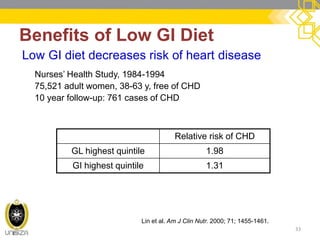
Low GI diet decreases risk of heart disease 
Nurses’ Health Study, 1984-1994 
75,521 adult women, 38-63 y, free of CHD 
10 year follow-up: 761 cases of CHD 
Lin et al. Am J Clin Nutr. 2000; 71; 1455-1461. 
Relative risk of CHD 
GL highest quintile 
1.98 
GI highest quintile 
1.31
Benefits of Low GI Diet 
34 
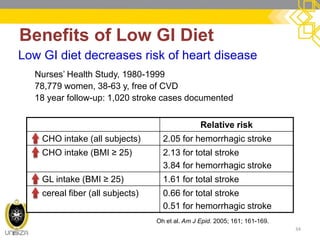
Low GI diet decreases risk of heart disease 
Nurses’ Health Study, 1980-1999 
78,779 women, 38-63 y, free of CVD 
18 year follow-up: 1,020 stroke cases documented 
Relative risk 
CHO intake (all subjects) 
2.05 for hemorrhagic stroke 
CHO intake (BMI ≥ 25) 
2.13 for total stroke 
3.84 for hemorrhagic stroke 
GL intake (BMI ≥ 25) 
1.61 for total stroke 
cereal fiber (all subjects) 
0.66 for total stroke 
0.51 for hemorrhagic stroke 
Oh et al. Am J Epid. 2005; 161; 161-169.
Benefits of Low GI Diet 
35 
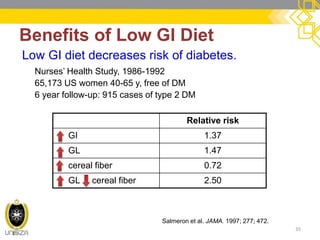
Low GI diet decreases risk of diabetes. 
Nurses’ Health Study, 1986-1992 
65,173 US women 40-65 y, free of DM 
6 year follow-up: 915 cases of type 2 DM 
Relative risk 
GI 
1.37 
GL 
1.47 
cereal fiber 
0.72 
GL cereal fiber 
2.50 
Salmeron et al. JAMA. 1997; 277; 472.
Take home message 
•Eat high-fiber breakfast cereals (oats, bran, barley) OR add berries, nuts, flaxseed and cinnamon to high GI cereals. 
•Choose dense, whole grain and sourdough breads and crackers OR add a heart-healthy protein and/or condiment to high GI breads and crackers. 
•Include 5-9 servings of fruits and vegetables every day. 
•Replace white potatoes with yams or sweet potatoes OR consume smaller portion of high GI potatoes. 
•Eat less refined sugars and convenience foods (soda, sweets, desserts, etc.) OR combine nuts, fruit, yogurt, ice cream with commercial sweets – watch portion sizes. 
36
Thank You 
37

6. Glycemic index

  • 1.
    KNOWLEDGE FOR THEBENEFIT OF HUMANITY ADVANCED NUTRITION (HFS4352) GLYCEMIC INDEX Mohd Razif Shahril, PhD School of Nutrition & Dietetics Faculty of Medicine and Health Sciences Universiti Sultan Zainal Abidin 1
  • 2.
    Outline •What isGlycemix Index (GI)? •Glycemix Index Determination Protocol •Factors Influencing GI •Benefits of Low GI Diet •Take home message 2
  • 3.
    What is GlycemixIndex (GI) •A scale that ranks carbohydrate by how much they raise blood glucose levels compared to a reference food. –Developed by Jenkins et al. 1981. Am J Clin Nutr. 34(3):362-366. •References on GI –Brand-Miller et al. 2006. The New Glucose Revolution. 3rd ed. New York, NY: Marlowe & Co. –Written by experts on GI –Atkinson et al. 2008. Diabetes Care 31(12):2281- 2283 –Most comprehensive table of the GI of foods that has been assembled to date 3
  • 4.
    What is GlycemixIndex (GI) 4 Rapidly digested or absorbed carbohydrates Slowly digested or absorbed carbohydrates
  • 5.
    What does theGI value mean? •The glycemic index (GI) is expressed as a ratio comparing the blood glucose increase caused by a test food to that of a reference food (usually glucose) for 2 hours following ingestion. 5 Area Under the Curve for Test Food Area Under the Curve for Reference Food × 100 = GI GLYCEMIC INDEX VALUE Low GI 0 – 55 Moderate GI 56 – 69 High GI ≥ 70
  • 6.
    •The glycemic load(GL) takes into account the amount of carbohydrate (CHO) in a common serving in addition to its glycemic index (GI) –Example: Carrots (peeled, boiled) have a GI of 47 and 5 g CHO per serving Glycemic Load (GL)? 6 GL = (GI of CHO × grams of CHO per serving) ÷ 100 The GL of carrots is: (47 × 5) ÷ 100 = 2.4 GLYCEMIC LOAD VALUE Low GL 0 – 10 Moderate GL 11 – 19 High GL ≥ 20
  • 7.
    GI Determination Protocol 25 g or 50 g CHO of test food 1st hour – Blood taken every 15 minutes 2nd hour – Blood take every 30 minutes Glucose response value plotted in graph Calculate Area Under Curve (AUC) Test food response compared to reference food (glucose) Repeat among 8 to 10 volunteers GI value 7
  • 8.
  • 9.
    Factors Influencing GI Type of starch Physical entrapment Viscosity of fibre Sugar content Fat and protein content Acid content Food processing Cooking 9
  • 10.
    [1] Type ofstarch 10 Amylose Absorbs less water Molecules form tight clumps Slower rate of digestion LOWER GI E.g. Kidney beans (28) Amylopectin Absorbs more water Molecules are more open Faster rate of digestion HIGHER GI Eg. Russet potato (85)
  • 11.
    [1] Type ofstarch 11
  • 12.
    [2] Physical entrapment •Bran acts as a physical barrier that slows down enzymatic activity on the internal starch layer. •Lower GI –All Bran (38) –Pumpernickel bread (50) •Higher GI –Bagel (72) –Corn Flakes (92) 12
  • 13.
  • 14.
    [3] Viscosity offibre •Viscous, soluble fibers transform intestinal contents into gel-like matter that slows down enzymatic activity on starch. •High soluble fibre = lower GI •Lower GI –Apple (40) –Rolled oats (51) •Higher GI –Whole wheat bread (73) –Cheerios (74) 14
  • 15.
  • 16.
    [4] Sugar content •Lower GI –Frosted Flakes (55) –Raisin Bran (61) •Higher GI –Golden Grahams (71) –Rice Krispies (82) 16 sugar sucrose glucose + fructose starch maltose glucose + glucose (GI 60) (GI 100) (GI 19) (GI 105) (GI 100) (GI 100)
  • 17.
    [5] Fat andprotein content •Fat and protein slow down gastric emptying, and thus, slows down digestion of starch. •High fat and protein foods have lower GI •Lower GI –Peanut M&M’s (33) –Potato chips (54) –Special K (69) •Higher GI –Jelly beans (78) –Baked potato (85) –Corn Flakes (92) 17
  • 18.
    [6] Acid content •Acid slows down gastric emptying, and thus, slows down the digestion of starch. •Foods with higher acid content = lower GI •Lower GI –Sourdough wheat bread (54) •Higher GI –Wonder white bread (73) 18
  • 19.
    [7] Food processing •Highly processed foods require less digestive processing. •Processed foods = higher GI •Lower GI –Old fashioned, rolled oats (51) •Higher GI –Quick, 1-minute oats (66) 19
  • 20.
    [8] Cooking •Cookingswells starch molecules and softens foods, which speeds up the rate of digestion. •Overly cooked foods = Higher GI •Lower GI –Al dente spaghetti – boiled 10 to 15 minutes (44) •Higher GI –Over-cooked spaghetti – boiled 20 minutes (64) 20
  • 21.
    Low/High GI Meals/Snacks 21 GI = 60 GL = 48 GI = 42 GL = 31
  • 22.
    Low/High GI Meals/Snacks 22 GI = 85 GL = 48 GI = 39 GL = 22
  • 23.
    Low/High GI Meals/Snacks 23 GI = 83 GL = 19 GI = 14 GL = 1
  • 24.
    Low/High GI Meals/Snacks 24 GI = 80 GL = 32 GI = 61 GL = 12
  • 25.
    Low/High GI Meals/Snacks 25 GI = 57 GL = 31 GI = 32 GL = 16
  • 26.
  • 27.
    Benefits of LowGI Diet 27 Low GI diet helps lower blood glucose levels Meta-analysis of 14 studies, 356 subjects (types 1 & 2 DM), 2-52 weeks duration Mean difference •7.4% in glycated proteins over & above reduction compared to high GI diet. •0.43% points in HbA1c over & above reduction compared to high GI diet Brand-Miller et al. Diabetes Care. 2003; 26; 2263.
  • 28.
    Benefits of LowGI Diet 28 Low GI diet helps lower blood glucose levels EURODIAB IDDM Complications Study, 1996 2,054 people, 15-60 y, with type 1 DM Buyken et al. Am J Clin Nutr. 2001; 73; 578. GI HbA1c Lowest quartile 58-78 6.04 Highest quartile 86-112 6.60
  • 29.
    Benefits of LowGI Diet 29 Low GI diet improves lipid levels NHANES III, 1988-1994 13,907 American adults, 20+ y Ford & Liu. Arch Intern Med. 2001; 161; 572-576. GI HDL-C Lowest quintile 52.51 Highest quintile 49.42
  • 30.
    Benefits of LowGI Diet 30 Low GI diet improves lipid levels 23 obese young adults, 18-35 y, BMI > 27, 12 mos. duration GL Tot. chol. LDL HDL TG Ad libitum low GL diet 53 -8.5 -9.7 12.2 -37.2 Low calorie, low fat diet 77 -6.2 -7.4 1.1 -19.1 Ebbling et al. Am J Clin Nutr. 2005; 81; 981.
  • 31.
    Benefits of LowGI Diet 31 Nurses’ Health Study, 1984-1996 74,091 women, 38-63 y Lin et al. Am J Clin Nutr. 2003; 78; 923. Calculated odds ratios (lowest > highest quintiles) BMI (≥30) n = 6,400 Major weight gain (≥25kg) n = 657 Whole grains -19% -23% Refined grains +18% +26% Dietary fiber -34% -49% Low GI diet aids in weight control
  • 32.
    Benefits of LowGI Diet 32 0% 25% 50% 75% < 18.5 18.5 - 24.9 25.0 - 29.9 30.0 - 34.9 35.0 - 44.9 45.0 + BMI % of Subjects Burani & Longo. Diabetes Educ. 2006; 32; 83. Low GI diet aids in weight control Post low GI MNT counseling, 21 subjects, 21-89 y, 3-36 mos. pre LGI-MNT post LGI-MNT
  • 33.
    Benefits of LowGI Diet 33 Low GI diet decreases risk of heart disease Nurses’ Health Study, 1984-1994 75,521 adult women, 38-63 y, free of CHD 10 year follow-up: 761 cases of CHD Lin et al. Am J Clin Nutr. 2000; 71; 1455-1461. Relative risk of CHD GL highest quintile 1.98 GI highest quintile 1.31
  • 34.
    Benefits of LowGI Diet 34 Low GI diet decreases risk of heart disease Nurses’ Health Study, 1980-1999 78,779 women, 38-63 y, free of CVD 18 year follow-up: 1,020 stroke cases documented Relative risk CHO intake (all subjects) 2.05 for hemorrhagic stroke CHO intake (BMI ≥ 25) 2.13 for total stroke 3.84 for hemorrhagic stroke GL intake (BMI ≥ 25) 1.61 for total stroke cereal fiber (all subjects) 0.66 for total stroke 0.51 for hemorrhagic stroke Oh et al. Am J Epid. 2005; 161; 161-169.
  • 35.
    Benefits of LowGI Diet 35 Low GI diet decreases risk of diabetes. Nurses’ Health Study, 1986-1992 65,173 US women 40-65 y, free of DM 6 year follow-up: 915 cases of type 2 DM Relative risk GI 1.37 GL 1.47 cereal fiber 0.72 GL cereal fiber 2.50 Salmeron et al. JAMA. 1997; 277; 472.
  • 36.
    Take home message •Eat high-fiber breakfast cereals (oats, bran, barley) OR add berries, nuts, flaxseed and cinnamon to high GI cereals. •Choose dense, whole grain and sourdough breads and crackers OR add a heart-healthy protein and/or condiment to high GI breads and crackers. •Include 5-9 servings of fruits and vegetables every day. •Replace white potatoes with yams or sweet potatoes OR consume smaller portion of high GI potatoes. •Eat less refined sugars and convenience foods (soda, sweets, desserts, etc.) OR combine nuts, fruit, yogurt, ice cream with commercial sweets – watch portion sizes. 36
  • 37.