CASE CONTROL STUDY
15/03/2023 1
By Dr. Monisha Mary P
Post graduate in Community Medicine
LEARNING OBJECTIVES
❖ To know the Study design of epidemiological studies
❖ To define a Case-Control Study
❖ To describe the Basic steps of a case-control study
❖ To learn the bias involved in the Case-Control study
❖ To learn about advantages and disadvantages
15/03/2023 2
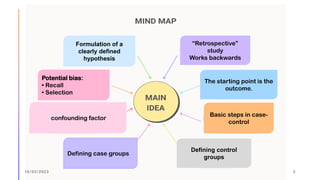
Formulation of a
clearly defined
hypothesis
“Retrospective”
study
Works backwards
Potential bias:
• Recall
• Selection
The starting point is the
outcome.
Basic steps in case-
control
Defining case groups
Defining control
groups
confounding factor
15/03/2023 3
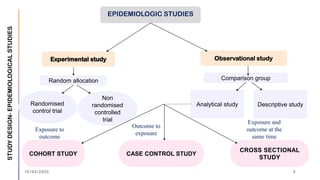
EPIDEMIOLOGIC STUDIES
Experimental study Observational study
Random allocation Comparison group
Randomised
control trial
Non
randomised
controlled
trial
Analytical study Descriptive study
COHORT STUDY CASE CONTROL STUDY
CROSS SECTIONAL
STUDY
Exposure to
outcome
Outcome to
exposure
Exposure and
outcome at the
same time
STUDY
DESIGN-
EPIDEMIOLOGICAL
STUDIES
15/03/2023 4
DEFINITION OF CASE CONTROL STUDY
• The observational epidemiological study of people with the
disease of interest and a suitable control group of persons
without the disease.
• A case-control study involves two populations – cases and
controls.
• Also called a “retrospective study”.
15/03/2023 5
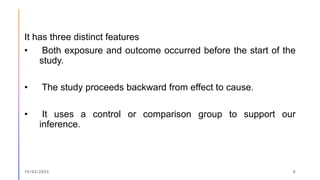
It has three distinct features
• Both exposure and outcome occurred before the start of the
study.
• The study proceeds backward from effect to cause.
• It uses a control or comparison group to support our
inference.
15/03/2023 6
• We identify Cases and Controls.
• We then determine what proportion of cases, controls were
exposed and what proportion of cases and controls were not
exposed.
• The hallmark of a Case-Control study is that it begins with
people with the disease and compares them to people without
the disease
15/03/2023 7
WHEN IS IT DESIRABLE TO CONDUCT A CASE CONTROL STUDY?
Exposure
management
is expensive
Disease is rare
Very little
understanding
of the disease
Many risk
factors can be
found out
Longer
duration(NCD)
Population is
dynamic
When Funds
are less
Carried out
quickly.
15/03/2023 8
DESIGN
OF
A
CASE
CONTROL
STUDY
HAVE THE DISEASE DO NOT HAVE THE DISEASE
WERE
EXPOSED
WERE NOT
EXPOSED
WERE EXPOSED
WERE NOT
EXPOSED
CASES CONTROLS
OUTCOME
EXPOSURE
15/03/2023 9
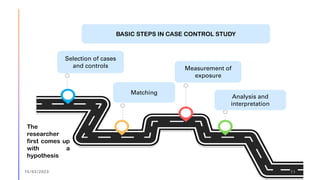
BASIC STEPS IN CASE CONTROL STUDY
❖SELECTION OF CASES AND CONTROLS
❖MATCHING
❖MEASUREMENT OF EXPOSURE
❖ANALYSIS AND INTERPRETATION
15/03/2023 10
Selection of cases
and controls
Matching
Measurement of
exposure
Analysis and
interpretation
BASIC STEPS IN CASE CONTROL STUDY
The
researcher
first comes up
with a
hypothesis
15/03/2023 11
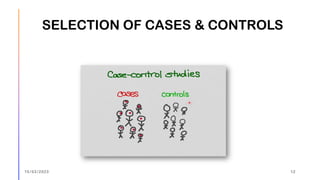
SELECTION OF CASES & CONTROLS
15/03/2023 12
SELECTION OF CASES
• It involves defining the case and determining the source of cases.
• As the cause and effect have already occurred, the proper diagnosis
of the disease under investigation is necessary in the selection of a
case.
• Once the diagnostic criteria are established, they should not be
changed or altered till the end of the investigation.
15/03/2023 13
• Hospital patients, patients in physicians’ practices, or clinic patients.
• Many communities also maintain registers for certain diseases like
cancer.
• Using incident or prevalent cases-Incident cases are preferable to
prevalent cases for reducing
❖Recall bias and
❖Over-representation of cases of long duration.
• Old or advanced stages of the disease should preferably not be used
(prevalent cases).
15/03/2023 14
SOURCES OF CASES
SELECTION OF CONTROLS
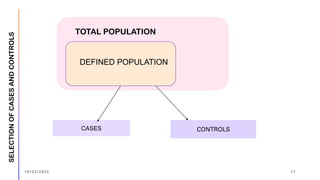
• Controls should be selected from the same population
• the source population (i.e. study base).
❖ Non-hospitalized
• Neighbourhood control
• Best friend control
• Spouse or sibling control
❖ Hospitalized control
• All other patients admitted
• Specific ‘another diagnosis’
15/03/2023 15
Potential
controls
Neighbourhood
Population
Register
Door to
Door
Hospital
Relative
Friend
SOURCES
OF
CONTROLS
15/03/2023 16
CASES CONTROLS
TOTAL POPULATION
DEFINED POPULATION
SELECTION
OF
CASES
AND
CONTROLS
15/03/2023 17
USE OF MULTIPLE CONTROLS
• Matching 1:2,1:3 or 1:4 will increase the statistical power of our
study.
• Therefore many case-control studies will have more controls than
cases.
• These controls may be
❖Controls of the same type.
❖Controls of different types.
15/03/2023 18
MATCHING
• An important consideration is to ensure comparability within the
cases and controls.
• Matching is defined as the process of selecting the controls so
that they are similar to the cases .
• In certain characteristics such as age, race,sex, socioeconomic
status, and occupation.
15/03/2023 19
• If not adequately matched for comparability, it could distort or
confound the results of the study.
• Matching may be of two types:
❖Group matching (Frequency matching).
❖Individual matching(matched pairs).
THE NEED FOR MATCHING
15/03/2023 20
GROUP MATCHING
Consists of selecting the controls in such a manner that the
proportion of controls with a certain characteristic is identical to
the proportion of cases with the same characteristic.
INDIVIDUAL MATCHING
In this approach, for each case selected, a control is selected
who is similar to the case in terms of the specific variables of
concern.
15/03/2023 21
UNPLANNED MATCHING
Unplanned matching may inadvertently occur in case-control
studies, for example
Example:
• Neighborhood controls-we are in effect matching for
socioeconomic status as well as for cultural and other
characteristics of a neighborhood.
• Best friend controls-his or her best friend share many lifestyle
characteristics, which in effect produces a match for these
characteristics.
15/03/2023 22
15/03/2023 23
EXAMPLE OF UNPLANNED MATCHING
Oral
contraceptive
Study of
cancer
best-friend
controls were
considered
study of oral
contraceptive
use and
cancer
Her best friend
would also be
likely to be an
oral
contraceptive
user
The result would be an unplanned matching of oral contraceptive use, so that
this variable could no longer be investigated in this study
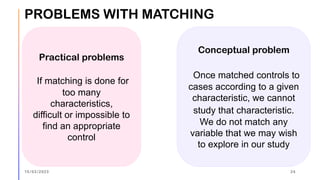
PROBLEMS WITH MATCHING
Practical problems
If matching is done for
too many
characteristics,
difficult or impossible to
find an appropriate
control
Conceptual problem
Once matched controls to
cases according to a given
characteristic, we cannot
study that characteristic.
We do not match any
variable that we may wish
to explore in our study
15/03/2023 24
CONFOUNDING FACTOR
• The term “confounding factor” is defined as one which is
associated with both exposure and disease and is distributed
unequally in study and control groups.
• More specifically, a confounding factor is one that although
associated with exposure under investigation by itself,
independently of any such association, a risk factor for the
disease.
15/03/2023 25
• Let us suppose that we are interested in examining the
relationship between the current use of oral contraceptives and
ovarian cancer.
• In this example, it is appropriate to match age, since age is
associated with the exposure of interest (current oral
contraceptive use) and is an independent risk factor for ovarian
cancer.
• In other words, age is a confounding factor.
• Failure to match, or otherwise control, for age would result in a
biased assessment of the effect of oral contraceptive use.
15/03/2023 26
OVERMATCHING
• Unplanned matching on a variable strongly related to the
exposure being investigated in the study is called overmatching.
• The most serious type of overmatching occurs when one
matches on a factor that is both affected by exposure and a
cause of disease.
15/03/2023 27
MEASUREMENT OF EXPOSURE
• Information about the exposure should be obtained from both
the cases and controls in the same manner.
• This may be achieved by:
❖Interviews
❖Questionnaires
❖Studying past records like hospital or employment records etc
❖Medical records.
15/03/2023 29
ANALYSIS
• This is the final step in a case-control study, and it provides:
❖ Exposure rates among cases and controls to the suspected
factor.
❖ Estimation of disease risk associated with exposure.
15/03/2023 30
EXPOSURE RATES
• A case-control study directly estimates the exposure rates to a
suspected factor in disease and non-disease groups.
• The significance of measuring the exposure rates lies in
estimating the probability of associating the disease and the
factor under study.
15/03/2023 31
• Exposure Rates: Cases = a/(a+c) =65/100 =65%
Controls =b/(b+d) =40/200= 20%
• The frequency of obesity is definitely higher among
T2DM than those without T2DM.
15/03/2023 32
Diabetes + Diabetes -
Obesity+ 65
(a)
40
(b)
Obesity- 35
(c)
160
(d)
Total 100
(a + c)
200
(b + d)
CASE-CONTROL STUDY OF TYPE 2 DIABETES AND OBESITY
ODDS RATIO
• It is a measure of the strength of the association between risk
factor and outcome.
• It is closely related to relative risk.
• The determination of the odds ratio is based on 3 assumptions
❖The disease to be investigated must be relatively rare or a
chronic disease.
❖ The cases must be representative of those with the disease
and
❖ The controls must be representative of those without the
disease.
15/03/2023 33
ODDS OF AN EVENT
Can be defined as the ratio of the number of ways the event can
occur to the number of ways the event cannot occur.
ODDS RATIO (OR)
Compares the odds of exposure among those with the disease to
the odds of exposure among those without the disease.
15/03/2023 34
DETERMINE ASSOCIATION
CASES CONTROLS
EXPOSED a b
UNEXPOSED c d
• Assess whether exposure is distributed between the cases
and controls, which may indicate that the exposure is a risk
factor for the health outcome under study.
15/03/2023 35
❖ Odds of a case being exposed = a:c or a/c
❖ Odds of control being exposed = b:d or b/d
❖ Odds ratio = odds that cases were exposed
/odds that controls were exposed
= ad/bc.
CASES CONTROLS
EXPOSED a b
UNEXPOSED c d
TOTAL (a + c) (b + d)
PROPORTIONS
EXPOSED
a/ (a + c) b/ (b + d)
15/03/2023 36
INTERPRETATION OF THE ODDS RATIO
• OR = 1: no association between outcome and exposure (same
odds of exposure in cases and controls = same odds of
disease in exposed vs. unexposed).
• OR >1: exposure is associated with increased risk for the
outcome (greater odds of exposure in cases than control
Harmful Effect.
• OR <1:exposure is associated with reduced risk for outcome
(lower odds of exposure in cases than controls =lower odds of
disease in exposed vs. unexposed) Protective Effect.
15/03/2023 37
CALCULATING ODDS RATIO IN AN UNMATCHED CASE CONTROL
STUDY
Odds Ratio=ad/bc
CALCULATING ODDS RATIO IN MATCHED PAIRS CASE-CONTROL
STUDY
15/03/2023 38
Concordant
pairs
Discordant
pairs
Pairs in which both case and control were exposed
Pairs in which neither the case nor the control was
exposed
Pairs in which the case was exposed but the control was
not
Pairs in which the control was exposed but the case was
not
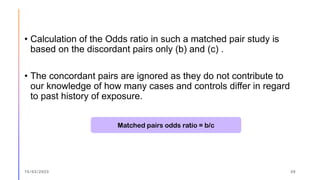
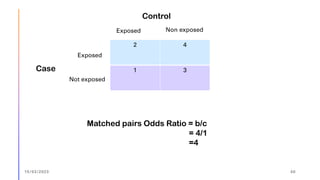
• Calculation of the Odds ratio in such a matched pair study is
based on the discordant pairs only (b) and (c) .
• The concordant pairs are ignored as they do not contribute to
our knowledge of how many cases and controls differ in regard
to past history of exposure.
15/03/2023 39
Matched pairs odds ratio = b/c
15/03/2023 40
2 4
1 3
Exposed Non exposed
Control
Exposed
Not exposed
Case
Matched pairs Odds Ratio = b/c
= 4/1
=4
15/03/2023 41
Diabetes + Diabetes -
Obesity+ 65 40
Obesity- 35 160
Total 100 200
CASE-CONTROL STUDY OF TYPE 2 DIABETES AND OBESITY
Odds Ratio-ad/bc =65x160/40x35
=7.42
• How much higher is the odds of exposure in the cases as
compared to controls?
• In the above example, individuals with Diabetes are 7.42 times
more likely to be obese as compared to those without Diabetes.
• The odds ratio is a key parameter in case-control studies.
15/03/2023 42
a b
c d
a b
c d
Develop
disease
Do not
develop
disease
Exposed
Non
exposed
CASES CONTROLS
History of exposure
No history of
exposure
OR=odds that an exposed person
develops disease/odds that a nonexposed
person develops the disease.
=ad/bc
OR=odds that a case was exposed/odds that
control was exposed.
=ad/bc
a b
c d
Disease No Disease
Exposed
Non exposed
Odds Ratio(OR)
Cross product ratio
ad/bc
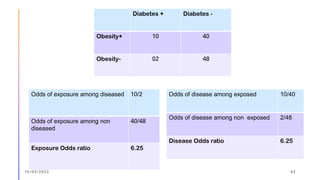
Diabetes + Diabetes -
Obesity+ 10 40
Obesity- 02 48
Odds of exposure among diseased 10/2
Odds of exposure among non
diseased
40/48
Exposure Odds ratio 6.25
Odds of disease among exposed 10/40
Odds of disease among non exposed 2/48
Disease Odds ratio 6.25
15/03/2023 43
• Because epidemiology is always concerned with identifying
predictors of disease
• And odds ratio of exposure is same as odds ratio of disease
• Therefore even in case control studies , the Interpretation is
always prospective .
15/03/2023 44
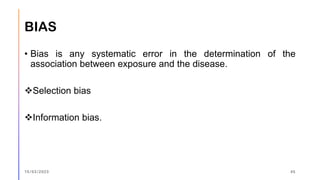
BIAS
• Bias is any systematic error in the determination of the
association between exposure and the disease.
❖Selection bias
❖Information bias.
15/03/2023 45
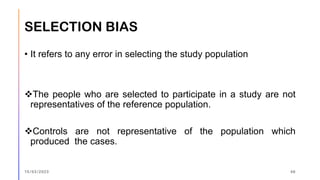
SELECTION BIAS
• It refers to any error in selecting the study population
❖The people who are selected to participate in a study are not
representatives of the reference population.
❖Controls are not representative of the population which
produced the cases.
15/03/2023 46
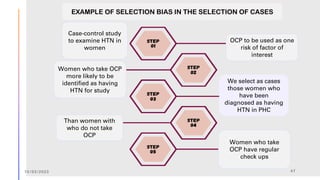
Case-control study
to examine HTN in
women
OCP to be used as one
risk of factor of
interest
Women who take
OCP have regular
check ups
Than women with
who do not take
OCP
Women who take OCP
more likely to be
identified as having
HTN for study
EXAMPLE OF SELECTION BIAS IN THE SELECTION OF CASES
15/03/2023 47
We select as cases
those women who
have been
diagnosed as having
HTN in PHC
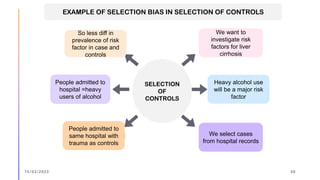
SELECTION
OF
CONTROLS
We want to
investigate risk
factors for liver
cirrhosis
Heavy alcohol use
will be a major risk
factor
We select cases
from hospital records
People admitted to
same hospital with
trauma as controls
People admitted to
hospital =heavy
users of alcohol
So less diff in
prevalence of risk
factor in case and
controls
EXAMPLE OF SELECTION BIAS IN SELECTION OF CONTROLS
15/03/2023 48
INFORMATION BIAS
RECALL BIAS
• When cases and controls are asked questions about their past
history, it may be more likely for the cases to recall the
existence of events than the controls who are healthy people.
• Cases may have a different recall of past events than controls.
15/03/2023 49
PROBLEMS OF RECALL
• A major problem in case control studies is that of recall of a
history of past exposure.
• Recall problems are of two types
❖Limitations in recall
❖Recall bias
• Recall bias is the main form of information bias in case control
study.
15/03/2023 50
LIMITATIONS OF RECALL
• Virtually all human beings are limited to varying degrees in their
ability to recall.
• Much of the information in case control involves collecting data
from subjects through interviews.
• People being interviewed may simply not have the information
being requested.
15/03/2023 51
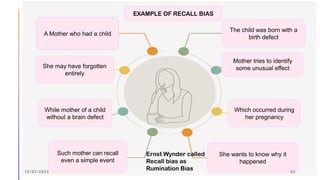
EXAMPLE OF RECALL BIAS
A Mother who had a child
The child was born with a
birth defect
She may have forgotten
entirely
Mother tries to identify
some unusual effect
While mother of a child
without a brain defect
Which occurred during
her pregnancy
Such mother can recall
even a simple event
She wants to know why it
happened
Ernst Wynder called
Recall bias as
Rumination Bias
15/03/2023 52
Defined Cohort
Developed
disease Have not developed
disease
CASES Subgroup selected as
CONTROLS
Years
Initial Data and/or
Serum, Urine, or Other
Specimens Obtained
Design
of
a
case-control
study
initiated
within
a
cohort
15/03/2023 53
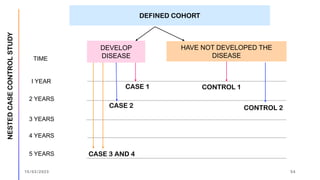
DEFINED COHORT
DEVELOP
DISEASE
HAVE NOT DEVELOPED THE
DISEASE
TIME
I YEAR
2 YEARS
3 YEARS
4 YEARS
5 YEARS
CASE 1
CASE 2
CASE 3 AND 4
CONTROL 1
CONTROL 2
NESTED
CASE
CONTROL
STUDY
15/03/2023 54
DEFINED COHORT
DEVELOP
DISEASE
TIME
I YEAR
2 YEARS
3 YEARS
4 YEARS
5 YEARS
CASE 1
CASE 2
CASE 3 AND 4
CASE 5 5 CASES 5 CONTROLS
CASE
COHORT
STUDY
DESIGN
15/03/2023 55
CASE-CROSSOVER DESIGN
• The case-crossover design is used for studying the etiology of
acute outcomes such as myocardial infarctions or deaths.
• In this type of study, a case is identified (for example, a person
who has suffered a myocardial infarction) and the level of the
environmental exposure, is ascertained for a short time period
preceding the event (the at-risk period).
• This level is compared with the level of exposure in a control
time period.
15/03/2023 56
WHEN IS A CASE CONTROL STUDY
WARRANTED?
• At an early stage in our search for an etiology, we may suspect
any one of the several exposures, but we may not have
evidence.
• Using case control study we compare people with the
disease(cases) and people without the disease (controls).
• We can then explore the possible roles of a variety of
exposures or characteristics in curing the disease.
15/03/2023 57
ADVANTAGES
• Relatively easy to carry out.
• Rapid and inexpensive.
• Require comparatively few subjects.
• Particularly suitable to investigate rare diseases.
• No risk to subjects.
• Allows study of different etiological factors.
• Risk factors can be identified.
15/03/2023 58
DISADVANTAGES
• Problems of bias rely on memory or past records, the accuracy
of which may be uncertain; validation of information obtained is
difficult or sometimes impossible.
• Selection of an appropriate control group may be difficult.
• We cannot measure incidence, and can only estimate the
relative risk.
• Do not distinguish between causes and associated factors.
15/03/2023 59
POSITION IN HIERARCHY
15/03/2023 60
Cohort Case control study
Study group Exposed person Cases
Comparison group Non exposed person Controls
Measurement of risk Absolute risk
Relative risk
Odds ratio
Attributable risk
Odds ratio
Time for study Long Short
Cost of study Expensive Inexpensive
Best when Exposure is rare Disease is rare
Population size needed Relatively large Relatively small
Potential bias Assessment of outcome Assessment of exposure
15/03/2023 61
EXPOSED NOT EXPOSED
DISEASE
DEVELOPS
DISEASE
DOES NOT
DEVELOP
PEOPLE WITH THE
DISEASE
PEOPLE WITHOUT
THE DISEASE
COMPARING
CASE
CONTROL
AND
COHORT
STUDIES
DISEASE
DEVELOPS
DISEASE
DOES NOT
DEVELOP
WERE
EXPOSED
WERE NOT
EXPOSED
WERE
EXPOSED
WERE NOT
EXPOSED
Start with
Then
follow
up for
Start with
CASES CONTROLS
Then
determine the
exposure
history
COHORT STUDY
CASE CONTROL STUDY
15/03/2023 62
Defined
population
Disease
develop
Disease
does not
develop
Exposed Non
Exposed
With disease Without disease
A
B
C
A
B
C
CASES CONTROLS
In a case-control study that starts by identifying cases and controls,
we can study multiple exposures but only one outcome.
In a cohort study that starts with a defined population, we can
study both multiple exposures and multiple outcomes.
CASE
CONTROL
AND
COHORT
STUDY
DESIGN
15/03/2023 63
CASE CONTROL
OUTCOME TO
EXPOSURE
COHORT STUDIES
EXPOSURE TO OUTCOME
Ca Lung patients and non
patients
Follows a cohort of smokers and
non smokers without Ca Lung
Clarifies if it was smokers who
contributed to high Ca Lung
Smokers develop Ca Lung more
frequently
15/03/2023 64
15/03/2023 65
15/03/2023 66
15/03/2023 67
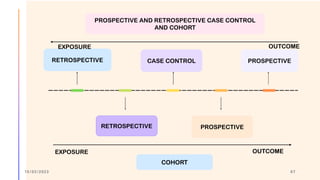
PROSPECTIVE AND RETROSPECTIVE CASE CONTROL
AND COHORT
RETROSPECTIVE CASE CONTROL PROSPECTIVE
RETROSPECTIVE PROSPECTIVE
COHORT
OUTCOME
EXPOSURE
EXPOSURE
OUTCOME
REFERENCES
1. Park k . Textbook of preventive and social medicine.
Principles of epidemiology and epidemiologic methods. 26th
ed. Jabalpur: M/S Banarsidas bhanot publications; 2021.p.83-
88.
1. Gordis L., Celentano David D., Szklo Moyses. Gordis
Epidemiology.Observational Studies. 6th edition. Elsevier
Saunders; 2019.p. 178-186.
15/03/2023 68
15/03/2023 69

Case control study- Dr Monisha Mary P.pdf

  • 1.
    CASE CONTROL STUDY 15/03/20231 By Dr. Monisha Mary P Post graduate in Community Medicine
  • 2.
    LEARNING OBJECTIVES ❖ Toknow the Study design of epidemiological studies ❖ To define a Case-Control Study ❖ To describe the Basic steps of a case-control study ❖ To learn the bias involved in the Case-Control study ❖ To learn about advantages and disadvantages 15/03/2023 2
  • 3.
    Formulation of a clearlydefined hypothesis “Retrospective” study Works backwards Potential bias: • Recall • Selection The starting point is the outcome. Basic steps in case- control Defining case groups Defining control groups confounding factor 15/03/2023 3
  • 4.
    EPIDEMIOLOGIC STUDIES Experimental studyObservational study Random allocation Comparison group Randomised control trial Non randomised controlled trial Analytical study Descriptive study COHORT STUDY CASE CONTROL STUDY CROSS SECTIONAL STUDY Exposure to outcome Outcome to exposure Exposure and outcome at the same time STUDY DESIGN- EPIDEMIOLOGICAL STUDIES 15/03/2023 4
  • 5.
    DEFINITION OF CASECONTROL STUDY • The observational epidemiological study of people with the disease of interest and a suitable control group of persons without the disease. • A case-control study involves two populations – cases and controls. • Also called a “retrospective study”. 15/03/2023 5
  • 6.
    It has threedistinct features • Both exposure and outcome occurred before the start of the study. • The study proceeds backward from effect to cause. • It uses a control or comparison group to support our inference. 15/03/2023 6
  • 7.
    • We identifyCases and Controls. • We then determine what proportion of cases, controls were exposed and what proportion of cases and controls were not exposed. • The hallmark of a Case-Control study is that it begins with people with the disease and compares them to people without the disease 15/03/2023 7
  • 8.
    WHEN IS ITDESIRABLE TO CONDUCT A CASE CONTROL STUDY? Exposure management is expensive Disease is rare Very little understanding of the disease Many risk factors can be found out Longer duration(NCD) Population is dynamic When Funds are less Carried out quickly. 15/03/2023 8
  • 9.
    DESIGN OF A CASE CONTROL STUDY HAVE THE DISEASEDO NOT HAVE THE DISEASE WERE EXPOSED WERE NOT EXPOSED WERE EXPOSED WERE NOT EXPOSED CASES CONTROLS OUTCOME EXPOSURE 15/03/2023 9
  • 10.
    BASIC STEPS INCASE CONTROL STUDY ❖SELECTION OF CASES AND CONTROLS ❖MATCHING ❖MEASUREMENT OF EXPOSURE ❖ANALYSIS AND INTERPRETATION 15/03/2023 10
  • 11.
    Selection of cases andcontrols Matching Measurement of exposure Analysis and interpretation BASIC STEPS IN CASE CONTROL STUDY The researcher first comes up with a hypothesis 15/03/2023 11
  • 12.
    SELECTION OF CASES& CONTROLS 15/03/2023 12
  • 13.
    SELECTION OF CASES •It involves defining the case and determining the source of cases. • As the cause and effect have already occurred, the proper diagnosis of the disease under investigation is necessary in the selection of a case. • Once the diagnostic criteria are established, they should not be changed or altered till the end of the investigation. 15/03/2023 13
  • 14.
    • Hospital patients,patients in physicians’ practices, or clinic patients. • Many communities also maintain registers for certain diseases like cancer. • Using incident or prevalent cases-Incident cases are preferable to prevalent cases for reducing ❖Recall bias and ❖Over-representation of cases of long duration. • Old or advanced stages of the disease should preferably not be used (prevalent cases). 15/03/2023 14 SOURCES OF CASES
  • 15.
    SELECTION OF CONTROLS •Controls should be selected from the same population • the source population (i.e. study base). ❖ Non-hospitalized • Neighbourhood control • Best friend control • Spouse or sibling control ❖ Hospitalized control • All other patients admitted • Specific ‘another diagnosis’ 15/03/2023 15
  • 16.
  • 17.
    CASES CONTROLS TOTAL POPULATION DEFINEDPOPULATION SELECTION OF CASES AND CONTROLS 15/03/2023 17
  • 18.
    USE OF MULTIPLECONTROLS • Matching 1:2,1:3 or 1:4 will increase the statistical power of our study. • Therefore many case-control studies will have more controls than cases. • These controls may be ❖Controls of the same type. ❖Controls of different types. 15/03/2023 18
  • 19.
    MATCHING • An importantconsideration is to ensure comparability within the cases and controls. • Matching is defined as the process of selecting the controls so that they are similar to the cases . • In certain characteristics such as age, race,sex, socioeconomic status, and occupation. 15/03/2023 19
  • 20.
    • If notadequately matched for comparability, it could distort or confound the results of the study. • Matching may be of two types: ❖Group matching (Frequency matching). ❖Individual matching(matched pairs). THE NEED FOR MATCHING 15/03/2023 20
  • 21.
    GROUP MATCHING Consists ofselecting the controls in such a manner that the proportion of controls with a certain characteristic is identical to the proportion of cases with the same characteristic. INDIVIDUAL MATCHING In this approach, for each case selected, a control is selected who is similar to the case in terms of the specific variables of concern. 15/03/2023 21
  • 22.
    UNPLANNED MATCHING Unplanned matchingmay inadvertently occur in case-control studies, for example Example: • Neighborhood controls-we are in effect matching for socioeconomic status as well as for cultural and other characteristics of a neighborhood. • Best friend controls-his or her best friend share many lifestyle characteristics, which in effect produces a match for these characteristics. 15/03/2023 22
  • 23.
    15/03/2023 23 EXAMPLE OFUNPLANNED MATCHING Oral contraceptive Study of cancer best-friend controls were considered study of oral contraceptive use and cancer Her best friend would also be likely to be an oral contraceptive user The result would be an unplanned matching of oral contraceptive use, so that this variable could no longer be investigated in this study
  • 24.
    PROBLEMS WITH MATCHING Practicalproblems If matching is done for too many characteristics, difficult or impossible to find an appropriate control Conceptual problem Once matched controls to cases according to a given characteristic, we cannot study that characteristic. We do not match any variable that we may wish to explore in our study 15/03/2023 24
  • 25.
    CONFOUNDING FACTOR • Theterm “confounding factor” is defined as one which is associated with both exposure and disease and is distributed unequally in study and control groups. • More specifically, a confounding factor is one that although associated with exposure under investigation by itself, independently of any such association, a risk factor for the disease. 15/03/2023 25
  • 26.
    • Let ussuppose that we are interested in examining the relationship between the current use of oral contraceptives and ovarian cancer. • In this example, it is appropriate to match age, since age is associated with the exposure of interest (current oral contraceptive use) and is an independent risk factor for ovarian cancer. • In other words, age is a confounding factor. • Failure to match, or otherwise control, for age would result in a biased assessment of the effect of oral contraceptive use. 15/03/2023 26
  • 27.
    OVERMATCHING • Unplanned matchingon a variable strongly related to the exposure being investigated in the study is called overmatching. • The most serious type of overmatching occurs when one matches on a factor that is both affected by exposure and a cause of disease. 15/03/2023 27
  • 28.
    MEASUREMENT OF EXPOSURE •Information about the exposure should be obtained from both the cases and controls in the same manner. • This may be achieved by: ❖Interviews ❖Questionnaires ❖Studying past records like hospital or employment records etc ❖Medical records. 15/03/2023 29
  • 29.
    ANALYSIS • This isthe final step in a case-control study, and it provides: ❖ Exposure rates among cases and controls to the suspected factor. ❖ Estimation of disease risk associated with exposure. 15/03/2023 30
  • 30.
    EXPOSURE RATES • Acase-control study directly estimates the exposure rates to a suspected factor in disease and non-disease groups. • The significance of measuring the exposure rates lies in estimating the probability of associating the disease and the factor under study. 15/03/2023 31
  • 31.
    • Exposure Rates:Cases = a/(a+c) =65/100 =65% Controls =b/(b+d) =40/200= 20% • The frequency of obesity is definitely higher among T2DM than those without T2DM. 15/03/2023 32 Diabetes + Diabetes - Obesity+ 65 (a) 40 (b) Obesity- 35 (c) 160 (d) Total 100 (a + c) 200 (b + d) CASE-CONTROL STUDY OF TYPE 2 DIABETES AND OBESITY
  • 32.
    ODDS RATIO • Itis a measure of the strength of the association between risk factor and outcome. • It is closely related to relative risk. • The determination of the odds ratio is based on 3 assumptions ❖The disease to be investigated must be relatively rare or a chronic disease. ❖ The cases must be representative of those with the disease and ❖ The controls must be representative of those without the disease. 15/03/2023 33
  • 33.
    ODDS OF ANEVENT Can be defined as the ratio of the number of ways the event can occur to the number of ways the event cannot occur. ODDS RATIO (OR) Compares the odds of exposure among those with the disease to the odds of exposure among those without the disease. 15/03/2023 34
  • 34.
    DETERMINE ASSOCIATION CASES CONTROLS EXPOSEDa b UNEXPOSED c d • Assess whether exposure is distributed between the cases and controls, which may indicate that the exposure is a risk factor for the health outcome under study. 15/03/2023 35
  • 35.
    ❖ Odds ofa case being exposed = a:c or a/c ❖ Odds of control being exposed = b:d or b/d ❖ Odds ratio = odds that cases were exposed /odds that controls were exposed = ad/bc. CASES CONTROLS EXPOSED a b UNEXPOSED c d TOTAL (a + c) (b + d) PROPORTIONS EXPOSED a/ (a + c) b/ (b + d) 15/03/2023 36
  • 36.
    INTERPRETATION OF THEODDS RATIO • OR = 1: no association between outcome and exposure (same odds of exposure in cases and controls = same odds of disease in exposed vs. unexposed). • OR >1: exposure is associated with increased risk for the outcome (greater odds of exposure in cases than control Harmful Effect. • OR <1:exposure is associated with reduced risk for outcome (lower odds of exposure in cases than controls =lower odds of disease in exposed vs. unexposed) Protective Effect. 15/03/2023 37
  • 37.
    CALCULATING ODDS RATIOIN AN UNMATCHED CASE CONTROL STUDY Odds Ratio=ad/bc CALCULATING ODDS RATIO IN MATCHED PAIRS CASE-CONTROL STUDY 15/03/2023 38 Concordant pairs Discordant pairs Pairs in which both case and control were exposed Pairs in which neither the case nor the control was exposed Pairs in which the case was exposed but the control was not Pairs in which the control was exposed but the case was not
  • 38.
    • Calculation ofthe Odds ratio in such a matched pair study is based on the discordant pairs only (b) and (c) . • The concordant pairs are ignored as they do not contribute to our knowledge of how many cases and controls differ in regard to past history of exposure. 15/03/2023 39 Matched pairs odds ratio = b/c
  • 39.
    15/03/2023 40 2 4 13 Exposed Non exposed Control Exposed Not exposed Case Matched pairs Odds Ratio = b/c = 4/1 =4
  • 40.
    15/03/2023 41 Diabetes +Diabetes - Obesity+ 65 40 Obesity- 35 160 Total 100 200 CASE-CONTROL STUDY OF TYPE 2 DIABETES AND OBESITY Odds Ratio-ad/bc =65x160/40x35 =7.42 • How much higher is the odds of exposure in the cases as compared to controls? • In the above example, individuals with Diabetes are 7.42 times more likely to be obese as compared to those without Diabetes. • The odds ratio is a key parameter in case-control studies.
  • 41.
    15/03/2023 42 a b cd a b c d Develop disease Do not develop disease Exposed Non exposed CASES CONTROLS History of exposure No history of exposure OR=odds that an exposed person develops disease/odds that a nonexposed person develops the disease. =ad/bc OR=odds that a case was exposed/odds that control was exposed. =ad/bc a b c d Disease No Disease Exposed Non exposed Odds Ratio(OR) Cross product ratio ad/bc
  • 42.
    Diabetes + Diabetes- Obesity+ 10 40 Obesity- 02 48 Odds of exposure among diseased 10/2 Odds of exposure among non diseased 40/48 Exposure Odds ratio 6.25 Odds of disease among exposed 10/40 Odds of disease among non exposed 2/48 Disease Odds ratio 6.25 15/03/2023 43
  • 43.
    • Because epidemiologyis always concerned with identifying predictors of disease • And odds ratio of exposure is same as odds ratio of disease • Therefore even in case control studies , the Interpretation is always prospective . 15/03/2023 44
  • 44.
    BIAS • Bias isany systematic error in the determination of the association between exposure and the disease. ❖Selection bias ❖Information bias. 15/03/2023 45
  • 45.
    SELECTION BIAS • Itrefers to any error in selecting the study population ❖The people who are selected to participate in a study are not representatives of the reference population. ❖Controls are not representative of the population which produced the cases. 15/03/2023 46
  • 46.
    Case-control study to examineHTN in women OCP to be used as one risk of factor of interest Women who take OCP have regular check ups Than women with who do not take OCP Women who take OCP more likely to be identified as having HTN for study EXAMPLE OF SELECTION BIAS IN THE SELECTION OF CASES 15/03/2023 47 We select as cases those women who have been diagnosed as having HTN in PHC
  • 47.
    SELECTION OF CONTROLS We want to investigaterisk factors for liver cirrhosis Heavy alcohol use will be a major risk factor We select cases from hospital records People admitted to same hospital with trauma as controls People admitted to hospital =heavy users of alcohol So less diff in prevalence of risk factor in case and controls EXAMPLE OF SELECTION BIAS IN SELECTION OF CONTROLS 15/03/2023 48
  • 48.
    INFORMATION BIAS RECALL BIAS •When cases and controls are asked questions about their past history, it may be more likely for the cases to recall the existence of events than the controls who are healthy people. • Cases may have a different recall of past events than controls. 15/03/2023 49
  • 49.
    PROBLEMS OF RECALL •A major problem in case control studies is that of recall of a history of past exposure. • Recall problems are of two types ❖Limitations in recall ❖Recall bias • Recall bias is the main form of information bias in case control study. 15/03/2023 50
  • 50.
    LIMITATIONS OF RECALL •Virtually all human beings are limited to varying degrees in their ability to recall. • Much of the information in case control involves collecting data from subjects through interviews. • People being interviewed may simply not have the information being requested. 15/03/2023 51
  • 51.
    EXAMPLE OF RECALLBIAS A Mother who had a child The child was born with a birth defect She may have forgotten entirely Mother tries to identify some unusual effect While mother of a child without a brain defect Which occurred during her pregnancy Such mother can recall even a simple event She wants to know why it happened Ernst Wynder called Recall bias as Rumination Bias 15/03/2023 52
  • 52.
    Defined Cohort Developed disease Havenot developed disease CASES Subgroup selected as CONTROLS Years Initial Data and/or Serum, Urine, or Other Specimens Obtained Design of a case-control study initiated within a cohort 15/03/2023 53
  • 53.
    DEFINED COHORT DEVELOP DISEASE HAVE NOTDEVELOPED THE DISEASE TIME I YEAR 2 YEARS 3 YEARS 4 YEARS 5 YEARS CASE 1 CASE 2 CASE 3 AND 4 CONTROL 1 CONTROL 2 NESTED CASE CONTROL STUDY 15/03/2023 54
  • 54.
    DEFINED COHORT DEVELOP DISEASE TIME I YEAR 2YEARS 3 YEARS 4 YEARS 5 YEARS CASE 1 CASE 2 CASE 3 AND 4 CASE 5 5 CASES 5 CONTROLS CASE COHORT STUDY DESIGN 15/03/2023 55
  • 55.
    CASE-CROSSOVER DESIGN • Thecase-crossover design is used for studying the etiology of acute outcomes such as myocardial infarctions or deaths. • In this type of study, a case is identified (for example, a person who has suffered a myocardial infarction) and the level of the environmental exposure, is ascertained for a short time period preceding the event (the at-risk period). • This level is compared with the level of exposure in a control time period. 15/03/2023 56
  • 56.
    WHEN IS ACASE CONTROL STUDY WARRANTED? • At an early stage in our search for an etiology, we may suspect any one of the several exposures, but we may not have evidence. • Using case control study we compare people with the disease(cases) and people without the disease (controls). • We can then explore the possible roles of a variety of exposures or characteristics in curing the disease. 15/03/2023 57
  • 57.
    ADVANTAGES • Relatively easyto carry out. • Rapid and inexpensive. • Require comparatively few subjects. • Particularly suitable to investigate rare diseases. • No risk to subjects. • Allows study of different etiological factors. • Risk factors can be identified. 15/03/2023 58
  • 58.
    DISADVANTAGES • Problems ofbias rely on memory or past records, the accuracy of which may be uncertain; validation of information obtained is difficult or sometimes impossible. • Selection of an appropriate control group may be difficult. • We cannot measure incidence, and can only estimate the relative risk. • Do not distinguish between causes and associated factors. 15/03/2023 59
  • 59.
  • 60.
    Cohort Case controlstudy Study group Exposed person Cases Comparison group Non exposed person Controls Measurement of risk Absolute risk Relative risk Odds ratio Attributable risk Odds ratio Time for study Long Short Cost of study Expensive Inexpensive Best when Exposure is rare Disease is rare Population size needed Relatively large Relatively small Potential bias Assessment of outcome Assessment of exposure 15/03/2023 61
  • 61.
    EXPOSED NOT EXPOSED DISEASE DEVELOPS DISEASE DOESNOT DEVELOP PEOPLE WITH THE DISEASE PEOPLE WITHOUT THE DISEASE COMPARING CASE CONTROL AND COHORT STUDIES DISEASE DEVELOPS DISEASE DOES NOT DEVELOP WERE EXPOSED WERE NOT EXPOSED WERE EXPOSED WERE NOT EXPOSED Start with Then follow up for Start with CASES CONTROLS Then determine the exposure history COHORT STUDY CASE CONTROL STUDY 15/03/2023 62
  • 62.
    Defined population Disease develop Disease does not develop Exposed Non Exposed Withdisease Without disease A B C A B C CASES CONTROLS In a case-control study that starts by identifying cases and controls, we can study multiple exposures but only one outcome. In a cohort study that starts with a defined population, we can study both multiple exposures and multiple outcomes. CASE CONTROL AND COHORT STUDY DESIGN 15/03/2023 63
  • 63.
    CASE CONTROL OUTCOME TO EXPOSURE COHORTSTUDIES EXPOSURE TO OUTCOME Ca Lung patients and non patients Follows a cohort of smokers and non smokers without Ca Lung Clarifies if it was smokers who contributed to high Ca Lung Smokers develop Ca Lung more frequently 15/03/2023 64
  • 64.
  • 65.
  • 66.
    15/03/2023 67 PROSPECTIVE ANDRETROSPECTIVE CASE CONTROL AND COHORT RETROSPECTIVE CASE CONTROL PROSPECTIVE RETROSPECTIVE PROSPECTIVE COHORT OUTCOME EXPOSURE EXPOSURE OUTCOME
  • 67.
    REFERENCES 1. Park k. Textbook of preventive and social medicine. Principles of epidemiology and epidemiologic methods. 26th ed. Jabalpur: M/S Banarsidas bhanot publications; 2021.p.83- 88. 1. Gordis L., Celentano David D., Szklo Moyses. Gordis Epidemiology.Observational Studies. 6th edition. Elsevier Saunders; 2019.p. 178-186. 15/03/2023 68
  • 68.