8. validity and reliability of research instruments
This document discusses validity and reliability in research instruments. It begins by defining validity as measuring what the instrument is designed to measure, and reliability as consistency and stability of measurements. The document then describes different types of validity, including face validity, content validity, concurrent validity, predictive validity, and construct validity. It also discusses factors that can affect an instrument's reliability, such as question wording and environment. Finally, it outlines several methods for determining reliability, like test-retest, parallel forms, and split-half techniques. The document concludes by noting alternative criteria used to evaluate qualitative research validity and reliability.
Introduction to research methodology focusing on validity and reliability. Learning outcomes include understanding concepts and differentiating validity types.
Explains the concept of validity, its importance in research, and criteria to assess if an instrument measures what it's intended to.
Describes various types of validity, including face, content, concurrent, predictive, and construct validity, highlighting their definitions and applications.
Defines reliability in research instruments, emphasizing consistency, stability, and factors that can impact reliability.
Explains methods such as internal consistency, test/retest, and parallel forms to determine reliability of research instruments.
Explores how validity and reliability are assessed in qualitative research, including criteria like credibility, transferability, and dependability.
8. validity and reliability of research instruments
1.
KNOWLEDGE FOR THEBENEFIT OF HUMANITYKNOWLEDGE FOR THE BENEFIT OF HUMANITY
RESEARCH METHODOLOGY (HFS4343)
VALIDITY AND RELIABILITY OF
A RESEARCH INSTRUMENT
Dr.Dr. MohdMohd RazifRazif ShahrilShahril
School of Nutrition & DieteticsSchool of Nutrition & Dietetics
Faculty of Health SciencesFaculty of Health Sciences
UniversitiUniversiti SultanSultan ZainalZainal AbidinAbidin
1
2.
S C HO O L O F N U T R I T I O N A N D D I E T E T I C S • U N I V E R S I T I S U L T A N Z A I N A L A B I D I N
Topic Learning Outcomes
At the end of this lecture, students should be able to;
• describe the concept of validity
• explain different types of validity
• describe the concept of reliability
• explain factors affecting the reliability of a research
instrument
• illustrate methods of determining the reliability of an
instrument
• differentiate validity and reliability in qualitative research
2
3.
S C HO O L O F N U T R I T I O N A N D D I E T E T I C S • U N I V E R S I T I S U L T A N Z A I N A L A B I D I N
The concept of validity
3
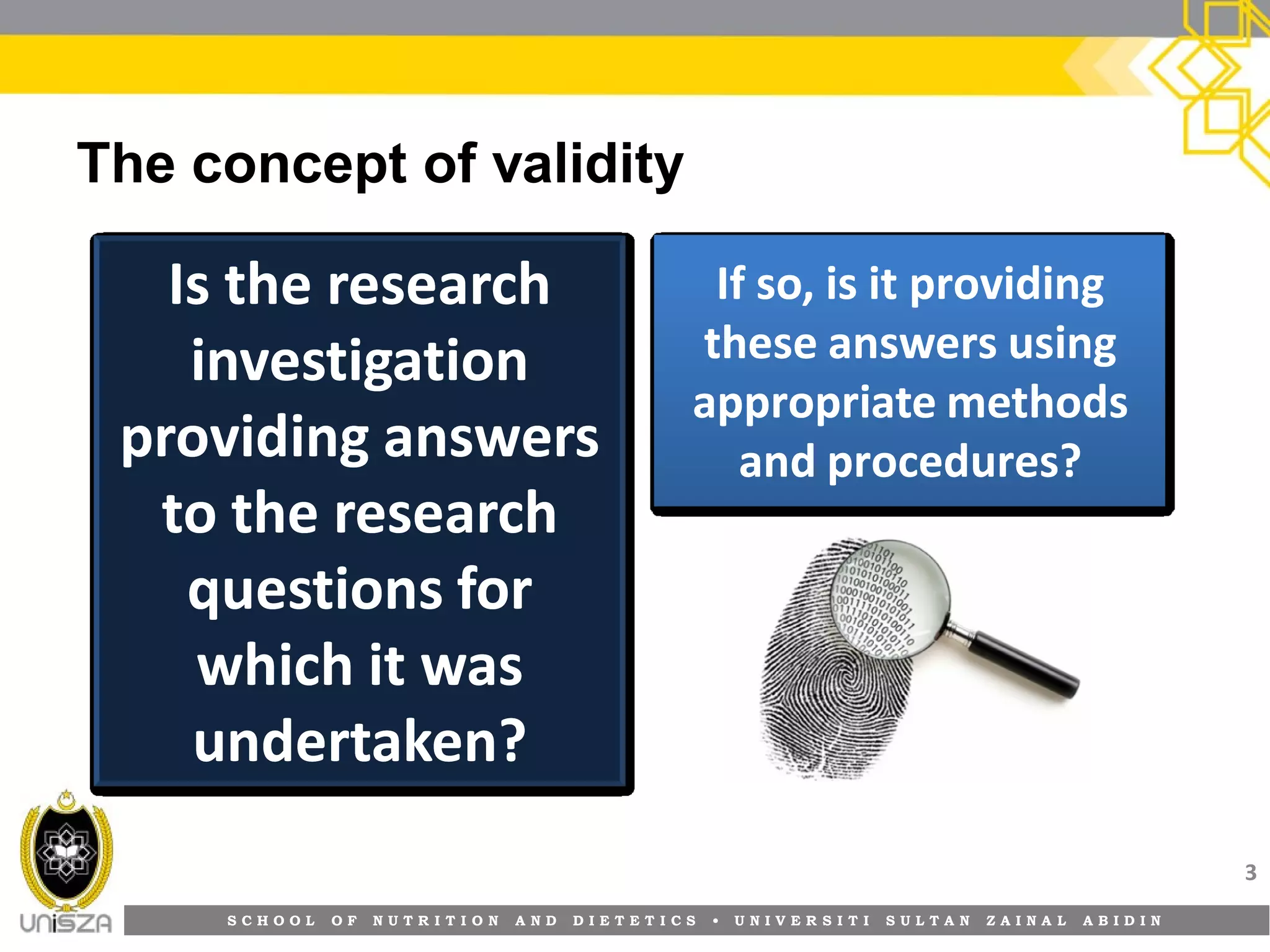
Is the researchIs the research
investigationinvestigation
providing answersproviding answers
to the researchto the research
questions forquestions for
which it waswhich it was
undertaken?undertaken?
If so, is it providingIf so, is it providing
these answers usingthese answers using
appropriate methodsappropriate methods
and procedures?and procedures?
4.
S C HO O L O F N U T R I T I O N A N D D I E T E T I C S • U N I V E R S I T I S U L T A N Z A I N A L A B I D I N
The concept of validity
• Are we measuring what we think we are measuring?
• Validity is the ability of an instrument to measure
what it is designed to measure.
• Key questions;
– Who decides whether an instrument is measuring what it is
supposed to measure?
– How can it be established that an instrument is measuring what
it supposed to measure?
4
5.
S C HO O L O F N U T R I T I O N A N D D I E T E T I C S • U N I V E R S I T I S U L T A N Z A I N A L A B I D I N
Types of validity in quantitative research
5
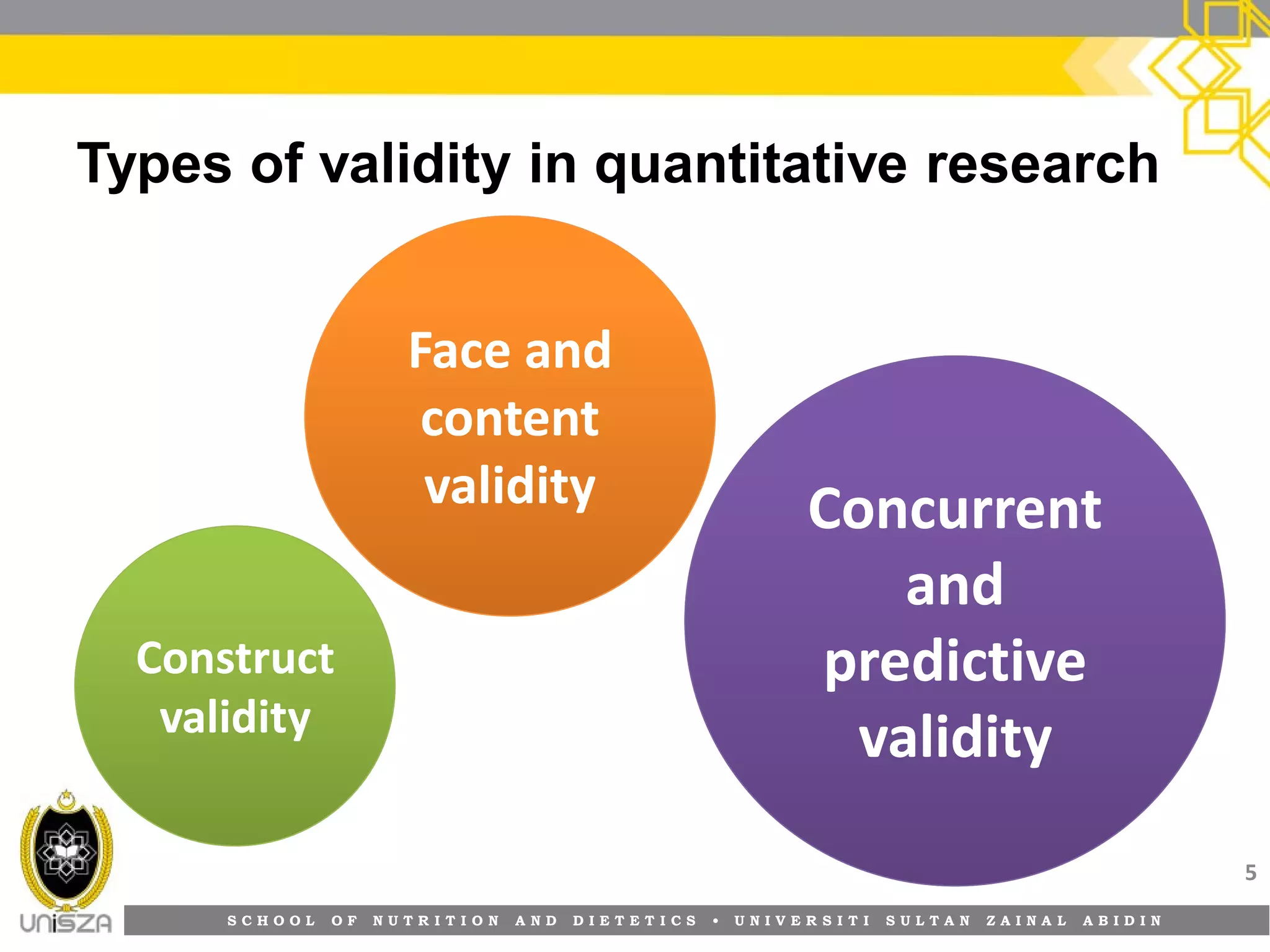
Face andFace and
contentcontent
validityvalidity ConcurrentConcurrent
andand
predictivepredictive
validityvalidity
ConstructConstruct
validityvalidity
6.
S C HO O L O F N U T R I T I O N A N D D I E T E T I C S • U N I V E R S I T I S U L T A N Z A I N A L A B I D I N
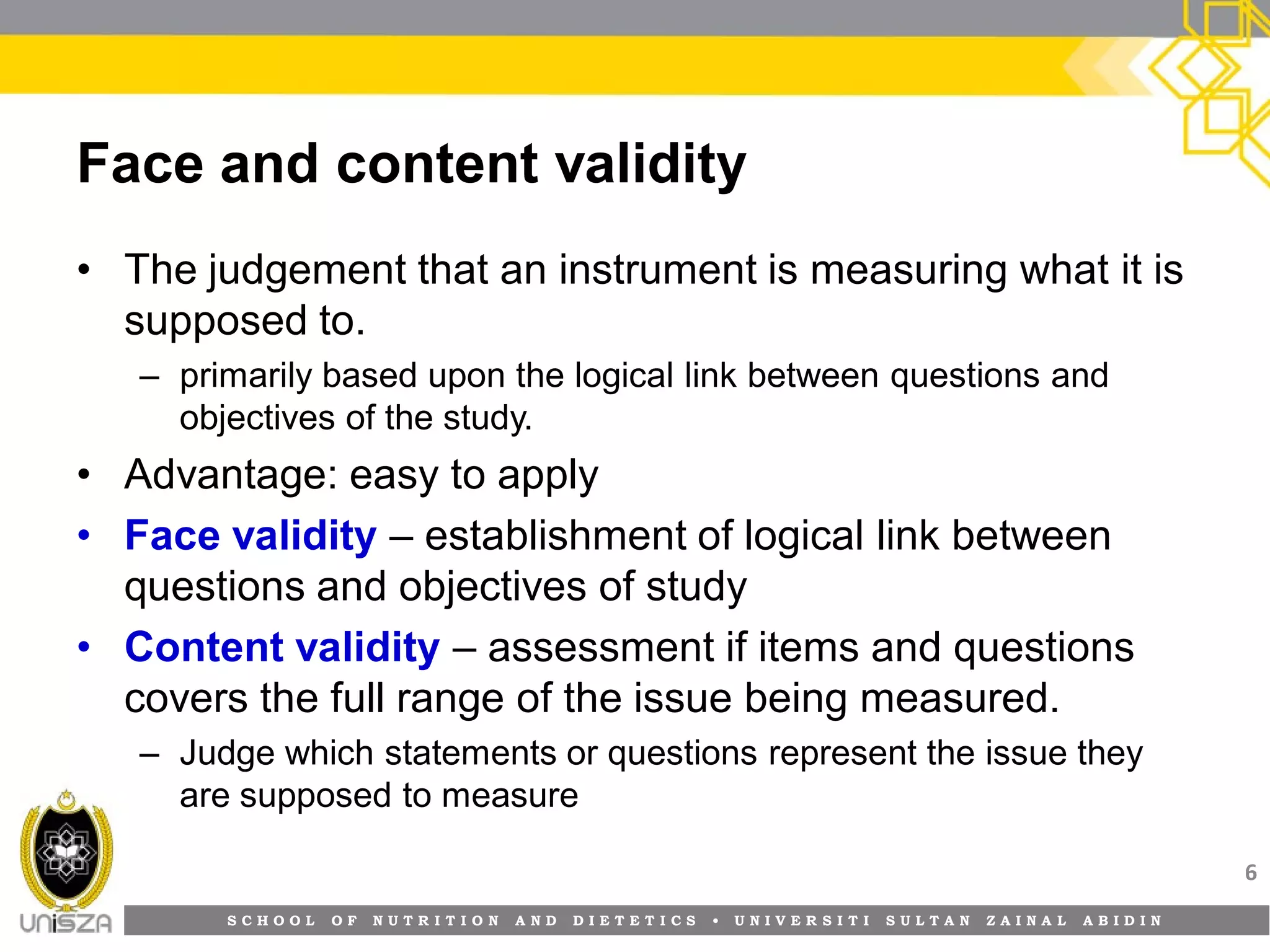
Face and content validity
• The judgement that an instrument is measuring what it is
supposed to.
– primarily based upon the logical link between questions and
objectives of the study.
• Advantage: easy to apply
• Face validity – establishment of logical link between
questions and objectives of study
• Content validity – assessment if items and questions
covers the full range of the issue being measured.
– Judge which statements or questions represent the issue they
are supposed to measure
6
7.
S C HO O L O F N U T R I T I O N A N D D I E T E T I C S • U N I V E R S I T I S U L T A N Z A I N A L A B I D I N
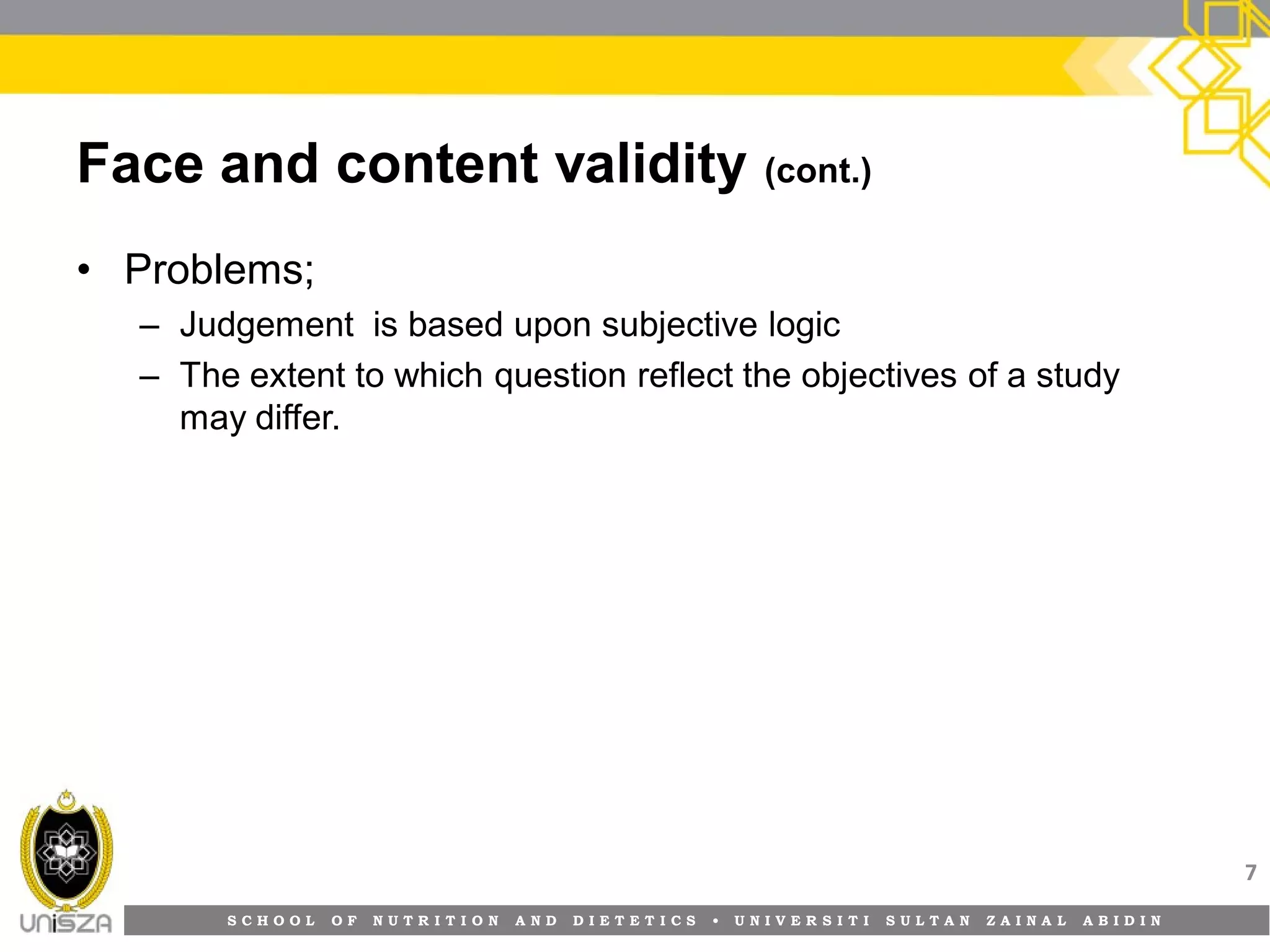
Face and content validity (cont.)
• Problems;
– Judgement is based upon subjective logic
– The extent to which question reflect the objectives of a study
may differ.
7
8.
S C HO O L O F N U T R I T I O N A N D D I E T E T I C S • U N I V E R S I T I S U L T A N Z A I N A L A B I D I N
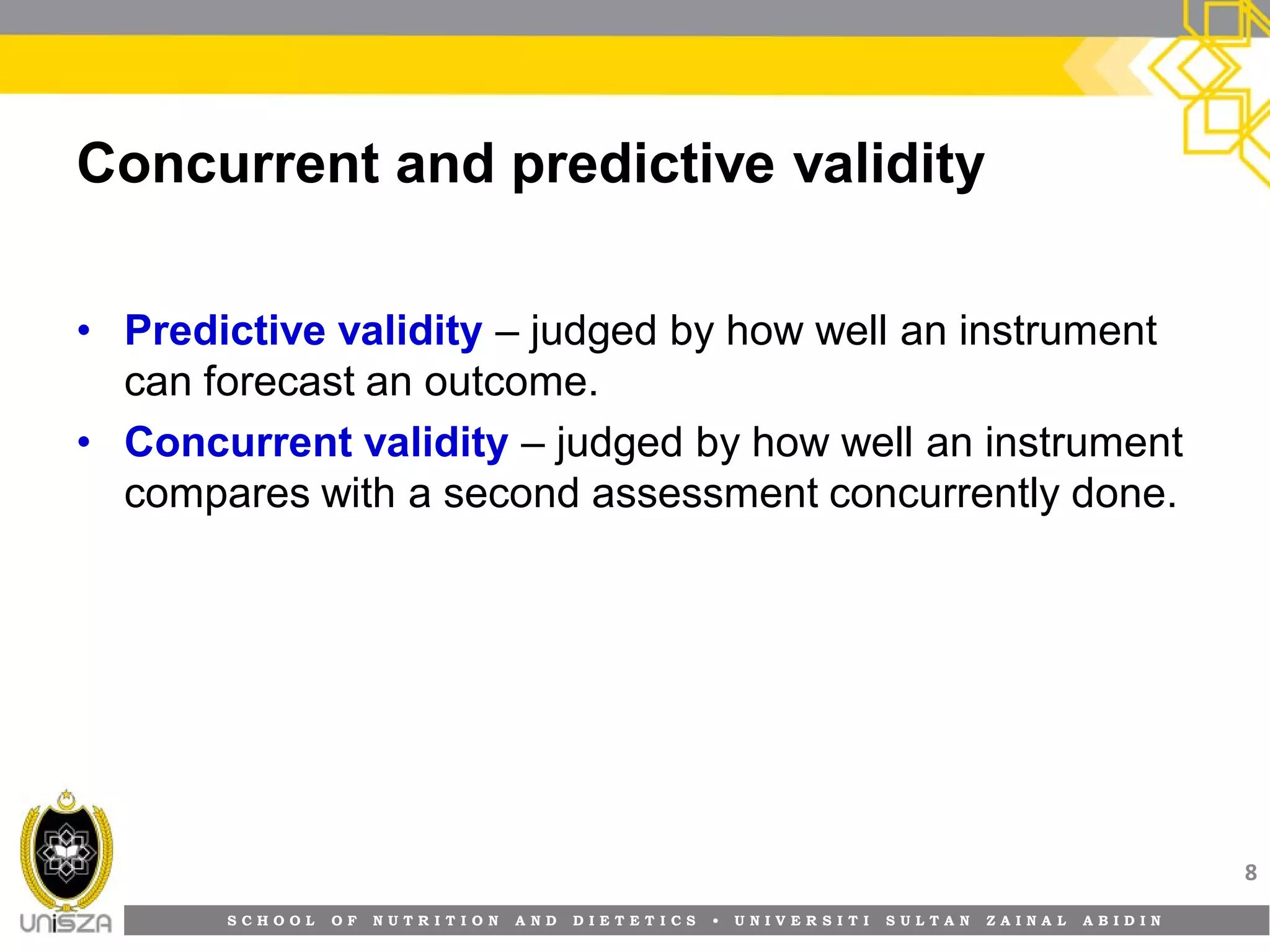
Concurrent and predictive validity
• Predictive validity – judged by how well an instrument
can forecast an outcome.
• Concurrent validity – judged by how well an instrument
compares with a second assessment concurrently done.
8
9.
S C HO O L O F N U T R I T I O N A N D D I E T E T I C S • U N I V E R S I T I S U L T A N Z A I N A L A B I D I N
Construct validity
• Construct validity – determined by ascertaining the
contribution of each construct to the total variance
observed in a phenomenon.
• Based upon statistical procedure.
• The greater the variance attributable to the construct, the
higher the validity of the instrument.
9
10.
S C HO O L O F N U T R I T I O N A N D D I E T E T I C S • U N I V E R S I T I S U L T A N Z A I N A L A B I D I N
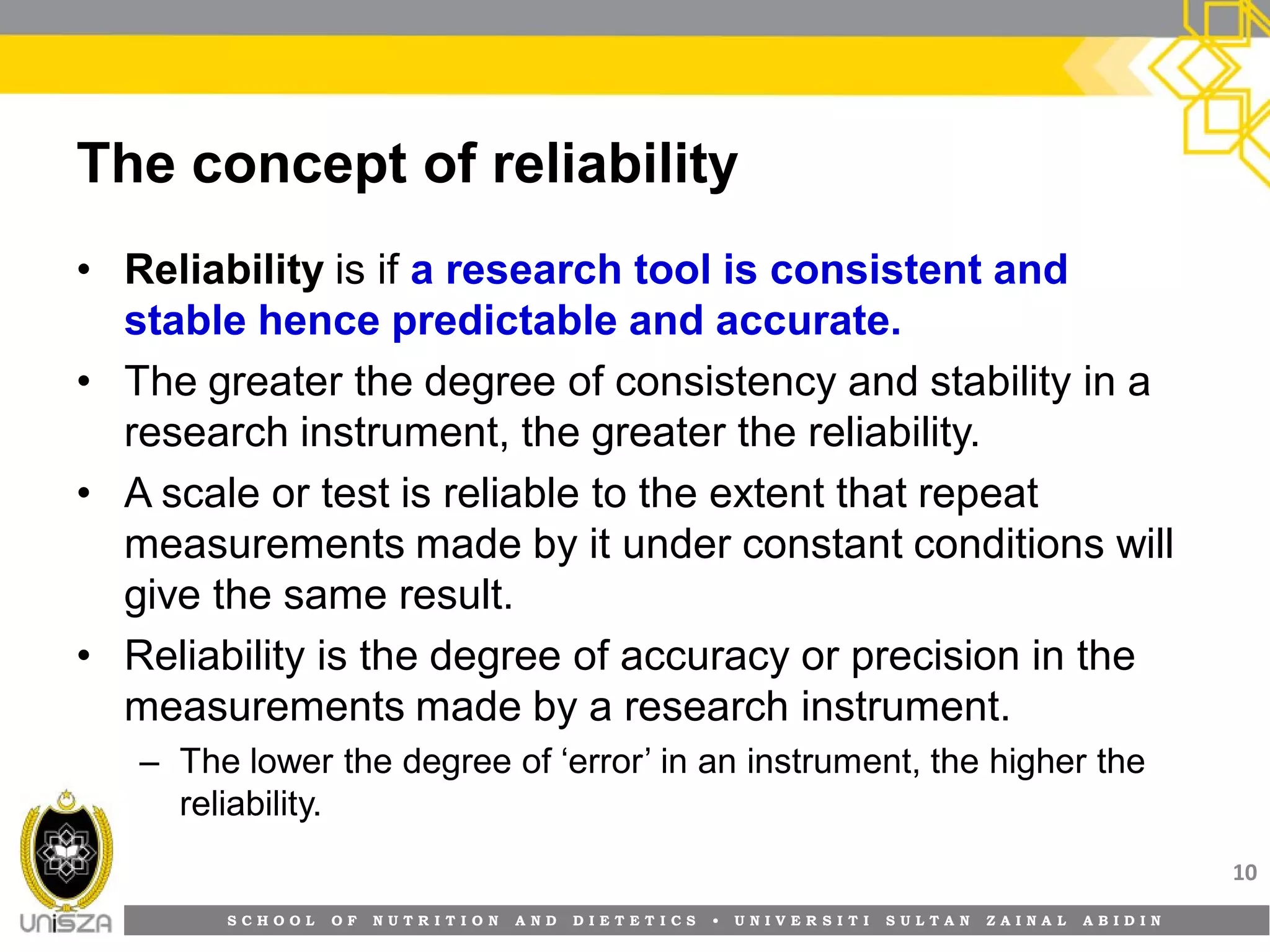
The concept of reliability
• Reliability is if a research tool is consistent and
stable hence predictable and accurate.
• The greater the degree of consistency and stability in a
research instrument, the greater the reliability.
• A scale or test is reliable to the extent that repeat
measurements made by it under constant conditions will
give the same result.
• Reliability is the degree of accuracy or precision in the
measurements made by a research instrument.
– The lower the degree of ‘error’ in an instrument, the higher the
reliability.
10
11.
S C HO O L O F N U T R I T I O N A N D D I E T E T I C S • U N I V E R S I T I S U L T A N Z A I N A L A B I D I N
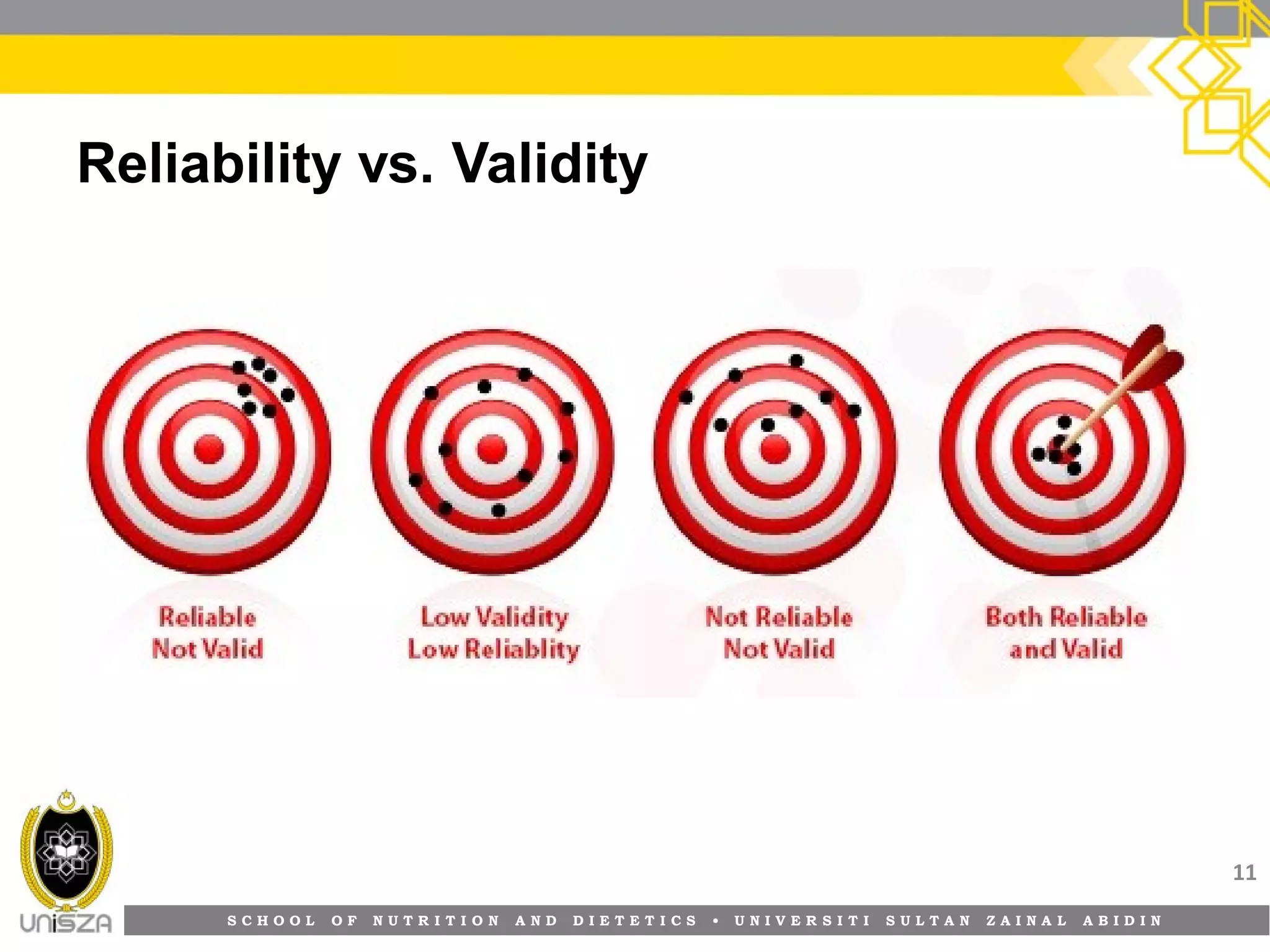
Reliability vs. Validity
11
12.
S C HO O L O F N U T R I T I O N A N D D I E T E T I C S • U N I V E R S I T I S U L T A N Z A I N A L A B I D I N
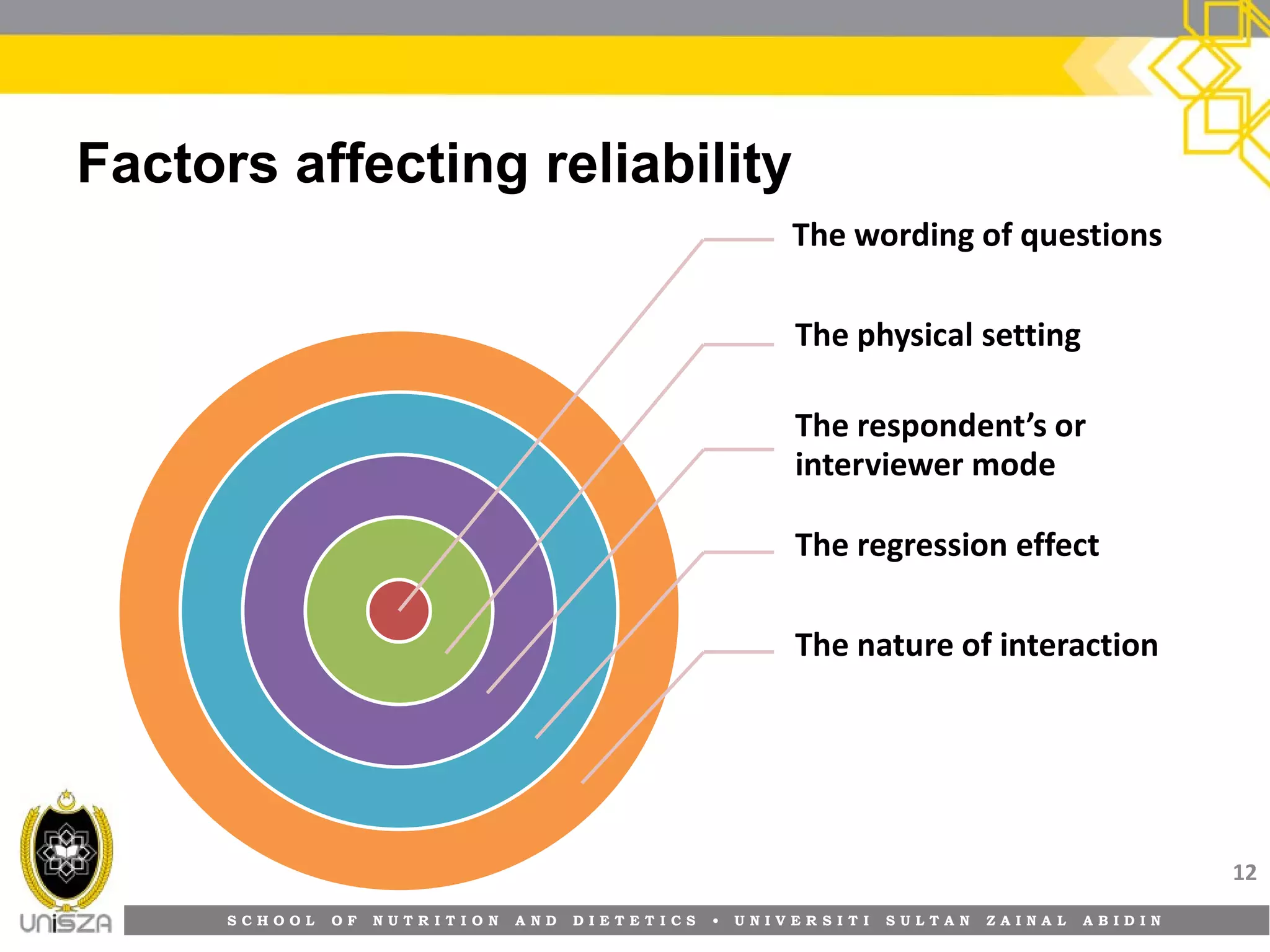
Factors affecting reliability
12
The wording of questions
The physical setting
The respondent’s or
interviewer mode
The regression effect
The nature of interaction
13.
S C HO O L O F N U T R I T I O N A N D D I E T E T I C S • U N I V E R S I T I S U L T A N Z A I N A L A B I D I N
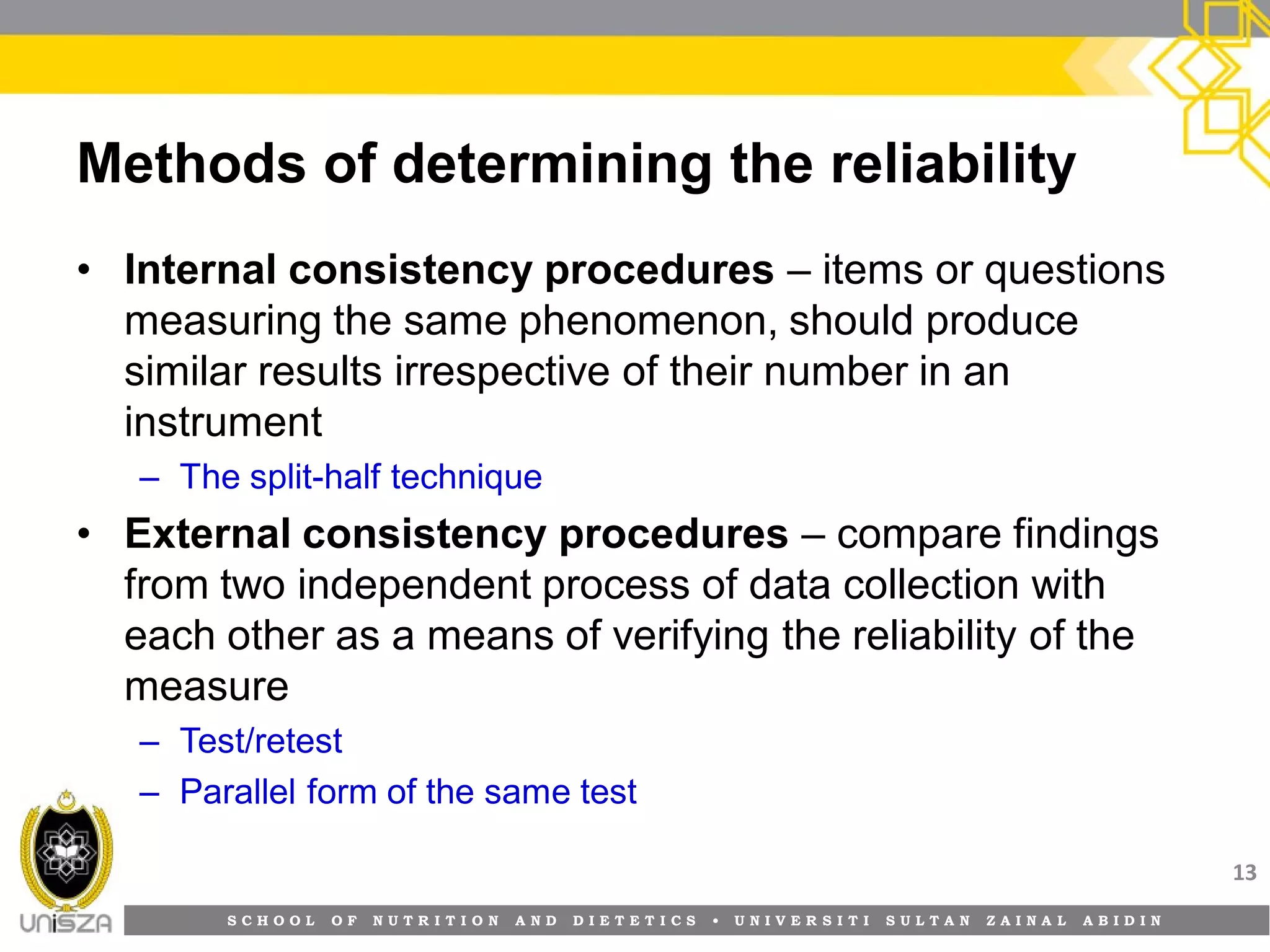
Methods of determining the reliability
• Internal consistency procedures – items or questions
measuring the same phenomenon, should produce
similar results irrespective of their number in an
instrument
– The split-half technique
• External consistency procedures – compare findings
from two independent process of data collection with
each other as a means of verifying the reliability of the
measure
– Test/retest
– Parallel form of the same test
13
14.
S C HO O L O F N U T R I T I O N A N D D I E T E T I C S • U N I V E R S I T I S U L T A N Z A I N A L A B I D I N
Split-half technique
• To correlate half of the items with the other half in a
research instruments
• Questions are divided in half in such way that any two
questions intended to measure the same aspect fall into
different halves.
• The scores obtained by administering the two halves are
correlated.
• Reliability is calculated using product moment correlation
between scores
14
15.
S C HO O L O F N U T R I T I O N A N D D I E T E T I C S • U N I V E R S I T I S U L T A N Z A I N A L A B I D I N
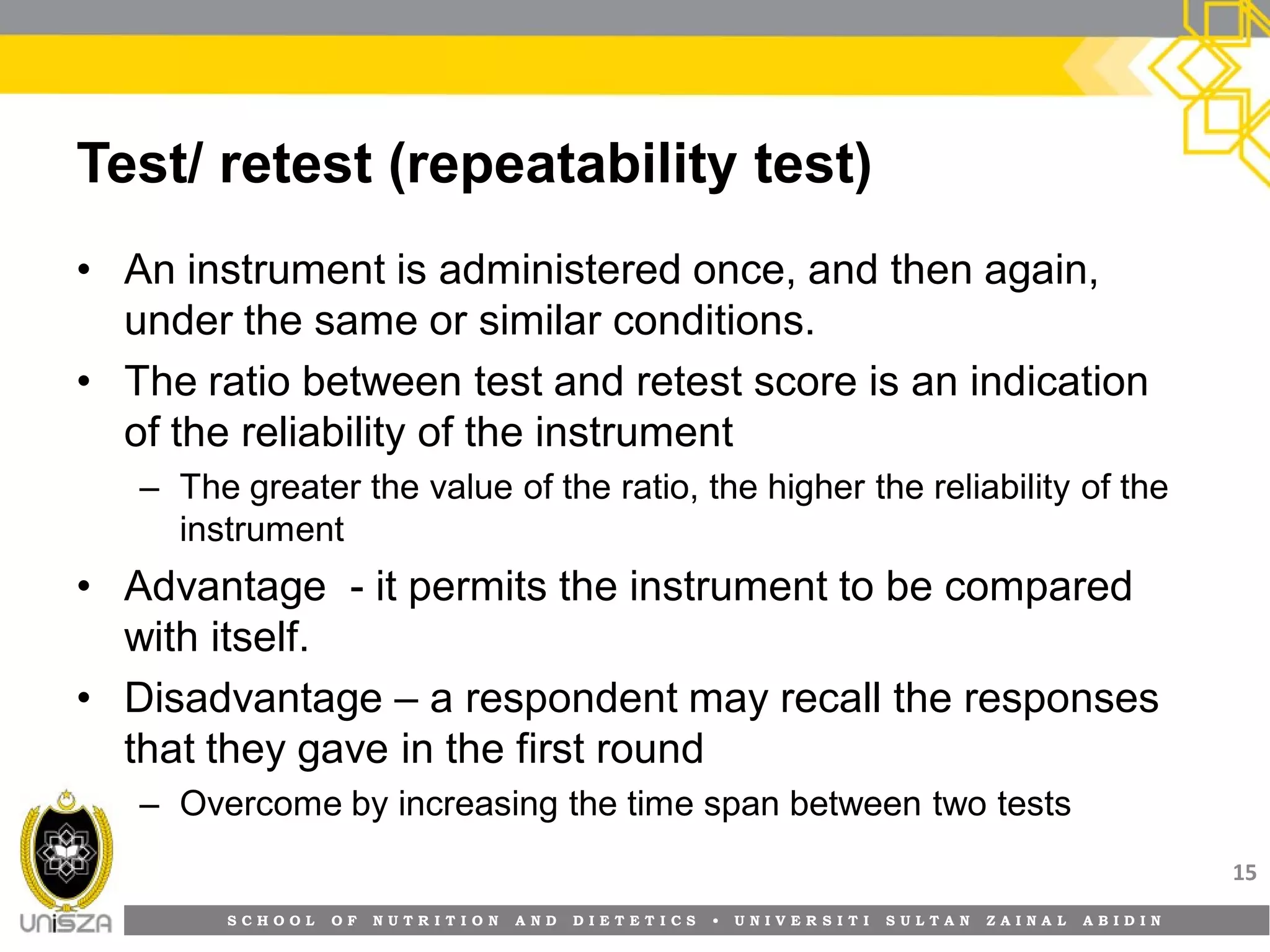
Test/ retest (repeatability test)
• An instrument is administered once, and then again,
under the same or similar conditions.
• The ratio between test and retest score is an indication
of the reliability of the instrument
– The greater the value of the ratio, the higher the reliability of the
instrument
• Advantage - it permits the instrument to be compared
with itself.
• Disadvantage – a respondent may recall the responses
that they gave in the first round
– Overcome by increasing the time span between two tests
15
16.
S C HO O L O F N U T R I T I O N A N D D I E T E T I C S • U N I V E R S I T I S U L T A N Z A I N A L A B I D I N
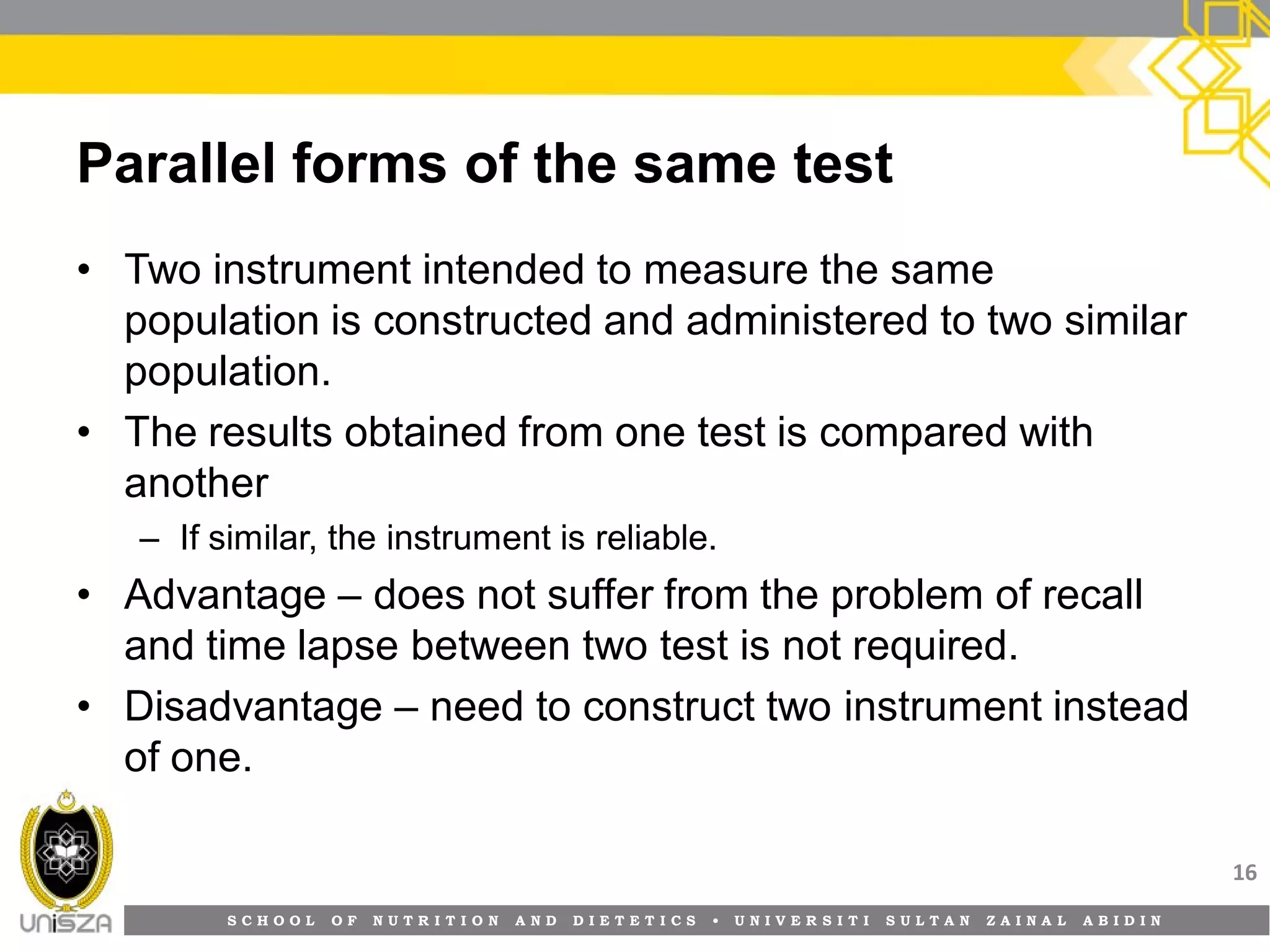
Parallel forms of the same test
• Two instrument intended to measure the same
population is constructed and administered to two similar
population.
• The results obtained from one test is compared with
another
– If similar, the instrument is reliable.
• Advantage – does not suffer from the problem of recall
and time lapse between two test is not required.
• Disadvantage – need to construct two instrument instead
of one.
16
17.
S C HO O L O F N U T R I T I O N A N D D I E T E T I C S • U N I V E R S I T I S U L T A N Z A I N A L A B I D I N
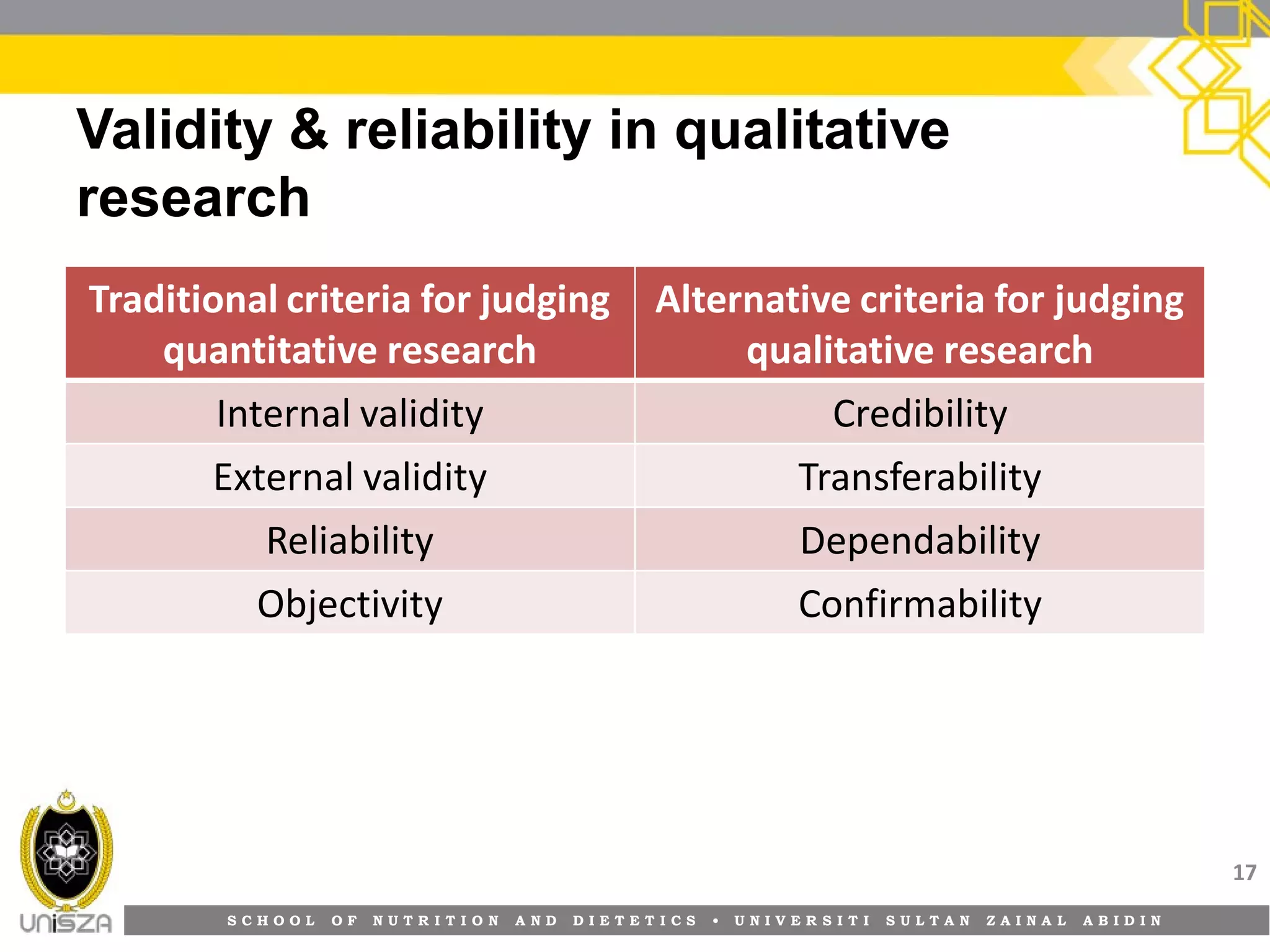
Validity & reliability in qualitative
research
17
Traditional criteria for judging
quantitative research
Alternative criteria for judging
qualitative research
Internal validity Credibility
External validity Transferability
Reliability Dependability
Objectivity Confirmability
18.
S C HO O L O F N U T R I T I O N A N D D I E T E T I C S • U N I V E R S I T I S U L T A N Z A I N A L A B I D I N
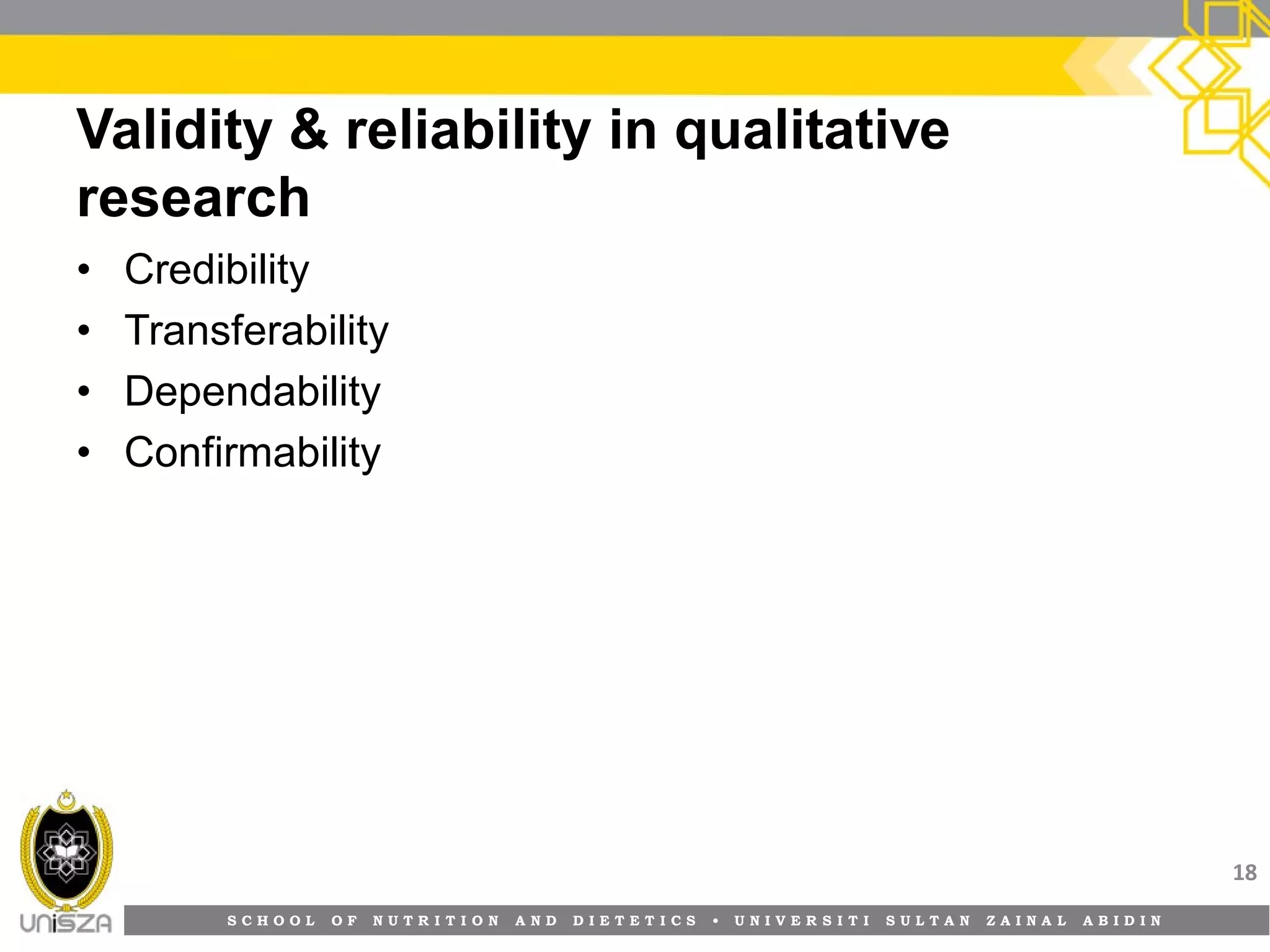
Validity & reliability in qualitative
research
• Credibility
• Transferability
• Dependability
• Confirmability
18