
Epidemiological statistics
Stages of epidemiological investigations
Types of epidemiological study
Dr. S. Parasuraman M.Pharm., Ph.D.,
Senior Lecturer, Faculty of Pharmacy,
AIMST University,
Bedong 08100, Malaysia.
Epidemiological statistics
• Epidemiology: The branch of medicine dealing with the
incidence and prevalence of disease in large populations
and with detection of the source and cause of epidemics
of infectious disease.
• Epidemiology statistics: Epidemiological statistics is the
science that is primarily concerned with making inferences
about population parameters using sampled
measurement, statistical methods provide the tools for
epidemiological research.
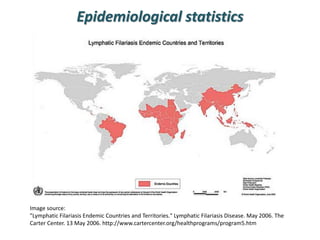
Epidemiological statistics
Image source:
"Lymphatic Filariasis Endemic Countries and Territories." Lymphatic Filariasis Disease. May 2006. The
Carter Center. 13 May 2006. http://www.cartercenter.org/healthprograms/program5.htm
Objectives of epidemiology
• To identify the cause of disease and risk factors
• To determine the extent of disease found in community
• To study natural history and prognosis of disease
• To evaluate existing and new preventive measures
• To provide foundation for developing public policies
Stages of epidemiological investigations
• A diagnostic phase (conformation of presence of the diseases)
• A descriptive phase (formation of hypotheses)
• An investigative phase (normally involves the implementation
of a series of field studies to test these hypotheses)
• An experimental phase (experiment will be conduced under
controlled conditions to test the hypotheses)
• An analytical phase (analysis of research data)
• An intervention phase (method for control of disease are
examined either under experimental condition or field)
• A decision-making phase.
• A monitoring phase (implementation of the control measures)
Stages of epidemiological investigations
• Diagnostic phase
– Presence of disease is conformed with evidence of clinical
findings and laboratory diagnosis.
– Route cause of the disease is identified.
• Descriptive phase
– Describes the populations at risk and the distribution of the
disease, both in time and space, within these populations.
– This may then allow a series of hypotheses to be formed about
the likely determinants of the disease and the effects of these on
the frequency with which the disease occurs in the populations
at risk.
Stages of epidemiological investigations
• Investigative phase
– Implementation of the study hypothesis
– Study plan
– Study filing
• Experimental phase
– Testing hypothesis
– Exposure of the drug
– Study the effect of drug/ placebo
– Collect the clinical data
– Monitor the effect of drug
• Analytical phase
– Arrangement of data
– Data mining
– Statistical analysis
– Data interpretation
Stages of epidemiological investigations
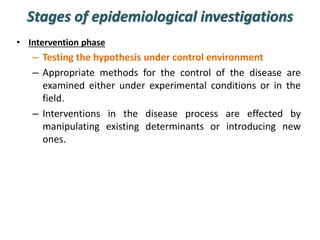
• Intervention phase
– Testing the hypothesis under control environment
– Appropriate methods for the control of the disease are
examined either under experimental conditions or in the
field.
– Interventions in the disease process are effected by
manipulating existing determinants or introducing new
ones.
Stages of epidemiological investigations
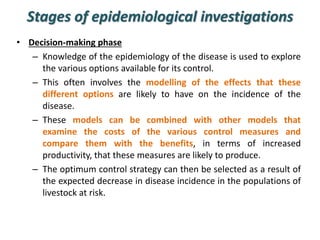
• Decision-making phase
– Knowledge of the epidemiology of the disease is used to explore
the various options available for its control.
– This often involves the modelling of the effects that these
different options are likely to have on the incidence of the
disease.
– These models can be combined with other models that
examine the costs of the various control measures and
compare them with the benefits, in terms of increased
productivity, that these measures are likely to produce.
– The optimum control strategy can then be selected as a result of
the expected decrease in disease incidence in the populations of
livestock at risk.
Stages of epidemiological investigations
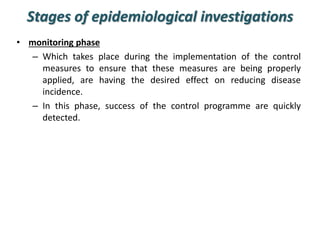
• monitoring phase
– Which takes place during the implementation of the control
measures to ensure that these measures are being properly
applied, are having the desired effect on reducing disease
incidence.
– In this phase, success of the control programme are quickly
detected.
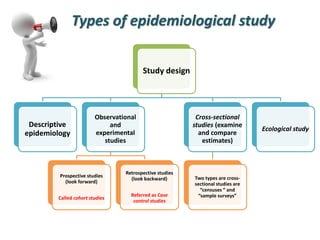
Types of epidemiological study
Study design
Descriptive
epidemiology
Observational
and
experimental
studies
Prospective studies
(look forward)
Called cohort studies
Retrospective studies
(look backward)
Referred as Case
control studies
Cross-sectional
studies (examine
and compare
estimates)
Two types are cross-
sectional studies are
“censuses “ and
“sample surveys”
Ecological study
Types of epidemiological study
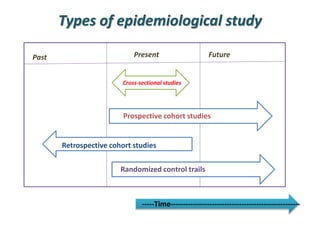
Past FuturePresent
Cross-sectional studies
Prospective cohort studies
Retrospective cohort studies
Randomized control trails
-----Time-----------------------------------------------------
Types of epidemiological study
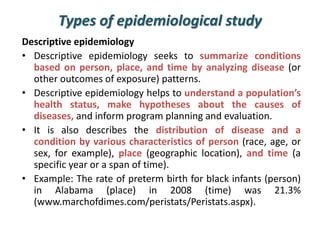
Descriptive epidemiology
• Descriptive epidemiology seeks to summarize conditions
based on person, place, and time by analyzing disease (or
other outcomes of exposure) patterns.
• Descriptive epidemiology helps to understand a population’s
health status, make hypotheses about the causes of
diseases, and inform program planning and evaluation.
• It is also describes the distribution of disease and a
condition by various characteristics of person (race, age, or
sex, for example), place (geographic location), and time (a
specific year or a span of time).
• Example: The rate of preterm birth for black infants (person)
in Alabama (place) in 2008 (time) was 21.3%
(www.marchofdimes.com/peristats/Peristats.aspx).
Types of epidemiological study
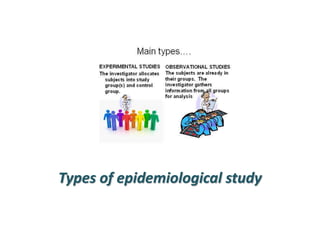
Observational and experimental studies
• The major types of epidemiological studies are experimental and
observational.
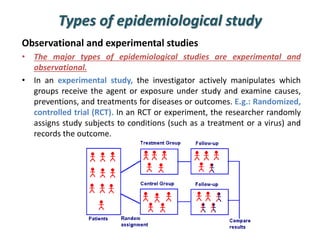
• In an experimental study, the investigator actively manipulates which
groups receive the agent or exposure under study and examine causes,
preventions, and treatments for diseases or outcomes. E.g.: Randomized,
controlled trial (RCT). In an RCT or experiment, the researcher randomly
assigns study subjects to conditions (such as a treatment or a virus) and
records the outcome.
Types of epidemiological study
Observational studies
• Example for observation study: Many health issues of public
health interest cannot be studied through experiments; they
must instead be studied through observational studies.
• Observational studies can be prospective or retrospective. In
some cases, studies are ambi-directional and thus have
elements of both prospective and retrospective studies (such
as when exposure has happened but subjects are followed to
observe the outcomes of the exposure).
Types of epidemiological study
Observational studies
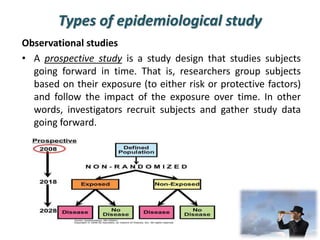
• A prospective study is a study design that studies subjects
going forward in time. That is, researchers group subjects
based on their exposure (to either risk or protective factors)
and follow the impact of the exposure over time. In other
words, investigators recruit subjects and gather study data
going forward.
Types of epidemiological study
Observational studies
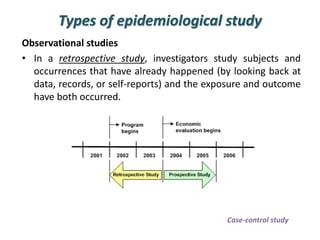
• In a retrospective study, investigators study subjects and
occurrences that have already happened (by looking back at
data, records, or self-reports) and the exposure and outcome
have both occurred.
Case-control study
Types of epidemiological study
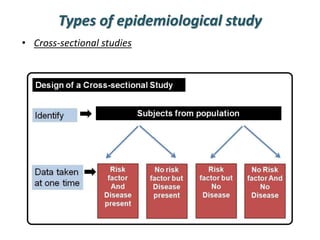
Cross-sectional studies
Cross-sectional studies are sometimes carried out to investigate
associations between risk factors and the outcome of interest.
Data collection may at a defined time/ single point of time.
They are often used to assess the prevalence of acute or chronic
conditions, or to answer questions about the causes of disease
or the results of intervention. They may also be described as
censuses. Cross-sectional studies may involve special data
collection, including questions about the past, but they often
rely on data originally collected for other purposes. They are not
suitable for the study of rare diseases. Difficulty in recalling
past events may also contribute bias.
Types of epidemiological study
• Cross-sectional studies
Types of epidemiological study
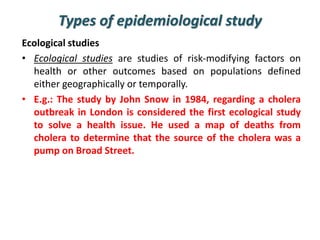
Ecological studies
• Ecological studies are studies of risk-modifying factors on
health or other outcomes based on populations defined
either geographically or temporally.
• E.g.: The study by John Snow in 1984, regarding a cholera
outbreak in London is considered the first ecological study
to solve a health issue. He used a map of deaths from
cholera to determine that the source of the cholera was a
pump on Broad Street.
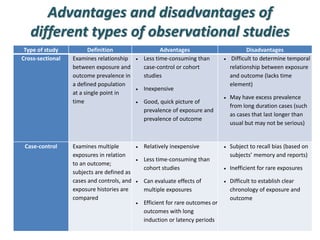
Advantages and disadvantages of
different types of observational studies
Type of study Definition Advantages Disadvantages
Cross-sectional Examines relationship
between exposure and
outcome prevalence in
a defined population
at a single point in
time
 Less time-consuming than
case-control or cohort
studies
 Inexpensive
 Good, quick picture of
prevalence of exposure and
prevalence of outcome
 Difficult to determine temporal
relationship between exposure
and outcome (lacks time
element)
 May have excess prevalence
from long duration cases (such
as cases that last longer than
usual but may not be serious)
Case-control Examines multiple
exposures in relation
to an outcome;
subjects are defined as
cases and controls, and
exposure histories are
compared
 Relatively inexpensive
 Less time-consuming than
cohort studies
 Can evaluate effects of
multiple exposures
 Efficient for rare outcomes or
outcomes with long
induction or latency periods
 Subject to recall bias (based on
subjects’ memory and reports)
 Inefficient for rare exposures
 Difficult to establish clear
chronology of exposure and
outcome
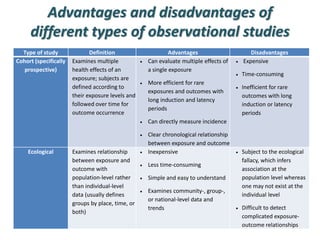
Advantages and disadvantages of
different types of observational studies
Type of study Definition Advantages Disadvantages
Cohort (specifically
prospective)
Examines multiple
health effects of an
exposure; subjects are
defined according to
their exposure levels and
followed over time for
outcome occurrence
 Can evaluate multiple effects of
a single exposure
 More efficient for rare
exposures and outcomes with
long induction and latency
periods
 Can directly measure incidence
 Clear chronological relationship
between exposure and outcome
 Expensive
 Time-consuming
 Inefficient for rare
outcomes with long
induction or latency
periods
Ecological Examines relationship
between exposure and
outcome with
population-level rather
than individual-level
data (usually defines
groups by place, time, or
both)
 Inexpensive
 Less time-consuming
 Simple and easy to understand
 Examines community-, group-,
or national-level data and
trends
 Subject to the ecological
fallacy, which infers
association at the
population level whereas
one may not exist at the
individual level
 Difficult to detect
complicated exposure-
outcome relationships
Thank you

Epidemiological statistics I

  • 1.
    Epidemiological statistics Stages ofepidemiological investigations Types of epidemiological study Dr. S. Parasuraman M.Pharm., Ph.D., Senior Lecturer, Faculty of Pharmacy, AIMST University, Bedong 08100, Malaysia.
  • 2.
    Epidemiological statistics • Epidemiology:The branch of medicine dealing with the incidence and prevalence of disease in large populations and with detection of the source and cause of epidemics of infectious disease. • Epidemiology statistics: Epidemiological statistics is the science that is primarily concerned with making inferences about population parameters using sampled measurement, statistical methods provide the tools for epidemiological research.
  • 3.
    Epidemiological statistics Image source: "LymphaticFilariasis Endemic Countries and Territories." Lymphatic Filariasis Disease. May 2006. The Carter Center. 13 May 2006. http://www.cartercenter.org/healthprograms/program5.htm
  • 4.
    Objectives of epidemiology •To identify the cause of disease and risk factors • To determine the extent of disease found in community • To study natural history and prognosis of disease • To evaluate existing and new preventive measures • To provide foundation for developing public policies
  • 5.
    Stages of epidemiologicalinvestigations • A diagnostic phase (conformation of presence of the diseases) • A descriptive phase (formation of hypotheses) • An investigative phase (normally involves the implementation of a series of field studies to test these hypotheses) • An experimental phase (experiment will be conduced under controlled conditions to test the hypotheses) • An analytical phase (analysis of research data) • An intervention phase (method for control of disease are examined either under experimental condition or field) • A decision-making phase. • A monitoring phase (implementation of the control measures)
  • 6.
    Stages of epidemiologicalinvestigations • Diagnostic phase – Presence of disease is conformed with evidence of clinical findings and laboratory diagnosis. – Route cause of the disease is identified. • Descriptive phase – Describes the populations at risk and the distribution of the disease, both in time and space, within these populations. – This may then allow a series of hypotheses to be formed about the likely determinants of the disease and the effects of these on the frequency with which the disease occurs in the populations at risk.
  • 7.
    Stages of epidemiologicalinvestigations • Investigative phase – Implementation of the study hypothesis – Study plan – Study filing • Experimental phase – Testing hypothesis – Exposure of the drug – Study the effect of drug/ placebo – Collect the clinical data – Monitor the effect of drug • Analytical phase – Arrangement of data – Data mining – Statistical analysis – Data interpretation
  • 8.
    Stages of epidemiologicalinvestigations • Intervention phase – Testing the hypothesis under control environment – Appropriate methods for the control of the disease are examined either under experimental conditions or in the field. – Interventions in the disease process are effected by manipulating existing determinants or introducing new ones.
  • 9.
    Stages of epidemiologicalinvestigations • Decision-making phase – Knowledge of the epidemiology of the disease is used to explore the various options available for its control. – This often involves the modelling of the effects that these different options are likely to have on the incidence of the disease. – These models can be combined with other models that examine the costs of the various control measures and compare them with the benefits, in terms of increased productivity, that these measures are likely to produce. – The optimum control strategy can then be selected as a result of the expected decrease in disease incidence in the populations of livestock at risk.
  • 10.
    Stages of epidemiologicalinvestigations • monitoring phase – Which takes place during the implementation of the control measures to ensure that these measures are being properly applied, are having the desired effect on reducing disease incidence. – In this phase, success of the control programme are quickly detected.
  • 11.
    Types of epidemiologicalstudy Study design Descriptive epidemiology Observational and experimental studies Prospective studies (look forward) Called cohort studies Retrospective studies (look backward) Referred as Case control studies Cross-sectional studies (examine and compare estimates) Two types are cross- sectional studies are “censuses “ and “sample surveys” Ecological study
  • 12.
    Types of epidemiologicalstudy Past FuturePresent Cross-sectional studies Prospective cohort studies Retrospective cohort studies Randomized control trails -----Time-----------------------------------------------------
  • 13.
    Types of epidemiologicalstudy Descriptive epidemiology • Descriptive epidemiology seeks to summarize conditions based on person, place, and time by analyzing disease (or other outcomes of exposure) patterns. • Descriptive epidemiology helps to understand a population’s health status, make hypotheses about the causes of diseases, and inform program planning and evaluation. • It is also describes the distribution of disease and a condition by various characteristics of person (race, age, or sex, for example), place (geographic location), and time (a specific year or a span of time). • Example: The rate of preterm birth for black infants (person) in Alabama (place) in 2008 (time) was 21.3% (www.marchofdimes.com/peristats/Peristats.aspx).
  • 14.
  • 15.
    Types of epidemiologicalstudy Observational and experimental studies • The major types of epidemiological studies are experimental and observational. • In an experimental study, the investigator actively manipulates which groups receive the agent or exposure under study and examine causes, preventions, and treatments for diseases or outcomes. E.g.: Randomized, controlled trial (RCT). In an RCT or experiment, the researcher randomly assigns study subjects to conditions (such as a treatment or a virus) and records the outcome.
  • 16.
    Types of epidemiologicalstudy Observational studies • Example for observation study: Many health issues of public health interest cannot be studied through experiments; they must instead be studied through observational studies. • Observational studies can be prospective or retrospective. In some cases, studies are ambi-directional and thus have elements of both prospective and retrospective studies (such as when exposure has happened but subjects are followed to observe the outcomes of the exposure).
  • 17.
    Types of epidemiologicalstudy Observational studies • A prospective study is a study design that studies subjects going forward in time. That is, researchers group subjects based on their exposure (to either risk or protective factors) and follow the impact of the exposure over time. In other words, investigators recruit subjects and gather study data going forward.
  • 18.
    Types of epidemiologicalstudy Observational studies • In a retrospective study, investigators study subjects and occurrences that have already happened (by looking back at data, records, or self-reports) and the exposure and outcome have both occurred. Case-control study
  • 19.
    Types of epidemiologicalstudy Cross-sectional studies Cross-sectional studies are sometimes carried out to investigate associations between risk factors and the outcome of interest. Data collection may at a defined time/ single point of time. They are often used to assess the prevalence of acute or chronic conditions, or to answer questions about the causes of disease or the results of intervention. They may also be described as censuses. Cross-sectional studies may involve special data collection, including questions about the past, but they often rely on data originally collected for other purposes. They are not suitable for the study of rare diseases. Difficulty in recalling past events may also contribute bias.
  • 20.
    Types of epidemiologicalstudy • Cross-sectional studies
  • 21.
    Types of epidemiologicalstudy Ecological studies • Ecological studies are studies of risk-modifying factors on health or other outcomes based on populations defined either geographically or temporally. • E.g.: The study by John Snow in 1984, regarding a cholera outbreak in London is considered the first ecological study to solve a health issue. He used a map of deaths from cholera to determine that the source of the cholera was a pump on Broad Street.
  • 22.
    Advantages and disadvantagesof different types of observational studies Type of study Definition Advantages Disadvantages Cross-sectional Examines relationship between exposure and outcome prevalence in a defined population at a single point in time  Less time-consuming than case-control or cohort studies  Inexpensive  Good, quick picture of prevalence of exposure and prevalence of outcome  Difficult to determine temporal relationship between exposure and outcome (lacks time element)  May have excess prevalence from long duration cases (such as cases that last longer than usual but may not be serious) Case-control Examines multiple exposures in relation to an outcome; subjects are defined as cases and controls, and exposure histories are compared  Relatively inexpensive  Less time-consuming than cohort studies  Can evaluate effects of multiple exposures  Efficient for rare outcomes or outcomes with long induction or latency periods  Subject to recall bias (based on subjects’ memory and reports)  Inefficient for rare exposures  Difficult to establish clear chronology of exposure and outcome
  • 23.
    Advantages and disadvantagesof different types of observational studies Type of study Definition Advantages Disadvantages Cohort (specifically prospective) Examines multiple health effects of an exposure; subjects are defined according to their exposure levels and followed over time for outcome occurrence  Can evaluate multiple effects of a single exposure  More efficient for rare exposures and outcomes with long induction and latency periods  Can directly measure incidence  Clear chronological relationship between exposure and outcome  Expensive  Time-consuming  Inefficient for rare outcomes with long induction or latency periods Ecological Examines relationship between exposure and outcome with population-level rather than individual-level data (usually defines groups by place, time, or both)  Inexpensive  Less time-consuming  Simple and easy to understand  Examines community-, group-, or national-level data and trends  Subject to the ecological fallacy, which infers association at the population level whereas one may not exist at the individual level  Difficult to detect complicated exposure- outcome relationships
  • 24.