ANALYTIC STUDIES
Prepared By:
Dr.Anees AlSaadi

CMT-P R4
December 2013
ANALYTIC STUDIES
• OUTLINE:
– Hierarchy of Study design.
– Introduction for analytic Studies./ Exposure &
Outcome.
– Cohort and Case control Study design:
• Definition.
• Character.
• Advantages and disadvantages.
ANALYTIC STUDIES
Introduction
ANALYTIC STUDIES
Introduction:
Testing specific hypotheses.
Samples of subjects are identified and information
about exposure status and outcome is collected.
ANALYTIC STUDIES
Introduction:

Groups of subjects are compared in order to estimate
the magnitude of association between exposures and
outcomes.
ANALYTIC STUDIES
Introduction:
The two main types:

Cohort study
Case-control study
ANALYTIC STUDIES
Introduction:

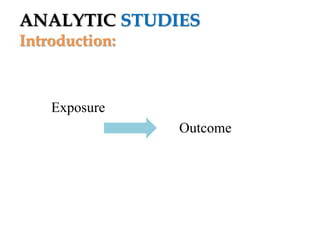
Exposure
Outcome
ANALYTIC STUDIES
Cohort study:

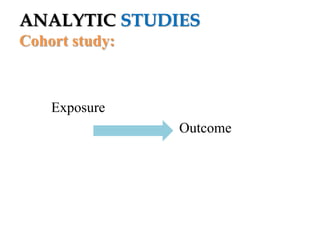
Exposure
Outcome
ANALYTIC STUDIES
Cohort study:
Definition
ANALYTIC STUDIES
Cohort study:
Definition
ANALYTIC STUDIES
Cohort study:
Definition
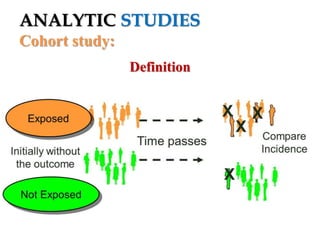
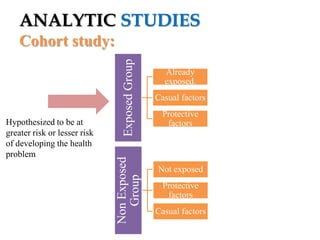
Is an analytic epidemiologic research design in
.which the study population is composed of
individuals who are classified as exposed and no
exposed to particular risk factors. These groups are
followed forward for a specific period of time to
estimate the incidence rate of an outcome or the
development of a health problem.
ANALYTIC STUDIES

Non Exposed
Group

Hypothesized to be at
greater risk or lesser risk
of developing the health
problem

Exposed Group

Cohort study:
Already
exposed.
Casual factors

Protective
factors

Not exposed
Protective
factors
Casual factors
ANALYTIC STUDIES
Cohort study:

What is the Potential Source of Study
Subjects…… ?
ANALYTIC STUDIES
Cohort study:
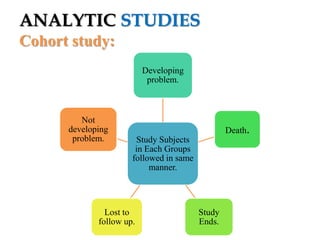
Developing
problem.

Not
developing
problem.

Death.
Study Subjects
in Each Groups
followed in same
manner.

Lost to
follow up.

Study
Ends.
ANALYTIC STUDIES
Cohort study:
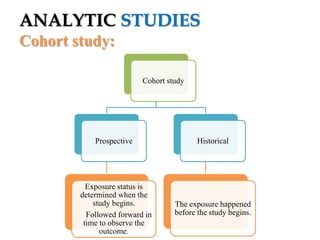
Cohort study

Prospective

Historical

Exposure status is
determined when the
study begins.
Followed forward in
time to observe the
outcome.

The exposure happened
before the study begins.
ANALYTIC STUDIES
Cohort study:
Example
ANALYTIC STUDIES
Cohort study:

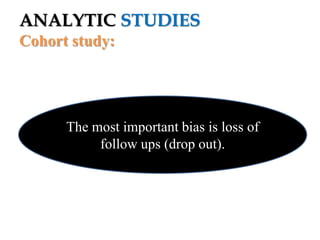
The most important bias is loss of
follow ups (drop out).
ANALYTIC STUDIES
Cohort study:
•
•

•
•
•
•

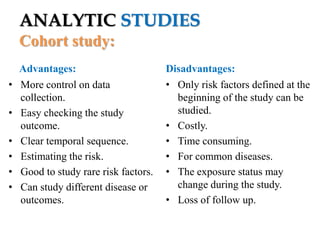
Advantages:
More control on data
collection.
Easy checking the study
outcome.
Clear temporal sequence.
Estimating the risk.
Good to study rare risk factors.
Can study different disease or
outcomes.

Disadvantages:
• Only risk factors defined at the
beginning of the study can be
studied.
• Costly.
• Time consuming.
• For common diseases.
• The exposure status may
change during the study.
• Loss of follow up.
ANALYTIC STUDIES
Case Control Study:
Definition
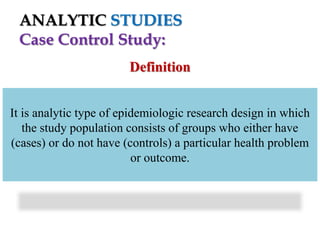
It is analytic type of epidemiologic research design in which
the study population consists of groups who either have
(cases) or do not have (controls) a particular health problem
or outcome.
ANALYTIC STUDIES
Case Control Study:
ANALYTIC STUDIES
Case Control Study:

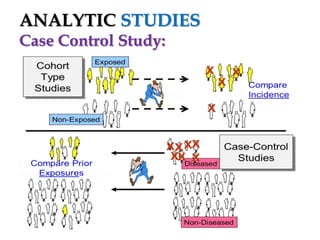
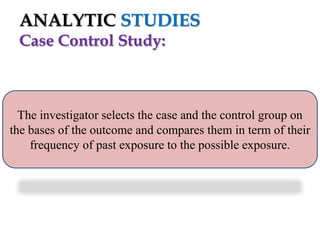
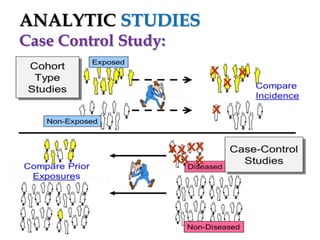
The investigator selects the case and the control group on
the bases of the outcome and compares them in term of their
frequency of past exposure to the possible exposure.
ANALYTIC STUDIES
Case Control Study:

Retrospective Study
ANALYTIC STUDIES
Case Control Study:

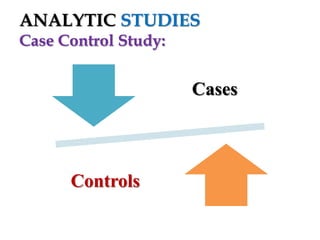
Cases

Controls
ANALYTIC STUDIES
Case Control Study:

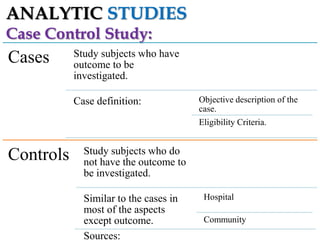
Cases

Study subjects who have
outcome to be
investigated.
Case definition:

Objective description of the
case.

Eligibility Criteria.

Controls

Study subjects who do
not have the outcome to
be investigated.
Similar to the cases in
most of the aspects
except outcome.
Sources:

Hospital
Community
ANALYTIC STUDIES
Case Control Study:
ANALYTIC STUDIES
Case Control Study:

Controls

Cases

Similarity
ANALYTIC STUDIES
Case Control Study:
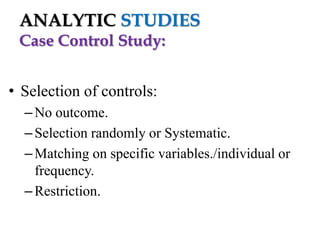
• Selection of controls:
– No outcome.
– Selection randomly or Systematic.
– Matching on specific variables./individual or
frequency.
– Restriction.
ANALYTIC STUDIES
Case Control Study:

What is the Potential Source of Study
Subjects…… ?
ANALYTIC STUDIES
Case Control Study:

The most important bias is recall .
ANALYTIC STUDIES
Case Control Study:
•
•
•
•
•
•

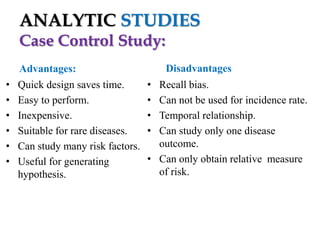
Advantages:
Quick design saves time.
Easy to perform.
Inexpensive.
Suitable for rare diseases.
Can study many risk factors.
Useful for generating
hypothesis.

Disadvantages
•
•
•
•

Recall bias.
Can not be used for incidence rate.
Temporal relationship.
Can study only one disease
outcome.
• Can only obtain relative measure
of risk.
Practical Exercise
Analytic studies
Analytic studies
Analytic studies
Analytic studies
Analytic studies

Analytic studies