Cross-sectional
Studies
•
HARSHITHA
•
5TH PHARMD
Cross sectional study examines the relationship between a disease and
an exposure in individuals in a different population at a point of time
without follow up.
Like cohort studies, cross-sectional studies conceptually begin with a
population base. But unlike cohort studies, in cross-sectional studies
we do not follow individuals over time. Instead, we only look at the
prevalence of disease and/or exposure at one moment in time.
These studies take a "snapshot" of the proportion of individuals in the
population that are, for example, diseased and non-diseased at one
point in time. Other health outcomes besides diseases may also be
studied.
• The most common type of cross-sectional studies is the
environmental health survey, in which participants are enrolled from
exposed and unexposed areas to collect the information on health
status, exposure to environmental factors, and potential confounding
factors.
• As the disease and exposure data are collected simultaneously, the
causal temporality of disease and exposure needs further evaluation.
Descriptive
cross-
sectional
study
A cross-sectional survey may be
purely descriptive and used to
assess the burden of a particular
disease in a defined population.
For example, a random sample of
schools across London may be used
to assess the prevalence of asthma
among 12-14-year-olds.
Analytical
cross-
sectional
study
In analytical cross-sectional studies, data on the
prevalence of both exposure and a health outcome are
obtained for the purpose of comparing health outcome
differences between exposed and unexposed.
Analytical studies attempt to describe the prevalence of,
for example, disease or non-disease by first beginning
with a population base. These studies differ from solely
descriptive cross-sectional studies in that they compare
the proportion of exposed persons who are diseased
(a/(a+b)) with the proportion of non-exposed persons
who are diseased (c/ (c+d)).
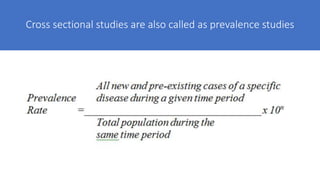
Cross sectional studies are also called as prevalence studies
Steps in cross-
sectional
study
State the criteria for
the
disease/condition
Define co-variables
to be measured
Examine ethical
issues
Identify the
reference
population
State inclusion and
exclusion criteria
Data collection
(clinical records,
interviews and
questionnaire)
Summarize data
Analyze and
interpret findings
Report
Sample
selection and
response rates
The sample frame used to select a sample and the
response rate determine how well results can be
generalized to the population as a whole. The sample used
in a large cross-sectional study is often taken from the
whole population.
This is the optimum situation: if the sample is selected
using a random technique it is likely that it will be highly
representative. In order for the results to be representative
of the population, however, not only must the selected
sample be representative but so must the responders.
Nonresponse is a common problem in wide-scale surveys;
techniques to minimize nonresponse include telephone
and mail prompting, second and third mailing of surveys,
letters outlining the importance of replying and a range of
incentives
Measures of
outcome and
exposure
A lot of information can be collected about
potential risk factors in a cross-sectional study.
Loss to follow-up is a common concern in
longitudinal studies and one of the strategies
used to overcome this is to minimize the amount
of information collected. This is not a problem in
cross-sectional study design.
It is advisable to think carefully about what might
be relevant because this is a good opportunity to
gain a broad base of knowledge about subjects
who have/do not have the outcome of interest,
but it is also important to maintain optimum
response levels. Associations between outcomes
and exposures of long duration are particularly
difficult to establish using cross-sectional studies.
Applications
In sudden outbreaks of disease, a cross-sectional
study to measure several exposures can be the
most convenient first step in investigating the
cause.
Data from cross-sectional studies are helpful in
assessing the health care needs of populations.
Data from repeated cross-sectional surveys using
independent random samples with standardized
definitions and survey methods provide useful
indications of trends.
Applications
Many countries conduct regular cross-sectional
surveys on representative samples of their
populations focusing on personal and demographic
characteristics, illnesses and health-related habits.
Frequency of disease and risk factors can then be
examined in relation to age, sex, and ethnicity.
Cross-sectional studies of risk factors for chronic
diseases have been done in a wide range of
countries.
Advantages
Relatively quick and easy to conduct (no long
periods of follow-up).
Data on all variables is only collected once.
Able to measure prevalence for all factors under
investigation.
Multiple outcomes and exposures can be
studied.
Good for descriptive analysis and for generating
hypotheses.
Disadvantages
Difficult to determine whether the outcome followed exposure in time or exposure resulted
from the outcome.
Not suitable for studying rare diseases or diseases with a short duration.
As cross-sectional studies measure prevalent rather than incident cases, the data will always
reflect determinants of survival as well as etiology.
Unable to measure incidence.
Associations identified may be difficult to interpret.
Susceptible to bias due to low response and misclassification due to recall bias.
Non-response is a particular problem affecting cross-sectional studies and can result in bias of
the measures of outcome. This is a particular problem when the characteristics of non-
responders differ from responders.
THANK YOU

Cross sectional study

  • 1.
  • 2.
    Cross sectional studyexamines the relationship between a disease and an exposure in individuals in a different population at a point of time without follow up. Like cohort studies, cross-sectional studies conceptually begin with a population base. But unlike cohort studies, in cross-sectional studies we do not follow individuals over time. Instead, we only look at the prevalence of disease and/or exposure at one moment in time. These studies take a "snapshot" of the proportion of individuals in the population that are, for example, diseased and non-diseased at one point in time. Other health outcomes besides diseases may also be studied.
  • 3.
    • The mostcommon type of cross-sectional studies is the environmental health survey, in which participants are enrolled from exposed and unexposed areas to collect the information on health status, exposure to environmental factors, and potential confounding factors. • As the disease and exposure data are collected simultaneously, the causal temporality of disease and exposure needs further evaluation.
  • 4.
    Descriptive cross- sectional study A cross-sectional surveymay be purely descriptive and used to assess the burden of a particular disease in a defined population. For example, a random sample of schools across London may be used to assess the prevalence of asthma among 12-14-year-olds.
  • 5.
    Analytical cross- sectional study In analytical cross-sectionalstudies, data on the prevalence of both exposure and a health outcome are obtained for the purpose of comparing health outcome differences between exposed and unexposed. Analytical studies attempt to describe the prevalence of, for example, disease or non-disease by first beginning with a population base. These studies differ from solely descriptive cross-sectional studies in that they compare the proportion of exposed persons who are diseased (a/(a+b)) with the proportion of non-exposed persons who are diseased (c/ (c+d)).
  • 6.
    Cross sectional studiesare also called as prevalence studies
  • 7.
    Steps in cross- sectional study Statethe criteria for the disease/condition Define co-variables to be measured Examine ethical issues Identify the reference population State inclusion and exclusion criteria Data collection (clinical records, interviews and questionnaire) Summarize data Analyze and interpret findings Report
  • 8.
    Sample selection and response rates Thesample frame used to select a sample and the response rate determine how well results can be generalized to the population as a whole. The sample used in a large cross-sectional study is often taken from the whole population. This is the optimum situation: if the sample is selected using a random technique it is likely that it will be highly representative. In order for the results to be representative of the population, however, not only must the selected sample be representative but so must the responders. Nonresponse is a common problem in wide-scale surveys; techniques to minimize nonresponse include telephone and mail prompting, second and third mailing of surveys, letters outlining the importance of replying and a range of incentives
  • 9.
    Measures of outcome and exposure Alot of information can be collected about potential risk factors in a cross-sectional study. Loss to follow-up is a common concern in longitudinal studies and one of the strategies used to overcome this is to minimize the amount of information collected. This is not a problem in cross-sectional study design. It is advisable to think carefully about what might be relevant because this is a good opportunity to gain a broad base of knowledge about subjects who have/do not have the outcome of interest, but it is also important to maintain optimum response levels. Associations between outcomes and exposures of long duration are particularly difficult to establish using cross-sectional studies.
  • 10.
    Applications In sudden outbreaksof disease, a cross-sectional study to measure several exposures can be the most convenient first step in investigating the cause. Data from cross-sectional studies are helpful in assessing the health care needs of populations. Data from repeated cross-sectional surveys using independent random samples with standardized definitions and survey methods provide useful indications of trends.
  • 11.
    Applications Many countries conductregular cross-sectional surveys on representative samples of their populations focusing on personal and demographic characteristics, illnesses and health-related habits. Frequency of disease and risk factors can then be examined in relation to age, sex, and ethnicity. Cross-sectional studies of risk factors for chronic diseases have been done in a wide range of countries.
  • 12.
    Advantages Relatively quick andeasy to conduct (no long periods of follow-up). Data on all variables is only collected once. Able to measure prevalence for all factors under investigation. Multiple outcomes and exposures can be studied. Good for descriptive analysis and for generating hypotheses.
  • 13.
    Disadvantages Difficult to determinewhether the outcome followed exposure in time or exposure resulted from the outcome. Not suitable for studying rare diseases or diseases with a short duration. As cross-sectional studies measure prevalent rather than incident cases, the data will always reflect determinants of survival as well as etiology. Unable to measure incidence. Associations identified may be difficult to interpret. Susceptible to bias due to low response and misclassification due to recall bias. Non-response is a particular problem affecting cross-sectional studies and can result in bias of the measures of outcome. This is a particular problem when the characteristics of non- responders differ from responders.
  • 14.