Networking Fundamentals
MULTIPLE ACCESS
12.1
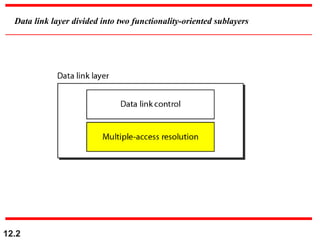
Data link layer divided into two functionality-oriented sublayers
12.2
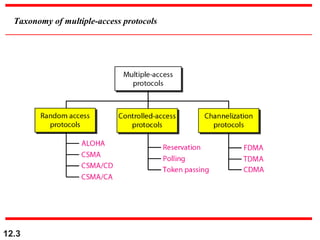
Taxonomy of multiple-access protocols
12.3
RANDOM ACCESSRANDOM ACCESS
• InIn random accessrandom access oror contentioncontention methods, no stationmethods, no station
is superior to another station and none is assignedis superior to another station and none is assigned
the control over another.the control over another.
• No station permits, or does not permit, anotherNo station permits, or does not permit, another
station to send.station to send.
• At each instance, a station that has data to sendAt each instance, a station that has data to send
uses a procedure defined by the protocol to make auses a procedure defined by the protocol to make a
decision on whether or not to send.decision on whether or not to send.
12.4
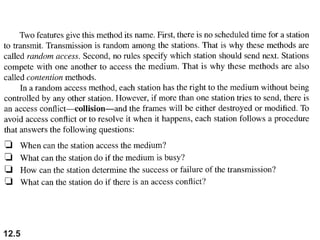
12.5
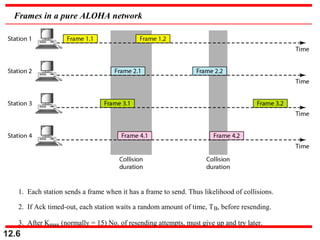
Frames in a pure ALOHA network
12.6
1. Each station sends a frame when it has a frame to send. Thus likelihood of collisions.
2. If Ack timed-out, each station waits a random amount of time, TB, before resending.
3. After Kmax (normally = 15) No. of resending attempts, must give up and try later.
12.7
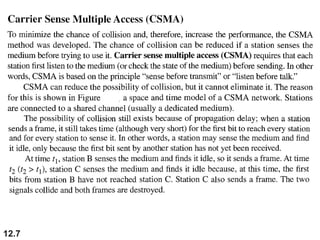
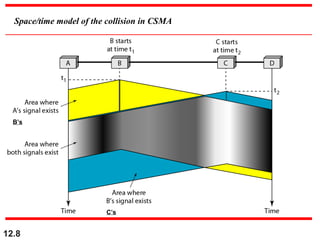
Space/time model of the collision in CSMA
12.8
B’s
C’s
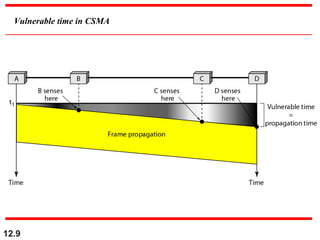
Vulnerable time in CSMA
12.9
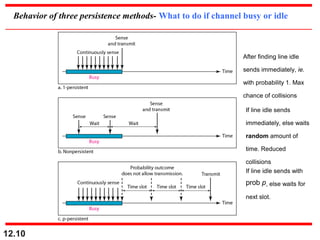
Behavior of three persistence methods- What to do if channel busy or idle
12.10
After finding line idle
sends immediately, ie.
with probability 1. Max
chance of collisions
If line idle sends
immediately, else waits
random amount of
time. Reduced
collisions
If line idle sends with
prob p, else waits for
next slot.
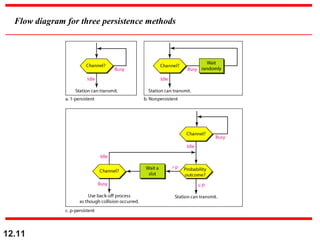
Flow diagram for three persistence methods
12.11
12.12
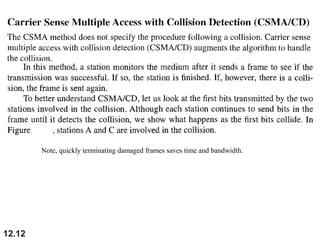
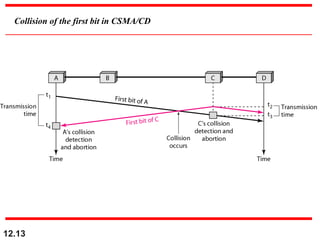
Note, quickly terminating damaged frames saves time and bandwidth.
Collision of the first bit in CSMA/CD
12.13
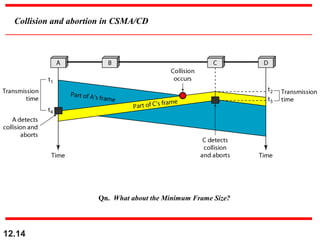
Collision and abortion in CSMA/CD
12.14
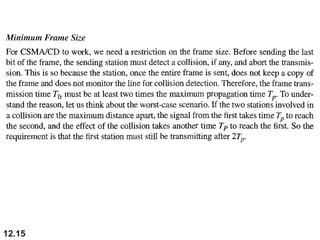
Qn. What about the Minimum Frame Size?
12.15
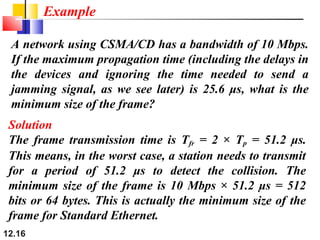
A network using CSMA/CD has a bandwidth of 10 Mbps.
If the maximum propagation time (including the delays in
the devices and ignoring the time needed to send a
jamming signal, as we see later) is 25.6 μs, what is the
minimum size of the frame?
Example
Solution
The frame transmission time is Tfr = 2 × Tp = 51.2 μs.
This means, in the worst case, a station needs to transmit
for a period of 51.2 μs to detect the collision. The
minimum size of the frame is 10 Mbps × 51.2 μs = 512
bits or 64 bytes. This is actually the minimum size of the
frame for Standard Ethernet.
12.16
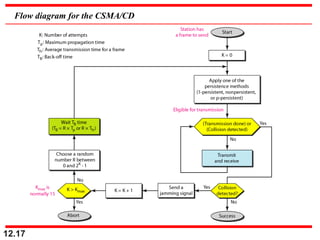
Flow diagram for the CSMA/CD
12.17
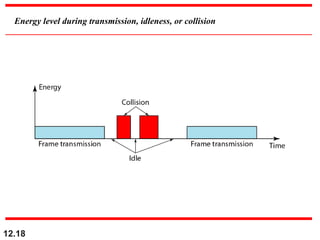
Energy level during transmission, idleness, or collision
12.18
12.19
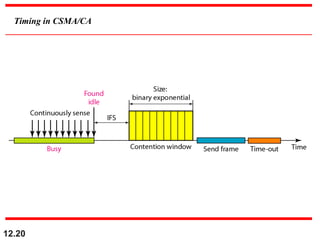
Timing in CSMA/CA
12.20
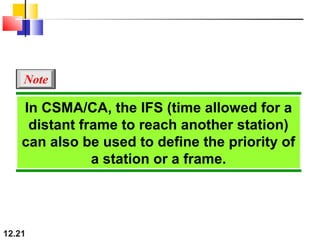
In CSMA/CA, the IFS (time allowed for a
distant frame to reach another station)
can also be used to define the priority of
a station or a frame.
Note
12.21
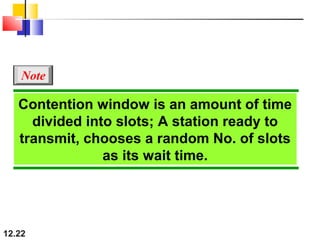
Contention window is an amount of time
divided into slots; A station ready to
transmit, chooses a random No. of slots
as its wait time.
Note
12.22
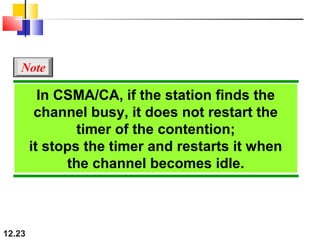
In CSMA/CA, if the station finds the
channel busy, it does not restart the
timer of the contention;
it stops the timer and restarts it when
the channel becomes idle.
Note
12.23
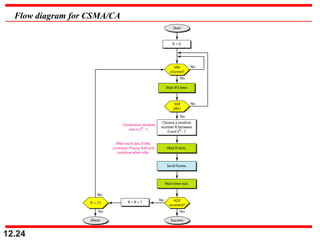
Flow diagram for CSMA/CA
12.24
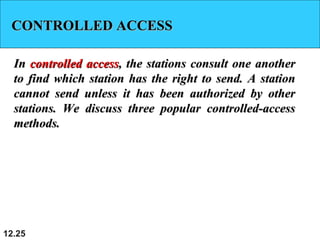
CONTROLLED ACCESSCONTROLLED ACCESS
InIn controlled accesscontrolled access, the stations consult one another, the stations consult one another
to find which station has the right to send. A stationto find which station has the right to send. A station
cannot send unless it has been authorized by othercannot send unless it has been authorized by other
stations. We discuss three popular controlled-accessstations. We discuss three popular controlled-access
methods.methods.
12.25
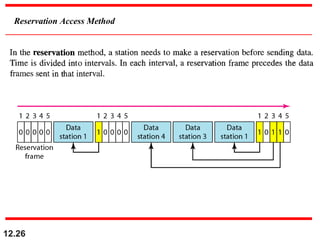
Reservation Access Method
12.26
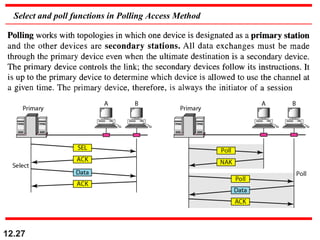
Select and poll functions in Polling Access Method
12.27
12.28
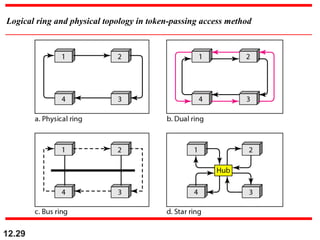
Logical ring and physical topology in token-passing access method
12.29

3b multiple access

  • 1.
  • 2.
    Data link layerdivided into two functionality-oriented sublayers 12.2
  • 3.
  • 4.
    RANDOM ACCESSRANDOM ACCESS •InIn random accessrandom access oror contentioncontention methods, no stationmethods, no station is superior to another station and none is assignedis superior to another station and none is assigned the control over another.the control over another. • No station permits, or does not permit, anotherNo station permits, or does not permit, another station to send.station to send. • At each instance, a station that has data to sendAt each instance, a station that has data to send uses a procedure defined by the protocol to make auses a procedure defined by the protocol to make a decision on whether or not to send.decision on whether or not to send. 12.4
  • 5.
  • 6.
    Frames in apure ALOHA network 12.6 1. Each station sends a frame when it has a frame to send. Thus likelihood of collisions. 2. If Ack timed-out, each station waits a random amount of time, TB, before resending. 3. After Kmax (normally = 15) No. of resending attempts, must give up and try later.
  • 7.
  • 8.
    Space/time model ofthe collision in CSMA 12.8 B’s C’s
  • 9.
  • 10.
    Behavior of threepersistence methods- What to do if channel busy or idle 12.10 After finding line idle sends immediately, ie. with probability 1. Max chance of collisions If line idle sends immediately, else waits random amount of time. Reduced collisions If line idle sends with prob p, else waits for next slot.
  • 11.
    Flow diagram forthree persistence methods 12.11
  • 12.
    12.12 Note, quickly terminatingdamaged frames saves time and bandwidth.
  • 13.
    Collision of thefirst bit in CSMA/CD 12.13
  • 14.
    Collision and abortionin CSMA/CD 12.14 Qn. What about the Minimum Frame Size?
  • 15.
  • 16.
    A network usingCSMA/CD has a bandwidth of 10 Mbps. If the maximum propagation time (including the delays in the devices and ignoring the time needed to send a jamming signal, as we see later) is 25.6 μs, what is the minimum size of the frame? Example Solution The frame transmission time is Tfr = 2 × Tp = 51.2 μs. This means, in the worst case, a station needs to transmit for a period of 51.2 μs to detect the collision. The minimum size of the frame is 10 Mbps × 51.2 μs = 512 bits or 64 bytes. This is actually the minimum size of the frame for Standard Ethernet. 12.16
  • 17.
    Flow diagram forthe CSMA/CD 12.17
  • 18.
    Energy level duringtransmission, idleness, or collision 12.18
  • 19.
  • 20.
  • 21.
    In CSMA/CA, theIFS (time allowed for a distant frame to reach another station) can also be used to define the priority of a station or a frame. Note 12.21
  • 22.
    Contention window isan amount of time divided into slots; A station ready to transmit, chooses a random No. of slots as its wait time. Note 12.22
  • 23.
    In CSMA/CA, ifthe station finds the channel busy, it does not restart the timer of the contention; it stops the timer and restarts it when the channel becomes idle. Note 12.23
  • 24.
    Flow diagram forCSMA/CA 12.24
  • 25.
    CONTROLLED ACCESSCONTROLLED ACCESS InIncontrolled accesscontrolled access, the stations consult one another, the stations consult one another to find which station has the right to send. A stationto find which station has the right to send. A station cannot send unless it has been authorized by othercannot send unless it has been authorized by other stations. We discuss three popular controlled-accessstations. We discuss three popular controlled-access methods.methods. 12.25
  • 26.
  • 27.
    Select and pollfunctions in Polling Access Method 12.27
  • 28.
  • 29.
    Logical ring andphysical topology in token-passing access method 12.29