LAN Technologies


                 802.11 Wireless LAN
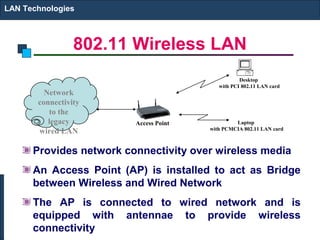
                                                   Desktop
                                           with PCI 802.11 LAN card
         Network
       connectivity
          to the
          legacy         Access Point            Laptop
                                        with PCMCIA 802.11 LAN card
       wired LAN

      Provides network connectivity over wireless media
      An Access Point (AP) is installed to act as Bridge
      between Wireless and Wired Network
      The AP is connected to wired network and is
      equipped with antennae to provide wireless
      connectivity
LAN Technologies


               802.11 Wireless LAN
      Range ( Distance between Access Point and WLAN
      client) depends on structural hindrances and RF
      gain of the antenna at the Access Point
      To service larger areas, multiple APs may be
      installed with a 20-30% overlap
      A client is always associated with one AP and when
      the client moves closer to another AP, it associates
      with the new AP (Hand-Off)
      Three flavors:
        802.11b
        802.11a
        802.11g
LAN Technologies

       Multiple Access with Collision
             Avoidance (MACA)
  other node in                                   other node in
                     sender           receiver
 sender’s range                                  receiver’s range
                    RTS
                                           CTS

                    data

                                     ACK

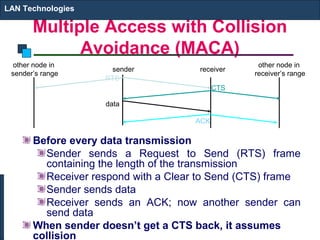
       Before every data transmission
         Sender sends a Request to Send (RTS) frame
         containing the length of the transmission
         Receiver respond with a Clear to Send (CTS) frame
         Sender sends data
         Receiver sends an ACK; now another sender can
         send data
       When sender doesn’t get a CTS back, it assumes
       collision
LAN Technologies


                   WLAN : 802.11b
      The most popular 802.11 standard currently in
      deployment.
      Supports 1, 2, 5.5 and 11 Mbps data rates in the 2.4
      GHz ISM (Industrial-Scientific-Medical) band
LAN Technologies


                   WLAN : 802.11a
      Operates in the 5 GHz UNII (Unlicensed National
      Information Infrastructure) band
      Incompatible with devices operating in 2.4GHz
      Supports Data rates up to 54 Mbps.
LAN Technologies


                   WLAN : 802.11g
      Supports data rates as high as 54 Mbps on the 2.4
      GHz band
      Provides backward    compatibility   with   802.11b
      equipment
Repeater, HUB, Bridge & Switch


     REPEATER, HUB, BRIDGE AND
              SWITCH
Repeater, Hub, Bridge & Switch


                             Repeater
       A repeater receives a signal, regenerates it, and
       passes it on.
       It can regenerate and retime network signals at the
       bit level to allow them to travel a longer distance on
       the media.
       It operates at Physical Layer of OSI
       The Four Repeater Rule for 10-Mbps Ethernet should
       be used as a standard when extending LAN
       segments.
       This rule states that no more than four repeaters can
       be used between hosts on a LAN.
       This rule is used to limit latency added to frame
       travel by each repeater.
Repeater, Hub, Bridge & Switch


                                 Hub
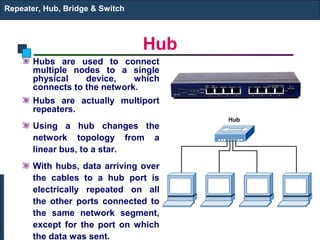
       Hubs are used to connect
       multiple nodes to a single
       physical    device,    which
       connects to the network.
       Hubs are actually multiport
       repeaters.
       Using a hub changes the
       network topology from a
       linear bus, to a star.
       With hubs, data arriving over
       the cables to a hub port is
       electrically repeated on all
       the other ports connected to
       the same network segment,
       except for the port on which
       the data was sent.
Repeater, Hub, Bridge & Switch


                                 Bridge
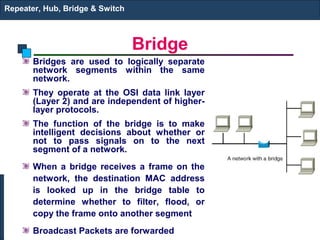
       Bridges are used to logically separate
       network segments within the same
       network.
       They operate at the OSI data link layer
       (Layer 2) and are independent of higher-
       layer protocols.
       The function of the bridge is to make
       intelligent decisions about whether or
       not to pass signals on to the next
       segment of a network.
       When a bridge receives a frame on the
       network, the destination MAC address
       is looked up in the bridge table to
       determine whether to filter, flood, or
       copy the frame onto another segment
       Broadcast Packets are forwarded
Repeater, Hub, Bridge & Switch


                                 Switch
       Switches are Multiport Bridges.
       Switches provide a unique network segment on each
       port, thereby separating collision domains.
       Today, network designers are replacing hubs in their
       wiring closets with switches to increase their network
       performance and bandwidth while protecting their
       existing wiring investments.
       Like bridges, switches learn certain information about
       the data packets that are received from various
       computers on the network.
       Switches use this information to build forwarding
       tables to determine the destination of data being sent
       by one computer to another computer on the network.
Repeater, Hub, Bridge & Switch


        Switches: Dedicated Access
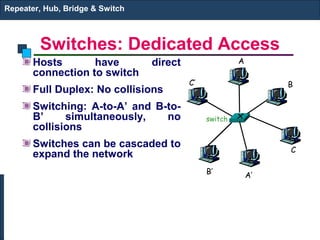
       Hosts       have          direct                 A
       connection to switch
                                          C’                     B
       Full Duplex: No collisions
       Switching: A-to-A’ and B-to-
       B’     simultaneously,   no             switch
       collisions
       Switches can be cascaded to
                                                                 C
       expand the network
                                               B’           A’

802.11 wireless lan

  • 1.
    LAN Technologies 802.11 Wireless LAN Desktop with PCI 802.11 LAN card Network connectivity to the legacy Access Point Laptop with PCMCIA 802.11 LAN card wired LAN Provides network connectivity over wireless media An Access Point (AP) is installed to act as Bridge between Wireless and Wired Network The AP is connected to wired network and is equipped with antennae to provide wireless connectivity
  • 2.
    LAN Technologies 802.11 Wireless LAN Range ( Distance between Access Point and WLAN client) depends on structural hindrances and RF gain of the antenna at the Access Point To service larger areas, multiple APs may be installed with a 20-30% overlap A client is always associated with one AP and when the client moves closer to another AP, it associates with the new AP (Hand-Off) Three flavors: 802.11b 802.11a 802.11g
  • 3.
    LAN Technologies Multiple Access with Collision Avoidance (MACA) other node in other node in sender receiver sender’s range receiver’s range RTS CTS data ACK Before every data transmission Sender sends a Request to Send (RTS) frame containing the length of the transmission Receiver respond with a Clear to Send (CTS) frame Sender sends data Receiver sends an ACK; now another sender can send data When sender doesn’t get a CTS back, it assumes collision
  • 4.
    LAN Technologies WLAN : 802.11b The most popular 802.11 standard currently in deployment. Supports 1, 2, 5.5 and 11 Mbps data rates in the 2.4 GHz ISM (Industrial-Scientific-Medical) band
  • 5.
    LAN Technologies WLAN : 802.11a Operates in the 5 GHz UNII (Unlicensed National Information Infrastructure) band Incompatible with devices operating in 2.4GHz Supports Data rates up to 54 Mbps.
  • 6.
    LAN Technologies WLAN : 802.11g Supports data rates as high as 54 Mbps on the 2.4 GHz band Provides backward compatibility with 802.11b equipment
  • 7.
    Repeater, HUB, Bridge& Switch REPEATER, HUB, BRIDGE AND SWITCH
  • 8.
    Repeater, Hub, Bridge& Switch Repeater A repeater receives a signal, regenerates it, and passes it on. It can regenerate and retime network signals at the bit level to allow them to travel a longer distance on the media. It operates at Physical Layer of OSI The Four Repeater Rule for 10-Mbps Ethernet should be used as a standard when extending LAN segments. This rule states that no more than four repeaters can be used between hosts on a LAN. This rule is used to limit latency added to frame travel by each repeater.
  • 9.
    Repeater, Hub, Bridge& Switch Hub Hubs are used to connect multiple nodes to a single physical device, which connects to the network. Hubs are actually multiport repeaters. Using a hub changes the network topology from a linear bus, to a star. With hubs, data arriving over the cables to a hub port is electrically repeated on all the other ports connected to the same network segment, except for the port on which the data was sent.
  • 10.
    Repeater, Hub, Bridge& Switch Bridge Bridges are used to logically separate network segments within the same network. They operate at the OSI data link layer (Layer 2) and are independent of higher- layer protocols. The function of the bridge is to make intelligent decisions about whether or not to pass signals on to the next segment of a network. When a bridge receives a frame on the network, the destination MAC address is looked up in the bridge table to determine whether to filter, flood, or copy the frame onto another segment Broadcast Packets are forwarded
  • 11.
    Repeater, Hub, Bridge& Switch Switch Switches are Multiport Bridges. Switches provide a unique network segment on each port, thereby separating collision domains. Today, network designers are replacing hubs in their wiring closets with switches to increase their network performance and bandwidth while protecting their existing wiring investments. Like bridges, switches learn certain information about the data packets that are received from various computers on the network. Switches use this information to build forwarding tables to determine the destination of data being sent by one computer to another computer on the network.
  • 12.
    Repeater, Hub, Bridge& Switch Switches: Dedicated Access Hosts have direct A connection to switch C’ B Full Duplex: No collisions Switching: A-to-A’ and B-to- B’ simultaneously, no switch collisions Switches can be cascaded to C expand the network B’ A’