The MAC layer


Guided by:         Presented by:
Mr. Atma Prakash   Mohd Waseem
                   CS-3rd Year
Functions


 To provide MAC Addressing.
 To provide Multiple Access.
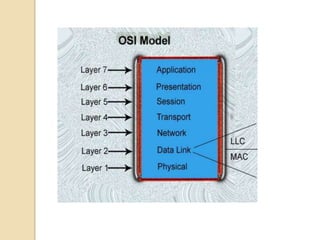
MAC Addressing
   A MAC address is a unique serial
    number. Once a MAC address has
    been assigned to a particular network
    interface (typically at time of
    manufacture), that device should be
    uniquely identifiable amongst all other
    network devices in the world. This
    guarantees that each device in a
    network will have a different MAC
    address (analogous to a street
    address).
Multiple Access
   The channel access control
    mechanisms provided by the MAC
    layer are also known as a multiple
    access protocol. This makes it
    possible for several stations
    connected to the same physical
    medium to share it.
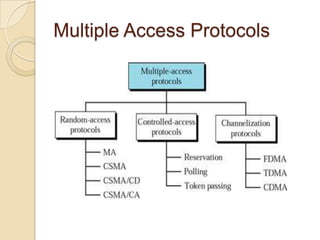
Multiple Access Protocols
Random Access
   In random access or contention methods, no
    station is superior to another station and
    none is assigned the control over another. No
    station permits, or does not permit, another
    station to send. At each instance, a station
    that has data to send uses a procedure
    defined by the protocol to make a decision on
    whether or not to send. This decision
    depends on the state of the medium (idle or
    busy). In other words, each station can
    transmit when it desires on the condition that
    it follows the predefined procedure, including
    the testing of the state of the medium.
CSMA
CSMA/CA
There are three strategies to avoid a
  collision:
 Interframe Space (IFS)
 Contention Window
 Acknowledgment
Controlled Access
   In controlled access, the stations
    consult one another to find which
    station has the right to send. A station
    cannot send unless it has been
    authorized by other stations. We
    discuss three popular controlled-
    access methods.
Polling
 All data exchanges must be made
  through a primary device.
 If the primary wants to receive data, it
  asks if the others want to send: this is
  poll function.
 If the primary wants to send data, it
  tells the secondary to get ready to
  receive: this is called select function.
Channelization
   Channelization is a multiple-access
    method in which the available
    bandwidth of a link is shared in
    time, frequency, or through
    code, between different stations. In
    this section, we discuss three
    channelization protocols:
    FDMA, TDMA, and CDMA.
FDMA
   In frequency-division multiple
    access, the available bandwidth is
    divided into frequency bands. Each
    station is allocated a band to send its
    data.
TDMA

   In time-division multiple access, the
    stations share the bandwidth of the
    channel in time. Each station is
    allocated a time slot during which it
    can send data.
Thank you!

The mac layer

  • 1.
    The MAC layer Guidedby: Presented by: Mr. Atma Prakash Mohd Waseem CS-3rd Year
  • 4.
    Functions  To provideMAC Addressing.  To provide Multiple Access.
  • 5.
    MAC Addressing  A MAC address is a unique serial number. Once a MAC address has been assigned to a particular network interface (typically at time of manufacture), that device should be uniquely identifiable amongst all other network devices in the world. This guarantees that each device in a network will have a different MAC address (analogous to a street address).
  • 6.
    Multiple Access  The channel access control mechanisms provided by the MAC layer are also known as a multiple access protocol. This makes it possible for several stations connected to the same physical medium to share it.
  • 7.
  • 8.
    Random Access  In random access or contention methods, no station is superior to another station and none is assigned the control over another. No station permits, or does not permit, another station to send. At each instance, a station that has data to send uses a procedure defined by the protocol to make a decision on whether or not to send. This decision depends on the state of the medium (idle or busy). In other words, each station can transmit when it desires on the condition that it follows the predefined procedure, including the testing of the state of the medium.
  • 9.
  • 10.
    CSMA/CA There are threestrategies to avoid a collision:  Interframe Space (IFS)  Contention Window  Acknowledgment
  • 11.
    Controlled Access  In controlled access, the stations consult one another to find which station has the right to send. A station cannot send unless it has been authorized by other stations. We discuss three popular controlled- access methods.
  • 12.
    Polling  All dataexchanges must be made through a primary device.  If the primary wants to receive data, it asks if the others want to send: this is poll function.  If the primary wants to send data, it tells the secondary to get ready to receive: this is called select function.
  • 13.
    Channelization  Channelization is a multiple-access method in which the available bandwidth of a link is shared in time, frequency, or through code, between different stations. In this section, we discuss three channelization protocols: FDMA, TDMA, and CDMA.
  • 14.
    FDMA  In frequency-division multiple access, the available bandwidth is divided into frequency bands. Each station is allocated a band to send its data.
  • 15.
    TDMA  In time-division multiple access, the stations share the bandwidth of the channel in time. Each station is allocated a time slot during which it can send data.
  • 16.