12.3
MEDIA ACCESS PROTOCOLS
MEDIAACCESS PROTOCOLS
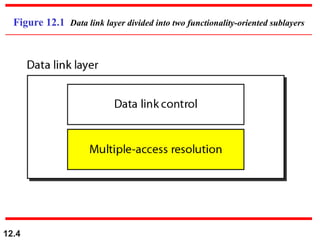
We said that the
We said that the data-link layer is divided into two
data-link layer is divided into two
sublayers:
sublayers:
data-link control (DLC) and
data-link control (DLC) and
media access control.
media access control.
When we are using a dedicated link
When we are using a dedicated link, such as a dial-
, such as a dial-
up telephone line, we need only a data-link-control
up telephone line, we need only a data-link-control
protocol, such as the Point-to-Point Protocol (PPP),
protocol, such as the Point-to-Point Protocol (PPP),
that manages the data transfer between the two ends.
that manages the data transfer between the two ends.
On the other hand, if we are sharing the media
On the other hand, if we are sharing the media, wire
, wire
or air, with other users, we need to have a protocol to
or air, with other users, we need to have a protocol to
first manage the sharing process and then to do the
first manage the sharing process and then to do the
data transfer.
data transfer.
12.5
MEDIA ACCESS PROTOCOLS
MEDIAACCESS PROTOCOLS
When
When nodes or stations are connected and use a
nodes or stations are connected and use a
common link, called a multipoint or broadcast link
common link, called a multipoint or broadcast link, we
, we
need a multiple-access protocol to coordinate access to
need a multiple-access protocol to coordinate access to
the link.
the link.
The
The problem of controlling access to the medium
problem of controlling access to the medium is
is
similar to the rules of speaking in an assembly.
similar to the rules of speaking in an assembly.
The first goal is
The first goal is to prevent any collision between
to prevent any collision between
nodes
nodes. If somehow a collision does occur, the second
. If somehow a collision does occur, the second
goal is to handle the collision.
goal is to handle the collision.
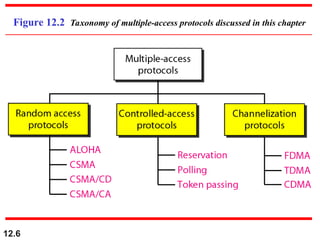
Many protocols have been devised to handle access to
Many protocols have been devised to handle access to
a shared link
a shared link. We categorize them into three groups.
. We categorize them into three groups.
12.7
12-1 RANDOM ACCESS
12-1RANDOM ACCESS
In
In random access
random access or
or contention
contention methods, no station is
methods, no station is
superior to another station and none is assigned the
superior to another station and none is assigned the
control over another. No station permits, or does not
control over another. No station permits, or does not
permit, another station to send. At each instance, a
permit, another station to send. At each instance, a
station that has data to send uses a procedure defined
station that has data to send uses a procedure defined
by the protocol to make a decision on whether or not to
by the protocol to make a decision on whether or not to
send.
send.
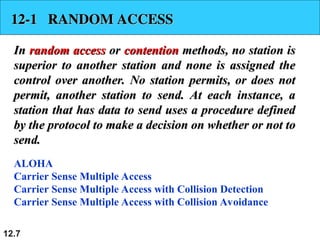
ALOHA
Carrier Sense Multiple Access
Carrier Sense Multiple Access with Collision Detection
Carrier Sense Multiple Access with Collision Avoidance
8.
12.8
RANDOM ACCESS
RANDOM ACCESS
ALOHA
ALOHA
ALOHA,the earliest random-access method, was developed at the
ALOHA, the earliest random-access method, was developed at the
University of Hawaii in early 1970.
University of Hawaii in early 1970.
It was designed for a radio (wireless) LAN, but it can be used on any
It was designed for a radio (wireless) LAN, but it can be used on any
shared medium.
shared medium.
It is noticeable that there are potential collisions in this arrangement.
It is noticeable that there are potential collisions in this arrangement.
The medium is shared between the stations. When a station sends data,
The medium is shared between the stations. When a station sends data,
another station may attempt to do so at the same time
another station may attempt to do so at the same time. The data from the
. The data from the
two stations collide and become garbled.
two stations collide and become garbled.
Pure ALOHA
Pure ALOHA
The original ALOHA protocol is called pure ALOHA.
The original ALOHA protocol is called pure ALOHA. This is a simple
This is a simple
but elegant protocol. The
but elegant protocol. The idea is that each station sends a frame
idea is that each station sends a frame
whenever it has a frame to send (multiple access).
whenever it has a frame to send (multiple access). However, because
However, because
there is only one channel to share,
there is only one channel to share, there is the possibility of collision
there is the possibility of collision
between frames from different stations.
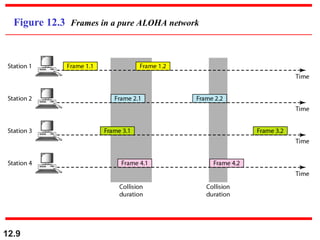
between frames from different stations. Figure 3.24 shows an example of
Figure 3.24 shows an example of
frame collisions in pure ALOHA.
frame collisions in pure ALOHA.
12.10
RANDOM ACCESS
RANDOM ACCESS
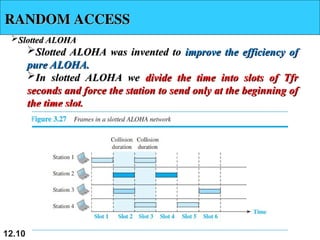
SlottedALOHA
Slotted ALOHA
Slotted ALOHA was invented to
Slotted ALOHA was invented to improve the efficiency of
improve the efficiency of
pure ALOHA.
pure ALOHA.
In slotted ALOHA we
In slotted ALOHA we divide the time into slots of Tfr
divide the time into slots of Tfr
seconds and force the station to send only at the beginning of
seconds and force the station to send only at the beginning of
the time slot.
the time slot.
11.
12.11
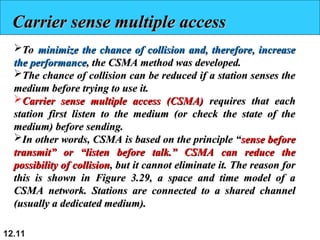
Carrier sense multipleaccess
Carrier sense multiple access
To
To minimize the chance of collision and, therefore, increase
minimize the chance of collision and, therefore, increase
the performance
the performance, the CSMA method was developed.
, the CSMA method was developed.
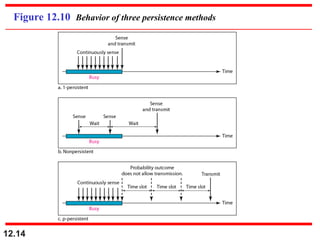
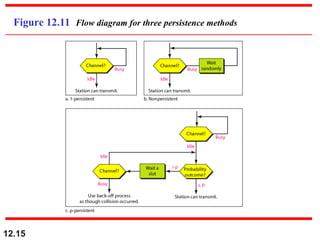
The chance of collision can be reduced if a station senses the
The chance of collision can be reduced if a station senses the
medium before trying to use it.
medium before trying to use it.
Carrier sense multiple access (CSMA)
Carrier sense multiple access (CSMA) requires that each
requires that each
station first listen to the medium (or check the state of the
station first listen to the medium (or check the state of the
medium) before sending.
medium) before sending.
In other words, CSMA is based on the principle “
In other words, CSMA is based on the principle “sense before
sense before
transmit” or “listen before talk.” CSMA can reduce the
transmit” or “listen before talk.” CSMA can reduce the
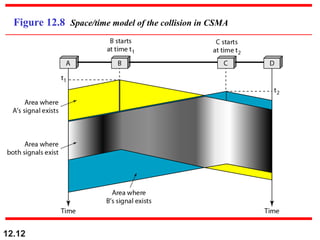
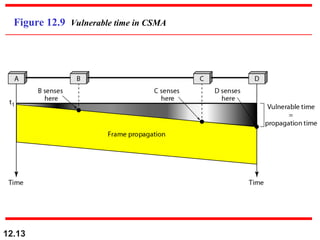
possibility of collision
possibility of collision, but it cannot eliminate it. The reason for
, but it cannot eliminate it. The reason for
this is shown in Figure 3.29, a space and time model of a
this is shown in Figure 3.29, a space and time model of a
CSMA network. Stations are connected to a shared channel
CSMA network. Stations are connected to a shared channel
(usually a dedicated medium).
(usually a dedicated medium).
12.18
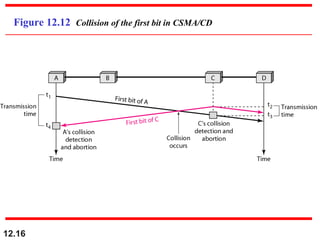
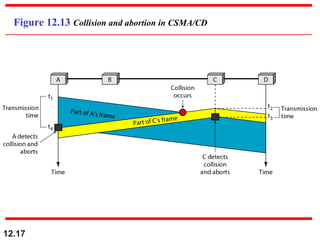
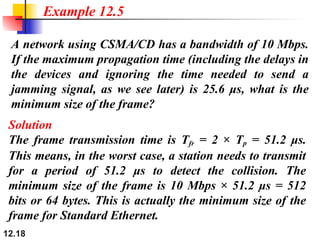
A network usingCSMA/CD has a bandwidth of 10 Mbps.
If the maximum propagation time (including the delays in
the devices and ignoring the time needed to send a
jamming signal, as we see later) is 25.6 μs, what is the
minimum size of the frame?
Example 12.5
Solution
The frame transmission time is Tfr = 2 × Tp = 51.2 μs.
This means, in the worst case, a station needs to transmit
for a period of 51.2 μs to detect the collision. The
minimum size of the frame is 10 Mbps × 51.2 μs = 512
bits or 64 bytes. This is actually the minimum size of the
frame for Standard Ethernet.
12.22
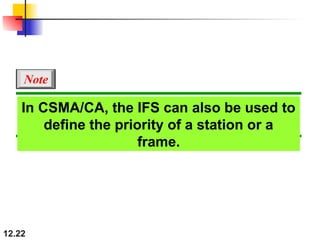
In CSMA/CA, theIFS can also be used to
define the priority of a station or a
frame.
Note
23.
12.23
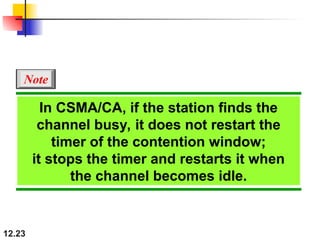
In CSMA/CA, ifthe station finds the
channel busy, it does not restart the
timer of the contention window;
it stops the timer and restarts it when
the channel becomes idle.
Note
12.25
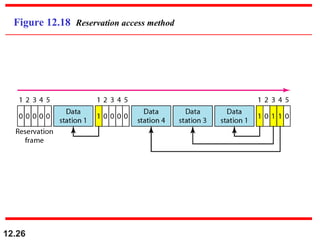
12-2 CONTROLLED ACCESS
12-2CONTROLLED ACCESS
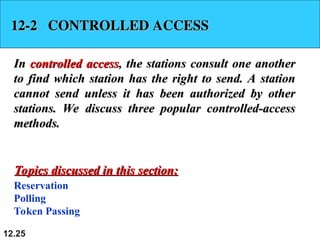
In
In controlled access
controlled access, the stations consult one another
, the stations consult one another
to find which station has the right to send. A station
to find which station has the right to send. A station
cannot send unless it has been authorized by other
cannot send unless it has been authorized by other
stations. We discuss three popular controlled-access
stations. We discuss three popular controlled-access
methods.
methods.
Reservation
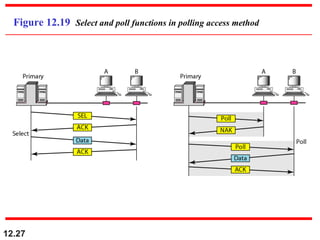
Polling
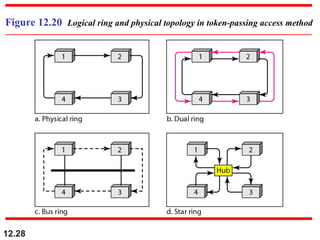
Token Passing
Topics discussed in this section:
Topics discussed in this section:
12.29
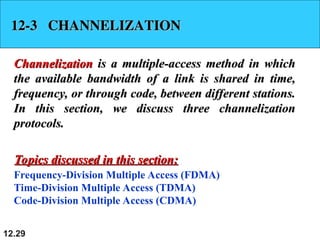
12-3 CHANNELIZATION
12-3 CHANNELIZATION
Channelization
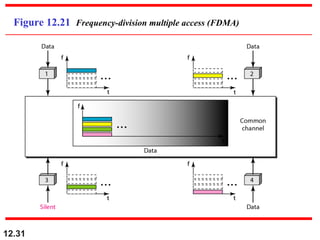
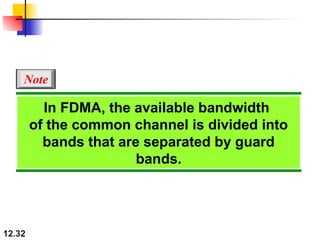
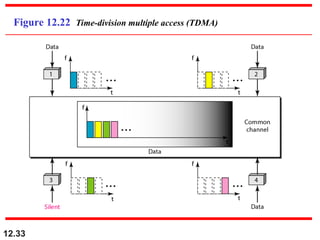
Channelizationis a multiple-access method in which
is a multiple-access method in which
the available bandwidth of a link is shared in time,
the available bandwidth of a link is shared in time,
frequency, or through code, between different stations.
frequency, or through code, between different stations.
In this section, we discuss three channelization
In this section, we discuss three channelization
protocols.
protocols.
Frequency-Division Multiple Access (FDMA)
Time-Division Multiple Access (TDMA)
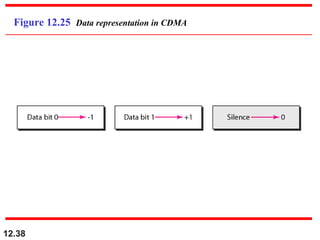
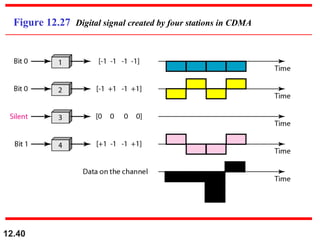
Code-Division Multiple Access (CDMA)
Topics discussed in this section:
Topics discussed in this section:
30.
12.30
We see theapplication of all these
methods in Chapter 16 when
we discuss cellular phone systems.
Note
12.44
Find the chipsfor a network with
a. Two stations b. Four stations
Example 12.6
Solution
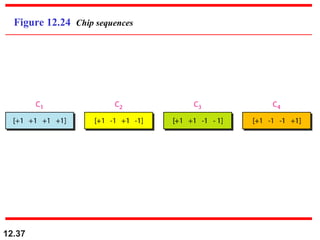
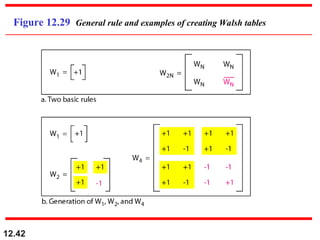
We can use the rows of W2 and W4 in Figure 12.29:
a. For a two-station network, we have
[+1 +1] and [+1 −1].
b. For a four-station network we have
[+1 +1 +1 +1], [+1 −1 +1 −1],
[+1 +1 −1 −1], and [+1 −1 −1 +1].
45.
12.45
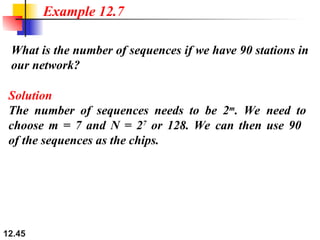
What is thenumber of sequences if we have 90 stations in
our network?
Example 12.7
Solution
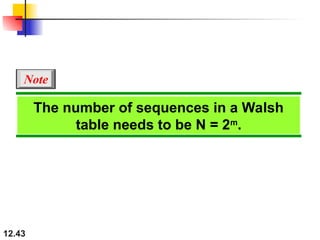
The number of sequences needs to be 2m
. We need to
choose m = 7 and N = 27
or 128. We can then use 90
of the sequences as the chips.
46.
12.46
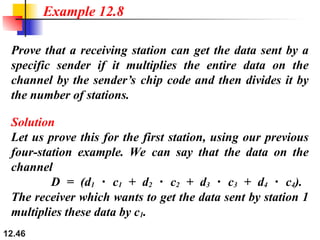
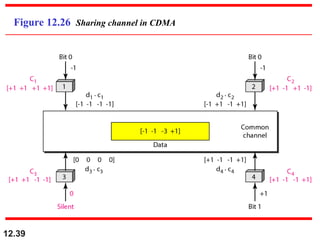
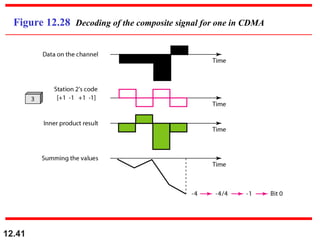
Prove that areceiving station can get the data sent by a
specific sender if it multiplies the entire data on the
channel by the sender’s chip code and then divides it by
the number of stations.
Example 12.8
Solution
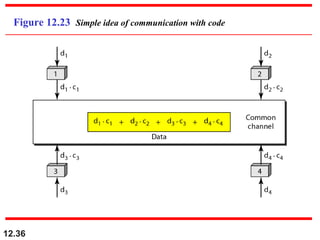
Let us prove this for the first station, using our previous
four-station example. We can say that the data on the
channel
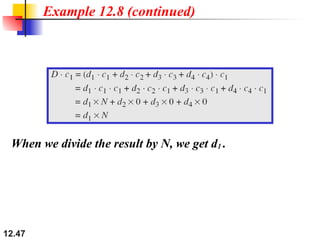
D = (d1 c
⋅ 1 + d2 c
⋅ 2 + d3 c
⋅ 3 + d4 c
⋅ 4).
The receiver which wants to get the data sent by station 1
multiplies these data by c1.
![12.44
Find the chips for a network with
a. Two stations b. Four stations
Example 12.6
Solution
We can use the rows of W2 and W4 in Figure 12.29:
a. For a two-station network, we have
[+1 +1] and [+1 −1].
b. For a four-station network we have
[+1 +1 +1 +1], [+1 −1 +1 −1],
[+1 +1 −1 −1], and [+1 −1 −1 +1].](https://image.slidesharecdn.com/multipleaccess-250614070807-930fc2c6/85/Multiple-Access-mechanism-in-Computer-Network-ppt-44-320.jpg)