S.VIJAYALAKSHMI M.SC(CS)
NADAR SARASWATHI COLLEGE OF
ARTS AND SCIENCE
THENI
Media Access Control
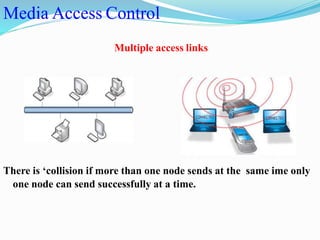
Multiple access links
There is ‘collision if more than one node sends at the same ime only
one node can send successfully at a time.
 When a "collision" occurs, the signals will get distorted and the frame will be lose
the link bandwidth is wasted during collision
 Question: How to coordinate the access of multiple sending and receiving
nodes to the shared link ?
 Solution: We need a protocol to determine how nodes share channelMedium
Access control (MAC) protocol
 The main task of a MAC protocol is to minimize collisions in order to utilize
the bandwidth by:
Determining when a node can use the link (medium)
What a node should do when the link is busy
What the node should do when it is involved in collision
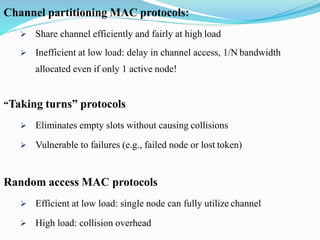
Channel partitioning MAC protocols:
 Share channel efficiently and fairly at high load
 Inefficient at low load: delay in channel access, 1/N bandwidth
allocated even if only 1 active node!
“Taking turns” protocols
 Eliminates empty slots without causing collisions
 Vulnerable to failures (e.g., failed node or lost token)
Random access MAC protocols
 Efficient at low load: single node can fully utilize channel
 High load: collision overhead
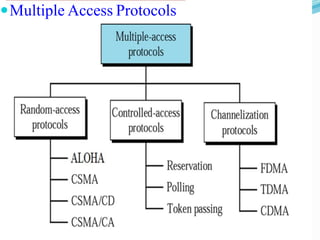
Multiple Access Protocols
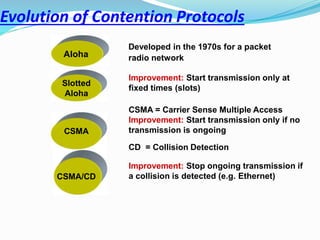
Developed in the 1970s for a packet
radio network
Improvement: Start transmission only at
fixed times (slots)
CSMA = Carrier Sense Multiple Access
Improvement: Start transmission only if no
transmission is ongoing
CD = Collision Detection
Improvement: Stop ongoing transmission if
a collision is detected (e.g. Ethernet)
Evolution of Contention Protocols
Slotted
Aloha
CSMA
Aloha
CSMA/CD
ALOHA
Pure ALOHA
 Developed by Abramson in the 1970s for a packet radio network by
Hawaii University.
 Whenever a station has a data, it transmits immediately. Sender finds
out whether transmission was successful or experienced a collision by
listening to the broadcast from the destination station. Sender
retransmits after some random time if there is a collision.
Slotted ALOHA
 Improvement: Time is slotted and a packet can only be transmitted at
the beginning of one slot. Thus, it can reduce the collision duration.
ALOHA
 Mountainous islands – land network difficult to install
 Fully decentralized protocol
 The node waits for an ACK for time-out equals to the maximum
round-trip propagation delay = 2* tprop
Frame Transmission in pure ALOHA
 If the frame is collided (no ACK was received) the stations wait
for a random time and retransmit the frame again.
 ThroughputAnalysis
A frame (red frame) will be in a collision if and only if another
transmission begins in the vulnerable period of the frame
 Vulnerable period has the length of 2 frame times
Frame which collides
with start of red frame
Frame
t0 t0+F
Vulnerable
Period of red frame
Time
Frame which collides
with end of red frame
Vulnerable time- example
 A pure ALOHA network transmits 200-bit frames on a shared channel
of 200 kbps. What is the requirement to make this frame collision-free?
Solution
 Average frame transmission time Tfr is 200 bits/200 kbps or 1 ms. The
vulnerable time is 2 × 1 ms = 2 ms. This means no station should send
later than 1 ms before this station starts transmission and no station
should start sending during the one 1-ms period that this station is
sending.
 For small G: S ≈ G, there is nearly no collision, S is small
because the load is small
 For large G: G >> S, there are many backlogged users, S is
small because there are many collisions
ThroughputAnalysis
SlottedALOHA
 time divided into discrete intervals (1 interval = 1 frame)
 the sending station waits until the beginning of the next discrete
interval
Throughput for slottedALOHA
S=Ge-G
Pure and Slotted ALOHA Throughput
 Simple improvement but big impact
8
0.4
0.3
0.2
0.1
00
SlottedAloha
Aloha
0.368
0.184
G
S
CSMA (Carrier Sense MultipleAccess
 Collisions hurt the efficiency of ALOHA protocol
At best, channel is useful 37% of the time
 CSMA gives improved throughput compared to Aloha protocols.
 CSMA: listen before transmit
If channel sensed idle: transmit entire frame
If channel sensed busy, defer transmission
 Human analogy: don’t interrupt others!
 Collisions can still occur: propagation delay means two nodes may
not hear each other’s transmission
 Collision: entire packet
 transmission time wasted
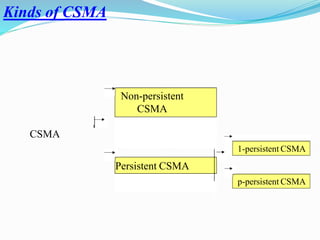
Kinds of CSMA
Non-persistent
CSMA
CSMA
1-persistent CSMA
Persistent CSMA
p-persistent CSMA
 reduces chance of collisions
 reduces the efficiency
increases the chance for collisions
1-persistan
p-persistent
increase the chance for collisions
Improves efficiency
Nonpersistent vs. persistent
Media Access Control

Media Access Control

  • 1.
    S.VIJAYALAKSHMI M.SC(CS) NADAR SARASWATHICOLLEGE OF ARTS AND SCIENCE THENI
  • 2.
    Media Access Control Multipleaccess links There is ‘collision if more than one node sends at the same ime only one node can send successfully at a time.
  • 3.
     When a"collision" occurs, the signals will get distorted and the frame will be lose the link bandwidth is wasted during collision  Question: How to coordinate the access of multiple sending and receiving nodes to the shared link ?  Solution: We need a protocol to determine how nodes share channelMedium Access control (MAC) protocol  The main task of a MAC protocol is to minimize collisions in order to utilize the bandwidth by: Determining when a node can use the link (medium) What a node should do when the link is busy What the node should do when it is involved in collision
  • 4.
    Channel partitioning MACprotocols:  Share channel efficiently and fairly at high load  Inefficient at low load: delay in channel access, 1/N bandwidth allocated even if only 1 active node! “Taking turns” protocols  Eliminates empty slots without causing collisions  Vulnerable to failures (e.g., failed node or lost token) Random access MAC protocols  Efficient at low load: single node can fully utilize channel  High load: collision overhead
  • 5.
  • 6.
    Developed in the1970s for a packet radio network Improvement: Start transmission only at fixed times (slots) CSMA = Carrier Sense Multiple Access Improvement: Start transmission only if no transmission is ongoing CD = Collision Detection Improvement: Stop ongoing transmission if a collision is detected (e.g. Ethernet) Evolution of Contention Protocols Slotted Aloha CSMA Aloha CSMA/CD
  • 7.
    ALOHA Pure ALOHA  Developedby Abramson in the 1970s for a packet radio network by Hawaii University.  Whenever a station has a data, it transmits immediately. Sender finds out whether transmission was successful or experienced a collision by listening to the broadcast from the destination station. Sender retransmits after some random time if there is a collision. Slotted ALOHA  Improvement: Time is slotted and a packet can only be transmitted at the beginning of one slot. Thus, it can reduce the collision duration.
  • 8.
    ALOHA  Mountainous islands– land network difficult to install  Fully decentralized protocol  The node waits for an ACK for time-out equals to the maximum round-trip propagation delay = 2* tprop
  • 9.
    Frame Transmission inpure ALOHA  If the frame is collided (no ACK was received) the stations wait for a random time and retransmit the frame again.
  • 10.
     ThroughputAnalysis A frame(red frame) will be in a collision if and only if another transmission begins in the vulnerable period of the frame  Vulnerable period has the length of 2 frame times Frame which collides with start of red frame Frame t0 t0+F Vulnerable Period of red frame Time Frame which collides with end of red frame
  • 11.
    Vulnerable time- example A pure ALOHA network transmits 200-bit frames on a shared channel of 200 kbps. What is the requirement to make this frame collision-free? Solution  Average frame transmission time Tfr is 200 bits/200 kbps or 1 ms. The vulnerable time is 2 × 1 ms = 2 ms. This means no station should send later than 1 ms before this station starts transmission and no station should start sending during the one 1-ms period that this station is sending.
  • 12.
     For smallG: S ≈ G, there is nearly no collision, S is small because the load is small  For large G: G >> S, there are many backlogged users, S is small because there are many collisions ThroughputAnalysis
  • 13.
    SlottedALOHA  time dividedinto discrete intervals (1 interval = 1 frame)  the sending station waits until the beginning of the next discrete interval
  • 14.
  • 15.
    Pure and SlottedALOHA Throughput  Simple improvement but big impact 8 0.4 0.3 0.2 0.1 00 SlottedAloha Aloha 0.368 0.184 G S
  • 16.
    CSMA (Carrier SenseMultipleAccess  Collisions hurt the efficiency of ALOHA protocol At best, channel is useful 37% of the time  CSMA gives improved throughput compared to Aloha protocols.  CSMA: listen before transmit If channel sensed idle: transmit entire frame If channel sensed busy, defer transmission  Human analogy: don’t interrupt others!
  • 17.
     Collisions canstill occur: propagation delay means two nodes may not hear each other’s transmission  Collision: entire packet  transmission time wasted
  • 18.
    Kinds of CSMA Non-persistent CSMA CSMA 1-persistentCSMA Persistent CSMA p-persistent CSMA
  • 19.
     reduces chanceof collisions  reduces the efficiency increases the chance for collisions 1-persistan p-persistent increase the chance for collisions Improves efficiency Nonpersistent vs. persistent