© Oxford University Press 2007. All rights reserved.
1
Mobile Transport Layer
Lesson 07
Snooping TCP, Wireless TCP and
Delayed DACK Protocol
© Oxford University Press 2007. All rights reserved.
2
TCP-aware link layer based methods
• Snoop TCP
• WirelessTCP (WTCP)
• Delayed Duplicate Acknowledgement
protocol (Delayed DACK)
© Oxford University Press 2007. All rights reserved.
3
Snoop
• Looking into or examining something
secretly
• A TCP connection splits into two─
between the mobile node (MN) and base
transceiver (BTS) and other between the
BTS and the fixed node (FN)
© Oxford University Press 2007. All rights reserved.
4
Snoop
• Some changes in the BTS and some at
the MN
• The BTS has a TCP-aware data-link sub-
layer, DLM
• The sub-layer DLM ─ agent for snooping
and buffering the TCP connection
© Oxford University Press 2007. All rights reserved.
5
Role of the Agent DLM
• Ensures the delivery of packets to the MN
in their incoming sequence from the fixed
network
• Attends to request from the MN for
retransmission
© Oxford University Press 2007. All rights reserved.
6
Role of the Agent DLM
• Buffers during snooping packets from the
fixed connection TCPF layer for
transmission to the MN on wireless
• Also buffers the packets on wireless from
MN for transmitting to TCPF layer by a
fixed line
© Oxford University Press 2007. All rights reserved.
7
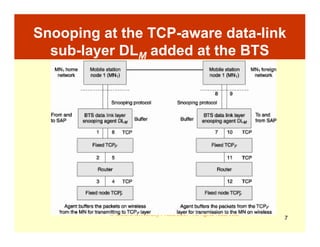
Snooping at the TCP-aware data-link
sub-layer DLM added at the BTS
© Oxford University Press 2007. All rights reserved.
8
Method for acknowledgements to and
from the MN
• Acknowledgements at agent detected on
timeouts or duplicated acknowledgements
detected from the MN
© Oxford University Press 2007. All rights reserved.
9
Alternate method for acknowledgement
to and from the MN
• Acknowledgements at the MN detected by
negative acknowledgement
• A request for retransmission is conveyed
to the MN, in case the packets are not
received (lost) through the wireless
network
© Oxford University Press 2007. All rights reserved.
10
The method for acknowledgements to
and from the MN
• Using snooping, the agent takes note of
the acknowledgements from the MN and
requests the MN for retransmission by
sending a negative acknowledgement
© Oxford University Press 2007. All rights reserved.
11
Snooping TCP functioning
1. Data streams are received from the
service access point (application) at the
MN and buffered at the agent
The data streams sent to the service
access point (application) at the MN are
buffered at the agent and then sent to
the MN
© Oxford University Press 2007. All rights reserved.
12
Snooping TCP functioning
2. DLM agent at the BTS also buffers the
data and sends and receives the packets
to and from the TCPF layer at the fixed
node
Transparent connection between the
agent and TCPF
© Oxford University Press 2007. All rights reserved.
13
Snooping TCP functioning
• DLM layer agent at the BTS sends and
receives the packets to and from TCPF
and then from another fixed node TCP'F
by multiple hops through the routers
© Oxford University Press 2007. All rights reserved.
14
Snooping TCP functioning
3. DLM agent at the BTS snoops into the
packets (data stream) when sending and
receiving to and from the MN
© Oxford University Press 2007. All rights reserved.
15
Snooping TCP functioning
4. The agent and MN control the
acknowledgements, lack of
acknowledgements, and DACKs of the
received data stream from the MN and to
the agent, respectively
© Oxford University Press 2007. All rights reserved.
16
Snooping TCP functioning
5. Packet loss discovered at the
agent from the timeout or DACKs from
the MN
The DLM retransmits if needed to the MN
in case of lost packets that are not
acknowledged by the MN in the timeout
period or if there are DACKs
© Oxford University Press 2007. All rights reserved.
17
Snooping TCP functioning
Packet loss discovered at the MN from
the retransmission request from the
agent to the MN
The MN retransmits to DLM in case of
lost packets for which a negative
acknowledgement is sent by DLM
© Oxford University Press 2007. All rights reserved.
18
Snooping TCP functioning
6. The buffer empties to the fixed network
through TCPF on receipt of an
acknowledgement at the agent from the
MN
The buffer empties to the MN on receipt
of acknowledgement at the agent from
the MN
© Oxford University Press 2007. All rights reserved.
19
Snooping TCP functioning
7. The data stream transfer
mechanism between the MN and DLM
simple, as in wireless networks
Only one hop. In retransmission from
DLM to MN
The delay is very small, unlike that
between the fixed nodes
© Oxford University Press 2007. All rights reserved.
20
Handover of the MN while visiting a
foreign network
• The packets for transmission now
snooped into at DL'M at the other end
• On handover, neither the socket (port and
IP address) nor its present state migrates
from DL M to DL'M
© Oxford University Press 2007. All rights reserved.
21
Advantage of snooping TCP
• Transparent end-to-end TCP connection
(without any transport layer changes)
• The mobile part of the network between
the base and the mobile node has very
limited isolation and is completely isolated
from the base and the conventional fixed
TCP connection
© Oxford University Press 2007. All rights reserved.
22
Advantage of snooping TCP
• No change in the existing TCP network,
only a snooping sub-layer is added at the
base
© Oxford University Press 2007. All rights reserved.
23
Disadvantages of snooping TCP
• Security risk involved in snooping
• Difficulties in case of encrypted segment
transmission
• Insufficient isolation between the fixed
node transport layer and the snooping
layer in case of an asymmetric path
© Oxford University Press 2007. All rights reserved.
24
Asymmetric path
• A fixed node connecting to the mobile
node at the other end
• The node at the other end does not have a
snooping layer for retransmission and
acknowledgement
© Oxford University Press 2007. All rights reserved.
25
Wireless TCP
• A modification of snooping TCP
• WCTP modifies the time stamp on the
packets while returning
acknowledgements to compensate for the
increased RTT
© Oxford University Press 2007. All rights reserved.
26
Advantage of WTCP
• Modifying Timeout periods by enhancing
timestamp time compensating for the
increased RTT between the agent at the
base and the mobile node
• Useful when retransmission intervals are
greater than the timeout period
© Oxford University Press 2007. All rights reserved.
27
Disadvantage of WTCP
• Can not be used on shared LANs
© Oxford University Press 2007. All rights reserved.
28
Delayed DACK protocol for delayed
congestion response (TCP-DCR)
• DLM agent is not TCP aware
• The difference between TCP aware and
unaware—Retransmission takes place in
TCP-aware DLM, whenever there is
timeout or DACK
• Both of these indicate loss of packets
© Oxford University Press 2007. All rights reserved.
29
Delayed DACK protocol for delayed
congestion response (DCR)
• When a packet reaches the receiver out of
order (TCP connection, for example the
TCP layer in the mobile node) sends the
DACK
• Further, the window is adjusted to a lower
level for each instance of detection of
packet loss, whether due to timeout or
DACK
© Oxford University Press 2007. All rights reserved.
30
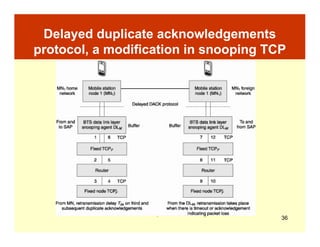
TCP unaware DLM
• Packet losses are due to two reasons,
congestion and channel transmission errors
• The channel errors are due to interference in the
medium
• Retransmission from the DLM takes place when
there is timeout or acknowledgement from the
MN, but the MN delays the DACKs so that the
channel can recover from the channel errors
© Oxford University Press 2007. All rights reserved.
31
TCP unaware DLM
• Retransmission from the DLM takes place
when there is timeout or
acknowledgement from the MN, but the
MN delays the DACKs so that the channel
can recover from the channel errors
© Oxford University Press 2007. All rights reserved.
32
TCP unaware DLM
• The MN attempts to reduce interference
between data stream bits of the MN and
retransmitted bits from DLM
• Delays the third and subsequent DACKs
by a time interval Tda
© Oxford University Press 2007. All rights reserved.
33
TCP unaware DLM
• When the first consecutive out of order
packets (COP) reach, the MN responds by
a DACK
• When further consecutive out of order
packets reach, each DACK is delayed by a
period = Tda
© Oxford University Press 2007. All rights reserved.
34
TCP unaware DLM
• The MN no longer needs to send delayed
DACKs if the next packet is in sequence
within Tda─ the channel has recovered
from channel errors
• During Tda, the DLM-MN channel recovers
from channel errors
© Oxford University Press 2007. All rights reserved.
35
TCP unaware DLM
• The MN may permit out-of-order packet
delivery from the agent and it may also
look into the TCP header and reassemble
the packets itself in order of sequence
• Between DLM at one end and TCPF and
TCP'F at the other, the data stream
transfers, as in case of conventional fixed-
end TCP
© Oxford University Press 2007. All rights reserved.
36
Delayed duplicate acknowledgements
protocol, a modification in snooping TCP
© Oxford University Press 2007. All rights reserved.
37
Advantage of DelayedACK protocol
• TCP headers can be encrypted, as the
agent is not TCP aware
© Oxford University Press 2007. All rights reserved.
38
Disadvantage of DelayedACK protocol
• Duplicate ACKs are delayed, the
retransmission of the packets lost due to
congestion also delayed
© Oxford University Press 2007. All rights reserved.
39
Summary
• TCP-aware data-link sub-layer, DLM in
TCP snooping
• Agent snooping and buffering the TCP
connection
• Agent ensures the delivery of packets to
the MN in their incoming sequence from
the fixed network
• Attends to request from the MN for
retransmission …
© Oxford University Press 2007. All rights reserved.
40
… Summary
• Wireless TCP modifies timestamp on
packet for return ACK to compensate
for increased RTT─ retransmission
delayed to enable recovery of lossed
packet
• TCP unaware agent Delayed ACKs─
retransmission delayed for a timeout to
enable recovery of lossed packet
© Oxford University Press 2007. All rights reserved.
41
End of Lesson 07
Snooping TCP, Wireless TCP and
Delayed DACK Protocol

Snooping TCP

  • 1.
    © Oxford UniversityPress 2007. All rights reserved. 1 Mobile Transport Layer Lesson 07 Snooping TCP, Wireless TCP and Delayed DACK Protocol
  • 2.
    © Oxford UniversityPress 2007. All rights reserved. 2 TCP-aware link layer based methods • Snoop TCP • WirelessTCP (WTCP) • Delayed Duplicate Acknowledgement protocol (Delayed DACK)
  • 3.
    © Oxford UniversityPress 2007. All rights reserved. 3 Snoop • Looking into or examining something secretly • A TCP connection splits into two─ between the mobile node (MN) and base transceiver (BTS) and other between the BTS and the fixed node (FN)
  • 4.
    © Oxford UniversityPress 2007. All rights reserved. 4 Snoop • Some changes in the BTS and some at the MN • The BTS has a TCP-aware data-link sub- layer, DLM • The sub-layer DLM ─ agent for snooping and buffering the TCP connection
  • 5.
    © Oxford UniversityPress 2007. All rights reserved. 5 Role of the Agent DLM • Ensures the delivery of packets to the MN in their incoming sequence from the fixed network • Attends to request from the MN for retransmission
  • 6.
    © Oxford UniversityPress 2007. All rights reserved. 6 Role of the Agent DLM • Buffers during snooping packets from the fixed connection TCPF layer for transmission to the MN on wireless • Also buffers the packets on wireless from MN for transmitting to TCPF layer by a fixed line
  • 7.
    © Oxford UniversityPress 2007. All rights reserved. 7 Snooping at the TCP-aware data-link sub-layer DLM added at the BTS
  • 8.
    © Oxford UniversityPress 2007. All rights reserved. 8 Method for acknowledgements to and from the MN • Acknowledgements at agent detected on timeouts or duplicated acknowledgements detected from the MN
  • 9.
    © Oxford UniversityPress 2007. All rights reserved. 9 Alternate method for acknowledgement to and from the MN • Acknowledgements at the MN detected by negative acknowledgement • A request for retransmission is conveyed to the MN, in case the packets are not received (lost) through the wireless network
  • 10.
    © Oxford UniversityPress 2007. All rights reserved. 10 The method for acknowledgements to and from the MN • Using snooping, the agent takes note of the acknowledgements from the MN and requests the MN for retransmission by sending a negative acknowledgement
  • 11.
    © Oxford UniversityPress 2007. All rights reserved. 11 Snooping TCP functioning 1. Data streams are received from the service access point (application) at the MN and buffered at the agent The data streams sent to the service access point (application) at the MN are buffered at the agent and then sent to the MN
  • 12.
    © Oxford UniversityPress 2007. All rights reserved. 12 Snooping TCP functioning 2. DLM agent at the BTS also buffers the data and sends and receives the packets to and from the TCPF layer at the fixed node Transparent connection between the agent and TCPF
  • 13.
    © Oxford UniversityPress 2007. All rights reserved. 13 Snooping TCP functioning • DLM layer agent at the BTS sends and receives the packets to and from TCPF and then from another fixed node TCP'F by multiple hops through the routers
  • 14.
    © Oxford UniversityPress 2007. All rights reserved. 14 Snooping TCP functioning 3. DLM agent at the BTS snoops into the packets (data stream) when sending and receiving to and from the MN
  • 15.
    © Oxford UniversityPress 2007. All rights reserved. 15 Snooping TCP functioning 4. The agent and MN control the acknowledgements, lack of acknowledgements, and DACKs of the received data stream from the MN and to the agent, respectively
  • 16.
    © Oxford UniversityPress 2007. All rights reserved. 16 Snooping TCP functioning 5. Packet loss discovered at the agent from the timeout or DACKs from the MN The DLM retransmits if needed to the MN in case of lost packets that are not acknowledged by the MN in the timeout period or if there are DACKs
  • 17.
    © Oxford UniversityPress 2007. All rights reserved. 17 Snooping TCP functioning Packet loss discovered at the MN from the retransmission request from the agent to the MN The MN retransmits to DLM in case of lost packets for which a negative acknowledgement is sent by DLM
  • 18.
    © Oxford UniversityPress 2007. All rights reserved. 18 Snooping TCP functioning 6. The buffer empties to the fixed network through TCPF on receipt of an acknowledgement at the agent from the MN The buffer empties to the MN on receipt of acknowledgement at the agent from the MN
  • 19.
    © Oxford UniversityPress 2007. All rights reserved. 19 Snooping TCP functioning 7. The data stream transfer mechanism between the MN and DLM simple, as in wireless networks Only one hop. In retransmission from DLM to MN The delay is very small, unlike that between the fixed nodes
  • 20.
    © Oxford UniversityPress 2007. All rights reserved. 20 Handover of the MN while visiting a foreign network • The packets for transmission now snooped into at DL'M at the other end • On handover, neither the socket (port and IP address) nor its present state migrates from DL M to DL'M
  • 21.
    © Oxford UniversityPress 2007. All rights reserved. 21 Advantage of snooping TCP • Transparent end-to-end TCP connection (without any transport layer changes) • The mobile part of the network between the base and the mobile node has very limited isolation and is completely isolated from the base and the conventional fixed TCP connection
  • 22.
    © Oxford UniversityPress 2007. All rights reserved. 22 Advantage of snooping TCP • No change in the existing TCP network, only a snooping sub-layer is added at the base
  • 23.
    © Oxford UniversityPress 2007. All rights reserved. 23 Disadvantages of snooping TCP • Security risk involved in snooping • Difficulties in case of encrypted segment transmission • Insufficient isolation between the fixed node transport layer and the snooping layer in case of an asymmetric path
  • 24.
    © Oxford UniversityPress 2007. All rights reserved. 24 Asymmetric path • A fixed node connecting to the mobile node at the other end • The node at the other end does not have a snooping layer for retransmission and acknowledgement
  • 25.
    © Oxford UniversityPress 2007. All rights reserved. 25 Wireless TCP • A modification of snooping TCP • WCTP modifies the time stamp on the packets while returning acknowledgements to compensate for the increased RTT
  • 26.
    © Oxford UniversityPress 2007. All rights reserved. 26 Advantage of WTCP • Modifying Timeout periods by enhancing timestamp time compensating for the increased RTT between the agent at the base and the mobile node • Useful when retransmission intervals are greater than the timeout period
  • 27.
    © Oxford UniversityPress 2007. All rights reserved. 27 Disadvantage of WTCP • Can not be used on shared LANs
  • 28.
    © Oxford UniversityPress 2007. All rights reserved. 28 Delayed DACK protocol for delayed congestion response (TCP-DCR) • DLM agent is not TCP aware • The difference between TCP aware and unaware—Retransmission takes place in TCP-aware DLM, whenever there is timeout or DACK • Both of these indicate loss of packets
  • 29.
    © Oxford UniversityPress 2007. All rights reserved. 29 Delayed DACK protocol for delayed congestion response (DCR) • When a packet reaches the receiver out of order (TCP connection, for example the TCP layer in the mobile node) sends the DACK • Further, the window is adjusted to a lower level for each instance of detection of packet loss, whether due to timeout or DACK
  • 30.
    © Oxford UniversityPress 2007. All rights reserved. 30 TCP unaware DLM • Packet losses are due to two reasons, congestion and channel transmission errors • The channel errors are due to interference in the medium • Retransmission from the DLM takes place when there is timeout or acknowledgement from the MN, but the MN delays the DACKs so that the channel can recover from the channel errors
  • 31.
    © Oxford UniversityPress 2007. All rights reserved. 31 TCP unaware DLM • Retransmission from the DLM takes place when there is timeout or acknowledgement from the MN, but the MN delays the DACKs so that the channel can recover from the channel errors
  • 32.
    © Oxford UniversityPress 2007. All rights reserved. 32 TCP unaware DLM • The MN attempts to reduce interference between data stream bits of the MN and retransmitted bits from DLM • Delays the third and subsequent DACKs by a time interval Tda
  • 33.
    © Oxford UniversityPress 2007. All rights reserved. 33 TCP unaware DLM • When the first consecutive out of order packets (COP) reach, the MN responds by a DACK • When further consecutive out of order packets reach, each DACK is delayed by a period = Tda
  • 34.
    © Oxford UniversityPress 2007. All rights reserved. 34 TCP unaware DLM • The MN no longer needs to send delayed DACKs if the next packet is in sequence within Tda─ the channel has recovered from channel errors • During Tda, the DLM-MN channel recovers from channel errors
  • 35.
    © Oxford UniversityPress 2007. All rights reserved. 35 TCP unaware DLM • The MN may permit out-of-order packet delivery from the agent and it may also look into the TCP header and reassemble the packets itself in order of sequence • Between DLM at one end and TCPF and TCP'F at the other, the data stream transfers, as in case of conventional fixed- end TCP
  • 36.
    © Oxford UniversityPress 2007. All rights reserved. 36 Delayed duplicate acknowledgements protocol, a modification in snooping TCP
  • 37.
    © Oxford UniversityPress 2007. All rights reserved. 37 Advantage of DelayedACK protocol • TCP headers can be encrypted, as the agent is not TCP aware
  • 38.
    © Oxford UniversityPress 2007. All rights reserved. 38 Disadvantage of DelayedACK protocol • Duplicate ACKs are delayed, the retransmission of the packets lost due to congestion also delayed
  • 39.
    © Oxford UniversityPress 2007. All rights reserved. 39 Summary • TCP-aware data-link sub-layer, DLM in TCP snooping • Agent snooping and buffering the TCP connection • Agent ensures the delivery of packets to the MN in their incoming sequence from the fixed network • Attends to request from the MN for retransmission …
  • 40.
    © Oxford UniversityPress 2007. All rights reserved. 40 … Summary • Wireless TCP modifies timestamp on packet for return ACK to compensate for increased RTT─ retransmission delayed to enable recovery of lossed packet • TCP unaware agent Delayed ACKs─ retransmission delayed for a timeout to enable recovery of lossed packet
  • 41.
    © Oxford UniversityPress 2007. All rights reserved. 41 End of Lesson 07 Snooping TCP, Wireless TCP and Delayed DACK Protocol