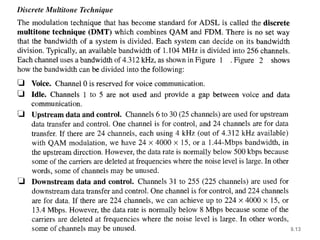
9.1
Using Wireline Networks
for Data Transmission
Networking Fundamentals
9.2
TELEPHONE NETWORKTELEPHONE NETWORK
Telephone networks use circuit switching. TheTelephone networks use circuit switching. The
telephone network had its beginnings in the latetelephone network had its beginnings in the late
1800s. The entire network, which is referred to as the1800s. The entire network, which is referred to as the
plain old telephone systemplain old telephone system ((POTSPOTS), was originally an), was originally an
analog system using analog signals to transmit voice.analog system using analog signals to transmit voice.
9.3
DIAL-UP MODEMSDIAL-UP MODEMS
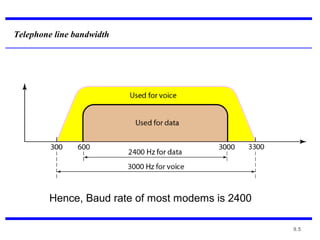
Traditional telephone lines can carry frequenciesTraditional telephone lines can carry frequencies
between 300 and 3300 Hz, giving them a bandwidth ofbetween 300 and 3300 Hz, giving them a bandwidth of
3000 Hz. All this range is used for transmitting voice,3000 Hz. All this range is used for transmitting voice,
where a great deal of interference and distortion canwhere a great deal of interference and distortion can
be accepted without loss of intelligibility.be accepted without loss of intelligibility.
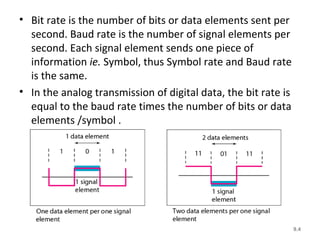
• Bit rate is the number of bits or data elements sent per
second. Baud rate is the number of signal elements per
second. Each signal element sends one piece of
information ie. Symbol, thus Symbol rate and Baud rate
is the same.
• In the analog transmission of digital data, the bit rate is
equal to the baud rate times the number of bits or data
elements /symbol .
9.4
9.5
Telephone line bandwidth
Hence, Baud rate of most modems is 2400
9.6
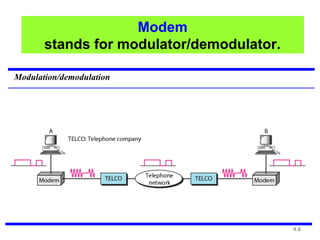
Modulation/demodulation
Modem
stands for modulator/demodulator.
9.7
9.8
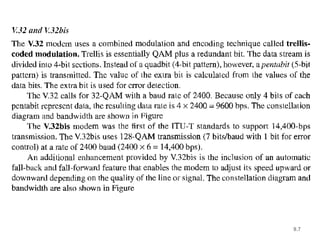
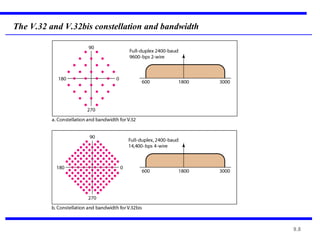
The V.32 and V.32bis constellation and bandwidth
9.10
DIGITAL SUBSCRIBER LINEDIGITAL SUBSCRIBER LINE
After traditional modems reached their peakAfter traditional modems reached their peak
data rate, telephone companies developed anotherdata rate, telephone companies developed another
technology, DSL, to provide higher-speed access to thetechnology, DSL, to provide higher-speed access to the
Internet.Internet. Digital subscriber lineDigital subscriber line ((DSLDSL) technology is) technology is
one of the most promising for supporting high-speedone of the most promising for supporting high-speed
digital communication over the existing local loops.digital communication over the existing local loops.
The set of technologies is often referred asThe set of technologies is often referred as
xDSL.xDSL.
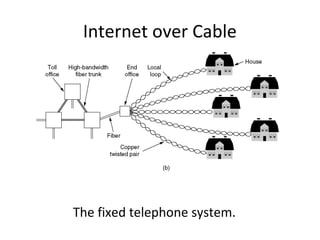
Internet over Cable
The fixed telephone system.
9.12
ADSL
• ADSL is an asymmetric communication
technology designed for residential users; it is
not suitable for businesses.
• It uses the existing local loops that can
handle bandwidths up to 1.1 MHz.
• It uses an adaptive technology. The
system uses a data rate based on the
condition of the local loop line.
9.13
1 2
9.14
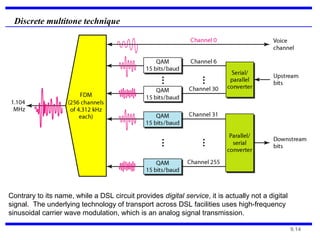
Discrete multitone technique
Contrary to its name, while a DSL circuit provides digital service, it is actually not a digital
signal. The underlying technology of transport across DSL facilities uses high-frequency
sinusoidal carrier wave modulation, which is an analog signal transmission.
9.15
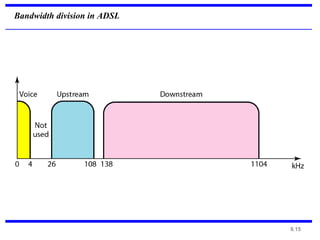
Bandwidth division in ADSL
9.16
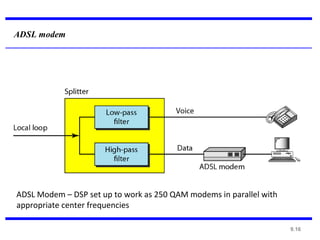
ADSL modem
ADSL Modem – DSP set up to work as 250 QAM modems in parallel with
appropriate center frequencies
9.17
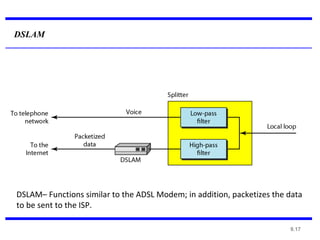
DSLAM
DSLAM– Functions similar to the ADSL Modem; in addition, packetizes the data
to be sent to the ISP.
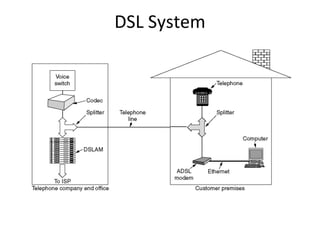
DSL System
A typical ADSL equipment configuration.
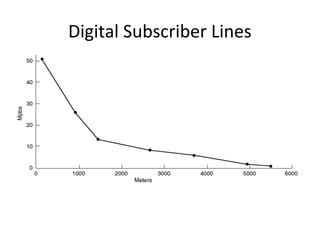
Digital Subscriber Lines
Bandwidth versus distanced over category 3
UTP for DSL.
9.20
CABLE TV NETWORKSCABLE TV NETWORKS
TheThe cable TV networkcable TV network started as a video servicestarted as a video service
provider, but it has moved to the business of Internetprovider, but it has moved to the business of Internet
access. We discuss how this network can be used toaccess. We discuss how this network can be used to
provide high-speed access to the Internet.provide high-speed access to the Internet.
9.21
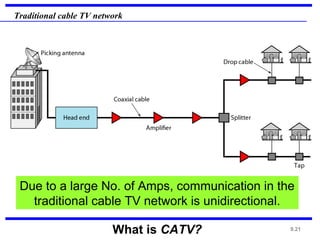
Traditional cable TV network
Due to a large No. of Amps, communication in the
traditional cable TV network is unidirectional.
What is CATV?
9.22
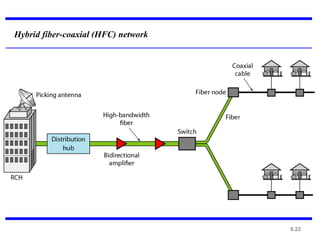
Hybrid fiber-coaxial (HFC) network
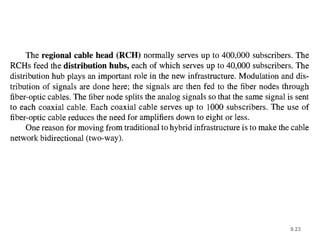
9.23
9.24
CABLE TV FOR DATA TRANSFERCABLE TV FOR DATA TRANSFER
Cable companies are now competing with telephoneCable companies are now competing with telephone
companies for the residential customer who wantscompanies for the residential customer who wants
high-speed data transfer.high-speed data transfer.
9.25
Bandwidth
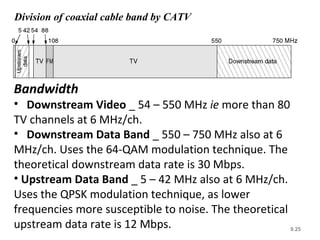
• Downstream Video _ 54 – 550 MHz ie more than 80
TV channels at 6 MHz/ch.
• Downstream Data Band _ 550 – 750 MHz also at 6
MHz/ch. Uses the 64-QAM modulation technique. The
theoretical downstream data rate is 30 Mbps.
• Upstream Data Band _ 5 – 42 MHz also at 6 MHz/ch.
Uses the QPSK modulation technique, as lower
frequencies more susceptible to noise. The theoretical
upstream data rate is 12 Mbps.
Division of coaxial cable band by CATV
9.26
9.27
1
2
9.28
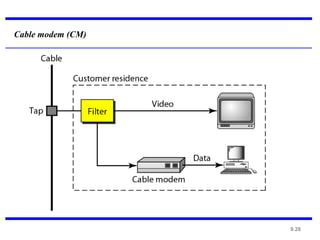
Cable modem (CM)
9.29
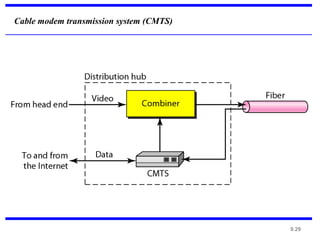
Cable modem transmission system (CMTS)

2c wired transmission

  • 1.
    9.1 Using Wireline Networks forData Transmission Networking Fundamentals
  • 2.
    9.2 TELEPHONE NETWORKTELEPHONE NETWORK Telephonenetworks use circuit switching. TheTelephone networks use circuit switching. The telephone network had its beginnings in the latetelephone network had its beginnings in the late 1800s. The entire network, which is referred to as the1800s. The entire network, which is referred to as the plain old telephone systemplain old telephone system ((POTSPOTS), was originally an), was originally an analog system using analog signals to transmit voice.analog system using analog signals to transmit voice.
  • 3.
    9.3 DIAL-UP MODEMSDIAL-UP MODEMS Traditionaltelephone lines can carry frequenciesTraditional telephone lines can carry frequencies between 300 and 3300 Hz, giving them a bandwidth ofbetween 300 and 3300 Hz, giving them a bandwidth of 3000 Hz. All this range is used for transmitting voice,3000 Hz. All this range is used for transmitting voice, where a great deal of interference and distortion canwhere a great deal of interference and distortion can be accepted without loss of intelligibility.be accepted without loss of intelligibility.
  • 4.
    • Bit rateis the number of bits or data elements sent per second. Baud rate is the number of signal elements per second. Each signal element sends one piece of information ie. Symbol, thus Symbol rate and Baud rate is the same. • In the analog transmission of digital data, the bit rate is equal to the baud rate times the number of bits or data elements /symbol . 9.4
  • 5.
    9.5 Telephone line bandwidth Hence,Baud rate of most modems is 2400
  • 6.
  • 7.
  • 8.
    9.8 The V.32 andV.32bis constellation and bandwidth
  • 9.
    9.10 DIGITAL SUBSCRIBER LINEDIGITALSUBSCRIBER LINE After traditional modems reached their peakAfter traditional modems reached their peak data rate, telephone companies developed anotherdata rate, telephone companies developed another technology, DSL, to provide higher-speed access to thetechnology, DSL, to provide higher-speed access to the Internet.Internet. Digital subscriber lineDigital subscriber line ((DSLDSL) technology is) technology is one of the most promising for supporting high-speedone of the most promising for supporting high-speed digital communication over the existing local loops.digital communication over the existing local loops. The set of technologies is often referred asThe set of technologies is often referred as xDSL.xDSL.
  • 10.
    Internet over Cable Thefixed telephone system.
  • 11.
    9.12 ADSL • ADSL isan asymmetric communication technology designed for residential users; it is not suitable for businesses. • It uses the existing local loops that can handle bandwidths up to 1.1 MHz. • It uses an adaptive technology. The system uses a data rate based on the condition of the local loop line.
  • 12.
  • 13.
    9.14 Discrete multitone technique Contraryto its name, while a DSL circuit provides digital service, it is actually not a digital signal. The underlying technology of transport across DSL facilities uses high-frequency sinusoidal carrier wave modulation, which is an analog signal transmission.
  • 14.
  • 15.
    9.16 ADSL modem ADSL Modem– DSP set up to work as 250 QAM modems in parallel with appropriate center frequencies
  • 16.
    9.17 DSLAM DSLAM– Functions similarto the ADSL Modem; in addition, packetizes the data to be sent to the ISP.
  • 17.
    DSL System A typicalADSL equipment configuration.
  • 18.
    Digital Subscriber Lines Bandwidthversus distanced over category 3 UTP for DSL.
  • 19.
    9.20 CABLE TV NETWORKSCABLETV NETWORKS TheThe cable TV networkcable TV network started as a video servicestarted as a video service provider, but it has moved to the business of Internetprovider, but it has moved to the business of Internet access. We discuss how this network can be used toaccess. We discuss how this network can be used to provide high-speed access to the Internet.provide high-speed access to the Internet.
  • 20.
    9.21 Traditional cable TVnetwork Due to a large No. of Amps, communication in the traditional cable TV network is unidirectional. What is CATV?
  • 21.
  • 22.
  • 23.
    9.24 CABLE TV FORDATA TRANSFERCABLE TV FOR DATA TRANSFER Cable companies are now competing with telephoneCable companies are now competing with telephone companies for the residential customer who wantscompanies for the residential customer who wants high-speed data transfer.high-speed data transfer.
  • 24.
    9.25 Bandwidth • Downstream Video_ 54 – 550 MHz ie more than 80 TV channels at 6 MHz/ch. • Downstream Data Band _ 550 – 750 MHz also at 6 MHz/ch. Uses the 64-QAM modulation technique. The theoretical downstream data rate is 30 Mbps. • Upstream Data Band _ 5 – 42 MHz also at 6 MHz/ch. Uses the QPSK modulation technique, as lower frequencies more susceptible to noise. The theoretical upstream data rate is 12 Mbps. Division of coaxial cable band by CATV
  • 25.
  • 26.
  • 27.
  • 28.