(Note on class topic )
Multiplexing
Course Title: Data Communication
Course Code: CSE 313
Submitted To Submitted by
Pronab nath bondhu Fairuz Fatemi
Lecturer ID:1834902087
City University Batch:49(B)Day
B.S.C in CSE
D:08/10/2021
1
• Multiple access protocol
• Multiple access protocols are a set of protocols operating in the Medium
Access Control sublayer (MAC sublayer) of the Open Systems
Interconnection (OSI) model. These protocols allow a number of nodes or
users to access a shared network channel. Several data streams originating
from several nodes are transferred through the multi-point transmission
channel.
• The Data Link Layer is responsible for transmission of data between two
nodes. Its main functions are-
• Data Link Control
• Multiple Access Control
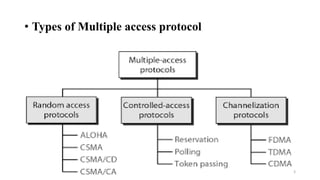
• Types of Multiple access protocol
3
• Random access protocol
• Random access protocols assign uniform priority to all connected
nodes. Any node can send data if the transmission channel is idle. No
fixed time or fixed sequence is given for data transmission.
• Random Access Protocol. In this protocol, all the station has the equal
priority to send the data over a channel. In random access protocol,
one or more stations cannot depend on another station nor any station
control another station.
•
• The four random access protocols are−
• ALOHA
• Carrier sense multiple access (CMSA)
• Carrier sense multiple access with collision detection (CMSA/CD)
• Carrier sense multiple access with collision avoidance (CMSA/CA)
• ALOHA Random Access Protocol
• The ALOHA protocol or also known as the ALOHA method is a
simple communication scheme in which every transmitting station or
source in a network will send the data whenever a frame is available
for transmission.
• But remember, if the data frame is not received by the receiver then
the frame is sent again until it successfully reaches the receiver's end.
• Type of two. 1. Pure aloha &
2. Sotted aloha.
• Pure Aloha:
When a station sends data it waits for an acknowledgement. If the
acknowledgement doesn’t come within the allotted time then the
station waits for a random amount of time called back-off time (Tb)
and re-sends the data. Since different stations wait for different amount
of time, the probability of further collision decreases.
• Slotted Aloha:
It is similar to pure aloha, except that we divide time into slots and
sending of data is allowed only at the beginning of these slots. If a
station misses out the allowed time, it must wait for the next slot. This
reduces the probability of collision.
CSMA Random Access Protocol
• In this, first the node checks the channel, if the channel is idle then the
node or station transmits data, otherwise it keeps on waiting and
whenever the channel is idle, the stations transmit the data-frame.
• Non-persistent mode
• 1-persistent mode
• P-persistent mode
• O-persistent
CSMA/CD Random Access Protocol
• In this, whenever station transmits data-frame it then monitors the
channel or the medium to acknowledge the state of the transmission
i.e. successfully transmitted or failed. If the transmission succeeds,
then it prepares for the next frame otherwise it resends the previously
failed data-frame.
CSMA/CA Random Access Protocol
• Sender receives the acknowledgement and if there is only one
acknowledgment present (it's own) then this means that the data-frame
has been sent successfully. But, if there are 2 or more acknowledgment
signals then this indicates that the collision has occurred.
• Interframe space
• Contention Window
• Acknowledgment
Reference:
• https://www.studytonight.com/post/random-access-protocols-aloha-
csma-csmaca-and-csmacd
• https://ieeexplore.ieee.org/document/6991523/ (page num:142)
clas 8

clas 8

  • 1.
    (Note on classtopic ) Multiplexing Course Title: Data Communication Course Code: CSE 313 Submitted To Submitted by Pronab nath bondhu Fairuz Fatemi Lecturer ID:1834902087 City University Batch:49(B)Day B.S.C in CSE D:08/10/2021 1
  • 2.
    • Multiple accessprotocol • Multiple access protocols are a set of protocols operating in the Medium Access Control sublayer (MAC sublayer) of the Open Systems Interconnection (OSI) model. These protocols allow a number of nodes or users to access a shared network channel. Several data streams originating from several nodes are transferred through the multi-point transmission channel. • The Data Link Layer is responsible for transmission of data between two nodes. Its main functions are- • Data Link Control • Multiple Access Control
  • 3.
    • Types ofMultiple access protocol 3
  • 4.
    • Random accessprotocol • Random access protocols assign uniform priority to all connected nodes. Any node can send data if the transmission channel is idle. No fixed time or fixed sequence is given for data transmission. • Random Access Protocol. In this protocol, all the station has the equal priority to send the data over a channel. In random access protocol, one or more stations cannot depend on another station nor any station control another station. •
  • 5.
    • The fourrandom access protocols are− • ALOHA • Carrier sense multiple access (CMSA) • Carrier sense multiple access with collision detection (CMSA/CD) • Carrier sense multiple access with collision avoidance (CMSA/CA)
  • 6.
    • ALOHA RandomAccess Protocol • The ALOHA protocol or also known as the ALOHA method is a simple communication scheme in which every transmitting station or source in a network will send the data whenever a frame is available for transmission. • But remember, if the data frame is not received by the receiver then the frame is sent again until it successfully reaches the receiver's end. • Type of two. 1. Pure aloha & 2. Sotted aloha.
  • 7.
    • Pure Aloha: Whena station sends data it waits for an acknowledgement. If the acknowledgement doesn’t come within the allotted time then the station waits for a random amount of time called back-off time (Tb) and re-sends the data. Since different stations wait for different amount of time, the probability of further collision decreases. • Slotted Aloha: It is similar to pure aloha, except that we divide time into slots and sending of data is allowed only at the beginning of these slots. If a station misses out the allowed time, it must wait for the next slot. This reduces the probability of collision.
  • 8.
    CSMA Random AccessProtocol • In this, first the node checks the channel, if the channel is idle then the node or station transmits data, otherwise it keeps on waiting and whenever the channel is idle, the stations transmit the data-frame. • Non-persistent mode • 1-persistent mode • P-persistent mode • O-persistent
  • 9.
    CSMA/CD Random AccessProtocol • In this, whenever station transmits data-frame it then monitors the channel or the medium to acknowledge the state of the transmission i.e. successfully transmitted or failed. If the transmission succeeds, then it prepares for the next frame otherwise it resends the previously failed data-frame.
  • 10.
    CSMA/CA Random AccessProtocol • Sender receives the acknowledgement and if there is only one acknowledgment present (it's own) then this means that the data-frame has been sent successfully. But, if there are 2 or more acknowledgment signals then this indicates that the collision has occurred. • Interframe space • Contention Window • Acknowledgment
  • 11.