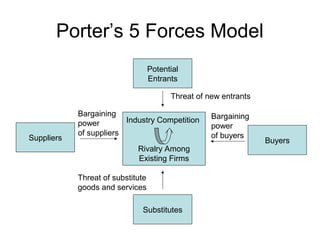
Porter’s 5 Forces Model
Potential
Entrants
Industry Competition
Rivalry Among
Existing Firms
Suppliers Buyers
Substitutes
Threat of new entrants
Threat of substitute
goods and services
Bargaining
power
of buyers
Bargaining
power
of suppliers
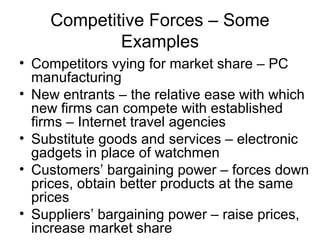
Competitive Forces – Some
Examples
• Competitors vying for market share – PC
manufacturing
• New entrants – the relative ease with which
new firms can compete with established
firms – Internet travel agencies
• Substitute goods and services – electronic
gadgets in place of watchmen
• Customers’ bargaining power – forces down
prices, obtain better products at the same
prices
• Suppliers’ bargaining power – raise prices,
increase market share
Potential Entrants–Barriers to Entry
• Economies of scale
• Product differentiation
• Capital requirements
• Switching costs
• Government policy
• Cost disadvantages independent of scale
Potential Entrants–Barriers to Entry
• Cost disadvantages independent of scale
– Proprietary product technology
– Favourable access to raw materials
– Favourable locations
– Government subsidies
– Learning curve or experience curve
Buyers
• A buyer group is powerful if the following
circumstances hold true
– It is concentrated
– Purchases large volumes relative to the
seller’s sales
– Products it purchases from the industry are
standard or undifferentiated
Suppliers
• A supplier or supplier group is powerful if
the following circumstances hold true
– Suppliers are connected and have a tacit
agreement
– They supply important ingredients that are
needed by the industry
– Substitutes are not easily available

5 forces model

  • 3.
    Porter’s 5 ForcesModel Potential Entrants Industry Competition Rivalry Among Existing Firms Suppliers Buyers Substitutes Threat of new entrants Threat of substitute goods and services Bargaining power of buyers Bargaining power of suppliers
  • 4.
    Competitive Forces –Some Examples • Competitors vying for market share – PC manufacturing • New entrants – the relative ease with which new firms can compete with established firms – Internet travel agencies • Substitute goods and services – electronic gadgets in place of watchmen • Customers’ bargaining power – forces down prices, obtain better products at the same prices • Suppliers’ bargaining power – raise prices, increase market share
  • 5.
    Potential Entrants–Barriers toEntry • Economies of scale • Product differentiation • Capital requirements • Switching costs • Government policy • Cost disadvantages independent of scale
  • 6.
    Potential Entrants–Barriers toEntry • Cost disadvantages independent of scale – Proprietary product technology – Favourable access to raw materials – Favourable locations – Government subsidies – Learning curve or experience curve
  • 7.
    Buyers • A buyergroup is powerful if the following circumstances hold true – It is concentrated – Purchases large volumes relative to the seller’s sales – Products it purchases from the industry are standard or undifferentiated
  • 8.
    Suppliers • A supplieror supplier group is powerful if the following circumstances hold true – Suppliers are connected and have a tacit agreement – They supply important ingredients that are needed by the industry – Substitutes are not easily available