Multiple Access
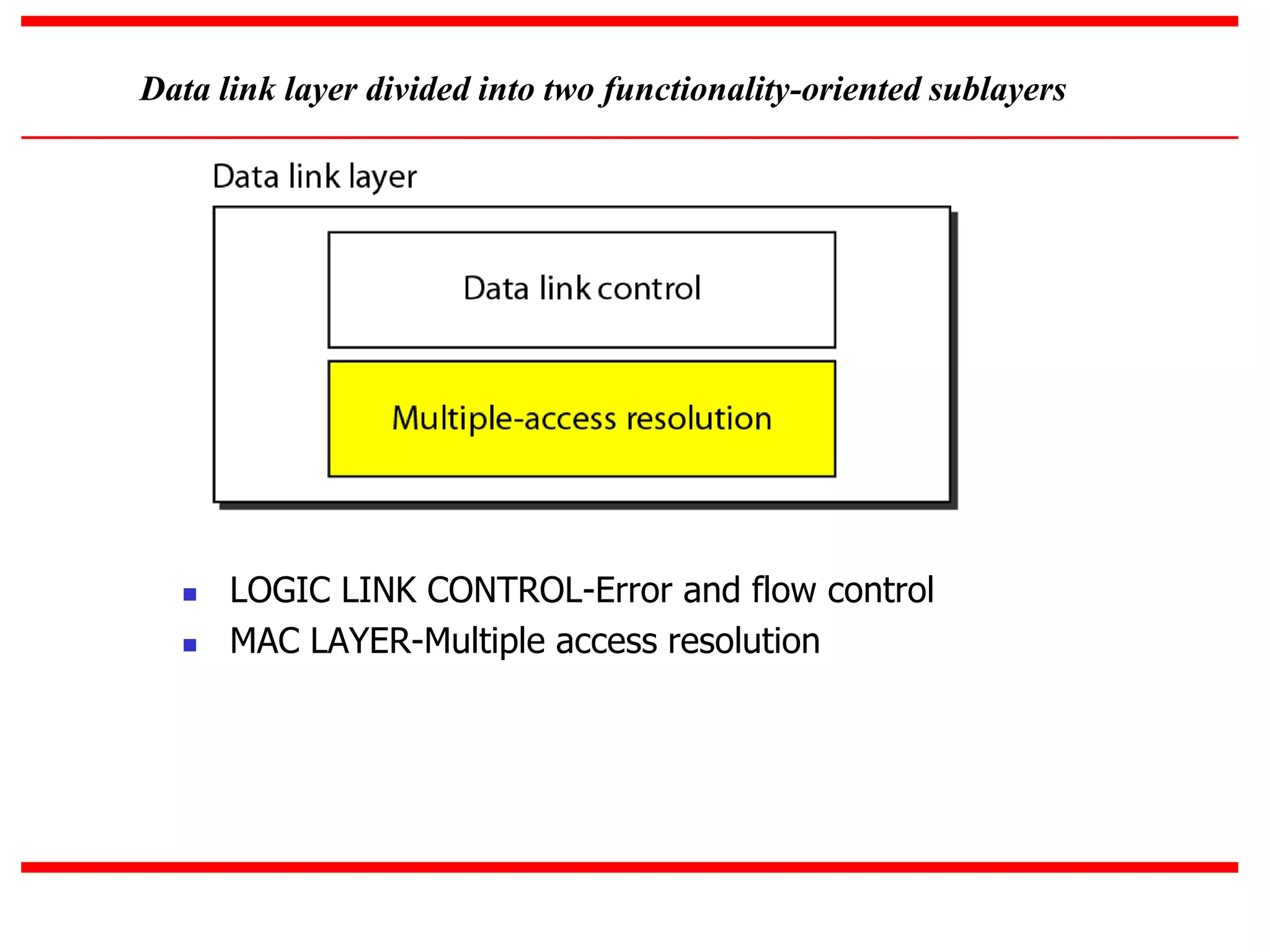
Data link layer divided into two functionality-oriented sublayers
 LOGIC LINK CONTROL-Error and flow control
 MAC LAYER-Multiple access resolution
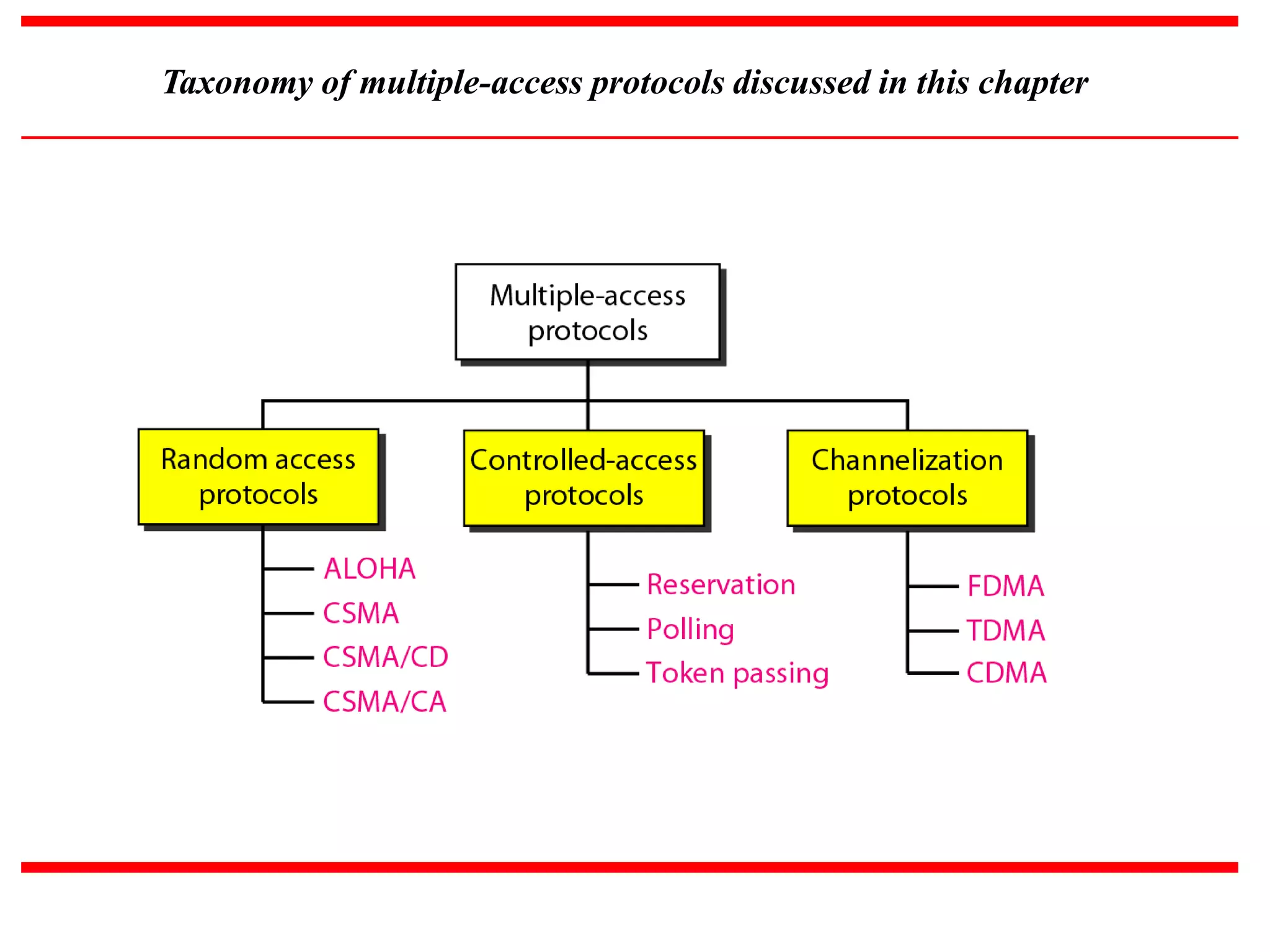
Taxonomy of multiple-access protocols discussed in this chapter
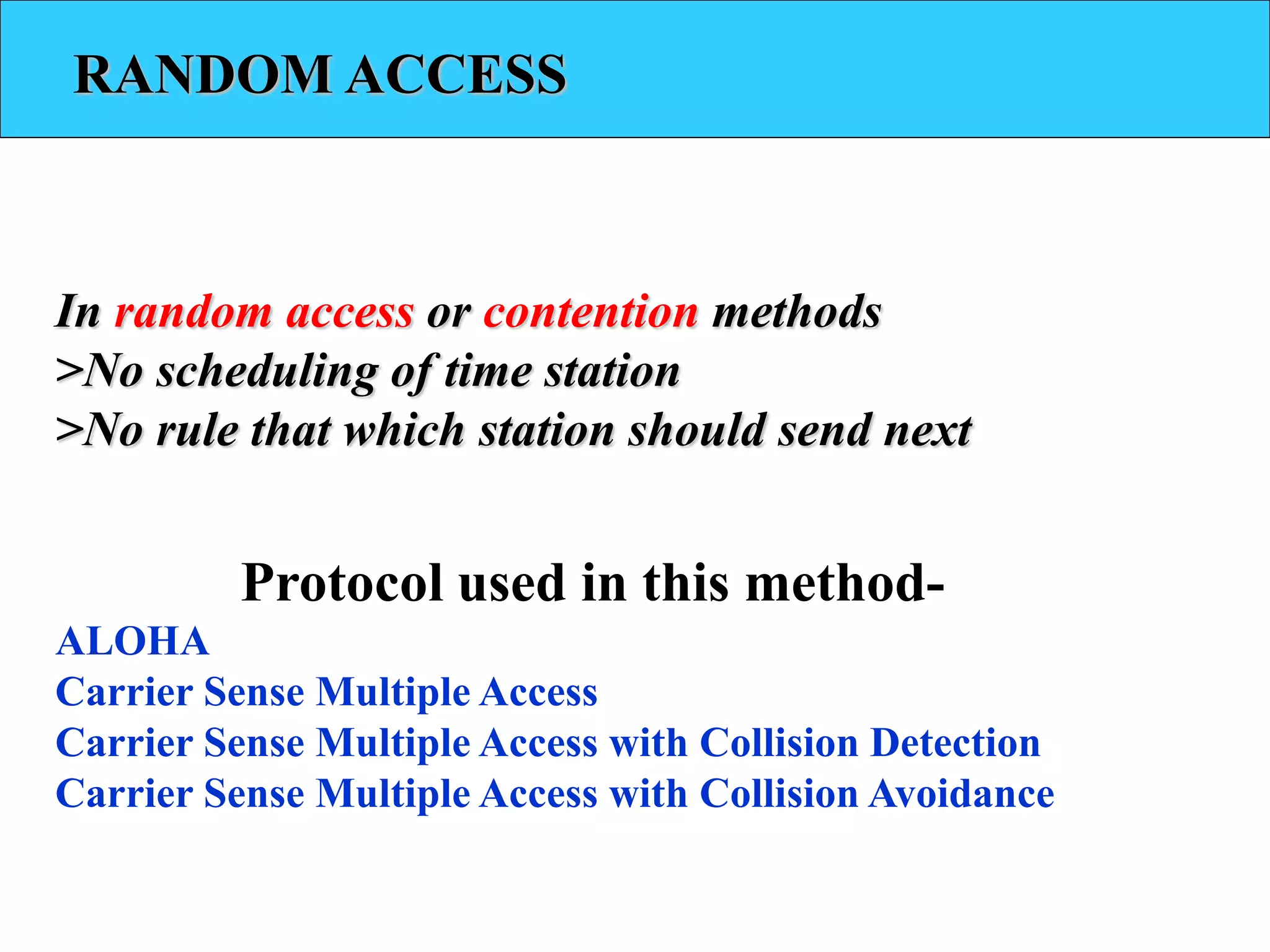
RANDOM ACCESS
In random access or contention methods
>No scheduling of time station
>No rule that which station should send next
Protocol used in this method-
ALOHA
Carrier Sense Multiple Access
Carrier Sense Multiple Access with Collision Detection
Carrier Sense Multiple Access with Collision Avoidance
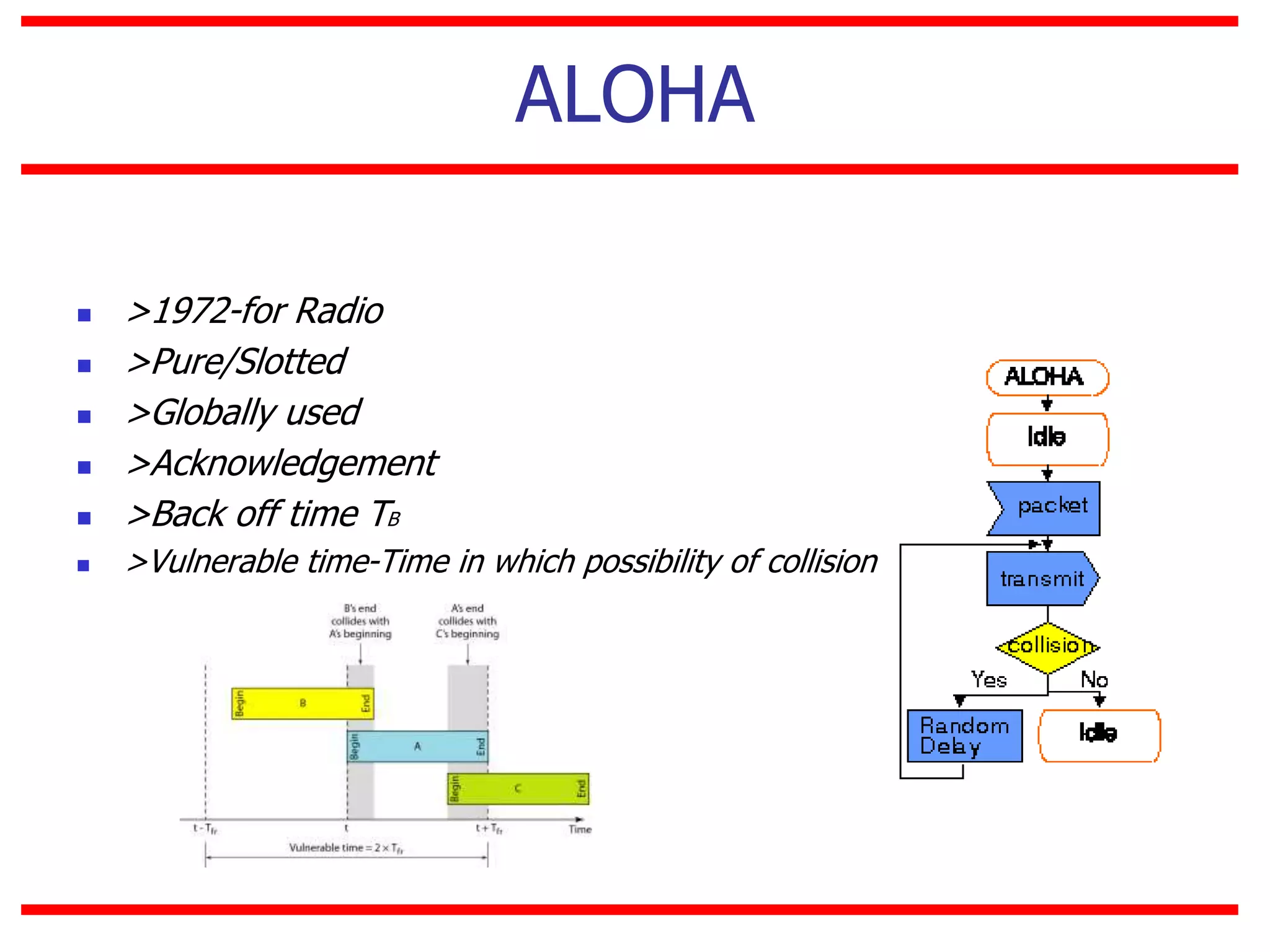
 >1972-for Radio
 >Pure/Slotted
 >Globally used
 >Acknowledgement
 >Back off time TB
 >Vulnerable time-Time in which possibility of collision
ALOHA
12.6
Frames in a pure ALOHA network
 >Carrier sense multiple access
 >Vulnerable time-Time need to propagate from one to another
 >Senses the medium
 >Method- 1.Persistent I
2. Non Persistent- Random amount of time
3.P-Persiustance- change of slot duration> max
propagation time
CSMA
12.8
Figure 12.10 Behavior of three persistence methods
 >Carrier sense multiple access/collision Detection
 >Arguments algorithm to handle for collision
 >Monitors
CSMA/CD
12.10
Figure 12.16 CSMA/CA
 >Carrier sense multiple access/collision avoidance
 >Two signal
 >For wireless –because collision cannot be detected
 >Three strategy-Interframe Space(short ifs high priority)
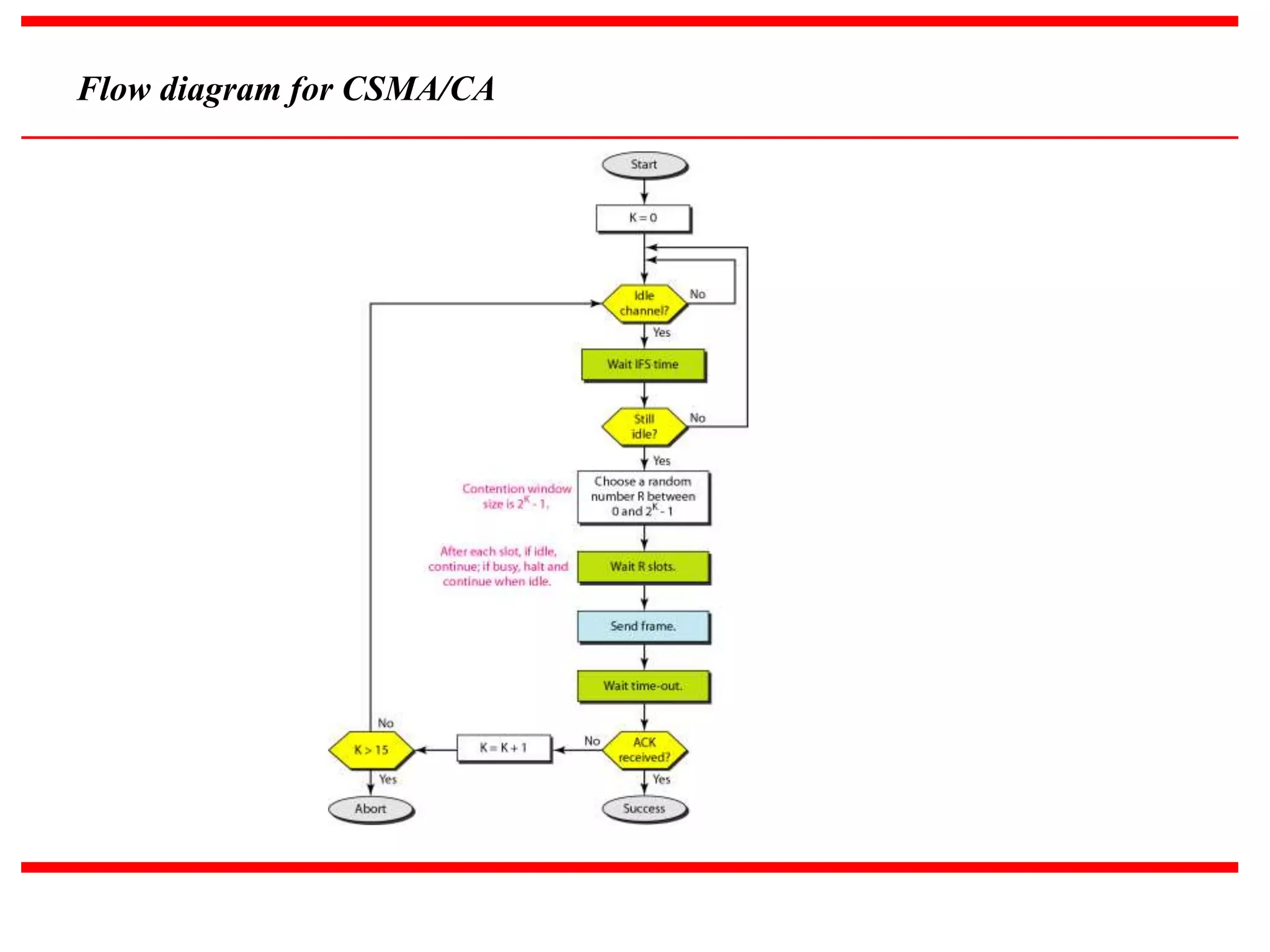
Contention window
Acknowledgement
CSMA/CA
Flow diagram for CSMA/CA
12.13
CONTROLLED ACCESS
In controlled access, the stations consult one another
to find which station has the right to send. A station
cannot send unless it has been authorized by other
stations.
Reservation
Polling
Token Passing
Three popular controlled-access methods
Reservation access method
Select and poll functions in polling access method
>Primary device
>Link is available
>Select-selection of primary
>Poll-primary device verify and allow to transmit
Logical ring and physical topology in token-passing access method
CHANNELIZATION
Channelization is a multiple-access method in which
the available bandwidth of a link is shared in time,
frequency, or through code, between different stations.
Frequency-Division Multiple Access (FDMA)-Guard band
Time-Division Multiple Access (TDMA)-Access method of DLL to control PL
Code-Division Multiple Access (CDMA)-One chanel all transmission, simuntaniously
Protocol

Multiple acessing

  • 1.
  • 2.
    Data link layerdivided into two functionality-oriented sublayers  LOGIC LINK CONTROL-Error and flow control  MAC LAYER-Multiple access resolution
  • 3.
    Taxonomy of multiple-accessprotocols discussed in this chapter
  • 4.
    RANDOM ACCESS In randomaccess or contention methods >No scheduling of time station >No rule that which station should send next Protocol used in this method- ALOHA Carrier Sense Multiple Access Carrier Sense Multiple Access with Collision Detection Carrier Sense Multiple Access with Collision Avoidance
  • 5.
     >1972-for Radio >Pure/Slotted  >Globally used  >Acknowledgement  >Back off time TB  >Vulnerable time-Time in which possibility of collision ALOHA
  • 6.
    12.6 Frames in apure ALOHA network
  • 7.
     >Carrier sensemultiple access  >Vulnerable time-Time need to propagate from one to another  >Senses the medium  >Method- 1.Persistent I 2. Non Persistent- Random amount of time 3.P-Persiustance- change of slot duration> max propagation time CSMA
  • 8.
    12.8 Figure 12.10 Behaviorof three persistence methods
  • 9.
     >Carrier sensemultiple access/collision Detection  >Arguments algorithm to handle for collision  >Monitors CSMA/CD
  • 10.
  • 11.
     >Carrier sensemultiple access/collision avoidance  >Two signal  >For wireless –because collision cannot be detected  >Three strategy-Interframe Space(short ifs high priority) Contention window Acknowledgement CSMA/CA
  • 12.
  • 13.
    12.13 CONTROLLED ACCESS In controlledaccess, the stations consult one another to find which station has the right to send. A station cannot send unless it has been authorized by other stations. Reservation Polling Token Passing Three popular controlled-access methods
  • 14.
  • 15.
    Select and pollfunctions in polling access method >Primary device >Link is available >Select-selection of primary >Poll-primary device verify and allow to transmit
  • 16.
    Logical ring andphysical topology in token-passing access method
  • 17.
    CHANNELIZATION Channelization is amultiple-access method in which the available bandwidth of a link is shared in time, frequency, or through code, between different stations. Frequency-Division Multiple Access (FDMA)-Guard band Time-Division Multiple Access (TDMA)-Access method of DLL to control PL Code-Division Multiple Access (CDMA)-One chanel all transmission, simuntaniously Protocol