9.1
Data Link Control
Networking Fundamentals
Data Link Layer – Main Functions
• Data Link Control – procedures for node to
node communications
• Framing
• Error Control
• Flow Control
• Media Access Control – procedures to share
the link
11.3
FRAMINGFRAMING
The data link layer needs to pack bits intoThe data link layer needs to pack bits into framesframes, so, so
that each frame is distinguishable from another. Ourthat each frame is distinguishable from another. Our
postal system practices a type of framing. The simplepostal system practices a type of framing. The simple
act of inserting a letter into an envelope separates oneact of inserting a letter into an envelope separates one
piece of information from another; the envelope servespiece of information from another; the envelope serves
as the delimiter.as the delimiter.
11.4
lecture
11.5
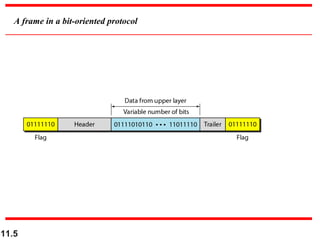
A frame in a bit-oriented protocol
11.6
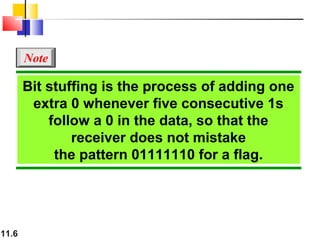
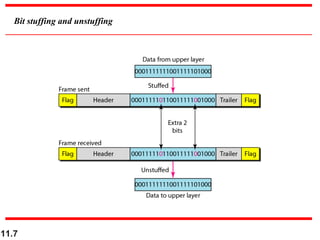
Bit stuffing is the process of adding one
extra 0 whenever five consecutive 1s
follow a 0 in the data, so that the
receiver does not mistake
the pattern 01111110 for a flag.
Note
11.7
Bit stuffing and unstuffing
11.8
FLOW AND ERROR CONTROLFLOW AND ERROR CONTROL
• Two important responsibilities of the data link layerTwo important responsibilities of the data link layer
areare flow controlflow control andand error controlerror control..
• Flow control refers to a set of procedures used to
restrict the amount of data that the sender can
send before getting an acknowledgment.
• Error control in the data link layer are procedures
based on automatic repeat request (ARQ), which is
the retransmission of data.
11.9
PROTOCOLSPROTOCOLS
Now let us see how the data link layer can combineNow let us see how the data link layer can combine
framing, flow control and error control to achieve theframing, flow control and error control to achieve the
delivery of data from one node to another. Thedelivery of data from one node to another. The
protocols are normally implemented in software byprotocols are normally implemented in software by
using one of the common programming languages. Tousing one of the common programming languages. To
make our discussions language-free, we have writtenmake our discussions language-free, we have written
in pseudocode a version of each protocol thatin pseudocode a version of each protocol that
concentrates mostly on the procedure instead ofconcentrates mostly on the procedure instead of
delving into the details of language rules.delving into the details of language rules.
11.10
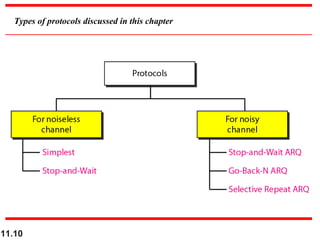
Types of protocols discussed in this chapter
11.11
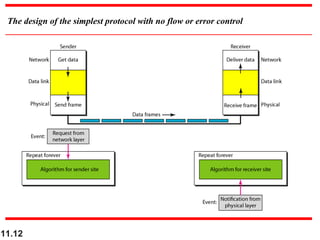
NOISELESS CHANNELSNOISELESS CHANNELS
Let us first assume we have an ideal channel in whichLet us first assume we have an ideal channel in which
no frames are lost, duplicated, or corrupted. Weno frames are lost, duplicated, or corrupted. We
introduce two protocols for this type of channel.introduce two protocols for this type of channel.
11.12
The design of the simplest protocol with no flow or error control
11.13
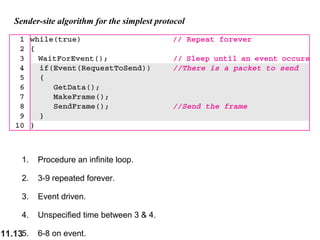
Sender-site algorithm for the simplest protocol
1. Procedure an infinite loop.
2. 3-9 repeated forever.
3. Event driven.
4. Unspecified time between 3 & 4.
5. 6-8 on event.
11.14
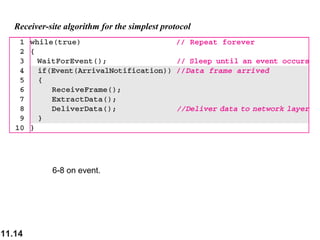
Receiver-site algorithm for the simplest protocol
6-8 on event.
11.15
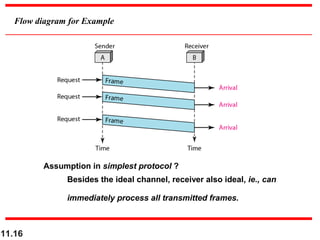
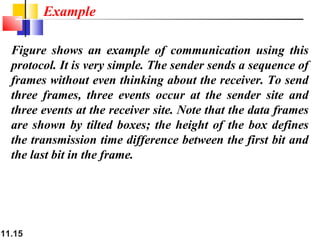
Figure shows an example of communication using this
protocol. It is very simple. The sender sends a sequence of
frames without even thinking about the receiver. To send
three frames, three events occur at the sender site and
three events at the receiver site. Note that the data frames
are shown by tilted boxes; the height of the box defines
the transmission time difference between the first bit and
the last bit in the frame.
Example
11.16
Flow diagram for Example
Assumption in simplest protocol ?
Besides the ideal channel, receiver also ideal, ie., can
immediately process all transmitted frames.
11.17
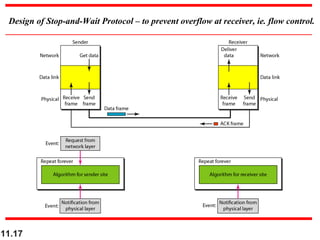
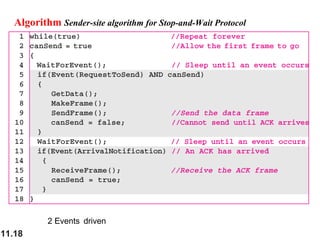
Design of Stop-and-Wait Protocol – to prevent overflow at receiver, ie. flow control.
11.18
Algorithm Sender-site algorithm for Stop-and-Wait Protocol
2 Events driven
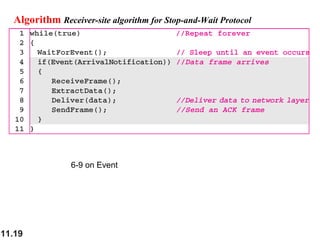
11.19
Algorithm Receiver-site algorithm for Stop-and-Wait Protocol
6-9 on Event
11.20
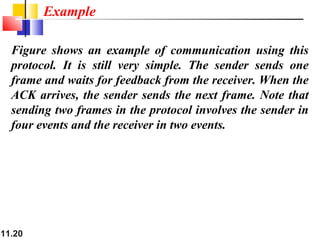
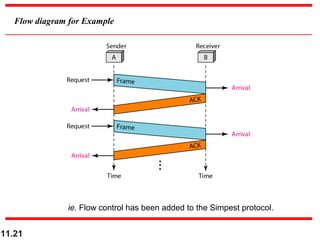
Figure shows an example of communication using this
protocol. It is still very simple. The sender sends one
frame and waits for feedback from the receiver. When the
ACK arrives, the sender sends the next frame. Note that
sending two frames in the protocol involves the sender in
four events and the receiver in two events.
Example
11.21
Flow diagram for Example
ie. Flow control has been added to the Simpest protocol.
11.22
NOISY CHANNELSNOISY CHANNELS
Although the Stop-and-Wait Protocol gives us an ideaAlthough the Stop-and-Wait Protocol gives us an idea
of how to add flow control to its predecessor, noiselessof how to add flow control to its predecessor, noiseless
channels are nonexistent. We discuss three protocolschannels are nonexistent. We discuss three protocols
for noiseless channels that use flow and error control.for noiseless channels that use flow and error control.
• Stop-and-Wait Automatic Repeat Request
• Go-Back-N Automatic Repeat Request
• Selective Repeat Automatic Repeat Request
11.23
Error correction in Stop-and-Wait ARQ
is done by keeping a copy of the sent
frame and retransmission of the frame
when the timer expires.
Note
11.24
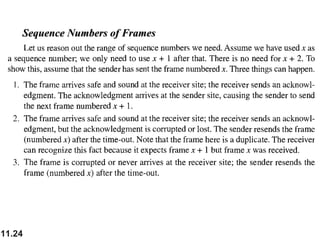
Sequence Numbers of FramesSequence Numbers of Frames
11.25
In Stop-and-Wait ARQ, we use sequence
numbers to number the frames.
The sequence numbers are based on
modulo-2 arithmetic, ie. The sequence is
0, 1, 0, 1, 0, 1 … .
Note
11.26
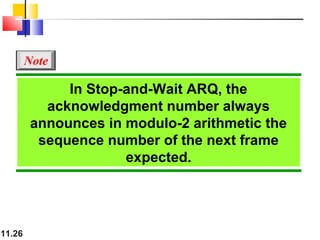
In Stop-and-Wait ARQ, the
acknowledgment number always
announces in modulo-2 arithmetic the
sequence number of the next frame
expected.
Note
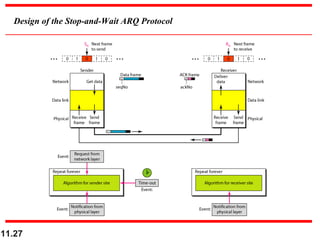
11.27
Design of the Stop-and-Wait ARQ Protocol
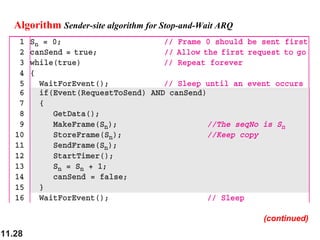
11.28
Algorithm Sender-site algorithm for Stop-and-Wait ARQ
(continued)
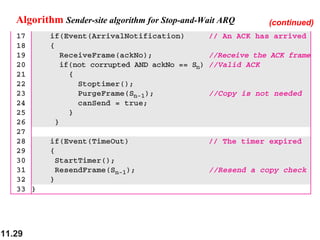
11.29
Algorithm Sender-site algorithm for Stop-and-Wait ARQ (continued)
11.30
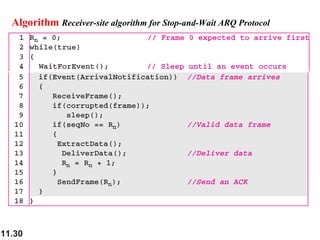
Algorithm Receiver-site algorithm for Stop-and-Wait ARQ Protocol
11.31
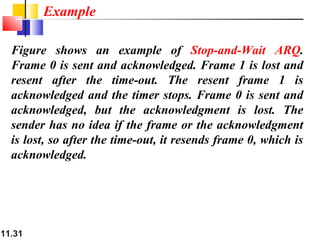
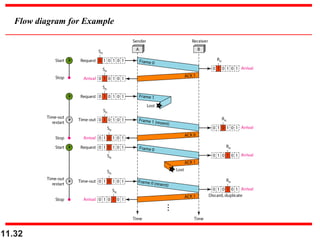
Figure shows an example of Stop-and-Wait ARQ.
Frame 0 is sent and acknowledged. Frame 1 is lost and
resent after the time-out. The resent frame 1 is
acknowledged and the timer stops. Frame 0 is sent and
acknowledged, but the acknowledgment is lost. The
sender has no idea if the frame or the acknowledgment
is lost, so after the time-out, it resends frame 0, which is
acknowledged.
Example
11.32
Flow diagram for Example
11.33
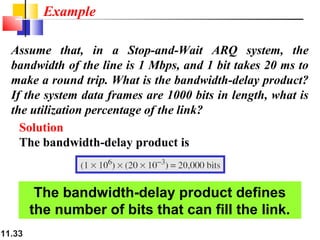
Assume that, in a Stop-and-Wait ARQ system, the
bandwidth of the line is 1 Mbps, and 1 bit takes 20 ms to
make a round trip. What is the bandwidth-delay product?
If the system data frames are 1000 bits in length, what is
the utilization percentage of the link?
Solution
The bandwidth-delay product is
Example
The bandwidth-delay product defines
the number of bits that can fill the link.
11.34
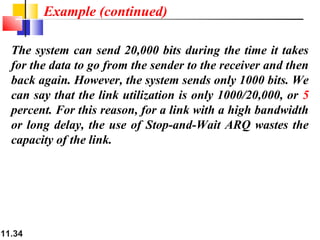
The system can send 20,000 bits during the time it takes
for the data to go from the sender to the receiver and then
back again. However, the system sends only 1000 bits. We
can say that the link utilization is only 1000/20,000, or 5
percent. For this reason, for a link with a high bandwidth
or long delay, the use of Stop-and-Wait ARQ wastes the
capacity of the link.
Example (continued)
11.35
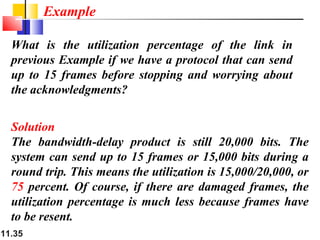
What is the utilization percentage of the link in
previous Example if we have a protocol that can send
up to 15 frames before stopping and worrying about
the acknowledgments?
Solution
The bandwidth-delay product is still 20,000 bits. The
system can send up to 15 frames or 15,000 bits during a
round trip. This means the utilization is 15,000/20,000, or
75 percent. Of course, if there are damaged frames, the
utilization percentage is much less because frames have
to be resent.
Example
11.36
11.37
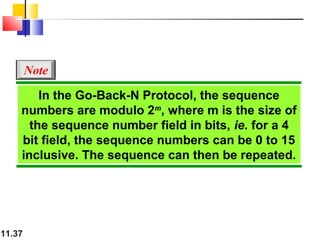
In the Go-Back-N Protocol, the sequence
numbers are modulo 2m
, where m is the size of
the sequence number field in bits, ie. for a 4
bit field, the sequence numbers can be 0 to 15
inclusive. The sequence can then be repeated.
Note
11.38
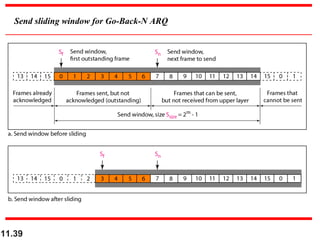
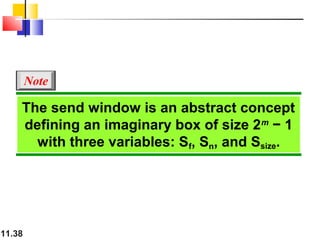
The send window is an abstract concept
defining an imaginary box of size 2m
− 1
with three variables: Sf, Sn, and Ssize.
Note
11.39
Send sliding window for Go-Back-N ARQ
11.40
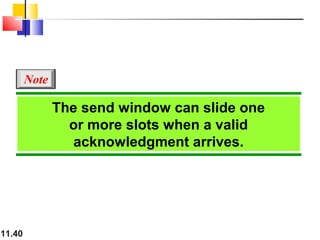
The send window can slide one
or more slots when a valid
acknowledgment arrives.
Note
11.41
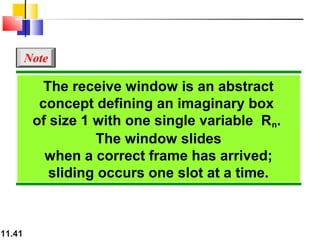
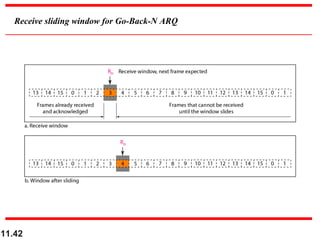
The receive window is an abstract
concept defining an imaginary box
of size 1 with one single variable Rn.
The window slides
when a correct frame has arrived;
sliding occurs one slot at a time.
Note
11.42
Receive sliding window for Go-Back-N ARQ
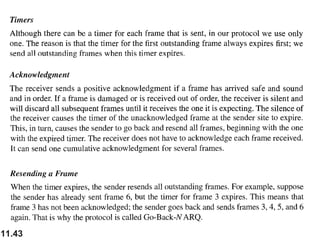
11.43
11.44
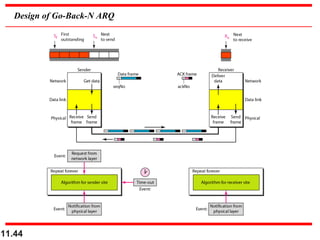
Design of Go-Back-N ARQ
11.45
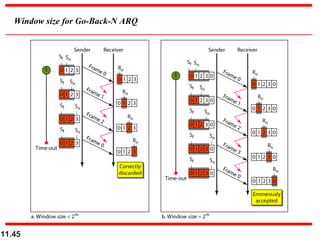
Window size for Go-Back-N ARQ
11.46
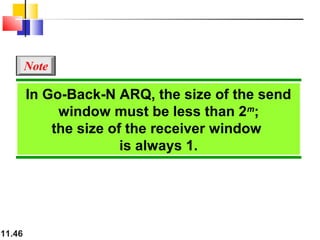
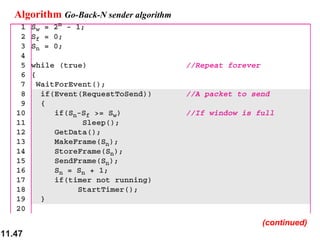
In Go-Back-N ARQ, the size of the send
window must be less than 2m
;
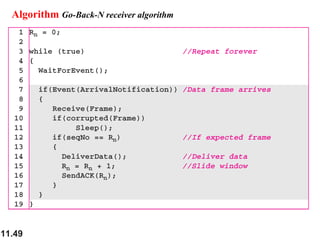
the size of the receiver window
is always 1.
Note
11.47
Algorithm Go-Back-N sender algorithm
(continued)
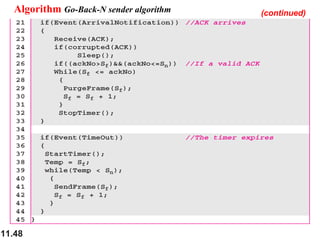
11.48
Algorithm Go-Back-N sender algorithm (continued)
11.49
Algorithm Go-Back-N receiver algorithm
11.50
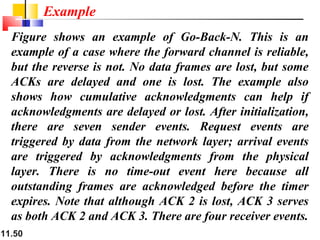
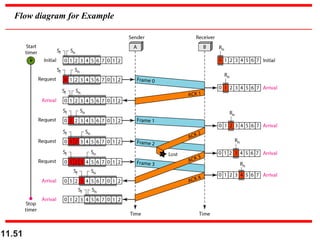
Example
Figure shows an example of Go-Back-N. This is an
example of a case where the forward channel is reliable,
but the reverse is not. No data frames are lost, but some
ACKs are delayed and one is lost. The example also
shows how cumulative acknowledgments can help if
acknowledgments are delayed or lost. After initialization,
there are seven sender events. Request events are
triggered by data from the network layer; arrival events
are triggered by acknowledgments from the physical
layer. There is no time-out event here because all
outstanding frames are acknowledged before the timer
expires. Note that although ACK 2 is lost, ACK 3 serves
as both ACK 2 and ACK 3. There are four receiver events.
11.51
Flow diagram for Example
11.52
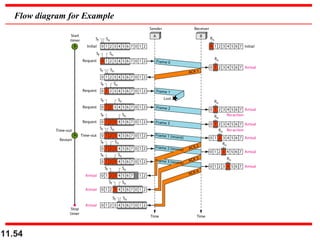
Figure shows what happens when a frame is lost. Frames
0, 1, 2, and 3 are sent. However, frame 1 is lost. The
receiver receives frames 2 and 3, but they are discarded
because they are received out of order. The sender
receives no acknowledgment about frames 1, 2, or 3. Its
timer finally expires. The sender sends all outstanding
frames (1, 2, and 3) because it does not know what is
wrong. Note that the resending of frames 1, 2, and 3 is the
response to one single event. When the sender is
responding to this event, it cannot accept the triggering of
other events. This means that when ACK 2 arrives, the
sender is still busy with sending frame 3.
Example
11.53
The physical layer must wait until this event is completed
and the data link layer goes back to its sleeping state. We
have shown a vertical line to indicate the delay. It is the
same story with ACK 3; but when ACK 3 arrives, the
sender is busy responding to ACK 2. It happens again
when ACK 4 arrives. Note that before the second timer
expires, all outstanding frames have been sent and the
timer is stopped.
Example (continued)
11.54
Flow diagram for Example
11.55
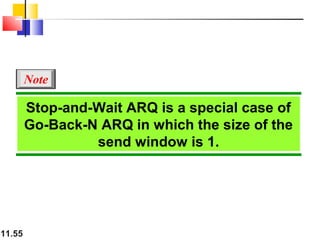
Stop-and-Wait ARQ is a special case of
Go-Back-N ARQ in which the size of the
send window is 1.
Note

3a data link layer

  • 1.
  • 2.
    Data Link Layer– Main Functions • Data Link Control – procedures for node to node communications • Framing • Error Control • Flow Control • Media Access Control – procedures to share the link
  • 3.
    11.3 FRAMINGFRAMING The data linklayer needs to pack bits intoThe data link layer needs to pack bits into framesframes, so, so that each frame is distinguishable from another. Ourthat each frame is distinguishable from another. Our postal system practices a type of framing. The simplepostal system practices a type of framing. The simple act of inserting a letter into an envelope separates oneact of inserting a letter into an envelope separates one piece of information from another; the envelope servespiece of information from another; the envelope serves as the delimiter.as the delimiter.
  • 4.
  • 5.
    11.5 A frame ina bit-oriented protocol
  • 6.
    11.6 Bit stuffing isthe process of adding one extra 0 whenever five consecutive 1s follow a 0 in the data, so that the receiver does not mistake the pattern 01111110 for a flag. Note
  • 7.
  • 8.
    11.8 FLOW AND ERRORCONTROLFLOW AND ERROR CONTROL • Two important responsibilities of the data link layerTwo important responsibilities of the data link layer areare flow controlflow control andand error controlerror control.. • Flow control refers to a set of procedures used to restrict the amount of data that the sender can send before getting an acknowledgment. • Error control in the data link layer are procedures based on automatic repeat request (ARQ), which is the retransmission of data.
  • 9.
    11.9 PROTOCOLSPROTOCOLS Now let ussee how the data link layer can combineNow let us see how the data link layer can combine framing, flow control and error control to achieve theframing, flow control and error control to achieve the delivery of data from one node to another. Thedelivery of data from one node to another. The protocols are normally implemented in software byprotocols are normally implemented in software by using one of the common programming languages. Tousing one of the common programming languages. To make our discussions language-free, we have writtenmake our discussions language-free, we have written in pseudocode a version of each protocol thatin pseudocode a version of each protocol that concentrates mostly on the procedure instead ofconcentrates mostly on the procedure instead of delving into the details of language rules.delving into the details of language rules.
  • 10.
    11.10 Types of protocolsdiscussed in this chapter
  • 11.
    11.11 NOISELESS CHANNELSNOISELESS CHANNELS Letus first assume we have an ideal channel in whichLet us first assume we have an ideal channel in which no frames are lost, duplicated, or corrupted. Weno frames are lost, duplicated, or corrupted. We introduce two protocols for this type of channel.introduce two protocols for this type of channel.
  • 12.
    11.12 The design ofthe simplest protocol with no flow or error control
  • 13.
    11.13 Sender-site algorithm forthe simplest protocol 1. Procedure an infinite loop. 2. 3-9 repeated forever. 3. Event driven. 4. Unspecified time between 3 & 4. 5. 6-8 on event.
  • 14.
    11.14 Receiver-site algorithm forthe simplest protocol 6-8 on event.
  • 15.
    11.15 Figure shows anexample of communication using this protocol. It is very simple. The sender sends a sequence of frames without even thinking about the receiver. To send three frames, three events occur at the sender site and three events at the receiver site. Note that the data frames are shown by tilted boxes; the height of the box defines the transmission time difference between the first bit and the last bit in the frame. Example
  • 16.
    11.16 Flow diagram forExample Assumption in simplest protocol ? Besides the ideal channel, receiver also ideal, ie., can immediately process all transmitted frames.
  • 17.
    11.17 Design of Stop-and-WaitProtocol – to prevent overflow at receiver, ie. flow control.
  • 18.
    11.18 Algorithm Sender-site algorithmfor Stop-and-Wait Protocol 2 Events driven
  • 19.
    11.19 Algorithm Receiver-site algorithmfor Stop-and-Wait Protocol 6-9 on Event
  • 20.
    11.20 Figure shows anexample of communication using this protocol. It is still very simple. The sender sends one frame and waits for feedback from the receiver. When the ACK arrives, the sender sends the next frame. Note that sending two frames in the protocol involves the sender in four events and the receiver in two events. Example
  • 21.
    11.21 Flow diagram forExample ie. Flow control has been added to the Simpest protocol.
  • 22.
    11.22 NOISY CHANNELSNOISY CHANNELS Althoughthe Stop-and-Wait Protocol gives us an ideaAlthough the Stop-and-Wait Protocol gives us an idea of how to add flow control to its predecessor, noiselessof how to add flow control to its predecessor, noiseless channels are nonexistent. We discuss three protocolschannels are nonexistent. We discuss three protocols for noiseless channels that use flow and error control.for noiseless channels that use flow and error control. • Stop-and-Wait Automatic Repeat Request • Go-Back-N Automatic Repeat Request • Selective Repeat Automatic Repeat Request
  • 23.
    11.23 Error correction inStop-and-Wait ARQ is done by keeping a copy of the sent frame and retransmission of the frame when the timer expires. Note
  • 24.
    11.24 Sequence Numbers ofFramesSequence Numbers of Frames
  • 25.
    11.25 In Stop-and-Wait ARQ,we use sequence numbers to number the frames. The sequence numbers are based on modulo-2 arithmetic, ie. The sequence is 0, 1, 0, 1, 0, 1 … . Note
  • 26.
    11.26 In Stop-and-Wait ARQ,the acknowledgment number always announces in modulo-2 arithmetic the sequence number of the next frame expected. Note
  • 27.
    11.27 Design of theStop-and-Wait ARQ Protocol
  • 28.
    11.28 Algorithm Sender-site algorithmfor Stop-and-Wait ARQ (continued)
  • 29.
    11.29 Algorithm Sender-site algorithmfor Stop-and-Wait ARQ (continued)
  • 30.
    11.30 Algorithm Receiver-site algorithmfor Stop-and-Wait ARQ Protocol
  • 31.
    11.31 Figure shows anexample of Stop-and-Wait ARQ. Frame 0 is sent and acknowledged. Frame 1 is lost and resent after the time-out. The resent frame 1 is acknowledged and the timer stops. Frame 0 is sent and acknowledged, but the acknowledgment is lost. The sender has no idea if the frame or the acknowledgment is lost, so after the time-out, it resends frame 0, which is acknowledged. Example
  • 32.
  • 33.
    11.33 Assume that, ina Stop-and-Wait ARQ system, the bandwidth of the line is 1 Mbps, and 1 bit takes 20 ms to make a round trip. What is the bandwidth-delay product? If the system data frames are 1000 bits in length, what is the utilization percentage of the link? Solution The bandwidth-delay product is Example The bandwidth-delay product defines the number of bits that can fill the link.
  • 34.
    11.34 The system cansend 20,000 bits during the time it takes for the data to go from the sender to the receiver and then back again. However, the system sends only 1000 bits. We can say that the link utilization is only 1000/20,000, or 5 percent. For this reason, for a link with a high bandwidth or long delay, the use of Stop-and-Wait ARQ wastes the capacity of the link. Example (continued)
  • 35.
    11.35 What is theutilization percentage of the link in previous Example if we have a protocol that can send up to 15 frames before stopping and worrying about the acknowledgments? Solution The bandwidth-delay product is still 20,000 bits. The system can send up to 15 frames or 15,000 bits during a round trip. This means the utilization is 15,000/20,000, or 75 percent. Of course, if there are damaged frames, the utilization percentage is much less because frames have to be resent. Example
  • 36.
  • 37.
    11.37 In the Go-Back-NProtocol, the sequence numbers are modulo 2m , where m is the size of the sequence number field in bits, ie. for a 4 bit field, the sequence numbers can be 0 to 15 inclusive. The sequence can then be repeated. Note
  • 38.
    11.38 The send windowis an abstract concept defining an imaginary box of size 2m − 1 with three variables: Sf, Sn, and Ssize. Note
  • 39.
    11.39 Send sliding windowfor Go-Back-N ARQ
  • 40.
    11.40 The send windowcan slide one or more slots when a valid acknowledgment arrives. Note
  • 41.
    11.41 The receive windowis an abstract concept defining an imaginary box of size 1 with one single variable Rn. The window slides when a correct frame has arrived; sliding occurs one slot at a time. Note
  • 42.
  • 43.
  • 44.
  • 45.
    11.45 Window size forGo-Back-N ARQ
  • 46.
    11.46 In Go-Back-N ARQ,the size of the send window must be less than 2m ; the size of the receiver window is always 1. Note
  • 47.
    11.47 Algorithm Go-Back-N senderalgorithm (continued)
  • 48.
    11.48 Algorithm Go-Back-N senderalgorithm (continued)
  • 49.
  • 50.
    11.50 Example Figure shows anexample of Go-Back-N. This is an example of a case where the forward channel is reliable, but the reverse is not. No data frames are lost, but some ACKs are delayed and one is lost. The example also shows how cumulative acknowledgments can help if acknowledgments are delayed or lost. After initialization, there are seven sender events. Request events are triggered by data from the network layer; arrival events are triggered by acknowledgments from the physical layer. There is no time-out event here because all outstanding frames are acknowledged before the timer expires. Note that although ACK 2 is lost, ACK 3 serves as both ACK 2 and ACK 3. There are four receiver events.
  • 51.
  • 52.
    11.52 Figure shows whathappens when a frame is lost. Frames 0, 1, 2, and 3 are sent. However, frame 1 is lost. The receiver receives frames 2 and 3, but they are discarded because they are received out of order. The sender receives no acknowledgment about frames 1, 2, or 3. Its timer finally expires. The sender sends all outstanding frames (1, 2, and 3) because it does not know what is wrong. Note that the resending of frames 1, 2, and 3 is the response to one single event. When the sender is responding to this event, it cannot accept the triggering of other events. This means that when ACK 2 arrives, the sender is still busy with sending frame 3. Example
  • 53.
    11.53 The physical layermust wait until this event is completed and the data link layer goes back to its sleeping state. We have shown a vertical line to indicate the delay. It is the same story with ACK 3; but when ACK 3 arrives, the sender is busy responding to ACK 2. It happens again when ACK 4 arrives. Note that before the second timer expires, all outstanding frames have been sent and the timer is stopped. Example (continued)
  • 54.
  • 55.
    11.55 Stop-and-Wait ARQ isa special case of Go-Back-N ARQ in which the size of the send window is 1. Note