McGraw-Hill ©The McGraw-Hill Companies, Inc., 2004
Chapter 12
Multiple Access
McGraw-Hill ©The McGraw-Hill Companies, Inc., 2004
Multiple Access
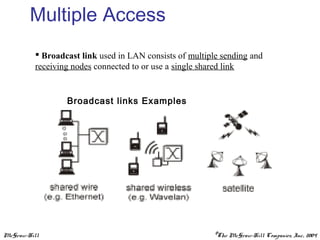
 Broadcast link used in LAN consists of multiple sending and
receiving nodes connected to or use a single shared link
Broadcast links Examples
McGraw-Hill ©The McGraw-Hill Companies, Inc., 2004
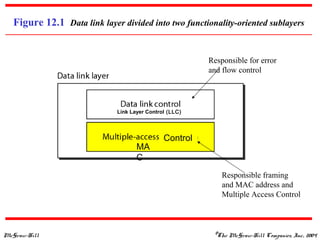
Figure 12.1 Data link layer divided into two functionality-oriented sublayers
Link Layer Control (LLC)
MA
C
Responsible for error
and flow control
Control
Responsible framing
and MAC address and
Multiple Access Control
McGraw-Hill ©The McGraw-Hill Companies, Inc., 2004
Multiple Access
 Problem: When two or more nodes transmit at the same time, their
frames will collide and the link bandwidth is wasted during collision
 How to coordinate the access of multiple sending/receiving nodes
to the shared link???
 Solution: We need a protocol to coordinate the transmission of the
active nodes
 These protocols are called Medium or Multiple Access Control
(MAC) Protocols belong to a sublayer of the data link layer called
MAC (Medium Access Control)
 What is expected from Multiple Access Protocols:
 Main task is to minimize collisions in order to utilize the bandwidth by:

Determining when a station can use the link (medium)

what a station should do when the link is busy

what the station should do when it is involved in collision
McGraw-Hill ©The McGraw-Hill Companies, Inc., 2004
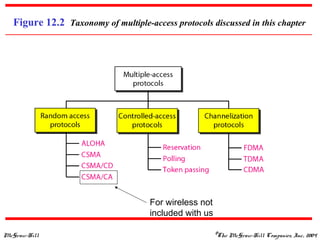
Figure 12.2 Taxonomy of multiple-access protocols discussed in this chapter
For wireless not
included with us
McGraw-Hill ©The McGraw-Hill Companies, Inc., 2004
Random Access
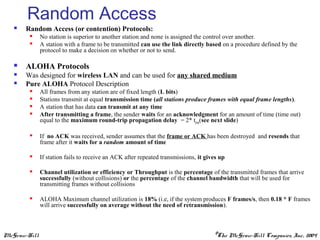
 Random Access (or contention) Protocols:
 No station is superior to another station and none is assigned the control over another.
 A station with a frame to be transmitted can use the link directly based on a procedure defined by the
protocol to make a decision on whether or not to send.
 ALOHA Protocols
 Was designed for wireless LAN and can be used for any shared medium
 Pure ALOHA Protocol Description
 All frames from any station are of fixed length (L bits)
 Stations transmit at equal transmission time (all stations produce frames with equal frame lengths).
 A station that has data can transmit at any time
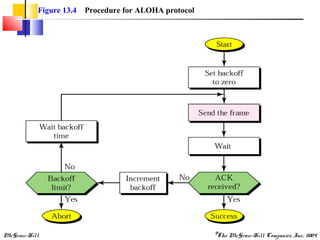
 After transmitting a frame, the sender waits for an acknowledgment for an amount of time (time out)
equal to the maximum round-trip propagation delay = 2* tprop(see next slide)
 If no ACK was received, sender assumes that the frame or ACK has been destroyed and resends that
frame after it waits for a random amount of time
 If station fails to receive an ACK after repeated transmissions, it gives up
 Channel utilization or efficiency or Throughput is the percentage of the transmitted frames that arrive
successfully (without collisions) or the percentage of the channel bandwidth that will be used for
transmitting frames without collisions
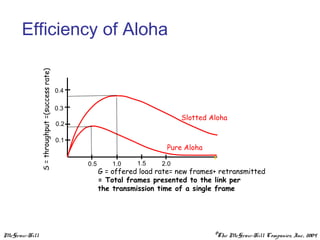
 ALOHA Maximum channel utilization is 18% (i.e, if the system produces F frames/s, then 0.18 * F frames
will arrive successfully on average without the need of retransmission).
McGraw-Hill ©The McGraw-Hill Companies, Inc., 2004
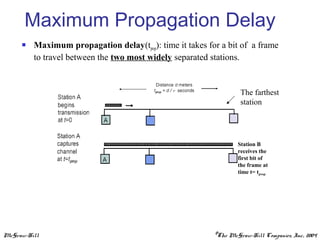
Maximum Propagation Delay
 Maximum propagation delay(tprop): time it takes for a bit of a frame
to travel between the two most widely separated stations.
The farthest
station
Station B
receives the
first bit of
the frame at
time t= tprop
McGraw-Hill ©The McGraw-Hill Companies, Inc., 2004
Figure 13.4 Procedure for ALOHA protocol
McGraw-Hill ©The McGraw-Hill Companies, Inc., 2004
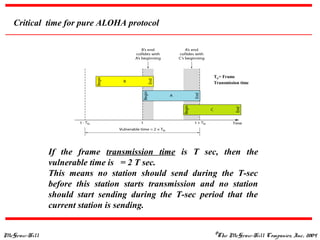
Critical time for pure ALOHA protocol
If the frame transmission time is T sec, then the
vulnerable time is = 2 T sec.
This means no station should send during the T-sec
before this station starts transmission and no station
should start sending during the T-sec period that the
current station is sending.
Tfr= Frame
Transmission time
McGraw-Hill ©The McGraw-Hill Companies, Inc., 2004
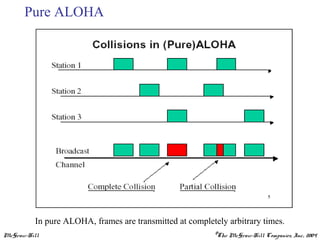
Pure ALOHA
In pure ALOHA, frames are transmitted at completely arbitrary times.
McGraw-Hill ©The McGraw-Hill Companies, Inc., 2004
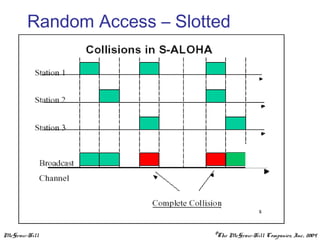
Random Access – Slotted
ALOHA Time is divided into slots equal to a frame transmission
time (Tfr)
 A station can transmit at the beginning of a slot only
 If a station misses the beginning of a slot, it has to wait
until the beginning of the next time slot.
 A central clock or station informs all stations about the
start of a each slot
 Maximum channel utilization is 37%
McGraw-Hill ©The McGraw-Hill Companies, Inc., 2004
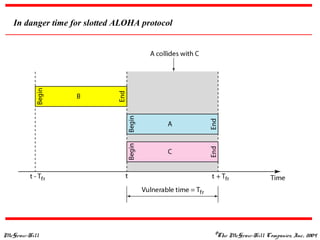
In danger time for slotted ALOHA protocol
McGraw-Hill ©The McGraw-Hill Companies, Inc., 2004
Random Access – Slotted
ALOHA
McGraw-Hill ©The McGraw-Hill Companies, Inc., 2004
Efficiency of Aloha
S=throughput=(successrate)
G = offered load rate= new frames+ retransmitted
= Total frames presented to the link per
the transmission time of a single frame
0.5 1.0 1.5 2.0
0.1
0.2
0.3
0.4
Pure Aloha
Slotted Aloha
McGraw-Hill ©The McGraw-Hill Companies, Inc., 2004
Advantage of ALOHA protocols
A node that has frames to be transmitted can transmit continuously at the
full rate of channel (R bps) if it is the only node with frames
Simple to be implemented
No master station is needed to control the medium
Disadvantage
If (M) nodes want to transmit, many collisions can occur
 This causes low channel utilization
McGraw-Hill ©The McGraw-Hill Companies, Inc., 2004
Random Access – Carrier Sense Multiple Access
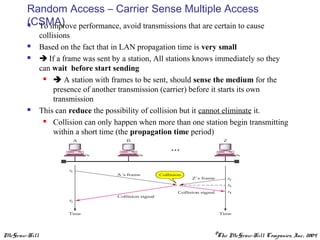
(CSMA) To improve performance, avoid transmissions that are certain to cause
collisions
 Based on the fact that in LAN propagation time is very small
  If a frame was sent by a station, All stations knows immediately so they
can wait before start sending
  A station with frames to be sent, should sense the medium for the
presence of another transmission (carrier) before it starts its own
transmission
 This can reduce the possibility of collision but it cannot eliminate it.
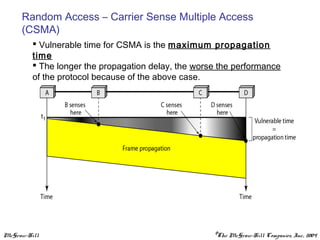
 Collision can only happen when more than one station begin transmitting
within a short time (the propagation time period)
McGraw-Hill ©The McGraw-Hill Companies, Inc., 2004
Random Access – Carrier Sense Multiple Access
(CSMA)
 Vulnerable time for CSMA is the maximum propagation
time
 The longer the propagation delay, the worse the performance
of the protocol because of the above case.
McGraw-Hill ©The McGraw-Hill Companies, Inc., 2004
Types of CSMA Protocols
Different CSMA protocols that determine:
 What a station should do when the medium is idle?
 What a station should do when the medium is busy?
1. Non-Persistent CSMA
2. 1-Persistent CSMA
3. p-Persistent CSMA
McGraw-Hill ©The McGraw-Hill Companies, Inc., 2004
Nonpersistent CSMA
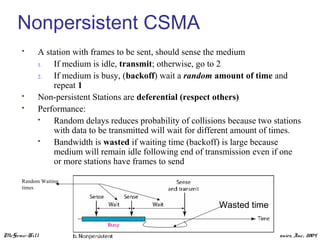
 A station with frames to be sent, should sense the medium
1. If medium is idle, transmit; otherwise, go to 2
2. If medium is busy, (backoff) wait a random amount of time and
repeat 1
 Non-persistent Stations are deferential (respect others)
 Performance:
 Random delays reduces probability of collisions because two stations
with data to be transmitted will wait for different amount of times.
 Bandwidth is wasted if waiting time (backoff) is large because
medium will remain idle following end of transmission even if one
or more stations have frames to send
Random Waiting
times
Wasted time
McGraw-Hill ©The McGraw-Hill Companies, Inc., 2004
1-persistent CSMA
 To avoid idle channel time, 1-persistent protocol used
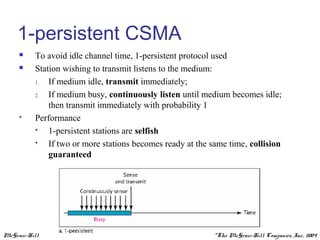
 Station wishing to transmit listens to the medium:
1. If medium idle, transmit immediately;
2. If medium busy, continuously listen until medium becomes idle;
then transmit immediately with probability 1
 Performance
 1-persistent stations are selfish
 If two or more stations becomes ready at the same time, collision
guaranteed
McGraw-Hill ©The McGraw-Hill Companies, Inc., 2004
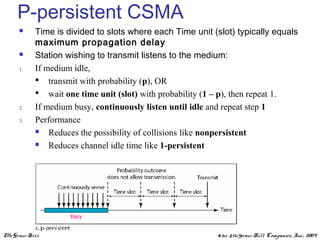
P-persistent CSMA
 Time is divided to slots where each Time unit (slot) typically equals
maximum propagation delay
 Station wishing to transmit listens to the medium:
1. If medium idle,
 transmit with probability (p), OR
 wait one time unit (slot) with probability (1 – p), then repeat 1.
2. If medium busy, continuously listen until idle and repeat step 1
3. Performance
 Reduces the possibility of collisions like nonpersistent
 Reduces channel idle time like 1-persistent
McGraw-Hill ©The McGraw-Hill Companies, Inc., 2004
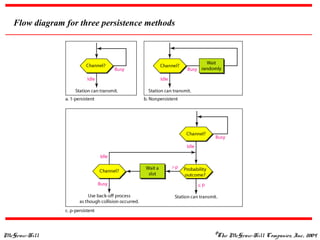
Flow diagram for three persistence methods
McGraw-Hill ©The McGraw-Hill Companies, Inc., 2004
CSMA/CD (Collision Detection)
 CSMA (all previous methods) has an inefficiency:
 If a collision has occurred, the channel is unstable until
colliding packets have been fully transmitted
 CSMA/CD (Carrier Sense Multiple Access with Collision
Detection) overcomes this as follows:
 While transmitting, the sender is listening to medium for
collisions.
 Sender stops transmission if collision has occurred
reducing channel wastage .
CSMA/CD is Widely used for bus topology LANs (IEEE 802.3,
Ethernet).
McGraw-Hill ©The McGraw-Hill Companies, Inc., 2004
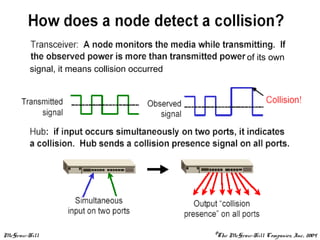
of its own
signal, it means collision occurred
McGraw-Hill ©The McGraw-Hill Companies, Inc., 2004
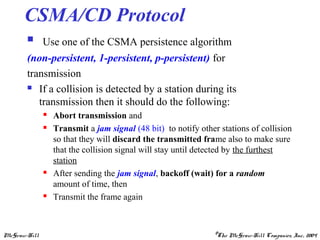
CSMA/CD Protocol
 Use one of the CSMA persistence algorithm
(non-persistent, 1-persistent, p-persistent) for
transmission
 If a collision is detected by a station during its
transmission then it should do the following:
 Abort transmission and
 Transmit a jam signal (48 bit) to notify other stations of collision
so that they will discard the transmitted frame also to make sure
that the collision signal will stay until detected by the furthest
station
 After sending the jam signal, backoff (wait) for a random
amount of time, then
 Transmit the frame again
McGraw-Hill ©The McGraw-Hill Companies, Inc., 2004
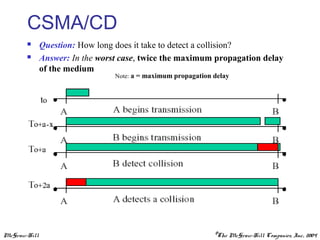
CSMA/CD
 Question: How long does it take to detect a collision?
 Answer: In the worst case, twice the maximum propagation delay
of the medium
Note: a = maximum propagation delay
McGraw-Hill ©The McGraw-Hill Companies, Inc., 2004
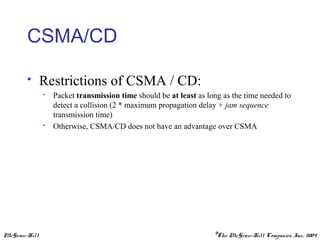
CSMA/CD
 Restrictions of CSMA / CD:
 Packet transmission time should be at least as long as the time needed to
detect a collision (2 * maximum propagation delay + jam sequence
transmission time)
 Otherwise, CSMA/CD does not have an advantage over CSMA
McGraw-Hill ©The McGraw-Hill Companies, Inc., 2004
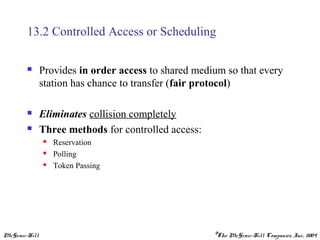
13.2 Controlled Access or Scheduling
 Provides in order access to shared medium so that every
station has chance to transfer (fair protocol)
 Eliminates collision completely
 Three methods for controlled access:
 Reservation
 Polling
 Token Passing
McGraw-Hill ©The McGraw-Hill Companies, Inc., 2004
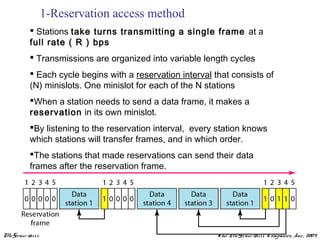
1-Reservation access method
 Stations take turns transmitting a single frame at a
full rate ( R ) bps
 Transmissions are organized into variable length cycles
 Each cycle begins with a reservation interval that consists of
(N) minislots. One minislot for each of the N stations
When a station needs to send a data frame, it makes a
reservation in its own minislot.
By listening to the reservation interval, every station knows
which stations will transfer frames, and in which order.
The stations that made reservations can send their data
frames after the reservation frame.
McGraw-Hill ©The McGraw-Hill Companies, Inc., 2004
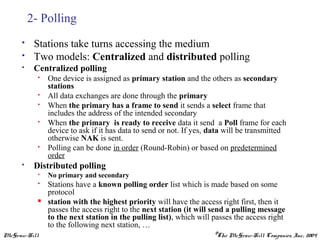
2- Polling
 Stations take turns accessing the medium
 Two models: Centralized and distributed polling
 Centralized polling
 One device is assigned as primary station and the others as secondary
stations
 All data exchanges are done through the primary
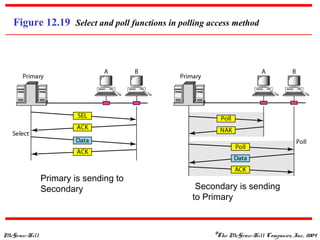
 When the primary has a frame to send it sends a select frame that
includes the address of the intended secondary
 When the primary is ready to receive data it send a Poll frame for each
device to ask if it has data to send or not. If yes, data will be transmitted
otherwise NAK is sent.
 Polling can be done in order (Round-Robin) or based on predetermined
order
 Distributed polling
 No primary and secondary
 Stations have a known polling order list which is made based on some
protocol
 station with the highest priority will have the access right first, then it
passes the access right to the next station (it will send a pulling message
to the next station in the pulling list), which will passes the access right
to the following next station, …
McGraw-Hill ©The McGraw-Hill Companies, Inc., 2004
Figure 12.19 Select and poll functions in polling access method
Primary is sending to
Secondary Secondary is sending
to Primary
McGraw-Hill ©The McGraw-Hill Companies, Inc., 2004
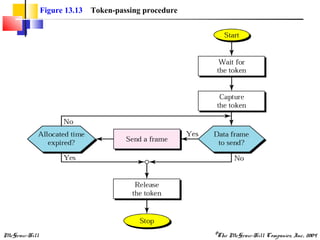
Figure 13.13 Token-passing procedure
McGraw-Hill ©The McGraw-Hill Companies, Inc., 2004
12-3 CHANNELIZATION12-3 CHANNELIZATION
ChannelizationChannelization is a multiple-access method in whichis a multiple-access method in which
the available bandwidth of a link is shared in time,the available bandwidth of a link is shared in time,
frequency, or through code, between different stations.frequency, or through code, between different stations.
In this section, we discuss three channelizationIn this section, we discuss three channelization
protocols.protocols.
Frequency-Division Multiple Access (FDMA)
Time-Division Multiple Access (TDMA)
Code-Division Multiple Access (CDMA)
Topics discussed in this section:Topics discussed in this section:
McGraw-Hill ©The McGraw-Hill Companies, Inc., 2004
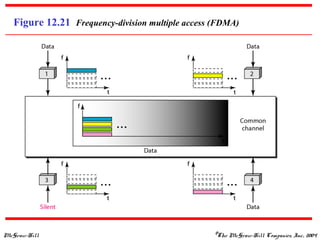
Figure 12.21 Frequency-division multiple access (FDMA)
McGraw-Hill ©The McGraw-Hill Companies, Inc., 2004
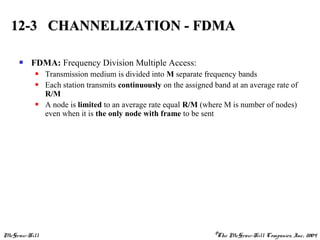
 FDMA: Frequency Division Multiple Access:
 Transmission medium is divided into M separate frequency bands
 Each station transmits continuously on the assigned band at an average rate of
R/M
 A node is limited to an average rate equal R/M (where M is number of nodes)
even when it is the only node with frame to be sent
12-3 CHANNELIZATION - FDMA12-3 CHANNELIZATION - FDMA
McGraw-Hill ©The McGraw-Hill Companies, Inc., 2004
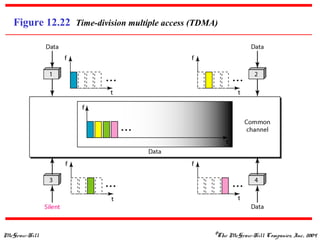
Figure 12.22 Time-division multiple access (TDMA)
McGraw-Hill ©The McGraw-Hill Companies, Inc., 2004
 TDMA: Time Division Multiple Access
 The entire bandwidth capacity is a single channel with its capacity shared in
time between M stations
 A node must always wait for its turn until its slot time arrives even when it is
the only node with frames to send
 A node is limited to an average rate equal R/M (where M is number of nodes)
even when it is the only node with frame to be sent
12-3 CHANNELIZATION - TDMA12-3 CHANNELIZATION - TDMA
McGraw-Hill ©The McGraw-Hill Companies, Inc., 2004
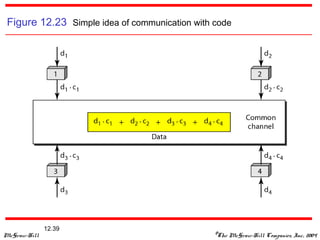
 CDMA: Code Division Multiple Access
 In CDMA, one channel carries all transmissions simultaneously
 Each station codes its data signal by a specific codes before transmission
 The stations receivers use these codes to recover the data for the desired
station
12-3 CHANNELIZATION - CDMA12-3 CHANNELIZATION - CDMA
McGraw-Hill ©The McGraw-Hill Companies, Inc., 2004
12.39
Figure 12.23 Simple idea of communication with code

Unit 1 mac vsd

  • 1.
    McGraw-Hill ©The McGraw-HillCompanies, Inc., 2004 Chapter 12 Multiple Access
  • 2.
    McGraw-Hill ©The McGraw-HillCompanies, Inc., 2004 Multiple Access  Broadcast link used in LAN consists of multiple sending and receiving nodes connected to or use a single shared link Broadcast links Examples
  • 3.
    McGraw-Hill ©The McGraw-HillCompanies, Inc., 2004 Figure 12.1 Data link layer divided into two functionality-oriented sublayers Link Layer Control (LLC) MA C Responsible for error and flow control Control Responsible framing and MAC address and Multiple Access Control
  • 4.
    McGraw-Hill ©The McGraw-HillCompanies, Inc., 2004 Multiple Access  Problem: When two or more nodes transmit at the same time, their frames will collide and the link bandwidth is wasted during collision  How to coordinate the access of multiple sending/receiving nodes to the shared link???  Solution: We need a protocol to coordinate the transmission of the active nodes  These protocols are called Medium or Multiple Access Control (MAC) Protocols belong to a sublayer of the data link layer called MAC (Medium Access Control)  What is expected from Multiple Access Protocols:  Main task is to minimize collisions in order to utilize the bandwidth by:  Determining when a station can use the link (medium)  what a station should do when the link is busy  what the station should do when it is involved in collision
  • 5.
    McGraw-Hill ©The McGraw-HillCompanies, Inc., 2004 Figure 12.2 Taxonomy of multiple-access protocols discussed in this chapter For wireless not included with us
  • 6.
    McGraw-Hill ©The McGraw-HillCompanies, Inc., 2004 Random Access  Random Access (or contention) Protocols:  No station is superior to another station and none is assigned the control over another.  A station with a frame to be transmitted can use the link directly based on a procedure defined by the protocol to make a decision on whether or not to send.  ALOHA Protocols  Was designed for wireless LAN and can be used for any shared medium  Pure ALOHA Protocol Description  All frames from any station are of fixed length (L bits)  Stations transmit at equal transmission time (all stations produce frames with equal frame lengths).  A station that has data can transmit at any time  After transmitting a frame, the sender waits for an acknowledgment for an amount of time (time out) equal to the maximum round-trip propagation delay = 2* tprop(see next slide)  If no ACK was received, sender assumes that the frame or ACK has been destroyed and resends that frame after it waits for a random amount of time  If station fails to receive an ACK after repeated transmissions, it gives up  Channel utilization or efficiency or Throughput is the percentage of the transmitted frames that arrive successfully (without collisions) or the percentage of the channel bandwidth that will be used for transmitting frames without collisions  ALOHA Maximum channel utilization is 18% (i.e, if the system produces F frames/s, then 0.18 * F frames will arrive successfully on average without the need of retransmission).
  • 7.
    McGraw-Hill ©The McGraw-HillCompanies, Inc., 2004 Maximum Propagation Delay  Maximum propagation delay(tprop): time it takes for a bit of a frame to travel between the two most widely separated stations. The farthest station Station B receives the first bit of the frame at time t= tprop
  • 8.
    McGraw-Hill ©The McGraw-HillCompanies, Inc., 2004 Figure 13.4 Procedure for ALOHA protocol
  • 9.
    McGraw-Hill ©The McGraw-HillCompanies, Inc., 2004 Critical time for pure ALOHA protocol If the frame transmission time is T sec, then the vulnerable time is = 2 T sec. This means no station should send during the T-sec before this station starts transmission and no station should start sending during the T-sec period that the current station is sending. Tfr= Frame Transmission time
  • 10.
    McGraw-Hill ©The McGraw-HillCompanies, Inc., 2004 Pure ALOHA In pure ALOHA, frames are transmitted at completely arbitrary times.
  • 11.
    McGraw-Hill ©The McGraw-HillCompanies, Inc., 2004 Random Access – Slotted ALOHA Time is divided into slots equal to a frame transmission time (Tfr)  A station can transmit at the beginning of a slot only  If a station misses the beginning of a slot, it has to wait until the beginning of the next time slot.  A central clock or station informs all stations about the start of a each slot  Maximum channel utilization is 37%
  • 12.
    McGraw-Hill ©The McGraw-HillCompanies, Inc., 2004 In danger time for slotted ALOHA protocol
  • 13.
    McGraw-Hill ©The McGraw-HillCompanies, Inc., 2004 Random Access – Slotted ALOHA
  • 14.
    McGraw-Hill ©The McGraw-HillCompanies, Inc., 2004 Efficiency of Aloha S=throughput=(successrate) G = offered load rate= new frames+ retransmitted = Total frames presented to the link per the transmission time of a single frame 0.5 1.0 1.5 2.0 0.1 0.2 0.3 0.4 Pure Aloha Slotted Aloha
  • 15.
    McGraw-Hill ©The McGraw-HillCompanies, Inc., 2004 Advantage of ALOHA protocols A node that has frames to be transmitted can transmit continuously at the full rate of channel (R bps) if it is the only node with frames Simple to be implemented No master station is needed to control the medium Disadvantage If (M) nodes want to transmit, many collisions can occur  This causes low channel utilization
  • 16.
    McGraw-Hill ©The McGraw-HillCompanies, Inc., 2004 Random Access – Carrier Sense Multiple Access (CSMA) To improve performance, avoid transmissions that are certain to cause collisions  Based on the fact that in LAN propagation time is very small   If a frame was sent by a station, All stations knows immediately so they can wait before start sending   A station with frames to be sent, should sense the medium for the presence of another transmission (carrier) before it starts its own transmission  This can reduce the possibility of collision but it cannot eliminate it.  Collision can only happen when more than one station begin transmitting within a short time (the propagation time period)
  • 17.
    McGraw-Hill ©The McGraw-HillCompanies, Inc., 2004 Random Access – Carrier Sense Multiple Access (CSMA)  Vulnerable time for CSMA is the maximum propagation time  The longer the propagation delay, the worse the performance of the protocol because of the above case.
  • 18.
    McGraw-Hill ©The McGraw-HillCompanies, Inc., 2004 Types of CSMA Protocols Different CSMA protocols that determine:  What a station should do when the medium is idle?  What a station should do when the medium is busy? 1. Non-Persistent CSMA 2. 1-Persistent CSMA 3. p-Persistent CSMA
  • 19.
    McGraw-Hill ©The McGraw-HillCompanies, Inc., 2004 Nonpersistent CSMA  A station with frames to be sent, should sense the medium 1. If medium is idle, transmit; otherwise, go to 2 2. If medium is busy, (backoff) wait a random amount of time and repeat 1  Non-persistent Stations are deferential (respect others)  Performance:  Random delays reduces probability of collisions because two stations with data to be transmitted will wait for different amount of times.  Bandwidth is wasted if waiting time (backoff) is large because medium will remain idle following end of transmission even if one or more stations have frames to send Random Waiting times Wasted time
  • 20.
    McGraw-Hill ©The McGraw-HillCompanies, Inc., 2004 1-persistent CSMA  To avoid idle channel time, 1-persistent protocol used  Station wishing to transmit listens to the medium: 1. If medium idle, transmit immediately; 2. If medium busy, continuously listen until medium becomes idle; then transmit immediately with probability 1  Performance  1-persistent stations are selfish  If two or more stations becomes ready at the same time, collision guaranteed
  • 21.
    McGraw-Hill ©The McGraw-HillCompanies, Inc., 2004 P-persistent CSMA  Time is divided to slots where each Time unit (slot) typically equals maximum propagation delay  Station wishing to transmit listens to the medium: 1. If medium idle,  transmit with probability (p), OR  wait one time unit (slot) with probability (1 – p), then repeat 1. 2. If medium busy, continuously listen until idle and repeat step 1 3. Performance  Reduces the possibility of collisions like nonpersistent  Reduces channel idle time like 1-persistent
  • 22.
    McGraw-Hill ©The McGraw-HillCompanies, Inc., 2004 Flow diagram for three persistence methods
  • 23.
    McGraw-Hill ©The McGraw-HillCompanies, Inc., 2004 CSMA/CD (Collision Detection)  CSMA (all previous methods) has an inefficiency:  If a collision has occurred, the channel is unstable until colliding packets have been fully transmitted  CSMA/CD (Carrier Sense Multiple Access with Collision Detection) overcomes this as follows:  While transmitting, the sender is listening to medium for collisions.  Sender stops transmission if collision has occurred reducing channel wastage . CSMA/CD is Widely used for bus topology LANs (IEEE 802.3, Ethernet).
  • 24.
    McGraw-Hill ©The McGraw-HillCompanies, Inc., 2004 of its own signal, it means collision occurred
  • 25.
    McGraw-Hill ©The McGraw-HillCompanies, Inc., 2004 CSMA/CD Protocol  Use one of the CSMA persistence algorithm (non-persistent, 1-persistent, p-persistent) for transmission  If a collision is detected by a station during its transmission then it should do the following:  Abort transmission and  Transmit a jam signal (48 bit) to notify other stations of collision so that they will discard the transmitted frame also to make sure that the collision signal will stay until detected by the furthest station  After sending the jam signal, backoff (wait) for a random amount of time, then  Transmit the frame again
  • 26.
    McGraw-Hill ©The McGraw-HillCompanies, Inc., 2004 CSMA/CD  Question: How long does it take to detect a collision?  Answer: In the worst case, twice the maximum propagation delay of the medium Note: a = maximum propagation delay
  • 27.
    McGraw-Hill ©The McGraw-HillCompanies, Inc., 2004 CSMA/CD  Restrictions of CSMA / CD:  Packet transmission time should be at least as long as the time needed to detect a collision (2 * maximum propagation delay + jam sequence transmission time)  Otherwise, CSMA/CD does not have an advantage over CSMA
  • 28.
    McGraw-Hill ©The McGraw-HillCompanies, Inc., 2004 13.2 Controlled Access or Scheduling  Provides in order access to shared medium so that every station has chance to transfer (fair protocol)  Eliminates collision completely  Three methods for controlled access:  Reservation  Polling  Token Passing
  • 29.
    McGraw-Hill ©The McGraw-HillCompanies, Inc., 2004 1-Reservation access method  Stations take turns transmitting a single frame at a full rate ( R ) bps  Transmissions are organized into variable length cycles  Each cycle begins with a reservation interval that consists of (N) minislots. One minislot for each of the N stations When a station needs to send a data frame, it makes a reservation in its own minislot. By listening to the reservation interval, every station knows which stations will transfer frames, and in which order. The stations that made reservations can send their data frames after the reservation frame.
  • 30.
    McGraw-Hill ©The McGraw-HillCompanies, Inc., 2004 2- Polling  Stations take turns accessing the medium  Two models: Centralized and distributed polling  Centralized polling  One device is assigned as primary station and the others as secondary stations  All data exchanges are done through the primary  When the primary has a frame to send it sends a select frame that includes the address of the intended secondary  When the primary is ready to receive data it send a Poll frame for each device to ask if it has data to send or not. If yes, data will be transmitted otherwise NAK is sent.  Polling can be done in order (Round-Robin) or based on predetermined order  Distributed polling  No primary and secondary  Stations have a known polling order list which is made based on some protocol  station with the highest priority will have the access right first, then it passes the access right to the next station (it will send a pulling message to the next station in the pulling list), which will passes the access right to the following next station, …
  • 31.
    McGraw-Hill ©The McGraw-HillCompanies, Inc., 2004 Figure 12.19 Select and poll functions in polling access method Primary is sending to Secondary Secondary is sending to Primary
  • 32.
    McGraw-Hill ©The McGraw-HillCompanies, Inc., 2004 Figure 13.13 Token-passing procedure
  • 33.
    McGraw-Hill ©The McGraw-HillCompanies, Inc., 2004 12-3 CHANNELIZATION12-3 CHANNELIZATION ChannelizationChannelization is a multiple-access method in whichis a multiple-access method in which the available bandwidth of a link is shared in time,the available bandwidth of a link is shared in time, frequency, or through code, between different stations.frequency, or through code, between different stations. In this section, we discuss three channelizationIn this section, we discuss three channelization protocols.protocols. Frequency-Division Multiple Access (FDMA) Time-Division Multiple Access (TDMA) Code-Division Multiple Access (CDMA) Topics discussed in this section:Topics discussed in this section:
  • 34.
    McGraw-Hill ©The McGraw-HillCompanies, Inc., 2004 Figure 12.21 Frequency-division multiple access (FDMA)
  • 35.
    McGraw-Hill ©The McGraw-HillCompanies, Inc., 2004  FDMA: Frequency Division Multiple Access:  Transmission medium is divided into M separate frequency bands  Each station transmits continuously on the assigned band at an average rate of R/M  A node is limited to an average rate equal R/M (where M is number of nodes) even when it is the only node with frame to be sent 12-3 CHANNELIZATION - FDMA12-3 CHANNELIZATION - FDMA
  • 36.
    McGraw-Hill ©The McGraw-HillCompanies, Inc., 2004 Figure 12.22 Time-division multiple access (TDMA)
  • 37.
    McGraw-Hill ©The McGraw-HillCompanies, Inc., 2004  TDMA: Time Division Multiple Access  The entire bandwidth capacity is a single channel with its capacity shared in time between M stations  A node must always wait for its turn until its slot time arrives even when it is the only node with frames to send  A node is limited to an average rate equal R/M (where M is number of nodes) even when it is the only node with frame to be sent 12-3 CHANNELIZATION - TDMA12-3 CHANNELIZATION - TDMA
  • 38.
    McGraw-Hill ©The McGraw-HillCompanies, Inc., 2004  CDMA: Code Division Multiple Access  In CDMA, one channel carries all transmissions simultaneously  Each station codes its data signal by a specific codes before transmission  The stations receivers use these codes to recover the data for the desired station 12-3 CHANNELIZATION - CDMA12-3 CHANNELIZATION - CDMA
  • 39.
    McGraw-Hill ©The McGraw-HillCompanies, Inc., 2004 12.39 Figure 12.23 Simple idea of communication with code