
Multiple
Access
Data Communication and
Computer Networks
SHASHI KUMAR SUMAN
Pgdav college
University of delhi
Outline
 Multiple access mechanisms
 Random access
 Controlled access
 Channelization
2
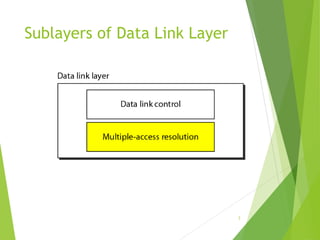
Sublayers of Data Link Layer
3
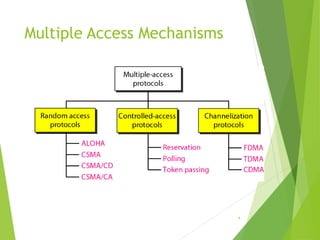
Multiple Access Mechanisms
4
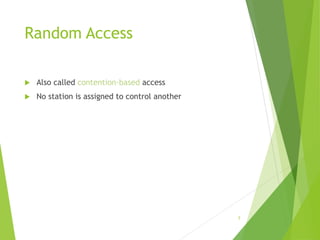
Random Access
 Also called contention-based access
 No station is assigned to control another
5
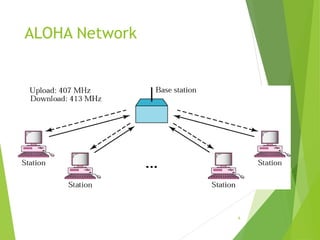
ALOHA Network
6
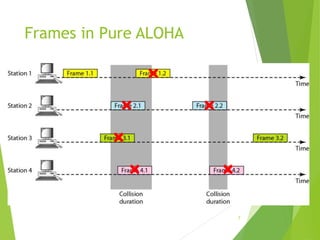
Frames in Pure ALOHA
7
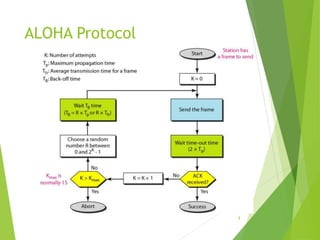
ALOHA Protocol
8
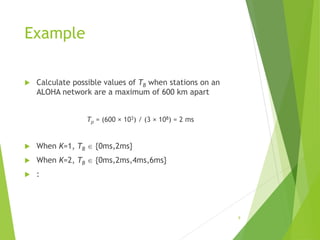
Example
 Calculate possible values of TB when stations on an
ALOHA network are a maximum of 600 km apart
Tp = (600 × 103) / (3 × 10⁸) = 2 ms
 When K=1, TB  {0ms,2ms}
 When K=2, TB  {0ms,2ms,4ms,6ms}
 :
9
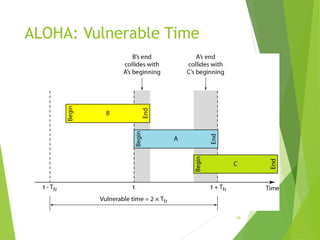
ALOHA: Vulnerable Time
10
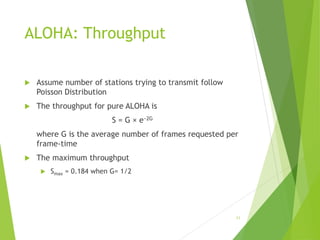
ALOHA: Throughput
 Assume number of stations trying to transmit follow
Poisson Distribution
 The throughput for pure ALOHA is
S = G × e−2G
where G is the average number of frames requested per
frame-time
 The maximum throughput
 Smax = 0.184 when G= 1/2
11
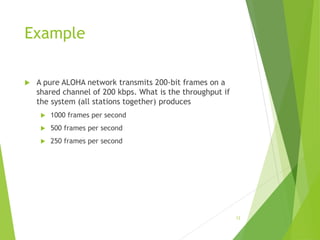
Example
 A pure ALOHA network transmits 200-bit frames on a
shared channel of 200 kbps. What is the throughput if
the system (all stations together) produces
 1000 frames per second
 500 frames per second
 250 frames per second
12
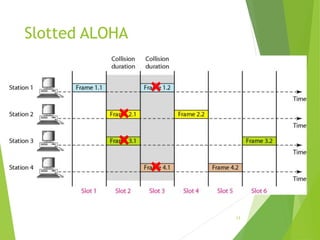
Slotted ALOHA
13
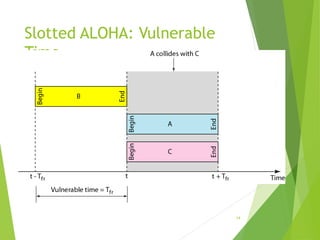
Slotted ALOHA: Vulnerable
Time
14
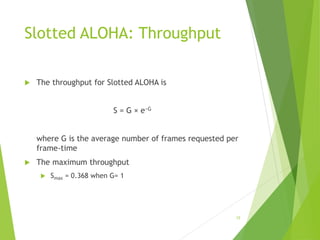
Slotted ALOHA: Throughput
 The throughput for Slotted ALOHA is
S = G × e−G
where G is the average number of frames requested per
frame-time
 The maximum throughput
 Smax = 0.368 when G= 1
15
Example
 A Slotted ALOHA network transmits 200-bit frames on a
shared channel of 200 kbps. What is the throughput if
the system (all stations together) produces
 1000 frames per second
 500 frames per second
 250 frames per second
16

Multiple Access Networking