12.1
Chapter 3.3
Multiple Access
Copyright © The McGraw-Hill Companies, Inc. Permission required for reproduction or display.
12.2
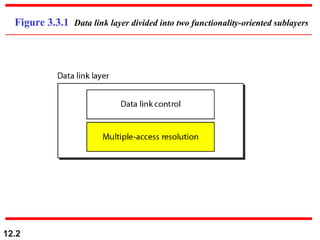
Figure 3.3.1 Data link layer divided into two functionality-oriented sublayers
12.3
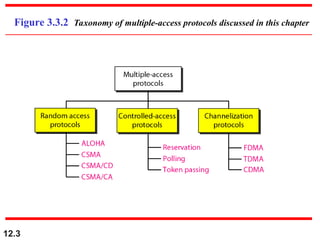
Figure 3.3.2 Taxonomy of multiple-access protocols discussed in this chapter
12.4
3.3-1 RANDOM ACCESS
3.3-1 RANDOM ACCESS
In
In random access
random access or
or contention
contention methods, no station is
methods, no station is
superior to another station and none is assigned the
control over another. No station permits, or does not
permit, another station to send. At each instance, a
station that has data to send uses a procedure defined
by the protocol to make a decision on whether or not to
send.
send.
ALOHA
Carrier Sense Multiple Access
Carrier Sense Multiple Access with Collision Detection
Carrier Sense Multiple Access with Collision Avoidance
Topics discussed in this section:
12.5
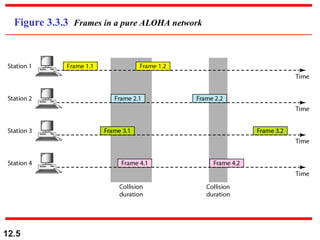
Figure 3.3.3 Frames in a pure ALOHA network
12.6
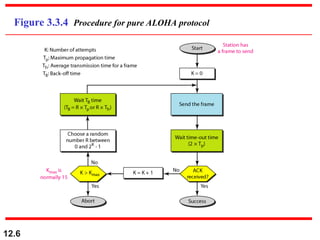
Figure 3.3.4 Procedure for pure ALOHA protocol
12.7
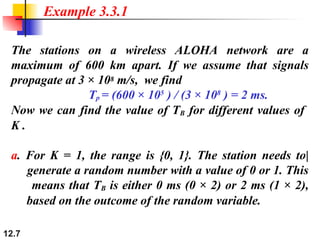
The stations on a wireless ALOHA network are a
maximum of 600 km apart. If we assume that signals
propagate at 3 × 10⁸ m/s, we find
Tp = (600 × 105
) / (3 × 10⁸
) = 2 ms.
Now we can find the value of TB for different values of
K .
a. For K = 1, the range is {0, 1}. The station needs to|
generate a random number with a value of 0 or 1. This
means that TB is either 0 ms (0 × 2) or 2 ms (1 × 2),
based on the outcome of the random variable.
Example 3.3.1
12.8
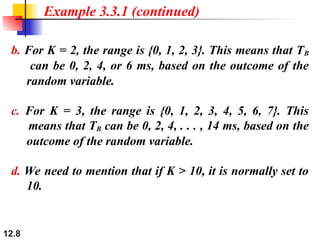
b. For K = 2, the range is {0, 1, 2, 3}. This means that TB
can be 0, 2, 4, or 6 ms, based on the outcome of the
random variable.
c. For K = 3, the range is {0, 1, 2, 3, 4, 5, 6, 7}. This
means that TB can be 0, 2, 4, . . . , 14 ms, based on the
outcome of the random variable.
d. We need to mention that if K > 10, it is normally set to
10.
Example 3.3.1 (continued)
12.9
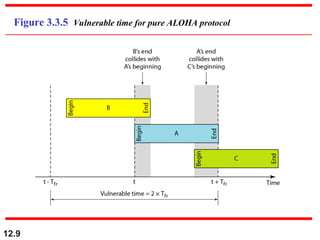
Figure 3.3.5 Vulnerable time for pure ALOHA protocol
12.10
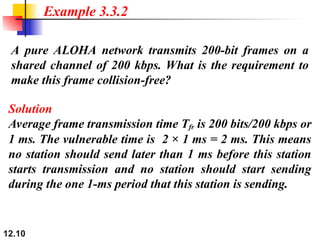
A pure ALOHA network transmits 200-bit frames on a
shared channel of 200 kbps. What is the requirement to
make this frame collision-free?
Example 3.3.2
Solution
Average frame transmission time Tfr is 200 bits/200 kbps or
1 ms. The vulnerable time is 2 × 1 ms = 2 ms. This means
no station should send later than 1 ms before this station
starts transmission and no station should start sending
during the one 1-ms period that this station is sending.
12.11
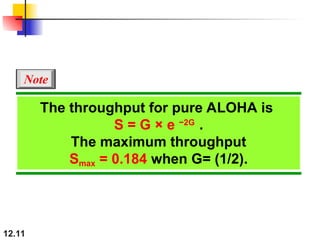
The throughput for pure ALOHA is
S = G × e −2G
.
The maximum throughput
Smax = 0.184 when G= (1/2).
Note
12.12
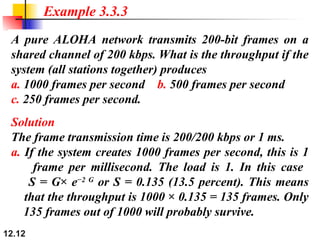
A pure ALOHA network transmits 200-bit frames on a
shared channel of 200 kbps. What is the throughput if the
system (all stations together) produces
a. 1000 frames per second b. 500 frames per second
c. 250 frames per second.
Example 3.3.3
Solution
The frame transmission time is 200/200 kbps or 1 ms.
a. If the system creates 1000 frames per second, this is 1
frame per millisecond. The load is 1. In this case
S = G× e−2 G
or S = 0.135 (13.5 percent). This means
that the throughput is 1000 × 0.135 = 135 frames. Only
135 frames out of 1000 will probably survive.
12.13
Example 3.3.3 (continued)
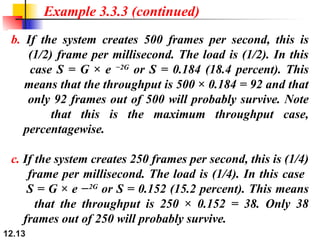
b. If the system creates 500 frames per second, this is
(1/2) frame per millisecond. The load is (1/2). In this
case S = G × e −2G
or S = 0.184 (18.4 percent). This
means that the throughput is 500 × 0.184 = 92 and that
only 92 frames out of 500 will probably survive. Note
that this is the maximum throughput case,
percentagewise.
c. If the system creates 250 frames per second, this is (1/4)
frame per millisecond. The load is (1/4). In this case
S = G × e −2G
or S = 0.152 (15.2 percent). This means
that the throughput is 250 × 0.152 = 38. Only 38
frames out of 250 will probably survive.
12.14
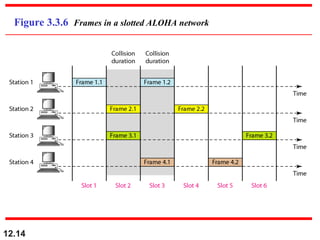
Figure 3.3.6 Frames in a slotted ALOHA network
12.15
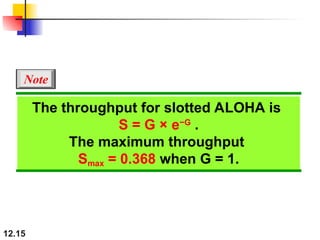
The throughput for slotted ALOHA is
S = G × e−G
.
The maximum throughput
Smax = 0.368 when G = 1.
Note
12.16
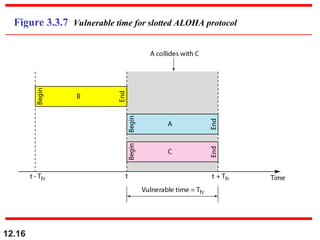
Figure 3.3.7 Vulnerable time for slotted ALOHA protocol
12.17
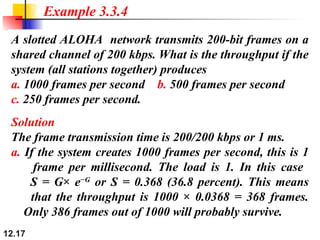
A slotted ALOHA network transmits 200-bit frames on a
shared channel of 200 kbps. What is the throughput if the
system (all stations together) produces
a. 1000 frames per second b. 500 frames per second
c. 250 frames per second.
Example 3.3.4
Solution
The frame transmission time is 200/200 kbps or 1 ms.
a. If the system creates 1000 frames per second, this is 1
frame per millisecond. The load is 1. In this case
S = G× e−G
or S = 0.368 (36.8 percent). This means
that the throughput is 1000 × 0.0368 = 368 frames.
Only 386 frames out of 1000 will probably survive.
12.18
Example 3.3.4 (continued)
b. If the system creates 500 frames per second, this is
(1/2) frame per millisecond. The load is (1/2). In this
case S = G × e−G
or S = 0.303 (30.3 percent). This
means that the throughput is 500 × 0.0303 = 151.
Only 151 frames out of 500 will probably survive.
c. If the system creates 250 frames per second, this is (1/4)
frame per millisecond. The load is (1/4). In this case
S = G × e −G
or S = 0.195 (19.5 percent). This means
that the throughput is 250 × 0.195 = 49. Only 49
frames out of 250 will probably survive.
12.19
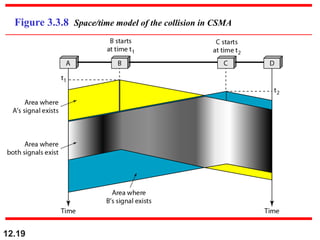
Figure 3.3.8 Space/time model of the collision in CSMA
12.20
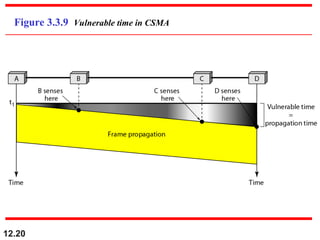
Figure 3.3.9 Vulnerable time in CSMA
12.21
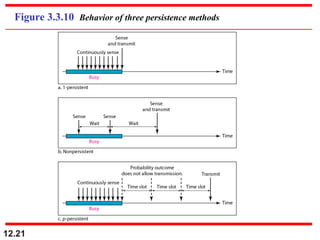
Figure 3.3.10 Behavior of three persistence methods
12.22
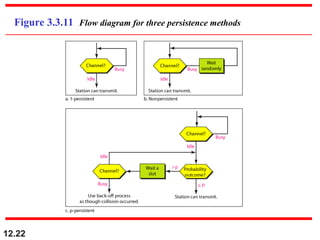
Figure 3.3.11 Flow diagram for three persistence methods
12.23
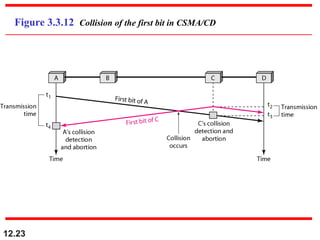
Figure 3.3.12 Collision of the first bit in CSMA/CD
12.24
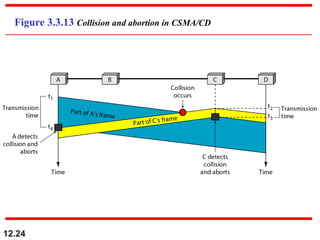
Figure 3.3.13 Collision and abortion in CSMA/CD
12.25
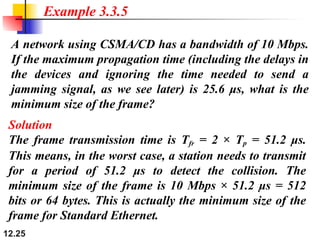
A network using CSMA/CD has a bandwidth of 10 Mbps.
If the maximum propagation time (including the delays in
the devices and ignoring the time needed to send a
jamming signal, as we see later) is 25.6 μs, what is the
minimum size of the frame?
Example 3.3.5
Solution
The frame transmission time is Tfr = 2 × Tp = 51.2 μs.
This means, in the worst case, a station needs to transmit
for a period of 51.2 μs to detect the collision. The
minimum size of the frame is 10 Mbps × 51.2 μs = 512
bits or 64 bytes. This is actually the minimum size of the
frame for Standard Ethernet.
12.26
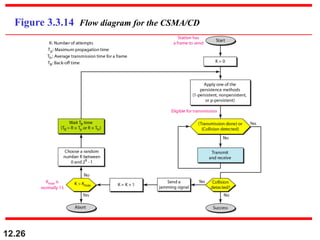
Figure 3.3.14 Flow diagram for the CSMA/CD
12.27
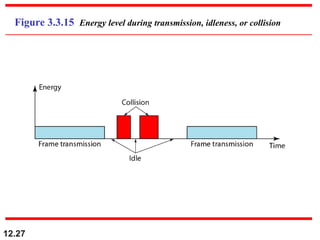
Figure 3.3.15 Energy level during transmission, idleness, or collision
12.28
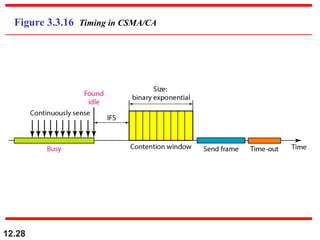
Figure 3.3.16 Timing in CSMA/CA
12.29
In CSMA/CA, the IFS can also be used to
define the priority of a station or a
frame.
Note
12.30
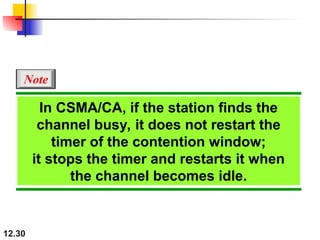
In CSMA/CA, if the station finds the
channel busy, it does not restart the
timer of the contention window;
it stops the timer and restarts it when
the channel becomes idle.
Note
12.31
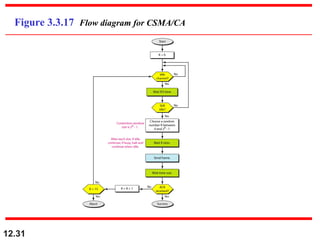
Figure 3.3.17 Flow diagram for CSMA/CA
12.32
3.3-2 CONTROLLED ACCESS
In
In controlled access
controlled access, the stations consult one another
, the stations consult one another
to find which station has the right to send. A station
cannot send unless it has been authorized by other
stations. We discuss three popular controlled-access
methods.
methods.
Reservation
Polling
Token Passing
Topics discussed in this section:
12.33
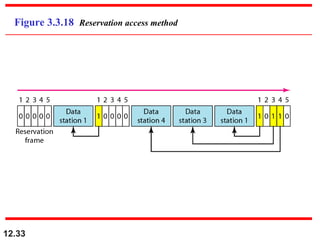
Figure 3.3.18 Reservation access method
12.34
Figure 3.3.19 Select and poll functions in polling access method
12.35
Figure 3.3.20 Logical ring and physical topology in token-passing access method
12.36
3.3-3 CHANNELIZATION
Channelization
Channelization is a multiple-access method in which
is a multiple-access method in which
the available bandwidth of a link is shared in time,
frequency, or through code, between different stations.
In this section, we discuss three channelization
protocols.
protocols.
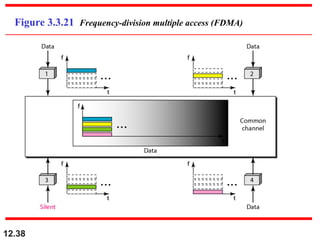
Frequency-Division Multiple Access (FDMA)
Time-Division Multiple Access (TDMA)
Code-Division Multiple Access (CDMA)
Topics discussed in this section:
12.37
We see the application of all these
methods in Chapter 16 when
we discuss cellular phone systems.
Note
12.38
Figure 3.3.21 Frequency-division multiple access (FDMA)
12.39
In FDMA, the available bandwidth
of the common channel is divided into
bands that are separated by guard
bands.
Note
12.40
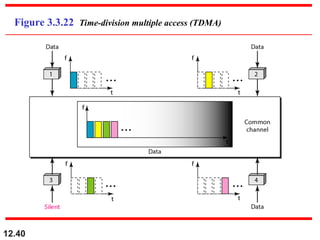
Figure 3.3.22 Time-division multiple access (TDMA)
12.41
In TDMA, the bandwidth is just one
channel that is timeshared between
different stations.
Note
12.42
In CDMA, one channel carries all
transmissions simultaneously.
Note
12.43
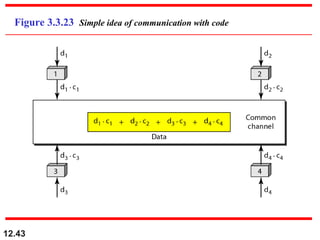
Figure 3.3.23 Simple idea of communication with code
12.44
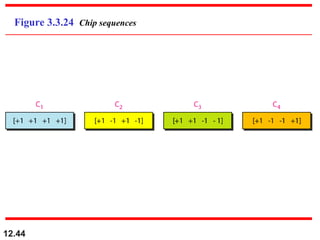
Figure 3.3.24 Chip sequences
12.45
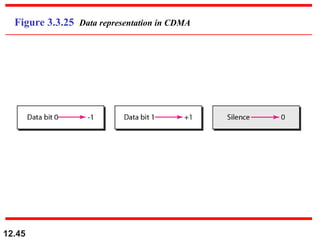
Figure 3.3.25 Data representation in CDMA
12.46
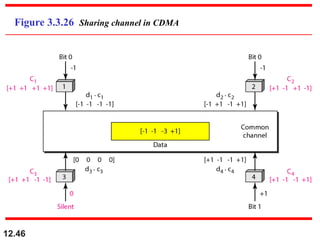
Figure 3.3.26 Sharing channel in CDMA
12.47
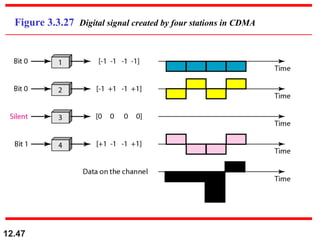
Figure 3.3.27 Digital signal created by four stations in CDMA
12.48
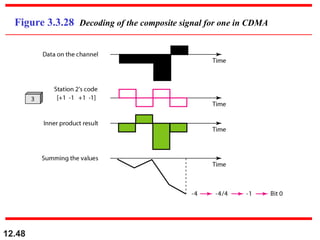
Figure 3.3.28 Decoding of the composite signal for one in CDMA
12.49
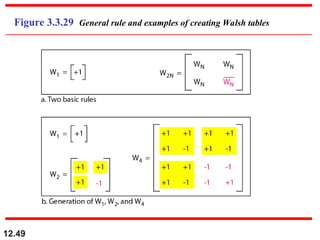
Figure 3.3.29 General rule and examples of creating Walsh tables
12.50
The number of sequences in a Walsh
table needs to be N = 2m
.
Note
12.51
Find the chips for a network with
a. Two stations b. Four stations
Example 3.3.6
Solution
We can use the rows of W2 and W4 in Figure 12.29:
a. For a two-station network, we have
[+1 +1] and [+1 −1].
b. For a four-station network we have
[+1 +1 +1 +1], [+1 −1 +1 −1],
[+1 +1 −1 −1], and [+1 −1 −1 +1].
12.52
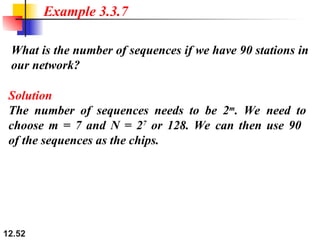
What is the number of sequences if we have 90 stations in
our network?
Example 3.3.7
Solution
The number of sequences needs to be 2m
. We need to
choose m = 7 and N = 27
or 128. We can then use 90
of the sequences as the chips.
12.53
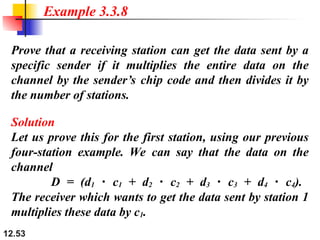
Prove that a receiving station can get the data sent by a
specific sender if it multiplies the entire data on the
channel by the sender’s chip code and then divides it by
the number of stations.
Example 3.3.8
Solution
Let us prove this for the first station, using our previous
four-station example. We can say that the data on the
channel
D = (d1 c
⋅ 1 + d2 c
⋅ 2 + d3 c
⋅ 3 + d4 c
⋅ 4).
The receiver which wants to get the data sent by station 1
multiplies these data by c1.
12.54
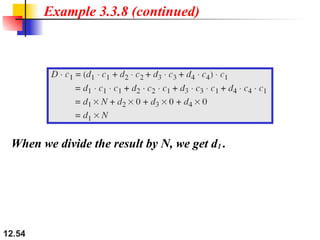
Example 3.3.8 (continued)
When we divide the result by N, we get d1 .

Lesson 3.3 Multiple Access.pptLesson_3.2- Data-link-Control.ppt

  • 1.
    12.1 Chapter 3.3 Multiple Access Copyright© The McGraw-Hill Companies, Inc. Permission required for reproduction or display.
  • 2.
    12.2 Figure 3.3.1 Datalink layer divided into two functionality-oriented sublayers
  • 3.
    12.3 Figure 3.3.2 Taxonomyof multiple-access protocols discussed in this chapter
  • 4.
    12.4 3.3-1 RANDOM ACCESS 3.3-1RANDOM ACCESS In In random access random access or or contention contention methods, no station is methods, no station is superior to another station and none is assigned the superior to another station and none is assigned the control over another. No station permits, or does not control over another. No station permits, or does not permit, another station to send. At each instance, a permit, another station to send. At each instance, a station that has data to send uses a procedure defined station that has data to send uses a procedure defined by the protocol to make a decision on whether or not to by the protocol to make a decision on whether or not to send. send. ALOHA Carrier Sense Multiple Access Carrier Sense Multiple Access with Collision Detection Carrier Sense Multiple Access with Collision Avoidance Topics discussed in this section: Topics discussed in this section:
  • 5.
    12.5 Figure 3.3.3 Framesin a pure ALOHA network
  • 6.
    12.6 Figure 3.3.4 Procedurefor pure ALOHA protocol
  • 7.
    12.7 The stations ona wireless ALOHA network are a maximum of 600 km apart. If we assume that signals propagate at 3 × 10⁸ m/s, we find Tp = (600 × 105 ) / (3 × 10⁸ ) = 2 ms. Now we can find the value of TB for different values of K . a. For K = 1, the range is {0, 1}. The station needs to| generate a random number with a value of 0 or 1. This means that TB is either 0 ms (0 × 2) or 2 ms (1 × 2), based on the outcome of the random variable. Example 3.3.1
  • 8.
    12.8 b. For K= 2, the range is {0, 1, 2, 3}. This means that TB can be 0, 2, 4, or 6 ms, based on the outcome of the random variable. c. For K = 3, the range is {0, 1, 2, 3, 4, 5, 6, 7}. This means that TB can be 0, 2, 4, . . . , 14 ms, based on the outcome of the random variable. d. We need to mention that if K > 10, it is normally set to 10. Example 3.3.1 (continued)
  • 9.
    12.9 Figure 3.3.5 Vulnerabletime for pure ALOHA protocol
  • 10.
    12.10 A pure ALOHAnetwork transmits 200-bit frames on a shared channel of 200 kbps. What is the requirement to make this frame collision-free? Example 3.3.2 Solution Average frame transmission time Tfr is 200 bits/200 kbps or 1 ms. The vulnerable time is 2 × 1 ms = 2 ms. This means no station should send later than 1 ms before this station starts transmission and no station should start sending during the one 1-ms period that this station is sending.
  • 11.
    12.11 The throughput forpure ALOHA is S = G × e −2G . The maximum throughput Smax = 0.184 when G= (1/2). Note
  • 12.
    12.12 A pure ALOHAnetwork transmits 200-bit frames on a shared channel of 200 kbps. What is the throughput if the system (all stations together) produces a. 1000 frames per second b. 500 frames per second c. 250 frames per second. Example 3.3.3 Solution The frame transmission time is 200/200 kbps or 1 ms. a. If the system creates 1000 frames per second, this is 1 frame per millisecond. The load is 1. In this case S = G× e−2 G or S = 0.135 (13.5 percent). This means that the throughput is 1000 × 0.135 = 135 frames. Only 135 frames out of 1000 will probably survive.
  • 13.
    12.13 Example 3.3.3 (continued) b.If the system creates 500 frames per second, this is (1/2) frame per millisecond. The load is (1/2). In this case S = G × e −2G or S = 0.184 (18.4 percent). This means that the throughput is 500 × 0.184 = 92 and that only 92 frames out of 500 will probably survive. Note that this is the maximum throughput case, percentagewise. c. If the system creates 250 frames per second, this is (1/4) frame per millisecond. The load is (1/4). In this case S = G × e −2G or S = 0.152 (15.2 percent). This means that the throughput is 250 × 0.152 = 38. Only 38 frames out of 250 will probably survive.
  • 14.
    12.14 Figure 3.3.6 Framesin a slotted ALOHA network
  • 15.
    12.15 The throughput forslotted ALOHA is S = G × e−G . The maximum throughput Smax = 0.368 when G = 1. Note
  • 16.
    12.16 Figure 3.3.7 Vulnerabletime for slotted ALOHA protocol
  • 17.
    12.17 A slotted ALOHAnetwork transmits 200-bit frames on a shared channel of 200 kbps. What is the throughput if the system (all stations together) produces a. 1000 frames per second b. 500 frames per second c. 250 frames per second. Example 3.3.4 Solution The frame transmission time is 200/200 kbps or 1 ms. a. If the system creates 1000 frames per second, this is 1 frame per millisecond. The load is 1. In this case S = G× e−G or S = 0.368 (36.8 percent). This means that the throughput is 1000 × 0.0368 = 368 frames. Only 386 frames out of 1000 will probably survive.
  • 18.
    12.18 Example 3.3.4 (continued) b.If the system creates 500 frames per second, this is (1/2) frame per millisecond. The load is (1/2). In this case S = G × e−G or S = 0.303 (30.3 percent). This means that the throughput is 500 × 0.0303 = 151. Only 151 frames out of 500 will probably survive. c. If the system creates 250 frames per second, this is (1/4) frame per millisecond. The load is (1/4). In this case S = G × e −G or S = 0.195 (19.5 percent). This means that the throughput is 250 × 0.195 = 49. Only 49 frames out of 250 will probably survive.
  • 19.
    12.19 Figure 3.3.8 Space/timemodel of the collision in CSMA
  • 20.
  • 21.
    12.21 Figure 3.3.10 Behaviorof three persistence methods
  • 22.
    12.22 Figure 3.3.11 Flowdiagram for three persistence methods
  • 23.
    12.23 Figure 3.3.12 Collisionof the first bit in CSMA/CD
  • 24.
    12.24 Figure 3.3.13 Collisionand abortion in CSMA/CD
  • 25.
    12.25 A network usingCSMA/CD has a bandwidth of 10 Mbps. If the maximum propagation time (including the delays in the devices and ignoring the time needed to send a jamming signal, as we see later) is 25.6 μs, what is the minimum size of the frame? Example 3.3.5 Solution The frame transmission time is Tfr = 2 × Tp = 51.2 μs. This means, in the worst case, a station needs to transmit for a period of 51.2 μs to detect the collision. The minimum size of the frame is 10 Mbps × 51.2 μs = 512 bits or 64 bytes. This is actually the minimum size of the frame for Standard Ethernet.
  • 26.
    12.26 Figure 3.3.14 Flowdiagram for the CSMA/CD
  • 27.
    12.27 Figure 3.3.15 Energylevel during transmission, idleness, or collision
  • 28.
  • 29.
    12.29 In CSMA/CA, theIFS can also be used to define the priority of a station or a frame. Note
  • 30.
    12.30 In CSMA/CA, ifthe station finds the channel busy, it does not restart the timer of the contention window; it stops the timer and restarts it when the channel becomes idle. Note
  • 31.
    12.31 Figure 3.3.17 Flowdiagram for CSMA/CA
  • 32.
    12.32 3.3-2 CONTROLLED ACCESS 3.3-2CONTROLLED ACCESS In In controlled access controlled access, the stations consult one another , the stations consult one another to find which station has the right to send. A station to find which station has the right to send. A station cannot send unless it has been authorized by other cannot send unless it has been authorized by other stations. We discuss three popular controlled-access stations. We discuss three popular controlled-access methods. methods. Reservation Polling Token Passing Topics discussed in this section: Topics discussed in this section:
  • 33.
  • 34.
    12.34 Figure 3.3.19 Selectand poll functions in polling access method
  • 35.
    12.35 Figure 3.3.20 Logicalring and physical topology in token-passing access method
  • 36.
    12.36 3.3-3 CHANNELIZATION 3.3-3 CHANNELIZATION Channelization Channelizationis a multiple-access method in which is a multiple-access method in which the available bandwidth of a link is shared in time, the available bandwidth of a link is shared in time, frequency, or through code, between different stations. frequency, or through code, between different stations. In this section, we discuss three channelization In this section, we discuss three channelization protocols. protocols. Frequency-Division Multiple Access (FDMA) Time-Division Multiple Access (TDMA) Code-Division Multiple Access (CDMA) Topics discussed in this section: Topics discussed in this section:
  • 37.
    12.37 We see theapplication of all these methods in Chapter 16 when we discuss cellular phone systems. Note
  • 38.
  • 39.
    12.39 In FDMA, theavailable bandwidth of the common channel is divided into bands that are separated by guard bands. Note
  • 40.
    12.40 Figure 3.3.22 Time-divisionmultiple access (TDMA)
  • 41.
    12.41 In TDMA, thebandwidth is just one channel that is timeshared between different stations. Note
  • 42.
    12.42 In CDMA, onechannel carries all transmissions simultaneously. Note
  • 43.
    12.43 Figure 3.3.23 Simpleidea of communication with code
  • 44.
  • 45.
    12.45 Figure 3.3.25 Datarepresentation in CDMA
  • 46.
  • 47.
    12.47 Figure 3.3.27 Digitalsignal created by four stations in CDMA
  • 48.
    12.48 Figure 3.3.28 Decodingof the composite signal for one in CDMA
  • 49.
    12.49 Figure 3.3.29 Generalrule and examples of creating Walsh tables
  • 50.
    12.50 The number ofsequences in a Walsh table needs to be N = 2m . Note
  • 51.
    12.51 Find the chipsfor a network with a. Two stations b. Four stations Example 3.3.6 Solution We can use the rows of W2 and W4 in Figure 12.29: a. For a two-station network, we have [+1 +1] and [+1 −1]. b. For a four-station network we have [+1 +1 +1 +1], [+1 −1 +1 −1], [+1 +1 −1 −1], and [+1 −1 −1 +1].
  • 52.
    12.52 What is thenumber of sequences if we have 90 stations in our network? Example 3.3.7 Solution The number of sequences needs to be 2m . We need to choose m = 7 and N = 27 or 128. We can then use 90 of the sequences as the chips.
  • 53.
    12.53 Prove that areceiving station can get the data sent by a specific sender if it multiplies the entire data on the channel by the sender’s chip code and then divides it by the number of stations. Example 3.3.8 Solution Let us prove this for the first station, using our previous four-station example. We can say that the data on the channel D = (d1 c ⋅ 1 + d2 c ⋅ 2 + d3 c ⋅ 3 + d4 c ⋅ 4). The receiver which wants to get the data sent by station 1 multiplies these data by c1.
  • 54.
    12.54 Example 3.3.8 (continued) Whenwe divide the result by N, we get d1 .