Medium access control methods from fixed networks like CSMA/CD may not work well for wireless networks due to signal strength degradation over distance and hidden and exposed terminal problems. Various MAC protocols were developed for wireless including TDMA, FDMA, polling, and random access methods like Aloha and its variants. Later protocols use signaling messages to reserve channels and avoid collisions, like MACA which uses RTS/CTS messages.
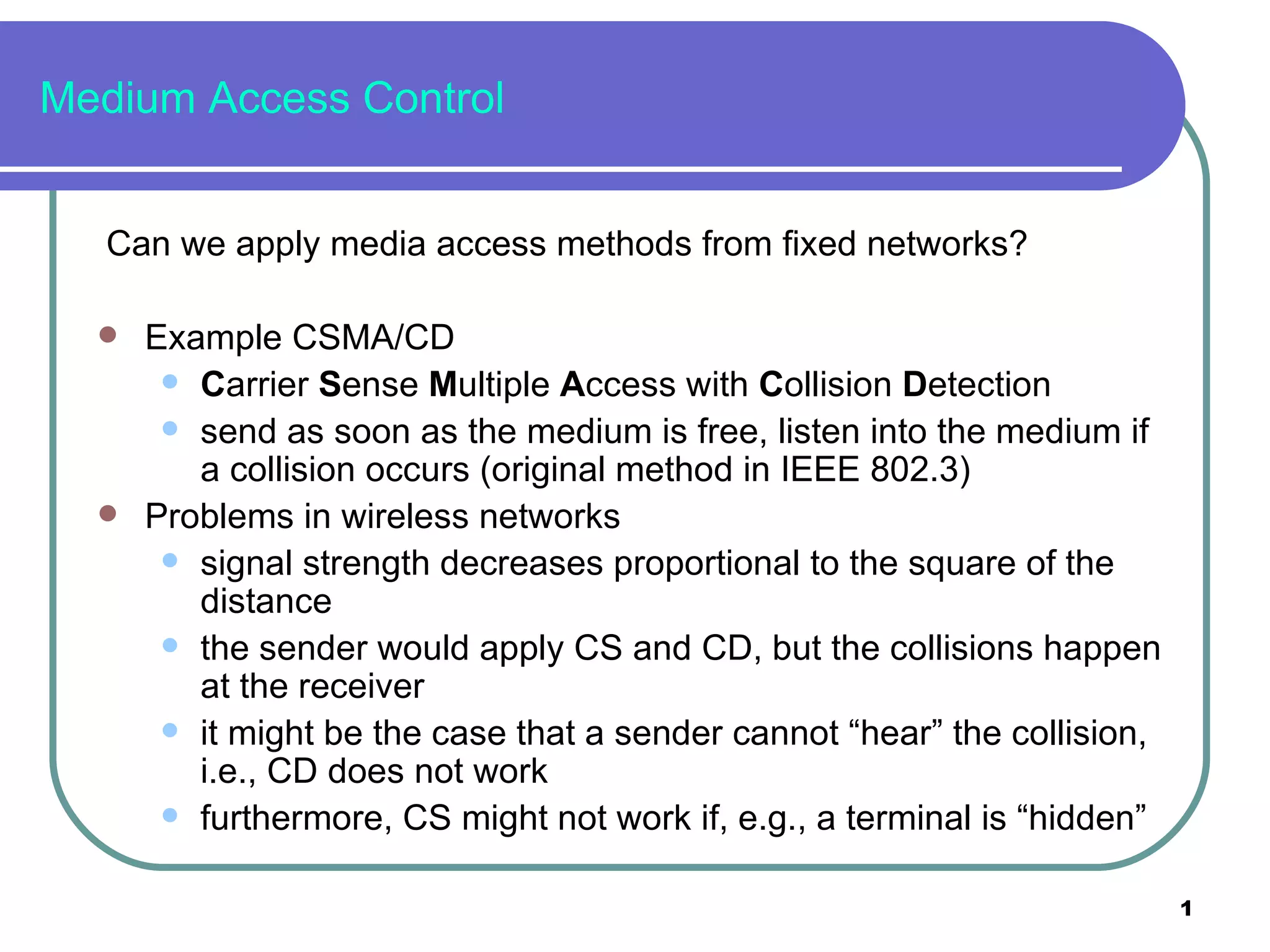
Medium Access ControlCan we apply media access methods from fixed networks? Example CSMA/CD C arrier S ense M ultiple A ccess with C ollision D etection send as soon as the medium is free, listen into the medium if a collision occurs (original method in IEEE 802.3) Problems in wireless networks signal strength decreases proportional to the square of the distance the sender would apply CS and CD, but the collisions happen at the receiver it might be the case that a sender cannot “hear” the collision, i.e., CD does not work furthermore, CS might not work if, e.g., a terminal is “hidden”
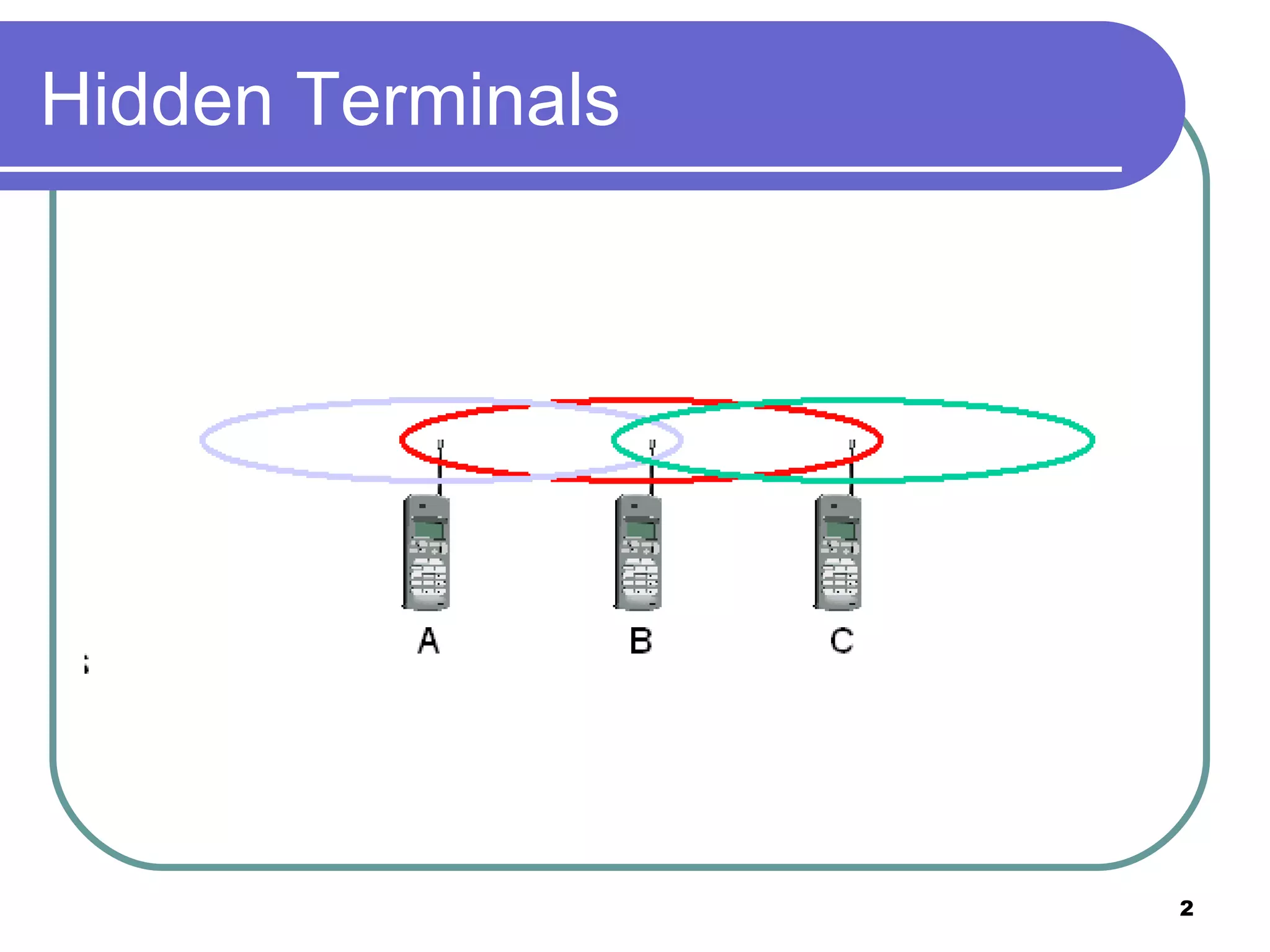
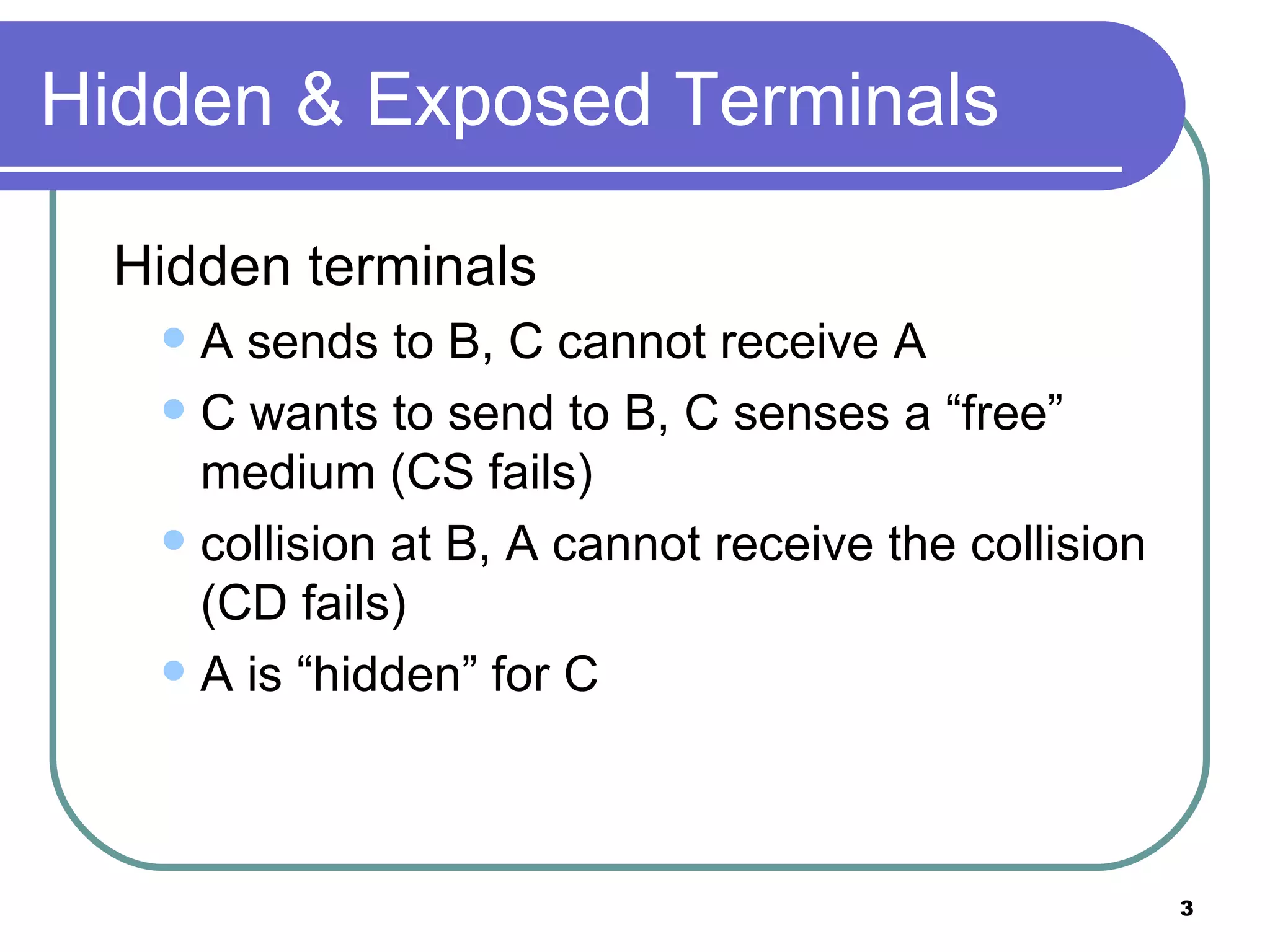
Hidden & ExposedTerminals Hidden terminals A sends to B, C cannot receive A C wants to send to B, C senses a “free” medium (CS fails) collision at B, A cannot receive the collision (CD fails) A is “hidden” for C
4.
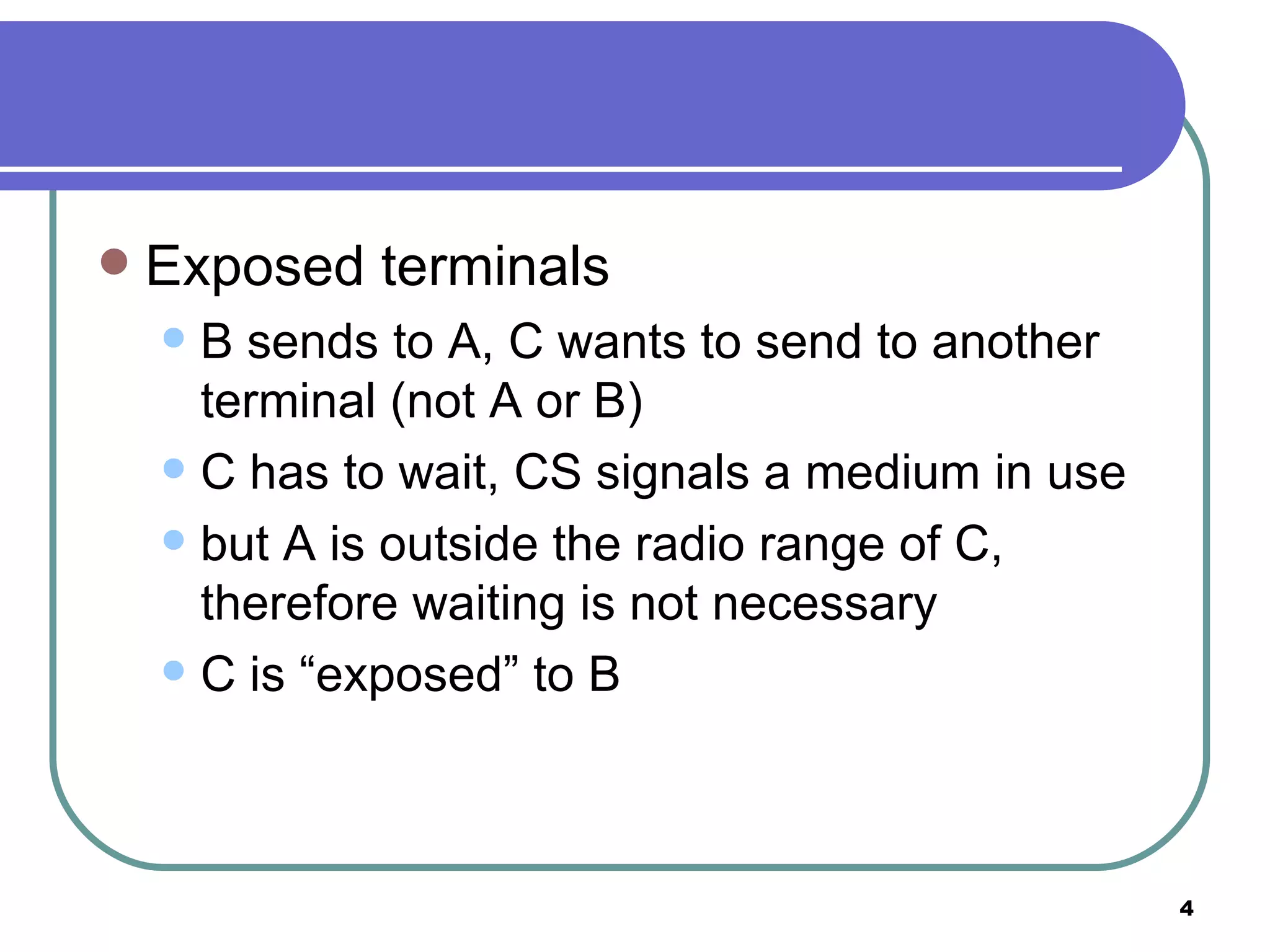
Exposed terminals Bsends to A, C wants to send to another terminal (not A or B) C has to wait, CS signals a medium in use but A is outside the radio range of C, therefore waiting is not necessary C is “exposed” to B
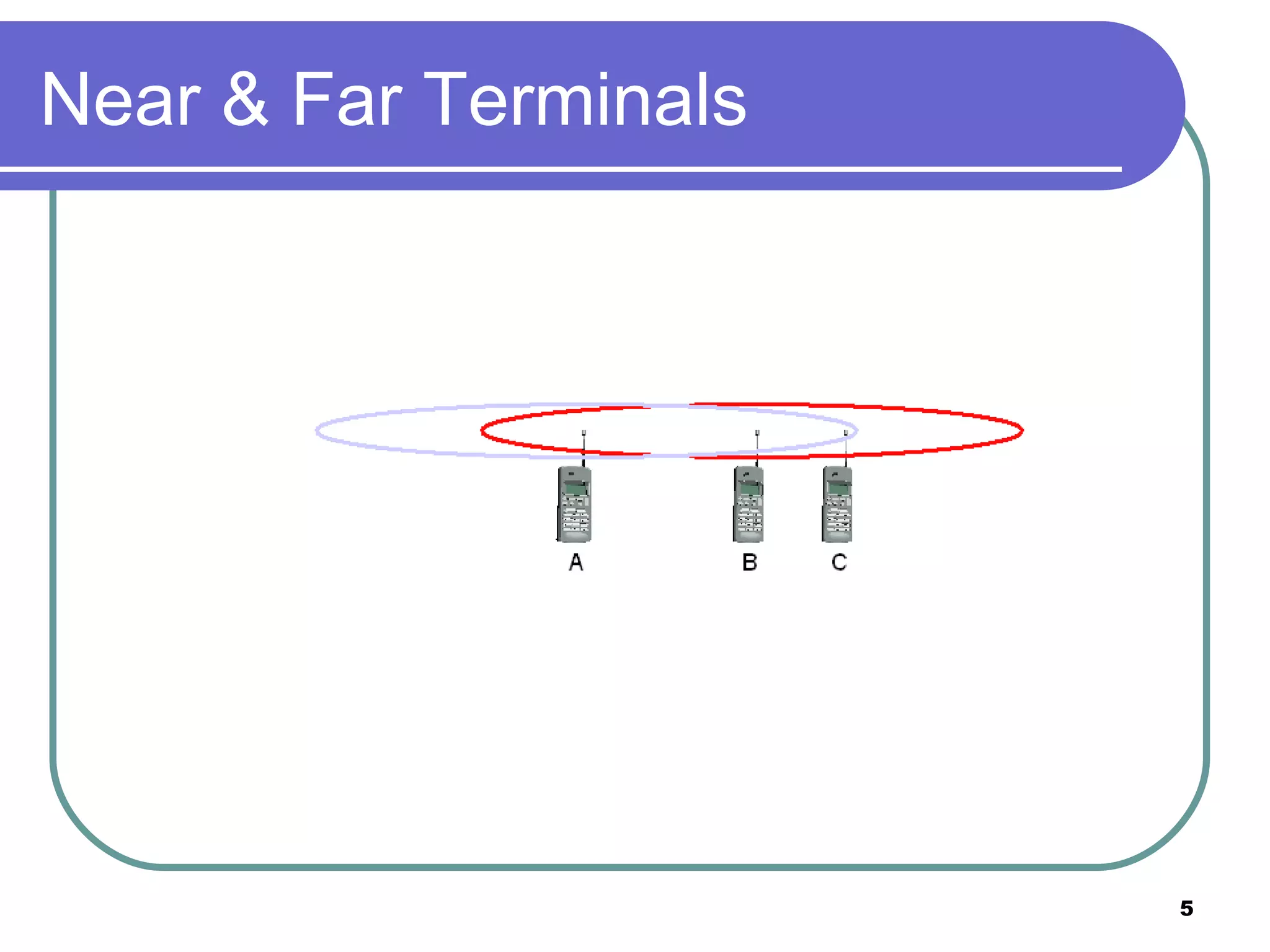
Near & FarTerminals Terminals A and B send, C receives signal strength decreases proportional to the square of the distance the signal of terminal B therefore drowns out A’s signal C cannot receive A
7.
Near & FarTerminals If C for example was an arbiter for sending rights, terminal B would drown out terminal A already on the physical layer Also severe problem for CDMA-networks - precise power control needed!
8.
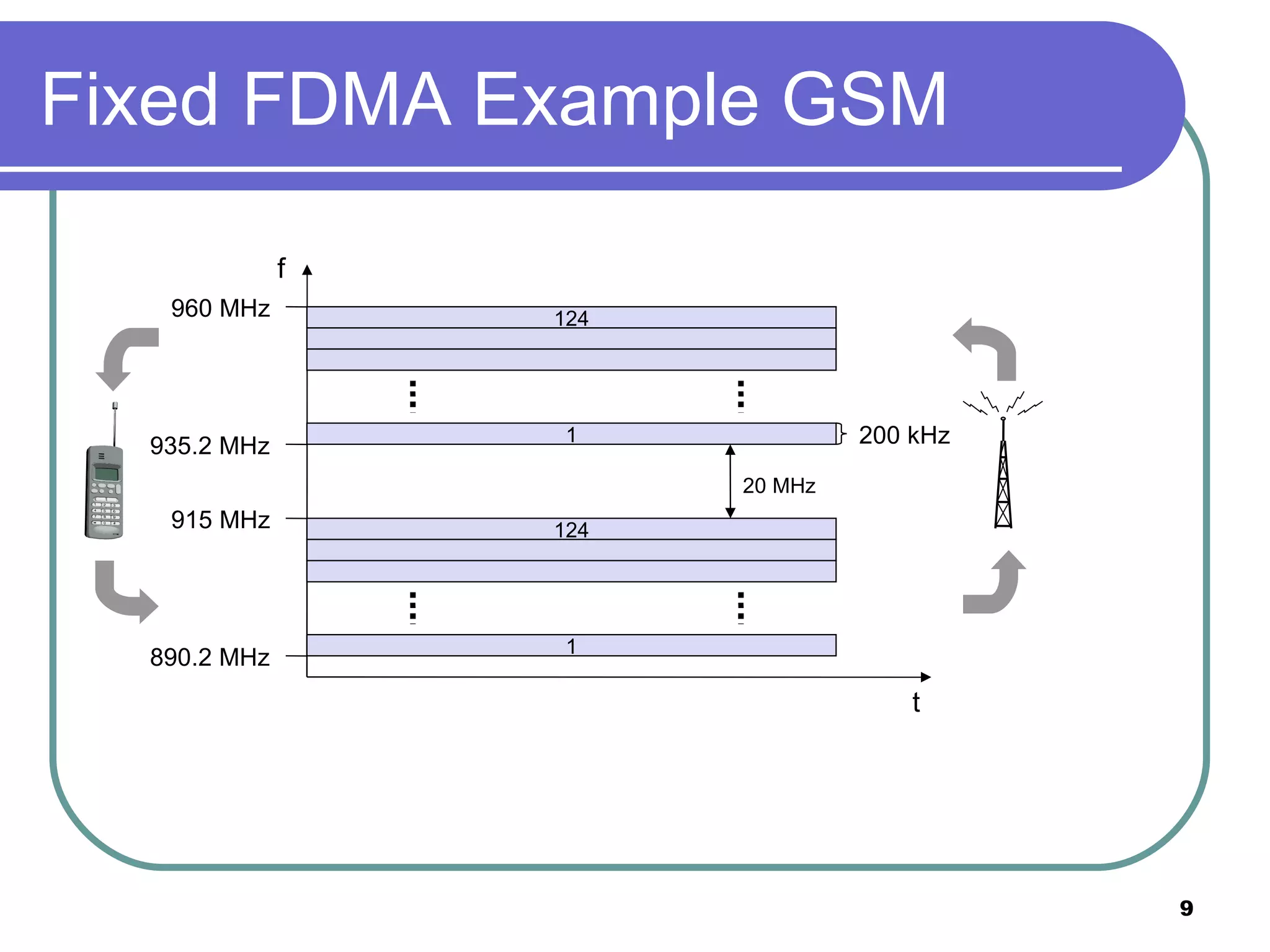
Access methods SDMA/FDMA/TDMA SDMA (Space Division Multiple Access) segment space into sectors, use directed antennas cell structure FDMA (Frequency Division Multiple Access) assign a certain frequency to a transmission channel between a sender and a receiver permanent (e.g., radio broadcast), slow hopping (e.g., GSM), fast hopping (FHSS, Frequency Hopping Spread Spectrum) TDMA (Time Division Multiple Access) assign the fixed sending frequency to a transmission channel between a sender and a receiver for a certain amount of time
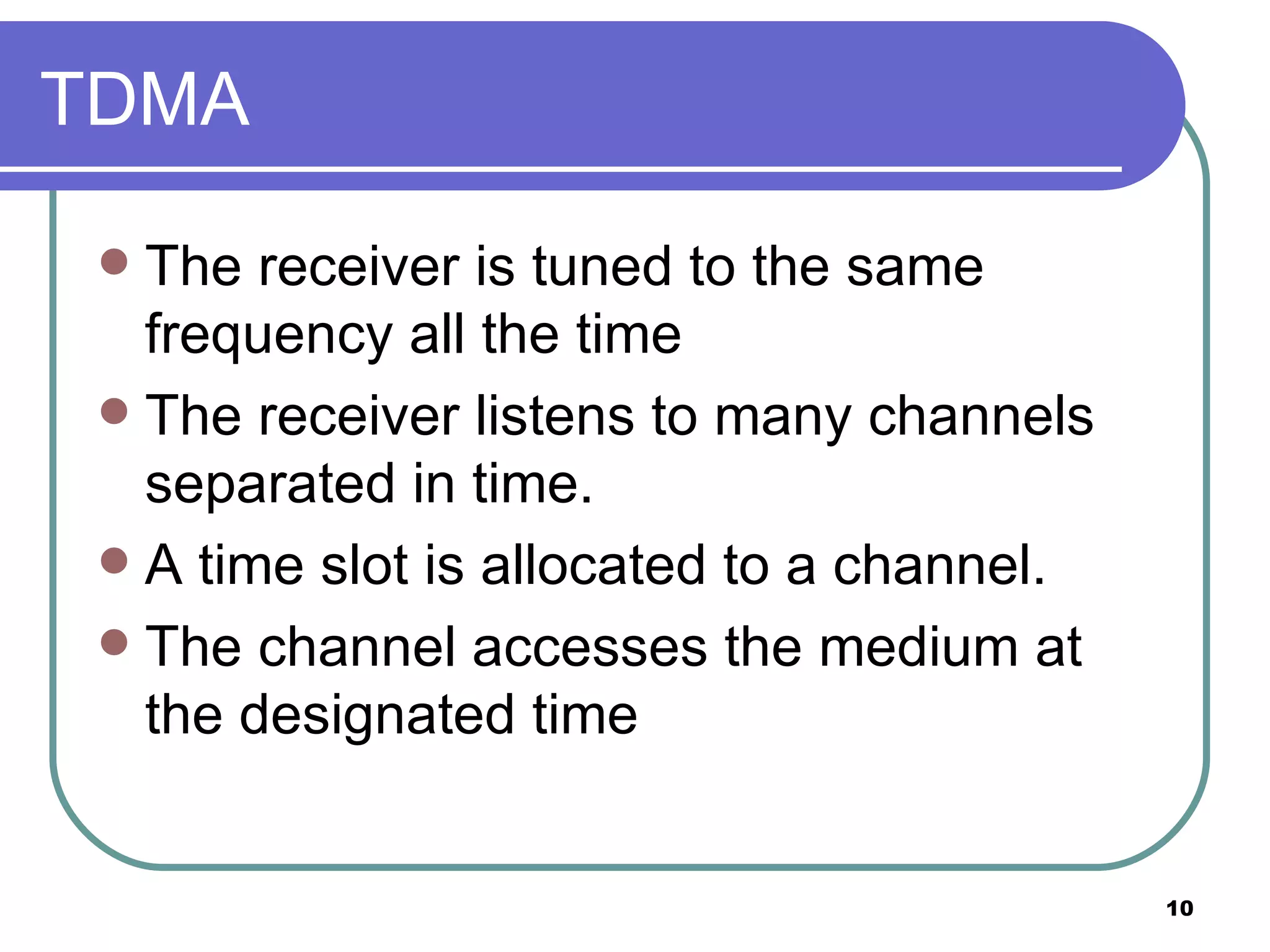
TDMA The receiveris tuned to the same frequency all the time The receiver listens to many channels separated in time. A time slot is allocated to a channel. The channel accesses the medium at the designated time
11.
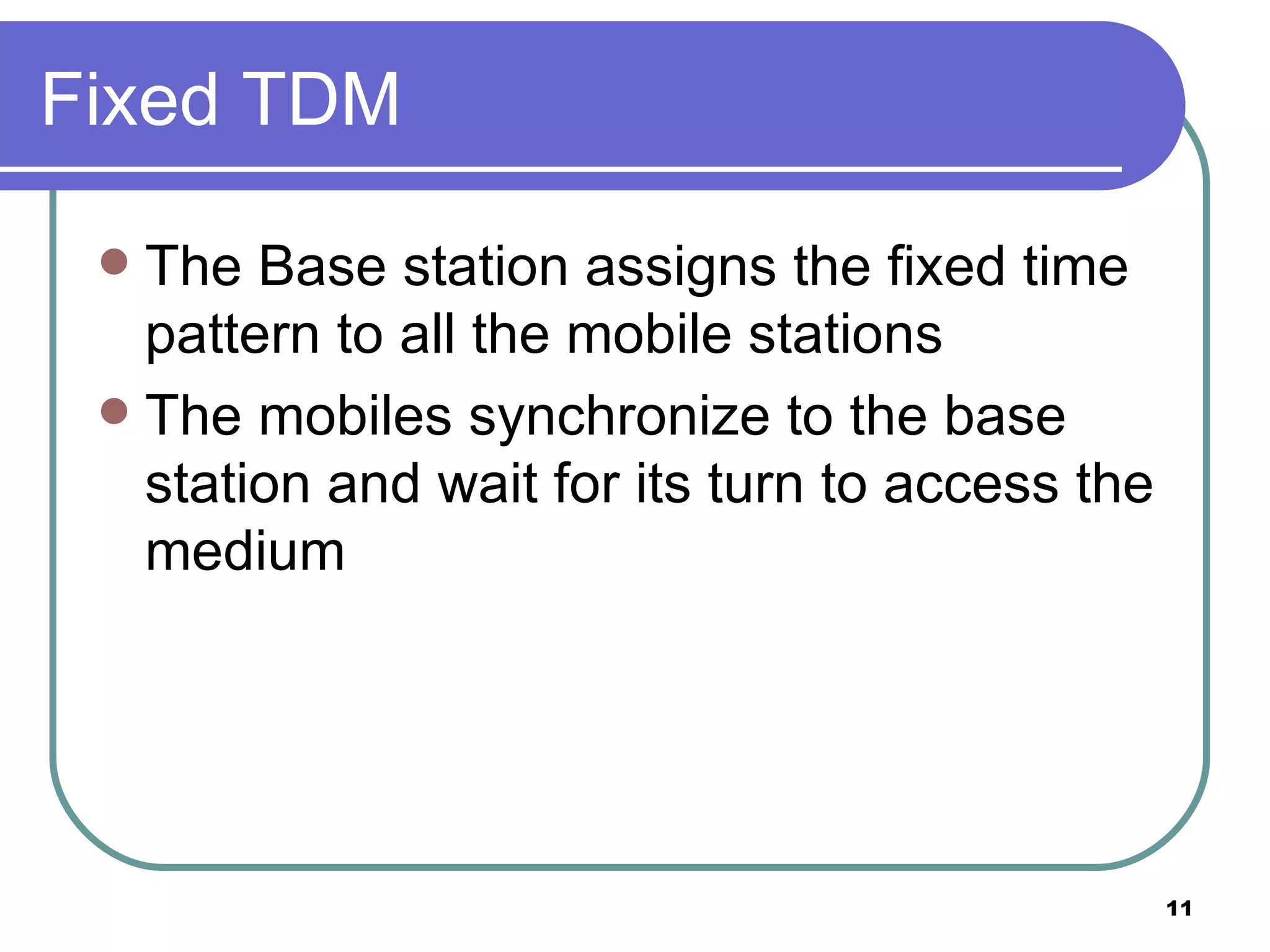
Fixed TDM TheBase station assigns the fixed time pattern to all the mobile stations The mobiles synchronize to the base station and wait for its turn to access the medium
12.
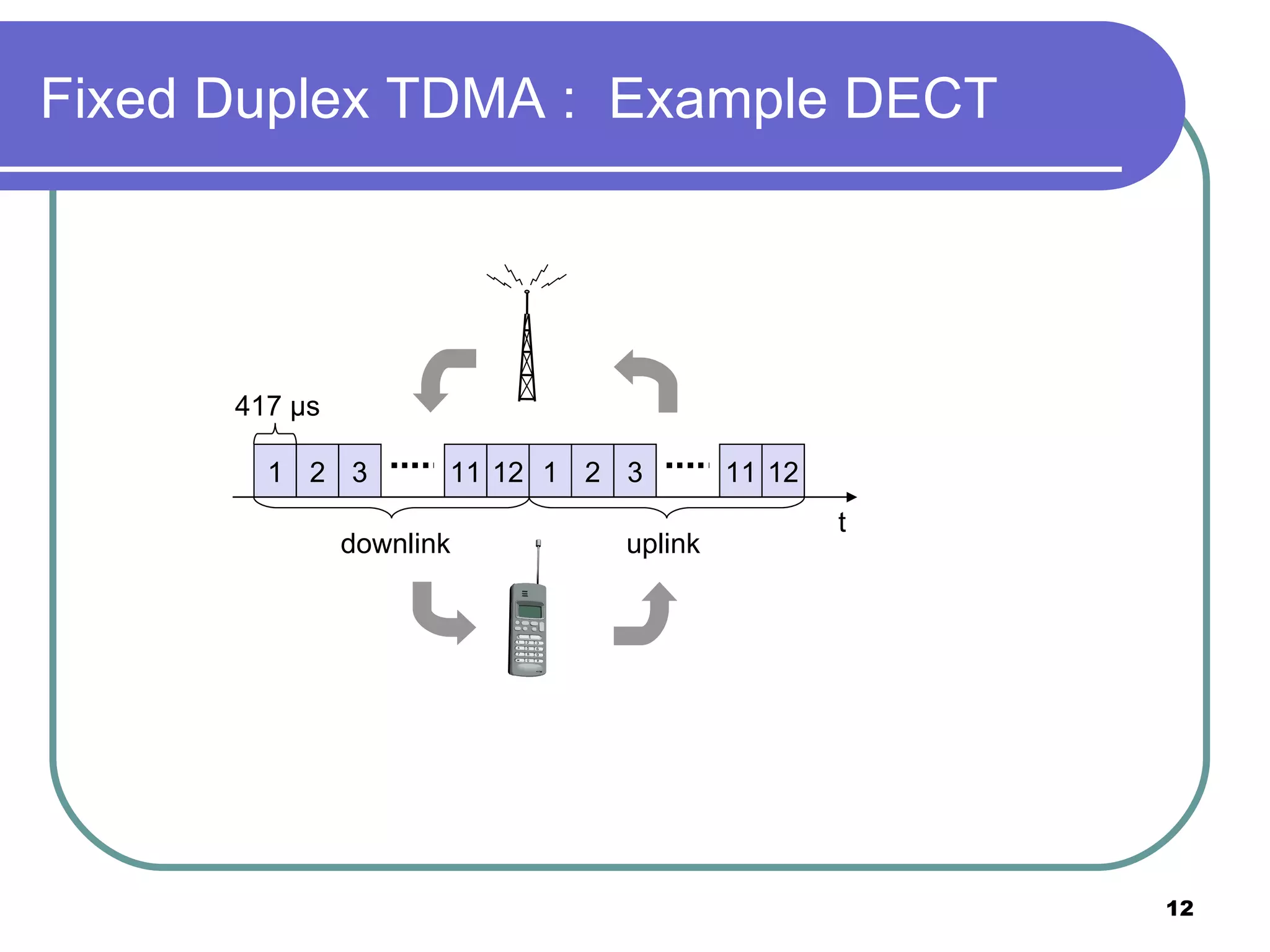
Fixed Duplex TDMA: Example DECT 1 2 3 11 12 1 2 3 11 12 t downlink uplink 417 µs
13.
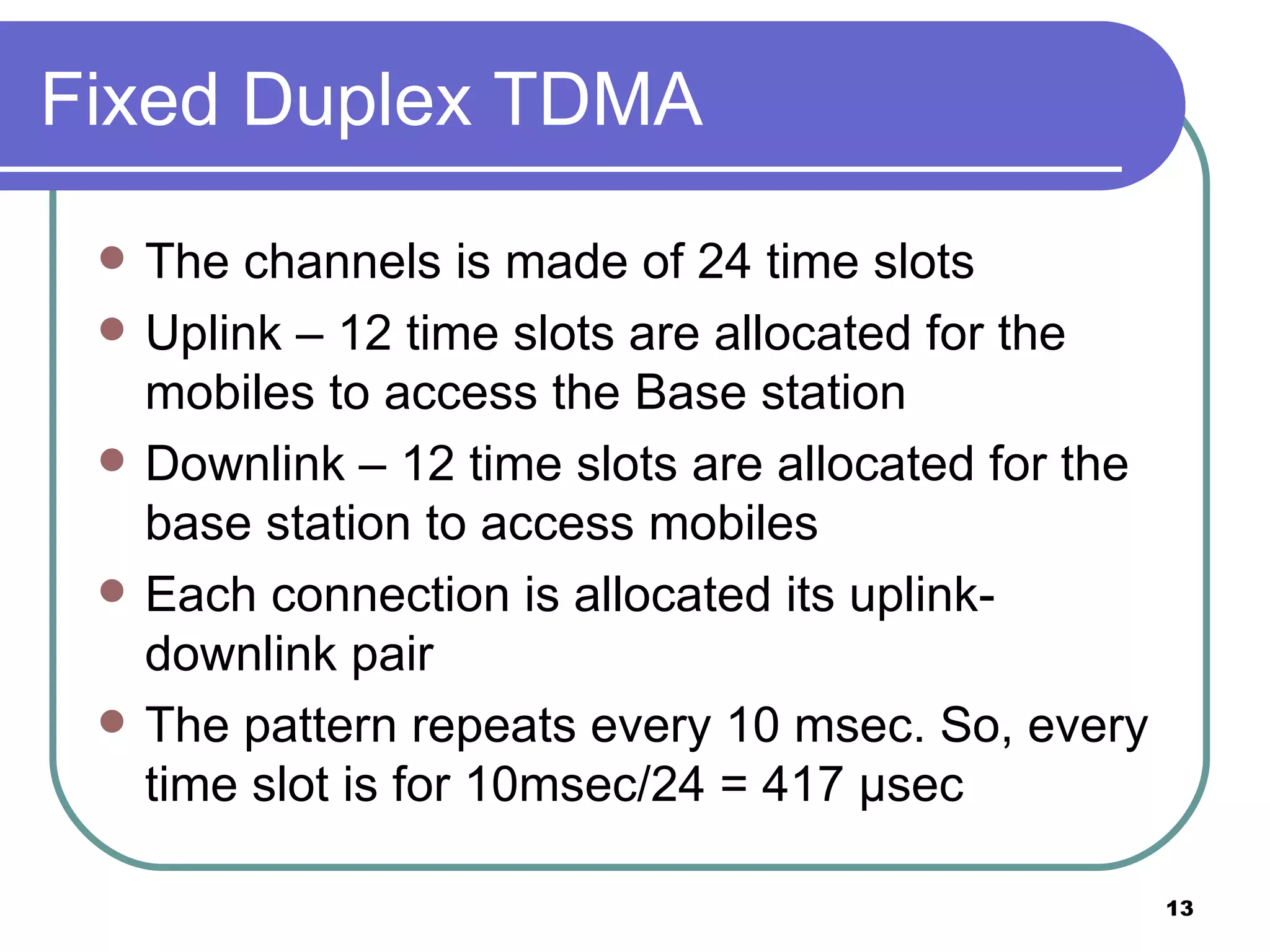
Fixed Duplex TDMAThe channels is made of 24 time slots Uplink – 12 time slots are allocated for the mobiles to access the Base station Downlink – 12 time slots are allocated for the base station to access mobiles Each connection is allocated its uplink-downlink pair The pattern repeats every 10 msec. So, every time slot is for 10msec/24 = 417 μ sec
14.
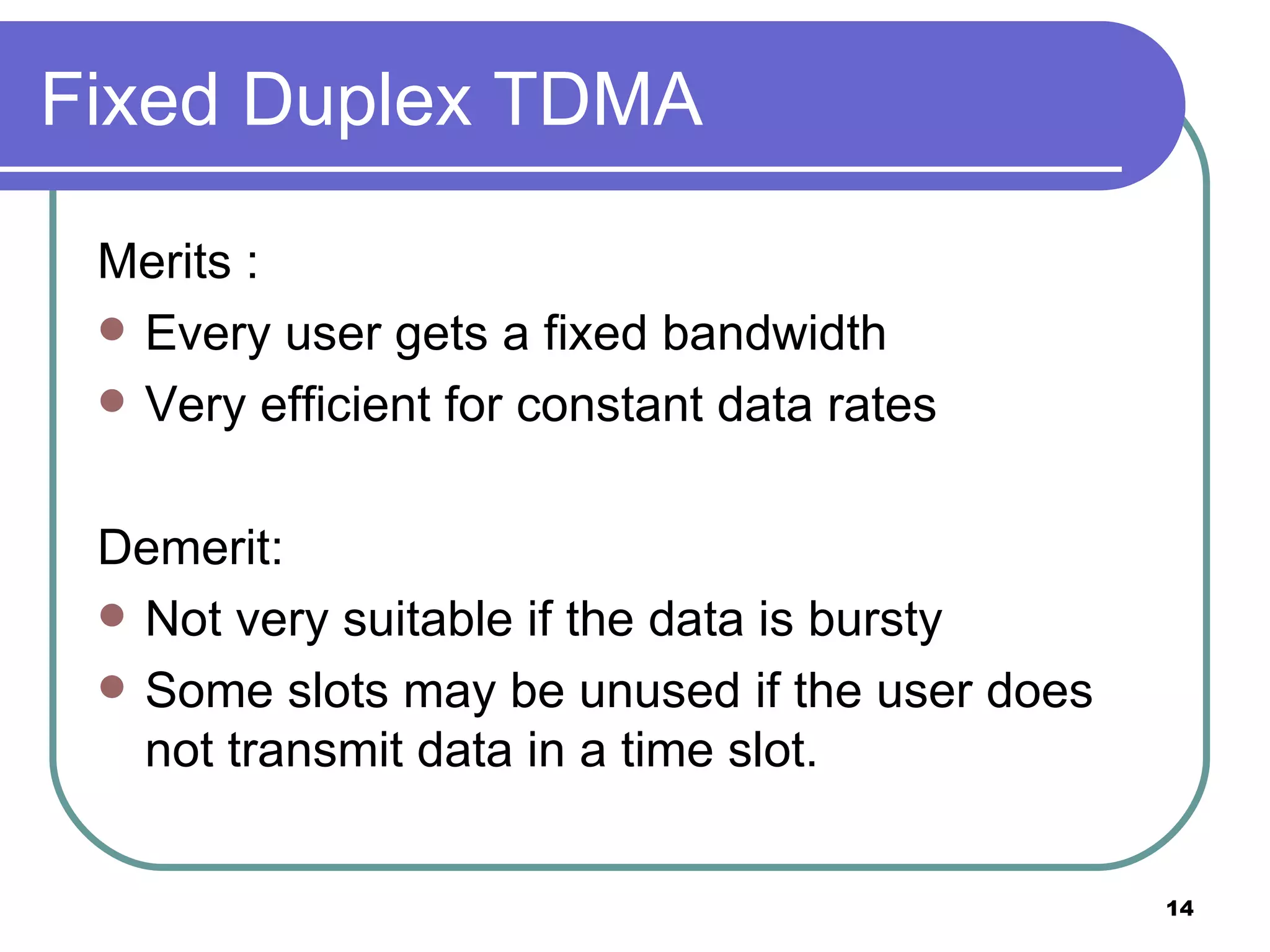
Fixed Duplex TDMAMerits : Every user gets a fixed bandwidth Very efficient for constant data rates Demerit: Not very suitable if the data is bursty Some slots may be unused if the user does not transmit data in a time slot.
15.
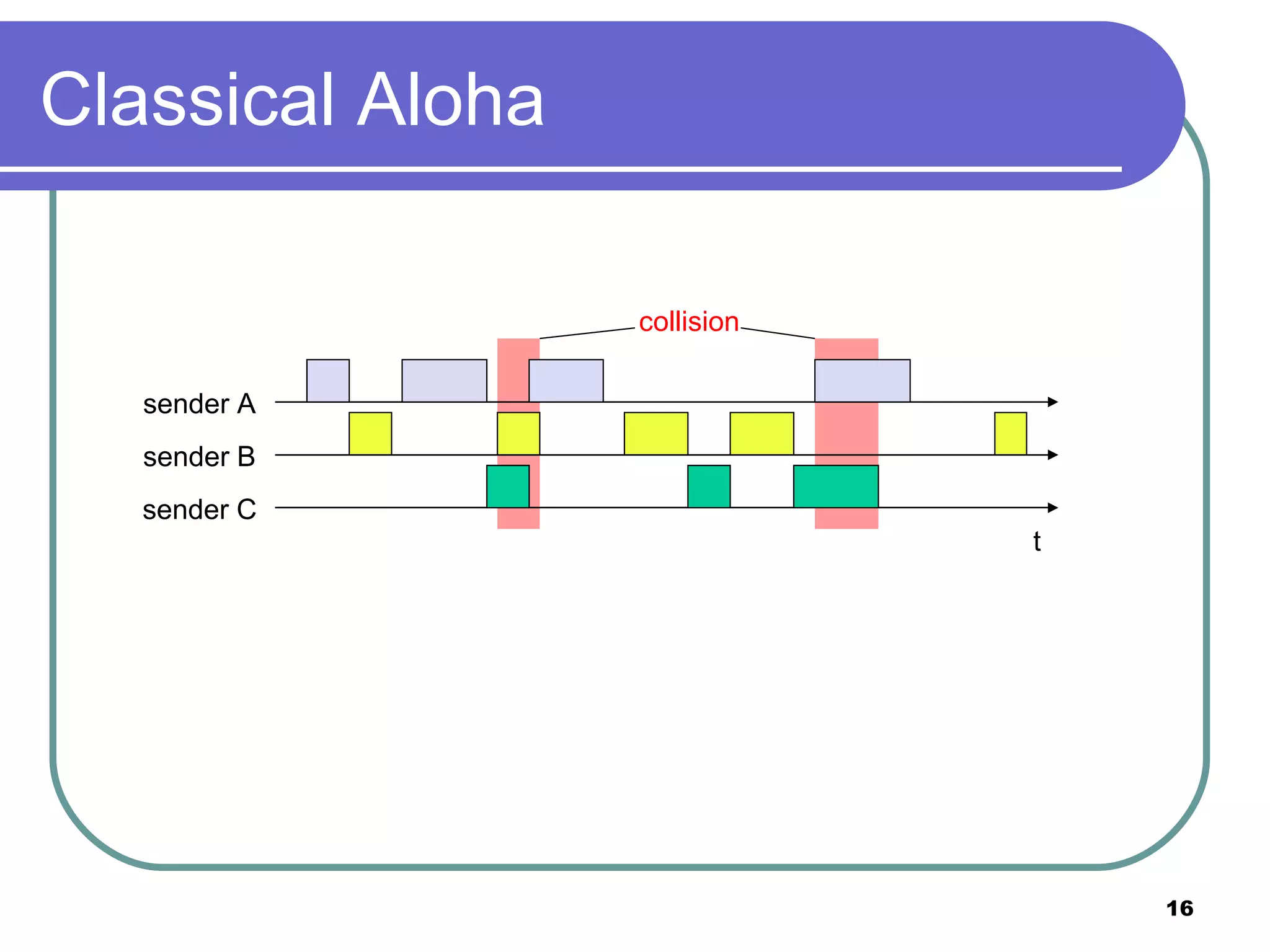
Classical Aloha TDMis applied without any access control Aloha does not coordinate the medium It does not resolve contention on MAC layer
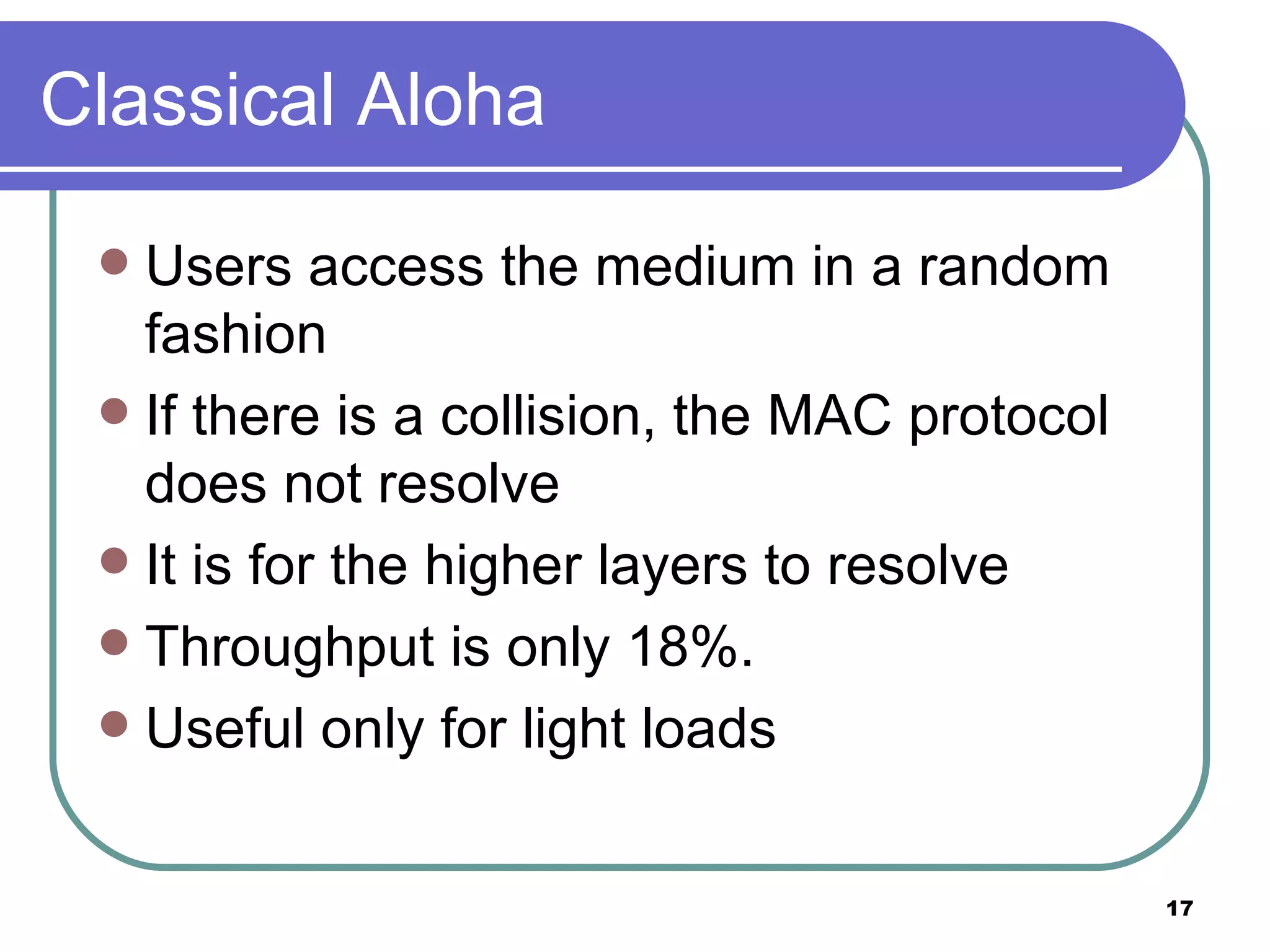
Classical Aloha Usersaccess the medium in a random fashion If there is a collision, the MAC protocol does not resolve It is for the higher layers to resolve Throughput is only 18%. Useful only for light loads
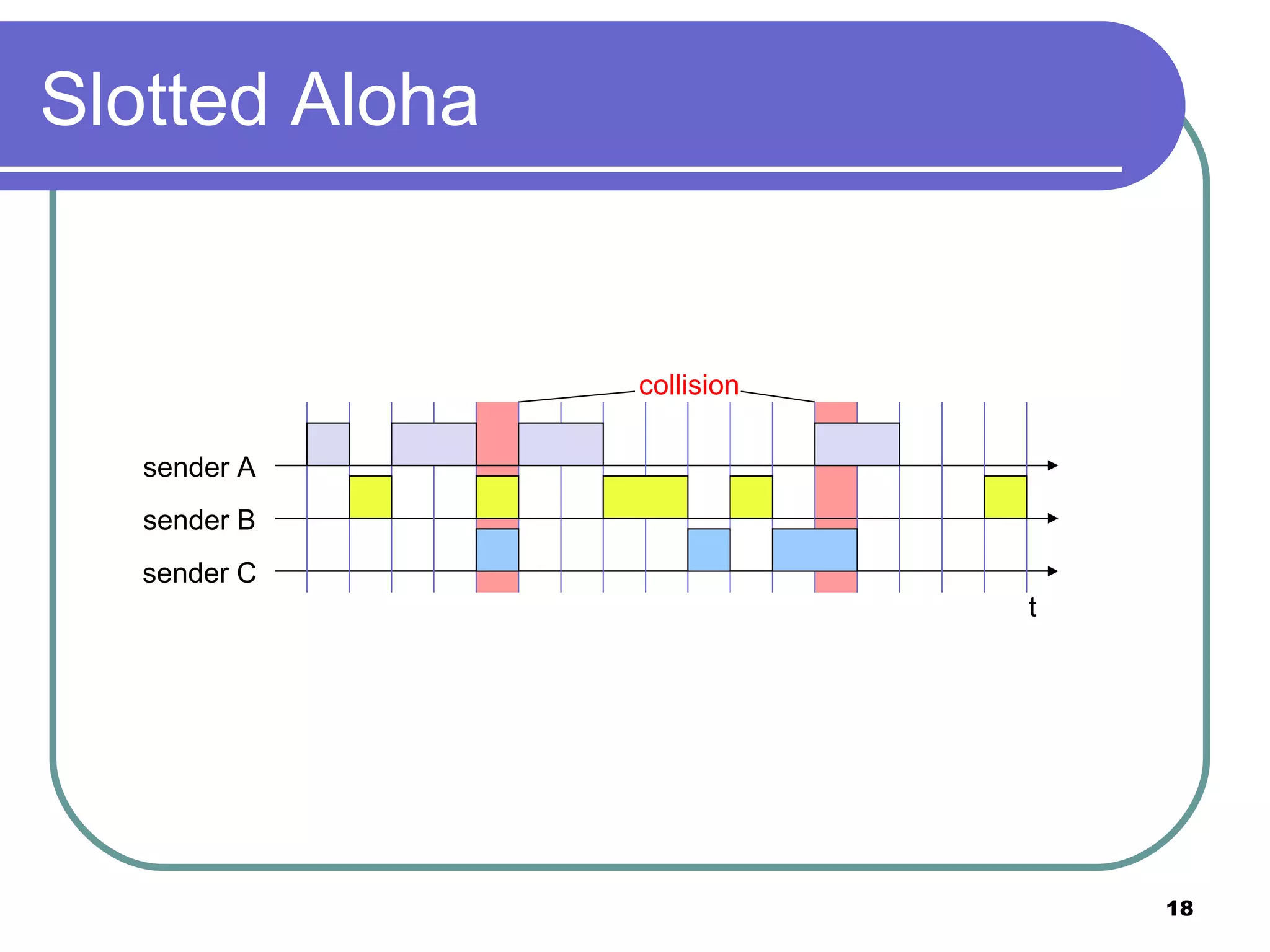
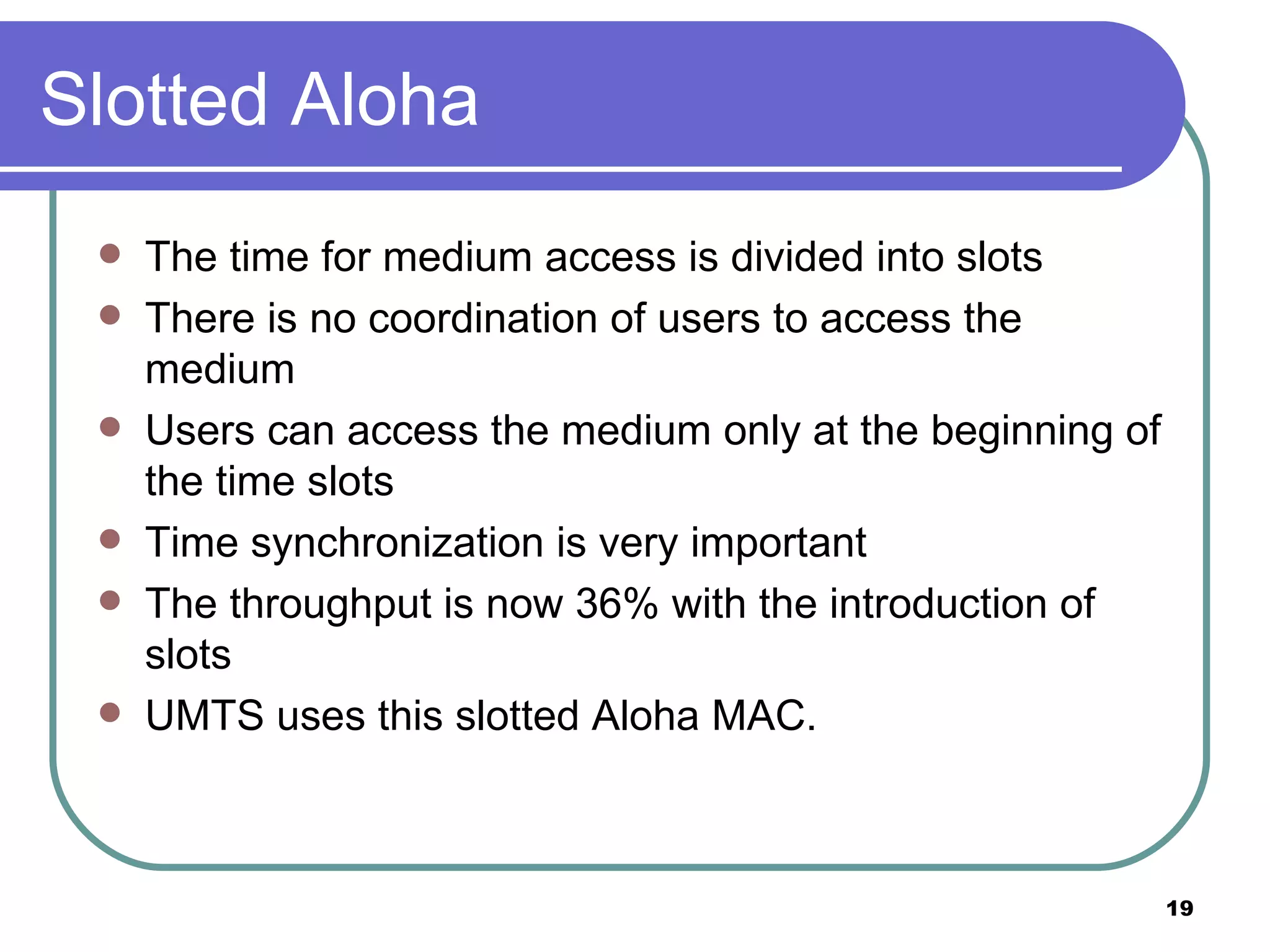
Slotted Aloha Thetime for medium access is divided into slots There is no coordination of users to access the medium Users can access the medium only at the beginning of the time slots Time synchronization is very important The throughput is now 36% with the introduction of slots UMTS uses this slotted Aloha MAC.
20.
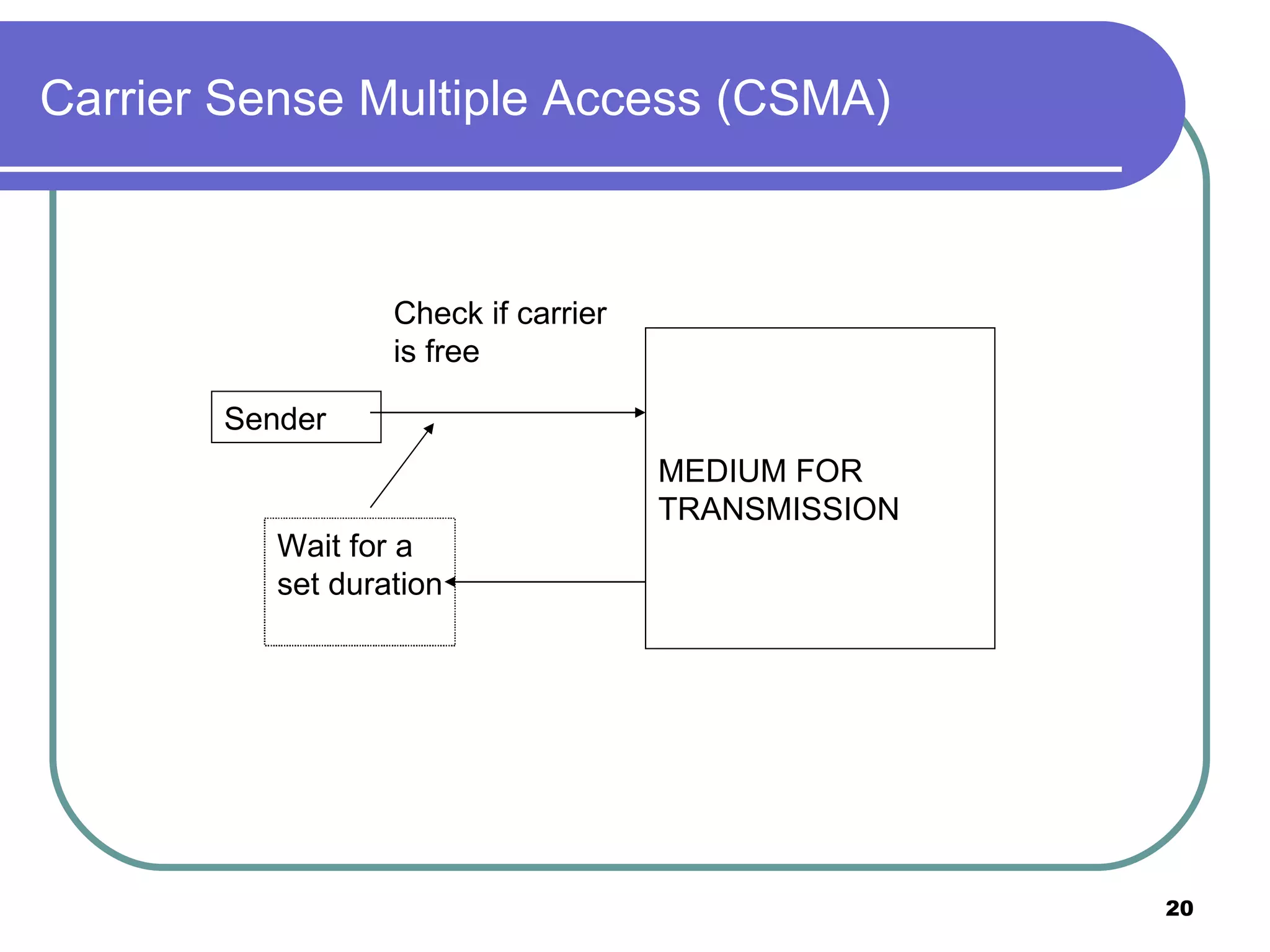
Carrier Sense MultipleAccess (CSMA) Sender MEDIUM FOR TRANSMISSION Check if carrier is free Wait for a set duration
21.
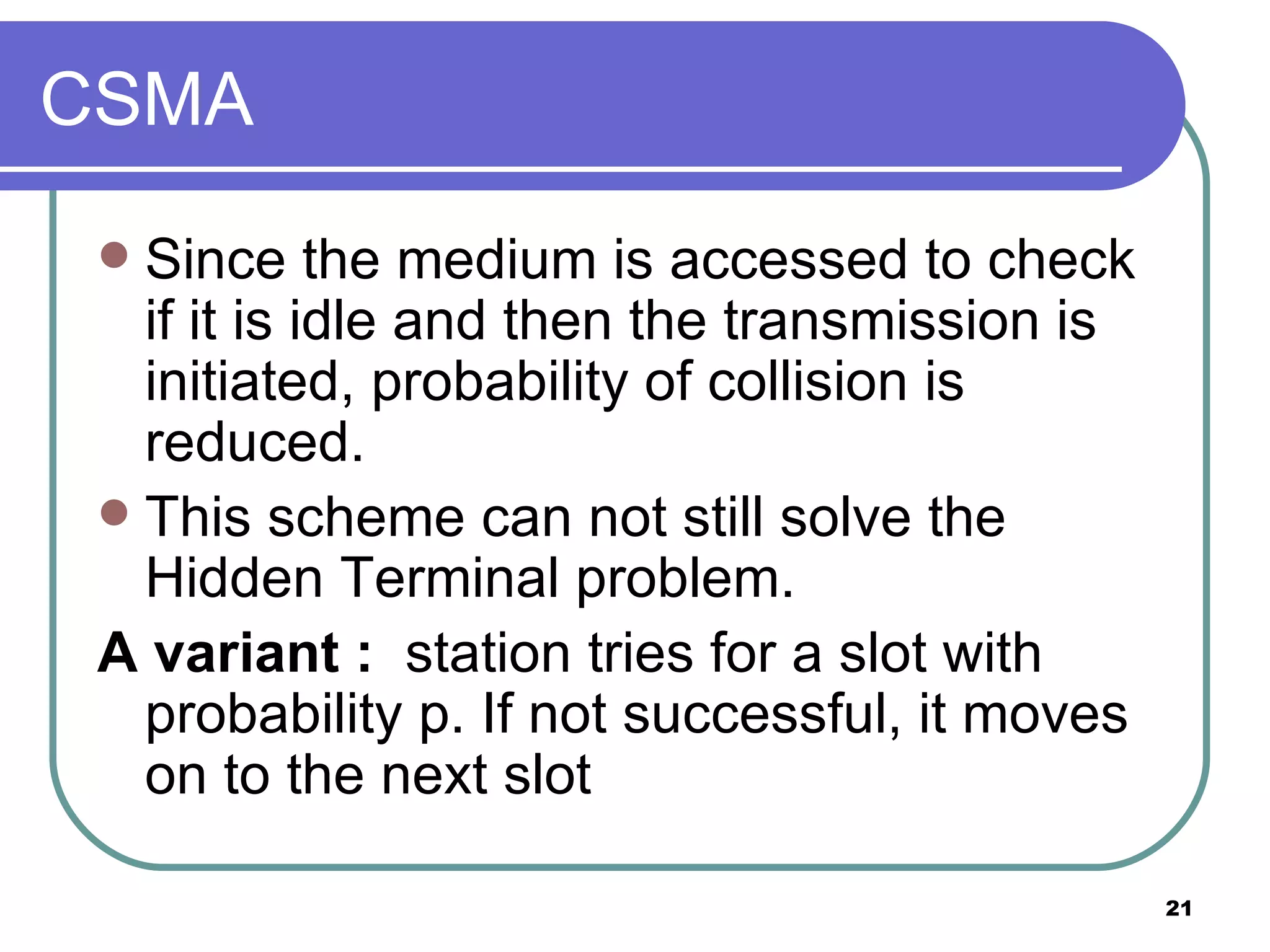
CSMA Since themedium is accessed to check if it is idle and then the transmission is initiated, probability of collision is reduced. This scheme can not still solve the Hidden Terminal problem. A variant : station tries for a slot with probability p. If not successful, it moves on to the next slot
22.
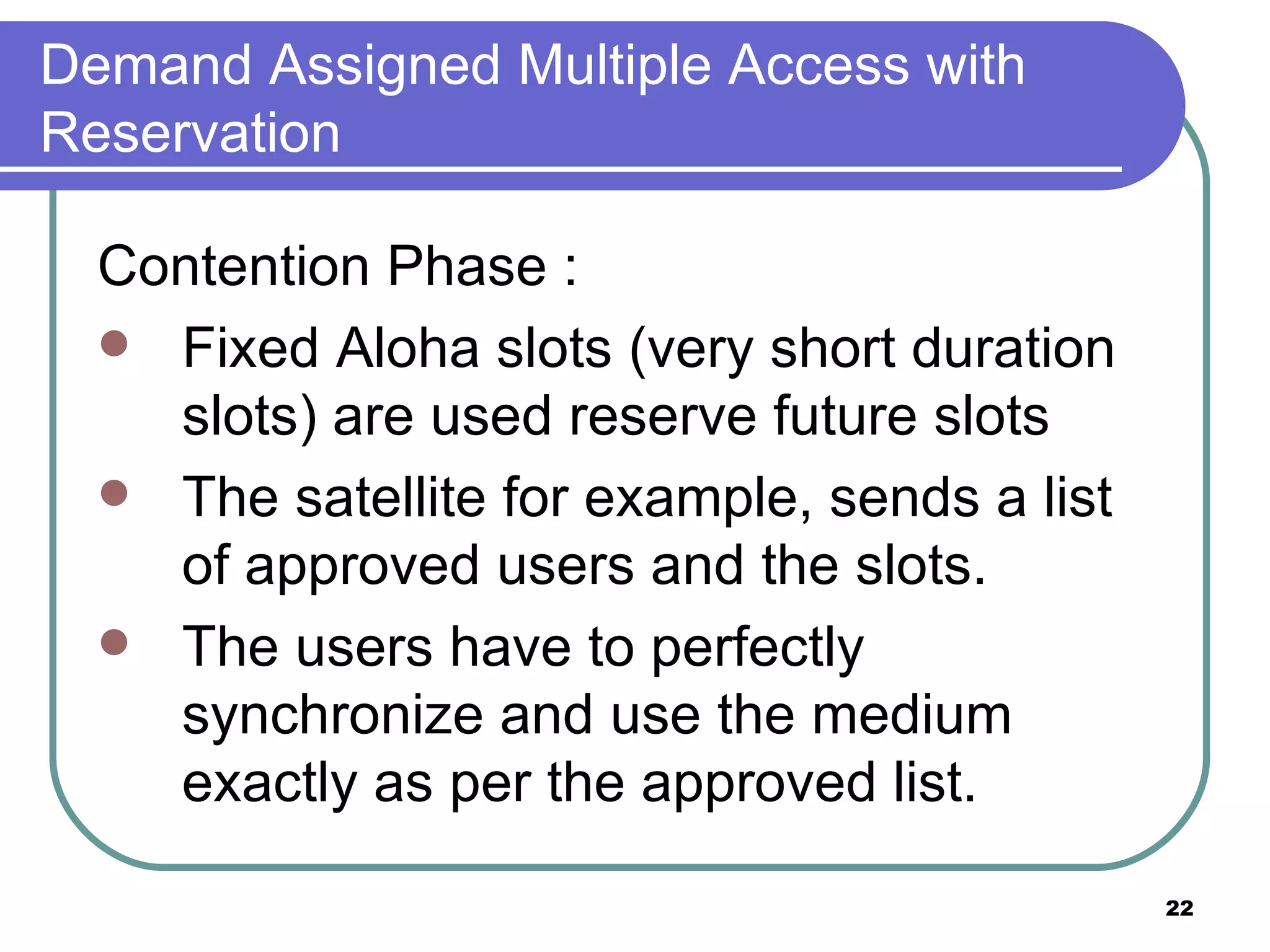
Demand Assigned MultipleAccess with Reservation Contention Phase : Fixed Aloha slots (very short duration slots) are used reserve future slots The satellite for example, sends a list of approved users and the slots. The users have to perfectly synchronize and use the medium exactly as per the approved list.
23.
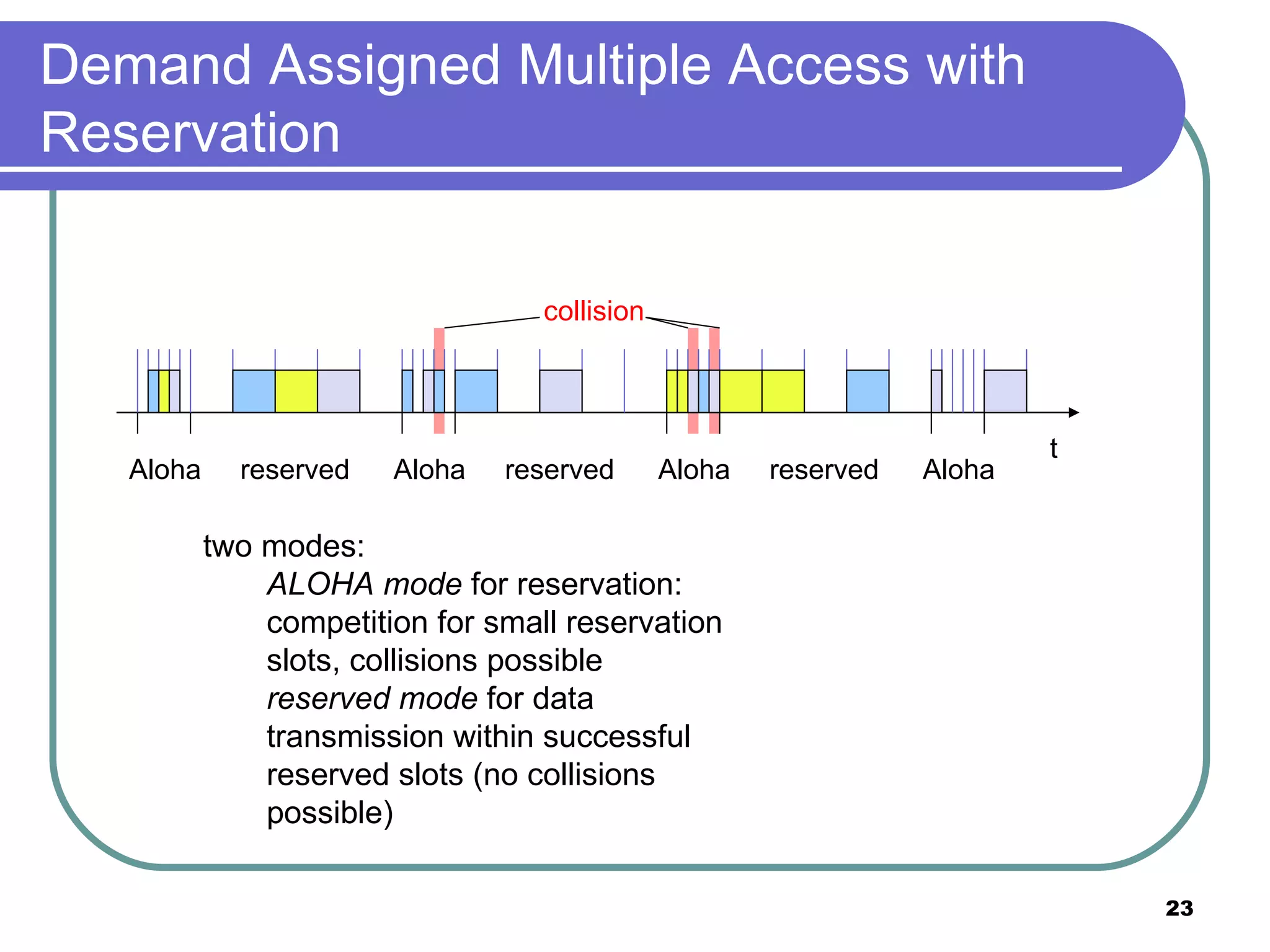
Demand Assigned MultipleAccess with Reservation Aloha reserved Aloha reserved Aloha reserved Aloha collision t two modes: ALOHA mode for reservation: competition for small reservation slots, collisions possible reserved mode for data transmission within successful reserved slots (no collisions possible)
24.
Demand Assigned MultipleAccess with Reservation it is important for all stations to keep the reservation list consistent at any point in time and, therefore, all stations have to synchronize from time to time
25.
Implicit reservation (PRMA- Packet Reservation MA): Implicit reservation (PRMA - Packet Reservation MA): a certain number of slots form a frame, frames are repeated stations compete for empty slots according to the slotted aloha principle once a station reserves a slot successfully, this slot is automatically assigned to this station in all following frames as long as the station has data to send competition for this slots starts again as soon as the slot was empty in the last frame
26.
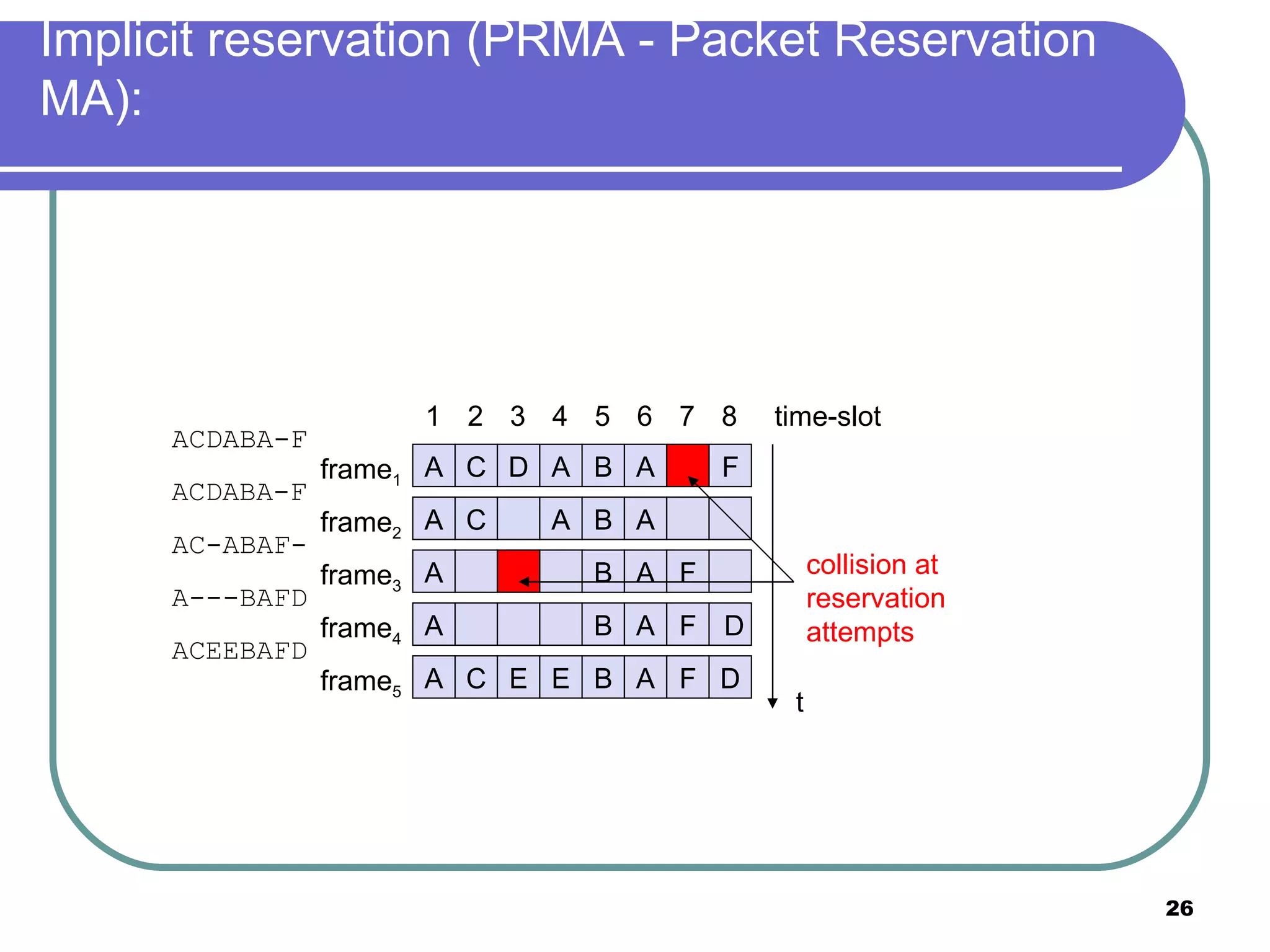
Implicit reservation (PRMA- Packet Reservation MA): frame 1 frame 2 frame 3 frame 4 frame 5 1 2 3 4 5 6 7 8 time-slot collision at reservation attempts A C D A B A F A C A B A A B A F A B A F D A C E E B A F D t ACDABA-F ACDABA-F AC-ABAF- A---BAFD ACEEBAFD
27.
PRMA - PacketReservation MA A Base station (for ex., a satellite) broadcasts the status of slots (for example, ACDABA-F) to all mobiles. The mobiles know which all slots are allocated to them in this frame. All stations needing a slot will contend for the free slot (Slot F in this case). There is a collision here since more than one mobile is trying for the free slot F. Slot F is not allocated since there is a collision. In the next frame, stations can compete for this and any released slots.
28.
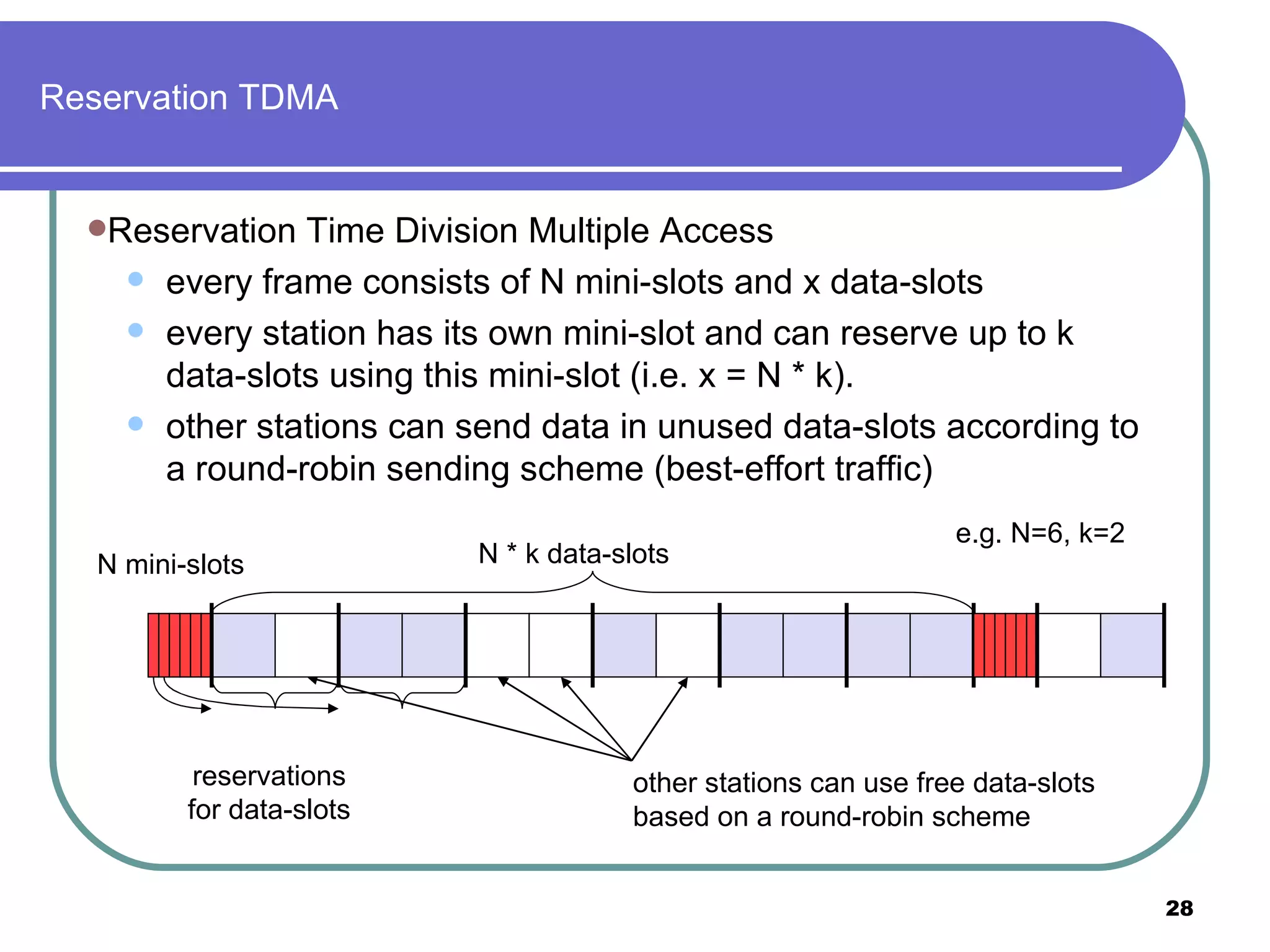
Reservation TDMA ReservationTime Division Multiple Access every frame consists of N mini-slots and x data-slots every station has its own mini-slot and can reserve up to k data-slots using this mini-slot (i.e. x = N * k). other stations can send data in unused data-slots according to a round-robin sending scheme (best-effort traffic) N mini-slots N * k data-slots reservations for data-slots other stations can use free data-slots based on a round-robin scheme e.g. N=6, k=2
29.
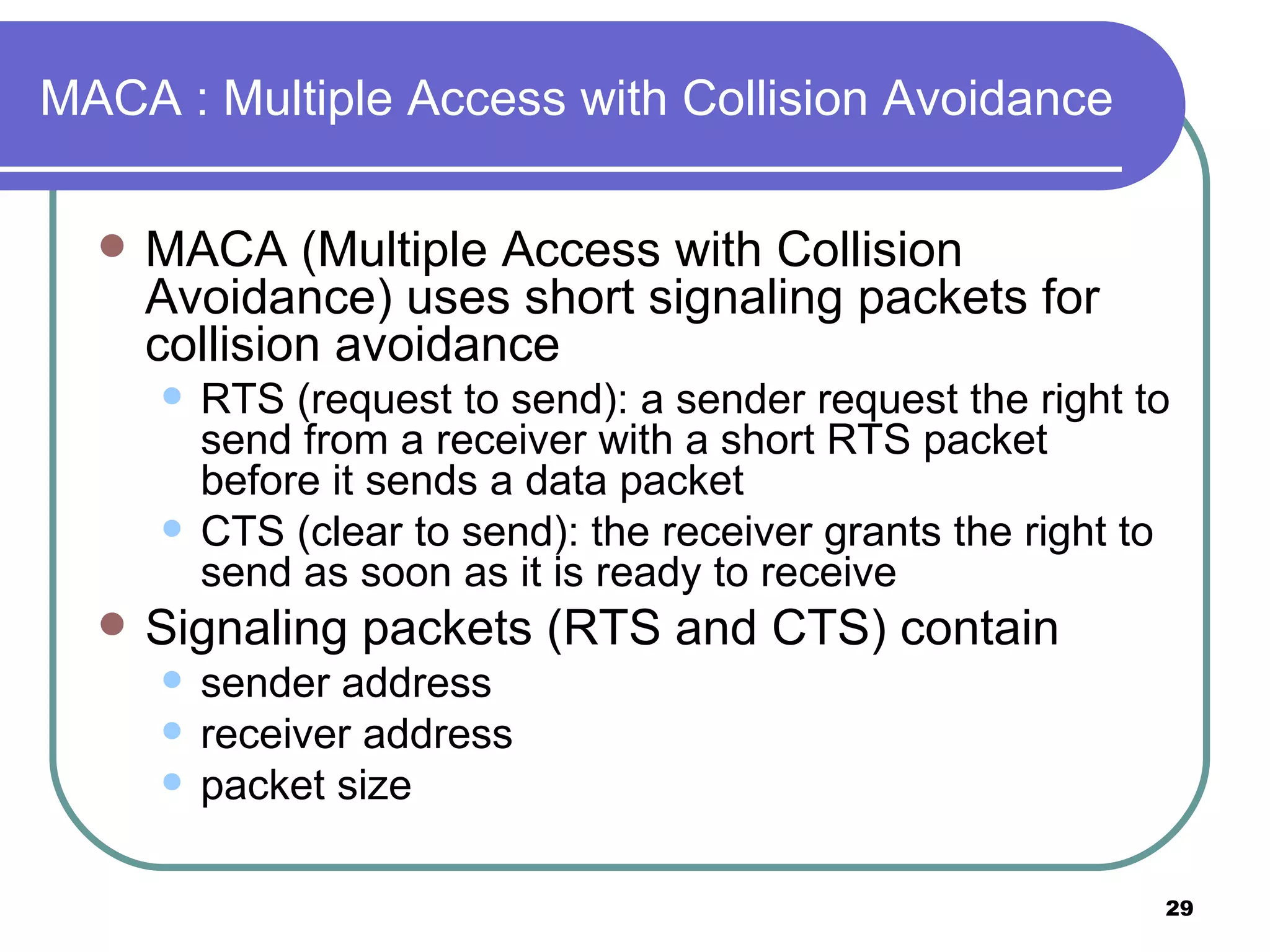
MACA : MultipleAccess with Collision Avoidance MACA (Multiple Access with Collision Avoidance) uses short signaling packets for collision avoidance RTS (request to send): a sender request the right to send from a receiver with a short RTS packet before it sends a data packet CTS (clear to send): the receiver grants the right to send as soon as it is ready to receive Signaling packets (RTS and CTS) contain sender address receiver address packet size
30.
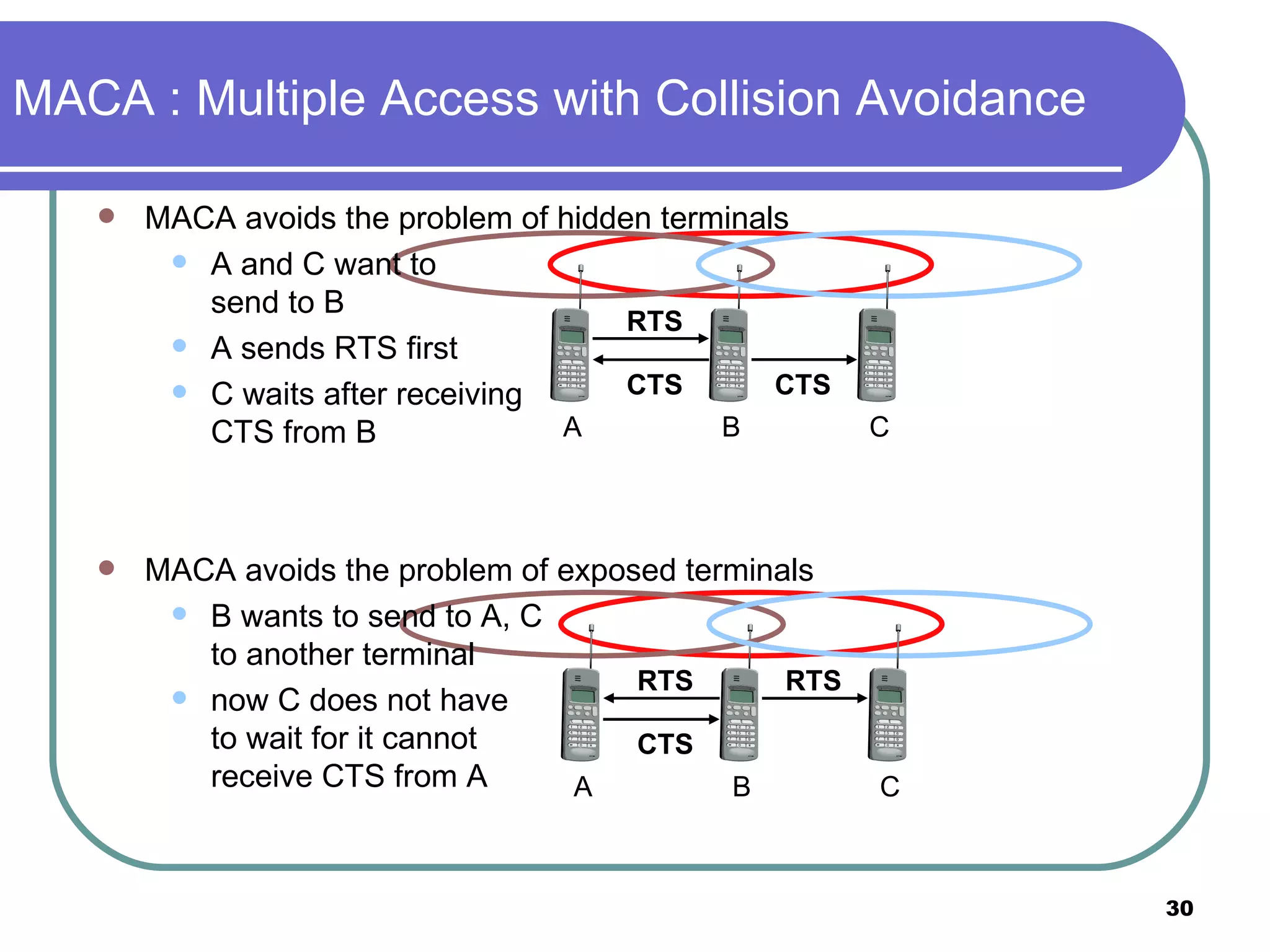
MACA : MultipleAccess with Collision Avoidance B RTS CTS CTS B RTS CTS RTS MACA avoids the problem of hidden terminals A and C want to send to B A sends RTS first C waits after receiving CTS from B MACA avoids the problem of exposed terminals B wants to send to A, C to another terminal now C does not have to wait for it cannot receive CTS from A A C A C
31.
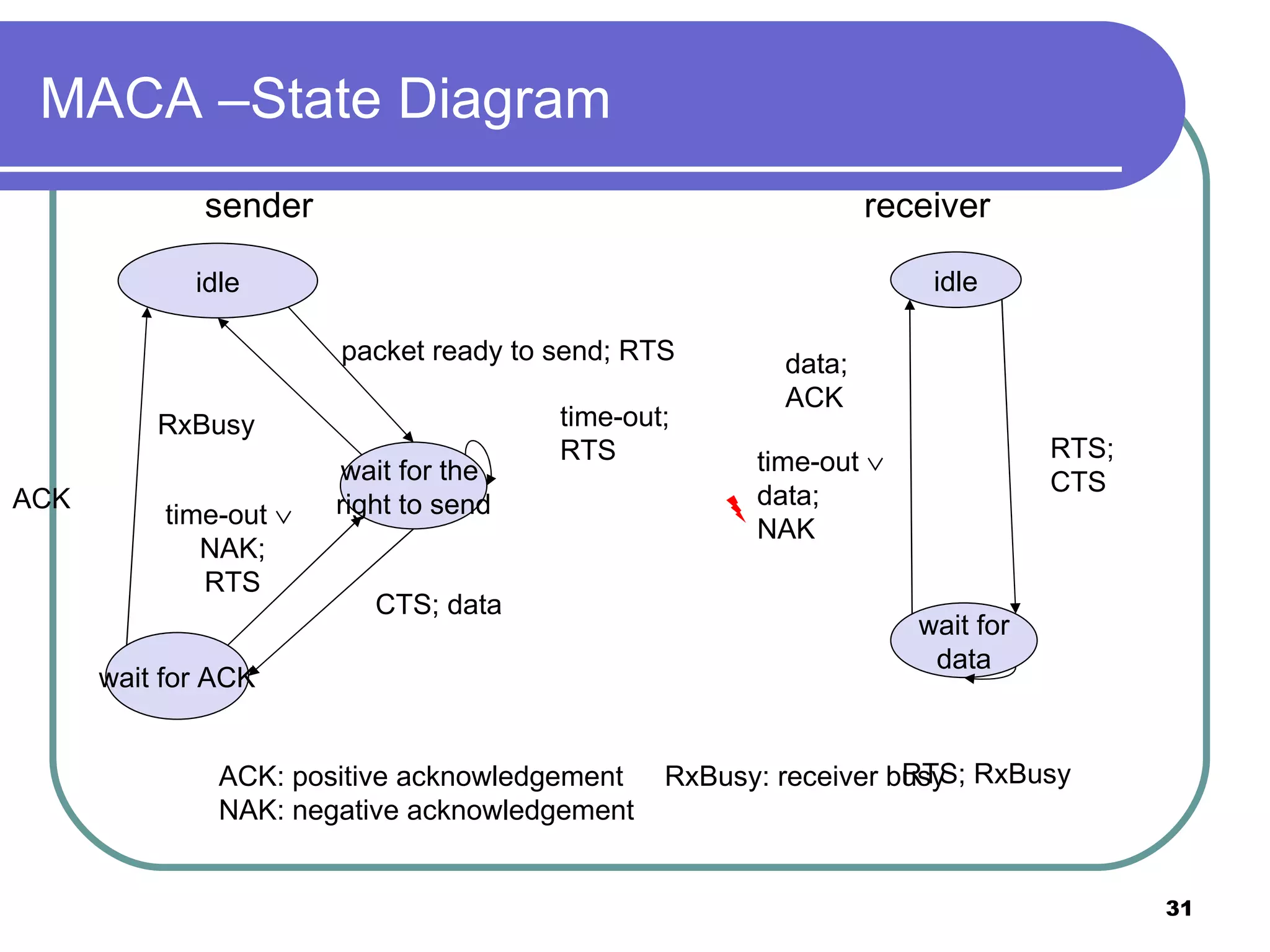
MACA –State Diagramidle wait for the right to send wait for ACK sender receiver packet ready to send; RTS time-out; RTS CTS; data ACK RxBusy idle wait for data RTS; RxBusy RTS; CTS data; ACK time-out data; NAK ACK: positive acknowledgement NAK: negative acknowledgement RxBusy: receiver busy time-out NAK; RTS
32.
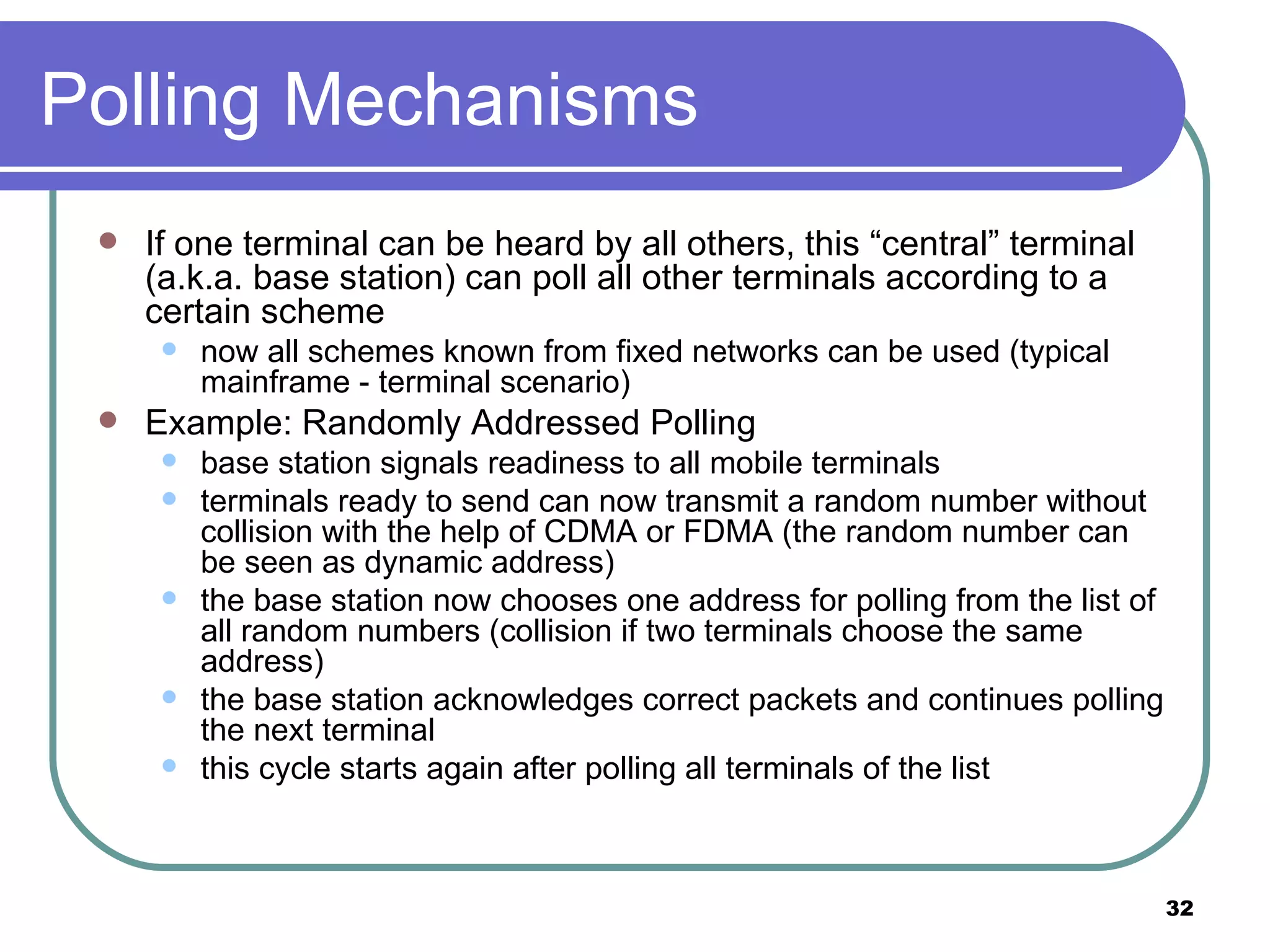
Polling Mechanisms Ifone terminal can be heard by all others, this “central” terminal (a.k.a. base station) can poll all other terminals according to a certain scheme now all schemes known from fixed networks can be used (typical mainframe - terminal scenario) Example: Randomly Addressed Polling base station signals readiness to all mobile terminals terminals ready to send can now transmit a random number without collision with the help of CDMA or FDMA (the random number can be seen as dynamic address) the base station now chooses one address for polling from the list of all random numbers (collision if two terminals choose the same address) the base station acknowledges correct packets and continues polling the next terminal this cycle starts again after polling all terminals of the list
33.
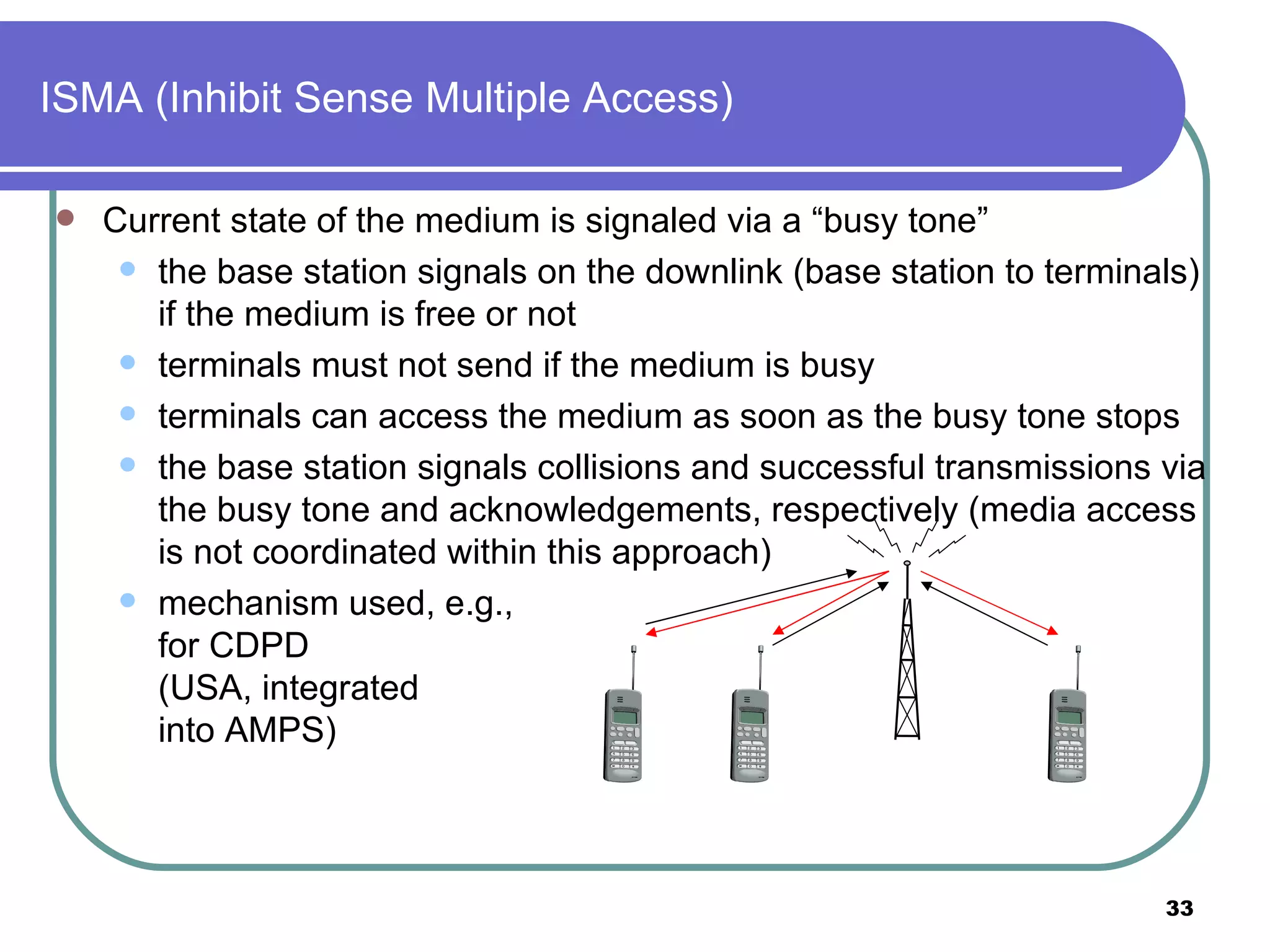
ISMA (Inhibit SenseMultiple Access) Current state of the medium is signaled via a “busy tone” the base station signals on the downlink (base station to terminals) if the medium is free or not terminals must not send if the medium is busy terminals can access the medium as soon as the busy tone stops the base station signals collisions and successful transmissions via the busy tone and acknowledgements, respectively (media access is not coordinated within this approach) mechanism used, e.g., for CDPD (USA, integrated into AMPS)