12.1
Chapter 12
Multiple Access
Copyright © The McGraw-Hill Companies, Inc. Permission required for reproduction or display.
12.2
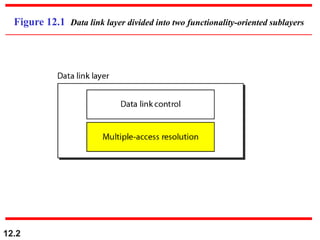
Figure 12.1 Data link layer divided into two functionality-oriented sublayers
12.3
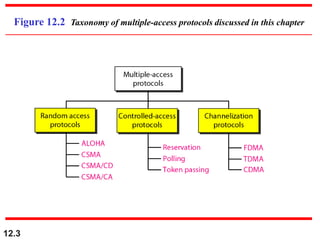
Figure 12.2 Taxonomy of multiple-access protocols discussed in this chapter
12.4
12-1 RANDOM ACCESS
In random access or contention methods, no station is
superior to another station and none is assigned the
control over another. No station permits, or does not
permit, another station to send. At each instance, a
station that has data to send uses a procedure defined
by the protocol to make a decision on whether or not to
send.
ALOHA
Carrier Sense Multiple Access
Carrier Sense Multiple Access with Collision Detection
Carrier Sense Multiple Access with Collision Avoidance
Topics discussed in this section:
 First, there is no scheduled time for a station to transmit.
 Transmission is random among the stations. That is why these
methods are called random access.
 Second, no rules specify which station should send next.
 Stations compete with one another to access the medium. That
is why these methods are also called contention methods.
 However, if more than one station tries to send, there is an
access conflict—collision—and the frames will be either
destroyed or modified.
12.5
ALOHA
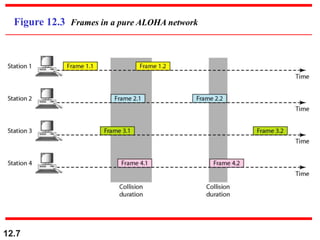
 The original ALOHA protocol is called pure ALOHA.
 The idea is that each station sends a frame whenever it has a
frame to send (multiple access).
 However, since there is only one channel to share, there is the
possibility of collision between frames from different stations.
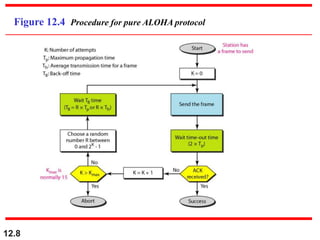
 The pure ALOHA protocol relies on acknowledgments from the
receiver.
 The time-out period is equal to the maximum possible round-trip
propagation delay, which is twice the amount of time required to
send a frame between the two most widely separated stations (2
× Tp).
12.6
12.7
Figure 12.3 Frames in a pure ALOHA network
12.8
Figure 12.4 Procedure for pure ALOHA protocol
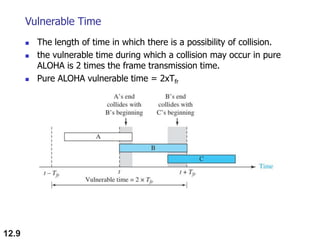
Vulnerable Time
 The length of time in which there is a possibility of collision.
 the vulnerable time during which a collision may occur in pure
ALOHA is 2 times the frame transmission time.
 Pure ALOHA vulnerable time = 2xTfr
12.9
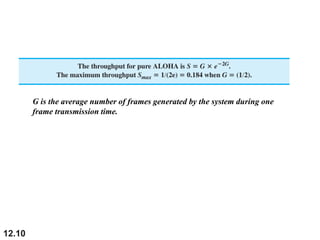
12.10
G is the average number of frames generated by the system during one
frame transmission time.
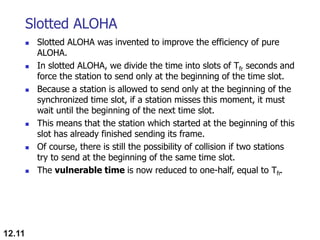
Slotted ALOHA
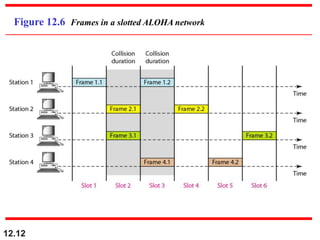
 Slotted ALOHA was invented to improve the efficiency of pure
ALOHA.
 In slotted ALOHA, we divide the time into slots of Tfr seconds and
force the station to send only at the beginning of the time slot.
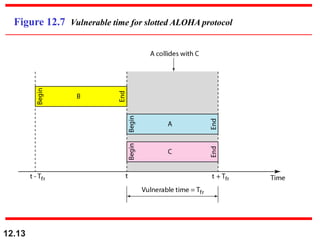
 Because a station is allowed to send only at the beginning of the
synchronized time slot, if a station misses this moment, it must
wait until the beginning of the next time slot.
 This means that the station which started at the beginning of this
slot has already finished sending its frame.
 Of course, there is still the possibility of collision if two stations
try to send at the beginning of the same time slot.
 The vulnerable time is now reduced to one-half, equal to Tfr.
12.11
12.12
Figure 12.6 Frames in a slotted ALOHA network
12.13
Figure 12.7 Vulnerable time for slotted ALOHA protocol
12.14
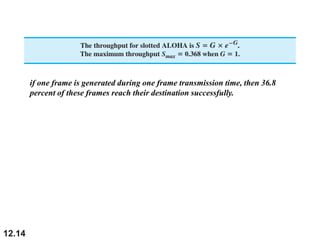
if one frame is generated during one frame transmission time, then 36.8
percent of these frames reach their destination successfully.
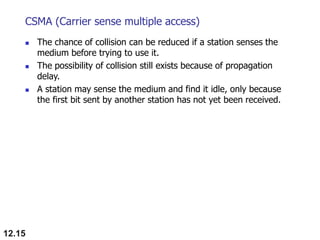
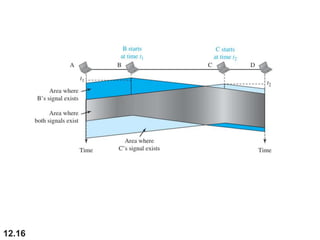
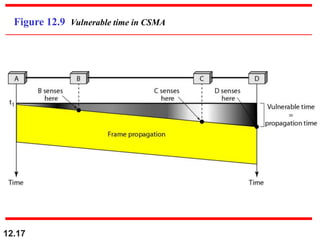
CSMA (Carrier sense multiple access)
 The chance of collision can be reduced if a station senses the
medium before trying to use it.
 The possibility of collision still exists because of propagation
delay.
 A station may sense the medium and find it idle, only because
the first bit sent by another station has not yet been received.
12.15
12.16
12.17
Figure 12.9 Vulnerable time in CSMA
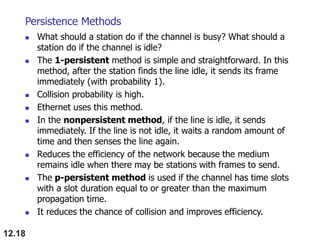
Persistence Methods
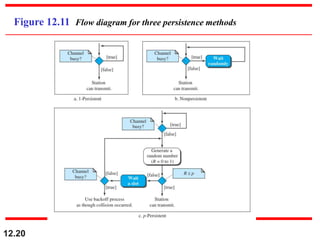
 What should a station do if the channel is busy? What should a
station do if the channel is idle?
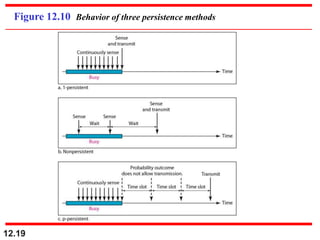
 The 1-persistent method is simple and straightforward. In this
method, after the station finds the line idle, it sends its frame
immediately (with probability 1).
 Collision probability is high.
 Ethernet uses this method.
 In the nonpersistent method, if the line is idle, it sends
immediately. If the line is not idle, it waits a random amount of
time and then senses the line again.
 Reduces the efficiency of the network because the medium
remains idle when there may be stations with frames to send.
 The p-persistent method is used if the channel has time slots
with a slot duration equal to or greater than the maximum
propagation time.
 It reduces the chance of collision and improves efficiency.
12.18
12.19
Figure 12.10 Behavior of three persistence methods
12.20
Figure 12.11 Flow diagram for three persistence methods
CSMA/CD
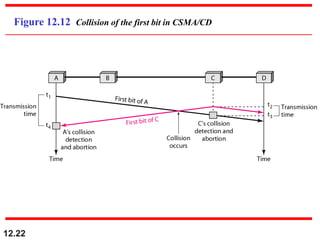
 Carrier sense multiple access with collision detection (CSMA/CD)
augments the algorithm to handle the collision.
12.21
12.22
Figure 12.12 Collision of the first bit in CSMA/CD
12.23
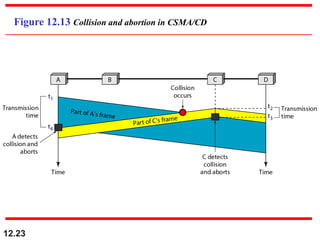
Figure 12.13 Collision and abortion in CSMA/CD
Minimum Frame Size
 For CSMA/CD to work, we need a restriction on the frame size.
 Before sending the last bit of the frame, the sending station must
detect a collision, if any, and abort the transmission.
 Therefore, the frame transmission time Tfr must be at least two
times the maximum propagation time Tp.
12.24
12.25
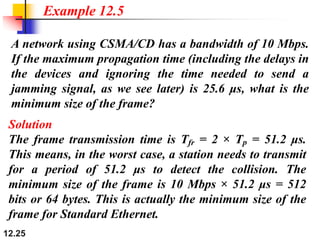
A network using CSMA/CD has a bandwidth of 10 Mbps.
If the maximum propagation time (including the delays in
the devices and ignoring the time needed to send a
jamming signal, as we see later) is 25.6 μs, what is the
minimum size of the frame?
Example 12.5
Solution
The frame transmission time is Tfr = 2 × Tp = 51.2 μs.
This means, in the worst case, a station needs to transmit
for a period of 51.2 μs to detect the collision. The
minimum size of the frame is 10 Mbps × 51.2 μs = 512
bits or 64 bytes. This is actually the minimum size of the
frame for Standard Ethernet.
12.26
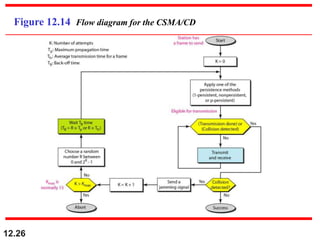
Figure 12.14 Flow diagram for the CSMA/CD
12.27
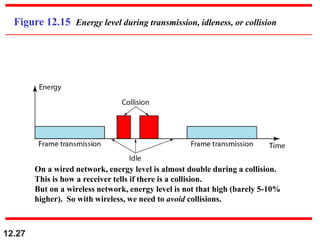
Figure 12.15 Energy level during transmission, idleness, or collision
On a wired network, energy level is almost double during a collision.
This is how a receiver tells if there is a collision.
But on a wireless network, energy level is not that high (barely 5-10%
higher). So with wireless, we need to avoid collisions.
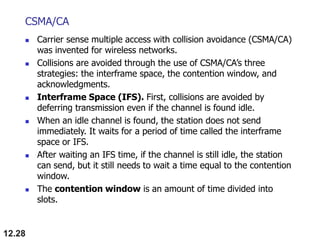
CSMA/CA
 Carrier sense multiple access with collision avoidance (CSMA/CA)
was invented for wireless networks.
 Collisions are avoided through the use of CSMA/CA’s three
strategies: the interframe space, the contention window, and
acknowledgments.
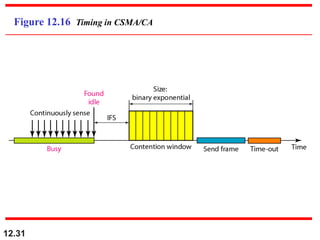
 Interframe Space (IFS). First, collisions are avoided by
deferring transmission even if the channel is found idle.
 When an idle channel is found, the station does not send
immediately. It waits for a period of time called the interframe
space or IFS.
 After waiting an IFS time, if the channel is still idle, the station
can send, but it still needs to wait a time equal to the contention
window.
 The contention window is an amount of time divided into
slots.
12.28
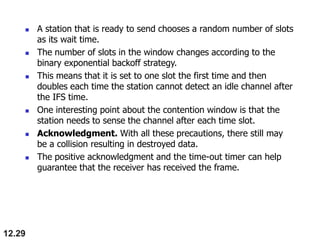
 A station that is ready to send chooses a random number of slots
as its wait time.
 The number of slots in the window changes according to the
binary exponential backoff strategy.
 This means that it is set to one slot the first time and then
doubles each time the station cannot detect an idle channel after
the IFS time.
 One interesting point about the contention window is that the
station needs to sense the channel after each time slot.
 Acknowledgment. With all these precautions, there still may
be a collision resulting in destroyed data.
 The positive acknowledgment and the time-out timer can help
guarantee that the receiver has received the frame.
12.29
12.30
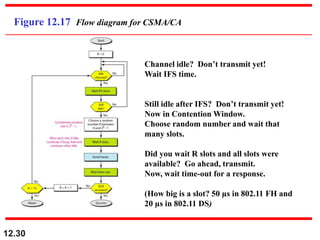
Figure 12.17 Flow diagram for CSMA/CA
Channel idle? Don’t transmit yet!
Wait IFS time.
Still idle after IFS? Don’t transmit yet!
Now in Contention Window.
Choose random number and wait that
many slots.
Did you wait R slots and all slots were
available? Go ahead, transmit.
Now, wait time-out for a response.
(How big is a slot? 50 µs in 802.11 FH and
20 µs in 802.11 DS)
12.31
Figure 12.16 Timing in CSMA/CA
12.32
In CSMA/CA, the IFS can also be used to
define the priority of a station or a frame.
Note
12.33
12-2 CONTROLLED ACCESS
In controlled access, the stations consult one another
to find which station has the right to send. A station
cannot send unless it has been authorized by other
stations. We discuss three popular controlled-access
methods.
Reservation
Polling
Token Passing
Topics discussed in this section:
12.34
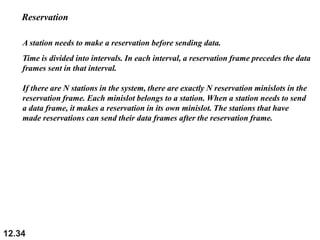
Reservation
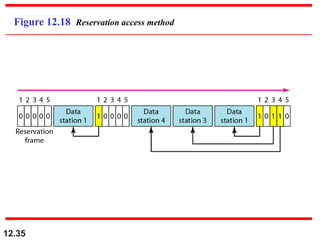
A station needs to make a reservation before sending data.
Time is divided into intervals. In each interval, a reservation frame precedes the data
frames sent in that interval.
If there are N stations in the system, there are exactly N reservation minislots in the
reservation frame. Each minislot belongs to a station. When a station needs to send
a data frame, it makes a reservation in its own minislot. The stations that have
made reservations can send their data frames after the reservation frame.
12.35
Figure 12.18 Reservation access method
12.36
Polling
Polling works with topologies in which one device is designated as a primary
station and the other devices are secondary stations.
All data exchanges must be made through the primary device even when the ultimate
destination is a secondary device.
The primary device controls the link; the secondary devices follow its instructions.
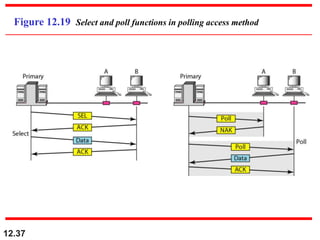
The select function is used whenever the primary device has something to send.
If the primary is neither sending nor receiving data, it knows the link is available.
The primary must alert the secondary to the upcoming transmission and wait for
an acknowledgment of the secondary’s ready status.
Before sending data, the primary creates and transmits a select (SEL) frame.
The poll function is used by the primary device to solicit transmissions from the
secondary devices.
12.37
Figure 12.19 Select and poll functions in polling access method
12.38
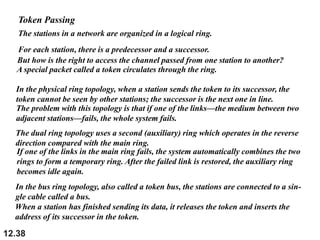
Token Passing
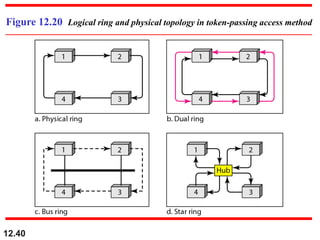
The stations in a network are organized in a logical ring.
For each station, there is a predecessor and a successor.
But how is the right to access the channel passed from one station to another?
A special packet called a token circulates through the ring.
In the physical ring topology, when a station sends the token to its successor, the
token cannot be seen by other stations; the successor is the next one in line.
The problem with this topology is that if one of the links—the medium between two
adjacent stations—fails, the whole system fails.
The dual ring topology uses a second (auxiliary) ring which operates in the reverse
direction compared with the main ring.
If one of the links in the main ring fails, the system automatically combines the two
rings to form a temporary ring. After the failed link is restored, the auxiliary ring
becomes idle again.
In the bus ring topology, also called a token bus, the stations are connected to a sin-
gle cable called a bus.
When a station has finished sending its data, it releases the token and inserts the
address of its successor in the token.
12.39
In a star ring topology, the physical topology is a star. There is a hub, however, that
acts as the connector. The wiring inside the hub makes the ring; the stations are
connected to this ring through the two wire connections. This topology makes the
network less prone to failure because if a link goes down, it will be bypassed by the
hub and the rest of the stations can operate.
12.40
Figure 12.20 Logical ring and physical topology in token-passing access method
12.41
12-3 CHANNELIZATION
Channelization is a multiple-access method in which
the available bandwidth of a link is shared in time,
frequency, or through code, between different stations.
In this section, we discuss three channelization
protocols.
Frequency-Division Multiple Access (FDMA)
Time-Division Multiple Access (TDMA)
Code-Division Multiple Access (CDMA)
Topics discussed in this section:
12.42
We see the application of all these
methods in Chapter 16 when
we discuss cellular phone systems.
Note
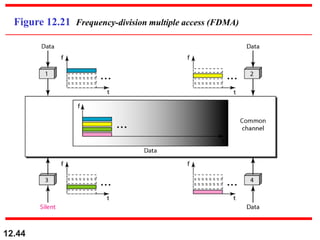
FDMA
 The available bandwidth is divided into frequency bands.
 Each station is allocated a band to send its data.
 The allocated bands are separated from one another by small
guard bands to prevent interference.
FDMA specifies a predetermined frequency band for the entire
period of communication.
12.43
12.44
Figure 12.21 Frequency-division multiple access (FDMA)
12.45
In FDMA, the available bandwidth
of the common channel is divided into
bands that are separated by guard
bands.
Note
TDMA
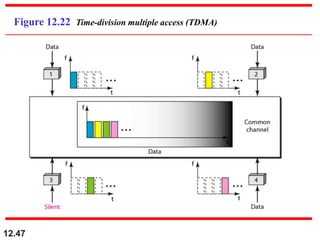
 In time-division multiple access (TDMA), the stations share the
bandwidth of the channel in time.
 Each station is allocated a time slot during which it can send
data.
 The main problem with TDMA lies in achieving synchronization
between the different stations.
 Each station needs to know the beginning of its slot and the
location of its slot.
 This may be difficult because of propagation delays introduced in
the system if the stations are spread over a large area.
 To compensate for the delays, we can insert guard times
(preamble bits at the beginning of each slot).
12.46
12.47
Figure 12.22 Time-division multiple access (TDMA)
12.48
In TDMA, the bandwidth is just one
channel that is timeshared between
different stations.
Note
CDMA
 CDMA differs from FDMA in that only one channel occupies the
entire bandwidth of the link.
 It differs from TDMA in that all stations can send data
simultaneously.
 Analogy.
12.49
12.50
In CDMA, one channel carries all
transmissions simultaneously.
Note
12.51
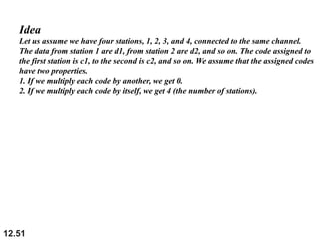
Idea
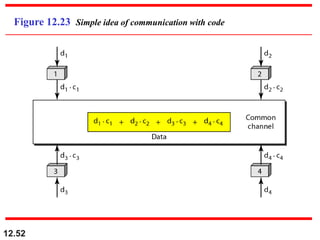
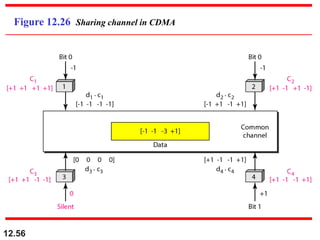
Let us assume we have four stations, 1, 2, 3, and 4, connected to the same channel.
The data from station 1 are d1, from station 2 are d2, and so on. The code assigned to
the first station is c1, to the second is c2, and so on. We assume that the assigned codes
have two properties.
1. If we multiply each code by another, we get 0.
2. If we multiply each code by itself, we get 4 (the number of stations).
12.52
Figure 12.23 Simple idea of communication with code
Chips
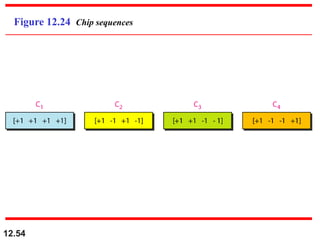
 CDMA is based on coding theory. Each station is assigned a code,
which is a sequence of numbers called chips.
 They are called orthogonal sequences and have the following
properties:
1. Each sequence is made of N elements, where N is the number
of stations.
2. If we multiply a sequence by a number, every element in the
sequence is multiplied by that element.
3. If we multiply two equal sequences, element by element, and
add the results, we get N, where N is the number of elements in
each sequence.
4. If we multiply two different sequences, element by element, and
add the results, we get 0.
5. Adding two sequences means adding the corresponding
elements. The result is another sequence.
12.53
12.54
Figure 12.24 Chip sequences
12.55
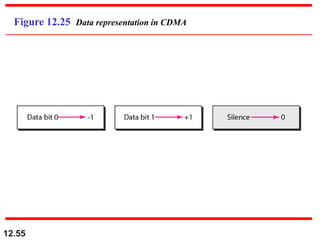
Figure 12.25 Data representation in CDMA
12.56
Figure 12.26 Sharing channel in CDMA
12.57
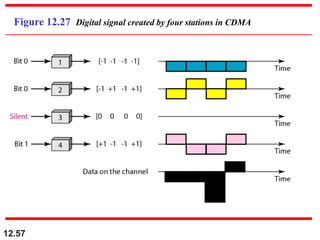
Figure 12.27 Digital signal created by four stations in CDMA
12.58
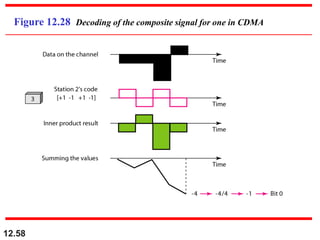
Figure 12.28 Decoding of the composite signal for one in CDMA
12.59
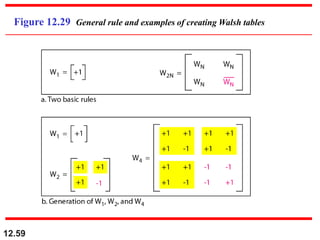
Figure 12.29 General rule and examples of creating Walsh tables
12.60
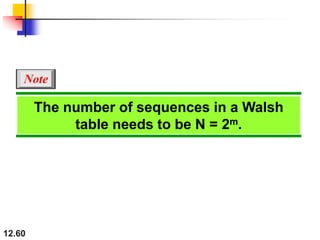
The number of sequences in a Walsh
table needs to be N = 2m.
Note
12.61
Find the chips for a network with
a. Two stations b. Four stations
Example 12.6
Solution
We can use the rows of W2 and W4 in Figure 12.29:
a. For a two-station network, we have
[+1 +1] and [+1 −1].
b. For a four-station network we have
[+1 +1 +1 +1], [+1 −1 +1 −1],
[+1 +1 −1 −1], and [+1 −1 −1 +1].
12.62
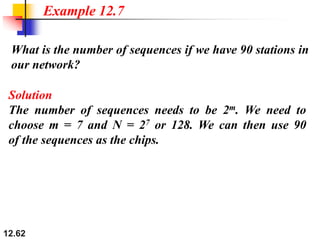
What is the number of sequences if we have 90 stations in
our network?
Example 12.7
Solution
The number of sequences needs to be 2m. We need to
choose m = 7 and N = 27 or 128. We can then use 90
of the sequences as the chips.
12.63
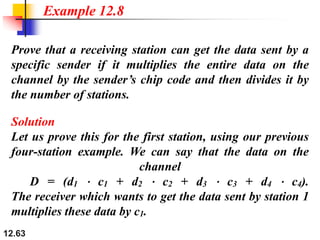
Prove that a receiving station can get the data sent by a
specific sender if it multiplies the entire data on the
channel by the sender’s chip code and then divides it by
the number of stations.
Example 12.8
Solution
Let us prove this for the first station, using our previous
four-station example. We can say that the data on the
channel
D = (d1 ⋅ c1 + d2 ⋅ c2 + d3 ⋅ c3 + d4 ⋅ c4).
The receiver which wants to get the data sent by station 1
multiplies these data by c1.
12.64
Example 12.8 (continued)
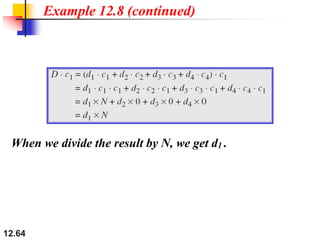
When we divide the result by N, we get d1 .

Multiple Access ppt in Object Oriented Programming

  • 1.
    12.1 Chapter 12 Multiple Access Copyright© The McGraw-Hill Companies, Inc. Permission required for reproduction or display.
  • 2.
    12.2 Figure 12.1 Datalink layer divided into two functionality-oriented sublayers
  • 3.
    12.3 Figure 12.2 Taxonomyof multiple-access protocols discussed in this chapter
  • 4.
    12.4 12-1 RANDOM ACCESS Inrandom access or contention methods, no station is superior to another station and none is assigned the control over another. No station permits, or does not permit, another station to send. At each instance, a station that has data to send uses a procedure defined by the protocol to make a decision on whether or not to send. ALOHA Carrier Sense Multiple Access Carrier Sense Multiple Access with Collision Detection Carrier Sense Multiple Access with Collision Avoidance Topics discussed in this section:
  • 5.
     First, thereis no scheduled time for a station to transmit.  Transmission is random among the stations. That is why these methods are called random access.  Second, no rules specify which station should send next.  Stations compete with one another to access the medium. That is why these methods are also called contention methods.  However, if more than one station tries to send, there is an access conflict—collision—and the frames will be either destroyed or modified. 12.5
  • 6.
    ALOHA  The originalALOHA protocol is called pure ALOHA.  The idea is that each station sends a frame whenever it has a frame to send (multiple access).  However, since there is only one channel to share, there is the possibility of collision between frames from different stations.  The pure ALOHA protocol relies on acknowledgments from the receiver.  The time-out period is equal to the maximum possible round-trip propagation delay, which is twice the amount of time required to send a frame between the two most widely separated stations (2 × Tp). 12.6
  • 7.
    12.7 Figure 12.3 Framesin a pure ALOHA network
  • 8.
    12.8 Figure 12.4 Procedurefor pure ALOHA protocol
  • 9.
    Vulnerable Time  Thelength of time in which there is a possibility of collision.  the vulnerable time during which a collision may occur in pure ALOHA is 2 times the frame transmission time.  Pure ALOHA vulnerable time = 2xTfr 12.9
  • 10.
    12.10 G is theaverage number of frames generated by the system during one frame transmission time.
  • 11.
    Slotted ALOHA  SlottedALOHA was invented to improve the efficiency of pure ALOHA.  In slotted ALOHA, we divide the time into slots of Tfr seconds and force the station to send only at the beginning of the time slot.  Because a station is allowed to send only at the beginning of the synchronized time slot, if a station misses this moment, it must wait until the beginning of the next time slot.  This means that the station which started at the beginning of this slot has already finished sending its frame.  Of course, there is still the possibility of collision if two stations try to send at the beginning of the same time slot.  The vulnerable time is now reduced to one-half, equal to Tfr. 12.11
  • 12.
    12.12 Figure 12.6 Framesin a slotted ALOHA network
  • 13.
    12.13 Figure 12.7 Vulnerabletime for slotted ALOHA protocol
  • 14.
    12.14 if one frameis generated during one frame transmission time, then 36.8 percent of these frames reach their destination successfully.
  • 15.
    CSMA (Carrier sensemultiple access)  The chance of collision can be reduced if a station senses the medium before trying to use it.  The possibility of collision still exists because of propagation delay.  A station may sense the medium and find it idle, only because the first bit sent by another station has not yet been received. 12.15
  • 16.
  • 17.
  • 18.
    Persistence Methods  Whatshould a station do if the channel is busy? What should a station do if the channel is idle?  The 1-persistent method is simple and straightforward. In this method, after the station finds the line idle, it sends its frame immediately (with probability 1).  Collision probability is high.  Ethernet uses this method.  In the nonpersistent method, if the line is idle, it sends immediately. If the line is not idle, it waits a random amount of time and then senses the line again.  Reduces the efficiency of the network because the medium remains idle when there may be stations with frames to send.  The p-persistent method is used if the channel has time slots with a slot duration equal to or greater than the maximum propagation time.  It reduces the chance of collision and improves efficiency. 12.18
  • 19.
    12.19 Figure 12.10 Behaviorof three persistence methods
  • 20.
    12.20 Figure 12.11 Flowdiagram for three persistence methods
  • 21.
    CSMA/CD  Carrier sensemultiple access with collision detection (CSMA/CD) augments the algorithm to handle the collision. 12.21
  • 22.
    12.22 Figure 12.12 Collisionof the first bit in CSMA/CD
  • 23.
    12.23 Figure 12.13 Collisionand abortion in CSMA/CD
  • 24.
    Minimum Frame Size For CSMA/CD to work, we need a restriction on the frame size.  Before sending the last bit of the frame, the sending station must detect a collision, if any, and abort the transmission.  Therefore, the frame transmission time Tfr must be at least two times the maximum propagation time Tp. 12.24
  • 25.
    12.25 A network usingCSMA/CD has a bandwidth of 10 Mbps. If the maximum propagation time (including the delays in the devices and ignoring the time needed to send a jamming signal, as we see later) is 25.6 μs, what is the minimum size of the frame? Example 12.5 Solution The frame transmission time is Tfr = 2 × Tp = 51.2 μs. This means, in the worst case, a station needs to transmit for a period of 51.2 μs to detect the collision. The minimum size of the frame is 10 Mbps × 51.2 μs = 512 bits or 64 bytes. This is actually the minimum size of the frame for Standard Ethernet.
  • 26.
    12.26 Figure 12.14 Flowdiagram for the CSMA/CD
  • 27.
    12.27 Figure 12.15 Energylevel during transmission, idleness, or collision On a wired network, energy level is almost double during a collision. This is how a receiver tells if there is a collision. But on a wireless network, energy level is not that high (barely 5-10% higher). So with wireless, we need to avoid collisions.
  • 28.
    CSMA/CA  Carrier sensemultiple access with collision avoidance (CSMA/CA) was invented for wireless networks.  Collisions are avoided through the use of CSMA/CA’s three strategies: the interframe space, the contention window, and acknowledgments.  Interframe Space (IFS). First, collisions are avoided by deferring transmission even if the channel is found idle.  When an idle channel is found, the station does not send immediately. It waits for a period of time called the interframe space or IFS.  After waiting an IFS time, if the channel is still idle, the station can send, but it still needs to wait a time equal to the contention window.  The contention window is an amount of time divided into slots. 12.28
  • 29.
     A stationthat is ready to send chooses a random number of slots as its wait time.  The number of slots in the window changes according to the binary exponential backoff strategy.  This means that it is set to one slot the first time and then doubles each time the station cannot detect an idle channel after the IFS time.  One interesting point about the contention window is that the station needs to sense the channel after each time slot.  Acknowledgment. With all these precautions, there still may be a collision resulting in destroyed data.  The positive acknowledgment and the time-out timer can help guarantee that the receiver has received the frame. 12.29
  • 30.
    12.30 Figure 12.17 Flowdiagram for CSMA/CA Channel idle? Don’t transmit yet! Wait IFS time. Still idle after IFS? Don’t transmit yet! Now in Contention Window. Choose random number and wait that many slots. Did you wait R slots and all slots were available? Go ahead, transmit. Now, wait time-out for a response. (How big is a slot? 50 µs in 802.11 FH and 20 µs in 802.11 DS)
  • 31.
  • 32.
    12.32 In CSMA/CA, theIFS can also be used to define the priority of a station or a frame. Note
  • 33.
    12.33 12-2 CONTROLLED ACCESS Incontrolled access, the stations consult one another to find which station has the right to send. A station cannot send unless it has been authorized by other stations. We discuss three popular controlled-access methods. Reservation Polling Token Passing Topics discussed in this section:
  • 34.
    12.34 Reservation A station needsto make a reservation before sending data. Time is divided into intervals. In each interval, a reservation frame precedes the data frames sent in that interval. If there are N stations in the system, there are exactly N reservation minislots in the reservation frame. Each minislot belongs to a station. When a station needs to send a data frame, it makes a reservation in its own minislot. The stations that have made reservations can send their data frames after the reservation frame.
  • 35.
  • 36.
    12.36 Polling Polling works withtopologies in which one device is designated as a primary station and the other devices are secondary stations. All data exchanges must be made through the primary device even when the ultimate destination is a secondary device. The primary device controls the link; the secondary devices follow its instructions. The select function is used whenever the primary device has something to send. If the primary is neither sending nor receiving data, it knows the link is available. The primary must alert the secondary to the upcoming transmission and wait for an acknowledgment of the secondary’s ready status. Before sending data, the primary creates and transmits a select (SEL) frame. The poll function is used by the primary device to solicit transmissions from the secondary devices.
  • 37.
    12.37 Figure 12.19 Selectand poll functions in polling access method
  • 38.
    12.38 Token Passing The stationsin a network are organized in a logical ring. For each station, there is a predecessor and a successor. But how is the right to access the channel passed from one station to another? A special packet called a token circulates through the ring. In the physical ring topology, when a station sends the token to its successor, the token cannot be seen by other stations; the successor is the next one in line. The problem with this topology is that if one of the links—the medium between two adjacent stations—fails, the whole system fails. The dual ring topology uses a second (auxiliary) ring which operates in the reverse direction compared with the main ring. If one of the links in the main ring fails, the system automatically combines the two rings to form a temporary ring. After the failed link is restored, the auxiliary ring becomes idle again. In the bus ring topology, also called a token bus, the stations are connected to a sin- gle cable called a bus. When a station has finished sending its data, it releases the token and inserts the address of its successor in the token.
  • 39.
    12.39 In a starring topology, the physical topology is a star. There is a hub, however, that acts as the connector. The wiring inside the hub makes the ring; the stations are connected to this ring through the two wire connections. This topology makes the network less prone to failure because if a link goes down, it will be bypassed by the hub and the rest of the stations can operate.
  • 40.
    12.40 Figure 12.20 Logicalring and physical topology in token-passing access method
  • 41.
    12.41 12-3 CHANNELIZATION Channelization isa multiple-access method in which the available bandwidth of a link is shared in time, frequency, or through code, between different stations. In this section, we discuss three channelization protocols. Frequency-Division Multiple Access (FDMA) Time-Division Multiple Access (TDMA) Code-Division Multiple Access (CDMA) Topics discussed in this section:
  • 42.
    12.42 We see theapplication of all these methods in Chapter 16 when we discuss cellular phone systems. Note
  • 43.
    FDMA  The availablebandwidth is divided into frequency bands.  Each station is allocated a band to send its data.  The allocated bands are separated from one another by small guard bands to prevent interference. FDMA specifies a predetermined frequency band for the entire period of communication. 12.43
  • 44.
  • 45.
    12.45 In FDMA, theavailable bandwidth of the common channel is divided into bands that are separated by guard bands. Note
  • 46.
    TDMA  In time-divisionmultiple access (TDMA), the stations share the bandwidth of the channel in time.  Each station is allocated a time slot during which it can send data.  The main problem with TDMA lies in achieving synchronization between the different stations.  Each station needs to know the beginning of its slot and the location of its slot.  This may be difficult because of propagation delays introduced in the system if the stations are spread over a large area.  To compensate for the delays, we can insert guard times (preamble bits at the beginning of each slot). 12.46
  • 47.
    12.47 Figure 12.22 Time-divisionmultiple access (TDMA)
  • 48.
    12.48 In TDMA, thebandwidth is just one channel that is timeshared between different stations. Note
  • 49.
    CDMA  CDMA differsfrom FDMA in that only one channel occupies the entire bandwidth of the link.  It differs from TDMA in that all stations can send data simultaneously.  Analogy. 12.49
  • 50.
    12.50 In CDMA, onechannel carries all transmissions simultaneously. Note
  • 51.
    12.51 Idea Let us assumewe have four stations, 1, 2, 3, and 4, connected to the same channel. The data from station 1 are d1, from station 2 are d2, and so on. The code assigned to the first station is c1, to the second is c2, and so on. We assume that the assigned codes have two properties. 1. If we multiply each code by another, we get 0. 2. If we multiply each code by itself, we get 4 (the number of stations).
  • 52.
    12.52 Figure 12.23 Simpleidea of communication with code
  • 53.
    Chips  CDMA isbased on coding theory. Each station is assigned a code, which is a sequence of numbers called chips.  They are called orthogonal sequences and have the following properties: 1. Each sequence is made of N elements, where N is the number of stations. 2. If we multiply a sequence by a number, every element in the sequence is multiplied by that element. 3. If we multiply two equal sequences, element by element, and add the results, we get N, where N is the number of elements in each sequence. 4. If we multiply two different sequences, element by element, and add the results, we get 0. 5. Adding two sequences means adding the corresponding elements. The result is another sequence. 12.53
  • 54.
  • 55.
    12.55 Figure 12.25 Datarepresentation in CDMA
  • 56.
  • 57.
    12.57 Figure 12.27 Digitalsignal created by four stations in CDMA
  • 58.
    12.58 Figure 12.28 Decodingof the composite signal for one in CDMA
  • 59.
    12.59 Figure 12.29 Generalrule and examples of creating Walsh tables
  • 60.
    12.60 The number ofsequences in a Walsh table needs to be N = 2m. Note
  • 61.
    12.61 Find the chipsfor a network with a. Two stations b. Four stations Example 12.6 Solution We can use the rows of W2 and W4 in Figure 12.29: a. For a two-station network, we have [+1 +1] and [+1 −1]. b. For a four-station network we have [+1 +1 +1 +1], [+1 −1 +1 −1], [+1 +1 −1 −1], and [+1 −1 −1 +1].
  • 62.
    12.62 What is thenumber of sequences if we have 90 stations in our network? Example 12.7 Solution The number of sequences needs to be 2m. We need to choose m = 7 and N = 27 or 128. We can then use 90 of the sequences as the chips.
  • 63.
    12.63 Prove that areceiving station can get the data sent by a specific sender if it multiplies the entire data on the channel by the sender’s chip code and then divides it by the number of stations. Example 12.8 Solution Let us prove this for the first station, using our previous four-station example. We can say that the data on the channel D = (d1 ⋅ c1 + d2 ⋅ c2 + d3 ⋅ c3 + d4 ⋅ c4). The receiver which wants to get the data sent by station 1 multiplies these data by c1.
  • 64.
    12.64 Example 12.8 (continued) Whenwe divide the result by N, we get d1 .