{
M.A.C
Medium Access Control
 Random-access protocols
 Controlled-access protocols
 Channelization protocols
Classification of multiple-
access protocols
 Random access or contention methods, no
station is superior to another station and none
is assigned control over another. At each
instance, a station that has data to send uses a
procedure defined by the protocol to make a
decision or whether or not to send. This
decision depends on the state of the medium
(idle or busy)
What is Random-access
protocols?
 ALOHA
 CSMA
 CSMA/CD
 CSMA/CA
Type of Random-access
protocols
 was developed at the University of Hawaii in
early 1970.
 Designed for a radio (wireless) LAN.
 The medium is shared between the stations.
When a station sends data, another station may
attempt to do so at the same time. The data from
the two stations collide and become garbled.
ALOHA
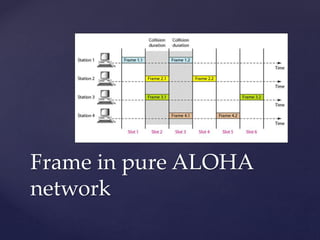
Frame in pure ALOHA
network
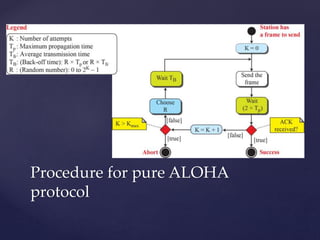
Procedure for pure ALOHA
protocol
 Minimize the change of collision.
 Increase the performance.
 CSMA is based on the principle
”sense before transmit” or “Listen before talk”.
CSMA
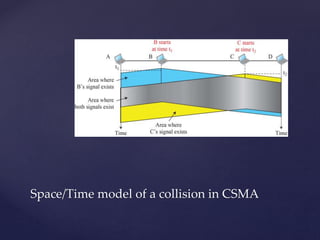
Space/Time model of a collision in CSMA
 Carrier sense multiple access with collision
detection (CSMA/CD) algorithm to handle the
collision.
CSMA/CD
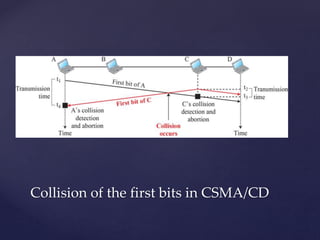
Collision of the first bits in CSMA/CD
 Carrier sense multiple access with collision
avoidance (CSMA/CA).
 Was invented for wireless network.
CSMA/CA
 In controlled access, the stations consult on
another to find which station has the right to
send. A station cannot send unless it has been
authorized by other stations.
What is Controlled-access
protocols
 Reservation
 Polling
 Token passing
Type of Controlled-access
protocols
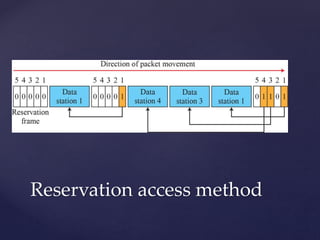
 Time is divided into intervals.
 A station needs to make a reservation before
sending data.
Reservation
Reservation access method
 Works with topologies.
 One device is designated as a primary station.
 Other device is are secondary stations.
 All exchange must be made through the
primary device.
Polling
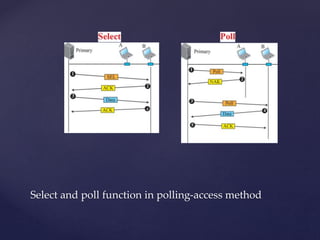
Select and poll function in polling-access method
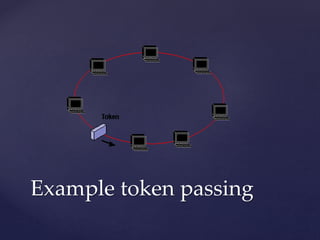
 The stations in a network are organized in a
logical ring.
 Predecessor: station which is logically before
the station in the ring.
 Successor: station which is after the station in
the ring.
Token Passing
Example token passing
 Channelization(channel partition) is a multiple-
access method in which the available
bandwidth of a link is shared in time
What is Channelization
protocols
 FDMA
 TDMA
 CDMA
Type of Channelization
protocols
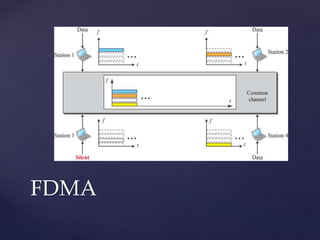
 Available bandwidth is divided into frequency
bands.
 Each station is allocated a band to send its data.
FDMA (Frequency-division multiple access)
FDMA
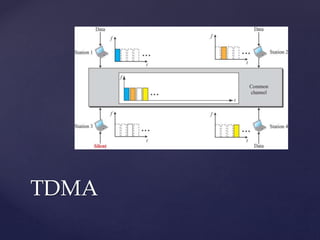
 Station share the bandwidth of the channel in
time.
 Each station is allocated a time slot during
which it can send data.
 Each station transmits its data in its assigned
time slot.
TDMA (Time-Division Multiple Access)
TDMA
 Was conceived several decades ago.
 Recent advance in electronic technology have
finally made its implementation possible.
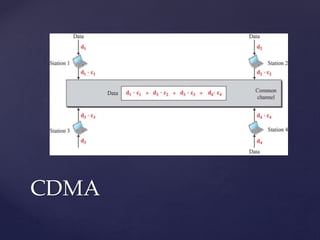
 CDMA differ from FDMA and TDMA.
 There no timesharing
CDMA (Code-Division Multiple Access)
CDMA

M.A.C (Medium Access Control)

  • 1.
  • 2.
     Random-access protocols Controlled-access protocols  Channelization protocols Classification of multiple- access protocols
  • 3.
     Random accessor contention methods, no station is superior to another station and none is assigned control over another. At each instance, a station that has data to send uses a procedure defined by the protocol to make a decision or whether or not to send. This decision depends on the state of the medium (idle or busy) What is Random-access protocols?
  • 4.
     ALOHA  CSMA CSMA/CD  CSMA/CA Type of Random-access protocols
  • 5.
     was developedat the University of Hawaii in early 1970.  Designed for a radio (wireless) LAN.  The medium is shared between the stations. When a station sends data, another station may attempt to do so at the same time. The data from the two stations collide and become garbled. ALOHA
  • 6.
    Frame in pureALOHA network
  • 7.
    Procedure for pureALOHA protocol
  • 8.
     Minimize thechange of collision.  Increase the performance.  CSMA is based on the principle ”sense before transmit” or “Listen before talk”. CSMA
  • 9.
    Space/Time model ofa collision in CSMA
  • 10.
     Carrier sensemultiple access with collision detection (CSMA/CD) algorithm to handle the collision. CSMA/CD
  • 11.
    Collision of thefirst bits in CSMA/CD
  • 12.
     Carrier sensemultiple access with collision avoidance (CSMA/CA).  Was invented for wireless network. CSMA/CA
  • 13.
     In controlledaccess, the stations consult on another to find which station has the right to send. A station cannot send unless it has been authorized by other stations. What is Controlled-access protocols
  • 14.
     Reservation  Polling Token passing Type of Controlled-access protocols
  • 15.
     Time isdivided into intervals.  A station needs to make a reservation before sending data. Reservation
  • 16.
  • 17.
     Works withtopologies.  One device is designated as a primary station.  Other device is are secondary stations.  All exchange must be made through the primary device. Polling
  • 18.
    Select and pollfunction in polling-access method
  • 19.
     The stationsin a network are organized in a logical ring.  Predecessor: station which is logically before the station in the ring.  Successor: station which is after the station in the ring. Token Passing
  • 20.
  • 21.
     Channelization(channel partition)is a multiple- access method in which the available bandwidth of a link is shared in time What is Channelization protocols
  • 22.
     FDMA  TDMA CDMA Type of Channelization protocols
  • 23.
     Available bandwidthis divided into frequency bands.  Each station is allocated a band to send its data. FDMA (Frequency-division multiple access)
  • 24.
  • 25.
     Station sharethe bandwidth of the channel in time.  Each station is allocated a time slot during which it can send data.  Each station transmits its data in its assigned time slot. TDMA (Time-Division Multiple Access)
  • 26.
  • 27.
     Was conceivedseveral decades ago.  Recent advance in electronic technology have finally made its implementation possible.  CDMA differ from FDMA and TDMA.  There no timesharing CDMA (Code-Division Multiple Access)
  • 28.