Multiple Access
Satellite Communications
Need of Multiple Access
• Satellites are usually built and employed for the
common good of one or more regions.
• This means a lot of people needs to send and
receive data through a satellite without major
mishaps
• For this purpose, we may use one of the several
multiple access techniques
• Mentioned here are FDMA, TDMA, CDMA and
DAMA.
Frequency Division Multiple
Access (FDMA)
• Frequency division, as the name suggests,
operates by dividing the available bandwidth
between users on the basis of frequency.
• A group of users maybe allotted a range of
frequencies and each individual user can use a
limited frequency shifted channels, within that
range.
• Earlier analogue FDMA used FM waves with
slightly different carrier frequencies to get the job
done.
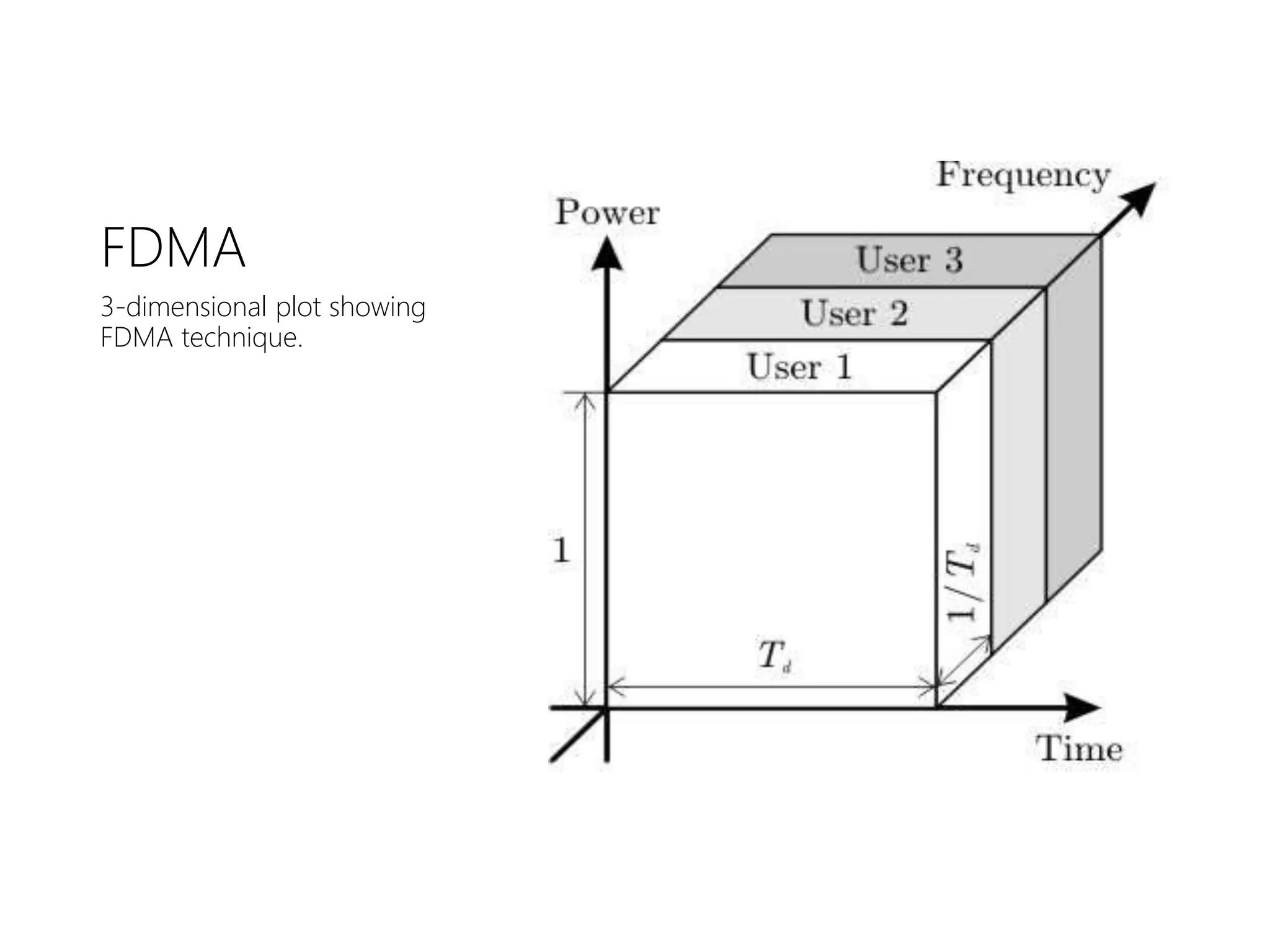
FDMA
3-dimensional plot showing
FDMA technique.
How it works
• FDM-FM was transmitted to satellite from ESs.
• These were received by a common transponder.
• Microwave filters were used in ESs to separate
signals within the transponder.
• The corresponding ESs received data back from
the transponder and the data get demuxed.
• If the frequency assignment has to be changed, all
the ESs’ filters must be retuned.
• This can cause long idle times too.
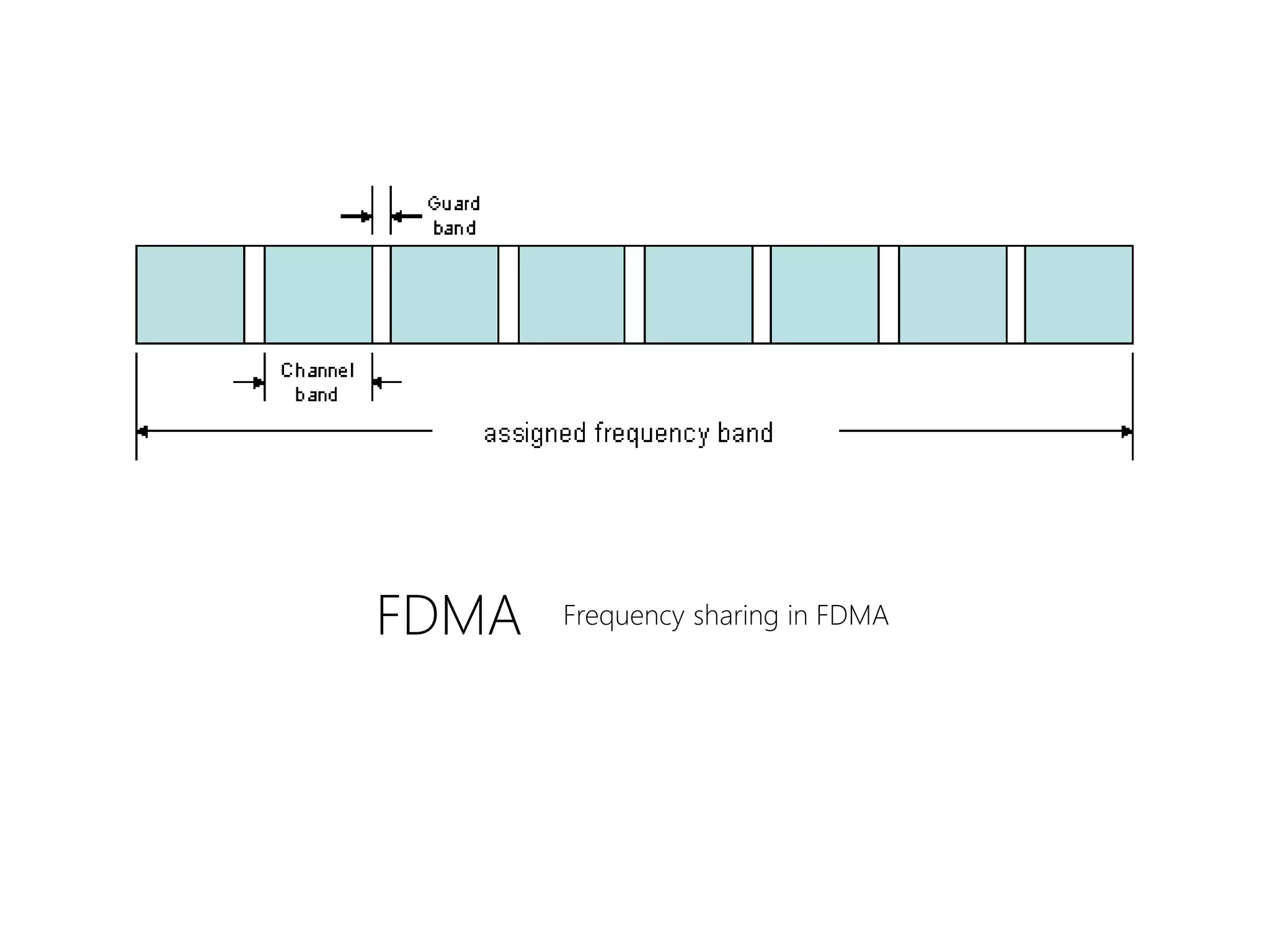
FDMA Frequency sharing in FDMA
Improving on it
• Single Channel Per Carrier (SCPC) technique
means a number of small mobile earth stations
can transmit and receive data over a single
transponder.
• This can enable satellite telephony
• This can also help utilise the whole wide
bandwidth of the transponders
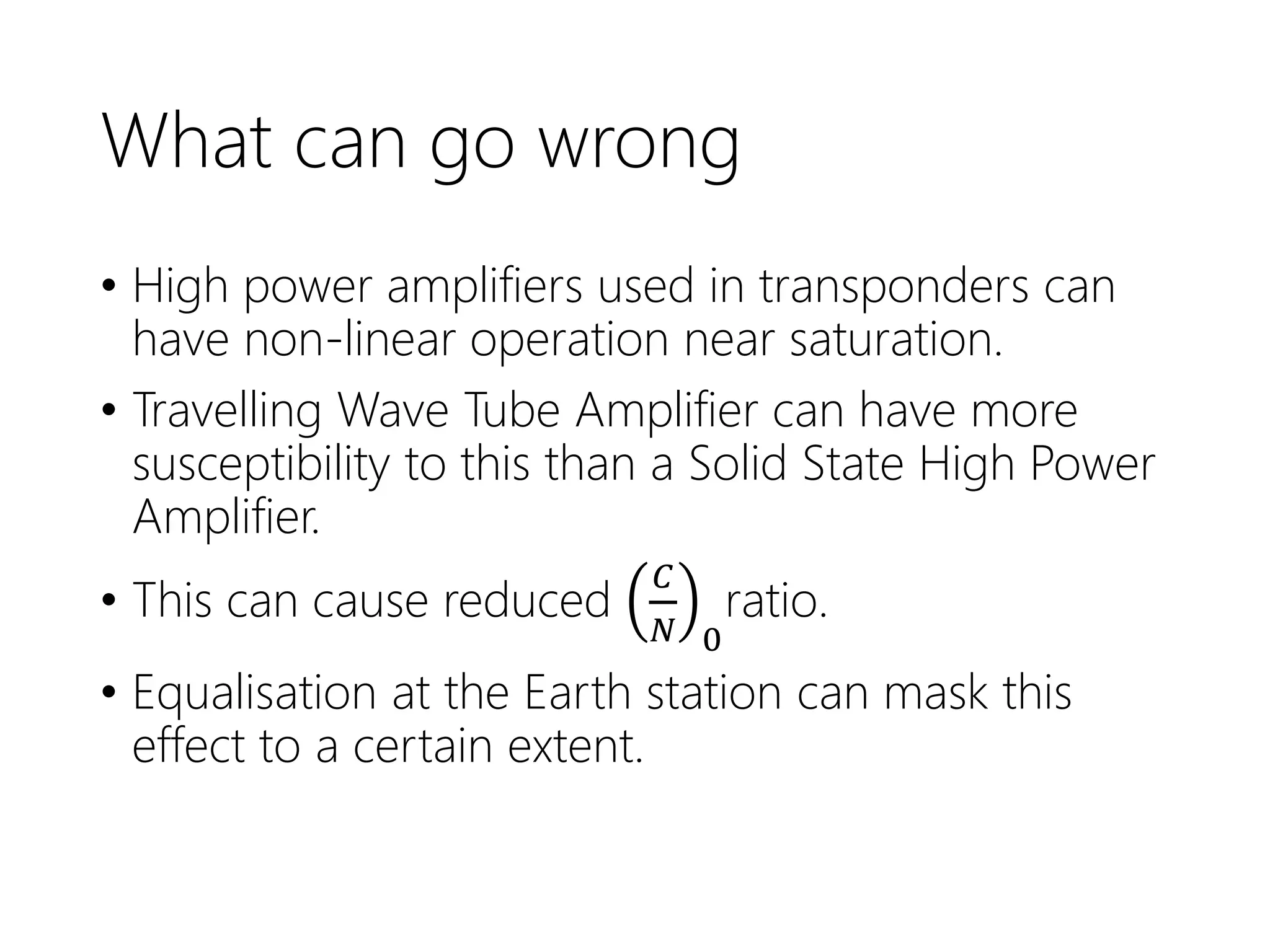
What can go wrong
• High power amplifiers used in transponders can
have non-linear operation near saturation.
• Travelling Wave Tube Amplifier can have more
susceptibility to this than a Solid State High Power
Amplifier.
• This can cause reduced
𝐶
𝑁 0
ratio.
• Equalisation at the Earth station can mask this
effect to a certain extent.
Intermodulation
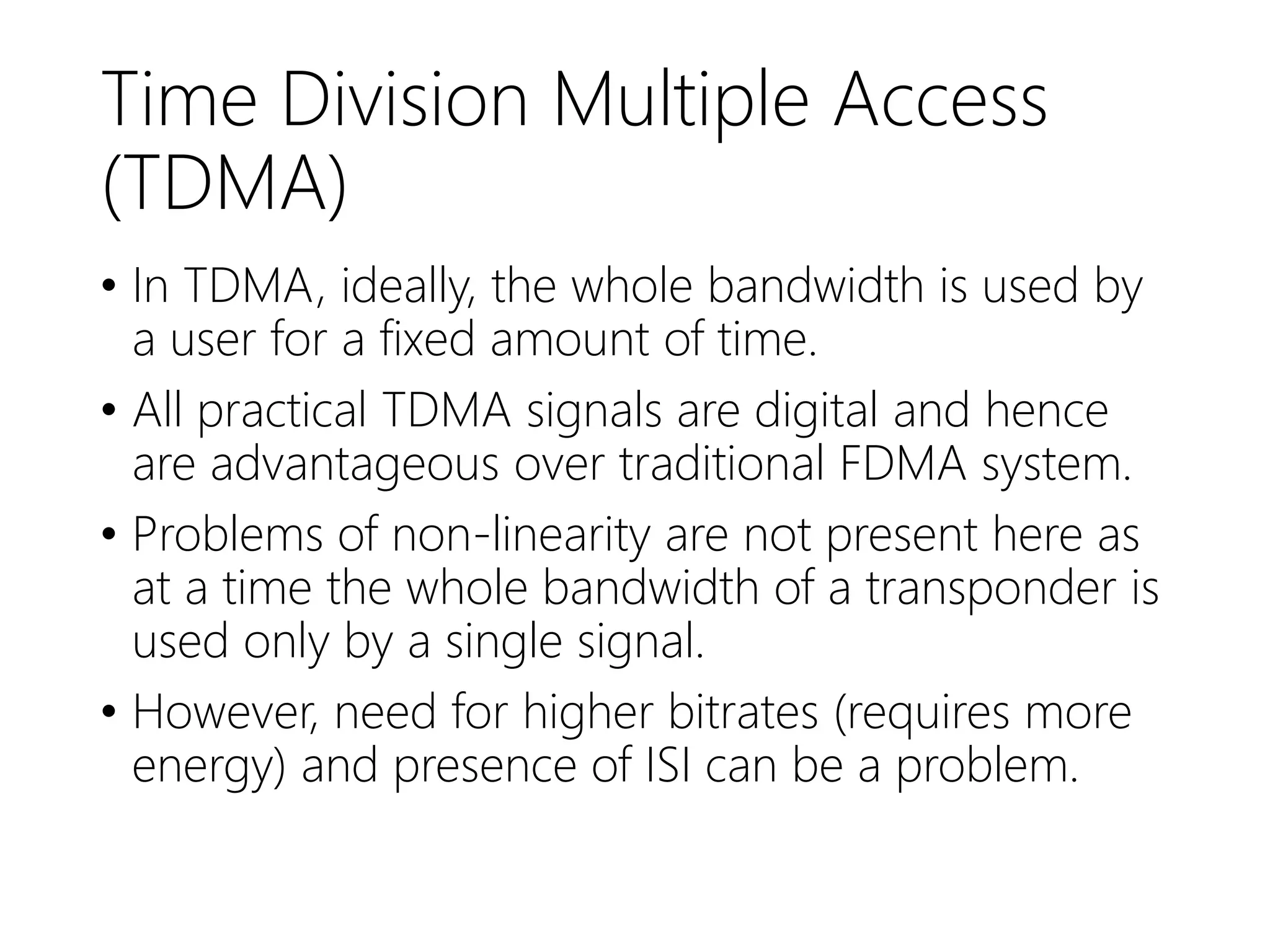
Time Division Multiple Access
(TDMA)
• In TDMA, ideally, the whole bandwidth is used by
a user for a fixed amount of time.
• All practical TDMA signals are digital and hence
are advantageous over traditional FDMA system.
• Problems of non-linearity are not present here as
at a time the whole bandwidth of a transponder is
used only by a single signal.
• However, need for higher bitrates (requires more
energy) and presence of ISI can be a problem.
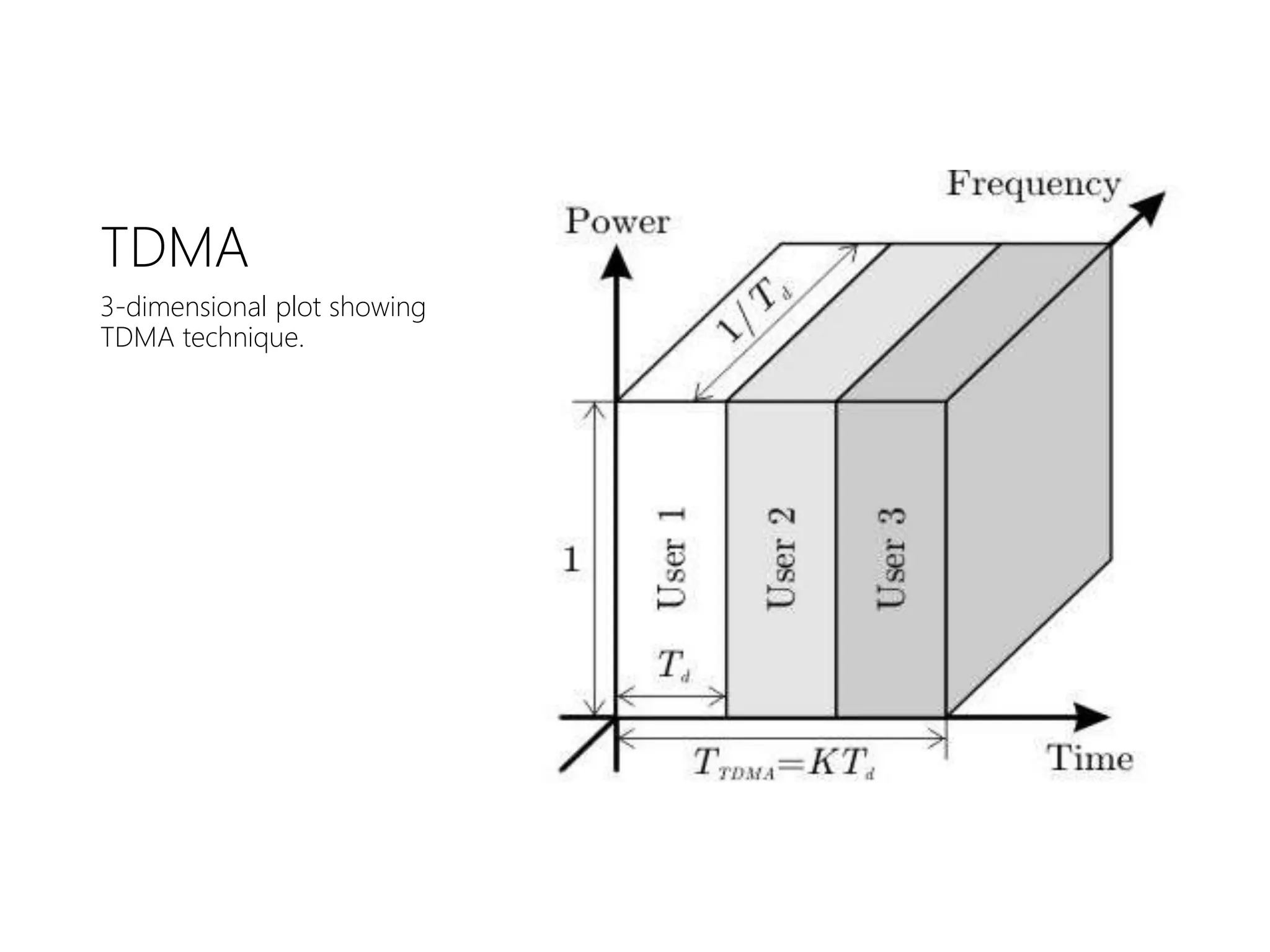
TDMA
3-dimensional plot showing
TDMA technique.
How it works
• Multiple ESs transmits data in short bursts so they
reach the transponder in a sequence
• The transponder simply outputs all the incoming
data into a continuous stream of serial data with
short guard times.
• All ESs must be synced for their signals to arrive
within the positions allotted to them in a frame.
• The received serial data can be recovered using
sync attained between transmitter.
Bits and pieces…
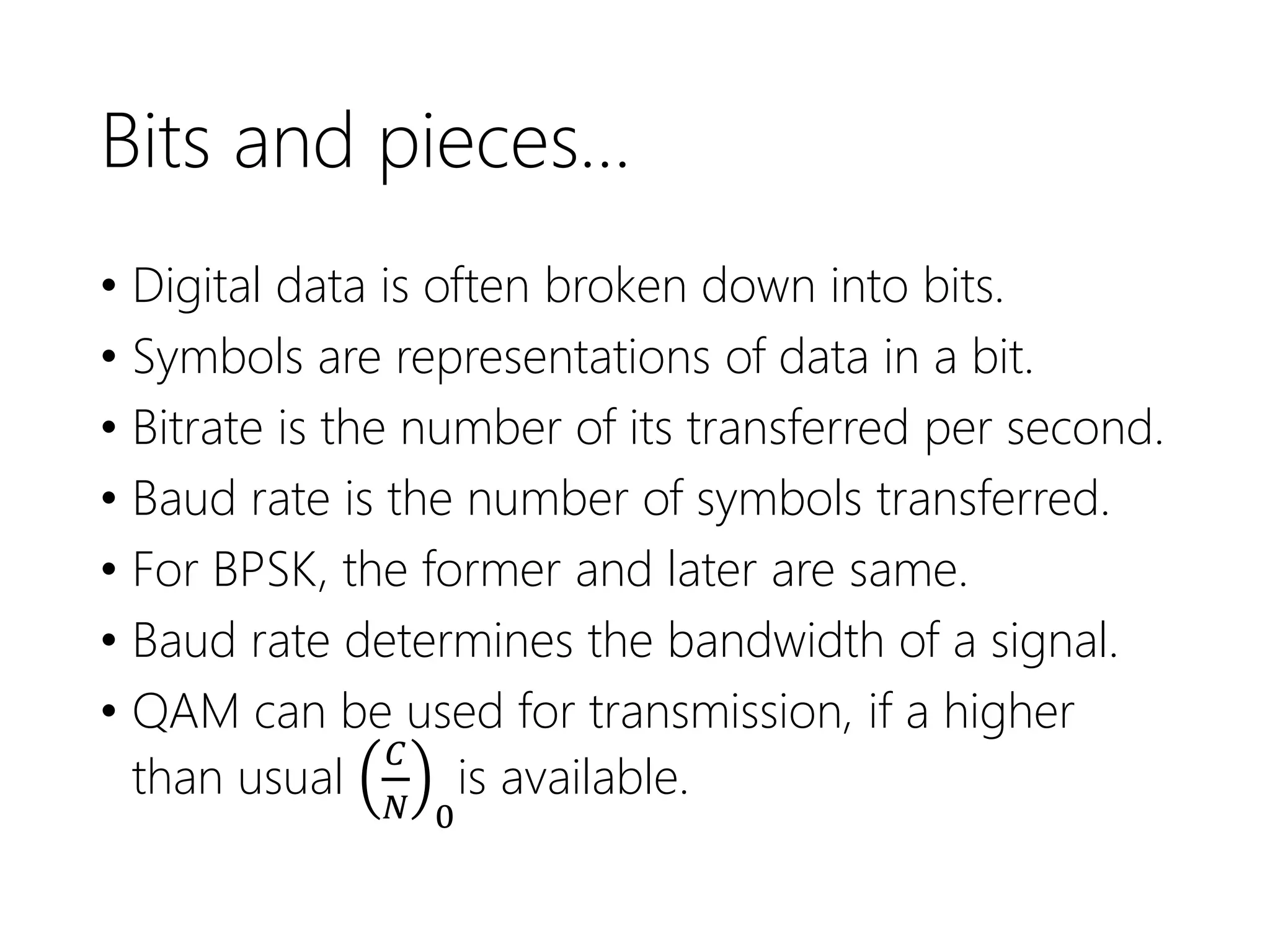
• Digital data is often broken down into bits.
• Symbols are representations of data in a bit.
• Bitrate is the number of its transferred per second.
• Baud rate is the number of symbols transferred.
• For BPSK, the former and later are same.
• Baud rate determines the bandwidth of a signal.
• QAM can be used for transmission, if a higher
than usual
𝐶
𝑁 0
is available.
Being framed
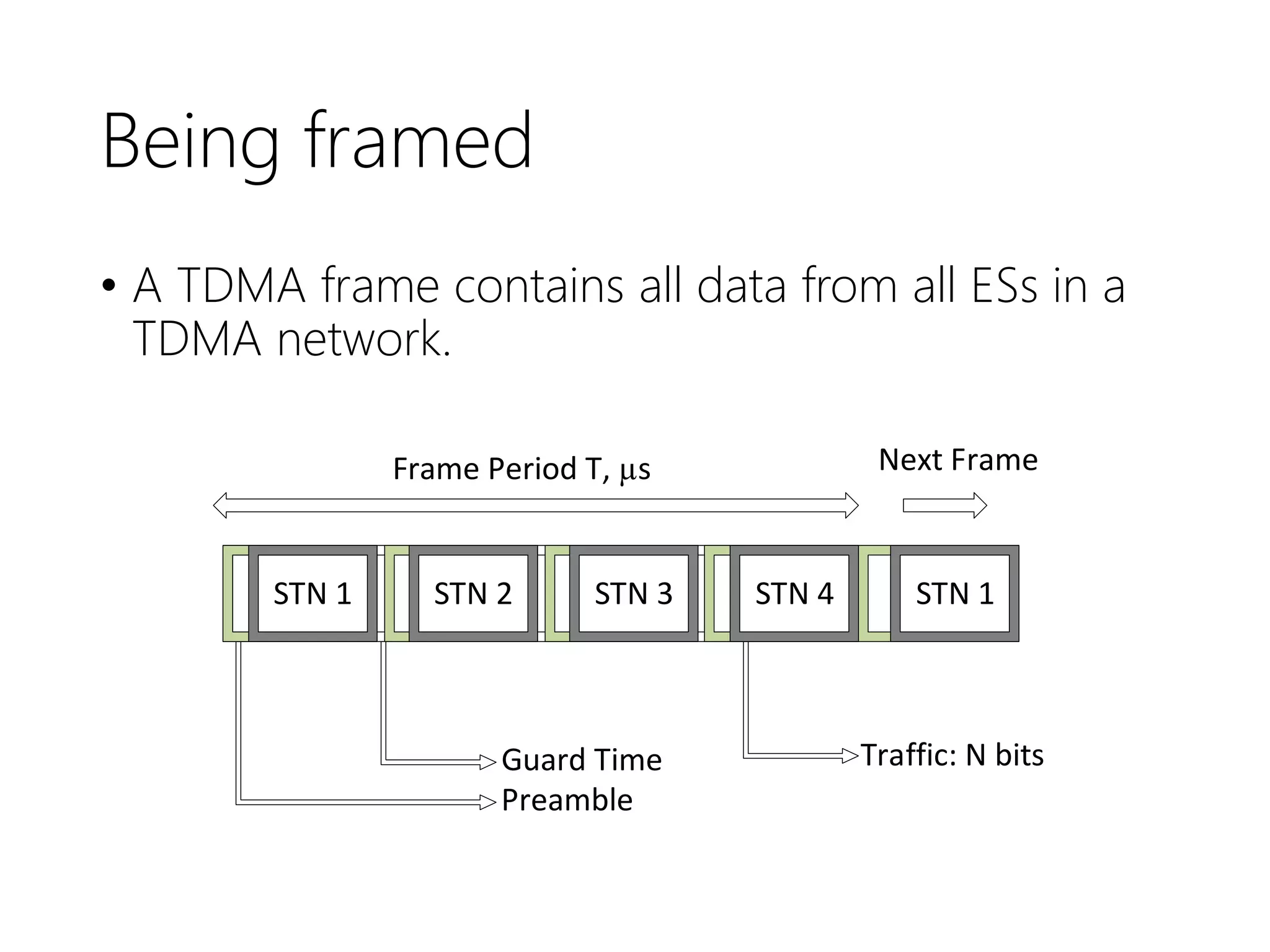
• A TDMA frame contains all data from all ESs in a
TDMA network.
STN 1 STN 2 STN 3 STN 4 STN 1
Frame Period T, µs
Preamble
Guard Time Traffic: N bits
Next Frame
Bursting with data
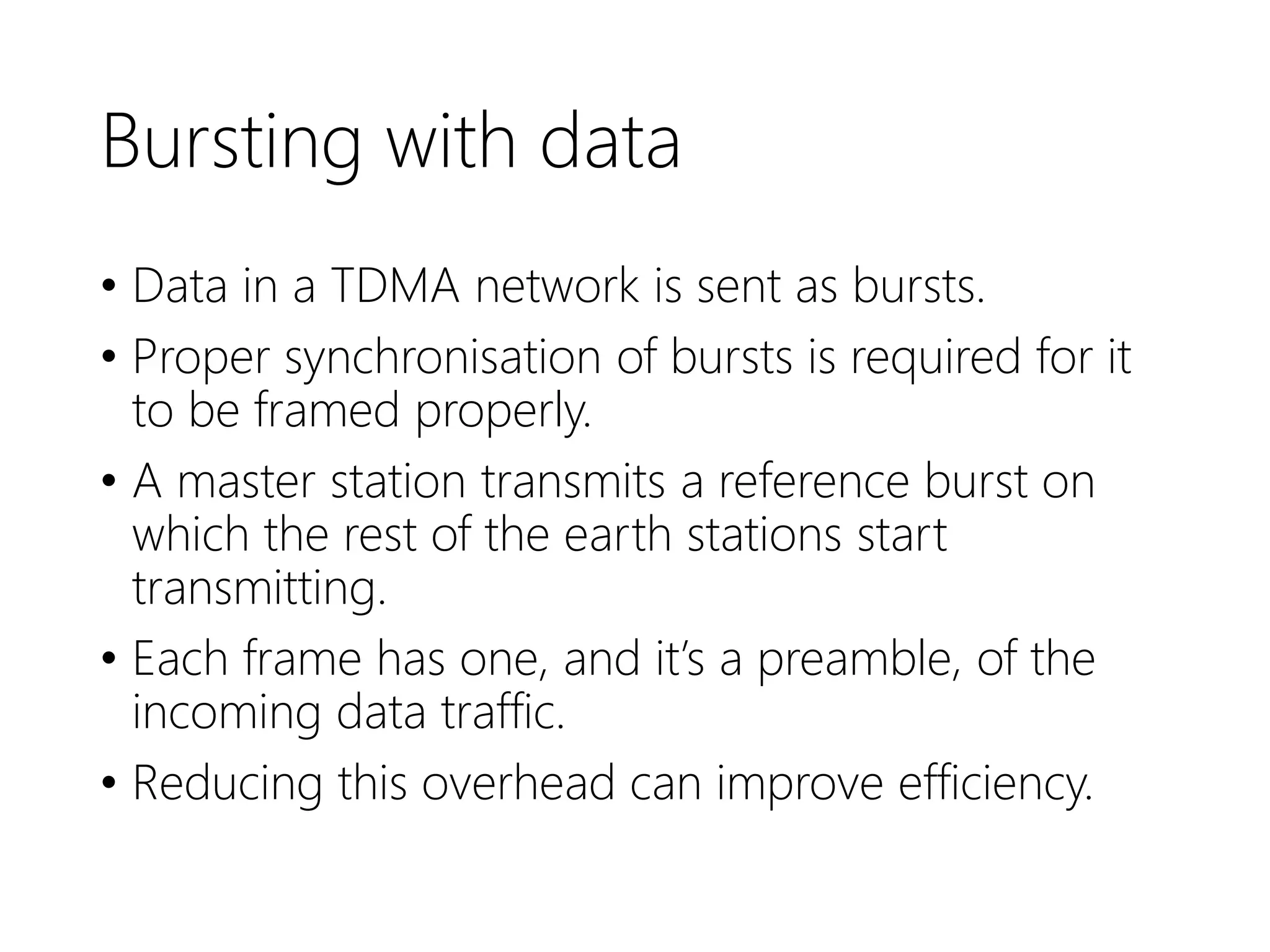
• Data in a TDMA network is sent as bursts.
• Proper synchronisation of bursts is required for it
to be framed properly.
• A master station transmits a reference burst on
which the rest of the earth stations start
transmitting.
• Each frame has one, and it’s a preamble, of the
incoming data traffic.
• Reducing this overhead can improve efficiency.
Guardians…
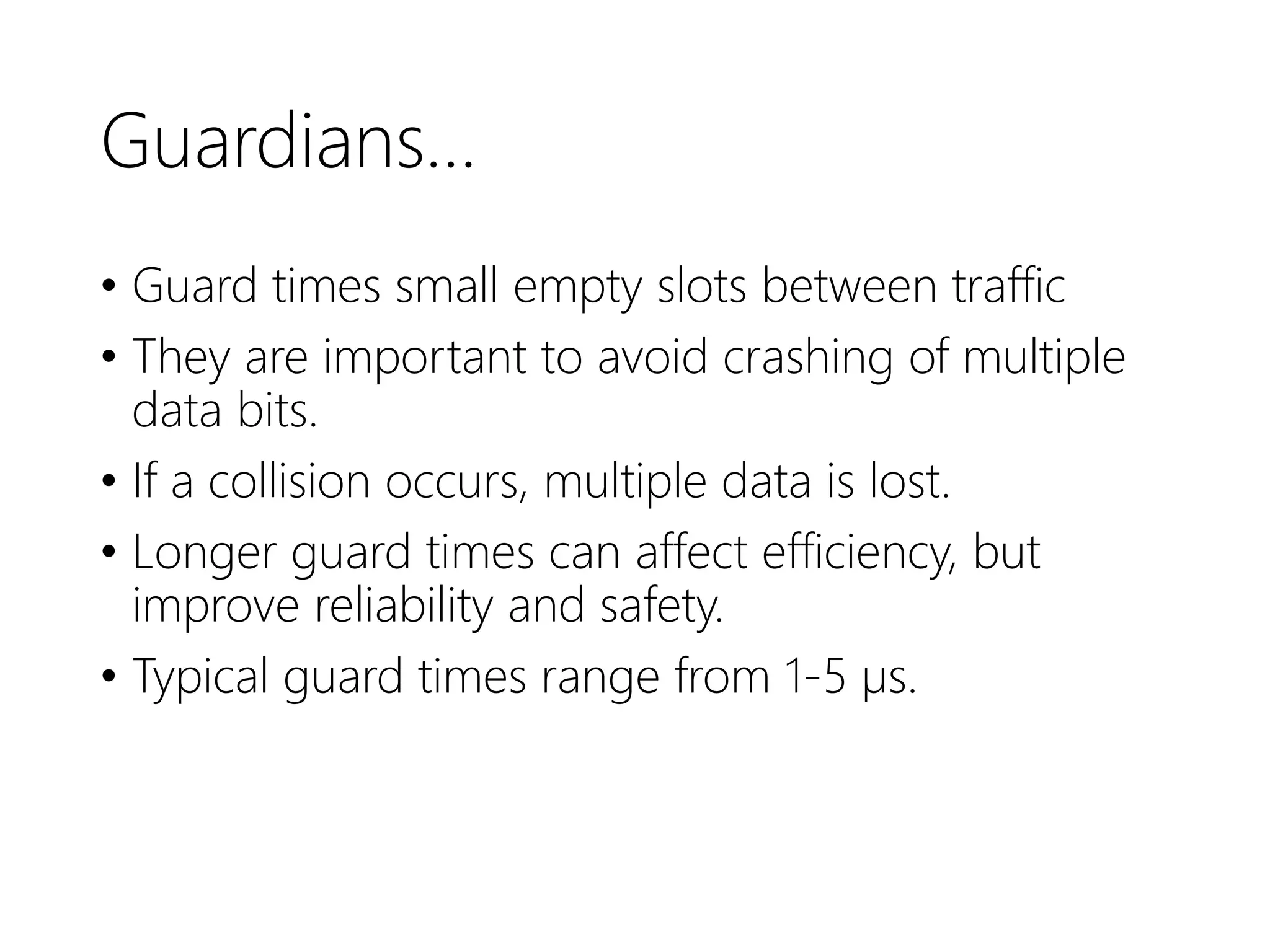
• Guard times small empty slots between traffic
• They are important to avoid crashing of multiple
data bits.
• If a collision occurs, multiple data is lost.
• Longer guard times can affect efficiency, but
improve reliability and safety.
• Typical guard times range from 1-5 µs.
Code Division Multiple Access
(CDMA)
• In CDMA, all users can use the whole bandwidth,
all the time.
• The data need not be synced or be filtered.
• It can allow users with more needs utilise the
bandwidth more, while conserving it when idled.
• Transmission times or frequencies are irrelevant
here, and there is hardly any spectrum allocation.
• Currently used method is Direct Sequence Spread
Spectrum.
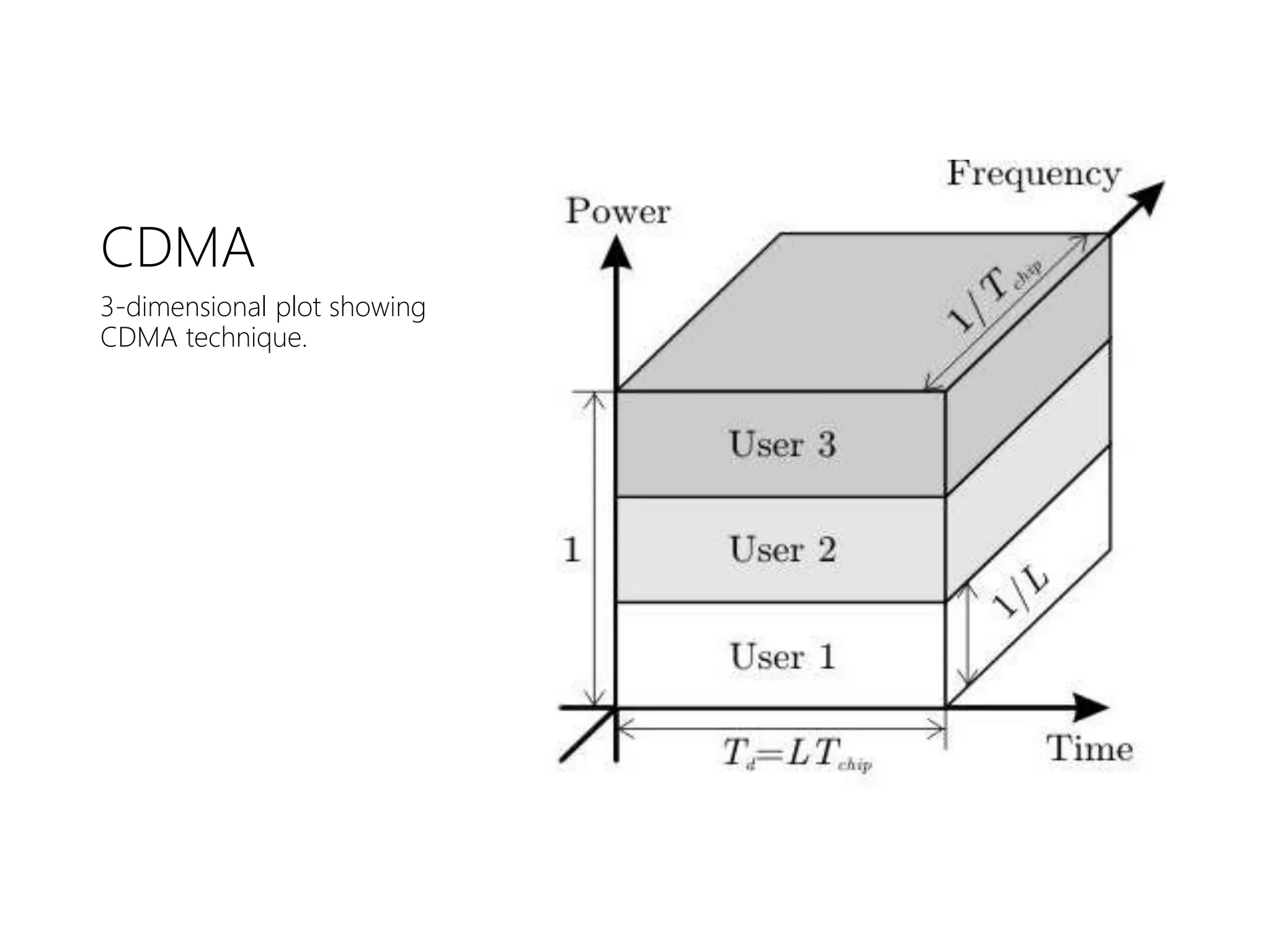
CDMA
3-dimensional plot showing
CDMA technique.
How it works
• Any earth station can code their data based on a
CDMA code, obeying a set of rules defined by an
organisation.
• This code can be 16 bits to several thousand bits
long.
• Since multiple stations can saturate the bandwidth
without much effort, this system is highly efficient.
• The receiver needs the same code used by the
transmitter.
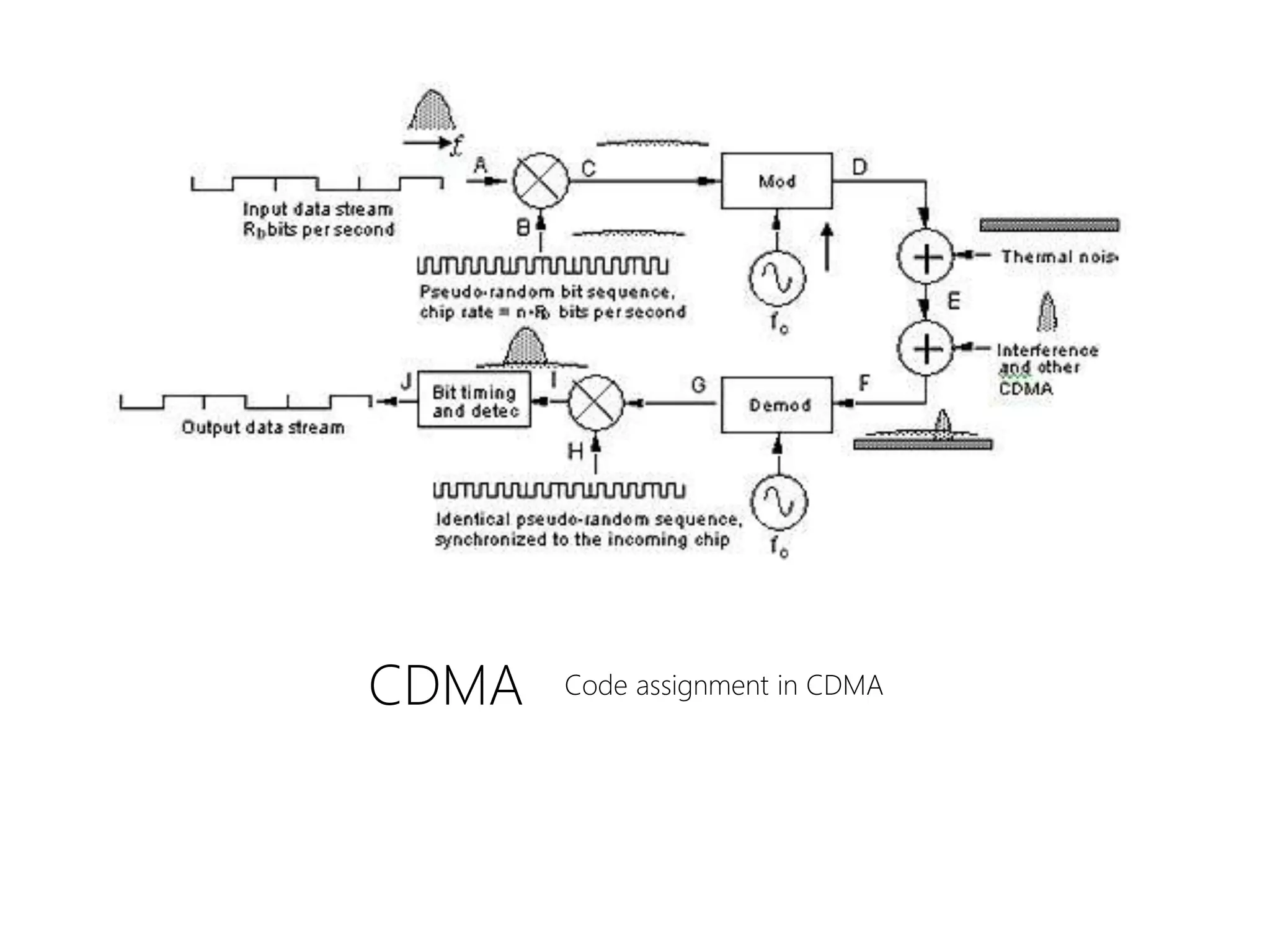
CDMA Code assignment in CDMA
Spreading it
• DS-SS essentially turns data into pseudo noise.
• This makes the resultant data useless for anyone
without the proper decoding key.
• This can improve security and increase efficieny at
the same time.
Demand Assigned Multiple
Access (DAMA)
• This technique is used when the link between the
station and satellite is not a constant one.
• This helps assign bandwidth according to
demand.
• This can be implemented on TDMA, or as a
combination with FDMA and TDMA.
• Commonly used in VSAT (Very Small Aperture
Terminal) systems.
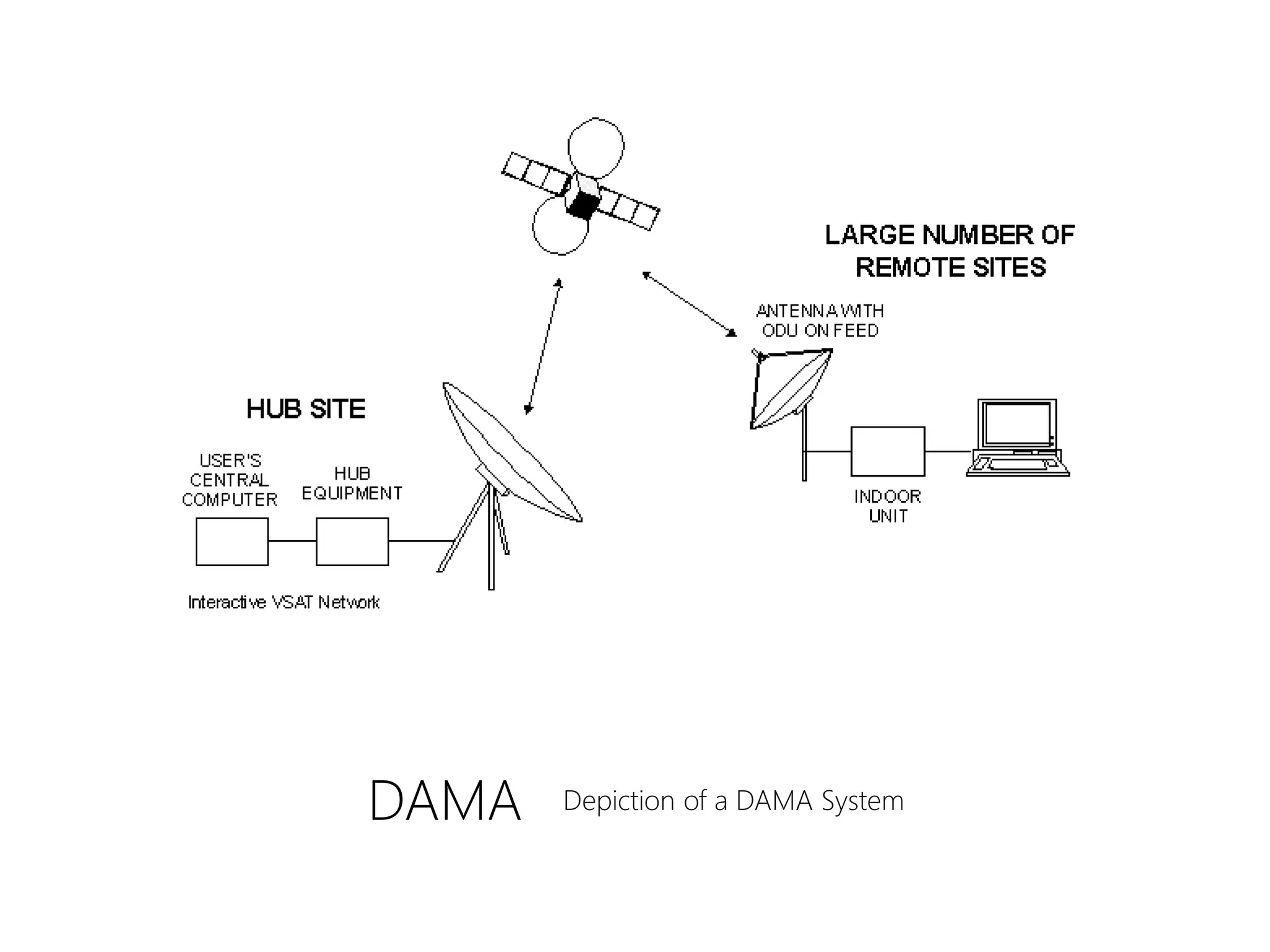
DAMA Depiction of a DAMA System
How it works
• There are two different types of channels in DAMA
• A Common Signalling Channel (CSC)
• And a Communication Channel (CC)
• A user wishing to enter the CC first calls the
controlling ES using CSC.
• Bent pipe transponders then accept the data and
retransmits.
• Receivers should listen in sync continuously to
retrieve the data.
Where it is used
• DAMA is often used in military environments due
to the relative simplicity of implementation and
ease of modelling
• It can operate with bent pipe transponders and
thus require no security on the satellite side.
• The master and slave stations can upgrade
compressions without expensive satellite
replacements.
Ends
• Multiple access schemes are unavoidable
considering the public nature of common
communication satellite.
• There are several more proprietary schemes in
practice, which are even more improved than the
ones described here.
• For general purposes though, these will suffice.

Satellite Multiple Access Schemes

  • 1.
  • 2.
    Need of MultipleAccess • Satellites are usually built and employed for the common good of one or more regions. • This means a lot of people needs to send and receive data through a satellite without major mishaps • For this purpose, we may use one of the several multiple access techniques • Mentioned here are FDMA, TDMA, CDMA and DAMA.
  • 3.
    Frequency Division Multiple Access(FDMA) • Frequency division, as the name suggests, operates by dividing the available bandwidth between users on the basis of frequency. • A group of users maybe allotted a range of frequencies and each individual user can use a limited frequency shifted channels, within that range. • Earlier analogue FDMA used FM waves with slightly different carrier frequencies to get the job done.
  • 4.
  • 5.
    How it works •FDM-FM was transmitted to satellite from ESs. • These were received by a common transponder. • Microwave filters were used in ESs to separate signals within the transponder. • The corresponding ESs received data back from the transponder and the data get demuxed. • If the frequency assignment has to be changed, all the ESs’ filters must be retuned. • This can cause long idle times too.
  • 6.
  • 7.
    Improving on it •Single Channel Per Carrier (SCPC) technique means a number of small mobile earth stations can transmit and receive data over a single transponder. • This can enable satellite telephony • This can also help utilise the whole wide bandwidth of the transponders
  • 8.
    What can gowrong • High power amplifiers used in transponders can have non-linear operation near saturation. • Travelling Wave Tube Amplifier can have more susceptibility to this than a Solid State High Power Amplifier. • This can cause reduced 𝐶 𝑁 0 ratio. • Equalisation at the Earth station can mask this effect to a certain extent.
  • 9.
  • 10.
    Time Division MultipleAccess (TDMA) • In TDMA, ideally, the whole bandwidth is used by a user for a fixed amount of time. • All practical TDMA signals are digital and hence are advantageous over traditional FDMA system. • Problems of non-linearity are not present here as at a time the whole bandwidth of a transponder is used only by a single signal. • However, need for higher bitrates (requires more energy) and presence of ISI can be a problem.
  • 11.
  • 12.
    How it works •Multiple ESs transmits data in short bursts so they reach the transponder in a sequence • The transponder simply outputs all the incoming data into a continuous stream of serial data with short guard times. • All ESs must be synced for their signals to arrive within the positions allotted to them in a frame. • The received serial data can be recovered using sync attained between transmitter.
  • 13.
    Bits and pieces… •Digital data is often broken down into bits. • Symbols are representations of data in a bit. • Bitrate is the number of its transferred per second. • Baud rate is the number of symbols transferred. • For BPSK, the former and later are same. • Baud rate determines the bandwidth of a signal. • QAM can be used for transmission, if a higher than usual 𝐶 𝑁 0 is available.
  • 14.
    Being framed • ATDMA frame contains all data from all ESs in a TDMA network. STN 1 STN 2 STN 3 STN 4 STN 1 Frame Period T, µs Preamble Guard Time Traffic: N bits Next Frame
  • 15.
    Bursting with data •Data in a TDMA network is sent as bursts. • Proper synchronisation of bursts is required for it to be framed properly. • A master station transmits a reference burst on which the rest of the earth stations start transmitting. • Each frame has one, and it’s a preamble, of the incoming data traffic. • Reducing this overhead can improve efficiency.
  • 16.
    Guardians… • Guard timessmall empty slots between traffic • They are important to avoid crashing of multiple data bits. • If a collision occurs, multiple data is lost. • Longer guard times can affect efficiency, but improve reliability and safety. • Typical guard times range from 1-5 µs.
  • 17.
    Code Division MultipleAccess (CDMA) • In CDMA, all users can use the whole bandwidth, all the time. • The data need not be synced or be filtered. • It can allow users with more needs utilise the bandwidth more, while conserving it when idled. • Transmission times or frequencies are irrelevant here, and there is hardly any spectrum allocation. • Currently used method is Direct Sequence Spread Spectrum.
  • 18.
  • 19.
    How it works •Any earth station can code their data based on a CDMA code, obeying a set of rules defined by an organisation. • This code can be 16 bits to several thousand bits long. • Since multiple stations can saturate the bandwidth without much effort, this system is highly efficient. • The receiver needs the same code used by the transmitter.
  • 20.
  • 21.
    Spreading it • DS-SSessentially turns data into pseudo noise. • This makes the resultant data useless for anyone without the proper decoding key. • This can improve security and increase efficieny at the same time.
  • 22.
    Demand Assigned Multiple Access(DAMA) • This technique is used when the link between the station and satellite is not a constant one. • This helps assign bandwidth according to demand. • This can be implemented on TDMA, or as a combination with FDMA and TDMA. • Commonly used in VSAT (Very Small Aperture Terminal) systems.
  • 23.
    DAMA Depiction ofa DAMA System
  • 24.
    How it works •There are two different types of channels in DAMA • A Common Signalling Channel (CSC) • And a Communication Channel (CC) • A user wishing to enter the CC first calls the controlling ES using CSC. • Bent pipe transponders then accept the data and retransmits. • Receivers should listen in sync continuously to retrieve the data.
  • 25.
    Where it isused • DAMA is often used in military environments due to the relative simplicity of implementation and ease of modelling • It can operate with bent pipe transponders and thus require no security on the satellite side. • The master and slave stations can upgrade compressions without expensive satellite replacements.
  • 26.
    Ends • Multiple accessschemes are unavoidable considering the public nature of common communication satellite. • There are several more proprietary schemes in practice, which are even more improved than the ones described here. • For general purposes though, these will suffice.