de Broglie Wavelength
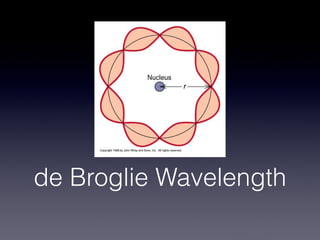
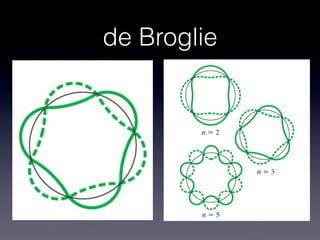
de Broglie
• Pictured the electron in its circular orbit as a
  particle wave

• Can produce "standing waves" under
  resonant conditions

• Developed the idea that a particle with mass,
  m, and a velocity, v, has a wavelength
  associated with it => de Broglie Wavelength
de Broglie
de Broglie
de Broglie
Schrödinger
• Used de Broglie wavelength to
  create a quantum theory based
  on waves

• Did not keep the "orbits"

• The wave/particle model cannot
  determine the location and
  momentum of an electron at the
  same time

• The quantum model predicts the
  probability that an e- is at a
  specific location
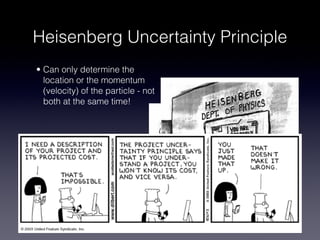
Heisenberg Uncertainty Principle
• Can only determine the
  location or the momentum
  (velocity) of the particle - not
  both at the same time!
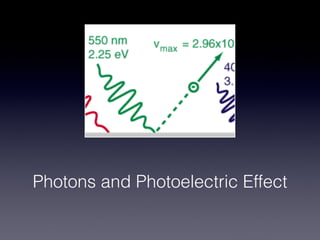
Photons and Photoelectric Effect
Photoelectric Effect

• Metal is illuminated by electromagnetic
  radiation

• Energy that is absorbed near the surface can
  free electrons, causing e's to fly off

• Released electrons are called photoelectrons
Wave theory predicts the
            following:
• Significant time delay between the illumination
  and ejection - build up of KE to free e-'s

• Increasing the intensity of light = cause
  electrons to leave with greater KE

• Photoelectrons would be released regardless
  of frequency of light, as long as the intensity
  was great enough....

              But these are FALSE!
Photoelectric Effect
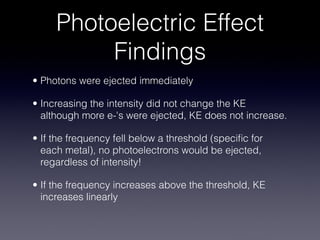
          Findings
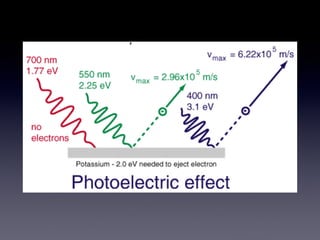
• Photons were ejected immediately

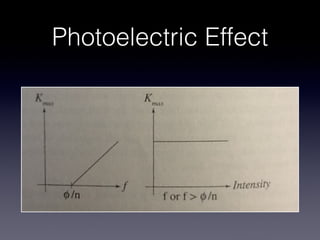
• Increasing the intensity did not change the KE
  although more e-'s were ejected, KE does not increase.

• If the frequency fell below a threshold (specific for
  each metal), no photoelectrons would be ejected,
  regardless of intensity!

• If the frequency increases above the threshold, KE
  increases linearly
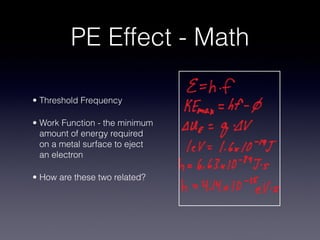
PE Effect - Math

• Threshold Frequency

• Work Function - the minimum
  amount of energy required
  on a metal surface to eject
  an electron

• How are these two related?
PE Effect - Math
Photoelectric Effect

EM Spectrum, de Broglie, PE Notes

  • 3.
  • 4.
    de Broglie • Picturedthe electron in its circular orbit as a particle wave • Can produce "standing waves" under resonant conditions • Developed the idea that a particle with mass, m, and a velocity, v, has a wavelength associated with it => de Broglie Wavelength
  • 5.
  • 6.
  • 7.
  • 8.
    Schrödinger • Used deBroglie wavelength to create a quantum theory based on waves • Did not keep the "orbits" • The wave/particle model cannot determine the location and momentum of an electron at the same time • The quantum model predicts the probability that an e- is at a specific location
  • 9.
    Heisenberg Uncertainty Principle •Can only determine the location or the momentum (velocity) of the particle - not both at the same time!
  • 11.
  • 12.
    Photoelectric Effect • Metalis illuminated by electromagnetic radiation • Energy that is absorbed near the surface can free electrons, causing e's to fly off • Released electrons are called photoelectrons
  • 13.
    Wave theory predictsthe following: • Significant time delay between the illumination and ejection - build up of KE to free e-'s • Increasing the intensity of light = cause electrons to leave with greater KE • Photoelectrons would be released regardless of frequency of light, as long as the intensity was great enough.... But these are FALSE!
  • 14.
    Photoelectric Effect Findings • Photons were ejected immediately • Increasing the intensity did not change the KE although more e-'s were ejected, KE does not increase. • If the frequency fell below a threshold (specific for each metal), no photoelectrons would be ejected, regardless of intensity! • If the frequency increases above the threshold, KE increases linearly
  • 16.
    PE Effect -Math • Threshold Frequency • Work Function - the minimum amount of energy required on a metal surface to eject an electron • How are these two related?
  • 17.
  • 18.