Duration: 60 min DPT Medical Physics Lecture 05
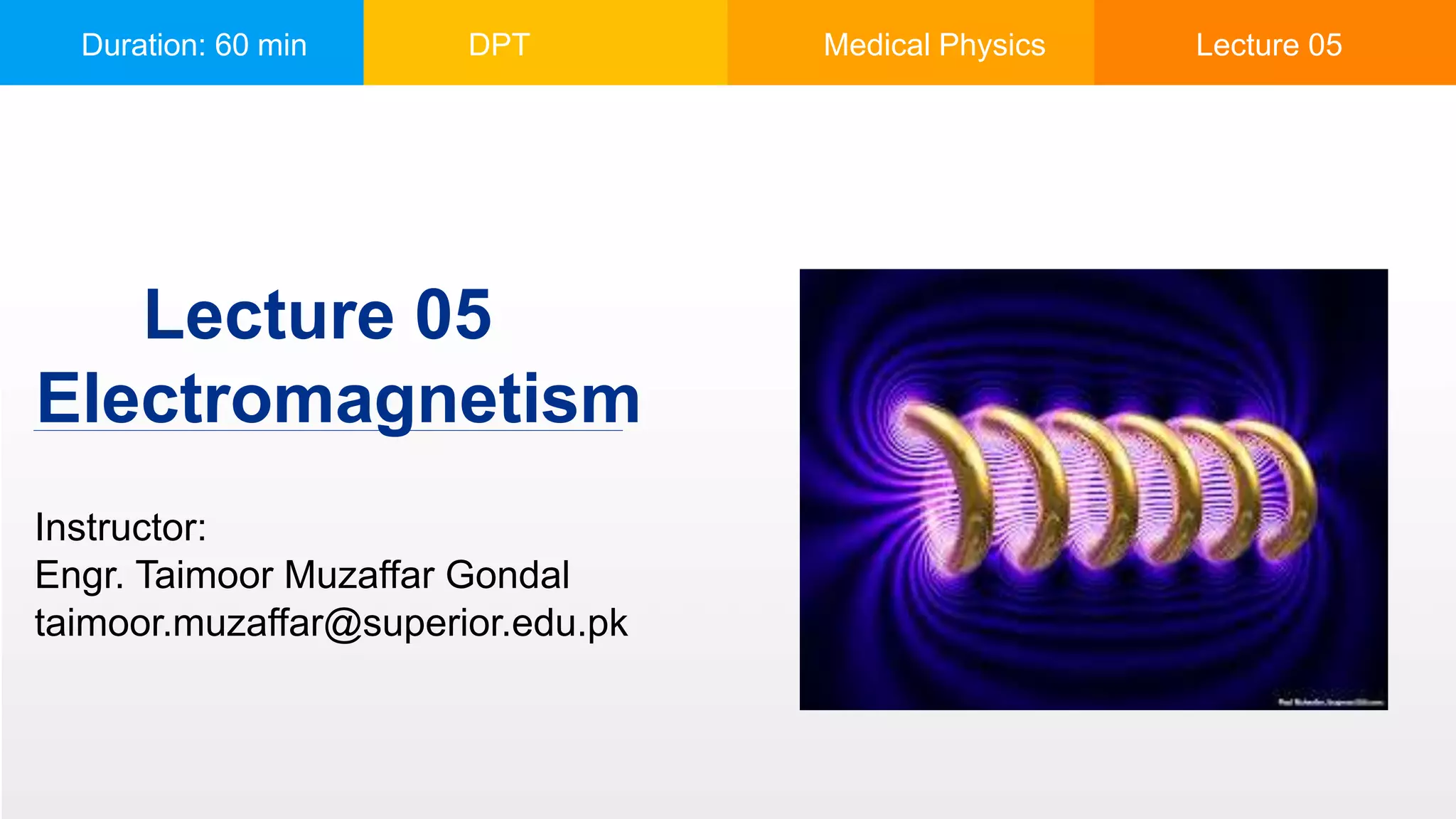
Electromagnetism
Instructor:
Engr. Taimoor Muzaffar Gondal
taimoor.muzaffar@superior.edu.pk
Lecture 05
Duration: 60 min DPT Medical Physics Lecture 05
A Brief History
1600 William Gilbert, On magnetism; magnetic materials; poles that attract & repel; Earth’s
magnetic field, compass ‘dip’
1820 Hans Christian Oersted finds that an electric current deflects a compass needle.
1820 Andre Marie Ampère finds that parallel wires carrying current produce forces on each other.
1820s, 1830s Michael Faraday develops the concept of electric field and shows that
electric current + magnetism -> motion (motor effect)
motion + magnetism -> electric current (electromagnetic induction)
1860s James Clerk Maxwell (1831-1879) established a mathematical description of
electromagnetism.
Duration: 60 min DPT Medical Physics Lecture 05
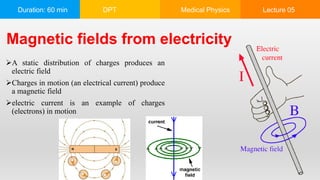
Magnetic fields from electricity
A static distribution of charges produces an
electric field
Charges in motion (an electrical current) produce
a magnetic field
electric current is an example of charges
(electrons) in motion
Duration: 60 min DPT Medical Physics Lecture 05
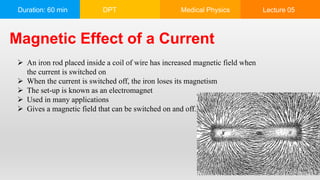
Magnetic Effect of a Current
 An iron rod placed inside a coil of wire has increased magnetic field when
the current is switched on
 When the current is switched off, the iron loses its magnetism
 The set-up is known as an electromagnet
 Used in many applications
 Gives a magnetic field that can be switched on and off. when desired
Duration: 60 min DPT Medical Physics Lecture 05
Electromagnets
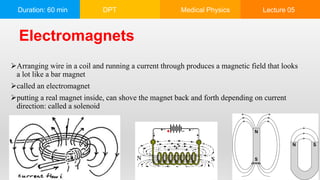
Arranging wire in a coil and running a current through produces a magnetic field that looks
a lot like a bar magnet
called an electromagnet
putting a real magnet inside, can shove the magnet back and forth depending on current
direction: called a solenoid
Duration: 60 min DPT Medical Physics Lecture 05
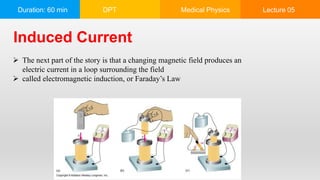
 The next part of the story is that a changing magnetic field produces an
electric current in a loop surrounding the field
 called electromagnetic induction, or Faraday’s Law
Induced Current
Duration: 60 min DPT Medical Physics Lecture 05
The Electromagnetic Connection
 A changing magnetic field produces an electric field, and a changing
electric field produces a magnetic field.
 Electric and Magnetic fields can produce forces on charges
 An accelerating charge produces electromagnetic waves (radiation)
 Both electric and magnetic fields can transport energy
 Electric field energy used in electrical circuits, e.g., released in
lightning
 Magnetic field carries energy through transformer, for example
Duration: 60 min DPT Medical Physics Lecture 05
What’s “Waving” in EM waves?
What medium transports sound waves? (Air)
 Can there be sound waves in the vacuum of outer space? (No)
 What medium transports water waves? (Ocean Water)
 What medium transports radio waves? (No medium)
 A topic of considerable debate in the late 1800’s and early 1900’s
 Led to the concept of the “aluminiferous ether” – an invisible “jello” that
was thought to vibrate electromagnetically
 Experiments that sought this ether didn’t find it!
 This was quite a surprise
Duration: 60 min DPT Medical Physics Lecture 05
Examples of Electromagnetic Radiation
 AM and FM radio waves (including TV signals)
 Cell phone communication links
 Microwaves
 Infrared radiation
 Light
 X-rays
 Gamma rays
 What distinguishes these from one another?
Duration: 60 min DPT Medical Physics Lecture 05
Uses of Electromagnetic Waves
 Communication systems
 One-way and two-way
 Radar
 Cooking (with microwaves)
 Medical Imaging (X rays)
 “Night Vision” (infrared)
 Astronomy (radio, wave, IR, visible, UV, gamma)
All that we experience through our eyes is conveyed by
electromagnetic radiation…
Duration: 60 min DPT Medical Physics Lecture 05
What are some uses for electric magnets?
 Electromagnets are useful for lifting and moving large metal objects
containing iron. When current runs through the solenoid coils, it creates a
magnetic field that attracts the metal objects. Turning off the current turns off
the magnetic field so that the metal can be easily dropped in a new place.
 Powerful electromagnets can raise a maglev train above its track. Just as
poles of a bar magnet repel each other, electromagnets in the train and track
repel each other when the electric current is turned on.
Duration: 60 min DPT Medical Physics Lecture 05
What are some uses for electric magnets?
 A galvanometer is a meter that measures the strength and direction of an electric
current in a wire.
 A galvanometer contains an electromagnet between the poles of a permanent
magnet. When current is applied to the electromagnet, the two magnetic fields
interact and cause the electromagnet to turn.
 The indicator, attached to the electromagnet, moves to one side of the zero on
the scale, indicting the strength and direction of the current.
Duration: 60 min DPT Medical Physics Lecture 05
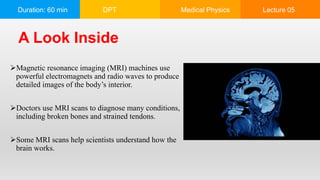
Magnetic resonance imaging (MRI) machines use
powerful electromagnets and radio waves to produce
detailed images of the body’s interior.
Doctors use MRI scans to diagnose many conditions,
including broken bones and strained tendons.
Some MRI scans help scientists understand how the
brain works.
A Look Inside
Duration: 60 min DPT Medical Physics Lecture 05
How do motors work?
 An electric motor changes electrical energy into mechanical
energy.
 Electric motors range in size from large motors, used to
power Ferris wheels, to small motors used in computer
cooling fans. Almost every time a device uses electricity to
make something move, there is a motor involved.
Duration: 60 min DPT Medical Physics Lecture 05
Motors everywhere
 lifts & escalators; fans, turbines, drills; wheelchairs; car windscreen wipers, starter
motors, windows & side mirrors; motors in electric cars, locomotives & conveyor
belts; industrial robots, saws and blades in cutting and slicing processes; food mixers
& blenders, microwave ovens; hand power tools such as drills, sanders, routers;
electric toothbrushes, shavers, hairdryers; vacuum cleaners, sound systems,
computers …
 using electricity supplied by power station generators
Duration: 60 min DPT Medical Physics Lecture 05
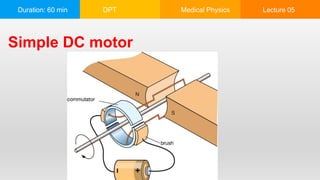
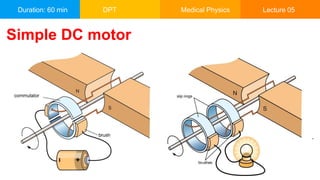
Simple DC motor
Duration: 60 min DPT Medical Physics Lecture 05
Simple DC motor
Duration: 60 min DPT Medical Physics Lecture 05
End of Lecture 05
For any kind of queries and questions you are advised to
write at
taimoor.muzaffar@superior.edu.pk
Or visit my office during consulting hours
This lectures can also be downloaded from
https://www.slideshare.net/Taimoor_Gondal

Electromagnetism Fundamentals

  • 1.
    Duration: 60 minDPT Medical Physics Lecture 05 Electromagnetism Instructor: Engr. Taimoor Muzaffar Gondal taimoor.muzaffar@superior.edu.pk Lecture 05
  • 2.
    Duration: 60 minDPT Medical Physics Lecture 05 A Brief History 1600 William Gilbert, On magnetism; magnetic materials; poles that attract & repel; Earth’s magnetic field, compass ‘dip’ 1820 Hans Christian Oersted finds that an electric current deflects a compass needle. 1820 Andre Marie Ampère finds that parallel wires carrying current produce forces on each other. 1820s, 1830s Michael Faraday develops the concept of electric field and shows that electric current + magnetism -> motion (motor effect) motion + magnetism -> electric current (electromagnetic induction) 1860s James Clerk Maxwell (1831-1879) established a mathematical description of electromagnetism.
  • 3.
    Duration: 60 minDPT Medical Physics Lecture 05 Magnetic fields from electricity A static distribution of charges produces an electric field Charges in motion (an electrical current) produce a magnetic field electric current is an example of charges (electrons) in motion
  • 4.
    Duration: 60 minDPT Medical Physics Lecture 05 Magnetic Effect of a Current  An iron rod placed inside a coil of wire has increased magnetic field when the current is switched on  When the current is switched off, the iron loses its magnetism  The set-up is known as an electromagnet  Used in many applications  Gives a magnetic field that can be switched on and off. when desired
  • 5.
    Duration: 60 minDPT Medical Physics Lecture 05 Electromagnets Arranging wire in a coil and running a current through produces a magnetic field that looks a lot like a bar magnet called an electromagnet putting a real magnet inside, can shove the magnet back and forth depending on current direction: called a solenoid
  • 6.
    Duration: 60 minDPT Medical Physics Lecture 05  The next part of the story is that a changing magnetic field produces an electric current in a loop surrounding the field  called electromagnetic induction, or Faraday’s Law Induced Current
  • 7.
    Duration: 60 minDPT Medical Physics Lecture 05 The Electromagnetic Connection  A changing magnetic field produces an electric field, and a changing electric field produces a magnetic field.  Electric and Magnetic fields can produce forces on charges  An accelerating charge produces electromagnetic waves (radiation)  Both electric and magnetic fields can transport energy  Electric field energy used in electrical circuits, e.g., released in lightning  Magnetic field carries energy through transformer, for example
  • 8.
    Duration: 60 minDPT Medical Physics Lecture 05 What’s “Waving” in EM waves? What medium transports sound waves? (Air)  Can there be sound waves in the vacuum of outer space? (No)  What medium transports water waves? (Ocean Water)  What medium transports radio waves? (No medium)  A topic of considerable debate in the late 1800’s and early 1900’s  Led to the concept of the “aluminiferous ether” – an invisible “jello” that was thought to vibrate electromagnetically  Experiments that sought this ether didn’t find it!  This was quite a surprise
  • 9.
    Duration: 60 minDPT Medical Physics Lecture 05 Examples of Electromagnetic Radiation  AM and FM radio waves (including TV signals)  Cell phone communication links  Microwaves  Infrared radiation  Light  X-rays  Gamma rays  What distinguishes these from one another?
  • 10.
    Duration: 60 minDPT Medical Physics Lecture 05 Uses of Electromagnetic Waves  Communication systems  One-way and two-way  Radar  Cooking (with microwaves)  Medical Imaging (X rays)  “Night Vision” (infrared)  Astronomy (radio, wave, IR, visible, UV, gamma) All that we experience through our eyes is conveyed by electromagnetic radiation…
  • 11.
    Duration: 60 minDPT Medical Physics Lecture 05 What are some uses for electric magnets?  Electromagnets are useful for lifting and moving large metal objects containing iron. When current runs through the solenoid coils, it creates a magnetic field that attracts the metal objects. Turning off the current turns off the magnetic field so that the metal can be easily dropped in a new place.  Powerful electromagnets can raise a maglev train above its track. Just as poles of a bar magnet repel each other, electromagnets in the train and track repel each other when the electric current is turned on.
  • 12.
    Duration: 60 minDPT Medical Physics Lecture 05 What are some uses for electric magnets?  A galvanometer is a meter that measures the strength and direction of an electric current in a wire.  A galvanometer contains an electromagnet between the poles of a permanent magnet. When current is applied to the electromagnet, the two magnetic fields interact and cause the electromagnet to turn.  The indicator, attached to the electromagnet, moves to one side of the zero on the scale, indicting the strength and direction of the current.
  • 13.
    Duration: 60 minDPT Medical Physics Lecture 05 Magnetic resonance imaging (MRI) machines use powerful electromagnets and radio waves to produce detailed images of the body’s interior. Doctors use MRI scans to diagnose many conditions, including broken bones and strained tendons. Some MRI scans help scientists understand how the brain works. A Look Inside
  • 14.
    Duration: 60 minDPT Medical Physics Lecture 05 How do motors work?  An electric motor changes electrical energy into mechanical energy.  Electric motors range in size from large motors, used to power Ferris wheels, to small motors used in computer cooling fans. Almost every time a device uses electricity to make something move, there is a motor involved.
  • 15.
    Duration: 60 minDPT Medical Physics Lecture 05 Motors everywhere  lifts & escalators; fans, turbines, drills; wheelchairs; car windscreen wipers, starter motors, windows & side mirrors; motors in electric cars, locomotives & conveyor belts; industrial robots, saws and blades in cutting and slicing processes; food mixers & blenders, microwave ovens; hand power tools such as drills, sanders, routers; electric toothbrushes, shavers, hairdryers; vacuum cleaners, sound systems, computers …  using electricity supplied by power station generators
  • 16.
    Duration: 60 minDPT Medical Physics Lecture 05 Simple DC motor
  • 17.
    Duration: 60 minDPT Medical Physics Lecture 05 Simple DC motor
  • 18.
    Duration: 60 minDPT Medical Physics Lecture 05 End of Lecture 05 For any kind of queries and questions you are advised to write at taimoor.muzaffar@superior.edu.pk Or visit my office during consulting hours This lectures can also be downloaded from https://www.slideshare.net/Taimoor_Gondal