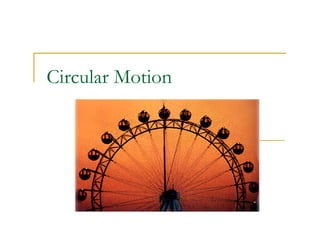
Circular Motion
Speed/Velocity in a Circle 
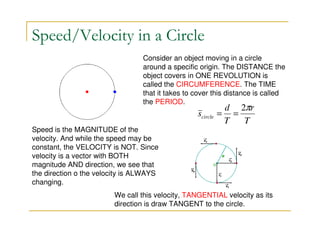
Consider an object moving in a circle 
around a specific origin. The DISTANCE the 
object covers in ONE REVOLUTION is 
called the CIRCUMFERENCE. The TIME 
that it takes to cover this distance is called 
the PERIOD. 
T 
r 
d 
T 
scircle 
2p 
= = 
Speed is the MAGNITUDE of the 
velocity. And while the speed may be 
constant, the VELOCITY is NOT. Since 
velocity is a vector with BOTH 
magnitude AND direction, we see that 
the direction o the velocity is ALWAYS 
changing. 
We call this velocity, TANGENTIAL velocity as its 
direction is draw TANGENT to the circle.
Centripetal Acceleration 
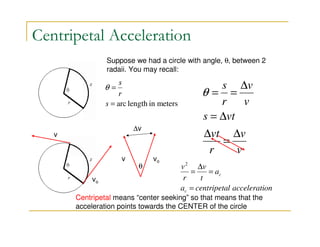
Suppose we had a circle with angle, q, between 2 
radaii. You may recall: 
= 
s 
= arc length in meters 
s 
r 
q 
v 
v 
s 
= D 
s vt 
vt 
r 
v 
v 
r 
D 
= 
D 
D 
q = = 
vo 
v 
Dv 
vo v 
q 
a 
v 
t 
v 
r 
a centripetal acceleration 
c 
c 
= 
= 
D 
= 
2 
Centripetal means “center seeking” so that means that the 
acceleration points towards the CENTER of the circle
Drawing the Directions correctly 
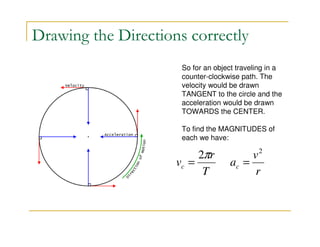
So for an object traveling in a 
counter-clockwise path. The 
velocity would be drawn 
TANGENT to the circle and the 
acceleration would be drawn 
TOWARDS the CENTER. 
To find the MAGNITUDES of 
each we have: 
2 2 
v 
= = 
r 
a 
p 
T 
r 
vc c
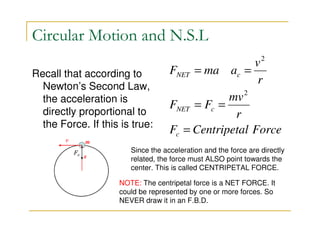
Circular Motion and N.S.L 
Recall that according to 
Newton’s Second Law, 
the acceleration is 
directly proportional to 
the Force. If this is true: 
= = 
F ma a 
NET c 
mv 
r 
F F 
v 
r 
NET c 
F Centripetal Force 
c 
= 
= = 
2 
2 
Since the acceleration and the force are directly 
related, the force must ALSO point towards the 
center. This is called CENTRIPETAL FORCE. 
NOTE: The centripetal force is a NET FORCE. It 
could be represented by one or more forces. So 
NEVER draw it in an F.B.D.
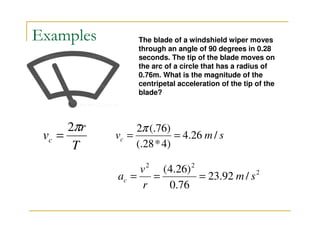
Examples 
T 
r 
vc 
The blade of a windshield wiper moves 
through an angle of 90 degrees in 0.28 
seconds. The tip of the blade moves on 
the arc of a circle that has a radius of 
0.76m. What is the magnitude of the 
centripetal acceleration of the tip of the 
blade? 
2p 
2 p 
(.76) 
= v c = = 
4.26 m / 
s (.28*4) 
2 
2 2 
23.92 / 
(4.26) 
ac = = = 
0.76 
m s 
v 
r
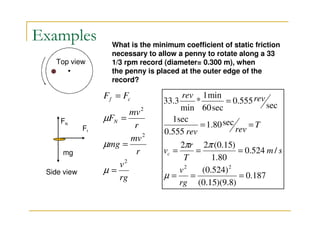
Examples 
F F 
f c 
= 
v 
rg 
mv 
2 
mv 
r 
μ 
μ 
mg 
r 
F 
N 
2 
2 
= 
= 
= 
μ 
What is the minimum coefficient of static friction 
necessary to allow a penny to rotate along a 33 
1/3 rpm record (diameter= 0.300 m), when 
the penny is placed at the outer edge of the 
record? 
Top view 
FN 
mg 
Ff 
1min 
* 
rev rev 
= 
1.80sec 
1sec 
= = 
2 2 (0.15) 
= = = 
(0.524) 
v 
Side view 0.187 
(0.15)(9.8) 
0.524 / 
1.80 
0.555 
sec 
0.555 
60sec 
min 
33.3 
2 2 
= = = 
rg 
m s 
T 
r 
v 
T 
rev rev 
c 
μ 
p p
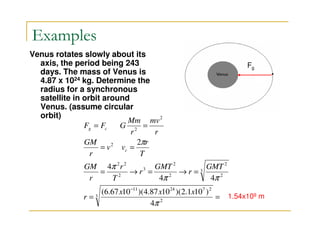
Examples 
Venus rotates slowly about its 
axis, the period being 243 
days. The mass of Venus is 
4.87 x 1024 kg. Determine the 
radius for a synchronous 
satellite in orbit around 
Venus. (assume circular 
orbit) 
Fg 
Mm 
= = 
= = 
2 2 
mv 
= ® = ® = 
− 
11 24 7 2 
(6.67 10 )(4.87 10 )(2.1 10 ) 
GM 
GM 
= 3 
= 
2 
3 
2 
2 
2 
2 
3 
2 
2 
2 
2 
4 
4 4 
4 
2 
p 
p p 
p 
p 
x x x 
r 
GMT 
r 
GMT 
r 
T 
r 
r 
T 
r 
v v 
r 
r 
r 
F F G 
c 
g c 
1.54x10⁹ m
Examples 
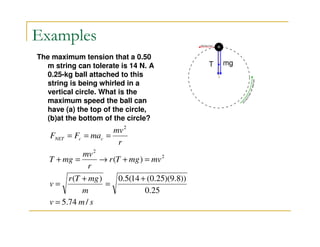
The maximum tension that a 0.50 
m string can tolerate is 14 N. A 
0.25-kg ball attached to this 
string is being whirled in a 
vertical circle. What is the 
maximum speed the ball can 
have (a) the top of the circle, 
(b)at the bottom of the circle? 
T mg 
mv 
( ) 2 
+ = ® + = 
( ) 0.5(14 (0.25)(9.8)) 
r T mg 
m 
v 
v m s 
mv 
r T mg mv 
r 
T mg 
r 
F F maNET c c 
5.74 / 
0.25 
2 
2 
= 
+ 
= 
+ 
= 
= = =
Examples 
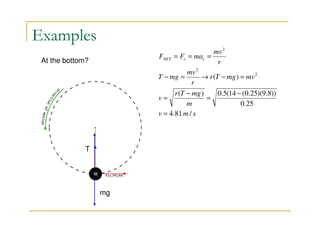
At the bottom? 
mv 
( ) 2 
− = ® − = 
( ) 0.5(14 (0.25)(9.8)) 
r T mg 
m 
v 
v m s 
mv 
r T mg mv 
r 
T mg 
r 
F F maNET c c 
4.81 / 
0.25 
2 
2 
= 
− 
= 
− 
= 
= = = 
mg 
T

Ap physics -_circular_motion

  • 1.
  • 2.
    Speed/Velocity in aCircle Consider an object moving in a circle around a specific origin. The DISTANCE the object covers in ONE REVOLUTION is called the CIRCUMFERENCE. The TIME that it takes to cover this distance is called the PERIOD. T r d T scircle 2p = = Speed is the MAGNITUDE of the velocity. And while the speed may be constant, the VELOCITY is NOT. Since velocity is a vector with BOTH magnitude AND direction, we see that the direction o the velocity is ALWAYS changing. We call this velocity, TANGENTIAL velocity as its direction is draw TANGENT to the circle.
  • 3.
    Centripetal Acceleration Supposewe had a circle with angle, q, between 2 radaii. You may recall: = s = arc length in meters s r q v v s = D s vt vt r v v r D = D D q = = vo v Dv vo v q a v t v r a centripetal acceleration c c = = D = 2 Centripetal means “center seeking” so that means that the acceleration points towards the CENTER of the circle
  • 4.
    Drawing the Directionscorrectly So for an object traveling in a counter-clockwise path. The velocity would be drawn TANGENT to the circle and the acceleration would be drawn TOWARDS the CENTER. To find the MAGNITUDES of each we have: 2 2 v = = r a p T r vc c
  • 5.
    Circular Motion andN.S.L Recall that according to Newton’s Second Law, the acceleration is directly proportional to the Force. If this is true: = = F ma a NET c mv r F F v r NET c F Centripetal Force c = = = 2 2 Since the acceleration and the force are directly related, the force must ALSO point towards the center. This is called CENTRIPETAL FORCE. NOTE: The centripetal force is a NET FORCE. It could be represented by one or more forces. So NEVER draw it in an F.B.D.
  • 6.
    Examples T r vc The blade of a windshield wiper moves through an angle of 90 degrees in 0.28 seconds. The tip of the blade moves on the arc of a circle that has a radius of 0.76m. What is the magnitude of the centripetal acceleration of the tip of the blade? 2p 2 p (.76) = v c = = 4.26 m / s (.28*4) 2 2 2 23.92 / (4.26) ac = = = 0.76 m s v r
  • 7.
    Examples F F f c = v rg mv 2 mv r μ μ mg r F N 2 2 = = = μ What is the minimum coefficient of static friction necessary to allow a penny to rotate along a 33 1/3 rpm record (diameter= 0.300 m), when the penny is placed at the outer edge of the record? Top view FN mg Ff 1min * rev rev = 1.80sec 1sec = = 2 2 (0.15) = = = (0.524) v Side view 0.187 (0.15)(9.8) 0.524 / 1.80 0.555 sec 0.555 60sec min 33.3 2 2 = = = rg m s T r v T rev rev c μ p p
  • 8.
    Examples Venus rotatesslowly about its axis, the period being 243 days. The mass of Venus is 4.87 x 1024 kg. Determine the radius for a synchronous satellite in orbit around Venus. (assume circular orbit) Fg Mm = = = = 2 2 mv = ® = ® = − 11 24 7 2 (6.67 10 )(4.87 10 )(2.1 10 ) GM GM = 3 = 2 3 2 2 2 2 3 2 2 2 2 4 4 4 4 2 p p p p p x x x r GMT r GMT r T r r T r v v r r r F F G c g c 1.54x10⁹ m
  • 9.
    Examples The maximumtension that a 0.50 m string can tolerate is 14 N. A 0.25-kg ball attached to this string is being whirled in a vertical circle. What is the maximum speed the ball can have (a) the top of the circle, (b)at the bottom of the circle? T mg mv ( ) 2 + = ® + = ( ) 0.5(14 (0.25)(9.8)) r T mg m v v m s mv r T mg mv r T mg r F F maNET c c 5.74 / 0.25 2 2 = + = + = = = =
  • 10.
    Examples At thebottom? mv ( ) 2 − = ® − = ( ) 0.5(14 (0.25)(9.8)) r T mg m v v m s mv r T mg mv r T mg r F F maNET c c 4.81 / 0.25 2 2 = − = − = = = = mg T