Waves and sounds
What is a wave?
- A wave is a disturbance that travels through a
   medium from one location to another
- A wave is the motion of disturbance
- The frequency of a wave is its most basic factor
   which doesn’t change when entering one
   medium through another.
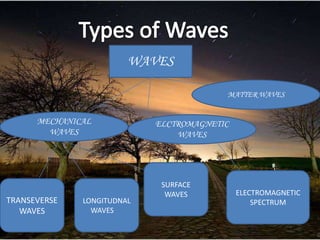
WAVES

                                         MATTER WAVES


      MECHANICAL            ELCTROMAGNETIC
        WAVES                   WAVES


                             SURFACE
                              WAVES          ELECTROMAGNETIC
TRANSEVERSE   LONGITUDNAL                        SPECTRUM
   WAVES        WAVES
-Mechanical waves are produced by a disturbance .

-It requires a medium to travel. Common examples include
  air, water and sound.

- There are 3 types: Transverse, Longitudinal and Surface
In transverse waves the direction of the disturbance is perpendicular
To that of the direction of travel of the wave.

They also occur when the source disturbance of the wave follows a
periodic motion.

They create crests and troughs while travelling and show polarization.
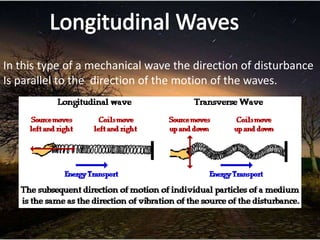
In this type of a mechanical wave the direction of disturbance
Is parallel to the direction of the motion of the waves.
Polarization : It is the process in which the wave vibrates in
only one plane.
Reflection: When a wave gets reflected back upon entering
a medium is known as reflection.
Refraction: When switching from one medium to another
when the speed of the wave changes and not the frequency.
Diffraction: The spreading of waves when it enters through a
small slit is known as diffraction.
Wave fronts: It gives the position of the waves at a certain
time
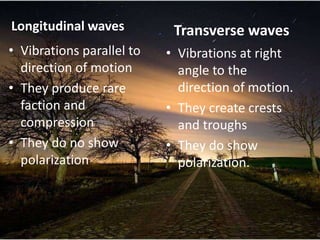
Longitudinal waves          Transverse waves
• Vibrations parallel to   • Vibrations at right
  direction of motion        angle to the
• They produce rare          direction of motion.
  faction and              • They create crests
  compression                and troughs
• They do no show          • They do show
  polarization               polarization.
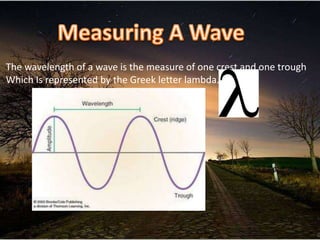
The wavelength of a wave is the measure of one crest and one trough
Which Is represented by the Greek letter lambda.
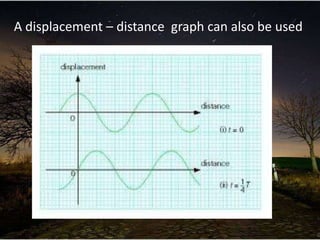
A displacement – distance graph can also be used
• Light, microwaves, x-rays, and TV and
  radio transmissions are all kinds of
  electromagnetic waves. They are all
  the same kind of wavy disturbance
  that repeats itself over a distance
  called the wavelength.
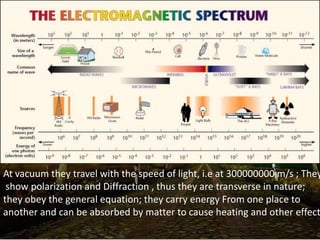
At vacuum they travel with the speed of light, i.e at 300000000 m/s ; They
 show polarization and Diffraction , thus they are transverse in nature;
they obey the general equation; they carry energy From one place to
another and can be absorbed by matter to cause heating and other effect
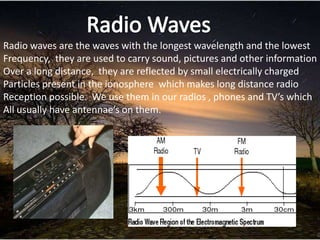
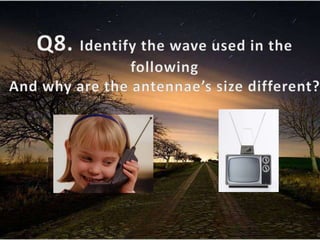
Radio waves are the waves with the longest wavelength and the lowest
Frequency, they are used to carry sound, pictures and other information
Over a long distance, they are reflected by small electrically charged
Particles present in the ionosphere which makes long distance radio
Reception possible. We use them in our radios , phones and TV’s which
All usually have antennae’s on them.
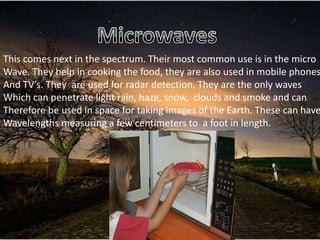
This comes next in the spectrum. Their most common use is in the micro
Wave. They help in cooking the food, they are also used in mobile phones
And TV’s. They are used for radar detection. They are the only waves
Which can penetrate light rain, haze, snow, clouds and smoke and can
Therefore be used in space for taking images of the Earth. These can have
Wavelengths measuring a few centimeters to a foot in length.
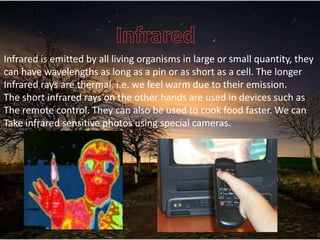
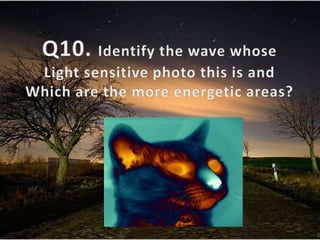
Infrared is emitted by all living organisms in large or small quantity, they
can have wavelengths as long as a pin or as short as a cell. The longer
Infrared rays are thermal, i.e. we feel warm due to their emission.
The short infrared rays on the other hands are used in devices such as
The remote control. They can also be used to cook food faster. We can
Take infrared sensitive photos using special cameras.
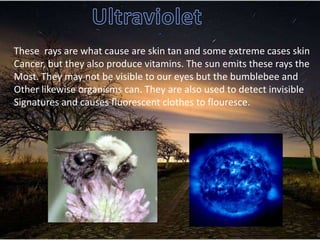
These rays are what cause are skin tan and some extreme cases skin
Cancer, but they also produce vitamins. The sun emits these rays the
Most. They may not be visible to our eyes but the bumblebee and
Other likewise organisms can. They are also used to detect invisible
Signatures and causes fluorescent clothes to flouresce.
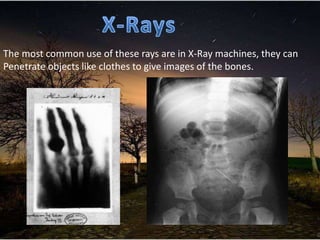
The most common use of these rays are in X-Ray machines, they can
Penetrate objects like clothes to give images of the bones.
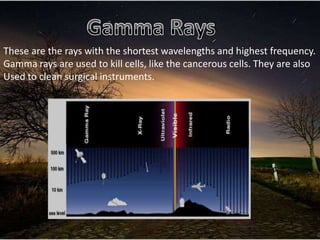
These are the rays with the shortest wavelengths and highest frequency.
Gamma rays are used to kill cells, like the cancerous cells. They are also
Used to clean surgical instruments.
It is a type of longitudinal wave which cannot like light waves travel
In vacuum and is best transmitted by solids followed by liquids and
Gases. It displays properties of interference and diffraction.

They are well reflected from hard and flat surfaces causing echo.
If the surface is nearer than 15m than the echo joins up with the original
Sound, this is called reverberation.
The speed of sound varies depending on the material it travels through.
In:
AIR(0 degree C ): 330m/s ( for rise of every 1 degree the speed increases
                             by 0.61 m/s)
WATER           : 1400m/s
CONCRETE        : 5000m/s
STEEL           : 6000m/s

We can find the speed using the general equation and to find the
Wavelength we can use the formula
Wavelength = velocity /frequency
Hearing capacity of humans is sound waves of frequency with 20Hz to
20,000 Hz.

The 3 properties of sound waves are:
1)Pitch – Directly proportional to the frequency
2) Loudness – Directly Proportional to the amplitude
3) Quality – No instrument except a tuning fork emits a pure note and
            They have a fundamental note mixed with other notes
            which are overtones and are exact multiples of the
            fundamental notes.

Frequencies of sound waves above 20,0000 Hz are called ultrasonic, and
Objects with speed slower than sound are called subsonic and vice versa
Are called supersonic.
Q.1. Sound is faster in ? Explain

-Air
- Water
- solid
Q. Suggest the properties of Sound that prove that it is a wave


Q. What are the factors that affect the speed of sound in any medium


Q. If a nurse cleans the surgical instruments just before a surgery ,
   which ray does she use?
Waves and sounds

Waves and sounds

  • 1.
  • 2.
    What is awave? - A wave is a disturbance that travels through a medium from one location to another - A wave is the motion of disturbance - The frequency of a wave is its most basic factor which doesn’t change when entering one medium through another.
  • 3.
    WAVES MATTER WAVES MECHANICAL ELCTROMAGNETIC WAVES WAVES SURFACE WAVES ELECTROMAGNETIC TRANSEVERSE LONGITUDNAL SPECTRUM WAVES WAVES
  • 4.
    -Mechanical waves areproduced by a disturbance . -It requires a medium to travel. Common examples include air, water and sound. - There are 3 types: Transverse, Longitudinal and Surface
  • 5.
    In transverse wavesthe direction of the disturbance is perpendicular To that of the direction of travel of the wave. They also occur when the source disturbance of the wave follows a periodic motion. They create crests and troughs while travelling and show polarization.
  • 6.
    In this typeof a mechanical wave the direction of disturbance Is parallel to the direction of the motion of the waves.
  • 7.
    Polarization : Itis the process in which the wave vibrates in only one plane. Reflection: When a wave gets reflected back upon entering a medium is known as reflection. Refraction: When switching from one medium to another when the speed of the wave changes and not the frequency. Diffraction: The spreading of waves when it enters through a small slit is known as diffraction. Wave fronts: It gives the position of the waves at a certain time
  • 8.
    Longitudinal waves Transverse waves • Vibrations parallel to • Vibrations at right direction of motion angle to the • They produce rare direction of motion. faction and • They create crests compression and troughs • They do no show • They do show polarization polarization.
  • 9.
    The wavelength ofa wave is the measure of one crest and one trough Which Is represented by the Greek letter lambda.
  • 10.
    A displacement –distance graph can also be used
  • 12.
    • Light, microwaves,x-rays, and TV and radio transmissions are all kinds of electromagnetic waves. They are all the same kind of wavy disturbance that repeats itself over a distance called the wavelength.
  • 13.
    At vacuum theytravel with the speed of light, i.e at 300000000 m/s ; They show polarization and Diffraction , thus they are transverse in nature; they obey the general equation; they carry energy From one place to another and can be absorbed by matter to cause heating and other effect
  • 14.
    Radio waves arethe waves with the longest wavelength and the lowest Frequency, they are used to carry sound, pictures and other information Over a long distance, they are reflected by small electrically charged Particles present in the ionosphere which makes long distance radio Reception possible. We use them in our radios , phones and TV’s which All usually have antennae’s on them.
  • 15.
    This comes nextin the spectrum. Their most common use is in the micro Wave. They help in cooking the food, they are also used in mobile phones And TV’s. They are used for radar detection. They are the only waves Which can penetrate light rain, haze, snow, clouds and smoke and can Therefore be used in space for taking images of the Earth. These can have Wavelengths measuring a few centimeters to a foot in length.
  • 16.
    Infrared is emittedby all living organisms in large or small quantity, they can have wavelengths as long as a pin or as short as a cell. The longer Infrared rays are thermal, i.e. we feel warm due to their emission. The short infrared rays on the other hands are used in devices such as The remote control. They can also be used to cook food faster. We can Take infrared sensitive photos using special cameras.
  • 18.
    These rays arewhat cause are skin tan and some extreme cases skin Cancer, but they also produce vitamins. The sun emits these rays the Most. They may not be visible to our eyes but the bumblebee and Other likewise organisms can. They are also used to detect invisible Signatures and causes fluorescent clothes to flouresce.
  • 19.
    The most commonuse of these rays are in X-Ray machines, they can Penetrate objects like clothes to give images of the bones.
  • 20.
    These are therays with the shortest wavelengths and highest frequency. Gamma rays are used to kill cells, like the cancerous cells. They are also Used to clean surgical instruments.
  • 21.
    It is atype of longitudinal wave which cannot like light waves travel In vacuum and is best transmitted by solids followed by liquids and Gases. It displays properties of interference and diffraction. They are well reflected from hard and flat surfaces causing echo. If the surface is nearer than 15m than the echo joins up with the original Sound, this is called reverberation.
  • 22.
    The speed ofsound varies depending on the material it travels through. In: AIR(0 degree C ): 330m/s ( for rise of every 1 degree the speed increases by 0.61 m/s) WATER : 1400m/s CONCRETE : 5000m/s STEEL : 6000m/s We can find the speed using the general equation and to find the Wavelength we can use the formula Wavelength = velocity /frequency
  • 23.
    Hearing capacity ofhumans is sound waves of frequency with 20Hz to 20,000 Hz. The 3 properties of sound waves are: 1)Pitch – Directly proportional to the frequency 2) Loudness – Directly Proportional to the amplitude 3) Quality – No instrument except a tuning fork emits a pure note and They have a fundamental note mixed with other notes which are overtones and are exact multiples of the fundamental notes. Frequencies of sound waves above 20,0000 Hz are called ultrasonic, and Objects with speed slower than sound are called subsonic and vice versa Are called supersonic.
  • 24.
    Q.1. Sound isfaster in ? Explain -Air - Water - solid
  • 34.
    Q. Suggest theproperties of Sound that prove that it is a wave Q. What are the factors that affect the speed of sound in any medium Q. If a nurse cleans the surgical instruments just before a surgery , which ray does she use?
Editor's Notes

  • #16 Shorter wavelengths in the radar.
  • #17 Sensory pits in animals like the snake that can sense warm blooded animals due to their infrared emission.