1
Temperature
• 11. Temperature
• Content
• 11.1 Thermal equilibrium
• 11.2 Temperature scales
• 11.3 Practical thermometers
• Learning Outcomes
• Candidates should be able to:
• (a) show an appreciation that thermal energy is transferred from a
region of higher
• temperature to a region of lower temperature.
• (b) show an understanding that regions of equal temperature are in
thermal equilibrium.
• (c) show an understanding that a physical property which varies
with temperature may be used for the measurement of
temperature and state examples of such properties.
• * (d) compare the relative advantages and disadvantages of
resistance and thermocouple thermometers as previously
calibrated instruments.
• (e) show an understanding that there is an absolute scale of
temperature which does not depend on the property of any
particular substance (i.e. the thermodynamic scale and the
concept of absolute zero).
• (f) convert temperatures measured in kelvin to degrees Celsius:
T / K = T / °C + 273.15.
3
Kinetic theory
 All matter is made up of tiny particles called
molecules which are constantly in motion and
attract each other strongly when close
together
 They have kinetic energy because they are
moving
 They have potential energy as the continuous
random motion keeps them separated despite
the attractions which try to pull them together
4
Temperature
 Temperature is a scientific quantity which
measures the degree of hotness and coldness of
a body
 Molecules of an object are constantly in motion.
The hotter the object the more kinetic energy its
molecules have and the faster they move
 More fundamentally temperature is a measure of
the average kinetic energy which each molecule
of an object possesses
Temperature fundamentals
 A temperature scale is a range of numbers used to indicate levels or
degrees of hotness or of thermal energy
 Most common well known scales are Fahrenheit & Celsius
(Centigrade) and Kelvin
 A thermometer is an instrument used to measure the degree of
hotness or coldness of a body i.e temperature
 Many physical properties change with temperature e.g. solids, liquids
and gases expand as their temperature is increased
 Electrical resistance of a metal wire increases with increase in
temperature.
 If 2 wires of different materials are twisted at one end and the other
ends are connected to a voltmeter, the voltage reading depends on the
temperature
6
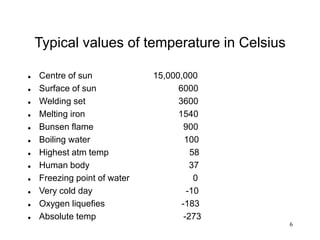
Typical values of temperature in Celsius
 Centre of sun 15,000,000
 Surface of sun 6000
 Welding set 3600
 Melting iron 1540
 Bunsen flame 900
 Boiling water 100
 Highest atm temp 58
 Human body 37
 Freezing point of water 0
 Very cold day -10
 Oxygen liquefies -183
 Absolute temp -273
7
Thermal equilibrium
 Two bodies are in thermal equilibrium when
there is no net flow of thermal energy between
them.
 Under such a condition, the two bodies are at the
same temperature.
 When there is a net heat flow, thermal energy is
transferred from the body with higher
temperature to the other body with lower
temperature.
 Heat is energy transferred due to temperature
difference.
8
Temperature sensitive properties
 The thermometric property of a thermometer is the
physical property which is measured to determine the
temperature.
 The working material of the thermometer is known as the
substance
 Such thermometric properties include length, resistance,
pressure, e.m.f. etc.
 For example, a mercury-in-glass thermometer makes use
of the change in length of the mercury thread with
temperature to measure the temperature of a body.
9
Establishing/fixing a temperature scale
 The fact that substances change state(from solid to liquid,
or from liquid to gas) at fixed temperatures is used to define
reference temperatures
 In order to establish a temperature scale it is necessary to
make use agreed upon fixed points.
 A fixed point is a standard degree of hotness which can be
accurately reproduced (e.g. the melting of ice under
specific conditions).
 At least two fixed points (usually the pure ice-point and the
steam-point of pure water at stp) are required to define a
scale of temperatures, with each fixed point given an exact
numerical value.
 Needs to be pure otherwise the point is lowered by
impurities
 Stp because any change in pressure alters the boiling point
of water
 The thermometer is one instrument with two calibrated
fixed points and equally spaced intervals or degrees
between the points that is used to measure temperature.
10
Definition of fixed points of
temperature.
 By taking the value of the thermometric property at 2
fixed points and dividing the range of values into a
number of equal steps or intervals, we can set up
what is called an empirical scale of temperature for
that instrument
 Empirical means derived by experiment
 The ice point is the temperature at which pure ice
can exist in equilibrium with water at standard
atmospheric pressure.
 The steam point is the temperature at which pure
water can exist in equilibrium with its vapour at
standard atmospheric pressure.
 The triple point of water is that unique temperature
at which pure ice, pure water and pure water vapour
can exist together in equilibrium.
11
Procedures for establishing a
temperature scale.
• Choose a thermometric substance (e.g. solid, liquid or
gas).
• Select the thermometric parameter X (e.g. X = length l,
pressure P, resistance R or e.m.f. E) that would vary
continuously with temperature changes.
 Choose two extreme fixed points of opposing degree of
hotness like the melting point of ice (ice-point) and the
boiling point of water (steam-point) which X will vary
uniformly, or linearly, with the temperature changes
between the points.
 Mark the two fixed points chosen on the instrument
concerned and divide the interval between the two marks
into equal divisions to establish the temperature scale.
12
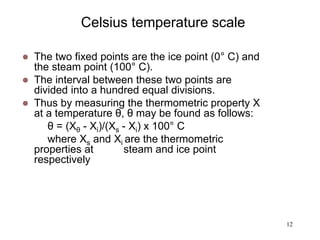
Celsius temperature scale
 The two fixed points are the ice point (0° C) and
the steam point (100° C).
 The interval between these two points are
divided into a hundred equal divisions.
 Thus by measuring the thermometric property X
at a temperature θ, θ may be found as follows:
θ = (Xθ - Xi)/(Xs - Xi) x 100° C
where Xs and Xi are the thermometric
properties at steam and ice point
respectively
13
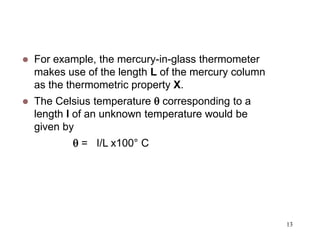
 For example, the mercury-in-glass thermometer
makes use of the length L of the mercury column
as the thermometric property X.
 The Celsius temperature  corresponding to a
length l of an unknown temperature would be
given by
 = I/L x100° C
14
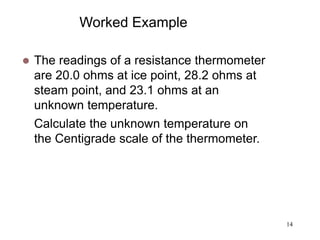
Worked Example
 The readings of a resistance thermometer
are 20.0 ohms at ice point, 28.2 ohms at
steam point, and 23.1 ohms at an
unknown temperature.
Calculate the unknown temperature on
the Centigrade scale of the thermometer.
15
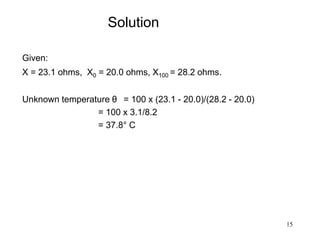
Solution
Given:
X = 23.1 ohms, X0 = 20.0 ohms, X100 = 28.2 ohms.
Unknown temperature θ = 100 x (23.1 - 20.0)/(28.2 - 20.0)
= 100 x 3.1/8.2
= 37.8° C
16
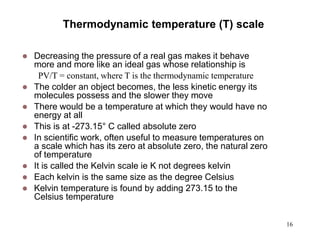
Thermodynamic temperature (T) scale
 Decreasing the pressure of a real gas makes it behave
more and more like an ideal gas whose relationship is
PV/T = constant, where T is the thermodynamic temperature
 The colder an object becomes, the less kinetic energy its
molecules possess and the slower they move
 There would be a temperature at which they would have no
energy at all
 This is at -273.15° C called absolute zero
 In scientific work, often useful to measure temperatures on
a scale which has its zero at absolute zero, the natural zero
of temperature
 It is called the Kelvin scale ie K not degrees kelvin
 Each kelvin is the same size as the degree Celsius
 Kelvin temperature is found by adding 273.15 to the
Celsius temperature
17
Kelvin scale
 The lower fixed point of this scale is the absolute
zero
 The upper fixed point is the triple point of water.
This point is the temperature at which saturated
water vapor, pure water and ice all coexist in
equilibrium.
 The triple point of water is defined as 273.16 K
by international agreement (i.e ice point is
actually 0.01° C)
 1 kelvin is the fraction 1/273.16 of the
thermodynamic temperature of the triple point of
water
18
Celsius temperature scale
 The Celsius temperature,θ, is defined by θ = T –
273.15.
 273.15 K is the ice point and 373.15 K the steam
point giving 100 equal spaces between ice and
steam
 Therefore ice point is 0° C. The steam point, at
760 mmHg (1.013 x 10⁵ Pa) is 100° C.
19
Shortcomings of the Centigrade
scale
 If one were to use different thermometers to
measure the temperature of a body, the readings
would be different. This disagreement arises
because the assumption that the thermometric
parameter, X, varies linearly with temperature is
not true.
 Different thermometric substances and hence
their properties do not respond in the same way
to changes in temperature. They only agree at
two fixed points, by definition. Only the Absolute
Thermodynamic Scale is independent of the
properties of the thermodynamic substances.
20
Practical Thermometers
 In general, all thermometers use some measurable
property of a substance which is sensitive to temperature
change.
 Industrial processes depend on sensitive, accurate
measurement and control of temperature over a wide range
 Also convenient to read the temp on a meter or display or a
computer
 The following are some types of thermometers which use
certain property change to measure the change in
temperature:
 constant-volume gas thermometer – use pressure change
with temperature of a gas at constant volume.
 resistance thermometer – use electrical resistance change
of a pure metal with temperature.
 liquid-in-glass thermometer – use change in volume of
liquid with temperature relative to that of glass.
 thermoelectric thermometer – use change in electromotive
force with temperature of two metals joined together
(thermocouple)
21
Constant Volume Gas Thermometer
 In most accurate work, temperatures are measured by gas
thermometers, for example, by the changes in pressure of
a gas at constant volume as differences in empirical scales
are small in the case of thermometers based on gases as
thermometric substances
 A gas thermometer is a large, bulky and awkward
instrument, demanding much skill and time, and useless for
measuring changing temperatures. In practice, gas
thermometers are used only for calibrating electrical
thermometers – resistance thermometers and
thermocouples.
 For a temperature of ° C,
 = (P - P0)/(P100 – P0) x 100° C
where P, P0 and P100 are the respective gas
pressures at the unknown temperature , the ice
point and steam point.
22
Thermo-Electric Thermometers
 Electrical thermometers are more accurate than other
types, except gas thermometers, quicker in action and less
cumbersome.
 For a thermoelectric thermometer (thermocouple), the
measuring element is the welded junction of two fine wires.
It is very small in size, and can therefore measure the
temperature almost at a point.
 It causes very little disturbance wherever it is placed,
because the wires leading from it are so thin that heat loss
along them is usually negligible.
 It has a very small heat capacity, and can therefore follow a
rapidly changing temperature. To measure such a
temperature, however, the e.m.f. of the junction must be
measured with a galvanometer, instead of a potentiometer,
and some accuracy is then lost.
 The Celsius temperature  on the thermoelectric
thermometer scale would be calculated from
 = (E - E0)/(E100 – E0) x 100° C
23
Resistance thermometer
 The measuring element of a resistance
thermometer is a spiral of fine wire (platinum).
 It has a greater size and heat capacity than a
thermo-junction, and cannot therefore measure a
local or rapidly changing temperature.
 Covers a range from -260 to 1700° C but the
range is not very linear, hence calibration is
necessary
 If semiconductor materials are used as
resistance thermometers, these are called
thermistors where the resistance of these
devices decreases very rapidly with increasing
temperature
  = (R - R0)/(R100 – R0) x 100° C
24
Liquid-in-glass Thermometer
 Liquid-in-glass thermometers use the fact that
most liquids expand slightly when they are
heated
 As the tube is narrow, a small increase in volume
makes the 'thread' move a long way up
 The narrower the tube the more the sensitivity
 They are convenient, sensitive and moderately
quick-acting
 The thermometric parameter for this type of
thermometer is the length of mercury/alcohol
column l. Therefore for any temperature 
between 0° C and 100° C,
 = (l - l0)/(l100 – l0) x 100° C
25
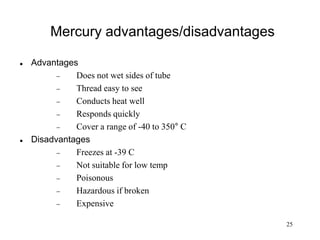
Mercury advantages/disadvantages
 Advantages
 Does not wet sides of tube
 Thread easy to see
 Conducts heat well
 Responds quickly
 Cover a range of -40 to 350° C
 Disadvantages
 Freezes at -39 C
 Not suitable for low temp
 Poisonous
 Hazardous if broken
 Expensive
26
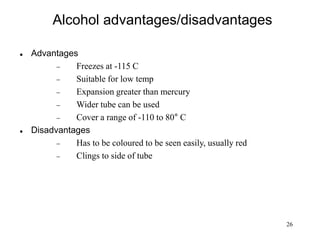
Alcohol advantages/disadvantages
 Advantages
 Freezes at -115 C
 Suitable for low temp
 Expansion greater than mercury
 Wider tube can be used
 Cover a range of -110 to 80° C
 Disadvantages
 Has to be coloured to be seen easily, usually red
 Clings to side of tube
27
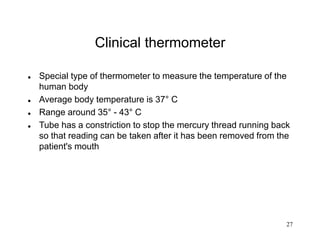
Clinical thermometer
 Special type of thermometer to measure the temperature of the
human body
 Average body temperature is 37° C
 Range around 35° - 43° C
 Tube has a constriction to stop the mercury thread running back
so that reading can be taken after it has been removed from the
patient's mouth

Wk 4 p1 wk 4-p8_11.1-11.3_temperature

  • 1.
    1 Temperature • 11. Temperature •Content • 11.1 Thermal equilibrium • 11.2 Temperature scales • 11.3 Practical thermometers • Learning Outcomes • Candidates should be able to: • (a) show an appreciation that thermal energy is transferred from a region of higher • temperature to a region of lower temperature. • (b) show an understanding that regions of equal temperature are in thermal equilibrium.
  • 2.
    • (c) showan understanding that a physical property which varies with temperature may be used for the measurement of temperature and state examples of such properties. • * (d) compare the relative advantages and disadvantages of resistance and thermocouple thermometers as previously calibrated instruments. • (e) show an understanding that there is an absolute scale of temperature which does not depend on the property of any particular substance (i.e. the thermodynamic scale and the concept of absolute zero). • (f) convert temperatures measured in kelvin to degrees Celsius: T / K = T / °C + 273.15.
  • 3.
    3 Kinetic theory  Allmatter is made up of tiny particles called molecules which are constantly in motion and attract each other strongly when close together  They have kinetic energy because they are moving  They have potential energy as the continuous random motion keeps them separated despite the attractions which try to pull them together
  • 4.
    4 Temperature  Temperature isa scientific quantity which measures the degree of hotness and coldness of a body  Molecules of an object are constantly in motion. The hotter the object the more kinetic energy its molecules have and the faster they move  More fundamentally temperature is a measure of the average kinetic energy which each molecule of an object possesses
  • 5.
    Temperature fundamentals  Atemperature scale is a range of numbers used to indicate levels or degrees of hotness or of thermal energy  Most common well known scales are Fahrenheit & Celsius (Centigrade) and Kelvin  A thermometer is an instrument used to measure the degree of hotness or coldness of a body i.e temperature  Many physical properties change with temperature e.g. solids, liquids and gases expand as their temperature is increased  Electrical resistance of a metal wire increases with increase in temperature.  If 2 wires of different materials are twisted at one end and the other ends are connected to a voltmeter, the voltage reading depends on the temperature
  • 6.
    6 Typical values oftemperature in Celsius  Centre of sun 15,000,000  Surface of sun 6000  Welding set 3600  Melting iron 1540  Bunsen flame 900  Boiling water 100  Highest atm temp 58  Human body 37  Freezing point of water 0  Very cold day -10  Oxygen liquefies -183  Absolute temp -273
  • 7.
    7 Thermal equilibrium  Twobodies are in thermal equilibrium when there is no net flow of thermal energy between them.  Under such a condition, the two bodies are at the same temperature.  When there is a net heat flow, thermal energy is transferred from the body with higher temperature to the other body with lower temperature.  Heat is energy transferred due to temperature difference.
  • 8.
    8 Temperature sensitive properties The thermometric property of a thermometer is the physical property which is measured to determine the temperature.  The working material of the thermometer is known as the substance  Such thermometric properties include length, resistance, pressure, e.m.f. etc.  For example, a mercury-in-glass thermometer makes use of the change in length of the mercury thread with temperature to measure the temperature of a body.
  • 9.
    9 Establishing/fixing a temperaturescale  The fact that substances change state(from solid to liquid, or from liquid to gas) at fixed temperatures is used to define reference temperatures  In order to establish a temperature scale it is necessary to make use agreed upon fixed points.  A fixed point is a standard degree of hotness which can be accurately reproduced (e.g. the melting of ice under specific conditions).  At least two fixed points (usually the pure ice-point and the steam-point of pure water at stp) are required to define a scale of temperatures, with each fixed point given an exact numerical value.  Needs to be pure otherwise the point is lowered by impurities  Stp because any change in pressure alters the boiling point of water  The thermometer is one instrument with two calibrated fixed points and equally spaced intervals or degrees between the points that is used to measure temperature.
  • 10.
    10 Definition of fixedpoints of temperature.  By taking the value of the thermometric property at 2 fixed points and dividing the range of values into a number of equal steps or intervals, we can set up what is called an empirical scale of temperature for that instrument  Empirical means derived by experiment  The ice point is the temperature at which pure ice can exist in equilibrium with water at standard atmospheric pressure.  The steam point is the temperature at which pure water can exist in equilibrium with its vapour at standard atmospheric pressure.  The triple point of water is that unique temperature at which pure ice, pure water and pure water vapour can exist together in equilibrium.
  • 11.
    11 Procedures for establishinga temperature scale. • Choose a thermometric substance (e.g. solid, liquid or gas). • Select the thermometric parameter X (e.g. X = length l, pressure P, resistance R or e.m.f. E) that would vary continuously with temperature changes.  Choose two extreme fixed points of opposing degree of hotness like the melting point of ice (ice-point) and the boiling point of water (steam-point) which X will vary uniformly, or linearly, with the temperature changes between the points.  Mark the two fixed points chosen on the instrument concerned and divide the interval between the two marks into equal divisions to establish the temperature scale.
  • 12.
    12 Celsius temperature scale The two fixed points are the ice point (0° C) and the steam point (100° C).  The interval between these two points are divided into a hundred equal divisions.  Thus by measuring the thermometric property X at a temperature θ, θ may be found as follows: θ = (Xθ - Xi)/(Xs - Xi) x 100° C where Xs and Xi are the thermometric properties at steam and ice point respectively
  • 13.
    13  For example,the mercury-in-glass thermometer makes use of the length L of the mercury column as the thermometric property X.  The Celsius temperature  corresponding to a length l of an unknown temperature would be given by  = I/L x100° C
  • 14.
    14 Worked Example  Thereadings of a resistance thermometer are 20.0 ohms at ice point, 28.2 ohms at steam point, and 23.1 ohms at an unknown temperature. Calculate the unknown temperature on the Centigrade scale of the thermometer.
  • 15.
    15 Solution Given: X = 23.1ohms, X0 = 20.0 ohms, X100 = 28.2 ohms. Unknown temperature θ = 100 x (23.1 - 20.0)/(28.2 - 20.0) = 100 x 3.1/8.2 = 37.8° C
  • 16.
    16 Thermodynamic temperature (T)scale  Decreasing the pressure of a real gas makes it behave more and more like an ideal gas whose relationship is PV/T = constant, where T is the thermodynamic temperature  The colder an object becomes, the less kinetic energy its molecules possess and the slower they move  There would be a temperature at which they would have no energy at all  This is at -273.15° C called absolute zero  In scientific work, often useful to measure temperatures on a scale which has its zero at absolute zero, the natural zero of temperature  It is called the Kelvin scale ie K not degrees kelvin  Each kelvin is the same size as the degree Celsius  Kelvin temperature is found by adding 273.15 to the Celsius temperature
  • 17.
    17 Kelvin scale  Thelower fixed point of this scale is the absolute zero  The upper fixed point is the triple point of water. This point is the temperature at which saturated water vapor, pure water and ice all coexist in equilibrium.  The triple point of water is defined as 273.16 K by international agreement (i.e ice point is actually 0.01° C)  1 kelvin is the fraction 1/273.16 of the thermodynamic temperature of the triple point of water
  • 18.
    18 Celsius temperature scale The Celsius temperature,θ, is defined by θ = T – 273.15.  273.15 K is the ice point and 373.15 K the steam point giving 100 equal spaces between ice and steam  Therefore ice point is 0° C. The steam point, at 760 mmHg (1.013 x 10⁵ Pa) is 100° C.
  • 19.
    19 Shortcomings of theCentigrade scale  If one were to use different thermometers to measure the temperature of a body, the readings would be different. This disagreement arises because the assumption that the thermometric parameter, X, varies linearly with temperature is not true.  Different thermometric substances and hence their properties do not respond in the same way to changes in temperature. They only agree at two fixed points, by definition. Only the Absolute Thermodynamic Scale is independent of the properties of the thermodynamic substances.
  • 20.
    20 Practical Thermometers  Ingeneral, all thermometers use some measurable property of a substance which is sensitive to temperature change.  Industrial processes depend on sensitive, accurate measurement and control of temperature over a wide range  Also convenient to read the temp on a meter or display or a computer  The following are some types of thermometers which use certain property change to measure the change in temperature:  constant-volume gas thermometer – use pressure change with temperature of a gas at constant volume.  resistance thermometer – use electrical resistance change of a pure metal with temperature.  liquid-in-glass thermometer – use change in volume of liquid with temperature relative to that of glass.  thermoelectric thermometer – use change in electromotive force with temperature of two metals joined together (thermocouple)
  • 21.
    21 Constant Volume GasThermometer  In most accurate work, temperatures are measured by gas thermometers, for example, by the changes in pressure of a gas at constant volume as differences in empirical scales are small in the case of thermometers based on gases as thermometric substances  A gas thermometer is a large, bulky and awkward instrument, demanding much skill and time, and useless for measuring changing temperatures. In practice, gas thermometers are used only for calibrating electrical thermometers – resistance thermometers and thermocouples.  For a temperature of ° C,  = (P - P0)/(P100 – P0) x 100° C where P, P0 and P100 are the respective gas pressures at the unknown temperature , the ice point and steam point.
  • 22.
    22 Thermo-Electric Thermometers  Electricalthermometers are more accurate than other types, except gas thermometers, quicker in action and less cumbersome.  For a thermoelectric thermometer (thermocouple), the measuring element is the welded junction of two fine wires. It is very small in size, and can therefore measure the temperature almost at a point.  It causes very little disturbance wherever it is placed, because the wires leading from it are so thin that heat loss along them is usually negligible.  It has a very small heat capacity, and can therefore follow a rapidly changing temperature. To measure such a temperature, however, the e.m.f. of the junction must be measured with a galvanometer, instead of a potentiometer, and some accuracy is then lost.  The Celsius temperature  on the thermoelectric thermometer scale would be calculated from  = (E - E0)/(E100 – E0) x 100° C
  • 23.
    23 Resistance thermometer  Themeasuring element of a resistance thermometer is a spiral of fine wire (platinum).  It has a greater size and heat capacity than a thermo-junction, and cannot therefore measure a local or rapidly changing temperature.  Covers a range from -260 to 1700° C but the range is not very linear, hence calibration is necessary  If semiconductor materials are used as resistance thermometers, these are called thermistors where the resistance of these devices decreases very rapidly with increasing temperature   = (R - R0)/(R100 – R0) x 100° C
  • 24.
    24 Liquid-in-glass Thermometer  Liquid-in-glassthermometers use the fact that most liquids expand slightly when they are heated  As the tube is narrow, a small increase in volume makes the 'thread' move a long way up  The narrower the tube the more the sensitivity  They are convenient, sensitive and moderately quick-acting  The thermometric parameter for this type of thermometer is the length of mercury/alcohol column l. Therefore for any temperature  between 0° C and 100° C,  = (l - l0)/(l100 – l0) x 100° C
  • 25.
    25 Mercury advantages/disadvantages  Advantages Does not wet sides of tube  Thread easy to see  Conducts heat well  Responds quickly  Cover a range of -40 to 350° C  Disadvantages  Freezes at -39 C  Not suitable for low temp  Poisonous  Hazardous if broken  Expensive
  • 26.
    26 Alcohol advantages/disadvantages  Advantages Freezes at -115 C  Suitable for low temp  Expansion greater than mercury  Wider tube can be used  Cover a range of -110 to 80° C  Disadvantages  Has to be coloured to be seen easily, usually red  Clings to side of tube
  • 27.
    27 Clinical thermometer  Specialtype of thermometer to measure the temperature of the human body  Average body temperature is 37° C  Range around 35° - 43° C  Tube has a constriction to stop the mercury thread running back so that reading can be taken after it has been removed from the patient's mouth